Oxford University Press is a department of the University of Oxford. It furthers the University’s objective of excellence in research, scholarship, and education by publishing worldwide. Oxford is a registered trade mark of Oxford University Press in the UK and certain other countries.
Published in the United States of America by Oxford University Press 198 Madison Avenue, New York, NY 10016, United States of America.
All rights reserved. No part of this publication may be reproduced, stored in a retrieval system, or transmitted, in any form or by any means, without the prior permission in writing of Oxford University Press, or as expressly permitted by law, by license, or under terms agreed with the appropriate reproduction rights organization. Inquiries concerning reproduction outside the scope of the above should be sent to the Rights Department, Oxford University Press, at the address above.
You must not circulate this work in any other form and you must impose this same condition on any acquirer.
CIP data is on file at the Library of Congress ISBN 978–0–19–069005–2 1 3 5 7 9 8
Printed by Integrated Books International, United States of America
Acknowledgments vii
Introduction: On the Western Side of Germany’s Iron Curtain 1
1. The Making of the West German Borderlands, 1945–1955 13
2. The East of the West: An Economic Backwater at the Border 53
3. “Greetings from the Zonal Border”: Tourism to the Iron Curtain 85
4. Salts, Sewage, and Sulfurous Air: Transboundary Pollution in the Borderlands 125
5. Transboundary Natures: The Consequences of the Iron Curtain for Landscape 159
6. Closing the Nuclear Fuel Cycle at Gorleben? West Germany’s Energy Future in the Borderlands 201
Conclusion: West Germany from the Periphery 245
Acknowledgments
Ev E rything anyon E has ever said about writing one’s second book is true. It takes much longer than you think, and in the end you are indebted to a team of medical professionals for having kept you going. I thus acknowledge with profound gratitude the skills of my eye surgeons at the Emory University Eye Center, Drs. Beck and Jain. They enabled me to finish this book.
Several grants and fellowships made this project possible. A Leibniz Fellowship at the Center for Contemporary History in Potsdam (ZZF) set me on the right path to do the necessary research for the chapter on border tourism. The ZZF’s journal also published my early work on the subject. Summer research fellowships from the German Academic Exchange Service (DAAD), the American Philosophical Society, and Emory’s College Research Grants in Humanistic Inquiry supported my archival work. The book took shape conceptually during my first full leave, supported by Emory’s University Research Committee (URC) Award and the American Academy in Berlin. At the American Academy, I benefited greatly from the input and joviality of my fellow fellows, and I thank Pieter M. Judson in particular for his friendship and generosity. Most of the writing of this book was supported by Alexander von Humboldt Foundation fellowship. I thank the late Axel Schildt and his colleagues, who hosted me at the Hamburg Forschungsstelle für Zeitgeschichte, for a fabulous year. I am grateful to the Department of History and Emory’s College of Arts and Sciences for underwriting my research leaves. The deans generously added a decisive completion leave semester at the very end that served the purpose it was designed to do.
I have benefited from the expertise of numerous archivists and librarians who supported my wide-ranging research. At the top of my list is Marie Hansen who, before her well-deserved retirement, served at Emory’s
Inter-Library Loan Department and managed to procure even the most obscure publications; she never flinched even if the requested title made me seem like a nuclear physicist. I also wish to thank the archivists and staff at the Bundesarchiv in Koblenz (particularly Kerstin Schenke), BerlinLichterfelde, and Freiburg who accommodated my many visits, sometimes at short notice. Thanks also to the archivists at the state archives in Wiesbaden, Munich, Hannover, Wolfenbüttel, and Schleswig. Rainer Hering at the Landesarchiv Schleswig-Holstein made an unprocessed collection of customs records available to me, and this gave me valuable leads at an early stage of my research. Herr Dziomba at the Stasi archive accommodated many twists and turns in my efforts to query the black box that is the BStU. Herr Heiko Fischer hosted me at the Archive of Lower Saxony’s State Parliament and scanned protocols not available elsewhere. Peter Krüger in Lüchow generously opened the county archive at times that accommodated my schedule. The most memorable day of archival work was the one that I spent at the Green Belt Project office in Nuremberg, where I read files while sitting in a beautiful garden.
My debt to colleagues, friends, and perfect strangers is so wide and deep that chances are high I will inadvertently forget to mention someone. People have answered my queries, taken my calls, shared memories and materials, and commented on my work. In alphabetical order, I wish to thank Ralf Ahrens, Reinhold Albert, Frank Altrichter, Hermann Behrens, Dieter Bieberstein, Hendrik Bindewald, Andrew Blowers, Peter Boag, Fritz Dieterich, Axel Doßmann, Ernst Eberhardt, Bryan Falgout, Bernd Friedrich, Alon Gelbman, Helmut Hammerich, Winfried Heinemann, Michael Heinz, Ingolf Hermann, Ulrike Jureit, Axel Kahrs, Bernd Katzer, Melanie Kreutz, Markus Leibenath, Thomas Lekan, Gunnar Maus, Alfred Milnik, Karsten Mund, Bernd Nicolai, Andrea Orzoff, Otto Puffahrt, Gerhard Sälter, Rainer Schenk, Ralf Schmidt, Detlef SchmiechenAckermann, Thomas Schmitt, Lu Seegers, Hasso Spode, Marita Sterly, Hartmut Strunz, Christoph Strupp, Maren Ullrich, and William Glenn Gray. Sigurd Müller and Harry Wieber granted me permission to use their photos.
Particular thanks go to my interview partners, who took considerable time out of their busy schedules to meet with me. I had the privilege of learning a great deal from the conservationists with whom I talked. My thanks to Karl Berke (Ilsenburg), Wolfram Brauneis (Eschwege), Kai Frobel (Nuremberg), Martin Görner (Ranis), Lebrecht Jeschke (Greifswald), Ralf Maaß (Mustin), and Hubert Weiger (Berlin).
I had the great fortune to work alongside colleagues who were conducting their own research on the Iron Curtain. The fact that my book is the last to come out from our loose group of five means that I benefited the most from everyone’s work. I thank Edith Sheffer, Sagi Schaefer, Jason B. Johnson, and Yuliya Komska for their support and for their books.
As the project was taking shape, I had the chance to gather feedback in several Forschungskolloquien, a venerable German academic tradition in which works-in-progress are thoroughly discussed. I thank all discussants at each venue, as well as Muriel Blaive and Thomas Lindenberger (Vienna), Ute Frevert (Berlin), Christof Mauch (Munich), Martin Sabrow (Potsdam), Dirk Schumann (Göttingen), and Hermann Wentker (Berlin) for inviting me. Over the years, the participants of the annual South-East German Studies Workshop (SEGSW) found themselves on the receiving end of multiple short papers related to my project. This gem of a workshop provided a wonderful opportunity to polish ideas still rough around the edges, and I thank everyone for their input.
At Emory, I benefited from collegial support in the History Department and across campus more generally. As chair for five years, Jeffrey Lesser advocated for my leaves and wrote many letters on my behalf. I learned a great deal from my two co-teachers, Sander Gilman and Matthew Payne, who sustained me with their insight, wit, and tremendous knowledge. I also thank Becky Herring, Kelly Richmond Yates, and Allison Rollins for having my back. Even at the busiest of times, Allison Adams’s “Sit Down and Write” group refocused me for at least an hour per week.
Some friends and colleagues went the extra mile and read sections of the manuscript and provided invaluable feedback at times when their own desks were already crowded. I wish to thank Joe Perry, Adam T. Rosenbaum, Stephen Milder, Andrew S. Tompkins, Sandra Chaney, Stefanie M. Woodard and Sean Wempe, as well as the Emory colleagues in Devin Stewart’s faculty writing workshop, the graduate students in the European borderlands seminar at Emory, and the graduate students at Berkeley’s Der Kreis group. I may not have managed to follow each and every one of their suggestions, and any resulting shortcomings are clearly my responsibility.
I am deeply indebted to the anonymous reviewers of the book proposal and the manuscript. Their constructive and helpful comments allowed me to wrap up this project. I am grateful to my language editor, Ulrike Guthrie, who went over my English and made this book a better read. At Oxford University Press, Alexandra Dauler and Macey Fairchild expertly
Acknowledgments
guided me through the assessment and production process and came through when I needed them the most. They assigned me the best copy editor one can ask for, and I am grateful to Mary Becker for her diligence. My close friends and family have heard more about this project than can be good for anyone. My parents still reside in the former West German borderlands and were the reason why I chose to write this book. I also thank Judy and Richard, Kelly, Suanne, George, Karen, Solveig, Polly and Daniel, Keno and Kora, Markus, Tanja, Knud, Katrin and Bob, Will, the Schwerins in Koblenz, and the Weinbergs in Efland for their friendship. I dedicate this book to the other two history PhDs in my family—Eike and Brian.
West Germany and the Iron Curtain
1 West Germany’s “zonal borderlands”
Source: Bill Nelson
Map
2 Lakes, rivers, and mountain ranges along the inter-German border
Source: Bill Nelson
Map
Map 3 The county of Lüchow-Dannenberg and Gorleben
Source: Bill Nelson
Introduction
On the Western Side of Germany’s Iron Curtain
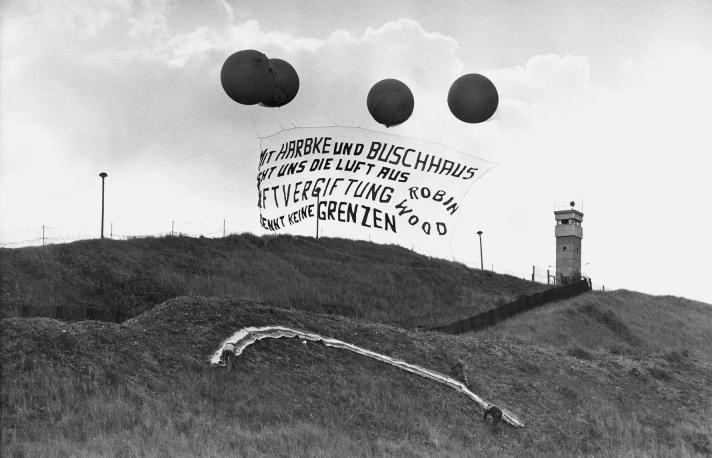
o n a ugust 3, 1984, a truck bearing the identity of the fake but cleverly named Friedemann Grün (or Peaceman Green) company carried Greenpeace activists into the compound of the coal-fired power station Buschhaus near Helmstedt. Within minutes, the protesters assembled a ladder, climbed a cooling tower, and unfurled a banner denouncing the plant as a major polluter (Figure I.1). Buschhaus became the object of an acute political crisis in the Federal Republic because it was slated to open without desulfurization filters at the height of public anxiety about acid rain and forest dieback. Although the West German government had passed a directive in 1983 that required such filters, Buschhaus had been authorized years earlier and was about to be grandfathered in without them. Its supporters cited the jobs the plant would provide, its opponents the pollution it would emit. The discord over Buschhaus entered the annals of West German environmental history as a classic conflict between economy and ecology and as an indicator of West Germany’s newly developed ecological consciousness.1
Yet what amplified the conflict was the coal power plant’s location. Buschhaus had been built in the West German borderlands right on the Iron Curtain. It belonged to a company, the Braunschweigische Kohle Bergwerke (BKB), whose coal mining fields had been sliced in half by the inter-German border in 1952. Without access to all the coal deposits, the long-term viability of BKB was at risk; its staff therefore regarded Buschhaus as a new lease on life. In the political economy of the Federal Republic, the regions along the border, the “zonal borderlands” where the BKB was located, had acquired preferential treatment as depressed
areas. State subsidies flowed into the border counties to create and retain industrial jobs, hence regional political leaders’ dogged support for the smoke-belching project. The border also magnified the environmental dimension of Buschhaus because it was instantly cast as a transboundary issue. At a time when the Federal Republic was chiding East Germany for its unparalleled sulfur dioxide emissions, allowing a coal power plant to go online without filters right on their shared border, and upwind of the German Democratic Republic (GDR), was diplomatically unwise. The environmental activists picked up on the transboundary cue. On June 17, 1985, the federal holiday celebrating German unity, the organization Robin Wood staged a protest on the border. Its banner hovered over the demarcation line, and a GDR watchtower formed the backdrop (Figure I.1). The conflict over Buschhaus was much more than a clash between economy and ecology. It was shaped by the presence of the inter-German border and reminded everyone that Germany remained a divided country.
This book examines the consequences of the volatile inter-German border for West Germany. It takes a fresh look at the history of the “old” Federal Republic and the German reunification process from the spatial perspective of the West German borderlands that emerged along the Cold
Figure I .1. On June 17, 1985, the environmental activists of Robin Wood staged a protest against the Buschhaus coal-fired power station right on the demarcation line against the backdrop of a GDR watchtower.
War demarcation line. The 1,393-kilometer-long border between the two German states was part of the Iron Curtain that divided postwar Europe into West and East. Unlike its urban sibling, the iconic Berlin Wall, the inter-German border meandered mostly through rural landscapes, often in the form of a fence running through fields. Yet the western border counties were also home to cities such as Lübeck, Wolfsburg, Braunschweig, Salzgitter, Göttingen, Kassel, Fulda, Coburg, and Hof. These borderlands did not merely mirror some larger developments in the Federal Republic but helped to shape them. Acknowledging my debt to the late Daphne Berdahl, one of the first scholars to address Iron Curtain borderlands after 1990, I consider these border regions to be “fields of heightened consciousness” and argue that they formed the most sensitive geographical space in West Germany.2 Throughout the lifetime of the “old” Federal Republic, this area constituted a laboratory where West Germany had to wrestle in concrete ways with its ideological adversary, socialist East Germany. If the new western state was to be successful, the blessings of its economic, political, and social order—the very countermodel to the GDR—had to reach into every corner of West Germany in order to unfold their integrative force. In the borderlands, state authorities had to address the practical consequences of partition in order to firmly integrate these liminal regions into the state territory. These consequences affected the local economies and infrastructure, manifested themselves as ideological competition in the realm of culture as long as the border was still permeable, and, as the Buschhaus episode indicates, became tangible in environmental relations.
To gauge the consequences of the Iron Curtain for West Germany and throw the border-centered interactions between West and East into sharp relief, this book employs topical chapters. Two chapters address the economic consequences of the inter-German border for the Federal Republic. They make the case that the West German borderlands coalesced as a spatial unit due to economic processes and the lobbying work of those affected by them. From the perspective of the eastern periphery, they trace how the Federal Republic adjusted to its postwar economic geography. A chapter on tourism to the Iron Curtain explores West German ways of seeing the border and follows the narrative arc from the 1950s into the 1990s, when some of the same locations that used to put partition on display switched to commemorating a country once divided. Three chapters engage environmental themes, such as transboundary pollution, border-induced landscape change, and the planned nuclear industrial site at Gorleben that, like Buschhaus, was meant to bring jobs to the borderlands. Together, these
chapters constitute the first environmental history of the German Iron Curtain. The book thus examines the history of West Germany and the inter-German border from several perspectives, each of which considers the narrative beyond the 1990 caesura and thereby integrates the “long” postwar era with the postunification decades. Much historical scholarship on postwar Germany remains wedded to a 1945–1990 timeframe, leaving postunification history grossly understudied. The study of unification itself is strongly driven by anniversaries.3 There is diminishing justification for the 1990 caesura, and this book provides a model of how to write across it.
Recent scholarship on the German Iron Curtain has shown that the divide was profoundly shaped by the interactions between both German states and Germans on each side, by the give and take that unfolded in “high” politics as well as in local encounters.4 As the border solidified discursively and materially, it created borderlands on both sides. In the East, military authorities demarcated a 5-kilometer-deep security zone in 1952 that was off limits to nonresidents and became an integral part of the border fortifications. As Thomas Lindenberger has argued, the ripple effects of the GDR border regime proved constitutive for the East German dictatorship.5 In the West, residents of a county-deep strip along the demarcation line turned to the state for support to compensate for the economic disruptions the border was causing. State support was slow in coming, but once aid measures took shape, these areas came to be known in West Germany as “zonal borderlands” (Zonenrandgebiete). Including the “wet border” on the Baltic in the North and the border between Bavaria and Czechoslovakia in the South, the regions officially recognized as adversely affected by the Iron Curtain amounted to almost 20 percent of the Federal Republic’s territory and were inhabited by almost 12 percent of its population.6
Zonenrandgebiete: the awkward name of these border regions was itself an artifact of the early Cold War. It contained a dismissive slur against socialist East Germany. By referring to the German Democratic Republic as “the Zone,” West Germans implied that despite the founding of an independent East German state in 1949, the GDR remained a Soviet puppet regime not much different from the Soviet military occupation zone that it had once been. Calling the West German regions along the demarcation line “zonal borderlands” served as a reminder that they were a product of partition.7 This book explains how the conditions of the Cold War helped create these West German borderlands, elucidates the many ways in which
they mattered throughout the history of the “old” Federal Republic, and shows how their afterlives continue to reverberate in reunified Germany. The border regions thus stand at the center of inquiry. Yet they also serve as a lens through which to regard the history of the Federal Republic, its relations to the GDR, and the process of reunification.
As Eagle Glassheim reminds us, the borderlands created by the Iron Curtain have little in common with the lively contact zones and culturally hybrid spaces that animate much of borderland scholarship.8 Although the inter-German border was never hermetically sealed, as its moniker “Iron Curtain” implied, it was fully intended to separate adversarial ideologies and inhibit migration. It moved from being fluid and porous to becoming increasingly restrictive and static.9 East and West German border guards policed their respective sides, and Allied troops reserved the right to maintain military outposts on the demarcation line and to patrol it whenever they saw fit.10 From its early days, the inter-German border gained notoriety as a deadly structure; according to the latest figures, the East German border regime claimed up to three hundred lives there before it was dismantled.11 Throughout its existence, the inter-German border remained a contested political boundary and retained its symbolic power as the frontline of the global Cold War.
Fueled by this symbolic valence, the Iron Curtain magnified all activities and occurrences within its orbit. For example, East German border authorities perceived Sunday outings by ordinary West Germans who came to see the border as a centrally orchestrated psychological warfare operation to challenge the existence of the GDR. Similarly, the pollution of rivers in the borderlands was not just an environmental problem like any other but turned into a hot-button issue in inter-German relations because the pollutants swept into the Federal Republic from the GDR. Transboundary air and water contamination subsequently brought some locations in the West German borderlands into disrepute during the 1970s and 1980s, yet the same decades also marked the “rediscovery” of the borderlands as allegedly authentic rural spaces and “intact” landscapes. Since accelerated modernization during the postwar reconstruction years had passed these regions by, their less developed status now turned from an economic liability into a tourist asset. As this book shows, a borderland perspective provides a unique vantage point on the environmental histories of East and West Germany, in terms of both pollution and landscape change. Finally, the borderlands also assumed a key role in determining Germany’s energy future when they were chosen in 1977 as the site of a nuclear waste
reprocessing and storage plant that was thought to be essential to the nuclear industry’s development. However, instead of securing the industry’s ascendency, the choice of the village of Gorleben in Lower Saxony triggered a lasting protest movement that amalgamated with and furthered similar anti-nuclear protests elsewhere in the country, ultimately putting a stop to nuclear energy use in Germany. In all these respects, the periphery became central to West German history, even as remoteness and peripherality continued to undergird borderland residents’ claim to state support throughout the postwar decades.
As a historiographical subject, the inter-German border is finally moving out of the shadow of the better known Berlin Wall. Recent works have explored particular locales along the German Iron Curtain, adding significantly to our understanding of how the evolving border regime affected the communities it divided. On the basis of her microstudy of the adjacent towns Neustadt in Bavaria (West) and Sonneberg in Thuringia (East), Edith Sheffer argues that the border “was not simply imposed by the Cold War superpowers but was also an improvised outgrowth of anxious postwar society.”12 Daily interactions along the demarcation line solidified it before it was ever physically fortified: before a border was visible on the ground, it was becoming real in people’s minds. In rural areas, however, the dynamic sometimes differed. In the Eichsfeld region, where the social fabric was often tied to landholdings through which the border now ran, border residents could act only “within limits determined in constant interaction with state” authorities. Sagi Schaefer found that “individual agency diminished over the decades” as state structures in East and West, and thereby the border itself, grew stronger.13 Jason B. Johnson, by contrast, follows the more familiar narrative that the GDR regime pressured border residents into compliance. In his study of the divided village of Mödlareuth on the border between Bavaria (West) and Thuringia (East), those dwelling on the eastern side found themselves in a hyper-surveilled environment where “the Iron Curtain descended with a top-down nature, a process in which villagers saw the state as an external force imposing division.”14
The German Iron Curtain not only consisted of the Berlin Wall and the inter-German border, but also contained a stretch between Bavaria and Czechoslovakia that had long served as a state border and that had been drawn into nationality conflicts between Germans and Czechs during the interwar period.15 After 1945, most ethnic Germans from the former Sudetenland were expelled across the Czech–German border.16 Yuliya
Komska and Friederike Kind-Kovács show how those expellees who now resided in West Germany subsequently appropriated the Bavarian–Czech section of the Iron Curtain to commemorate their lost homeland. Whereas the inter-German border turned into a cruel symbol of the Cold War, the Bavarian–Czech section of the Iron Curtain carried the additional burden of memory relating to wartime suffering.17 Works on the Iron Curtain outside of Germany further confirm the uneven development of the Cold War divide, the importance of local contexts, and the relevance of prior experiences of living with state borders in the encounter with Europe’s postwar partition.18
Collectively, these various approaches to the “local Iron Curtain” (KindKovács) serve to de-essentialize the border by peeling off the layers of Cold War propaganda that have dominated its perception ever since Winston Churchill’s famous “Iron Curtain” speech in March 1946. “In many ways,” writes Edith Sheffer, “the Iron Curtain was a boundary like any other.”19 Despite posturing on each side that blamed the respective other for the militarization of the border and attributed to the ideological adversary the responsibility for its victims,20 the border itself remained a shared burden that triggered and necessitated interaction. This dynamic is best captured by the observation that Cold War Germany was politically “divided, but not disconnected.”21 The emerging border had predictable consequences with which borderland scholars are well familiar. Any fresh border, especially one enforced in a modern state with well-developed infrastructural networks and sophisticated interregional divisions of labor, would disrupt the flow of people, labor, and goods. It would alter economic, social, and—as this book shows—ecological conditions in its adjacent regions, and possibly even further afield.22 That the new border was ultimately sealed so tightly, and with increasing military force, made its effects in the abutting border regions all the deeper.
This book explores the development of the borderlands on the western side of the inter-German border. Chapter 1 introduces the economic heterogeneity of the borderlands through snapshots of the port city of Lübeck on the Baltic, the rural county of Lüchow-Dannenberg on the Elbe River, the city of Braunschweig in Lower Saxony, and the industrial town of Hof in Upper Franconia. As the tightening demarcation line made itself felt, a broad coalition of borderland advocates—elected officials in local, state, and federal parliaments, as well as civil servants and representatives from business and commerce—joined forces to pressure the federal government to help prevent their regions from turning into economic backwaters.
These lobbying efforts revealed that borderland residents cared less about living in the shadow of the Iron Curtain than about living in the shadow of the “economic miracle” that, from their perspective, was partially achieved at their expense. In their pitch for state aid, borderland advocates declared their regions to be economically, socially, and politically more vulnerable than other parts of the country and came up with the “brand name” Zonenrandgebiet, which enlisted Cold War parameters to imbue their demands with more urgency vis-à-vis regions that had “merely” been damaged by the recent war. Their efforts yielded the “zonal borderland aid” program (Zonenrandförderung), which soon became an integral part of the border regions’ economic and cultural life.
Chapter 2 explains how borderland aid became an ongoing feature of the West German subsidy landscape. By continuing to depict these regions as “victimized” by the Iron Curtain, borderland advocates succeeded in turning ad hoc aid measures into a regional aid law, but they also inadvertently transformed the border regions into “the East of the West” in the process: the “zonal borderlands” acquired the image of being behind and underdeveloped. Once firmly established by law in 1971, borderland aid benefited from a path dependency that insulated it against criticism even in the face of subsidy abuse. The persistent support for borderland aid across political parties left only the European Commission as a credible challenge to this regional aid program.23 Pushing beyond 1990, the chapter addresses the economic consequences of the fall of the border and the widespread hope that the erstwhile periphery would turn into the new “center” of Germany and Europe, an expectation prefigured by decades of advocacy that depicted the border as the root cause of economic decline. The borderlands turned into places where the postunification “cotransformation” was instantly felt.24 The toolkit of economic aid that had been employed to prop up the borderlands now moved a few miles farther east, across the former border: Zonenenrandförderung turned into Aufbau Ost (Reconstruction East), the program charged with rebuilding the economic capacity of East Germany along capitalist lines. The two chapters on the regional economy along the border not only uncover the strategies of borderland advocates to bring about and defend an aid package for their regions. More important, they historicize these discourses and show how they helped to construct the borderlands as such.
Chapter 3 considers tourism to the Iron Curtain as a way that West Germans and their visitors sought to make sense of the global Cold War through local activity. Already in the 1950s, the Iron Curtain attracted
curiosity seekers and eventually turned into a well-developed tourist attraction. Sightseeing at the border began as a grassroots activity that the state eventually harnessed and transformed into political education. An elaborate tourist infrastructure emerged on the western side of the interGerman border that allowed visitors to peek into East Germany from lookout towers, travel the Elbe River on pleasure boats, and collect colorful postcards depicting fences and watchtowers. The frontline of the Cold War was put on display in a way that provoked the East German border authorities into seeking opportunities to render Iron Curtain visits less attractive for western tourists. Especially during the 1950s and 1960s, border tourism offered an outlet for West German anti-Communism and was frequently framed as a demand for German unity. The chapter argues, however, that this activity did little to overcome partition but rather stabilized the political and territorial status quo. Border tourism helped West Germans become accustomed to partition.
Chapter 4 moves into environmental history and addresses a typical borderland problem—transboundary air and water pollution. During the 1970s and 1980s, rivers carried eastern industrial waste and sewage into West Germany; the wind blew sulfur dioxide both ways. Their environmental interdependency forced both German states to the negotiating table, eventually producing the ineffectual Environmental Accords of 1987. The western encounter with eastern pollution through the interface of the inter-German border confronted West German authorities with early signs of East Germany’s dissolution. While they failed to grasp this message, their experiences with East German pollution and the futile diplomatic efforts to curb it nonetheless gave rise to knowledge about the nature and extent of the GDR’s environmental problems that became the prerequisite for the post-1990 ecological restoration of East Germany, a task that turned into the “most elaborate environmental protection project in the world.”25
Chapter 5, in turn, investigates the consequences of the border regime for landscape and wildlife. The ecological impact of the inter-German border has become widely known through a postunification conservation project referred to as the Green Belt, which seeks to preserve the swath of land once occupied by the border and which is frequently presented as the beneficial outcome of an otherwise nasty situation. As is worth remembering, however, the Iron Curtain was first and foremost a military installation with a political function that encroached on Central European landscapes which had themselves been shaped by human interference for centuries. The chapter not only looks at the ecological footprint of the Iron