3. Conditioning and Associative Learning N. J. Mackintosh
4. Visual Masking B. G. Breitmeyer
5. The Musical Mind J. A. Sloboda
6. Elements of Psychophysical Theory J.-C. Falmagne
7. Animal Intelligence L. Weiskrantz
8. Response Times R. D. Luce
9. Mental Representations A. Paivio
10. Memory, Imprinting, and the Brain G. Horn
11. Working Memory A. Baddeley
12. Blindsight L. Weiskrantz
13. Profile Analysis D. M. Green
14. Spatial Vision R. L. DeValois and K. K. DeValois
15. The Neural and Behavioural Organization of Goal-Directed Movements M. Jeannerod
16. Visual Pattern Analyzers N. V. S. Graham
17. Cognitive Foundations of Musical Pitch C. L. Krumhansl
18. Perceptual and Associative Learning G. Hall
19. Implicit Learning and Tacit Knowledge A. S. Reber
20. Neuromotor Mechanisms in Human Communication D. Kimura
21. The Frontal Lobes and Voluntary Action R. Passingham
22. Classification and Cognition W. K. Estes
23. Vowel Perception and Production B. S. Rosner and J. B. Pickering
24. Visual Stress A. Wilkins
25. Electrophysiology of Mind Edited by M. D. Rugg and M. G. H. Coles
26. Attention and Memory N. Cowan
27. The Visual Brain in Action A. D. Milner and M. A. Goodale
28. Perceptual Consequences of Cochlear Damage B. C. J. Moore
29. Binocular Vision and Stereopsis I. P Howard and B. J Rogers
30. The Measurement of Sensation D. Laming
31. Conditioned Taste Aversion J. Bures, F. Bermúdez–Rattoni, and T. Yamamoto
32. The Developing Visual Brain J. Atkinson
33. The Neuropsychology of Anxiety, 2e J. A. Gray and N. McNaughton
34. Looking Down on Human Intelligence I. J. Deary
35. From Conditioning to Conscious Recollection H. Eichenbaum and N. J. Cohen
36. Understanding Figurative Language S. Glucksberg
37. Active Vision J. M. Findlay and I. D. Gilchrist
38. The Science of False Memory C. J. Brainerd and V. F. Reyna
39. The Case for Mental Imagery S. M. Kosslyn, W. L Thompson, and G. Ganis
40. Seeing Black and White A. Gilchrist
41. Visual Masking, 2e B. Breitmeyer and H. Öğmen
42. Motor Cognition M. Jeannerod
43. The Visual Brain in Action A. D. Milner and M. A. Goodale
44. The Continuity of Mind M. Spivey
45. Working Memory, Thought, and Action A. Baddeley
46. What Is Special about the Human Brain? R. Passingham
47. Visual Reflections M. McCloskey
48. Principles of Visual Attention C. Bundesen and T. Habekost
49. Major Issues in Cognitive Aging T. A. Salthouse
50. Perceiving in Depth Ian P. Howard
51. The Neurobiology of the Prefrontal Cortex: Anatomy, Evolution, and the Origin of Insight Richard E. Passingham and Steven P. Wise
52. The Evolution of Memory Systems: Ancestors, Anatomy, and Adaptations
Elisabeth A. Murray, Steven P. Wise, and Kim S. Graham
53. Understanding the Prefrontal Cortex: Selective advantage, connectivity, and neural operations Richard E. Passingham
Understanding the Prefrontal Cortex
Selective Advantage, Connectivity, and Neural Operations
RICHARD E. PASSINGHAM
Emeritus Professor of Cognitive Neuroscience Department of Experimental Psychology Oxford
University
3
Great Clarendon Street, Oxford, OX2 6DP, United Kingdom
Oxford University Press is a department of the University of Oxford. It furthers the University’s objective of excellence in research, scholarship, and education by publishing worldwide. Oxford is a registered trade mark of Oxford University Press in the UK and in certain other countries
All rights reserved. No part of this publication may be reproduced, stored in a retrieval system, or transmitted, in any form or by any means, without the prior permission in writing of Oxford University Press, or as expressly permitted by law, by licence or under terms agreed with the appropriate reprographics rights organization. Enquiries concerning reproduction outside the scope of the above should be sent to the Rights Department, Oxford University Press, at the address above
You must not circulate this work in any other form and you must impose this same condition on any acquirer
Published in the United States of America by Oxford University Press 198 Madison Avenue, New York, NY 10016, United States of America
British Library Cataloguing in Publication Data
Data available
Library of Congress Control Number: 2020945296
ISBN 978–0–19–884457–0
DOI: 10.1093/oso/9780198844570.001.0001
Printed and bound by CPI Group (UK) Ltd, Croydon, CR0 4YY
Oxford University Press makes no representation, express or implied, that the drug dosages in this book are correct. Readers must therefore always check the product information and clinical procedures with the most up-to-date published product information and data sheets provided by the manufacturers and the most recent codes of conduct and safety regulations. The authors and the publishers do not accept responsibility or legal liability for any errors in the text or for the misuse or misapplication of material in this work. Except where otherwise stated, drug dosages and recommendations are for the non-pregnant adult who is not breast-feeding
Links to third party websites are provided by Oxford in good faith and for information only. Oxford disclaims any responsibility for the materials contained in any third party website referenced in this work.
In memory of Alan Cowey (1935–2012) and Lawrence Weiskrantz (1926–2018).
‘If you want to understand function, study structure’ Francis Crick (What Mad Pursuit, 1988)
Note on the Cover
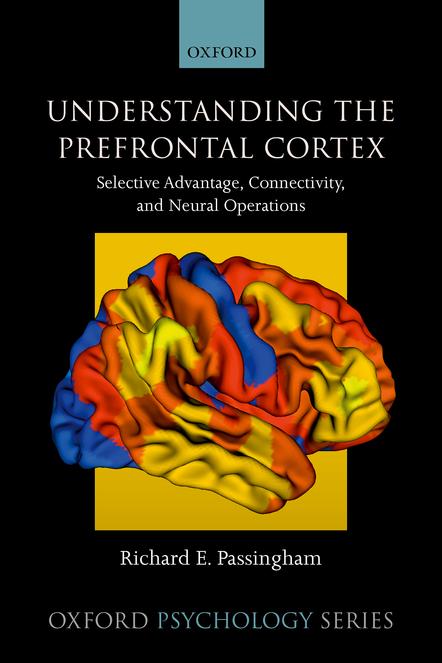
The picture on the front cover shows that, compared to the macaque monkey brain, it is the prefrontal cortex and other association areas (in yellow and orange) that have expanded most in the human brain.
Preface
Steve Wise and I published The Neurobiology of the Prefrontal Cortex in 2012. This date might seem recent to some, but scientific monographs have a shelf life of five years or less. This is the typical timespan over which many scientists consider such publications to be relevant. As in other scientific disciplines, neuroscience moves on apace, and ideas that once seemed novel and exciting soon become standard knowledge.
I decided that it was time to write a second edition. But, as I began revising the book, changes accumulated so rapidly that a new book took shape. That is why it has a new title. It retains some of the organizational structure of the original book, as well as some of the figures; and I have also made use of some of the material in the text. So, a clear palimpsest of the original remains. But the main burden of this book is totally new, and most of it has been written without reference to the original.
There are several reasons why a new book is required. First, I have changed my mind on many issues. In the original book, we attempted to frame our proposals as clearly as possible, but the danger of clarity is that errors can become obvious. Good scientists embrace the prospect that they might be wrong. Marvin Minsky, for example, cultivated ‘the habit of not wanting to be right for very long.’ As he put it: ‘If I still believe something after five years, I doubt it.’
A second reason is that the original book dealt mainly with functional neuroanatomy, and we described functions in general psychological terms. We argued that anatomical inputs constrain the function that each area performs and that the outputs convey the result to other areas. But we did not take things further by providing an explicit proposal concerning the transformation that each area performs from its inputs to its outputs. Chapters 3–7 discuss each area in turn, and they end with a proposal concerning the transformation that that area performs.
A focus on input–output transforms means that book must now consider what can be learned from computational neuroscience. It is this field of research that helps us to understand the transforms that are computed by cortical areas. Beginning with Zipser and Anderson (1988), neuroscientists have produced computational models that use neurophysiological data to suggest how populations of neurons with particular properties could perform specific functions. For example, Rolls (2016) has considered how attractor networks can account for the operations of the cerebral cortex. It is also increasingly common in functional brain-imaging studies to look for activations that are related to specific parameters in a computational model (e.g. Boorman et al., 2016).
Preface
I am not an expert in this field and am not therefore competent to present detailed computational models in this book. The transforms are therefore presented without fully worked-out proposals as to how they are actually implemented in the brain.
A third reason for a new book is that new methods have clarified the evolution of prefrontal areas. For example, imaging methods have enabled anthropologists to construct virtual endocasts from fossil crania (e.g., Long et al., 2015). These studies have augmented the methods of comparative neuroanatomy with a direct examination of ancestral species. Studies of the pattern of anatomical connections have provided a method for identifying which prefrontal areas are homologous in different species (Mars et al., 2017). And the development of phylogenetic statistics (Smaers & Rohlf, 2016) has also been a major advance.
There is a final reason why a new book was necessary. The literature on functional brain imaging has exploded in recent years, as Figure P.1 illustrates. The purple curve shows the number of publications on the prefrontal cortex stemming from research on humans, with the vast majority involving functional brain imaging.
In the original book, we based our proposals on the animal literature. We then included a single chapter in which we argued that the literature on the human brain from functional imaging was consistent with these proposals. But the imaging literature has now developed to the point where it is important to consider what new it has to tell us on its own. Only studies of the human brain itself can help us to understand capacities such as language that are unique to humans.
Figure P.1 The annual number of papers on the prefrontal cortex of humans (purple), rats (red), mice (blue), and monkeys (orange) since the late 1940s
Reproduced from eNeuro, 5 (4), Mark Laubach, Linda M. Amarante, Kyra Swanson, and Samantha R. White, What, if anything, is rodent prefrontal cortex? Figure 1a, Doi: https://doi.org/10.1523/ ENEURO.0315-18.2018 Copyright (c) 2018, The Authors. Licensed under CC BY 4.0.
Much of the evidence comes from functional imaging. But the extent of the imaging literature means that I cannot hope to do more than mention a selection of the published results. Rather than attempt a comprehensive review, I have chosen to highlight the results that best illuminate the topic. I therefore plead guilty to cherry-picking throughout this book. All that I can say is that I have done my best to avoid picking the rotten ones.
One final word of warning. This book conveys my understanding, as of now. There is always a danger that in trying to explain things, one skates over points that are inconvenient for the account. I hope that I have described the experimental evidence in enough detail that others can come to different conclusions. After all, that is how science progresses.
References
Boorman, E.D., Rajendran, V.G., O’Reilly, J.X., & Behrens, T.E. (2016) Two anatomically and computationally distinct learning signals predict changes to stimulus-outcome associations in hippocampus. Neuron, 89, 1343–54.
Laubach, M., Amarante, L.M., Swanson, K., & White, S.R. (2018) What, if anything, is rodent prefrontal cortex? eNeuro, 5 315–18.
Long, A., Bloch, J.I., & Silcox, M.T. (2015) Quantification of neocortical ratios in stem primates. Am J Phys Anthropol, 157, 363–73.
Mars, R.B., Passingham, R.E., Neubert, F.X., Verhagen, L., & Sallet, J. (2017) Evolutionary specializations of human association cortex. In Preuss, T.M., Kaas, J. (eds) Evolution of Nervous Systems. Elsevier, New York.
Rolls, E.T. (2016) Cerebral Cortex: Principles of Operation. Oxford University Press, Oxford. Smaers, J.B. & Rohlf, F.J. (2016) Testing species’ deviation from allometric predictions using the phylogenetic regression. Evolution, 70, 1145–49.
Zipser, D. & Andersen, R.A. (1988) A back-propagation programmed network that simulates response properties of a subset of posterior parietal neurons. Nature, 331, 679–84.
Acknowledgements
I could not have written this book without the help of Steve Wise. He read all the chapters, commented and made extensive revisions throughout the text. He contributed especially to Chapter 2 because he knows much more than I do about the evolution of the non-human primates, and in particular about the fossil record. I value in particular the critical comments that he made on Chapters 10 and 11: disagreement can be very much more helpful than agreement. Steve also helped me by producing many of the figures and telling me how to produce the others. I cannot say how grateful I am for all the work he has put in.
I confess to having stolen the idea of dividing the book into parts or sections from the book on ‘The Evolution of Memory Systems’ by Betsy Murray, Steve Wise, and Kim Graham (2017). Their book won a prize; so, it must be a good idea.
The fundamental way of thinking about the brain on which this book is based came out of a conversation with Klaas Stephan. It was written up a long time ago in a paper with Klaas and Rolf Kötter on ‘The anatomical basis of functional localization in the cortex’. The idea has since been further developed by Matthew Rushworth, Heidi Johansen-Berg, and Rogier Mars. The motivation for this book was to take it yet further, by changing the way in which we think about the function of brain areas.
I have other colleagues to thank for sharing ideas and demolishing some of my more outrageous speculations. In particular, Eleanor Maguire, Celia Heyes, and Hakwan Lau have patiently answered my emails and questions, and put up with my excitable nature.
Because I am long retired, it is hard to find the new literature. I am grateful in particular to Earl Miller and Matthew Rushworth for sending me some of their more recent papers. I have also been lucky enough to benefit from comments from Nils Kolling, Laurence Hunt, Jill O’Reilly, and their graduate students and postdocs who have read the whole book as a summer project during lockdown over COVID19. They have had the advantage of viewing the manuscript with young eyes.
I am indebted to Larry Weiskrantz and Alan Cowey who supported me throughout my career, and this book is dedicated to them. When I worked with them as a postdoctoral fellow, they allowed me to work on the prefrontal cortex although the grant was on vision. Those were the days.
I could not have published a book which is so lavishly illustrated had not the authors of the relevant papers taken the trouble to send me the originals of their figures. If the text is in danger of becoming dull, it always pays to add in a colour figure to spice things up.
Research is a collaborative project. So, I need to thank my graduate students, postdoctoral fellows, and others who actually did the work. In various ways all have contributed to the ideas in this book, whether they worked on prefrontal cortex or not. I have benefited from the contributions of Katie Alcock, Sara Bengtsson, Pierre Burbaud, Tony Canavan, Jim Colebatch, Marie-Pierre Deiber, Julie Grezes, Katie Hadland, Harri Jenkins, Louise Johns, Markus Jueptner, Mike Krams, Hakwan Lau, Rogier Mars, Phil Nixon, Narender Ramnani, James Rowe, Matthew Rushworth, Katsuyuki Sakai, Nat Schluter, Jeroen Smaers, David Thaler, and Ivan Toni. In retirement it is their stimulating company that I miss.
I would also like to thank the editors at Oxford University Press, Martin Baum and Charlotte Holloway, for encouraging a new book and guiding me through the process. Apart from dealing with the manuscript, Charlotte put in an enormous amount of work to seek the permissions for all the figures.
Finally, I would like to thank my wife Clare. I had promised her that I wouldn’t write another book; and she has forgiven me, I think.
PART III: THE PREFRONTAL CORTEX WITHIN THE SYSTEM AS A WHOLE
Prefrontal Cortex: Abstract Rules and Attentional Performance
List of Figures
P.1 The annual number of papers on the prefrontal cortex of humans (purple), rats (red), mice (blue), and monkeys (orange) since the late 1940s x
1.1
1.2
for the PF areas 9 and 14
1.3 (A & B) Connectional fingerprints of the SMA and the rostral ventral premotor cortex (PMvr)
1.4 Functional fingerprints showing selectivity for visually guided versus memory-guided movement sequences in the premotor cortex (lateral area 6), the primary motor cortex (area 4), and the supplementary motor area (medial area 6)
1.5 Functional fingerprints for the cortex in the anterior cingulate sulcus and the right anterior insular cortex (Ia)
1.6 Comparison of anatomical and functional borders
1.7 (A) Area 9 (part of the granular medial PF cortex) in human subjects; (B) Area 9 in macaques. The letters refer to the different sulci. (C) The functional connectivity fingerprints in humans (light blue) and macaques (purple) with the overlap shown in dark blue. (D) The summed absolute
2.1 The PF cortex and other frontal areas in macaque monkeys (A), rats (B), and (C) bushbabies (galagos)
2.2
2.3
2.4
2.5 Virtual brain endocasts of stem and crown primates
2.6 (A) Encephalization: Brain–body mass relationship in Rooneyia and other fossil primates. (B) Corticalization
2.7 Brain–body mass relationship for modern strepsirrhines, modern anthropoids, fossil anthropoids (red letters), and a fossil pongid (blue letters)
2.8 Circular cladogram showing a stack of encephalization quotients (EQs) for a series of species in each mammalian lineage, ordered by EQ value 57
2.9 Reconstructed phylogeny of encephalization quotients (EQs) for primates 58
2.10 Virtual brain endocasts of extinct catarrhines 59
3.1 Medial PF cortex in macaque monkeys (left) and humans (right), indicated by shading 72
3.2 Homologies among agranular parts of the medial PF cortex in rodents and anthropoids 74
3.3 Selected connections of the medial PF cortex in macaque monkeys 75
3.4 Reversal impairment for choices between two actions 83
3.5 (A) Areas that were specifically activated when monkeys watched videos of other monkeys interacting. (B) Flat map of areas that showed a difference in grey matter depending on the size of the group 90
3.6 Overlap between medial (default) network and social network in macaques 93
3.7 Medial network as visualized by fMRI 94
3.8 Cell activity encoding choices at feedback time for populations of cells in the polar PF cortex (area 10) (orange) and the orbital PF cortex (area 11) (green) 103
3.9 Pictures (p) for ‘object-in-scenes’ task, shown for two trials or runs, with 20 pictures per run
3.10 The effect of polar PF lesions in macaque monkeys
4.1 The orbital PF cortex in monkeys (left) and humans (right) indicated by shading
4.2 Selected connections of the orbital PF cortex
4.3 Total selection frequency for the category of nonpreferred foods (garlic, lemons, and monkey chow) for each experimental group across the pre-surgery, post-surgery, and shuffled testing phases
4.4 The effects of satiation on the choice between objects that were associated with particular foods
4.5 Effect of three lesions on choices in the devaluation task
4.6 The effect of amygdala lesions on the encoding of reward in the orbital PF cortex
4.7 Action reversal and object reversal tasks
4.8 Impairment in object reversal set in monkeys after lesions of the central and medial sectors of the orbital PF cortex
4.9 Errors made on the object reversal task, before and after the first correct choice
4.10 Performance on probabilistic reversals after lesions of the orbital PF cortex
4.11 Performance on a probabilistic reversal learning task: the 3-arm bandit task
4.12 Data for object reversal learning for different groups of lesioned macaques
5.1 The caudal PF cortex in the macaque monkeys (left) and humans (right) 154
5.2 Selected connections of the caudal PF cortex 156
5.3 Layout of the FEF circuit 162
5.4 Topographic maps in the frontal eye fields and posterior parietal cortex in one subject 165
5.5 Intrinsically defined dorsal and ventral attention systems and the overlap between them 168
5.6 A common version of the oculomotor delayed response task 172
5.7 Attention versus memory coding in the PF cortex 174
5.8 Performance on the oculomotor delayed response task for one lesioned monkey 176
5.9 Corrective saccades after a frank error 177
5.10 Change in population vectors on an oculomotor delayed response task 179
5.11 An example of a search array on which are superimposed the scan paths of one patient 180
6.1 The dorsal PF cortex in macaque monkeys (left) and humans (right) 192
6.2 Selected connections of the dorsal PF area 46 193
6.3 Areas 9/46 and 46 in the human brain as identified on the basis of the similarity of their connectional fingerprints to the same areas in a macaque monkey 197
6.4 (A) The anterior area of the dorsal PF cortex (green) that co-activated with the anterior cingulate cortex. (B) The posterior area of the dorsal PF cortex (red) that co-activated with the parietal cortex 198
6.5 Testing procedure for the classic delayed response task in a Wisconsin general testing apparatus (WGTA) 201
6.6 The top section shows the matching task and the bottom section the recall task that were used in an fMRI experiment 204
6.7 The course of the BOLD signal during the tasks that were illustrated in Figure 6.6 205
6.8 (A) The data for sites at which the spiking activity was informative. (B) The data for sites at which the spiking activity was not informative 214
6.9 (A) The task used in an imaging experiment to test for the effect of distraction in memory. (B) The relation between sustained activation during the delay and the accuracy of performance on trials on which there were no distractors and trials on which there were distractors 217
6.10 (A) The activation in the dorsal PF cortex on a task in which human subjects decide of their own accord which finger to move. (B) The plot of the degree of activation as a function of the equipotentiality index 220
6.11 (A) Task in which the monkeys used a handle to make sequences of four movements. (B) Activity of cells that encoded sequences with a particular abstract structure 222
6.12 Visual maze task 223
6.13 Population analysis of cells in the dorsal PF cortex during planning 224
7.1 The ventral PF cortex in macaque monkeys (left) and humans (right)
237
7.2 Cross section through the ventral limb of the arcuate sulcus on an MRI scan in a macaque monkey 238
7.3 Areas in the human ventral PF cortex that correspond with areas in the macaque monkey, as demonstrated by the functional fingerprint based on resting state covariance 239
7.4 Selected connections of the ventral PF cortex 241
7.5 Effect of lesions of the ventral PF cortex on simultaneous matching 245
7.6 Performance across trials within problems on a series of visuo-spatial problems before and after ventral PF surgery 254
7.7 Stimuli used in a categorization task 257
7.8 (A) A cell in the ventral PF cortex that encoded the category ‘dog’. (B) A cell in the ventral PF cortex that encoded the category ‘cat’
258
7.9 A cell in the ventral PF cortex that encoded arbitrary categories, demarcated by the lightly stippled vertical lines in Figure 7.7 260
7.10 Single cells reflecting both shape-shape associations and motion direction categories 263
7.11 Activations for shifting between categories, shown on inflated surface reconstructions of the macaque monkey brain (left) and human brain (right) 270
7.12 (A) The effect of a TMS pulse over the FEF on the activation in the MT complex when motion is relevant. (B) The effect of a TMS pulse over the FEF on the activation in the fusiform face area when the shape of the face is relevant 273
8.1 The central neocortical hub or core as shown by graph theory
8.2 The organization of the feedforward (blue) and feedback (red) connections in the neocortex
8.3 Organization of basal ganglia and cerebellar outputs to the cerebral cortex
289
291
293
8.4 The overlap of the projections to the striatum from different PF areas is shown in orange. The projections from the inferior parietal area PG are shown in green 295
8.5 PF cell encoding the abstract matching rule
8.6 The location of rule selective and generalist cells in the PF cortex that coded for the general rule ‘greater than’ or ‘lesser than’
8.7 Development of a learning set for visual discrimination problems, in a selection of mammalian species
300
301
303
8.8 Histograms showing mean percent error in trials 2–11 at each performance test on discrimination learning set 305
8.9 Strategy score (performance on repeat compared with change trials) before (black) and after (white) lesions 307
8.10 Population coding for abstract rules
8.11 Timing of the development of selectivity for visual objects, behavioral goals, and actions 310
9.1 Encephalization quotients (EQs) for fossil hominins, modern humans, and modern chimpanzees
9.2 CT scans of skulls of a chimpanzee, Homo heidelbergensis, Homo neanderthalensis, and Homo sapiens 336
9.3 Granular PF cortex as a percentage of the frontal lobe, plotted versus function of cerebral extent, in modern primates 338
9.4 Log-log plot of the estimated volume of the granular PF cortex as a function of non-PF cortex in the frontal lobe using the data from Smaers et al. (2011) 339
9.5 Myeloarchitectonics in the brains of humans, chimpanzees, and macaque monkeys 343
9.6 Regressions of the volume of the frontal pole cortex (area 10) as a function of brain volume in selected primates 344
9.7 Expansion of the area 10 in humans
9.8 (A) Relative expansion of cortical regions from macaque to human brains, shown on the human brain. (B) Relative expansion of cortical regions from chimpanzee to human brain, shown on the chimpanzee brain 347
9.9 Log-log plot of volume of the PF cortex as a function of an estimate of the other association areas (see text) 348
9.10 Degree of expansion and closeness centrality 351
9.11 Areas of the brain that have changed most in their connectivity as estimated from visualizing the major tracts using diffusion weighted imaging (DWI) 352
9.12 Arcuate fasciculus in the human and macaque monkey brain as visualized by diffusion weighted imaging
9.13 Postnatal cortical surface expansion 358
10.1 The multiple-demand system as visualized on the parcellation of the human brain by Glasser et al.
10.2 A typical problem on the Raven’s Progressive Matrices
10.3 The relation between fluid intelligence and the volume of damage to the frontal, parietal, or temporal lobe
10.4 Computerized version of the ‘Tower of London’
10.5 Areas that are activated when subjects plan 387
10.6 Activations in the left inferior caudal PF cortex (areas 44 and 45B) and the STS during deductive reasoning 389
10.7 The accuracy of decoding using a multivoxel pattern analysis for memories that were of events that occurred either 2 years ago or 10 years ago 392
10.8 The area in yellow shows the source of the theta oscillations as measured by MEG while the subjects retrieved personal memories from the past 394
10.9 Indices relating the activity for hits and misses 399
10.10 ERPs recorded on the Libet task for the conditions in which the subjects timed their intention to move (W) or the actual movement itself (M) 403
10.11 Brain regions with a significant difference between the prediction of the subjective ratings and skin conductance reactivity 408
11.1 (A) Areas that were activated during signing and speaking. (B) Areas that were only activated during signing 424
11.2 The arcuate fasciculus in the macaque monkeys and human brain 426
11.3 (A) The areas that were activated both when observing and when imitating. (B) The areas that were activated when imitating was contrasted with observing alone in green, and when observation was contrasted with imitation in red 428
11.4 Activations for speaking, imitation, and motor inhibition in the left and right hemisphere 429
11.5 Horizontal sections showing the areas that were under-activated in the brains of affected members of the KE family 430
11.6 Comparing sentences and small clauses 433
11.7 Areas of the neocortex which showed activity that was specific to naming pictures (blue), naming by definition (red), or that showed activity for naming in both conditions (pink) 436
11.8 Setting up the current task 442
11.9 Semantic task used by Vandenberghe et al. (1996) 443
11.10 Activations while expert stone knappers make Oldowan and Acheulean tools 446
11.11 The activations resulting from metanalyses of fMRI data for metacognition (yellow and red) and mentalizing (green and blue) 449
11.12 The overlap for the lesions that included the medial and orbital PF cortex in 19 patients who had had a medial meningioma removed at surgery (vmpfc) 451
List of Tables
1.1 Prefrontal areas in human and macaque monkey brains, with area numbers in parentheses, where applicable. 25
1.2 Groups of PF areas and a compact abbreviation for each. 29
2.1 PF areas with homologues (+) in mammals, strepsirrhine (prosimian) primates, anthropoids, and humans. 46
9.1 Remapping factors.
9.2 Remapping factors
9.3 Remapping factors
9.4 Factors that might account for the expansion of the PF cortex in hominins.
10.1 Remapping factors.
11.1 Handedness in chimpanzees.
11.2 Handedness in human subjects.
Style, Scope, and Terminology
I have thought it important to tell readers how the researchers obtained the results that are summarized in this book. Accordingly, I have avoided simply stating findings and conclusions as facts, followed by a long series of references in brackets. This practice is perfectly reasonable in a paper or review article, especially in view of the word limits imposed by many publishers. But the point of a textbook or monograph is not to provide references, however convenient that might be. The aim of this book is to further understanding, and this means spelling out in detail why the results of a particular experiment lead to certain conclusions and not to others.
Because each section describes a series of experiments in detail, to help the reader I have added summaries at the end of each section. These provide the provisional conclusions that I take to follow from these experiments. The final interpretation of the results is left to the end of the chapter, For convenience, I have adopted certain several semantic conventions:
• The word animal, when unmodified, refers to a non-human animal.
• The word monkey, when unmodified, refers to macaque monkeys.
• I have used the phrase granular prefrontal cortex, although its architecture is not truly granular in the same sense as the granular cortex of the primary sensory areas.
• I use the term lesion to cover all procedures that prevent a cortical area from functioning normally, including various forms of temporary disruption.
• The term cell is used to refer specifically to neurones throughout.
• I use the term activity to describe the rate of neuronal action potentials, commonly known as firing rate, discharge rate, or modulation; but I use the term activation to describe results from functional brain-imaging experiments because the BOLD signal is a vascular one.
• I have resisted using the term volunteers to describe people who take part in fMRI experiments. I doubt that readers will think that these people have been dragged kicking and screaming into the scanner. I know that the label participants is now de rigueur, but the word subject has the advantage that it can be used for all species, humans included.
• I will quite rightly draw the ire of anatomists by phrases that suggest that anatomical connections run from or to anatomical sulci such as the intraparietal sulcus. Of course, they run from the cortical tissue in the sulcus, not from the sulcus itself. I also realize that fMRI activations are in the cortex of the