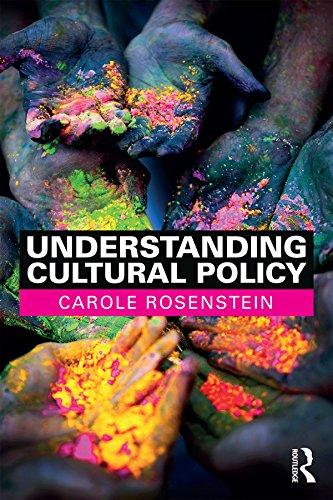
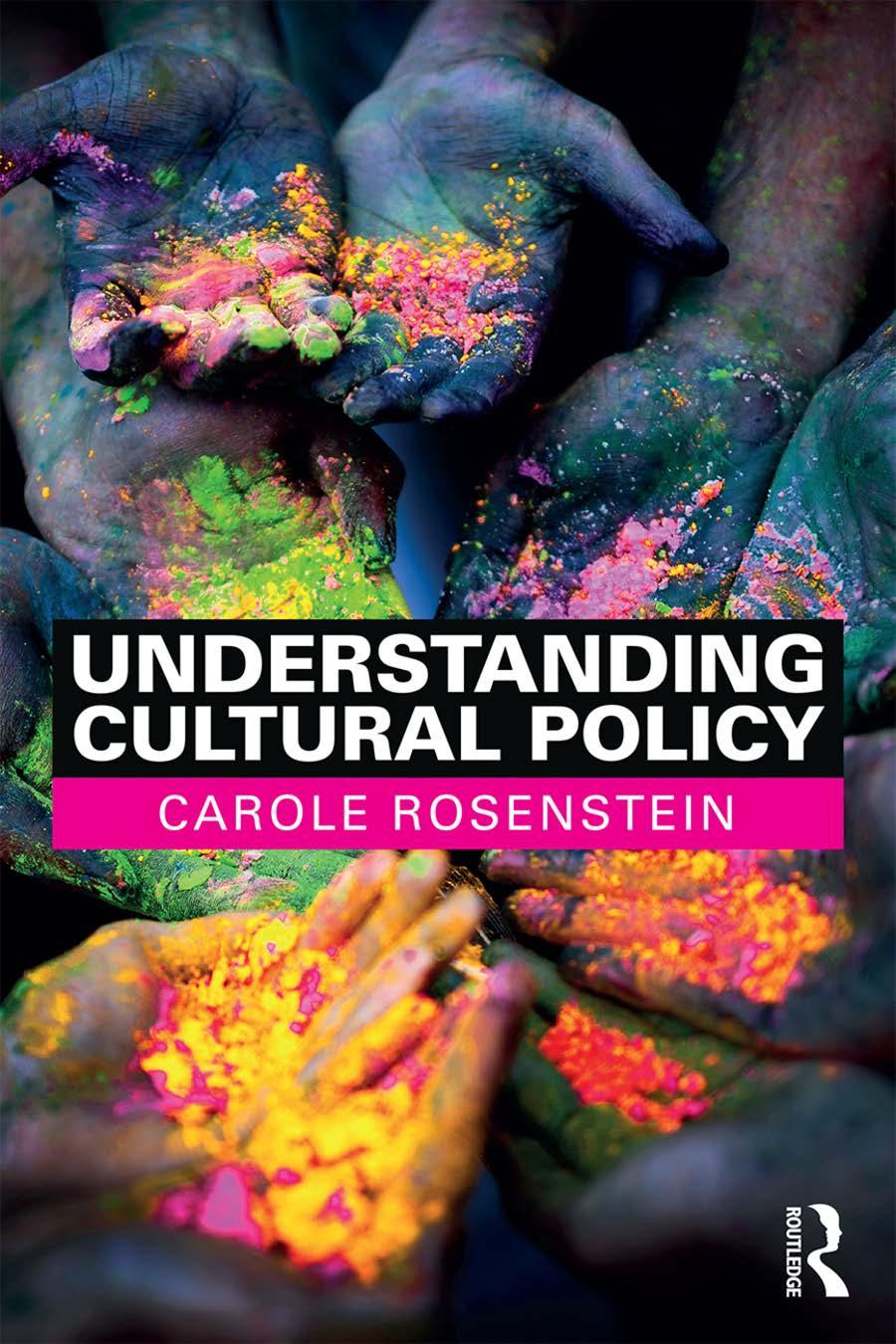
Understanding Cultural Policy provides a practical, comprehensive introduction to thinking about how and why governments intervene in the arts and culture.
Cultural policy expert Carole Rosenstein examines the field through comparative, historical, and administrative lenses, while engaging directly with the issues and tensions that plague policymakers across the world, including issues of censorship, culture-led development, cultural measurement, and globalization. Several of the textbook’s chapters end with a ‘policy lab’ designed to help students tie theory and concepts to real world, practical applications.
This book will prove a new and valuable resource for all students of cultural policy, cultural administration, and arts management.
Carole Rosenstein is an associate professor of arts management at George Mason University, USA. She has directed research projects for the Urban Institute, the National Endowment for the Arts, and the Institute for Museum and Library Services. Her scholarly work has been published in leading international cultural policy journals including The International Journal of Cultural Policy; The Journal of Arts Management, Law and Society; and Cultural Trends
Understanding Cultural Policy
Carole Rosenstein
First published 2018 by Routledge
711 Third Avenue, New York, NY 10017
and by Routledge
2 Park Square, Milton Park, Abingdon, Oxon, OX14 4RN
The r ight of Carole Rosenstein to be identified as author of this work has been asserted by her in accordance with sections 77 and 78 of the Copyright, Designs and Patents Act 1988.
All rights reserved. No part of this book may be reprinted or reproduced or utilized in any form or by any electronic, mechanical, or other means, now known or hereafter invented, including photocopying and recording, or in any information storage or retrieval system, without permission in writing from the publishers.
Trademark notice: Product or corporate names may be trademarks or registered trademarks, and are used only for identification and explanation without intent to infringe.
Library of Congress Cataloging-in-Publication Data
A catalog record for this book has been requested
ISBN: 978-1-138-69533-7 (hbk)
ISBN: 978-1-138-69535-1 (pbk)
ISBN: 978-1-315-52685-0 (ebk)
Typeset in Bembo by Apex CoVantage, LLC
For Harry
Every minute, billions of telegraph messages chatter around the world. Some are intercepted on ships. They interrupt law enforcement conferences and discussions of morality. Billions of signals rush over the ocean floor and fly above the clouds. Radio and television fill the air with sound. Satellites hurl messages thousands of miles in a matter of seconds. Today our problem is not making miracles—but managing miracles.
Lyndon Baines Johnson, comments upon signing the Public Broadcasting Act of 1967
All the suggestions heard thus far would amount to ideas with broken wings, were it not for a bit of false logic encountered in them. One adjusts all too readily to the prevailing conviction that the categories of culture and administration must simply be accepted as that into which they actually have developed to a large degree in historical terms: as static blocks which discretely oppose each other—as mere actualities. In so doing, one remains under the spell of that reification, the criticism of which is inherent in all the more cogent reflections upon culture and administration. No matter how reified both categories are in reality, neither is totally reified; both refer back to living subjects—just as does the most adventurous cybernetic machine.
Therefore, the spontaneous consciousness, not yet totally in the grips of reification, is still in a position to alter the function of the institution within which this consciousness expresses itself. For the present, within liberal-democratic order, the individual still has sufficient freedom within the institution and with its help to make a modest contribution to its correction. Whoever makes critically and unflinchingly conscious use of the means of administration and its institutions is still in a position to realize something which would be different from merely administrated culture.The minimal differences from the ever-constant which are open to him define for him—no matter how hopelessly—the difference concerning the totality; it is, however, in the difference itself—in divergence—that hope is concentrated.
Theodore
Adorno, Culture and Administration
The Culture Agenda: Prewar/Cold War 19 Philanthropy and Cultural Policy 24 Social Elites and Cultural Consensus 30 A National Cultural Center 34 A Federal Arts Policy 37
The National Foundation on the Ar ts and the Humanities Act (1965) 40
The Historic Preser vation Act (1966) 42 The Public Broadcasting Act (1967) 45
The Policy Arena 69
Cultural Bureaucracy on the National Level 74
On the Sub-National Level 82
On the Local Level 87
Policy Lab 3: The Federal Role in Cultural Policy 92
Why a Federal Cultural Policy? 92
The Culture Wars 98
CASE: The World Trade Center, New York, New York 100
4 For ms of State Intervention I: Regulation 103
Certification 105
Standards and Bans 109
Licensing and Permits 116
Planning 119
Policy Lab 4: Culture and the City 124
Why Regulate Culture? 124
What Local Regulation Requires 129
Problems Raised by Local Regulation 131
CASE: Jazz and the Tremé, New Orleans, Louisiana 132
5 For ms of State Intervention II: Provision 135
Public Provision 136
Subsidy 140
Grantmaking 145
Tax Expenditure 149
Policy Lab 5: Suppor ting Nonprofit Culture 155
Why Target Nonprofits? 155
Problems Raised by Delivering Provision Through Nonprofits 160
How Suppor t Is Delivered Matters 162
CASE: The Olympic Sculpture Park, Seattle, Washington 164
6 Data and Research 166
Data Infrastructure 166
Policy Research 175
Policy Lab 6: Cultural Measurement 185
Why Measure Culture? 185
Some Descriptive Cultural Measures 187
Baseline Measures 189
CASE: The Denver Scientific and Cultural Facilities District (SCFD), Denver, Colorado 192
7 Comparing Cultural Policies 195
Archetypes of National Cultural Policy 195
Cultural Policy and Cultural Ideology 209 Global Cultural Policy Nor ms 211
8 Contemporary Issues 216 Creativity 216 Place 220 Cultural Equity 223
0.1
3.2
3.3
3.4
3.5
3.9
4.1
4.3
7.1 Archetypes by Political Tradition, State Religion, and Style of Patronage
7.2 Archetypes by Primary Policy Instrument 198
7.3 Archetypes by Primary Policy Instrument, Degree of Intervention, and Market Ideology 198
7.4 Archetypes by Model Organizational Type and Cultural Ideology 210
7.5 Cultural Policy Models by Model Organizational Type and Cultural Ideology 210
Preface and Acknowledgments
This book is an in-depth introduction to the basic concepts, principles, workings, and functions of cultural policy in the United States. In it, I hope to provide readers with some concrete, practical knowledge about how cultural policy operates, knowledge they can use to understand and navigate on-the-ground choices and conflicts. The book includes the histories and theory of cultural policy that I believe every cultural administrator should hold in a professional repertoire. The field lacked a bespoke, synthetic work covering the historical, conceptual, and practical dimensions of cultural policy in the U.S. (This made it just about impossible to cover everything in one semester, and made for an over-long and repetitive reading list that was the bane of my students for a decade.) I have tried to build that work. The book was conceived as a primer for cultural administrators and aspiring policymakers, for those who are closely affected by cultural policy, and those who wish to intervene in cultural policymaking. I hope that it will g ive cultural administrators the foundation they need and will ease the future progression of students toward the advanced study of cultural policy.
This book’s focus on practical knowledge and its full integration of the administrative dimensions of policy distinguish it from existing approaches to cultural policy study and analysis.
The prevailing approach to policy analysis presents policy as transparently instrumental and primarily depends on economic theory and methods to understand policy. It is not the approach taken here. Instead, this book examines how cultural policy relates to history, politics, culture, and administration. I take that approach because I view policy as inextricable from the historical, political, cultural, and administrative contexts in which it is created and implemented. Even what is instrumental about policy—that is, even the relatively straightforwardly goal-oriented aspects of policy—are constituted in and by these contextual factors. I was trained as a cultural anthropologist, and that training shows in the way I approach the study and analysis of public policy. While economic approaches can be useful and certainly should make up a part of any analytical toolkit, I find the dominance of economic theory to be particularly unhelpful to understanding cultural policy. Public decision-making about whether, how, and how much to intervene in culture is heavily influenced by social and cultural structures and values. Economic
Preface and Acknowledgments xiii
approaches often appear driven not just to quantify value but to translate all sorts of value into quantifications realized on a monetary scale. Individual rationality is then assumed or asserted somehow to be associated with those monetary values in a necessary way, seeming to bypass social and cultural (and even economic!) structures. In my view, this does not provide a viable path toward fully understanding social and cultural values, comparing them to other sorts of value, and theorizing how those various sorts of value influence people’s preferences and the choices they make. (These limitations of economic approaches to policy analysis may apply to all sorts of policy; here, I am only concer ned with cultural policy.) Some counterweight is needed, and I hope that this book can contr ibute to creating a better balance among the approaches taken to cultural policy analysis.
Neither does this book easily fit within the academic literature of cultural policy study that is primarily informed by questions and frameworks central to the field of cultural studies. Most of that literature, I would argue, fundamentally views cultural policy as analogous to media, that is, as a system primarily oriented toward producing, distributing, and attempting to control the consumption of representations, and it interprets cultural policies in terms of the ways in which they further dominant economic, social, cultural, political, and other societal forces by privileging some representations over others. In general, its authors presuppose that cultural policy is a form of domination. Exceptions include an important strand of work following Foucault. Mitchell Dean suggests that an analytics of government can act:
in service not of a pure freedom beyond government, or even of a general stance against domination. , but of those “moral forces” that enhance our capacities for self-government by being able to understand how it is that we govern ourselves and others. It thus enhances our human capacity for the reflective practice of liberty, and the acts of selfdetermination this makes possible without prescribing how that liberty should be exercised. An analytics of government removes the “naturalness” and “taken-for-granted” character of how things are done. In so doing, it renders practices of government problematic and shows that things might be different from the way they are. Rather than prescribing a general stance against forms of domination (such as would take the form of the injunction to “resist all domination” or “minimize all domination”) it allows us to reveal domination as a contingent, historical product, and hence to be questioned.
(2010: 49)
This Foucauldian strand of thought has been introduced into cultural policy study by Tony Bennett—
The key questions to pose of any cultural politics are: how does it stand within a particular cultural technology? What difference will its pursuit make to the functioning of that technology? In what new directions
xiv Preface and Acknowledgments
will it point it? And to say that is also to begin to think the possibility of a politics which might take the form of an administrative program, and so to think also of a type of cultural studies that will aim to produce knowledges that can assist in the development of such programs.
(1992: 29)
—and by Stuart Cunningham—
A policy orientation in cultural studies would shift away from rhetorics of resistance, progressivism, and anti-commercialism on the one hand, and populism on the other, toward those of access, equity, empowerment and the divination of opportunities to exercise appropriate cultural leadership.
(2003: 21)
This book only indirectly is about cultural policies as systems for ordering representations. It primarily is about what people have (and have not) wanted cultural policies to accomplish and what structures and practices they have developed to try to accomplish those goals.
Cultural policies do reflect structures of power. I believe that cultural administrators are best situated to confront those structures of power and, in my experience, many of them wish to and do confront them every day. I am skeptical about the extent to which the writings of academic scholars can be especially helpful in doing that except insofar as that work helps cultural administrators to define, commit to, and inform their own professional ethics. On the other hand, all engagements with policy are political, and this book is no different. In it, I attempt to g ive those who will make and implement and change cultural policy some better means of understanding it in all its contingency, complexity, and importance. I do that in the hope that they will make the best decisions they can on our behalf.
There are some moments in life when luck shines on you. When I completed my dissertation and decided not to pursue a teaching job, I thought I’d take a look around to see how I might use what I had lear ned so far. To my great fortune, I ended up working on the growing cultural policy portfolio at the Urban Institute. In my time there, I lear ned what many a newly minted PhD most needs to learn: a commitment to service and the importance of collegiality. Many, many thanks to my UI colleagues, especially to Elizabeth Boris for her kindness and to Carol De Vita for her patience. I’ve been lucky in the place I landed afterwards, as well. I’m deeply grateful for the support I’ve received from George Mason University, from the College of Visual and Perfor ming Arts, and from the warm, talented, communityminded CVPA faculty. It is good to work in a place where people believe in you and trust in the value of what you are trying to do. I feel par ticularly grateful to be part of an arts faculty. Thanks to Stefan Toepler and J. P. Singh for forming the Mason CP mini-cohort. Sincere thanks to Claire Huschle
Preface and Acknowledgments xv for finding me some extra time to write. A special thanks to the indefatigable Richard Kamenitzer for br inging me to GMU.
Cultural policy study doesn’t really belong to any academic discipline. A few opportunities and recognitions have been sustaining to my work: thanks to the Smithsonian Institution Center for Folklife and Cultural Heritage for supporting my research and program development in post-Katrina New Orleans through a Rockefeller Humanities Fellowship in Cultural Policy; thanks to Mario Garcia Durham, Sunil Iyengar, and the National Endowment for the Arts for sponsoring and heralding the national study of arts festivals; thanks to Carolyn Fuqua, Norman Bradburn, and the American Academy of Arts and Sciences for continuing to include me in your work on nonprofit humanities organizations; thanks to Sharon Golan and Routledge for inviting me to write this book. Early on in my explorations into cultural policy, Mark Schuster gave me a thoughtful nudge in the right direction, and this book probably would not have been possible without his pioneering work. I’m sorry we lost him too soon. To my eminently intelligent and elegant friend Esther Hamburger and to her gracious husband Carlos Augusto Calil, many thanks for introducing me and my handful of lucky students to cultural policy in Brazil. I’m grateful that Arts Management has interest in and has found a space to include cultural policy study in the academy. To Patricia Dewey and Rich Maloney, many thanks for your friendship and support in that arena and beyond. I look forward to many years working together. To a decade of arts management graduate students: thanks for demanding so much; it is a privilege to be your teacher.
Writing a book on a deadline is not compatible with normal life and everyday responsibilities. Thanks for your understanding to all of my colleagues in the George Mason Arts Management Program, especially longtimers Nicole Springer and Karalee Dawn McKay. Thanks to Kristy Keteltas, Karolina Kawiaka, Sara Morris, and Shannen Hill for reminding me about the life of weekends, exhibitions, swimming, traveling, teacher conferences, pet vaccinations, house repairs, and for all of your regular “just-checking-in.” Here, everywhere, and always, thanks to Irv Rosenstein and Claire Rosenstein for sending me into the world with all of your love. To Harry: yes, birdy, it is done yet.
Introduction
This is a book about public cultural policy in the United States, that is, about why and how government in the U.S. intentionally intervenes in culture. Most often, public policies are presented in a way that highlights their instrumentality, their status as tools created and used to address some pressing public problem. Understanding that policies are conceived as tools of government action and that they are implemented, at least in part, in order to accomplish a goal is fundamental to understanding public policy. However, public policies are chosen for many reasons other than how well they might perform an intended instrumental function or functions. A whole range f actors influences which policies are adopted and how they work. History and politics influence public attention and priorities, determining which somethings it is that we choose to try to accomplish and when. Overall resources available to government are influential as well; policymaking always involves choices, but sometimes those choices are more constrained and sometimes less so. Cultural values and attitudes set horizons and influence priorities. Political traditions and institutions privilege certain ways of doing things and disallow others. So too do the preferences and experiences of public administrators. All sorts of information and knowledge will make a difference to how policy is formulated and implemented: knowledge about a problem to be tackled; knowledge about alternatives and their viability; knowledge about effectiveness and it how can be measured. Knowledge and information in any of these areas may be expansive or limited, and that will affect what a policy looks like. Understanding how a public policy works as a tool is important. Understanding why anyone finds it necessary to create such a tool, what knowledge, experience, and prejudices its creators bring to its invention and use, and what materials are available to them, equally so.
From the outset, certain parameters must be acknowledged: cultural policy in the U.S. is constrained by a belief that the role of government in the arts and culture should be a limited one. That belief is entrenched deeply, and fed by two strong streams in the American political tradition. Both flow from
the Bill of Rights and are reflected in the First Amendment to the U.S. Constitution:
Congress shall make no law respecting an establishment of religion, or prohibiting the free exercise thereof; or abridging the freedom of speech, or of the press; or the right of the people peaceably to assemble, and to petition the government for a redress of grievances.
The first tradition has to do with freedom of speech. Americans and American public institutions consider freedom of speech to be as fundamental to liberty as is freedom from tyranny. The Bill of Rights conceives freedom of speech as a natural, inalienable right of all individuals. Fostering and protecting free speech is understood to be essential to democracy, making political speech of special importance and binding freedom of speech inextricably to freedom of the press. The idea that freedom of speech is an inalienable right, fundamental to individual liberty, is the foundation for a more expansive notion of freedom of expression. The First Amendment protects all sorts of expression from signs to clothing to songs to dances to jokes. The channels through which those expressions are made public also must be free so that expressions may circulate and add to the pool of ideas, information, and imagination from which all may draw to develop into better and more fully realized citizens and people. The principle underlying these protections is that government poses an inherent danger to expression. Expression must be shielded from government interference or suppression. That attitude to government serves as a consistent and countervailing force opposed to the establishment of a comprehensive cultural policy in the U.S. In its essence, culture includes expression. In the American tradition, expression is conceived as being endangered by government, not aided by it. This principle limits the extent to which government in the U.S. can and will intervene in culture.
A second tradition has to do with the separation of church and state. Although freedom of expression more typically serves as a basis for understanding the character of U.S. cultural policy, the principle of freedom of religion is at least equally important. Cultural policy in the U.S. frames culture in a way that places religion above or beyond it, tending instead to view the arts as exemplary of culture. Nonetheless, American attitudes about the relationship between government and religion influence broad ideas about how government and culture should relate to one another and the organizational structures developed out of those ideas. In his classic nineteenth-century study of American culture, society, and democracy, Alexis de Tocqueville claimed that the distinctive way in which Americans link religion and liberty defines the American character.
In the bosom of that obscure democracy, which still had not sired generals, or philosophers, or great writers, a man [Cotton Mather]
could rise in the presence of a free people and give, to the acclimation of all, this beautiful definition of freedom: . . . “There is a liberty of corrupt nature, which is affected both by men and beasts, to do what they list; and this liberty is inconsistent with authority, impatient of all restraint; But there is a civil, a moral, a federal liberty, which is the proper end and object of authority; it is a liberty for that only which is just and good; for this liberty, you are to stand with the hazard of your very lives.”
I have already said enough to put the character of Anglo-American civilization in its true light. It is the product (and this point of departure ought constantly to be present in one’s thinking) of two perfectly distinct elements that elsewhere have made war with each other, but which, in America, they have succeeded in incorporating somehow into one another and combining marvelously. I mean to speak of the spirit of religion and the spirit of freedom.
(emphases in the original, 2000 [1805–1859]: 42)
De Tocqueville argues that the American capacity for political experiment depended upon both a fierce commitment to religion and the will to keep religion in “the place that is reserved for it.”
In the moral world, everything is classified, coordinated, foreseen, decided in advance. In the political world, everything is agitated, contested, uncertain; in the one, there is passive though voluntary obedience; in the other, there are independence, contempt for experience, and jealousy of every authority. Far from harming each other, the two tendencies, apparently so opposed, advance in accord and seem to lend each other a mutual support. Religion sees in civil freedom a noble exercise of the faculties of man; in the political world, a field left by the Creator to the efforts of intelligence. Free and powerful in its sphere, satisfied with the place that is reserved for it, it knows that its empire is all the better established when it reigns by its own strength alone and dominates over hearts without support.
(2000 [1805–1859]: 44)
To maintain its necessary moral authority, religion had to remain distinct from the new democratic political institutions and practices that Americans were inventing. This understanding later would be formalized in the idea that a wall must maintain the separation between church and state.
Of course, de Tocqueville also famously recognized the voluntary associations so central to American public life.
Americans of all ages, all conditions, all minds constantly unite. Not only do they have commercial and industrial associations in which all
take part, but they also have a thousand other kinds: religious, moral, grave, futile, very general and very particular, immense and very small; Americans use associations to give fetes, to found seminaries, to build inns, to raise churches, to distribute books, to send missionaries to the antipodes; in this manner they create hospitals, prisons, schools. Finally, if it is a question of bringing to light a truth or developing a sentiment with the support of a great example, they associate. Everywhere that, at the head of a new undertaking, you see government in France and a great lord in England, count on it that you will perceive an association in the United States.
(de Tocqueville 2000 [1805–1859]: 489)
For de Tocqueville, it is America’s essentially middle-class character that explains the prevalence and importance of voluntary associations. However, others argue that voluntary associations would flourish here because of the autonomous but still public domain created for religion in America. Poet and cultural critic Lewis Hyde (1999) claims that the centrality of voluntary association in the United States is rooted in the linking up of religion with liberty. In the American political imagination, the right to determine whether and which religion to follow is fundamental and it underwrites all freedom of association. For Americans, everywhere belief is, the freedom to choose also must be. Although this principle stems from ideas about and is most fundamental to religion, it pervades all questions about culture, disrupting an easy relationship between government and culture in public debates over education, language, public space, art, and every other cultural form.1 Consequently, the organization of culture in the U.S. is intersectoral and hybrid to its core, made up of and amalgamating public, nonprofit, and commercial institutions and forms to such an extent that it is not possible to pick them apart.
Given these real and substantial constraints, how is it that the United States has a cultural policy at all? National cultural policy began to emerge in the U.S. in the 1950s as a product of the Cold War. To understand how and why the U.S. developed a cultural policy, it is necessary to understand that Cold War context. The people who cared about making the arts and culture a part of American public life and a part of the state believed that this project was required to fight and win the Cold War. A histor y of the development of cultural policy in the U.S. during the immediate postwar period, through the Kennedy administration, and into the sweeping Great Society legislative agenda that included the nation’s keystone cultural policy provisions makes up the first chapter of this book. The impetus to bring the arts and culture into the portfolio of U.S. government responsibilities was fundamentally international. Work to build a national cultural policy in the U.S. informed and was informed by the establishment and ongoing work of the United Nations and of the UN Educational, Scientific and Cultural Organization (UNESCO). The development of the concept of cultural
policy and of recognized cultural policy norms, problems, rationales, and goals was an international project centered at UNESCO over this postwar period. Chapter 2 lays out the definition of cultural policy established there.
A consequence of viewing public policies as primarily or essentially instrumental is that the indelible marks left by culture, history, politics, and knowledge tend to get ignored or erased from our understandings of policy. For example, policies tend to present the problems they are created and implemented to solve as given. In fact, the process of policymaking is itself constitutive of those problems. This book puts history up front in order to underscore that point.
American cultural and political principles have acted as a formidable barrier, but they have not prevented the nation from developing cultural policies. They do, however, delimit and shape how cultural policy is created and administered in the U.S. The significant constraints on cultural policy’s development have contributed to creating a cultural policy system characterized by its decentralization and indirectness. Chapter 3 descr ibes the highly decentralized cultural bureaucracy through which culture is administered in the U.S. Chapters 4 and 5 describe the largely indirect administrative tools this bureaucracy uses to regulate and provide culture. These basic characteristics of U.S. cultural policy also are reflected in the cultural policy data and research infrastructure. The most important developments in conceiving and beginning to build cultural policy data and research with any sort of comprehensive reach have taken place in Europe and in global institutions. Researchers and cultural administrators and policymakers in the U.S. are responding to those developments, but are doing so only slowly and unevenly, in large part because of the decentralized and indirect institutional mechanisms available here. Chapter 6 discusses the state of the cultural policy data and research that is on-hand to inform decisionmaking in the U.S.
One of the best ways to recognize that cultural policy is delimited and shaped by cultural principles and values together with political traditions, structures, and institutions particular to a nation is to compare cultural policies across nations. In Chapter 7, national cultural policies and distinctive cultural policy instruments are compared, with a focus on the cultural, historical, and political factors that have shaped them. Comparisons aid in disrupting that taken-for-granted-ness that so often cloaks forms of governance and administrative instruments. Other people in other situations come up with other ways to solve a problem and may give precedence to different problems altogether. Such comparisons also are particularly valuable as global cultural policy exchanges increase. (The model for the National Endowment for the Arts was borrowed from England, for example, and many nations are interested in cultivating the U.S.’s corporate model of the nonprofit form.) Understanding the context within which a particular policy instrument developed and through which it functions is essential to deciding whether and how it might effectively be borrowed. Globalization is contributing to
significant cultural policy convergence, and that will be considered as well. The book closes with a brief discussion of three key contemporary cultural policy concerns—creativity, place, and cultural equity—linking them up to the history of cultural policy thinking and intentions.
Each of the four hands-on chapters of this book—Chapters 3 through 6—includes a policy lab. These labs take up the concepts discussed and apply them to a key cultural policy topic of concern: federalism, cities, nonprofits, and cultural measurement. The labs dissect these important policy topics, and serve as examples of how to apply policy concepts. Each lab closes by identifying and briefly sketching a case that readers might use to explore the issues further and in an even more concrete way. The labs also include two queries that lie at the root of the topic covered. These are difficult questions that demand advanced, sustained thinking and experience. In a sense, these questions lie at the heart of the book: each one is meant to serve as a springboard for further contemplation and research.
No aspect of cultural policy is particularly straightforward, and that includes the basic concepts necessary for studying it: culture, policy, and administration. Before setting out to investigate more complex topics in detail, here is a guide to these basic concepts as they are understood in what follows.
What Is Culture?
Settling on a definition of culture is notoriously difficult. In a pathbreaking series of lectures delivered at Yale University in the 1930s, linguistic anthropologist Edward Sapir suggested that culture belongs to a category of terms
that have a peculiar property. Ostensibly they mark off specific concepts, concepts that lay claim to a rigorous objective validity. In practice, they label vague terrains of thought that shift or narrow or widen with the point of view of whosoever makes use of them, embracing within their gamut of significance conceptions that not only do not harmonize but are in part contradictory.
(1994: 23)
In Keywords: A Vocabulary of Culture and Society, critic Raymond Williams famously called culture “one of the two or three most complicated words in the English language” (1983 [1976]: 87).
There are, however, two common understandings of this vexing word.
The first relates to the notion of cultivation, in the sense of agricultural cultivation: by controlling, modifying, ordering, and nurturing plants, they are cultivated into crops. Rooted in Enlightenment principles, this understanding conceives culture as a “general process of intellectual, spiritual and aesthetic development” (Williams 1983[1976]): 91). Culture evolves from savagery toward civilization, a state of order and refinement (Williams
1983[1976]): 58). This usage often is termed Arnoldian, for the Victorian poet and critic Mathew Arnold, who wrote that culture is “properly described . . . as having its origin in the love of perfection” (1869: 9):
a pursuit of our total perfection by means of getting to know, on all the matters which most concern us, the best which has been thought and said in the world and through this knowledge turning a stream of fresh and free thought upon our stock notions and habits.
(1869: preface)
Arnold’s definition of culture encompasses both forms—the “best that has been thought and said”—and their effects—directing human development toward “increased sweetness, increased light, increased life, increased sympathy” (1869:42). In contemporary common usage, the word culture typically refers to “the works and practices of intellectual and especially artistic activity culture is music, literature, painting and sculpture, theatre and film” (Williams 1983[1976]): 91). The association of culture with the arts is “an applied form of [the sense of culture as cultivation]: the idea of a general process of intellectual, spiritual, and aesthetic development as applied and effectively transferred to the works and practices that sustain it” (Williams 1983[1976]): 92).
The Arnoldian sense of the word culture is deeply contested because the manners and tastes of elites tend to be seen as representing the ends of cultural development; this understanding of culture is seen as being exemplified by Fine Art and not by other forms of expression. Sapir makes this sense explicit: this usage
implies a standard pertaining to an individual or group. To be “a man of culture” involves participation in special social values clustering around tradition. It is not the particular content of those traditions that is vital in distinguishing the cultured person from others . . . but the fact that they are traditional and valued.
(1994: 24)
In this iteration, culture is an “evaluational term referring to the activities of the elite” (Sapir 1994: 28). Pierre Bourdieu’s (1984) influential work in the sociology of culture insists that although social elites work hard to make these values appear natural, they are in fact carefully constituted and rigorously maintained. Elites naturalize their own ways of being and call this culture. Bourdieu argues that elite culture is a product of upbringing and education—that it is, in fact, cultivated.
In contrast to this evaluative, hierarchical understanding, a second meaning of culture is pluralistic, acknowledging the multiplicity of cultures, each grounded in “a particular way of life, whether of a people, a period, a group,
or humanity in general” (Williams 1983[1976]): 91). This sense of culture, what Sapir terms Kultur,
seems always to have something mystical in its meaning. It somehow embraces the idea of the geist of a people, the underlying soul or spirit. . . . Kultur is a unified or integrated conception of culture, emphasizing its complex of ideas, its sense of the larger values of life, and its definition of the ideal (for example, the Greek ideal of calmness and the perfect, static image).
(1994: 28)
This understanding of culture is associated with the German tradition, most intimately with the thought of eighteenth-century philosopher Johann Gottfried von Herder. Herder argued against the Enlightenment principle that there is a universal standard for human development, and saw his work as contributing to a “natural history of humanity” that could fully recognize human cultural diversity. Culture, for Herder, necessarily varies because it is the product of a particular language and history:
each nation has its riches and distinctive features of spirit, of character, and of country. These must be sought out, and cultivated. No human being, no land, no people, no history of a people, no state is like the other, and consequently the true, the beautiful, and the good is not alike in them.
(Herder quoted in Forster 2006: 18)
Herder’s thought is associated with the emergence of nationalism, particularly German Romantic nationalism, which asserted that the legitimacy of a state depends upon its relation to a “people,” that is, a group bounded by a common language, traditions, and values.
The pluralistic sense of the word culture grounds cultural relativism, the argument that human values only can be understood in the context of the distinct culture that shapes them. The earliest explicit argument for cultural relativism was developed by Franz Boas, known as the father of American cultural anthropology, as a part of his broader intellectual project to undermine racialism, the notion that race determines human character. (Boas, a German Jew who emigrated to the United States in the late 1880s, was a forceful advocate for racial equality and social justice.) With cultural relativism, the contrast between the two senses of the term culture is fully articulated. In Culture: A Cr itical Review of Concepts and Definitions (1952), a classic review of the term, anthropologists Alfred Kroeber and Clyde Kluckhohn set the two senses in clear opposition to one another: in what they call the “humanist” understanding, culture is singular, absolutist, and progressive, while the “anthropological” understanding of culture is plural, relativist, and static (Stocking 1966: 868).
Exploring the Variety of Random Documents with Different Content