No part of this publication may be reproduced, stored in a retrieval system, or transmitted in any form or by any means, electronic, mechanical, photocopying, recording, scanning, or otherwise, except as permitted under Section 107 or 108 of the 1976 United States Copyright Act, without either the prior written permission of the publisher, or authorization through payment of the appropriate per-copy fee to the Copyright Clearance Center, Inc., 222 Rosewood Drive, Danvers, MA 01923, 978-750-8400, fax 978-646-8600, or on the Web at www.copyright.com. Requests to the publisher for permission should be addressed to the Permissions Department, John Wiley & Sons, Inc, 111 River Street, Hoboken, NJ 07030, 201-748-6011, fax 201-748-6008, oronlineatwwwwileycom/go/permissions
Limit of Liability/Disclaimer of Warranty: While the publisher and author have used their best efforts in preparing this book, they make no representations or warranties with respect to the accuracy or completeness of the contents of this book and specifically disclaim any implied warranties of merchantability or fitness for a particular purpose No warranty may be created or extended by sales representatives or written sales materials The advice and strategies contained herein may not be suitable for your situation You should consult with a professional where appropriate. Neither the publisher nor author shall be liable for any loss of profit or any other commercial damages, including but not limited to special, incidental, consequential, or other damages. Readers should be aware that Internet Web sites offered as citations and/or sources for further information may have changedordisappearedbetweenthetimethiswaswrittenandwhenitisread Jossey-Bass books and products are available through most bookstores To contact Jossey-Bass directly call our CustomerCareDepartmentwithintheU.S.at800-956-7739,outsidetheU.S.at317-572-3986,orfax317-5724002.
Wileypublishesinavarietyofprintandelectronicformatsandbyprint-on-demand.Somematerialincludedwith standard print versions of this book may not be included in e-books or in print-on-demand If this book refers to media such as a CD or DVD that is not included in the version you purchased, you may download this material athttp://booksupport.wiley.com.FormoreinformationaboutWileyproducts,visitwww.wiley.com.
Library of Congress Cataloging-in-Publication Data
The previous editions of Understanding and Managing Public Organizations reviewed the literature on management and organization theory and suggested applications to the public sector grounded in evidence from research on public organizations and the people in them. The book has served primarily as a text in courses for masterofpublicadministrationstudentsandinseminarsfordoctoralstudentsinpublicadministrationandpublic affairsprograms Ithasalsoservedtheneedsofscholars,andithasahighnumberofcitationsintheSocialScience Citation Index for a book of this type, in this field. The revisions in this fifth edition seek to enhance the book’s usefulness to students and scholars. The book also seeks to meet certain needs of practicing managers and professionals
Reviewers of earlier editions suggested greater integration among the chapters and the addition of an organizing framework for the material The first chapter now includes a conceptual framework that links the chapters and topics in the book This framework emphasizes a fundamental challenge for leaders and members of organizations: that of integrating and coordinating the components and domains of the organization. These include the organization’s environment, strategy- and decision-making processes, goals and values, culture, structure, power relationships, tasks, and communication processes This integration, of course, must also include the people the organization’s leaders, teams, and groups, and their motivations, work attitudes, and behaviors As the book illustrates, the field of management and organizational theory has developed no comprehensive theory or scientific solution that achieves this integration. Without wanting to slight or offend my fellow authors, I assert that no existing text on organizations and their management achieves a highly effective integration of the topics any more than this one does Nevertheless, the book’s chapters describe concepts and insights from the organization and management literature that support leaders’ and managers ’ efforts to think and act comprehensively, and to integrate the topics and issues they face. The final chapter illustrates how to use the framework to approach management challenges such as privatization of public services in an integrative, comprehensive fashion In addition, an online instructor’s guide is available, which includes cases and exercises that instructors can use to challengestudentstoconsiderhowtobringmultipletopicsandconceptstobearonthesamecase.
The book’s chapters flesh out the conceptual framework by reviewing the theories, research, and practices associatedwith majortopics inthe fieldof organizationsand theirmanagement Asdescribed inChapter One, the field of public management and leadership has continued to develop rapidly since publication of the previous editions Accordingly,manychaptersandtopicsinthiseditionhavebeenexpandedtocovernewmaterialandnew developments This includes research on such topics as how public managers lead and behave, effective performance in government agencies, organizational commitment in public organizations, differences between public and private managers ’ perceptions of the personnel systems with which they work, organizational culture in public organizations, and many other topics This edition includes expanded coverage of developments on the topic of “public values,” of research on public service motivation, and of recent research on strategic decision making in public organizations. It includes much more coverage than in previous editions of the rapidly developing topic of networks and collaboration in the public service delivery and governance. This edition generally updates the reviews of research on the many topics in the book, such as the Meier-O’Toole model of public management The chapters on the major topics of the book show that researchers have published a profusion of studies on these and other topics since the fourth edition appeared, thus raising a major challenge for thosewhoseektoreviewandinterpretthemall.
In addition, previous editions of this book have analyzed, as does this one, the distinctions between public organizations and their members, on the one hand, and other types of organizations, leaders, and employees, such as those in the business sector, on the other Chapter Three presents a conceptual analysis of these distinctions: What do we mean when we refer to these different types of organizations and the people who work for them? How do we define them and study their differences? Subsequent chapters describe research articles and other forms of evidence that compare public and private organizations in terms of the topics that these chapters cover. Many studies of this type have appeared in recent years Assembling these studies, describing them, and interpretingthemforthereaderhasposedanotherseriouschallenge,butawelcomeone,becauseoneofthebook’s objectives is to provide the most comprehensive compilation and review possible of such research-based comparisonsofpublicandprivate(andpublicandnonprofit)organizations.
Another goal and challenge of the previous editions of the book was to cover important developments in the practice and contemporary context of general management and public management. Previous editions covered such topics as Total Quality Management (TQM); the influence of the best-selling book ReinventingGovernment (Osborne and Gaebler, 1992) and the REGO movement it spawned, including the federal government ’ s National
Performance Review; and the management of privatization and contracting-out programs, among others. Some of these developments have become dated and less prominent over time, but reviewers and colleagues advised against deleting them The review of such developments in Chapter Fourteen provides a history of many of the management improvement initiatives in recent decades. The review illustrates how ideas move through government and other domains over time, and the interplay between academic scholarship and theory, on the one hand, and the practice of management, on the other This edition reports on research evaluating the influence of these developments on governments at all levels in the United States and in other nations It also covers more recent developments such as the New Public Management movement around the world, the George W. Bush administration’sPresident’sManagementAgenda and its Program Assessment Rating Tool (PART), and the human capitalmovementingovernment
The book provides such coverage in part to make this edition more useful than the previous editions for practicing managers and professionals and for students interested in such roles It also offers many suggestions for those faced with practical leadership and management challenges, including managing relations with the media (Chapter Five), enhancing one ’ s power and authority (Chapter Seven), conducting strategic decision-making processes (Chapter Seven), motivating employees (Chapter Ten), managing and leading organizational culture (Chapter Eleven), managing conflict (Chapter Twelve), leading organizational change (Chapter Thirteen), and other topics In addition, it gives examples of how these insights and concepts are used in the field For instance, Chapter Eight begins with a description of the major structural reform that the U.S. Internal Revenue Service underwent, and of the structural changes made at a national laboratory in response to public concerns about its safety Chapter Nine points out that many of the efforts to reform pay systems in government would have been much more effective if they had been informed by a clear understanding of a number of motivation theories Chapter Thirteen shows how strategies for leading organizational change have led to successful large-scale change in government agencies, and how not applying such strategies has led to failure in other instances. Chapter Thirteen provides a summary of points of expert consensus about successful management of large-scale organizational change When my coauthor, Sergio Fernandez, and I published this summary in Public Administration Review (PAR) and on the PAR website, we received very positive comments from government officialsabouttheusefulnessofthesummary
Ultimately, the book pursues the theme that effective leadership involves the well-informed, thoughtful, integrative use of a variety of management concepts and points rather than the hot pursuit of catchy phrases and glib advice As an illustration of this theme, consider that many students of military strategy and history express great admiration for Carl Von Clausewitz’s classic treatise On War (1986) Clausewitz took the position that he could not advise an individual commander on how to conduct a specific campaign because such situations are so highly varied and contingent. Rather, he aimed to provide general perspective and insight on how to conceive of the nature and enterprise of war Even persons who loathe military force and military analogies might accept the point that people facing practical challenges often profit from general understanding and insight as much as from detailedprescriptions.
Audience
The primary audience for previous editions of Understanding and Managing Public Organizations included graduate students and scholars interested in public management and applications of organization theory to the public sector The difference between the needs of doctoral students and those of master of public administration (M.P.A.) students and undergraduate students presents a challenge for this book. Faculty colleagues at other universities who have used the book in their classes have sometimes mentioned that their M.P.A. students do not see the need for the many citations to academic research articles and reviews of such academic materials They also mention, however, that their doctoral students value and appreciate the reviews of academic literature and research, and the citation of such work. For this fifth edition, this raised the question of whether I should reduce the reviews and citations of academic research to meet the needs and preferences of some MPA students, or to keep this coverage and even extend it by updating it Faculty colleagues with whom I discussed this matter, as well as anonymous reviewers of the proposal for this edition, mostly advised the latter approach keeping the coverage of academic research. One reviewer emphatically insisted that this coverage represents a distinctive contribution of thebook,andthatIshouldavoid“dumbingdown”thebook
This edition does try to accommodate, in certain ways, the preferences of students who do not see the need for the academic citations. In Chapters One and Fourteen, long lists of parenthetic references citing multiple books and articles have been moved to endnotes, to enable an uninterrupted flow of the text In addition, as mentioned earlier, an instructor’s guide is now available It includes key terms, examples, potential writing assignments, and case discussion exercises. The instructor’s guide also includes and illustrates suggestions and alternatives for using the materials and approaching the topics of a course using the book. These materials can enliven the topics and make them more accessible for MPA students Microsoft PowerPoint presentations are also available for each chapter; they provide many rich illustrations and graphics that can enliven a discussion and coverage of the topics Theseresourcesareavailableatwww.wiley.com/college/rainey.
Reviewers of the previous editions said that practitioners would be unlikely to delve into the detailed reviews of research and theory the book provides. I concede this point, but grudgingly. This assumption underestimates many practicing leaders and managers who are thoughtful and reflective students of leadership and management. They may dislike abstruse academic discourse because they are inclined to action and strive for practical results They may also find quick advice and bright ideas attractive When practicing managers enroll in courses in academic settings, however, they often lead their classes in insight and in showing an interest in new concepts and broadperspectives.Theyoftenspurn“warstories”andhow-tomanuals.
Thus the lines between practicing managers, students, and management scholars often blur. Sometimes practicing managers seek degrees in long-term academic programs and play the role of student. Often they teach or help to teach courses Therefore, although the primary goal of this book is to serve students and scholars interested in research and theory, it can also serve practicing managers and leaders This book can serve as a reference for busy managers who want a review of basic topics in the field and who might find the conceptual frameworkandsomeofthesuggestionsandexamplesuseful.
Organization
The best overview of the organization of the book can be obtained by reviewing the table of contents. Part One covers the dynamic context of public organizations Its five chapters introduce the basic objectives and assumptions of the book and the conceptual framework mentioned earlier Chapter One discusses the current context of public management in practice and in scholarship, and the challenges this context raises for applying organization and management theory to public organizations. Chapter Two summarizes the history of organization and management theory, describing the development of some of the most important concepts and issues in the field, which are discussed further in later chapters In addition, this historical review shows that most of the prominent organization and management theorists have been concerned with developing the general theory of organizations and have not been particularly interested in public organizations as a category Their lack of interest in public organizations justifies the effort made in this book to apply organization theory to public organizations, and it also indicates the challenges involved Chapter Three defines public organizations and distinguishes them from private ones. It also provides an introductory overview of the assertions about the nature of public organizations made in later chapters Chapters Four and Five review the literature on organizational environments,particularlythepoliticalandinstitutionalenvironmentsofpublicorganizations
Part Two focuses on key dimensions of organizing and managing. These seven chapters concentrate on major topics in organization theory and management, including goals and effectiveness, power, strategy, decision making, structure and design, and the people in organizations (including discussions of values, motivation, workrelated behaviors and attitudes, leadership, organizational culture, teams and groups, communication, and conflict).Theydescribecurrentresearchonthesetopicsanddiscusshowitappliestopublicorganizations.
Part Three covers strategies for managing and improving public organizations. Chapter Thirteen addresses organizational change and development. Chapter Fourteen, the last chapter of the book, presents ideas for achieving organizational excellence in the public sector Finally, the chapter illustrates how the conceptual framework may be used to pursue a comprehensive management strategy that addresses both new initiatives and long-standingchallenges.
Acknowledgments
Istillowethankstoallthepeoplementionedinthefirstfoureditions,andthelisthasgrownevenlonger.Itdefies enumeration here Despite my concern about leaving out anyone, I must leave out a great many people anyway I offer thanks to all those who have discussed the book with me and made suggestions, including Craig Boardman, Barry Bozeman, Delmer Dunn, Patricia Ingraham, Ed Kellough, Ken Meier, Larry O’Toole, Sanjay Pandey, and many others, including anonymous reviewers for this and previous editions. As were the previous editions, this bookisdedicatedprimarilytomyson,Willis,mydaughter,Nancy,andmywife,Lucy Doctoral students in the School of Public and International Affairs at the University of Georgia provided invaluable assistance with this edition and previous ones These include Meriem Hodge and Harin Woo, who provided reviews of current research and suggestions about how to use them, as well as assistance in editing and revising the content. This edition also benefits from contributions to past editions by former doctoral students. These include Professor Young Han Chun of Seoul National University, Professor Jay Eungha Ryu of Ohio University, Professor Sergio Fernandez of the Indiana University School of Public and Environmental Affairs, Professor Chan Su Jung of the City University of Hong Kong, Professor John Ronquillo of DePaul University, ProfessorJungWookLeeofYonseiUniversity,andMikeKoehleroftheU.S.DepartmentofHomelandSecurity.
I refer to another of our doctoral graduates, Professor Deanna Malatesta of the School of Public and Environmental Affairs of Indiana University, Purdue University at Indianapolis, as my coauthor on the instructor’s guide and PowerPoint presentations. This claim is presumptuous on my part, because Deanna did so much of the work with such energy, initiative, and creativity that she would be justified in refusing to list me ascoauthor SeldomhaveIfeltsoindebtedtoacolleague
IowegratitudetorepresentativesofJossey-Basspublisherswhohavehelpedandsupportedtheworkonthisand previous editions For this edition, it has been a pleasure to work with Alison Hankey, with her combined high levelsofcompetence,soundnessofjudgment,efficiency,encouragement,andhelpfulness
The assumptions and arguments made in each edition of this book amount to acknowledgment of the contributions of numerous authors, both those I have cited and those I was unable to incorporate due to time and space limitations. These arguments include the assertion that public organizations are important institutions that provide crucial services They currently face a measure of public scorn, pressures to perform better with less money, and increasing demands to provide an elaborate array of functions and services These pressures are aggravated by misunderstandings, oversimplifications, myths, and outright lies about the nature and performance of public organizations and employees in the United States and many other countries. Public organizations are often highly effective, well-managed entities with hardworking, high-performing employees, yet they face distinctive pressures and constraints in addition to the typical challenges all organizations face, and these constraints can lead to dysfunction and poor performance The review of insights and concepts about organizations and management provided in this book seeks to support those who strive to maintain and advance the effective management of public organizations The book thus acknowledges all those who strive with sincerity toprovidepublic,social,andaltruisticservice
HalG Rainey
Athens,Georgia
February2014
THE AUTHOR
Hal G Rainey is Alumni Foundation Distinguished Professor in the Department of Public Administration and Policy, in the School of Public and International Affairs at the University of Georgia. He conducts research on management in the public sector, with an emphasis on leadership, incentives, organizational change, organizational culture and performance, and the comparison of organization and management in the public, private,andnonprofitsectors
The first edition of UnderstandingandManagingPublicOrganizations won the Best Book Award of the Public and Nonprofit Sectors Division of the Academy of Management in 1992 The book has been published in Chinese-andRussian-languageeditions.
In 1995, Rainey received the Charles H Levine Award for Excellence in Research, Teaching, and Service, conferred jointly by the American Society for Public Administration and the National Association of Schools of Public Affairs and Administration. In 2003, he was elected as a fellow of the National Academy of Public Administration Rainey received the 2009 Dwight Waldo Award for excellence in scholarship in public administration across an extended career In 2011, he received the John Gaus Award from the American Political Science Association and delivered the Gaus lecture at the annual meeting of the Association. The Gaus Award honors “the recipient’s lifetime of exemplary scholarship in the joint tradition of political science and public administration” He has served as chair of the Public and Nonprofit Sectors Division of the Academy of Management and as chair of the Public Administration Section of the American Political Science Association He received his B.A. degree (1968) in English from the University of North Carolina at Chapel Hill and his M.A. degree(1973)inpsychologyandPh.D.degree(1977)inpublicadministrationfromtheOhioStateUniversity.
Rainey has served on governmental commissions and task forces and in applied research and teaching roles at the three levels of government in the United States, and in service to governments in other nations. Before enteringuniversityteachingandresearch,RaineyservedasanofficerintheUS NavyandasaVISTAvolunteer
PART ONE
THE DYNAMIC CONTEXT OF PUBLIC ORGANIZATIONS
CHAPTER ONE
THE CHALLENGE OF EFFECTIVE PUBLIC ORGANIZATION AND MANAGEMENT
Asthisbookheadsforpublication,thepresidentoftheUnitedStatesandhispoliticalopponentsinCongresshave entered into a dispute over sequestration of federal funds Previous legislation required that funding for federal programs be sequestered, or withheld, if by a certain date the president and Congress could not agree on cuts in federal funding to reduce the federal deficit The date passed and the sequestration began Executives and managers in U.S. federal agencies had to decide how to make the funding reductions. They announced plans to reduce numerous federal programs and to reduce the services those programs delivered These reductions would have serious adverse effects on government services at the state and local levels Leaders of federal agencies announced plans to furlough tens of thousands of federal employees An agreement between the president and Congress was still possible, rendering it unclear whether or not these furloughs and service reductions would actually take place By the time readers devote attention to this book, they will know the outcomes of this sequestration episode Whatever the outcomes, the situation illustrates an important characteristic of public or governmental organizations and the people in them They are very heavily influenced by developments in the political and governmental context in which they operate. Even government employees who may never encounter an elected official in their day-to-day activities have their working lives influenced by the political system under whoseauspicestheyoperate
During the same period of time, the news media and professional publications provided generally similar examples each day A major storm caused immense damage in northeastern states Soon after, stories in the news media described sharp criticisms of the public works department of a major city Critics castigated the department’s management and leadership, alleging that weak management had led to an inadequate response to thestormthathadaggravatedthedamagefromit Instillanotherexample,amajornewspapercarriedafront-page story claiming that excessive bureaucracy and poor management were causing inadequate and delayed services for veterans and their beneficiaries Again and again, such reports illustrated similar points Government organizations, which this book will usually call public organizations, deliver important services and discharge functions that many citizens consider crucial Inadequate organization and management of those functions and services creates problems for citizens, from small irritations to severe and life-threatening damages The organizations and the people in them have to carry out their services and functions under the auspices and influenceofothergovernmentalauthorities.HencetheyoperatedirectlyorindirectlyinwhatDavidAberbachand Bert Rockman call “the web of politics” (Aberbach and Rockman, 2000) The examples generally apply as well to governmentsintheothernationsandtheorganizationswithinthosegovernments Nationsaroundtheworldhave followed a continuing pattern of organizing, reorganizing, reforming, and striving to improve government agencies’ management and performance (Kettl, 2002, 2009; Kickert, 2007, 2008; Light, 1997, 2008; Pollitt and Bouckaert, 2011) As in the United States, governmental or public organizations in all nations operate within a context of constitutional provisions, laws, and political authorities and processes that heavily influence their organizationandmanagement
Toward Improved Understanding and Management of Public Organizations
All nations face decisions about the roles of their government and private institutions in their society The pattern of reorganization and reform mentioned in the preceding section spawned a movement in many countries either tocurtailgovernmentauthorityandreplaceitwithgreaterprivateactivityortomakegovernmentoperationsmore likethoseofprivatebusinessfirms(ChristensenandLaegreid,2007;PollittandBouckeart,2011) Thisskepticism about government implies that there are sharp differences between government and privately managed organizations. During this same period, however, numerous writers argued that we had too little sound analysis of such differences and too little attention to management in the public sector A large body of scholarship in political science and economics that focused on government bureaucracy had too little to say about managing that bureaucracy This critique elicited a wave of research and writing on public management and public organization theory, in which experts and researchers have been working to provide more careful analyses of organizational and managerialissuesingovernment
This chapter elaborates on these points to develop another central theme of this book: we face a dilemma in combining our legitimate concerns about the performance of public organizations with the recognition that they play indispensable roles in society We need to maintain and improve their effectiveness We can profit by studying major topics from general management and organization theory and examining the rapidly increasing evidence of their successful application in the public sector. That evidence indicates that the governmental context strongly influences organization and management, sometimes constraining performance. Just as often, however, governmental organizations and managers perform much better than is commonly acknowledged Examples of effective public management abound These examples usually reflect the efforts of managers in government who combine managerial skill with effective knowledge of the public sector context. Experts continue to research and debate the nature of this combination, however, as more evidence appears rapidly and in diverse places This book seeks to base its analysis of public management and organizations on the most careful and current review of this evidencetodate
General Management and Public Management
This book proceeds on the argument that a review and explanation of the literature on organizations and their management, integrated with a review of the research on public organizations, supports understanding and improved management of public organizations As this implies, these two bodies of research and thought are related but separate, and their integration imposes a major challenge for those interested in public management. The character of these fields and of their separation needs clarification. We can begin that process by noting that scholars in sociology, psychology, and business administration have developed an elaborate body of knowledge in thefieldsoforganizationalbehaviorandorganizationtheory
Organizational Behavior, Organization Theory, and Management
The study of organizational behavior had its primary origins in industrial and social psychology. Researchers of organizational behavior typically concentrate on individual and group behaviors in organizations, analyzing motivation, work satisfaction, leadership, work-group dynamics, and the attitudes and behaviors of the members of organizations Organization theory, on the other hand, is based more in sociology It focuses on topics that concern the organization as a whole, such as organizational environments, goals and effectiveness, strategy and decision making, change and innovation, and structure and design. Some writers treat organizational behavior as a subfield of organization theory The distinction is primarily a matter of specialization among researchers; it is reflected in the relative emphasis each topic receives in specific textbooks (Daft, 2013; Schermerhorn, 2011) and indivisionsofprofessionalassociations.
Organization theory and organizational behavior are covered in every reputable, accredited program of business administration, public administration, educational administration, or other form of administration, because they areconsideredrelevanttomanagement.Thetermmanagementisusedinwidelydiverseways,andthestudyofthis field includes the use of sources outside typical academic research, such as government reports, books on applied management,andobservationsofpracticingmanagersabouttheirwork Whilemanyelementsplaycrucialrolesin effective management finance, information systems, inventory, purchasing, production processes, and others this book concentrates on organizational behavior and theory. We can further define this concentration as the analysis and practice of such functions as leading, organizing, motivating, planning and strategy making, evaluatingeffectiveness,andcommunicating
A strong tradition, hereafter called the “generic tradition,” pervades organization theory, organizational behavior, and general management As discussed in Chapters Two and Three, most of the major figures in this field, both classical and contemporary, apply their theories and insights to all types of organizations They have worked to build a general body of knowledge about organizations and management. Some pointedly reject any distinctions between public and private organizations as crude stereotypes Many current texts on organization theory and management contain applications to public, private, and nonprofit organizations (for example, Daft, 2013)
In addition, management researchers and consultants frequently work with public organizations and use the same concepts and techniques they use with private businesses They argue that their theories and frameworks apply to public organizations and managers since management and organization in government, nonprofit, and privatebusinesssettingsfacesimilarchallengesandfollowgenerallysimilarpatterns
Public Administration, Economics, and Political Science
The generic tradition offers many valuable insights and concepts, as this book will illustrate repeatedly Nevertheless, we do have a body of knowledge specific to public organizations and management We have a huge government, and it entails an immense amount of managerial activity. City managers, for example, have become highly professionalized We have a huge body of literature and knowledge about public administration Economists have developed theories of public bureaucracy (Downs, 1967) Political scientists have written extensively about it (Meier and Bothe, 2007; Stillman, 2004) These political scientists and economists usually depict the public bureaucracy as quite different from private business. Political scientists concentrate on the political role of public organizations and their relationships with legislators, courts, chief executives, and interest groups Economists analyzing the public bureaucracy emphasize the absence of economic markets for its outputs They have usually concluded that this absence of markets makes public organizations more bureaucratic, inefficient, change-resistant, and susceptible to political influence than private firms (Barton, 1980; Breton and Wintrobe,1982;DahlandLindblom,1953;Downs,1967;Niskanen,1971;Tullock,1965)
In the 1970s, authors began to point out the divergence between the generic management literature and that on the public bureaucracy and to call for better integration of these topics 1 These authors noted that organization theory and the organizational behavior literature offer elaborate models and concepts for analyzing organizational structure, change, decisions, strategy, environments, motivation, leadership, and other important topics. In addition, researchers had tested these frameworks in empirical research Because of their generic approach, however, they paid too little attention to the issues raised by political scientists and economists concerning public organizations. For instance, they virtually ignored the internationally significant issue of whether government ownershipandeconomicmarketexposuremakeadifferenceformanagementandorganization.
Critics also faulted the writings in political science and public administration for too much anecdotal description and too little theory and systematic research (Perry and Kraemer, 1983; Pitt and Smith, 1981). Scholarsinpublicadministrationgenerallydisparagedasinadequatetheresearchandtheoryinthatfield(Kraemer and Perry, 1989; McCurdy and Cleary, 1984; White and Adams, 1994) In a national survey of research projects on public management, Garson and Overman (1981, 1982) found relatively little funded research on general publicmanagementandconcludedthattheresearchthatdidexistwashighlyfragmentedanddiverse.
Neither the political science nor the economics literature on public bureaucracy paid as much attention to internal management designing the structure of the organization, motivating and leading employees, developing internal communications and teamwork as did the organization theory and general management literature From the perspective of organization theory, many of the general observations of political scientists and economistsaboutmotivation,structure,andotheraspectsofthepublicbureaucracyappearedoversimplified.
Issues in Education and Research
Concerns about the way we educate people for public management also fueled the debate about the topic In the wake of the upsurge in government activity during the 1960s, graduate programs in public administration spread among universities around the country. The National Association of Schools of Public Affairs and Administration began to accredit these programs Among other criteria, this process required master of public administration (MPA) programs to emphasize management skills and technical knowledge rather than to provide a modified master ’ s program in political science This implied the importance of identifying how MPA programs compare to master of business administration (M.B.A.) programs in preparing people for management positions. At the sametime,itraisedthequestionofhowpublicmanagementdiffersfrombusinessmanagement
These developments coincided with expressions of concern about the adequacy of our knowledge of public management. In 1979 the U.S. Office of Personnel Management (1980) organized a prestigious conference at the Brookings Institution The conference featured statements by prominent academics and government officials about the need for research on public management It sought to address a widespread concern among both practitioners and researchers about “the lack of depth of knowledge in this field” (p. 7). At around the same time, various authors produced a stream of articles and books arguing that public sector management involves relatively distinct issues andapproaches Theyalso complained, however, that too littleresearch andtheory andtoo few case exercises directly addressed the practice of active, effective public management (Allison, 1983; Chase and Reveal, 1983; Lynn, 1981, 1987). More recently, this concern with building research and theory on public management has developed into something of a movement, as more researchers have converged on the topic Beginning in 1990, a network of scholars have come together for a series of five National Public Management Research Conferences These conferences have led to the publication of books containing research reported at the conferences (Bozeman, 1993; Brudney, O’Toole, and Rainey, 2000; Frederickson and Johnston, 1999; Kettl and Milward, 1996) and of many professional journal articles In 2000, the group formed a professional association, the Public Management Research Association, to promote research on the topic Later chapters will cover many of theproductsandresultsoftheirresearch
Ineffective Public Management?
On a less positive note, recurrent complaints about inadequacies in the practice of public management have also fueled interest in the field, in an intellectual version of the ambivalence about public organizations and their management that the public and political officials tend to show We generally recognize that large bureaucracies especially government bureaucracies have a pervasive influence on our lives. They often blunder, and they can harm and oppress people, both inside the organizations and without (Adams and Balfour, 2009). We face severe challenges in ensuring both their effective operation and our control over them through democratic processes Someanalystscontendthatoureffortstomaintainthisbalanceofeffectiveoperationanddemocraticcontroloften create disincentives and constraints that prevent many public administrators from assuming the managerial roles that managers in industry typically play (Gore, 1993; Lynn, 1981; National Academy of Public Administration, 1986; Warwick, 1975) Some of these authors argue that too many public managers fail to seriously engage the challenges of motivating their subordinates, effectively designing their organizations and work processes, and otherwise actively managing their responsibilities. Both elected and politically appointed officials face short terms inoffice,complexlawsandrulesthatconstrainthechangestheycanmake,intenseexternalpoliticalpressures,and sometimes their own amateurishness Many concentrate on pressing public policy issues and, at their worst, exhibit political showmanship and pay little attention to the internal management of agencies and programs under their authority. Middle managers and career civil servants, constrained by central rules, have little authority or incentive to manage Experts also complain that too often elected officials charged with overseeing public organizationsshowtoolittleconcernwitheffectivelymanagingthem Electedofficialshavelittlepoliticalincentive to attend to “good government ” issues, such as effective management of agencies Some have little managerial background, and some tend to interpret managerial issues in ways that would be considered outmoded by managementexperts
Effective Public Management
Incontrastwithcriticismsofgovernmentagenciesandemployees,otherauthorscontendthatpublicbureaucracies perform better than is commonly acknowledged (Doig and Hargrove, 1987; Downs and Larkey, 1986; Goodsell, 2003, 2011; Milward and Rainey, 1983; Rainey and Steinbauer, 1999) Others described successful governmental innovationsandpolicies(Borins,2008;HolzerandCallahan,1998).Wamsleyandhiscolleagues(1990)calledfor increasing recognition that the administrative branches of governments in the United States play as essential and legitimate a role as the other branches of government Many of these authors pointed to evidence of excellent performance by many government organizations and officials and the difficulty of proving that the private sector performsbetter.
In response to this concern about the need for better analysis about effective public management, the literature continued to burgeon in the 1990s and into the new century. As later chapters will show, a genre has developed that includes numerous books and articles about effective leadership, management, and organizational practices in governmentagencies.2 These contributions tend to assert that government organizations can and do perform well, andthatweneedcontinuedinquiryintowhentheydo,andwhy.
The Challenge of Sustained Attention and Analysis
The controversies described in the previous sections reflect fundamental complexities of the American political and economic systems Those systems have always subjected the administrative branch of government to conflicting pressures over who should control and how, whose interests should be served, and what values should predominate (Waldo, [1947] 1984). Management involves paradoxes that require organizations and managers to balance conflicting objectives and priorities. Public management often involves particularly complex objectives andespeciallydifficultconflictsamongthem
Inthis debateover theperformance ofthe publicbureaucracy andwhether thepublic sectorrepresents a unique or a generic management context, both sides are correct, in a sense General management and organizational concepts can have valuable applications in government; however, unique aspects of the government context must often be taken into account. In fact, the examples of effective public management given in later chapters show the need for both. Managers in public agencies can effectively apply generic management procedures, but they must also skillfully negotiate external political pressures and administrative constraints to create a context in which they can manage effectively The real challenge involves identifying how much we know about this process and when, where, how, and why it applies. We need researchers, practitioners, officials, and citizens to devote sustained, seriousattentiontodevelopingourknowledgeofandsupportforeffectivepublicmanagementandeffectivepublic organizations
Organizations: A Definition and a Conceptual Framework
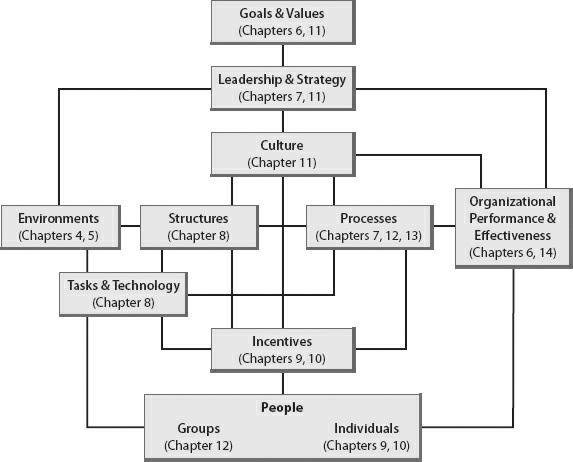
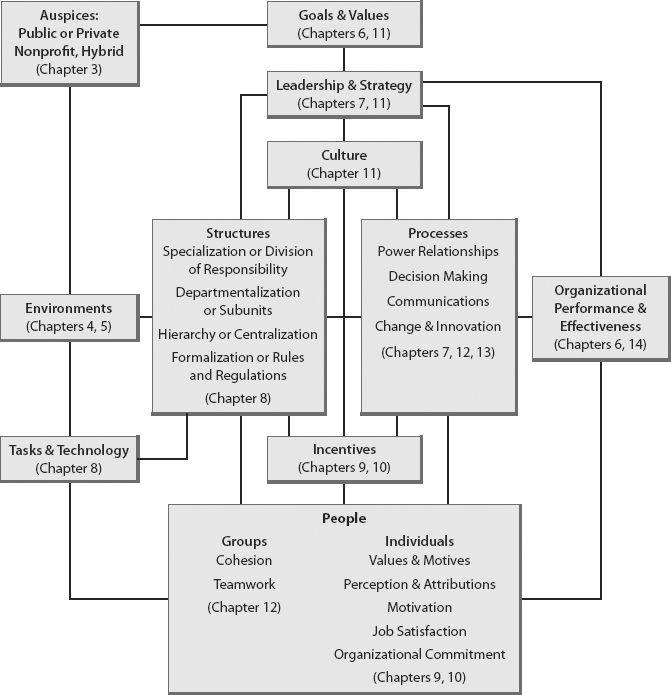
As we move toward a review and analysis of research relevant to public organizations and their management, it becomes useful to clarify the meaning of basic concepts about organizations and to develop a framework to guide the sustained analysis this book will provide. Figure 1.1 presents a framework for this purpose. Figure 1.2 elaborates on some of the basic components of this framework, providing more detail about organizational structures,processes,andpeople
1 1 A FRAMEWORK FOR ORGANIZATIONAL ANALYSIS
FIGURE 1 2 A FRAMEWORK FOR ORGANIZATIONAL ANALYSIS (ELABORATION OF FIGURE 1.1)
FIGURE
Writers on organization theory and management have argued for a long time over how best to define organization, reaching little consensus. It is not a good use of time to worry over a precise definition, so here is a provisional one that employs elements of Figure 11 This statement goes on too long to serve as a precise definition;itactuallyamountstomoreofaperspectiveonorganizations:
An organization is a group of people who work together to pursue a goal They do so by attaining resources from their environment They seek to transform those resources by accomplishing tasks and applying technologies to achieve effective performance of their goals, thereby attaining additional resources They deal with the many uncertainties and vagaries associated with these processes by organizing their activities. Organizing involves leadership processes, through which leaders guide the development of strategies for achieving goals and the establishment of structures and processes to support those strategies Structuresarethe relatively stable, observable assignments and divisions of responsibility within the organization, achieved through such means as hierarchies of authority, rules and regulations, and specialization of individuals, groups, and subunits The division of responsibility determined by the organizational structure divides the organization’s goals into components that the different groups and individuals can concentrate on hence the term organization, referring to the set of organs that make up the whole This division of responsibility requires that the individual activities and units be coordinated. Structures such as rules and regulations and hierarchies of authority can aid coordination Processes are less physically observable, more dynamic activities that also play a major role in the response to this imperative for coordination They include such activities as determining power relationships, decision making, evaluation, communication, conflict resolution, and change and innovation. Within these structures and processes, groups and individuals respond to incentives presentedtothem,makingthecontributionsandproducingtheproductsandservicesthatultimatelyresultin effectiveperformance
While this perspective on organizations and the framework depicted in the figures seem very general and uncontroversial, they have a number of serious implications that could be debated at length Mainly, however, they simply set forth the topics that the chapters of this book cover and indicate their importance as components ofaneffectiveorganization.Managementconsultantsworkingwithalltypesoforganizationsclaimgreatvalueand great successes for frameworks about as general as this one, as ways of guiding decision makers through important topics and issues Leaders, managers, and participants in organizations need to develop a sense of what it means to organizeeffectively,andofthemostimportantaspectsofanorganizationthattheyshouldthinkaboutintryingto improve the organization or to organize some part of it or some new undertaking. The framework offers one of many approaches to organizing one ’ s thinking about organizing, and the chapters to come elaborate its components
After that, the final chapter provides an example of applying the framework to organizing for and managing a majortrend,thecontractingoutofpublicservices
As this chapter has discussed, this book proceeds on certain assertions and assumptions. Government organizations perform crucial functions We can improve public management and the performance of public agencies by learning about the literature on organization theory, organizational behavior, and general management andapplyingittogovernmentagenciesandactivities.
The literature on organizations and management has not paid enough attention to distinctive characteristics of public sector organizations and managers This book integrates research and thought on the public sector context with the more general organizational and management theories and research. This integration has important implications for the debates over whether public management is basically ineffective or often excellent and over how to reform and improve public management and education for people who pursue it A sustained, careful analysis, drawing on available concepts, theories, and research and organized around the general framework presentedhere,cancontributeusefullytoadvancingourknowledgeofthesetopics.
CHAPTER TWO UNDERSTANDING THE STUDY OF ORGANIZATIONS
A Historical Review
Large, complex organizations and literature about them have existed for many centuries, but within the past two centuries in particular they have proliferated tremendously. Most of the large body of research and writing available today appeared fairly recently This chapter reviews major developments in the research, theory, and thinking about organizations and management over the past century Exhibit 21 provides a summary of the developmentsreviewedinthischapter
EXHIBIT 2.1
Major Developments in Organization and Management Theory in the Twentieth Century I CLASSIC THEORIES
Weber provided one of the early influential analyses of bureaucracy He defined its basic characteristics, such as hierarchies of authority, career service, selection and promotion on merit, and rules and regulations that define procedures and responsibilitiesofoffices
Weber argued that these characteristics grounded bureaucracy in a rational-legal form of authority and made it superior to organizational forms based on traditional authority (such as aristocracy) or charismatic authority Of these alternatives, bureaucracyprovidessuperiorefficiency,effectiveness,andprotectionofclients’rights
He also argued that bureaucracies are subject to problems in external accountability, as they are very specialized and expert in theirareasofresponsibilityandmaybesubjecttoself-servingandsecretivebehaviors
He advocated the use of systematic analyses, such as “time-motion” studies, to design the most efficient procedures for work tasks(usuallyconsistingofhighlevelsofspecializationandtasksimplification)
Taylor also argued that management must reward workers with fair pay for efficient production so that workers can increase their well-being through productivity This implies that simplified, specialized tasks and monetary rewards are primary motivators
C AdministrativeManagementSchool
The Administrative Management School sought to develop “principles of administration” that would provide guidelines for effectiveorganizationinalltypesoforganizations Theprinciplestendedtoemphasizespecializationandhierarchicalcontrol:
Division of Work Work must be divided among units on the basis of task requirements, geographic location, or interdependencyintheworkprocess
CoordinationofWork Workunitsmustbecoordinatedbacktogether,throughotherprinciples: SpanofControl.Asupervisor’s“spanofcontrol”shouldbelimitedtofivetotensubordinates. OneMaster Eachsubordinate(andsubunit)shouldreportdirectlytoonlyonesuperior Technical Efficiency Units should be grouped together for maximum technical efficiency on the basis of work requirements,technologicalinterdependence,orpurpose
The Scalar Principle Authority must be distributed in an organization like locations on a scale; as you move higher in thehierarchy,eachpositionmusthavesuccessivelymoreauthority,withultimateauthorityatthetop
II. REDIRECTIONS, NEW DIRECTIONS, AND NEW INSIGHTS
While studying physical conditions in the workplace, researchers found that weaker lighting in the workplace did not reduceproductivityaspredicted Theyconcludedthattheattentiontheypaidtotheworkersduringthestudyincreasedthe workers’ sense of importance, the attention they paid to their duties, and their communication, and this raised their productivity Otherphasesoftheresearchindicatedthattheworkgroupplayedanimportantroleininfluencingworkersto attend to their job and be productive The studies have come to be regarded as a classic illustration of the importance of socialandpsychologicalfactorsinmotivatingworkers.
2 Maslow:TheNeedsHierarchy
Maslow held that human needs and motives fall into a hierarchy, ranging from lower-order to higher-order needs from physiological needs (food, freedom from extremes of temperature) to needs for safety and security, love and belonging, self-