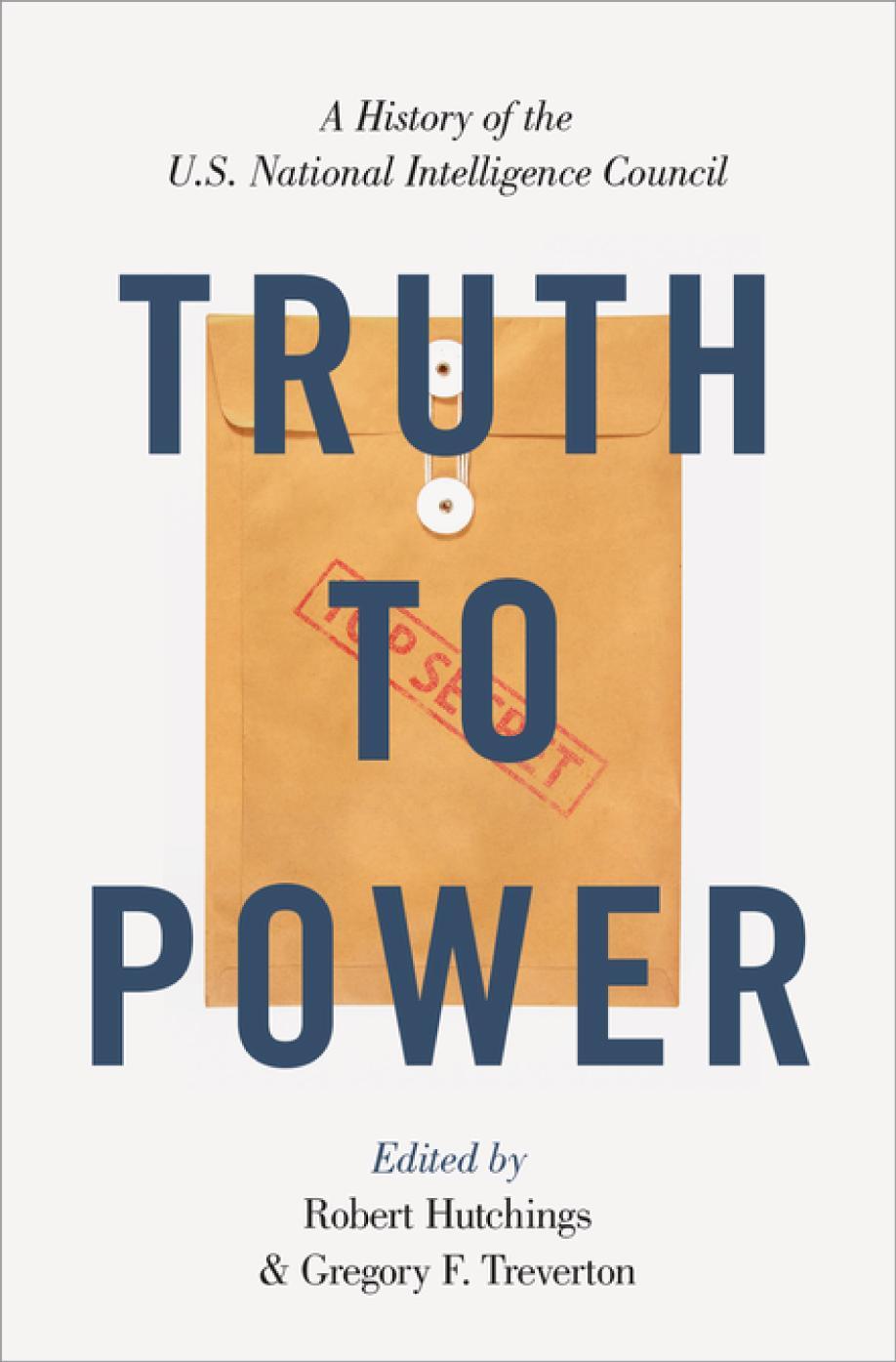
A History of the U.S. National Intelligence Council
Edited by ROBERT HUTCHINGS
GREGORY F. TREVERTON
1
Oxford University Press is a department of the University of Oxford. It furthers the University’s objective of excellence in research, scholarship, and education by publishing worldwide. Oxford is a registered trade mark of Oxford University Press in the UK and certain other countries.
Published in the United States of America by Oxford University Press 198 Madison Avenue, New York, NY 10016, United States of America.
All rights reserved. No part of this publication may be reproduced, stored in a retrieval system, or transmitted, in any form or by any means, without the prior permission in writing of Oxford University Press, or as expressly permitted by law, by license, or under terms agreed with the appropriate reproduction rights organization. Inquiries concerning reproduction outside the scope of the above should be sent to the Rights Department, Oxford University Press, at the address above.
You must not circulate this work in any other form and you must impose this same condition on any acquirer.
Library of Congress Cataloging-in-Publication Data
Title: Truth to power : a history of the U.S. National Intelligence Council / edited by Robert Hutchings and Gregory F. Treverton. Other titles: Truth to power (Oxford University Press)
Description: New York, NY, United States of America : Oxford University Press, [2019] | Includes bibliographical references.
Subjects: LCSH: National Intelligence Council (U.S.) | Intelligence service—United States—History—20th century. | Intelligence service—United States—History—21st century.
Classification: LCC JK468.I6 T77 2019 | DDC 327.1273—dc23 LC record available at https://lccn.loc.gov/2018035753
1 3 5 7 9 8 6 4 2
Paperback printed by WebCom, Inc., Canada
Hardback printed by Bridgeport National Bindery, Inc., United States of America
To our colleagues in American intelligence, consummate non-partisan professionals who pay a high price, not just in money but in lifestyle, to serve their country by doing their best to speak truth to power.
1. Estimative Intelligence after the Cold War: 1993–1994— Joseph S. Nye Jr .
2. Controlling Controversy: 1995–1997—Richard N. Cooper
3. A New Global Agenda: 1997–2001—John Gannon
4. The Trauma of 9/11: 2001–2002—John L. Helgerson
5. America at War: 2003–2005—Robert Hutchings
6. New Missions, New Challenges: 2005–2008—Thomas Fingar
7. Intelligence Integration and Reform: 2009–2014— Christopher Kojm
8. From Afghanistan to Trump: 2014–2017—Gregory Treverton
Conclusion: Looking to the Next Chapter—Gregory Treverton
Appendix 1: Extracts from the National Security Act of 1947
2: Excerpts from the
Acknowledgments
This book grew out of an offhand suggestion. In November 2016, Greg Treverton, then chairman of the National Intelligence Council, convened a workshop that brought together past chairs and vice-chairs with the aim of providing collective recommendations to the incoming administration. On his way to the workshop from Austin, Robert Hutchings happened to be on the same flight with his University of Texas colleague Alan Kuperman, who offered the suggestion, “You ought to write a history of the NIC.” Thus was planted an idea that took shape during the workshop. All of the last eight chairs were there, and we got on so well that it inspired the idea of telling the history of the NIC via the reflections and analyses of these eight chairs. To our delight and somewhat to our surprise, all agreed to contribute chapters. It seemed that each of us had a story that needed telling, and all of us saw the value of producing the first-ever history of this remarkable but little-known organization. And Hutchings, who seems alarmingly suggestible, is grateful that Kuperman didn’t suggest instead that he kayak solo across the Atlantic.
As coeditors, our first debt of gratitude is to the other six former chairs— Joseph Nye, Richard Cooper, John Gannon, John Helgerson, Thomas Fingar, and Christopher Kojm—for their willingness to be included and for their diligence in putting together the compelling chapters that make up the book. We encouraged them to tell the story of their tenures in the style that most suited them; we did not want to impose a common format or structure, except to the extent that we wanted each chapter to focus on the major foreign policy issues or challenges of the time and not simply on internal organizational matters. Working with these six friends and colleagues was a truly wonderful experience.
We are also grateful to the individuals and organizations that provided financial and logistical support along the way. Steve Slick, director of the Intelligence Studies Project at the University of Texas, provided seed money
Acknowledgments x
and, as important, support, advice, and encouragement along the way. The Policy Research Institute at the LBJ School of Public Affairs provided additional financial support that enabled us to bring on an expert graduate research assistant. We are also grateful to the Smith Richard Foundation and Marin Strmecki for underwriting this project as well as a follow- on study on the future of strategic intelligence.
We asked authors to submit first drafts of their chapters, which we circulated to all the others as well as to eight expert commentators we had asked to review and critique each chapter. We are enormously grateful to those scholars and practitioners: Richard Betts, Philip Bobbitt, Ellen Laipson, Carmen Medina, Paul Pillar, Josh Rovner, Jennifer Sims, and Steve Slick. All of us convened for a workshop at the LBJ School’s Washington Center in September 2017, to review the chapters and discuss the common themes and lessons that we felt should be included in the conclusion to this volume. We are grateful to the Center’s executive director, Tom O’Donnell, and deputy director, Robin Boone, for organizing and hosting the workshop.
We especially thank our graduate research assistant, Diana Bolsinger, a 20-year intelligence community veteran who is now a third-year PhD student at the University of Texas. She was far more than a research assistant and was instead a full collaborator from start to finish, often providing expert inside knowledge that neither of us possessed. This would not be the book it is without Diana’s invaluable contributions and unflagging energy and commitment.
Finally, we thank Dave McBride, our editor at Oxford University Press, for embracing the concept of a history of the NIC as seen through the eyes of the last eight chairs, whose tenures stretched from 1993 to 2017. We are also grateful to Holly Mitchell and the other members of Oxford’s editorial team for shepherding the manuscript through to successful conclusion. Both of us have published with Oxford before and found this experience as gratifying as the earlier ones.
Contributors
Richard N. Cooper is Maurits C. Boas Professor of International Economics at Harvard University. He is a member of the Trilateral Commission, the Council on Foreign Relations, the Executive Panel of the US Chief of Naval Operations, and the Brookings Panel on Economic Activity. He has served on several occasions in the US government, as chairman of the National Intelligence Council (1995–97), Under-secretary of State for Economic Affairs (1977–81), Deputy Assistant Secretary of State for International Monetary Affairs (1965–66), and senior staff economist at the Council of Economic Advisers (1961–63). He was also chairman of the Federal Reserve Bank of Boston (1990–92), and vice-chairman of the Global Development Network (2001–7). As a Marshall Scholar, he studied at the London School of Economics and earned his PhD at Harvard University. His most recent books include Boom, Crisis, and Adjustment (with others), Macroeconomic Management in Korea, 1970–1990 (with others), Environment and Resource Policies for the World Economy, and What the Future Holds (with others).
Thomas Fingar is a Shorenstein APARC Fellow in the Freeman Spogli Institute for International Studies at Stanford University. He was the inaugural Oksenberg-Rohlen Distinguished Fellow in 2010–2015 and the Payne Distinguished Lecturer at Stanford in 2009. From 2005 through 2008, he served as the first Deputy Director of National Intelligence for Analysis and, concurrently, as chairman of the National Intelligence Council. Dr. Fingar served previously as Assistant Secretary of the State Department’s Bureau of Intelligence and Research (2000–2001 and 2004–5), Principal Deputy Assistant Secretary (2001–3), Deputy Assistant Secretary for Analysis (1994–2000), Director of the Office of Analysis for East Asia and the Pacific (1989–94), and Chief of the China Division (1986–89). Between 1975 and 1986 he held a number of positions at Stanford University, including Senior Research Associate in the Center for International Security and Arms Control.
Dr. Fingar is a graduate of Cornell University (AB in government and history, 1968) and Stanford University (MA, 1969 and PhD, 1977 both in political science). His most recent books are Reducing Uncertainty: Intelligence Analysis and National Security (Stanford University Press, 2011), The New Great Game: China and South and Central Asia in the Era of Reform, editor (Stanford, 2016), and Uneasy Partnerships: China and Japan, the Koreas, and Russia in the Era of Reform, editor (Stanford, 2017).
John Gannon served as CIA’s Director of European Analysis (1992–95), as Deputy Director for Intelligence (1995–97), Assistant Director of Central Intelligence for Analysis and Production (1998–2001), and as chairman of the National Intelligence Council (1997–2001). After his retirement from the CIA in 2001, he served in the White House as the head of the intelligence team standing up the Department of Homeland Security (2002–3) and later on the Hill as the staff director of the House Select Committee on Homeland Security (2003–5), which became the new House Homeland Security Committee in 2005. In 2004, President George W. Bush awarded him the National Security Medal, the nation’s highest intelligence award. On leaving government in 2005, Gannon became a senior executive at BAE Systems, retiring in 2012 as a national sector president. Since 2004, Gannon has been an adjunct professor in the graduate Security Studies Program at Georgetown University. He earned his BA in psychology at Holy Cross College, and his MA and PhD in history at Washington University in St. Louis. He is a retired Naval Reserve captain and Vietnam veteran. He was elected to the city council in Falls Church, where he also served as chairman of the Planning Commission.
John L. Helgerson was chairman of the National Intelligence Council at the time of the terrorist attacks of 9/11 and during the challenging months that followed. A career intelligence officer, he had served previously as CIA’s deputy director for intelligence and at various points as a manager responsible for analysis of developments in Africa, Latin America, the Middle East, Russia, and Europe. He also served as deputy director of the National Imagery and Mapping Agency and as CIA’s director of congressional affairs. In his last government position, he served for seven years as the agency’s inspector general. Mr. Helgerson received a BA from Saint Olaf College and an MA and PhD in political science from Duke University. He began his government career as an analyst of African politics after serving as a research affiliate of the University of Zambia and as an assistant professor of African politics and international relations at the University of Cincinnati. He is now
an independent contractor, speaker and writer. His most recent unclassified publication is “Getting to Know the President: Intelligence Briefings of Presidential Candidates, 1952–2004.”
Robert Hutchings is the Walt and Elspeth Rostow Chair in National Security and Professor of Public Affairs at the Lyndon B. Johnson School of Public Affairs at the University of Texas at Austin and served as Dean of the LBJ School from 2010 to 2015. Before coming to UT, he was Diplomat in Residence at Princeton University, where he had also served as Assistant Dean of the Woodrow Wilson School of Public and International Affairs. During a public service leave from Princeton in 2003–05, he was chairman of the National Intelligence Council. His combined academic and diplomatic career has included service as Fellow and Director of International Studies at the Woodrow Wilson International Center for Scholars, Director for European Affairs with the National Security Council, and Special Adviser to the Secretary of State, with the rank of ambassador. A graduate of the US Naval Academy, he received his PhD from the University of Virginia. He is author or editor of four books, including American Diplomacy and the End of the Cold War, along with many articles and book chapters on US foreign policy and European affairs. His most recent book, co-edited with Jeremi Suri, is Foreign Policy Breakthroughs: Cases in Successful Diplomacy (Oxford, 2015).
Christopher Kojm served as chairman of the National Intelligence Council from 2009 to 2014. He is currently the Director of the Leadership, Ethics and Practice Initiative and a Professor of Practice at the Elliott School of International Affairs at George Washington University. He taught previously at Princeton’s Woodrow Wilson School. In his government career, Chris served as a staffer on the House Foreign Affairs Committee from 1984 to 1998 under Rep. Lee H. Hamilton, as a Deputy Assistant Secretary of State in the Bureau of Intelligence and Research (1998–2003), and as Deputy Director of the 9/11 Commission (2003–4). He served as president of the 9/11 Public Discourse Project, the commission’s follow-on public education organization (2004–5). He also served as a Senior Advisor to the Iraq Study Group (2006). Prior to government service, he was a writer and editor at the Foreign Policy Association in New York.
Joseph S. Nye Jr. is University Distinguished Service Professor and former Dean of Harvard’s Kennedy School of Government. He received his bachelor’s degree summa cum laude from Princeton University, won a Rhodes Scholarship to Oxford, and earned a PhD in political science from Harvard.
He has served as Assistant Secretary of Defense for International Security Affairs, chairman of the National Intelligence Council, and a Deputy Undersecretary of State. His most recent books include The Powers to Lead, The Future of Power, and Presidential Leadership and the Creation of the American Era. He is a fellow of the American Academy of Arts and Sciences, the British Academy, and the American Academy of Diplomacy. In a recent survey of international relations scholars, he was ranked as the most influential scholar on American foreign policy, and in 2011, Foreign Policy named him one of the top 100 Global Thinkers. In 2014, Japan awarded him the Order of the Rising Sun.
Gregory Treverton, now Professor of Practice at the University of Southern California, stepped down as chairman of the National Intelligence Council in January 2017. Earlier, he directed the RAND Corporation’s Center for Global Risk and Security, and before that its Intelligence Policy Center and its International Security and Defense Policy Center, and he was associate dean of the Pardee RAND Graduate School. He has served in government for the first Senate Select Committee on Intelligence, handling Europe for the National Security Council and as vice-chairman of the National Intelligence Council, overseeing the writing of America’s national intelligence estimates (NIEs). He has taught at Harvard and Columbia Universities, in addition to RAND, been a Senior Fellow at the Council on Foreign Relations, and Deputy Director of the International Institute for Strategic Studies in London. He holds an AB summa cum laude from Princeton University and an MPP (master’s in public policy) and PhD in economics and politics from Harvard. His latest books are Dividing Divided States (University of Pennsylvania Press, 2014) and Beyond the Great Divide: Relevance and Uncertainty in National Intelligence and Science for Policy (with Wilhelm Agrell, Oxford University Press, 2015).
Introduction
Robert Hutchings
We seek the truth; speak truth to power; and obtain, analyze, and provide intelligence objectively.
Principles of Professional Ethics for the Intelligence Community, 2014
Truth to power: it is a stirring phrase, often invoked by intelligence professionals, but what does it mean? It certainly does not mean that the US intelligence community believes itself to be the repository of Truth with a capital T. Nor does the following line of this breathless statement mean that intelligence analysts have achieved “objectivity,” while other mortals suffer from subjective biases and various other self-interested distortions.
The phrase is nonetheless apt. It is more than an aspiration; it is the defining strategic mission of the US intelligence community, going back to its creation at the end of World War II. When President Harry Truman issued National Intelligence Authority Directive No. 5 on July 8, 1946, instructing the director of central intelligence to “accomplish the evaluation and dissemination of strategic intelligence,” he deliberately did not send that instruction to the secretary of state or to the leaders of the armed services. He sent it to the National Intelligence Authority—and soon thereafter to the newly created Central Intelligence Agency—precisely to ensure that strategic intelligence analysis was developed independently of the principal policy agencies. That mandate has been in effect ever since. It creates a built-in tension between the worlds of policy and of intelligence. For the most part, this has been a constructive tension, ensuring that plans are subjected to critical review before being implemented or continued, and that strategy is developed on the basis of a reasonably dispassionate assessment of the world as it is, and of the risks and opportunities for US policy. Even when this mandate leads to
efforts to “politicize” intelligence to make it conform to policy preferences, or to the tendency to discount or ignore inconvenient intelligence analysis, it is a necessary tension.
Nowhere is this tension more acute than in the work of the National Intelligence Council, whose mission is to provide coordinated strategic intelligence analysis to the president and other senior policymakers. The challenge of telling “truth to power” is thus a leitmotif that runs through this book— muted and cordial in some administrations, contentious in others. If there were not some degree of conflict, the NIC (pronounced “nick,” by the way) probably would not be doing its job.
The book is a history of this remarkable organization, as told through the reflections and analyses of the eight most recent past chairs of the National Intelligence Council. They come from varied backgrounds: some are leading academics, others are senior intelligence officers or past members of key congressional staffs, and all have held senior policymaking positions in the State Department, Pentagon, Council of Economic Advisors, or National Security Council (NSC) in addition to their tenures as NIC chairs. Their stories, unlike those in some organizational histories, do not dwell on institutional matters but rather focus on the key intelligence and policy issues that confronted these eight chairs over the past quarter-century.
The National Intelligence Council is the locus within the US government for interagency, coordinated strategic intelligence analysis.1 The NIC’s work thus represents the coordinated judgments of all the agencies and departments of the US intelligence community, and it focuses not just on near-term tactical issues but on the most significant strategic issues affecting the country.
For most of its existence, the NIC reported to directors of central intelligence (DCIs) in their role as leader of the intelligence community as a whole (not in their other role as CIA director); since the intelligence reforms of 2004–5, it reports to the director of national intelligence (DNI). Its signature products are national intelligence estimates (NIEs), which typically reach forward a few years to provide strategic context to thinking about current policy. Even when NIEs and other NIC art forms—including shorter, more focused analyses—do not project far into the future, they aim to be definitive and to put issues into context, drawing connections among them. In essence, the NIC acts as a within-government think tank. In addition to its written reports and analyses, the NIC plays a key role in interagency policy meetings, ranging from formal meetings of the National Security Council chaired by the president to meetings of NSC deputies and a wide variety of meetings at senior working level.
The NIC brings together some dozen or more national intelligence officers (NIOs) and a larger number of deputy NIOs. It is organized like the State Department and National Security Council staff, with both regional and functional accounts. For NIOs, it recruits experts from outside and inside government, including prominent academics, former ambassadors, recently retired flag-rank military officers, business leaders, and career intelligence officers. Deputy NIOs typically come seconded from an intelligence agency and serve for two to three years, so turnover among them is relatively high. For NIOs, deputies, and chairs alike, the NIC is a much sought-after assignment because the work involves analysis of the most critical national issues and interaction with policymakers at the highest level.
The NIC is the most visible of intelligence agencies and serves as a bridge to outside experts in academia, think tanks, and elsewhere. It maintains regular contacts with several hundred “intelligence community associates,” outside experts who can be easily tapped for consultations, and it has less formal relations with many hundreds more, both within the United States and abroad. The NIC is also unusual among intelligence agencies in publishing unclassified analyses, including most prominently the Global Trends series, done every four years and looking out roughly 15 years into the future. The NIC also publishes unclassified work on water and food security, climate change, and other issues bearing on national security but where secrets matter less. Because the NIC is the most “public” of US intelligence agencies, its chairs are sought to set the tone at inside gatherings and are courted by outside groups.
As the authors of this book will agree, the position of NIC chair is, despite its occasional frustrations, one of the best jobs in government. NIC chairs typically have more autonomy than any other senior official in government, and their day-to-day work is highly substantive, ranging across the entire realm of national security issues. The challenges are also daunting, in that chairs are responsible for every bit of the NIC’s analysis, ranging from highly technical reports to high-stakes judgments about the most critical national security issues. The long history of the NIC and its predecessor organizations, replete with both successes and failures, place it at the center of some of the most consequential national security issues of the past half-century and more.
The Early History: Office of National Estimates
The origins of the National Intelligence Council may be traced back to December 7, 1941. Even earlier that year, as the United States embarked on
a war footing, the legendary William J. “Wild Bill” Donovan, having been named wartime coordinator of information (COI) by his friend President Franklin Roosevelt, was pushing for a centralized intelligence program that would bring together the intelligence offices of the navy, army, State Department, and FBI. The surprise Japanese attack on Pearl Harbor on December 7 sealed the deal, demonstrating the catastrophic consequences of uncoordinated intelligence collection and assessment.2 COI was renamed the Office of Strategic Services (OSS) and moved from under the aegis of the White House to the Joint Chiefs of Staff, with Donovan restored to active military service at his World War I rank of colonel (rising to brigadier and then major general in the course of the war).3 In a military order of June 13, 1942, Roosevelt formally established the OSS and directed it to “collect and analyze . . . strategic information” and to “plan and operate special services.”4
The cloak-and-dagger wartime operations of the OSS are the stuff of legend, as are the notable figures recruited to serve, including the poets Archibald MacLeish and Stephen Vincent Benét, the banker Paul Mellon, the psychologist Carl Jung, the philosopher Herbert Marcuse, the anthropologist Margaret Mead, and the movie director John Ford. Less well known is its role in strategic intelligence analysis through its Research and Analysis (R&A) Branch, led initially by James Phinney Baxter III, president of Williams College, and after 1943 by Harvard historian William Langer, identified in war correspondence as “OSS 117.”5
With a staff in Washington that expanded to 1,500 and an additional 450 analysts overseas, R&A produced over 3,000 studies during the course of the war.6 A team under Sherman Kent (later to become head of the Office of National Estimates) drafted target studies for the air force bombing campaign in Italy; the German section was deeply involved in planning the occupation and military governments in Germany.7 The Russian branch conducted extensive analyses of the Soviet leadership, economy, and military, including one report on Soviet capabilities and intentions that Langer argued “may justly be called the first national intelligence estimate”8 R&A also served as the incubator for area studies programs in the US universities, as many of its alumni returned to academia after the war.9
Yet the OSS was never given the central coordinating role that Donovan wanted. Roosevelt understandably deferred to military commanders who insisted on maintaining close control over their respective intelligence services. Those services in turn withheld information from OSS (so that they could guard their own positions within their services), and General Douglas MacArthur and Admiral Chester Nimitz went so far as to ban OSS from
their respective theaters of operation. Undaunted, as early as 1943 and looking to the postwar organization of intelligence, Donovan argued for a truly centralized peacetime intelligence system, led by a single agency, but his plan was successfully scuttled by the military services.10
After the war, President Truman, who had received scathing reports on the OSS from various (sometimes self-serving) sources, demobilized the OSS effective October 1, 1945, just weeks after VJ Day.11 The next few years saw a series of failed institutional arrangements that revealed contentious issues that were to become recurrent features in the debates over the organization of intelligence: the uncertain, episodic commitment to strategic intelligence on the part of the senior-most political leaders, and their reluctance to disrupt the military chain of command by creating a centralized, civilian-led intelligence system.12 The one thing the army, navy, State, and FBI could agree on, then and now, was that they opposed a strong central authority controlling their collection and analysis.13
The remnants of R&A were placed under the aegis of the State Department as the new Office of Research and Intelligence.14 Then, by an executive order of January 22, 1946, Truman established a Central Intelligence Group (CIG), headed by a director of central intelligence, with the DCI reporting not to the president but to a collective “National Intelligence Authority,” composed of the secretary of state, secretary of war, secretary of the navy, and the chief of staff to the president. It was a “weak DCI” model, as had been the case with the wartime OSS position that Donovan held, and for the same reasons. It was a compromise plan that denied the State Department the control it had sought but deprived the newly created CIG the authority it needed to fulfill its mandate. The arrangement was a congeries of competing interests and unresolved political battles that was destined to fail, and it did.
The National Security Act of 1947 essentially affirmed this institutional arrangement by establishing “under the National Security Council a Central Intelligence Agency with a Director of Central Intelligence, who shall be the head thereof.”15 In effect, the CIG became the CIA, and the newly created NSC took over the intelligence functions of the former NIA. The CIA was established “for the purpose of coordinating the intelligence activities of the several Government departments and agencies in the interest of national security,”16 yet the arrangement continued to reflect the strongly held positions of the key departments, and indeed of the president himself, for a decentralized intelligence structure and a weak DCI.17
The unviability of this arrangement was evident almost immediately. NIA Directive No. 5 of July 8, 1946, had established a strategic intelligence
function under the DCI, who accordingly created an Office of Reports and Estimates to issue longer-term strategic intelligence analyses, as well as to coordinate and synthesize intelligence reports and analyses of the various intelligence agencies. Facing the same resistance that had produced the weak DCI model in the first place, ORE could not enlist the cooperation of the other agencies and relied instead on self-generated national intelligence estimates, thereby drawing criticism both for failing to perform its coordinating role and for simply adding to the stream of uncoordinated intelligence analyses.18
These deficiencies were spelled out in a harsh critique of both the ORE and the CIA in general in a report issued by an Intelligence Report Group established by President Truman in early January 1948. Its report, also known as the Dulles-Jackson- Correa Report, warned that “unless the Central Intelligence Agency performs an essential service for each of [the] departments and coordinates their intelligence activities, it will fail in its mission.” The CIA’s “principal defect,” the report concluded, was “in the field of intelligence coordination and the production of intelligence estimates.”19 On July 7, 1949, the NSC endorsed the committee’s findings and recommended a massive reform of the CIA, but the agency’s first director, Rear Admiral Roscoe Hillenkoetter, successfully stalled and resisted most of the report’s recommendations.
As with the creation of the OSS, it took an intelligence failure—this time, failure to warn of North Korea’s invasion of the south in June 1950—to produce action. In response, Truman nominated Lt. Gen. Walter Bedell (“Beetle”) Smith, who had been chief of staff to General Dwight Eisenhower during World War II, to take over as DCI. Among his other early, decisive steps, Smith brought in William Langer and Sherman Kent to straighten out the analytic side of the agency as director and deputy director of a newly created Office of National Estimates (replacing ORE) and created a new analytic art form: the national intelligence estimate (NIE). As Langer later recalled, it was General Smith’s positive experiences with the OSS’s R&A branch during the war that “help to explain Smith’s attitude as director of Central Intelligence in 1950, when he insisted that the Office of National Estimates was the crux of all intelligence work and did so much to establish cooperation among the various agencies.”20
The Office of National Estimates and the associated Board of National Estimates, which was responsible for the production of NIEs, established the basic structure of strategic intelligence analysis that continues to this day. Harold Ford succinctly described the NIE process, which would be familiar to every subsequent ONE director or NIC chair:
Assisted by contributions from other entities of the intelligence communities, the O/NE prepared the draft NIEs, chaired their coordination by working level offices of the intelligence community and then submitted those Estimates for approval to the chiefs of the respective intelligence agencies who then met together under the chairmanship of the DCI. Every finished NIE indicated which agencies had participated in its preparation and pointed out dissenting judgments where they occurred.21
The Langer/Kent years are sometimes looked back upon as the “golden age” for national estimates. Certainly, Langer and Kent, who succeeded him in 1952 and served for 15 years, assembled an impressive group of academic luminaries. Langer himself was a leading diplomatic historian at Harvard and future winner of the Bancroft Prize, and Kent was a well-regarded Yale historian before interrupting his academic career for government service. In the early days, they were joined by Raymond Sontag, the Ehrman Professor of History at Berkeley, and Calvin Hoover, the James B. Duke Professor of Economics at Duke, along with several other academics, flag-rank military officers, and businessmen. Kent later offered a pithy and unvarnished sketch of these figures and their often-fraught relations with the brilliant but abrasive Langer.22 He also described the coordination process—that is, the process of reconciling differences among agencies on draft NIEs via a line-in, line- out, sometimes word-by-word review of the text.23 The coordination process remained every bit as tedious decades later, causing more than one NIC chair to wonder whether the process was so focused on the trees (and often on individual limbs, branches, or leaves) that it was losing sight of the forest.
Throughout this early period, the Board of National Estimates had a reputation of being a haven for liberal East Coast academics. Of the thirteen members of the board in 1964–65, only one had a professional military background, while eight had academic experience. Two were Rhodes Scholars, and a total of nine had graduated from Yale, Princeton, or Harvard.24 Whether these were the “best and brightest” is a question that would provoke a spirited challenge from several of the authors of this book, who as NIC chairs also assembled powerful teams of scholars, flag-rank military officers, intelligence professionals, and business leaders. Suffice it to say that in Kent’s BNE the balance was heavily tilted toward the academics.
What of the quality of its analysis? Certainly, some of the early work was of a high order for both analytic rigor and independence of judgment. The
board made seminal contributions to our understanding of Soviet strategic capabilities, and its analysis of China was better than that of policymakers or most of the academic community, starting with its early conclusion that the Communists would prevail in the Chinese civil war and continuing with its early recognition that the Sino-Soviet alliance was coming apart.25 It must be added that neither the prose nor the analysis of these early estimates was particularly elegant, but perhaps this can be attributed to the coordination process.
Although the Office of National Estimates enjoyed a degree of prestige during its heyday, it also attracted critics both within the intelligence community and beyond. Some of the structural sources of friction predated the CIA itself and have persisted ever since. First, the intelligence was to be coordinated, which meant that the office had a mandate to gather intelligence from all the agencies and then referee differences among them. Second, it was to be strategic, which put it in competition with agencies that trafficked mainly in current intelligence. Third, it was to be national, which implied that it was superordinate to the intelligence analysis coming out of any individual agency.
Among target audiences—that is, policymakers—NIEs came to be seen as opaque, detached, and Delphic—or, as national security advisor Henry Kissinger put it, “Talmudic.”26 They reflected Sherman Kent’s belief that policymakers wanted a glimpse of the future, and that his office could provide it. His seminal book, Strategic Intelligence for American World Policy, presented three elements of intelligence analysis: things that are known (facts), things that are unknown but knowable, and things that are unknowable.27 He believed that disciplined intelligence analysis could reduce the essential unknowability of the future, and he believed that to maintain analytic independence and scholarly integrity, analysts needed to keep policymakers at arm’s length. In short, Kent took the “truth to power” admonition to the extreme.
As Kent’s Yale faculty colleague Wilmoore Kendall argued in a sharply critical review of Strategic Intelligence, Kent’s Olympian detachment led to a “compulsive preoccupation with prediction” and to the intellectual arrogance of believing that ONE’s word on a subject should be the last one. In Kendall’s view, the function of intelligence was not to predict, but to help policymakers achieve their goals by identifying the elements of a situation that were amenable to US influence.28 While most policymakers would side decisively with Kendall in this debate, they might not recognize how this interpretation of the mission can contribute to policymakers’ exaggerated confidence in their
ability to impose their grand design on the world. Policymakers understandably want intelligence to help them implement their policies, but whether they know it or not, they also need intelligence as a somewhat detached check on their ambitions.
The liabilities of Kent’s approach were exposed in a disastrous September 1962 NIE, which not only failed to warn of the impending Soviet installation of nuclear ballistic missiles in Cuba, but resolutely argued, even as contrary evidence was accumulating, that such a move was virtually inconceivable because it would not fit long-standing Soviet patterns of behavior (according to Kent’s ordered methodology).29 This and other misestimates—on Soviet strategic weapons developments, for example—contributed to growing dissatisfaction with ONE’s work during the 1960s. Some of the criticism of the board was ill-founded and unduly deferential to policymakers, as when DCI John McCone savaged a 1963 draft estimate on Vietnam on grounds that its conclusions were far more negative than those of “the people who know Vietnam best.” The final version that McCone approved concluded that “Communist progress has been blunted and that the situation is improving.”30 As subsequent events amply demonstrated, McCone would have been better advised to allow ONE to “tell truth to power.”
Rightly or wrongly, the board had lost the confidence of much of the policy community, even as the focal point for strategic analysis shifted increasingly to the NSC staff under national security advisor Henry Kissinger—who had become, in Hal Ford’s judgment, “the de facto chief of U.S. intelligence.”31 Accordingly, President Nixon commissioned a review of US intelligence by James Schlesinger, who delivered a scathing report that was particularly critical of the Board of National Estimates. When Schlesinger became DCI for a brief stint in 1973, he initiated reforms to the board that were institutionalized later that year by his successor, William Colby.32 Colby promptly abolished the Office and Board of National Estimates and dismissed the staff. As he explained in his memoir,
I had sensed an ivory-tower mentality in the Board; its composition had tended to shift to a high proportion of senior analysts who had spent most of their careers at [CIA] and who had developed a “mindset” about a number of the issues in opposition to the views of the Pentagon and because of the way Nixon and Kissinger had excluded them from some of the White House’s more sensitive international dealings. . . . Thus, I created the positions of National Intelligence Officers.33
The Evolution of the National Intelligence Council
From 1974 to 1979, the board’s work was taken over by some dozen national intelligence officers (NIOs) and a deputy to the DCI for the NIOs. It was a loose arrangement that was probably destined to be short-lived anyway, but it was soon eclipsed by a broad and public exposé of CIA covert operations, including in a front-page New York Times article by Seymour Hersh chronicling domestic intelligence operations against antiwar protestors. Although the focus was on the covert side, the ensuing congressional investigations led by Senator Frank Church and Congressman Otis Pike strayed into many other areas, including intelligence analysis.34
The highly critical findings of the Church and Pike commissions were amplified by several analytic failures of the new NIO system in the mid1970s. First was the failure to predict the 1973 Egyptian and Syrian invasions of Israel that led to the Yom Kippur War—which, it should be added, Israeli intelligence also failed to predict. Even more damaging was the intelligence community’s failure to warn of the Iranian Revolution and the fall of the shah of Iran in 1978–79. The NIOs were marginalized, as was described in another highly critical congressional inquiry, this one conducted by the House Permanent Select Committee on Intelligence:
During most of 1978, intelligence community analysts struggled to produce a National Intelligence Estimate (NIE) on Iran. The NIE process . . . is inherently cumbersome and time-consuming. As the year wore on . . . [t]he process bogged down in differences over the product’s length and focus as well as over substantive differences. Ultimately, no NIE was produced.35
It was easy to fault the NIE process, then and later, for excessive caution and a “compulsive preoccupation with prediction,” to borrow Kendall’s critique of Kent, but the unfortunate truth is that when things go bad, the blame often starts with intelligence. “Why didn’t the intelligence community see this coming?” or “Why did our intelligence get this so badly wrong?” are the usual questions—whether “this” was Pearl Harbor, the fall of the shah, the collapse of the Soviet Union, or the terrorist attacks of September 11, 2001. Small wonder that those producing NIEs often adopt a defensive posture, trying to warn of every possible contingency and couching their judgments in language sufficiently ambiguous as to cover every eventuality. Successive
NIC chairs have struggled, in various ways and with mixed results, against these tendencies.
In the wake of the Church and Pike committee hearings, Admiral Stansfield Turner, who was appointed DCI by President Jimmy Carter in 1977, undertook a wholesale reorganization of the CIA. In Turner’s view, the national intelligence officers and CIA’s Directorate of Intelligence (DI) performed essentially the same functions and, as his deputy explained, that it made “no sense to have a distinction between NIOs and [the DI].” Accordingly, Turner merged the two under a newly created National Foreign Assessment Center, a move that increased the dependence of NIOs on CIA analysis and diminished their standing within the wider intelligence community and among policymakers.36 To instill greater discipline and coherence to the NIO system, in 1979 Turner placed the NIOs within a newly created National Intelligence Council, headed by a chairman (and later, a chairwoman) and supported by an expanded staff. This is essentially the same internal structure that has been in place ever since.
Created to overcome the isolation and “academic detachment” of the Board of National Estimates, the new arrangement introduced a new set of problems: greater susceptibility to politicization, a growing focus on current analysis, and a diminished mandate for in-depth research. It also led to the NIC’s greater integration into the CIA culture and to the CIA’s dominance in the production of most NIEs and other community assessments, a process that had begun even under Kent’s tenure.37 At the same time, many of the structural deficiencies of the earlier system remained: the weakness of the DCI’s intelligence community mandate, the autonomy of individual agencies, and the growing usurpation of strategic analysis by the NSC staff. The NIC’s role—and that of intelligence analysis generally—was also transformed by subtle cultural shifts brought on by a new generation of policymakers and intelligence analysts who had not experienced the close wartime connections between these two worlds. The two “tribes” (to use Greg Treverton’s vivid term) of intelligence professionals and policymakers had grown farther apart.38
Nowhere were the battles fiercer than in estimates of Soviet strategic capabilities and intentions, particularly after Nixon’s resignation in 1974 and the backlash against the Nixon/Kissinger policy of détente with the Soviet Union.39 As the Church Committee concluded,
The Committee has been particularly concerned with pressures from both the White House and Defense Department on the DCI to alter