Introductory Chemical Engineering Thermodynamics (Prentice Hall International Series in the Physical and Chemical Engineering Sciences) 2nd Edition, (Ebook PDF)
In the chemical and other physical processing industries, such as the food and biological processing industries, many similarities exist in the manner in which the entering feed materials are modified or processed into final products. We can take these seemingly different chemical, physical, or biological processes and break them down into a series of separate and distinct steps These steps are commonly called unit operations However, the term “unit operations” has sometimes been superceded by the more descriptive term “separation processes. ” These separation processes are com-mon to all types of diverse process industries.
For example, the separation process distillation is used to
purify or separate alcohol in the beverage industry and other types of hydrocarbons in the petroleum industry. Drying of grain and other foods is similar to drying of lumber, filtered precipitates, and wool The separation process absorption occurs in absorption of oxygen from air in a fermentation process or in a sewage treatment plant and in absorption of hydrogen gas in a process for liquid hydrogenation of oil. Evaporation of salt solutions in the chemical industry is similar to evaporation of sugar solutions in the food industry. Settling and sedimentation of suspended solids in the sewage industry and the mining industry are similar. Flow of liquid hydrocarbons in the petroleum refinery and flow of milk in a dairy plant are carried out in a similar fashion.
Many of these separation processes have certain fundamental and basic principles or mechanisms in common. For example, the mechanism of diffusion or mass transfer occurs in drying, membrane separation, absorption, distillation, and crystallization. Heat transfer occurs in drying, distillation, and evaporation. The following classification of a more fundamental nature is often made, according to transfer or transport processes:
1.1BFundamentalTransportProcesses
1 Momentum transfer This is concerned with the transfer of momentum which occurs in moving media, such as in the separation processes of fluid flow, sedimentation, mixing, and filtration. Momentum transfer is commonly called fluid mechanics in other disciplines.
2 Heat transfer In this fundamental process, we are concerned with the transfer energy in the form of heat from one place to another. It occurs in the separation processes of drying, evaporation, distillation, and many others.
3 Mass transfer Here, material (or mass) is being transferred from one phase to another distinct phase; the basic mechanism is the same whether the phases are gas, solid, or liquid. Separation processes dependent on mass transfer include distillation, absorption, liquid–liquid extraction, membrane separation, adsorption, crystallization, and leaching.
1.1CClassificationofSeparationProcesses
The separation processes deal mainly with the transfer and change of energy and the transfer and change of materials, primarily by physical means but also by physical–chemical means The important separation processes, which can be combined in various sequences in a process and which are covered in this text, are described next.
1 Evaporation This refers to the evaporation of a volatile solvent such as water from a nonvolatile solute such as salt or any other material in solution.
2 Drying In this operation volatile liquids, usually water, are removed from solid materials
3 Distillation This is an operation whereby components of a liquid mixture are separated by boiling because of their differences in vapor pressure
4 Absorption In this process a component is removed from a gas stream by treatment with a liq-uid
5 Membrane separation This process involves the separation of a solute from a fluid by diffusion of this solute from a liquid or gas through a semipermeable barrier (i.e., the membrane) to another fluid.
6. Liquid–liquid extraction. In this case a solute in a liquid solution is removed by contacting with another liquid solvent that is relatively immiscible with the solution.
7. Adsorption. In this process a component of a gas or liquid stream is removed and adsorbed by a solid adsorbent.
8. Ion exchange. Certain ions in solution are removed from a liquid by an ion-exchange solid.
9. Liquid–solid leaching. This involves treating a finely divided solid with a liquid that dissolves out and removes a solute contained in the solid.
10. Crystallization. This concerns the removal of a solute such as a salt from a solution by precipitating the solute from the solution.
11. Mechanical–physical separations. These involve separation of solids, liquids, or gases by mechanical means, such as filtration, settling, centrifugation, and size reduction
1.1DArrangementinParts1and2
This text is arranged in two parts:
Part I: Transport Processes: Momentum, Heat, and Mass. These fundamental principles are covered extensively in Chapters 1 through 21 in order to provide the basis for study of separation processes in Part 2 of this text.
Part II: Separation Process Principles. The various separation processes and their applications to process areas are studied in Part II of this text.
There are a number of elementary engineering principles, mathematical techniques, and laws of physics and chemistry that are basic to a study of the principles of momentum, heat, and mass transfer and the separation processes. These are reviewed for the reader in this first chapter Some readers, especially chemical engineers, agricultural engineers, civil engineers, and chemists, may be familiar with many of these principles and techniques and may wish to omit all or parts of this chapter.
in different sections, each corre-sponding to the number of a given section in the chapter
1.2 SI SYSTEM OF BASIC UNITS USED IN THIS TEXTAND OTHER SYSTEMS
There are three main systems of basic units employed at present in engineering and science. The first and most important of these is the SI (Système International d’Unités) system, which has as its three basic units the meter (m), the kilogram (kg), and the second (s) The other systems are the English foot (ft)–pound (lb)–second (s), or English system and the centimeter (cm)–gram (g)– second (s), or cgs system.
At present the SI system has been adopted officially for use exclusively in engineering and science, but the older English and cgs systems is still used. Much of the physical and chemical data and empirical equations are given in these latter two systems. Hence, engineers should not only be proficient in the SI system, but must also be able to use the other two systems as well
1.2ASISystemofUnits
The basic quantities used in the SI system are as follows: the unit of length is the meter (m); the unit of time is the second (s); the unit of mass is the kilogram (kg); the unit of temperature is the kelvin (K); and the unit of an element is the kilogram mole (kg mol). The other standard units are derived from these basic quantities.
The basic unit of force is the newton (N), defined as
1 newton (N) = 1 kg · m/s
The basic unit of work, energy, or heat is the newton-meter, or joule (J).
1 joule (J) = 1 newton m (N m) = 1 kg ms /s
Power is measured in joules/s or watts (W)
1 joule/s (J/s) = 1 watt (W)
The unit of pressure is the newton/m or pascal (Pa).
1 newton/m (N/m ) = 1 pascal (Pa)
The standard acceleration of gravity is defined as 1 g = 9.80665 m/s
A few of the standard prefixes for multiples of the basic units are as follows: giga (G) = 10 , mega (M) = 10 , kilo (k) = 10 , centi (c) = 10 , milli (m) = 10 , micro (μ) = 10 , and nano (n) = 10 .
in the SI system However, in practice, wide use is made of the degree Celsius (°C) scale, which is defined by
T (°C) = T (K) – 273.15
Note that 1°C = 1 K and that in the case of temperature difference,
ΔT (°C) = ΔT (K)
The standard preferred unit of time is the second (s), but time can be in nondecimal units of minutes (min), hours (h), or days (d)
1.2BCGSSystemofUnits
The cgs system is related to the SI system as follows:
1 g mass (g) = 1×10 kg mass (kg)
1 cm = 1×10 m
1 dyne (dyn) = 1 g · cm/s = 1× 10 newton (N)
1 erg = 1 dyn · cm = 1×10 joule (J)
The standard acceleration of gravity is g = 980 665 cm/s
1.2CEnglishfpsSystemofUnits
The English system is related to the SI system as follows:
1 lb mass (lb ) = 0.45359 kg
1 ft = 0 30480 m
1 lb force (lb ) = 4.4482 newton (N)
1 ft lb = 1.35582 newton m (N m) = 1.35582 joules (J)
1 psia = 6 89476 ×10 newton/m (N/m ) 1 8°F = 1 K = 1°C (centigrade or Celsius) g = 32.174 ft/s
The proportionality factor for Newton’s law is g = 32 174 ft lb /lb s
The factor g in SI units and cgs units is 1 0 and is frequently omitted
In Appendix A 1, convenient conversion factors for all three systems are tabulated Further discussions and use of these relationships are given in various sections of the text
This text uses the SI system as the primary set of units in the equations, sample problems, and homework problems However, the important equations derived in the text are given
in a dual set of units, SI and English, when these equations differ. Some example problems and homework problems are also given using English units. In some cases, intermediate steps and/or answers in example problems are also stated in English units.
A dimensionally homogeneous equation is one in which all the terms have the same units. These units can be the base units or derived ones (for example, kg/s · m or Pa). Such an equation can be used with any system of units provided that the same base or derived units are used throughout the equation. No conversion factors are needed when consistent units are used
The reader should be careful about using any equation and always checking it for dimensional homogeneity To do this, a system of units (SI, English, etc ) is first selected Then units are substituted for each term in the equation and like units in each term canceled out.
1.3 METHODS OF EXPRESSING TEMPERATURESAND COMPOSITIONS
1.3ATemperature
There are two temperature scales in common use in the chemical and biological industries. These are degrees Fahrenheit (abbreviated °F) and Celsius (°C). It is often necessary to convert from one scale to the other. Both use the freezing point and boiling point of water at 1 atmosphere pressure as base points Often temperatures are expressed as absolute degrees K (SI standard) or degrees Rankine (°R ) instead of °C or °F. ture scales. Table 1.3-1 shows the equivalences of the four temperature scales
Table 1.3-1. Temperature Scales and Equivalents
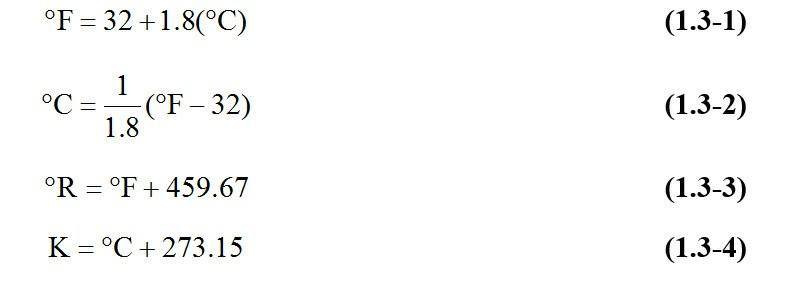
The difference between the boiling point of water and melting point of ice at 1 atm is 100°C or 180°F Thus, a 1 8°F change is equal to a 1°C change Usually, the value of –273 15°C is rounded to –273 2°C and –459 67°F to –460°F The following equations can be used to convert from one temperature scale to another:
There are many methods used to express compositions in gases, liquids, and solids. One of the most useful is molar units, since chemical reactions and gas laws are simpler to express in terms of molar units. A mole (mol) of a pure substance is defined as the amount of that substance whose mass is numerically equal to its molecular weight. Hence, 1 kg mol of methane CH contains 16.04 kg. Also, 1.0 lb mol of methane contains 16.04 lb
The mole fraction of a particular substance is simply the moles of this substance divided by the total number of moles Likewise, the weight or mass fraction is the mass of the substance divided by the total mass These two compositions, which hold for gases, liquids, and solids, can be expressed as follows for component A in a mixture:
Example 1.3-1. Mole and Mass or Weight Fraction of a Solution
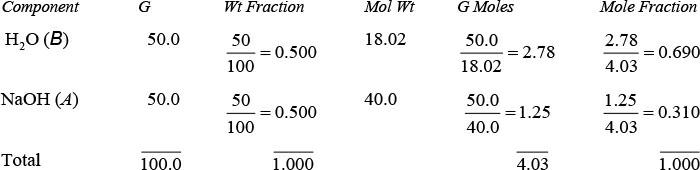
A container holds 50 g of water (B) and 50 g of NaOH (A). Calculate the weight fraction and mole fraction of NaOH. Also, calculate the lb of NaOH (A) and H O (B).
Solution: Taking as a basis for calculation 50 + 50 or 100 g of solution, the following data are calculated:
Hence, x = 0.310 and x = 0.690 and x + x = 0.310 + 0.690 = 1.00. Also, w + w = 0.500 + 0.500 = 1.00. To calculate the lb of each component, Appendix A.1 gives the conversion factor of 453.6 g per 1 lb . Using this,
Note that the g of A in the numerator cancels the g of A in the denominator, leaving lb of A in the numerator. The reader is cautioned to put all units down in an equation and cancel those appearing in the numerator and denominator. In a similar manner we obtain 0.1102 lb B (0.0500 kg B).
The analyses of solids and liquids are usually given as weight or mass fraction or weight percent, and gases as mole fraction or percent Unless otherwise stated, analyses of solids and
liquids will be assumed to be weight (mass) fraction or percent, and of gases to be mole fraction or percent
1.3CConcentrationUnitsforLiquids
In general, when one liquid is mixed with another miscible liquid, the volumes are not additive Hence, compositions of liquids are usually not expressed as volume percent of a component but as weight or mole percent. Another convenient way to express concentrations of components in a solution is molarity, which is defined as g mol of a component per liter of solution. Other methods used are kg/m , g/liter, g/cm , lb mol/ft , lb /ft , and lb /gallon. All these concentrations depend on temperature, so the temperature must be specified
The most common method of expressing total concentration per unit volume is density, kg/m , g/cm , or lb /ft For example, the density of water at 277 2 K (4°C) is 1000 kg/m , or 62 43 lb /ft Sometimes the density of a solution is expressed as specific gravity, which is defined as the density of the solution at its given temperature divided by the density of a reference substance at its temperature. If the reference substance is water at 277.2 K, the specific gravity and density of the substance are numerically equal.
1.4 GAS LAWSAND VAPOR PRESSURE
1.4APressure
There are numerous ways of expressing the pressure exerted by a fluid or system. An absolute pressure of 1.00 atm is equivalent to 760 mm Hg at 0°C, 29.921 in. Hg, 0.760 m Hg, 14.696 lb force per square inch (psia), or 33.90 ft of water at 4°C. Gage pressure is the pressure above the absolute pressure. Hence, a pressure of 21 5 lb per square inch gage (psig) is 21 5 + 14 7 (rounded off), or 36 2 psia In SI units, 1 psia = 6 89476 ×10 pascal (Pa) = 6 89476 ×10 newtons/m Also, 1 atm = 1 01325 ×10 Pa.
In some cases, particularly in evaporation, one may express the pressure as inches of mercury vacuum. This means the pressure as inches of mercury measured “below” the absolute barometric pressure. For example, a reading of 25.4 in. Hg vacuum is 29.92 – 25.4, or 4.52 in. Hg absolute pressure. Pressure conversion units are given in Appendix A.1.
1.4BIdealGasLaw
An ideal gas is defined as one that obeys simple laws. Also, in the ideal gas approximation, the gas molecules are considered as rigid spheres which themselves occupy no volume and do not exert forces on one another No real gases obey these laws exactly, but at ordinary temperatures and pressures of not more than several atmospheres, the ideal gas law give answers within a few percent or less of the actual answers. Hence, for certain situations, this law is sufficiently accurate for engineering
calculations
The ideal gas law of Boyle states that the volume of a gas is directly proportional to the absolute temperature and inversely proportional to the absolute pressure This is expressed as pV = nRT (1.4-1)
where p is the absolute pressure in N/m , V the volume of the gas in m , n the kg mol of the gas, T the absolute temperature in K, and R the gas law constant of 8314.3 kg · m /kg mol · s · K. When the volume is in ft , n in lb moles, and T in °R, R has a value of 0.7302 ft · atm/lb mol ·°R. For cgs units (see Appendix A 1), V = cm , T = K, R = 82 057 cm · atm/g mol · K, and n = g mol
In order that amounts of various gases may be compared, standard conditions of temperature and pressure (abbreviated STP or SC) are arbitrarily defined as 101.325 kPa (1.0 atm) abs and 273.15 K (0°C). Under these conditions the volumes are as follows:
volume of 1 0 kg mol (SC) = 22 414 m
volume of 1.0 g mol (SC) = 22.414 L (liter) = 22 414 cm
volume of 1.0 lb mol (SC) = 359.05 ft
Example 1.4-1. Gas-Law Constant
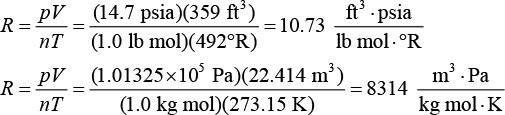
Calculate the value of the gas-law constant R when the pressure is in psia, moles in lb mol, volume in ft , and temperature in °R. Repeat for SI units.
Solution: At standard conditions, p = 14.7 psia, V = 359 ft , and T = 460 + 32 = 492°R (273.15 K). Substituting into Eq. (1.4-1) for n = 1.0 lb mol and solving for R,
A useful relation can be obtained from Eq (1 4-1) for n moles of gas at conditions p , V , T , and also at conditions p , V , T . Substituting into Eq. (1.4-1),
1.4CIdealGasMixtures
Dalton’s law for mixtures of ideal gases states that the total pressure of a gas mixture is equal to the sum of the individual partial pressures:
P = p + p + p + (1 4-3)
where P is total pressure and . . in the mixture. p , p , p , . . . are the partial pressures of the components A, B, C, .
Since the number of moles of a component is proportional to its partial pressure, the mole fraction of a component is
The volume fraction is equal to the mole fraction. Gas mixtures are almost always represented in terms of mole fractions and not weight fractions. For engineering purposes, Dalton’s law is sufficiently accurate to use for actual mixtures at total pressures of a few atmospheres or less
Example 1.4-2. Composition of a Gas Mixture
A gas mixture contains the following components and partial pressures: CO , 75 mm Hg; CO, 50 mm Hg; N , 595 mm Hg; O , 26 mm Hg. Calculate the total pressure and the composition in mole fraction
Solution: Substituting into Eq. (1.4-3),
P = p + p + p + p = 75 + 50 + 595 + 26 = 746 mm Hg
The mole fraction of CO is obtained by using Eq. (1.44).
In like manner, the mole fractions of CO, N , and O are calculated as 0.067, 0.797, and 0.035, respectively.
1.4DVaporPressureandBoilingPointofLiquids
When a liquid is placed in a sealed container, molecules of liquid will evaporate into the space above the liquid and fill it completely After a fixed amount of time, equilibrium is reached. This vapor will exert a pressure just like a gas and we call this pressure the vapor pressure of the liquid. The value of the vapor pressure is independent of the amount of liquid in the container as long as some is present.
If an inert gas such as air is also present in the vapor space, it will have very little effect on the vapor pressure. In general, the effect of total pressure on vapor pressure can be considered as negligible for pressures of a few atmospheres or less.
The vapor pressure of a liquid increases markedly with temperature For example, from Appendix A 2 for water, the vapor pressure at 50°C is 12 333 kPa (92 51 mm Hg) At 100°C the vapor pressure has increased greatly to 101.325 kPa (760 mm Hg).
The boiling point of a liquid is defined as the temperature at which the vapor pressure of a liquid equals the total pressure. Hence, if the atmospheric total pressure is 760 mm Hg, water will boil at 100°C. On top of a high mountain, where the total pressure is considerably less, water will boil at temperatures below 100°C.
A plot of vapor pressure P of a liquid versus temperature does not yield a straight line but a curve However, for moderate temperature ranges, a plot of log P versus 1/T is a reasonably straight line, as follows: where m is the slope, b is a constant for the liquid A, and T is the temperature in K.
1.5 CONSERVATION OF MASSAND MATERIALBALANCES
1.5AConservationofMass
One of the basic laws of physical science is the law of conservation of mass. This law, stated simply, says that mass cannot be created or destroyed (excluding, of course, nuclear or atomic reactions). Hence, the total mass (or weight) of all materials entering any process must equal the total mass of all materials leaving plus the mass of any materials accumulating or left in the process:
input = output + accumulation (1.5-1)
In many cases there will be no accumulation of materials in a process, and in those cases the input will simply equal the output. Stated in other words, “what goes in must come out.” We call this type of process a steady-state process:
input = output (steady state) (1.5-2)
1.5BSimpleMaterialBalances
In this section we do simple material (weight or mass) balances in various processes at steady state with no chemical reaction occurring. We can use units of kg, lb , lb mol, g, kg mol, and so on, in our balances. The reader is cautioned to be consistent and not to mix several units in a balance. When chemical reactions occur in the balances (as discussed in Section 1.5D), one should use kg mol units, since chemical equations relate moles reacting. In Chapter 4, overall mass balances will be covered in more detail and in Chapter 8, differential mass balances will be
To solve a material-balance problem, it is advisable to proceed by a series of definite steps, as listed below:
1. Sketch a simple diagram of the process. This can be a simple box diagram showing each stream entering by an arrow pointing in and each stream leaving by an arrow pointing out Include on each arrow the compositions, amounts, temperatures, and so on, of that stream All pertinent data should be on this diagram.
2 Write the chemical equations involved (if any)
3 Select a basis for calculation In most cases the problem is concerned with a specific amount of one of the streams in the process, which is selected as the basis.
4 Make a material balance The arrows into the process will be input items and the arrows going out output items. The balance can be a total material balance in Eq. (1.5-2) or a balance on each component present (if no chemical reaction occurs).
Typical processes that do not undergo chemical reactions are drying, evaporation, dilution of solutions, distillation, extraction, and so on. These can be solved by setting up material balances containing unknowns and solving these equations for the unknowns
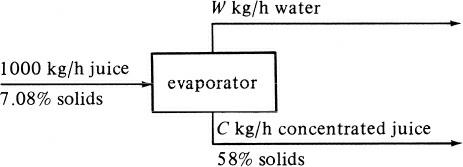
In the concentration of orange juice, a fresh extracted and strained juice containing 7.08 wt % solids is fed to a vacuum evaporator. In the evaporator, water is removed and the solids content increased to 58 wt % solids For 1000 kg/h entering, calculate the amounts of the outlet streams of concentrated juice and water
Solution: Following the four steps outlined, we make a process flow diagram (step 1) in Fig 1 5-1 Note that the letter W represents the unknown amount of water and C the amount of concentrated juice. No chemical reactions are given (step 2). Basis: 1000 kg/h entering juice (step 3).
To make the material balances (step 4), a total material balance will be made using Eq. (1.5-2):
1000 = W + C (1.5-3)
This gives one equation and two unknowns Hence, a component balance on solids will be made:
To solve these two equations, we solve Eq. (1.5-4) first for C since W drops out. We get C = 122.1 kg/h
Example 1.5-1. Concentration of Orange Juice
concentrated juice
Substituting the value of C into Eq. (1.5-3),
1000 = W + 122.1
and we obtain W = 877 9 kg/h water
1
As a check on our calculations, we can write a balance on the water component:
Solving,
929.2 = 877.9 + 51.3 = 929.2
In Example 1.5-1 only one unit or separate process was involved. Often, a number of processes in series are involved. Then we have a choice of making a separate balance over each separate process and/or a balance around the complete overall process
1.5CMaterialBalancesandRecycle
Processes that have a recycle or feedback of part of the product into the entering feed are sometimes encountered. For example, in a sewage treatment plant, part of the activated sludge from a sedimentation tank is recycled back to the aeration tank where the liquid is treated In some fooddrying operations, the humidity of the entering air is controlled by recirculating part of the hot, wet air that leaves the dryer. In chemical reactions, the material that did not react in the reactor can be separated from the final product and fed back to the reactor.
Example 1.5-2. Crystallization of KNO and Recycle
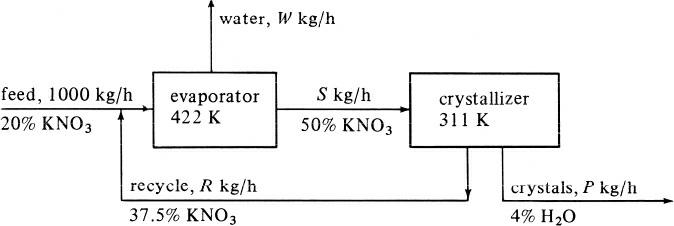
In a process producing KNO salt, 1000 kg/h of a feed solution containing 20 wt % KNO is fed to an evaporator, which evaporates some water at 422 K to produce a 50 wt % KNO solution. This is then fed to a crystallizer at 311 K, where crystals containing 96 wt % KNO are removed The saturated solution containing 37 5 wt % KNO is recycled to the evaporator Calculate the amount of recycle stream R in kg/h and the product stream of crystals P in kg/h.
Figure
5-1 Process flow diagram for Example 1 5-1
Solution: Figure 1 5-2 gives the process flow diagram As a basis we shall use 1000 kg/h of fresh feed No chemical reactions are occurring We can make an overall balance on the entire process for KNO and solve for P directly:
1 5-2 Process flow diagram for Example 1 5-2
To calculate the recycle stream, we can make a balance around the evaporator or the crystallizer. Using a balance on the crystallizer, since it now includes only two unknowns, S and R, we get for a total balance, S = R + 208.3 (1.5-7)
For a KNO balance on the crystallizer, S (0.50) = R(0.375) + 208.3(0.96) (1.5-8)
Substituting S from Eq. (1.5-7) into Eq. (1.5-8) and solving, R = 766.6 kg recycle/h and S = 974.9 kg/h.
1.5DMaterialBalancesandChemicalReaction
In many cases the materials entering a process undergo chemical reactions in the process, so that the materials leaving are different from those entering In these cases it is usually convenient to make a molar and not a weight balance on an individual component, such as kg mol H or kg atom H, kg mol ion, kg mol CaCO , kg atom Na , kg mol N , and so on. For example, in the combustion of CH with air, balances can be made on kg mol of H , C, O , or N .
Example 1.5-3. Combustion of Fuel Gas
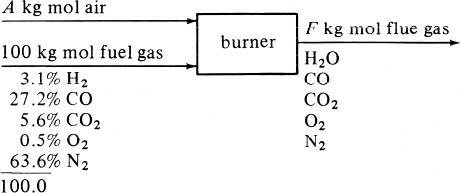
A fuel gas containing 3.1 mol % H , 27.2% CO, 5.6% CO , 0 5% O , and 63 6% N is burned with 20% excess air (i e , the air over and above that necessary for complete combustion to CO and H O) The combustion of CO is only 98% complete. For 100 kg mol of fuel gas, calculate the moles of each component in the exit flue gas.
Solution: First, the process flow diagram is drawn (Fig. 1.5-3). On the diagram the components in the flue gas are shown. Let A be moles of air and F be moles of
Figure
flue gas Next the chemical reactions are given:
An accounting of the total moles of O in the fuel gas is as follows:
2
For all the H to be completely burned to H O, we need, from Eq. (1.5-10), for 1 mol H , For completely burning the CO from Eq. (1.5-9), we need Hence, the amount of O we must add is, theoretically, as follows: mol O theoretically needed = 1.55 + 13.6 – 0.5 (in fuel gas ) = 14.65 mol O
For a 20% excess, we add 1.2(14.65), or 17.58 mol O . Since air contains 79 mol % N , the amount of N added is (79/21)(17.58), or 66.1 mol N .
To calculate the moles in the final flue gas, all the H gives H O, or 3.1 mol H O. For CO, 2.0% does not react. Hence, 0.02(27.2), or 0.54 mol CO will be unburned.
A total carbon balance is as follows: inlet moles C = 27.2 + 5.6 = 32.8 mol C. In the outlet flue gas, 0.54 mol will be as CO and the remainder of 32 8 – 0 54, or 32 26 mol as CO For calculating the outlet mol O , we make an overall O balance:
O in = 19 7 (in fuel gas) + 17 58 (in air) = 37 28 mol O
O out = (3.1/ 2) (in H O) + (0.54/ 2) (in CO) + 32.26 (in CO ) + free O
Equating inlet O to outlet, the free remaining O = 3.2 mol O . For the N balance, the outlet = 63.6 (in fuel gas) = 66.1 (in air), or 129.70 mol N . The outlet flue gas contains 3.10 mol H O, 0.54 mol CO, 32.26 mol CO , 3.20 mol O , and 129.7 mol N .
Figure 1 5-3 Process flow diagram for Example 1 5-3
In chemical reactions with several reactants, the limiting reactant component is defined as that compound which is present in an amount less than the amount necessary for it to react stoichiometrically with the other reactants. Then the percent completion of a reaction is the amount of this limiting reactant actually converted, divided by the amount originally present, times 100.
1.6 ENERGYAND HEAT UNITS
1.6AJoule,Calorie,andBtu
In a manner similar to that used in making material balances on chemical and biological processes, we can also make energy balances on a process. Often a large portion of the energy entering or leaving a system is in the form of heat Before such energy or heat balances are made, we must understand the various types of energy and heat units
In the SI system, energy is given in joules (J) or kilojoules (kJ) Energy is also expressed in Btu (British thermal units) or cal (calories). The calorie (abbreviated cal) is defined as the amount of heat needed to heat 1.0 g water 1.0°C (from 14.5°C to 15.5°C). Also, 1 kcal (kilocalorie) = 1000 cal. The btu is defined as the amount of heat needed to raise 1.0 lb water 1°F. Hence, from Appendix A.1,
1 Btu = 252.16 cal = 1.05506 kJ (1 6-1)
1.6BHeatCapacity
The heat capacity of a substance is defined as the amount of heat necessary to increase the temperature by 1 degree. It can be expressed for 1 g, 1 lb, 1 g mol, 1 kg mol, or 1 lb mol of the substance. For example, a heat capacity is expressed in SI units as J/kg mol · K; in other units as cal/g ·°C, cal/g mol · °C, kcal/kg mol · °C, Btu/lbm · °F, or Btu/lb mol · °F.
It can be shown that the actual numerical value of a heat capacity is the same in mass units or in molar units. That is,
1.0 cal/g · °C = 1.0 Btu/lb ·°F (1.6-2)
1.0 cal/g mol °C = 1.0 Btu/lb mol °F (1 6-3)
For example, to prove this, suppose that a substance has a heat capacity of 0.8 btu/lbm °F. The conversion is made using 1.8°F for 1°C or 1 K, 252.16 cal for 1 Btu, and 453.6 g for 1 lb , as follows:
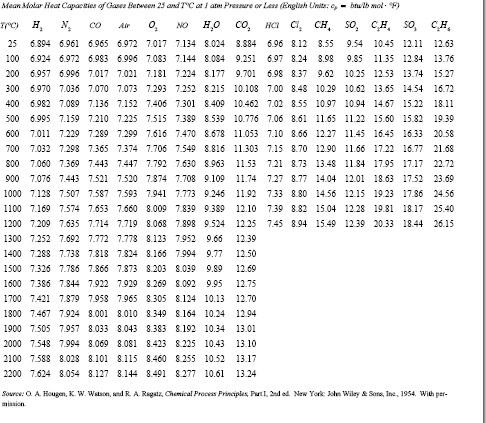
The heat capacities of gases (also called specific heat) at constant pressure c are functions of temperature and for m p
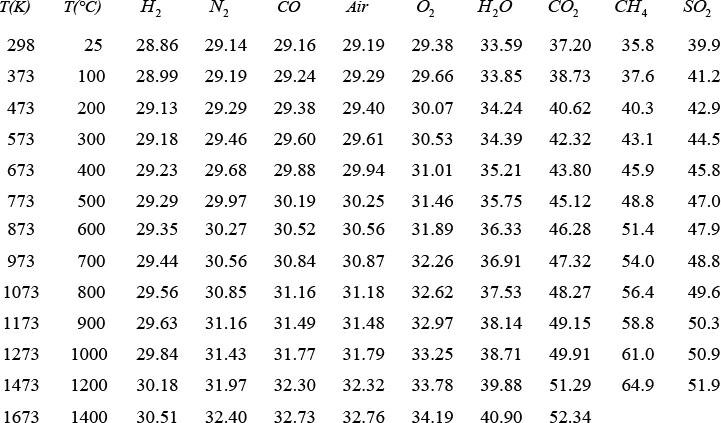
engineering purposes can often be assumed to be independent of pressure up to several atmospheres. In most process engineering calculations, one is usually interested in the amount of heat needed to heat a gas from one temperature t to another at t . Since the c varies with temperature, an integration must be performed or a suitable mean c used. These mean values for gases have been obtained for T of 298 K or 25°C (77°F) and various T values, and are tabulated in Table 1 6-1 at 101 325 kPa pressure or less as c in kJ/kg mol · K at various values of T in K or °C
Example
1
6-1 Heating of N Gas
The gas N at 1 atm pressure absolute is being heated in a heat exchanger Calculate the amount of heat needed in J to heat 3 0 g mol N in the following temperature ranges:
(a) 298–673 K (25–400°C)
(b) 298–1123 K (25–850°C)
(c) 673–1123 K (400–850°C)
Solution: For case (a), Table 1.6-1 gives c values at 1 atm pressure or less which can be used up to several atm pressures For N at 673 K, c = 29 68 kJ/kg mol · K or 29 68 J/g mol · K This is the mean heat capacity for the range 298–673 K:
Table 1 6-1 Mean Molar Heat Capacities of Gases Between 298 and TK (25 and T°C) at 101 325 kPa or Less (SI Units:
Substituting the known values,
Source: O A Hougen, K W Watson, and R A Ragatz, Chemical Process Principles, Part I, 2nd ed New York: John Wiley & Sons, Inc , 1954 With permission pm
For case (c), there is no mean heat capacity for the interval 673–1123 K. However, we can use the heat required to heat the gas from 298 to 673 K in case (a) and subtract it from case (b), which includes the heat to go from 298 to 673 K plus 673 to 1123 K:
Substituting the proper values into Eq. (1.6-5), heat required = 76 725 – 33 390 = 43 335 J
On heating a gas mixture, the total heat required is determined by first calculating the heat required for each individual component and then adding the results to obtain the total
The heat capacities of solids and liquids are also functions of temperature and independent of pressure Data are given in Appendix A 2, Physical Properties of Water; A 3, Physical Properties of Inorganic and Organic Compounds; and A 4, Physical Properties of Foods and Biological Materials. More data are available in (P1).
Example 1.6-2. Heating of Milk
Rich cows ’ milk (4536 kg/h) at 4.4°C is being heated in
a heat exchanger to 54.4°C by hot water. How much heat is needed?
Solution: From Appendix A 4, the average heat capacity of rich cows ’ milk is 3 85 kJ/kg · K
The enthalpy, H, of a substance in J/kg represents the sum of the internal energy plus the pressure–volume term. For no reaction and a constant-pressure process with a change in temperature, the heat change as computed from Eq. (1.6-4) is the difference in enthalpy, ΔH , of the substance relative to a given temperature or base point In other units, H = btu/lb or cal/g
1.6CLatentHeatandSteamTables
Whenever a substance undergoes a change of phase, relatively large amounts of heat change are involved at a constant temperature For example, ice at 0°C and 1 atm pressure can absorb 6013 4 kJ/kg mol This enthalpy change is called the latent heat of fusion Data for other compounds are available in various handbooks (P1, W1).
When a liquid phase vaporizes to a vapor phase under its vapor pressure at constant temperature, an amount of heat called the latent heat of vaporization must be added. For water at 25°C and a pressure of 23.75 mm Hg, the latent heat is 44 020 kJ/kg mol, and at 25°C and 760 mm Hg, 44 045 kJ/kg mol. Hence, the effect of pressure can be neglected in these types of engineering calculations. However, there is a large effect of temperature on the latent heat of water Also, the effect of pressure on the heat capacity of liquid water is small and can be neglected
Since water is a very common chemical, the thermodynamic properties of it have been compiled in steam tables and are given in Appendix A.2 in SI and in English units.
Example 1.6-3. Use of Steam Tables
Find the enthalpy change (i e , how much heat must be added) for each of the following cases using SI and English units:
(a) Heating 1 kg (lb ) water from 21.11°C (70°F) to 60°C (140°F) at 101.325 kPa (1 atm) pressure.
(b) Heating 1 kg (lb ) water from 21.11°C (70°F) to 115.6°C (240°F) and vaporizing at 172.2 kPa (24.97 psia).
(c) Vaporizing 1 kg (lb ) water at 115.6°C (240°F) and 172.2 kPa (24.97 psia).
Solution: For part (a), the effect of pressure on the enthalpy of liquid water is negligible From Appendix A 2,
H at 21.11°C = 88.60 kJ/kg or at 70°F = 38.09 btu/lb
H at 60°C = 251.13 kJ/kg or at 140°F = 107.96 btu/lb
When chemical reactions occur, heat effects always accompany these reactions. This area where energy changes occur is often called thermochemistry. For example, when HCl is neutralized with NaOH, heat is given off and the reaction is exothermic. Heat is absorbed in an endothermic reaction. This heat of reaction is dependent on the chemical nature of each reacting material and product and on their physical states
For purposes of organizing data, we define a standard heat of reaction ΔH as the change in enthalpy when 1 kg mol reacts under a pressure of 101 325 kPa at a temperature of 298 K (25°C) For example, for the reaction
the ΔH is –285.840 ×10 kJ/kg mol or –68.317 kcal/g mol. The reaction is exothermic and the value is negative since the reaction loses enthalpy. In this case, the H gas reacts with the O gas to give liquid water, all at 298 K (25°C)
Special names are given to ΔH depending upon the type of reaction When the product is formed from the elements, as in Eq (1 6-6), we call the ΔH the heat of formation of the product water, . For the combustion of CH to form CO and H O, we call it heat of combustion, Data are given in Appendix A.3 for various values of