
https://ebookmass.com/product/thought-and-play-in-musicalrhythm-asian-african-and-euro-american-perspectives-richard-
Instant digital products (PDF, ePub, MOBI) ready for you
Download now and discover formats that fit your needs...
Existentialist thought in African American literature before 1940 Melvin G Hill
https://ebookmass.com/product/existentialist-thought-in-africanamerican-literature-before-1940-melvin-g-hill/
ebookmass.com
Fashion Marketing in Emerging Economies Volume II: South American, Asian and African Perspectives (Palgrave Studies of Marketing in Emerging Economies) 1st ed. 2023 Edition
Frederica Brooksworth
https://ebookmass.com/product/fashion-marketing-in-emerging-economiesvolume-ii-south-american-asian-and-african-perspectives-palgravestudies-of-marketing-in-emerging-economies-1st-ed-2023-editionfrederica-brooksworth/ ebookmass.com
Collective Courage: A History of African American Cooperative Economic Thought and Practice 1st Edition, (Ebook PDF)
https://ebookmass.com/product/collective-courage-a-history-of-africanamerican-cooperative-economic-thought-and-practice-1st-edition-ebookpdf/ ebookmass.com
The Glow (Mountain City Chronicles Book 3) Alexander Nader


https://ebookmass.com/product/the-glow-mountain-city-chroniclesbook-3-alexander-nader/
ebookmass.com

https://ebookmass.com/product/radiant-sin-katee-robert/
ebookmass.com
English Sentence Builder 2nd Edition Ed Swick
https://ebookmass.com/product/english-sentence-builder-2nd-edition-edswick/
ebookmass.com
The Mandaean Book of John. Text and Translation Charles G. Haberl & James F. Mcgrath
https://ebookmass.com/product/the-mandaean-book-of-john-text-andtranslation-charles-g-haberl-james-f-mcgrath/
ebookmass.com
Down to a Sunlit Sea (The Winds of Fortune Book 5) John Wiltshire
https://ebookmass.com/product/down-to-a-sunlit-sea-the-winds-offortune-book-5-john-wiltshire/
ebookmass.com
5G Innovations for Industry Transformation: Data-driven Use Cases Jari Collin
https://ebookmass.com/product/5g-innovations-for-industrytransformation-data-driven-use-cases-jari-collin/
ebookmass.com





https://ebookmass.com/product/this-is-going-to-hurt-adam-kay/
ebookmass.com

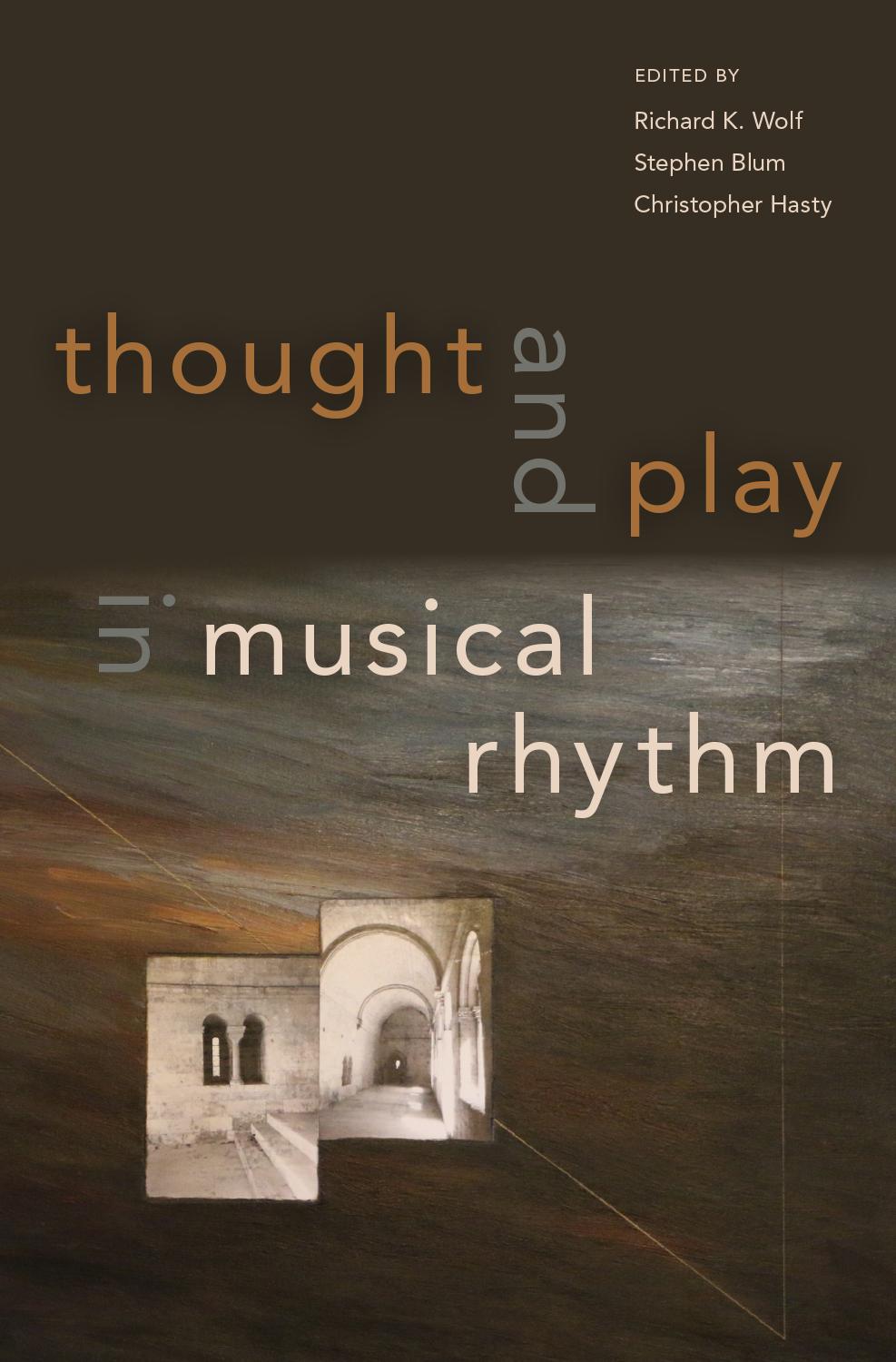
Thought and Play in Musical Rhythm
i Thought and Play in Musical Rhythm
Asi A n, Afric A n, A nd Euro- Am E ric A n P E rs PE ctiv E s
Edited by Richard K. Wolf, Stephen Blum, and Christopher Hasty
1
Oxford University Press is a department of the University of Oxford. It furthers the University’s objective of excellence in research, scholarship, and education by publishing worldwide. Oxford is a registered trade mark of Oxford University Press in the UK and certain other countries.
Published in the United States of America by Oxford University Press 198 Madison Avenue, New York, NY 10016, United States of America.
© Oxford University Press 2019
All rights reserved. No part of this publication may be reproduced, stored in a retrieval system, or transmitted, in any form or by any means, without the prior permission in writing of Oxford University Press, or as expressly permitted by law, by license, or under terms agreed with the appropriate reproduction rights organization. Inquiries concerning reproduction outside the scope of the above should be sent to the Rights Department, Oxford University Press, at the address above.
You must not circulate this work in any other form and you must impose this same condition on any acquirer.
CIP data is on file at the Library of Congress
ISBN 978–0–19–084149–2 (pbk.)
ISBN 978–0–19–084148–5 (hbk.)
9 8 7 6 5 4 3 2 1
Paperback printed by Marquis, Canada Hardback printed by Bridgeport National Bindery, Inc., United States of America
i Contents
List of Figures and Tables vii
Preface xiii
List of Contributors xv
About the Companion Website xvii
Introduction 1
Richard K. Wolf, Stephen Blum, and Christopher Hasty
1. Thinking With and About Rhythm 20
Christopher Hasty
2. Formative Processes of Durational Projection in “Free Rhythm” World Music 55
John Roeder
3. Meter and Rhythm in the Sung Poetry of Iranian Khorasan 75
Stephen Blum
4. An Approach to Musical Rhythm in Agbadza 100
David Locke
5. Rhythm and the Physical 146
Eugene Montague
6. Modern Drum Solos Over Ostinatos 174
Fernando Benadon
7. Temporal and Density Flow in Javanese Gamelan 196
Sumarsam
8. Layers and Elasticity in the Rhythm of Noh Songs: “Taking Komi” and Its Social Background 212
Takanori Fujita
9. Rhythmic Metamorphoses: Botanical Process Models on the Atlas Mountains of Morocco 232
Miriam Rovsing Olsen
10. Mapping a Rhythmic Revolution Through Eighteenth- and Nineteenth- Century Sources on Rhythm and Drumming in North India 253
James Kippen
11. Time Changes: Heterometric Music in South Asia 273
Richard Widdess
12. “Rhythm,” “Beat,” and “Freedom” in South Asian Musical Traditions 314
Richard K. Wolf
13. New Music—New Rhythm 337
Christopher Hasty
Glossary 381
Bibliography 393
Index 415
i
Figures and Tables
Figures
1.1. From a) two to b) three claps and the possibility c) of two larger events. 36
1.2. Joseph Haydn, String Quartet Op. 76 no. 4 (“Sunrise”), second movement, bs. 1–16. 39
1.3. Josquin des Prez, Missa pange lingua, the opening of Pleni sunt coeli, t.1–24. 42
1.4. Josquin des Prez, Missa pange lingua, the opening of Pleni sunt coeli, repetitions in altus, t.13–23. 46
2.1. Some temporal sensations associated with durational projection and realization. Adapted from Hasty, Meter as Rhythm (1997, 87–89). 57
2.2. Projective analysis of the introduction (darāmad) to the classical Persian chant (āvāz) of an extract from Bīdād from dastgāh homāyun, sung by Afsāne Ziā’i with Hoseyn Omumi, ney. 58
2.3. Projective analysis of the first seven cycles of “Flute,” performed by Zinzir, tatarore. 63
2.4. Two possible kinds of realized durational projections in “Flute” (under the assumption of parallelism). 64
2.5: Projective analysis of the opening (0:07–0:55) of the ālāp on rāga PūriyāKalyān performed by Budhaditya Mukherjee, sitar. Transcribed by Richard Widdess, adapted and annotated by John Roeder. 68
3.1. One quantitative poetic meter as represented in (a) the system of Arabic and Persian prosody, and (b) a simplified notation of attacks and durations in rhythmic cycles, which can also be used for poetic meters. 79
3.2. Moḥammad Ḥoseyn Yegāneh (d. 1992) singing a Persian quatrain to Šāh Xaṭā’i. 81
3.3. Initial quatrain of a monājāt (an intimate communication with God). 82
3.4. The guše of Šāh Xaṭā’i in the dastgāh of Navā, as sung by Maḥmud Karimi. 83
3.5. Quatrain from the story of Šāh Esmā‘il, sung by Moxtār Zambilbāf, 1972 (AWM RL 16245). 85
3.6. Quatrain from the story of Šāh Esmā‘il, sung by Moxtār Zambilbāf, 1972 (AWM RL 16245). 85
3.7. Two lines from Ferdowsi’s Šāh-nāma, sung to a 12-beat cycle by Ḥāj Ḥoseyn Xān Yāvari (age ca. 60) of Xarv Olyā (AWM RL 16234). 88
3.8 One verse of a fable from the Būstān of Sa‘di as sung by two naqqāls: (a) Ṣādeq ‘Ali Šāh (AWM RL 16211, and Naqqāli in Northern Khorāsān, track 6, 4:23–4:35); (b) Moḥammad Ḥasan Naqqāl (AWM RL 16225). 89
3.9. Two verses from the Šāh Nāma, sung by Sayyed Ḥasan Naqib Zāde (age 43), the moršed of a zur-xāna (men’s athletic club) in Sabzevār, 1995. 90
3.10. The same verses as in Figure 3.9, sung by Ḥasan Salaḥšur (age 18), a naqqāl active in tea houses of Bojnurd, 1969 (AWM RL 16208). 91
4.1. Rhythm of Agbadza dance movement. 103
4.2. Resultant rhythm of bell phrase with four- feel and six- feel beats. 109
4.3. Support drum function: articulation of offbeats. 110
4.4. Support drum phrase: accentuation in the metric matrix. 111
4.5. Music setting of drum language of the time parts. 112
4.6. Response drum themes for items 1–25. 114
4.7. Response theme, item 24: motion and accentuation “in four” and “in six.” 119
4.8. Lead drum: key to notation of strokes. 120
4.9. Lead drum themes for items 1–25. 121
4.10. Lead drum form: excerpt from complete score of item 1. 126
4.11. Modes of anhemitonic pentatonic scale. 131
4.12. Modes of hemitonic pentatonic scales. 132
4.13. Song-drum affinity in item 19: time-point 1.2. 137
4.14. Song: drum interaction in item 15. 139
4.15. Song and drums in item 16: cascading entrances, reinforcement of lexical meaning. 140
5.1. Eight ways to notate the son clavé rhythm, after Toussaint (2005). 149
5.2. A score of the first page of “Pianistes” from Saint- Saëns, Le carnaval des animaux. 153
5.3. A rhythmic analysis of the Piano I part at the opening of “Pianistes.” 154
5.4. A gestural-rhythmic analysis of the opening of Chopin, Étude in C major, Op. 10 no. 1. 158
5.5. Spans of the right hand in Chopin’s etude. 159
5.6. Calculating the stretch of each handspan in the basic instrumental gesture of Chopin, Op. 10 no. 1. 160
5.7. Stretching the hand: relative stretches of each of the three handspans A, B, and C in the first three phrases of Chopin, Op. 10 no. 1, measures 1–8, 9–16, and 17–24. 161
5.8. Three- voice counterpoint (bass line plus span C, the topmost two in Chopin, Op. 10 no. 1, measures 1–8). 162
5.9. A diagrammatic representation of the drummer’s gestures in a typical measure of “Straight Edge” by Minor Threat. 164
5.10. An interpretation of the metrical structure of the first four lines of “Straight Edge.” 166
5.11. An interpretation of the metrical structure of Mackaye’s performance of “Straight Edge.” 166
5.12. An interpretation of the durational structures of Mackaye’s performance of “Straight Edge.” 167
5.13. A rough alignment of the drum and vocal rhythms in the opening lines of “Straight Edge.” 167
5.14. A general analysis of the rhythmic relationships between voice and drums in the first section of “Straight Edge.” 168
6.1. Configurations in “synchronization space” for three- and two-element groups. Elements inside a circle are in synchrony with each other; d = drums, m = meter, o = ostinato. 175
6.2. Steve Gadd, “Quartet No. 2, Part II” (9:14). 177
6.3. Trilok Gurtu, “Belo Horizonte” (3:49). 181
6.4. Gurtu’s accent placements in the measure cycle. 182
6.5. Dave Weckl, “Master Plan” (3:12). 183
6.6. Vinnie Colaiuta, “Live at Catalina’s” (2:51). 184
6.7a–b. Vinnie Colaiuta, “Live at Catalina’s” (2:11). 185
6.8a–d. Jojo Mayer, “Jabon” (5:09, 5:19, 5:56, 6:11). 187
6.9. Gadd, clave solo (2:21). 189
6.10. Ostinato (top) vs. polymeter (staggered 2+3 pairs) vs. meter (vertical lines) in the first five measures of Figure 6.9. 191
6.11. Gadd’s 15- subdivision group and two “rational” approximations. 193
6.12. Drum notation key. 194
7.1a. A song for accompanying a deer dance: the original song. 199
7.1b. A song for accompanying a deer dance: Sindusawarno’s version of the melodic skeleton of the song. 200
7.2a. Example of the melodies of elaborating instruments (rebab, gender, bonang) and kendhang (drum) in irama dadi. 205
7.2b. Example of the melodies of elaborating instruments (rebab, gender, bonang) and kendhang (drum) in irama wilet: gendèr rangkep, bonang imbal, kendhang ciblon. 205
8.1. Original configuration of poetic syllables in hira-nori rhythm (a song from Noh Ataka). 213
8.2. Su-utai performed by amateur singers, at the amateur recital held on August 9, 2009, at the Noh theater in Otsu city. 215
8.3a. The libretto notation of a song in Ataka by Kita school published in 1924. 216
8.3b. Singer’s rhythm image of a song in Ataka. At the syllables with accent signs (⋏), choral singers have to extend the syllables to go with drumming pattern. 217
8.4a. Mitsuji pattern of o- tsuzumi and ko- tsuzumi. 218
8.4b. Tsuzuke pattern by o- tsuzumi and ko- tsuzumi. 218
Figures and Tables x i
8.5a. “Waving” modification of a drumming pattern in the dance music kakeri. 219
8.5b. “Contraction” of beats 2 and 4 in the entrance music shidai. 220
8.5c. Mitsuji pattern in “blur” modification, norazu. 221
8.6. Analysis of a hira-nori song in Ataka. 223
8.7. Alternation model of synchronization and detachment in a passage. 226
8.8. An amateur woman dancing with professional musicians at the back and choral singers at the side of the stage July 31, 2011, at the Noh theater in Otsu city. 228
9.1. The beginning of amarg sung by a soloist. 249
9.2. Amḫllf. The beginning of the two female choirs. 249
9.3. Amḫllf. Introduction of the first verse in the female choirs. 249
9.4. Amḫllf. Beginning of the drum ming and the dancing. 250
9.5. Tamssust. The same tune as before is sung alternately by the two choirs. 250
9.6. Tamssust. Rhythmic transition in the percussion instruments. 250
9.7. Tamssust. Introduction of a new melody. 251
11.1. Dāphā song He Śiva Bhairava as sung by the Dattātreya and Bhairavnāth temple dāphā groups, Bhaktapur, Nepal. 282
11.2. Singers of the Bhairavnāth temple dāphā group singing He Śiva Bhairava at the start of the Biskāḥ festival. The chariot of Bhairav can be seen in the background. Bhaktapur, Nepal, 2003. 283
11.3. Changes of metrical cycle in dāphā song He Śiva Bhairava. 285
11.4. Dāphā song Girīhe nandinī as sung by the Dattātreya temple dāphā group, Bhaktapur, Nepal. 287
11.5. The Dattātreya temple dāphā group, Bhaktapur, Nepal, 2012. 289
11.6. Proportional structure in dāphā song Girīhe nandinī. 290
11.7. Maṇḍala of Cakrasaṃvara. Painting on cloth, Nepal, c. 1100. 293
11.8. Singers making time-keeping gestures while performing Mahārudra Gvārā. Ikhālakhu Nekujātrā and Matayājātrā group, Patan, Nepal, 2011. 295
11.9. Proportional structure in Mahārudra Gvārā. 296
11.10. Structure of pāṇikā song. 299
11.11. The Ikhālakhu Nekujātrā and Matayājātrā group, Patan, Nepal, 2011. 306
11.12. Page from a modern notation-book showing heterometric structure of a gvārā song (Śākya 1995). 309
12.1. Ādi tāla with 2 kaḷā. 319
12.2. 12.2a: Tiruganāṭ basic version on tabaṭk, “one-beat” (or aṛy).
12.2b: Tiruganāṭ variation on tabaṭk, “two-beat” (eyṛ aṛy). 12.2c: Tiruganāṭ variation on tabaṭk, “three-beat” (mūṇḍ aṛy). 322
12.3. 12.3a: Do mār. 12.3b: Tīn mār. 324
12.4. The kalmah, a beat pattern corresponding to the Muslim statement of faith in one god. 329
12.5. Approximate oscillation rhythm on svara ma in nīlāmbari. 334
12.6. Approximate oscillation rhythm on svara ma in śankarābharaṇam. 334
Figures and Tables j xi
13.1a–b. Scheme for simple durational projection. 340
13.2a–e. Schemes for compound projections. 342
13.3. Scheme for triple unequal projection (deferral). 344
13.4. Pierre Boulez, Le Marteau sans maître, no. 9, “bel edifice et les pressentiments” double bs. 1–4. 349
13.5. Anton von Webern, Six Bagatelles for String Quartet, Op. 9 no. 6, bars 1–6. 350
13.6a–b. Lewin’s representation of a) Bamberger’s stimulus and b) her subjects’ interpretation (modified). 351
13.7a–b. Toru Takemitsu, Rain Tree, a) second section bs.1–8 (bottom of page 6); b) interpretation of figure X. 352
13.8. Salvatore Sciarrino, Muro d’orizzonte bs. 13–22. 355
13.9. Salvatore Sciarrino, Muro d’orizzonte bs. 1–12. 357
13.10. Toru Takemitsu, Rain Tree, first section bs. 30–45 (page 5 of score). 360
13.11. Toru Takemitsu, Rain Tree, opening bs. 1–29. 363
13.12. Morton Feldman, Spring of Chosroes bs. 1–7. 367
13.13. Morton Feldman, Crippled Symmetry first system (bs. 1–9). 369
13.14. Morton Feldman, De Kooning first system. 370
13.15. Morton Feldman, De Kooning final system. 372
Tables
2.1. Distribution of ratios of successive durations marked by grace-notegroup onsets. 71
2.2. Distribution of ratios of successive durations marked by long-note onsets. 72
4.1. Agbadza dance cadence “in four.” 104
4.2. Agbadza dance cadence “in six.” 104
4.3. Supporting instruments: implicit Ewe texts. 107
4.4. Agbadza kidi phrases: patterns of bounce and press strokes. 117
4.5. Lead drum: palette of strokes. 120
4.6. Agbadza songs: musical form, call-and-response, and duration in bell cycles. 133
4.7. Agbadza songs: nuanced form of melody with call-and-response. 134
5.1. The lyrics of Minor Threat’s “Straight Edge.” 166
9.1. Temporal development of a “womens’ aḥwaš”: the order of contributions to the performance. 246
9.2. The sung poetry reconstructed in its literary form from the performance of the aḥwaš. 247
9.3. The sung poetry transcribed as expressed in performance. 248
10.1. The three categories of tāl in the Sharḥ-i risāla-yi qawā’id-i tabla. 263
11.1. Levels of pulsation in Tīntāl (cardinality 16). 275
11.2. Levels of pulsation in Jhaptāl (cardinality 10). 276
11.3. Text and translation of dāphā song He Śiva Bhairava. 284
Figures and Tables
11.4. Text and translation of dāphā song Girīhe nandinī. 288
11.5. Proportional structure in Girīhe nandinī. 291
11.6. Proportional structure in Mahārudra Gvārā. 297
12.1. Beat structure of cāls performed by ḍhol group in Hyderabad, Sindh, Pakistan. 325
Preface
Earlier versions of the essays collected here were presented at a Conference on Rhythm held at Harvard University, March 3 and 4, 2012. The conference was planned in conjunction with a seminar on cross- cultural rhythm taught by Richard Wolf and Christopher Hasty during the spring semester of 2012; Stephen Blum was also involved in organizing the conference. We are grateful for financial support for the conference provided by the Harvard University Department of Music, the Provostial Fund for Arts and Humanities at Harvard, the Reischauer Institute of Japanese Studies at Harvard University, and the South Asia Initiative (now South Asia Institute) at Harvard.
We first conceived of the introduction as a conversation among the three of us, which we began to draft the day after the conference. When that plan proved unworkable, Richard Wolf made an outline of six topics that seemed to draw together themes from all the chapters, and these served as the basis of the introduction as it appears here. The opening section and the treatment of “Representations” and “Qualities” are Wolf’s work; Blum wrote the sections on “Units” and “Interactions”; and Hasty those on “Periodicity and Cycle” and “Meter.” Some topics are necessarily discussed in more than one section, just as the three of us are continually returning to them in our conversations.
We would like to thank the Harvard University Music Department for support during all stages of this project, and particularly Lesley Bannatyne, who assisted preparing the final manuscript.
RKW, SB, CFH
Contributors
Fernando Benadon is Professor of Music at American University.
Stephen Blum is Professor of Music Emeritus at the City University of New York Graduate Center.
Takanori Fujita is Professor of Ethnomusicology at the Research Centre for Japanese Traditional Music at Kyoto City University of Arts.
Christopher Hasty is Walter W. Naumburg Professor of Music at Harvard University.
James Kippen is Professor of Ethnomusicology at the University of Toronto.
David Locke is Professor at the Music Department of Tufts University.
Eugene Montague is Associate Professor of Music at the George Washington University.
Miriam Rovsing Olsen is Associate Professor Emeritus of Ethnomusicology and Member of the Center for Research in Ethnomusicology (CREM-LESC) at the University of Paris Nanterre.
John Roeder is Professor at the University of British Columbia School of Music.
Sumarsam is Winslow-Kaplan Professor of Music at Wesleyan University.
Richard Widdess is Professor of Musicology at SOAS University of London.
Richard K. Wolf is Professor of Music and South Asian Studies at Harvard University.
