1Oxford University Press is a department of the University of Oxford. It furthers the University’s objective of excellence in research, scholarship, and education by publishing worldwide. Oxford is a registered trade mark of Oxford University Press in the UK and certain other countries.
Published in the United States of America by Oxford University Press 198 Madison Avenue, New York, NY 10016, United States of America.
All rights reserved. No part of this publication may be reproduced, stored in a retrieval system, or transmitted, in any form or by any means, without the prior permission in writing of Oxford University Press, or as expressly permitted by law, by license, or under terms agreed with the appropriate reproduction rights organization. Inquiries concerning reproduction outside the scope of the above should be sent to the Rights Department, Oxford University Press, at the address above.
You must not circulate this work in any other form and you must impose this same condition on any acquirer.
Library of Congress Cataloging-in-Publication Data
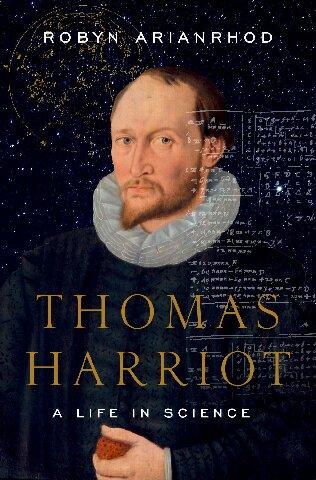
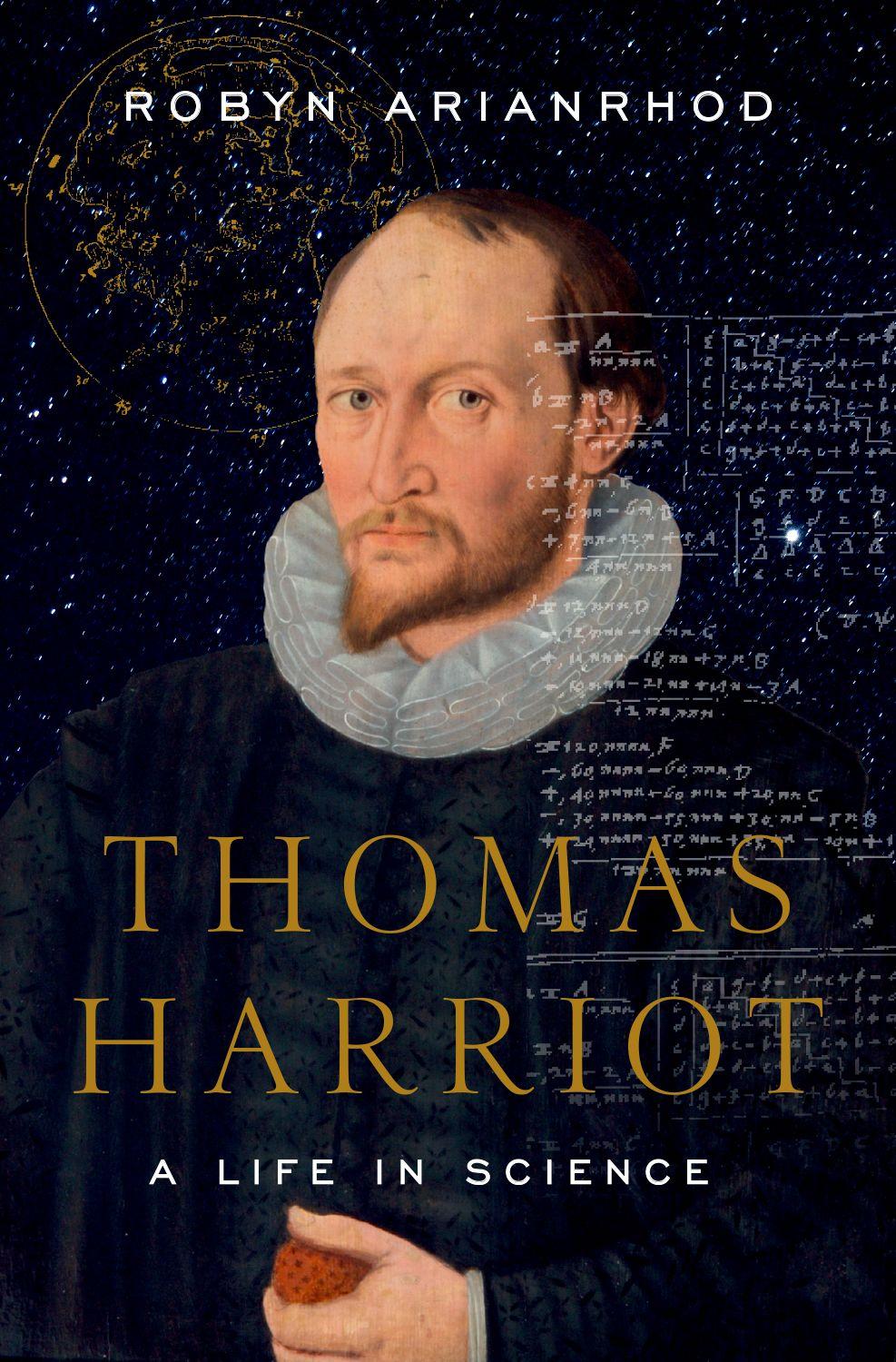
Names: Arianrhod, Robyn, author. Title: Thomas Harriot : a life in science / Robyn Arianrhod. Description: Oxford ; New York, NY : Oxford University Press, [2019]
Identifiers: LCCN 2018024943 | ISBN 9780190271855 (hardback : alk. paper) Subjects: LCSH: Harriot, Thomas, 1560-1621. | Scientists—Great Britain—Biography. | Explorers—Virginia—Biography. | Virginia—Discovery and exploration—English. Classification: LCC Q143.H36 A75 2019 | DDC 509.2—dc23 LC record available at https://lccn.loc.gov/2018024943
In loving memory of my grandmother Evareen Dinah Throckmorton
Things are in such a state here that it is not lawful for me to philosophize freely; we are still stuck in the mud.
—Thomas Harriot to Johannes Kepler, 1608
CONTENTS
prologue 1
Chapter 1: Harriot’s London 8
Chapter 2: Sea Fever 19
Chapter 3: The Science of Sea and Sky 27
Chapter 4: Practical Navigation (and Why the Winds Blow) 41
Chapter 5: America at Last 51
Chapter 6: Preparing for Virginia 62
Chapter 7: Roanoke Island 74
Chapter 8: After Roanoke 93
Chapter 9: War, and a New Calendar 105
Chapter 10: New Chances 117
Chapter 11: Setback 128
Chapter 12: Royal Refraction 140
Chapter 13: Spirals and Turmoil 152
Chapter 14: Changing of the Guard 163
Chapter 15: Algebra, Rainbows, and an Infamous Plot 171
Chapter 16: Solving the Rainbow 183
Chapter 17: Conversations with Kepler 188
Chapter 18: Atomic Speculations 195
Chapter 19: Searching the Skies 209
Chapter 20: Gravity 224
Chapter 21: Mathematics, Jamestown, Guiana 231
Chapter 22: The End of an Era 247
Chapter 23: All Things Must Pass 256
epilogue : Resurrecting Harriot 259
Acknowledgments 267
Appendix 269
Notes 287
Bibliography 341
Index 353
Thomas Harriot
ON APRIL 9, 1585, a three-masted sailing ship named the Tiger left the safety of Plymouth on the southwest coast of England and headed for the open ocean. Queen Elizabeth had loaned the 149-ton vessel to Sir Walter Ralegh. It was the flagship in his small fleet bound for North America, and there was a rough crossing ahead: cramped, unhealthy shipboard conditions and the Atlantic’s treacherous waves and sudden storms would test the nerves and stomachs of the hardiest sailors. Of the 160 passengers and crew on board the Tige r, however, one passenger in particular remained undaunted throughout the voyage. He was Thomas Harriot, a twenty-four-year-old Oxford graduate and a promising mathematician and scientist. As Ralegh’s expert navigational theorist, he was up on deck even in the foulest weather, advising the captain and his chief navigators, taking astronomical readings, and gathering firsthand information for improving the design and use of navigational instruments. In his spare time, he observed the sailors and their conditions, recording their patois in his notebook as they shouted instructions to one other. No occupation or task was too humble to attract his interest, and few details escaped him.
His interest in shipboard culture and dialect foreshadowed Harriot’s pioneering contributions to phonetics and American ethnology. His role in this expedition reflected his wide-ranging interests and abilities, for he was not only Ralegh’s navigational expert; he was effectively the first European diplomat to, and scientist-in-residence in, what is now the United States. He was among the first Europeans
to acquire a working knowledge of a North American language—in this case, North Carolina Algonquian—and by means of it to understand and record indigenous culture at the time of first contact with Europeans. Outgoing and amiable, he made friends with the people, hunted and feasted with them, learned their methods of agriculture, canoe building, and fishing, and clearly enjoyed much about their way of life. As a general rule, he recorded what he saw with the detachment of a physicist and the engagement of a linguist and ethnologist, describing rather than judging religious practices and cultural ceremonies that were completely alien to him, and observing in context the details of Algonquian life.1
“Physicist,” “ethnologist,” “linguist,” and “scientist”—these are all anachronistic terms that would have seemed as strange to Harriot as an Algonquian ceremony. With no road map in these yet-to-beformalized disciplines, he had to invent his own methods of recording and interpreting what he saw and heard. Not surprisingly, his assessments of America, like his ideas on physics, were not always complete or entirely accurate. That is the way with pioneering work. Nevertheless, his eye for detail and his intellectual rigor make him an almost unique guide to an age before the world had quite become modern—before the tragedy of a new wave of colonization that would soon unfold, and before modern science had emerged fully from its medieval and mystical past.
What makes Thomas Harriot’s story especially compelling is that it helps fill in some of the gaps in our picture of that transitional era, because he is one of those proverbial forgotten geniuses. He has a place in history for his work in America alone, but his scientific achievements offer a much bigger story and suggest that he should have a far bigger place in the scientific pantheon.
His career began a century before his countryman Isaac Newton set the keystone for modern science with his 1687 masterpiece Principia, which gave us the universal theory of gravity and pioneered modern theoretical physics and astronomy. Newton is arguably the greatest mathematical scientist of all time, although, as he famously told Robert Hooke, if he had accomplished anything it was because he had stood on the shoulders of giants. The best known of these are Harriot’s Continental contemporaries Galileo Galilei and Johannes Kepler. Galileo published the first empirical law of gravity—that of freely falling bodies near the surface of the earth—while Kepler derived the laws of planetary motion, including the fact that the shapes of the planetary orbits are ellipses about the sun.
Galileo and Kepler were working at a time when belief in magic was common, and science was struggling to free itself from the confusion of superstition and the constraints of scriptural literalism. Their discoveries, and their battles with authorities, are deservedly famous, but much less is known about what was happening in England at that time. There was the legendary Dr. Dee, of course— the Elizabethan “conjuror,” alchemist, mathematician, and astronomer. And this was also the age of William Shakespeare, Christopher Marlowe, Edmund Spenser, John Donne, Ben Jonson, and Philip Sidney and his sister, Mary, as well as Ralegh and so many other luminaries. These were writers, dramatists, and poets, all of them figures of profound culture. Dee notwithstanding, what seems missing from this stellar line-up is a standout scientist—an English bridge to Newton, or some one who personifies the scientific culture that ultimately produced him.
That’s where Harriot comes in, the man modern scholars consider the greatest British mathematical scientist before Newton.2 There were mathematicians closer to Newton’s time who were perhaps more sophisticated in their techniques than Harriot—notably James Gregory and John Wallis—as well as major scientists such as Edmond Halley and Robert Hooke. But Harriot stands alone, because of the quality and versatility of his best work, which, like Newton’s, spanned a range of topics, mathematical, theoretical, and experimental. He discovered the law of falling bodies and formulated fledgling laws of motion independently of Galileo. He outpaced Edward Wright—one of the most accomplished and well-known navigational experts in early seventeenth-century Europe—in the sophistication and priority of his practical and theoretical navigational work. He built his own telescope and studied the moon and the motion of sunspots, again independently of Galileo, and made some of the most accurate astronomical calculations of his time.
The list of achievements goes on. Harriot discovered the law of refraction and the secret of the rainbow decades before Willebrord Snell and René Descartes. He discovered the dispersion of light more than half a century before Newton and pioneered the “NewtonGregory interpolation formula” long before Newton and Gregory. He discovered binary arithmetic nearly a century before Gottfried Leibniz and made a quantitative study of population growth versus food supply two centuries before Thomas Malthus. He produced the first universal phonetic alphabet and the first fully symbolic algebra. He did all this and more, and yet who, outside of academia, knows
much about him? It is only relatively recently that historians themselves have begun to appreciate the wealth of material he left behind. Yet this long-lost pioneer had lived and worked at the heart of English intellectual and political life during one of his country’s most celebrated ages. Born in 1560 (so far as can be discerned), he was an almost exact contemporary of Shakespeare and witnessed the spectrum of Elizabeth’s reign, both its glories and its conflicts. He cheered the English defeat of the Spanish Armada in 1588; he explored the New World and learned some of its language and culture, as mentioned; he attended some of the plays of Shakespeare, and of his own close friend George Chapman, when they were first performed, and he read and conversed with other literary and scientific friends and acquaintances. He kept fully abreast of religious debates, too, which flourished and flared during the Elizabethan Age as it struggled to reconcile its religious identity and loyalties. Religious pamphlets were a favorite means of contributing publicly to the debate, but some of them included diatribes against Harriot and Dee—the supposedly “atheist” rational man of science and the “conjuring” mathematicianastrologer—and Harriot became caught up in the potentially deadly politics of patronage and the snares of sectarian strife. He was also affected, directly, by the repercussions of the Gunpowder Plot early in the reign of James I. During all this turmoil, excitement, drama, and danger, he worked, relentlessly, tirelessly, exploring nearly every facet of mathematics and physics. His scientific reputation in his own time was so great that Kepler had sought his advice, while others admired him as one of the fathers of modern algebra.3
It is no wonder, then, that for a growing number of scholars Harriot has become a cause, and restoring him to his rightful place in scientific history a powerful desire. It remains an unfinished task, though—a work in progress, like his own research. Indeed, the challenges of giving Harriot his due are daunting. He had no close family who might have passed down records and stories, and few of his letters have been found. Even the identity of the sitter in the portrait and engraving that were once thought to have been of him has been called into question.4 Most frustrating of all, he left behind no published edition of his scientific work—no polished, public account that would have made clear what his thousands of calculations and painstaking observational data meant to him, and how he wished them to be read. This was partly a matter of circumstance. Still, it was not unusual at that time to circulate manuscripts rather than published works, and it is understandable that a perfectionist such as Harriot didn’t rush into print. He did publish a short work on America, and
his executors eventually published an algebraic treatise based on some of his mathematics. Important as they were, these, too, were incomplete, because many of Harriot’s American notes were lost at sea, and his executors failed to understand his algebra sufficiently to publish a suitable exemplar.
This relative paucity of primary material explains why there has been no popular scientific biography of Harriot. What remains is his manuscripts, disordered and unfinished; together with his American booklet and a handful of documents they are the only direct evidence on which to base a biography.
To find his life, then, it is necessary to explore his writings— although it is something of a miracle that these exist at all. Within a few decades of his death in 1621, he had all but disappeared from the scientific record, and his manuscripts lay hidden, presumed lost, for nearly a hundred and fifty years. Then, in 1784, some eight thousand pages of his scientific and mathematical research were discovered at the ancestral home of Lord Egremont, a descendant of Harriot’s patron Henry Percy, 9th Earl of Northumberland, a major figure in Harriot’s story, as we’ll see. Thanks to the generosity of Lord Egremont’s family, most of the papers ended up in the British Library.
When I visited the library to see these for myself, the Manuscripts Reading Room felt like a place of pilgrimage. After all, it’s both thrilling and humbling to hold the handwritten treatises, jottings, and calculations of someone who died four centuries earlier—especially when these are virtually all that we have to reconstruct a life. I was amazed that Harriot’s thick, rough-edged foolscap pages were so well preserved. Unfortunately, his small, quill-penned handwriting and laconic style made deciphering his notes difficult, while the stops and starts in his working made following his trains of thought a challenge. Nevertheless, I soon came to admire the breadth and depth of these manuscripts, this lifetime of unpublished effort for the sake of science and mathematics. I understood why Harriot had attracted so much scholarly attention in recent years—and also that he will likely remain one of the most fascinating of history’s scientific figures partly because he is so elusive.
Yet these papers convinced me that it would be possible to write this biography. As I read through Harriot’s pages, sometimes puzzling over them, sometimes smiling with joy at his tours de force, I was moved by the intimacy they afforded. I began to feel the same enthrallment expressed by Voltaire—author of a popular book on Newton’s theories—as he alternately struggled with and delighted in the great Englishman’s work: “This strange man turns my head!”
I am, of course, not the first to feel this way about Harriot. One of the first modern scholars to study his papers was the American historian John Shirley, who published an invaluable scholarly biography in 1983. Shirley and his fellow “Harrioteers” inspired new generations of enthusiasts, who are spearheading Harriot’s gradual restoration to history after centuries of obscurity. I am indebted to all these researchers, whose work I gratefully reference in my bibliography and notes. My goal here is to join their efforts by bringing Harriot to a general readership.
Because this is a popular account of Harriot’s life and work, I have occasionally taken what scholars might rightly see as liberties. I’ve already mentioned anachronistic terms for professions such as “scientist,” and I’ll use modern nationalities such as Italian and German, although in Harriot’s time Continental political power and identity generally lay in city-states and regions rather than today’s nation-states or a unified Europe. (On the other hand, in speaking of ancient and medieval “Greek” and “Arabic” science, these descriptors refer to the scholars’ culture and language, not to modern notions of ethnicity and nationality.) I’ll also follow the common practice of modernizing spelling in my quotes from the period—and occasionally I’ll use the terms “Renaissance” and “Reformation,” although they belie the complex, humanist origins and ongoing nature of the intellectual, cultural, and theological developments of the fifteenth and sixteenth centuries. Finally, since one of my aims here is to give nonspecialist readers insight into the ideas and concepts that led to modern science and mathematics, I will sometimes move ahead in time to highlight differences and similarities between Harriot’s work and the corresponding modern view.
Still, this is a book that endeavors to put Harriot’s achievements into their context. This means offering a more general story about his life and times, and about the evolution of science through both his work and that of his contemporaries and forerunners. So sometimes I’ll also move back in time, especially in the early chapters, in order to highlight the legacy on which Harriot and his contemporaries built. I’ll also illustrate the vexed connection between the rise of science and the economic and imperial development of the Western world. I hope to give a feeling not only for Harriot’s scientific and mathematical achievements but also for the contingencies, people, and events that helped shape them—and that shaped Harriot himself. Above all, though, Harriot’s story is one of insatiable human curiosity. Imperialism and the economic imperative were not the only impetuses for the gradual but transformative process now known
as the Scientific Revolution. Curiosity, and where and how far it can take us in understanding our world, was a key driving force. So was the courage to question received wisdom, to challenge orthodoxy, even when doing so meant running personal risks. As Galileo and Harriot discovered to their cost, ongoing and often toxic fallout from the Reformation and Counter-Reformation meant that authorities were ever alert for “heretical” opinions. At the same time, the impact of the Renaissance also played its part. Rediscovered works of ancient Greek science and mathematics—together with medieval treatises by Middle Eastern and Indian scholars—were emboldening European physicists and mathematicians, liberating the bravest of them from the need to fit scientific discovery within a traditional theological and philosophical framework. Harriot read Latin and Greek fluently, and for all his willingness to put his life at risk in New World expeditions, ultimately he preferred intellectual to geographical adventuring. Not that he was always able to lead the life of quiet contemplation he craved, given the excitements, uncertainties, and ever-shifting alliances of the day. He moved in the most glittering of Elizabethan circles, and the most dangerous of Jacobean ones.
As for his scientific legacy, many of those thousands of manuscript pages contain false starts and dead ends, the detritus of trial and error that is the way of science. Had he published the gems of algebra, optics, astronomy, navigation, and mechanics that are embedded in the rough matrix, however, he would have earned lasting fame and influence. As it is, some of the reasons he didn’t publish add drama, intrigue, and tension to scientific history. They provide a human face to intellectual discovery. And in place of polished publications, with Harriot’s papers we can watch thought unfold. His works in progress are a window into the workings of an extraordinary mind, and they offer up not a metaphorical monument in stone but a life as it was lived—a life in science and mathematics during one of the most fascinating eras in history.
CHAPTER 1
Harriot’s London
IN THE WINTER OF 1583–84, when twenty-three-year-old Thomas Harriot moved into Durham House on London’s fashionable Strand, he entered a world of unaccustomed splendor. The house itself was fit for a king: according to contemporary accounts its great hall was “stately and high, supported by lofty marble pillars,” and there were sumptuous furnishings of soft green velvet and silver lace.1 Thirty uniformed attendants were on hand, serving meals on silver plates and generally catering to the occupants’ every whim. Harriot was not used to such a lavish lifestyle. He had been born in Oxfordshire of “plebeian” parents, according to the description of his background in the record of his 1577 admission to Oxford. This document, together with official references to his 1580 graduation, is the only extant evidence about his life before he moved into Durham House, and it tells us that his parents were commoners who worked for a living. His father was likely a craftsman or a yeoman (a small farmer), because it was not unusual for Elizabethans of this class to save sufficient money to send their sons to university—fees were reduced for plebeian scholars.2 Either way, we can surmise that Harriot had arrived in London with an Oxford bachelor of arts degree and little else. But his wide-ranging intellect—especially his knowledge of the principles of navigation by the stars, the hottest scientific topic of the day—had soon attracted a wealthy patron: the tall and dashing Walter Ralegh. No one knows when or how Harriot and Ralegh first met. It may have been through the Reverend Richard Hakluyt, an Oxford lecturer
interested in the New World. Temperamentally, though, the two men could not have been more different. Harriot was an intellectual with relatively little interest in fame or fortune, and in keeping with his vocation, he dressed in the understated black suits favored by many scholars at the time. The ambitious Ralegh, by contrast, was a notoriously flashy dresser whose very shoes were jewel encrusted. Harriot was steadfastly loyal to his friends, kept his opinions to himself, acted cautiously, and won the admiration of an eclectic group of friends and colleagues. The rash and brash Ralegh, on the other hand, had a penchant for upsetting people in power.
Harriot may have been studious, but he was also sociable, confident, and an astute judge of character. As for Ralegh, despite his ostentatious ways he was interested in literature, science, and mathematics, and he and Harriot were bonded by these pursuits. Harriot, of course, was doubly bonded: with no means of his own, he was dependent on his patron for his livelihood. Patronage was a key source of employment for innovative scholars and writers at the time. Nevertheless, accepting Ralegh as his patron meant that Harriot’s destiny was tied to his employer’s—and, as it turned out, Ralegh’s fate was encoded in Durham House’s stone tower, backing as it did onto the River Thames just a couple of miles upstream from the Tower of London, where Ralegh would spend his last days.
In early 1584, however, thirty-one-year-old Ralegh’s star was rising, thanks to his ability both to flatter Queen Elizabeth I, then nearly fifty, and to inspire her with his vision for England.3 Raised among the seafaring folk of Devon, he was a younger half brother of the pioneering North American explorer Sir Humphrey Gilbert, who had “claimed” Newfoundland for the British Crown just a few months earlier. Gilbert’s overreaching colonial ambitions had ended in disaster: his main supply ship was wrecked and more than eighty men drowned; Gilbert was forced to abandon his expedition and to order the remainder of his fleet to head back toward England. But the weather had turned terrifyingly wild, and Gilbert and his ship simply disappeared, swallowed up by the furious Atlantic.
Ralegh had contributed financially to the ill-fated venture, and now he was determined to build on his brother’s legacy. Like Gilbert, he dreamed of making Protestant England mistress of the oceans, displacing Catholic Spain from its position of naval supremacy, through which it dominated the New World. It ruled more than its share of the Old World, too—notably Portugal (since 1580), Belgium, and much of the Netherlands, although Dutch Protestants continued to rebel, with covert English aid. So Ralegh wanted to make England
not only rich, through a trading base in the New World, but also safe, able to defend itself in home waters if the growing threat of a Spanish invasion materialized. It was for these ends that he had employed young Harriot: to teach him astronomy, so that he and his captains and pilots would know how to navigate more surely.
During their study together, the respect between the two men had grown into friendship. Sometimes they conversed in Ralegh’s study in Durham House’s impressive lantern tower, which looked south across the Thames to the peaceful countryside beyond. On the river, boats busily plied their trade, ferrying goods and passengers— although sometimes they might offer less savory spectacles, such as when some petty offender, or some unfortunate woman deemed a “harlot” or a “shrew,” was condemned to punishment by “dragging” across the river.4 Generally, though, the view across the Thames from Durham House was, as Ralegh’s seventeenth-century countryman John Aubrey put it, “as pleasant, perhaps, as any in the world.”5
While Ralegh’s New World dreams would prove to be just the starting point for Harriot’s diverse career, they would eventually destroy Ralegh himself. But in those early, golden years of the 1580s, his energy and vision inspired those around him—including the queen, who had shown her admiration for her new favorite by giving him the use of Durham House. It seems a prescient as well as a generous gesture, for the mansion’s history offered a warning: not to take lightly the privilege of living there. Two of its most famous former occupants, Lady Jane Grey and Anne Boleyn, had been executed, victims of religious fanaticism and royal caprice.
In fact, the house’s provenance symbolized the religious and political tensions not only in England but also throughout postReformation Europe. Built in the thirteenth and fourteenth centuries for the bishops of Durham, it was occupied by generations of Catholic bishops until 1536, when Bishop Tunstall turned it over to Elizabeth’s father, Henry VIII, in exchange for a less prestigious property.6 In 1531, Henry had proclaimed himself head of the Church of England. By 1540, he had suppressed all Catholic monasteries, diverting most of their revenue to the Crown. On his death in 1547, Durham House passed to Princess Elizabeth (his daughter with Anne Boleyn), in accordance with his will. After Elizabeth’s Catholic half sister, Mary, became queen in 1553, however, the house was soon returned to Bishop Tunstall. Mary Tudor was the daughter of Henry’s first wife (Catherine of Aragon), but she died just five years into her reign. In those five years at least three hundred
English Protestants were burned at the stake. Many commoners had fanned the flames, believing that by inflicting physical suffering on these unbelievers they were doing God’s will. On her accession to the throne in 1558, Elizabeth took Durham House back, so that once again it was in Protestant hands. And although the new queen resolved to create an atmosphere of religious tolerance, by the 1580s, Catholic uprisings and plots to depose her had eroded her will.
For instance, in December 1583—around the time Harriot and Ralegh moved into Durham House—Francis Throckmorton was caught with coded messages to Mary Queen of Scots, a Catholic who had been under house arrest in England for the past sixteen years. (Having lost Scottish support after her supposed complicity in the murder of her former husband Lord Darnley, she had abdicated her throne and escaped to England, where she was kept safe, albeit as a “guest-prisoner.” Rebellious English Catholics believed that, as a great-granddaughter of Henry VII, Mary had a better claim to the English throne than the “bastard” Elizabeth—Catholics did not recognize Henry VIII’s divorce from Catherine, after which he had married Anne Boleyn—and so Mary was under house arrest both for her own safety and for Elizabeth’s.) Throckmorton was the son of a distinguished English Catholic family and had been acting as an intermediary between Mary and the Spanish ambassador, Bernardino de Mendoza. His papers revealed tentative plans for a Spanish invasion of England that would place the Queen of Scots on Elizabeth’s throne. Under repeated torture on the rack Throckmorton confessed to the plot. Mendoza was expelled, Anglo-Spanish tensions mounted, and Throckmorton was taken to Tyburn, located just outside the city’s gates, for execution. The very name of this notorious place inspired terror. Bells would ring and crowds would line the streets for miles to jeer—or cheer—the prisoners as they were carted on their long and excruciating journey from London to agony and oblivion. A traitor’s death was particularly horrific, with the victim being partly strangled and then drawn and quartered while still alive.
Just a few months after Throckmorton’s execution in mid-1584, his Protestant cousin Bess Throckmorton would become one of Elizabeth’s ladies of the privy chamber, a trusted inner group of the queen’s personal attendants. It was a fateful appointment, for she was destined to play a dramatic role in the life at Durham House. Yet for all the queen’s willingness to entrust another Throckmorton, Elizabeth was being forced into a corner. A key trigger for Catholic unrest and Protestant paranoia had been the 1570 papal bull
excommunicating Elizabeth and instructing her Catholic subjects to pledge loyalty not to their queen but to Rome. Her government’s ultimate response included making the act of converting anyone to Catholicism treasonous, and punishable by the ghastly form of execution administered to traitors. When Cardinal William Allen complained it was wrong to turn a matter of conscience into treason, he was only half right: until England was free of Roman interference, and of threats to Elizabeth’s legitimacy by supporters of foreign Catholic rulers, religion and politics would remain intimately entwined.7
Freedom of speech was another matter—it effectively did not exist.8 Like others in his position, Allen was writing from the safety of exile. He was right to be cautious; during Elizabeth’s long reign, 189 Catholics would be executed for their beliefs.9 The Jesuit missionary Edmund Campion was one of these. He had complained to a colleague that Protestant “heretics” had spies everywhere in England, so that he had to change his disguise frequently as he went about the country ministering and proselytizing. 10 Elizabeth’s ambivalence about the deteriorating course of religious politics meant she sometimes showed a degree of mercy, as she did to Campion, allowing him to be hanged until dead before being drawn and quartered. But a number of onlookers would have been disappointed: some Elizabethans enjoyed a gruesome execution, just as some enjoyed seeing animals fighting each other in gladiatorial combat. The queen herself was partial to a good bearbaiting.
It seems hard to believe anything ennobling could come from such a barbarous and fearful time, yet this was also one of the most dazzling periods in English history. In all times of momentous change, and perhaps in all exceptional individuals, contradictions coexist and moral, sometimes Faustian, bargains are made. The boldly original playwright Christopher Marlowe would soon become the first to dramatize the legendary pact with the devil, in his Tragical History of Doctor Faustus (1589), but first he worked his way through Cambridge as a courier for Elizabeth’s spymaster, Sir Francis Walsingham.11 Many well-placed scholars sometimes led double lives, gathering useful intelligence. John Dee—the most colorful and well-known English mathematician of the day, who would later become a friend of Harriot—is famous today for using the code name 007, although this is unproven. It’s also been conjectured that the Italian mystic and quasi-Copernican Giordano Bruno was the spy who helped Walsingham uncover the Throckmorton Plot.12
Poets also made their bargains. Edmund Spenser was weaving beautiful Homeric and Arthurian allegories from a stolen Irish castle,
having first worked for Lord Grey, the commander who, in 1580, had brutally crushed an Irish Catholic uprising that was part of the so-called Second Desmond Rebellion. Ralegh, too, profited from and participated in the ruthless English conquest of Ireland. His family background was fiercely anti-Catholic, and he had fought for his religion early in life. Inspired by a Huguenot (French Protestant) kinsman, he had joined a band of volunteer Devonshire soldiers who went to France to fight on the Huguenot side in the religious war that was tearing that country apart. He was about fifteen years old. Twelve years later, he had found himself fighting Catholics in Ireland.
The English had been trying for decades to “civilize” the “wild Irish”—to use an anti-Irish term that was common at the time—and to appropriate their land. Finally, desperate Irish leaders had begun to seek help from Catholic France and Spain, and the pope himself was only too willing to supply troops, weapons, and moral support in a “holy” war against the heretic Elizabeth. Ralegh’s involvement in such a war had begun in the summer of 1580. As a hotheaded young newcomer at court, he’d earned himself a reputation for brawling, but he was already someone to be noticed, and sympathetic statesmen such as Walsingham had hoped that a tour of duty in Ireland would teach him some discipline. Later that year, in preparation for what turned out to be one of the bloodiest battles in the Desmond Rebellions, Ralegh was given a post as captain of a hundred soldiers. His commander was none other than Lord Grey. Grey was a fanatical Protestant who showed no mercy even when papal troops, trapped in a fort, raised a white flag of surrender after a four-day siege. Along with the other officer on duty that day, Ralegh and his men carried out Grey’s orders, butchering with their swords hundreds of terrified Continental soldiers who had surrendered in the belief that their lives would be spared.13 Edmund Spenser, Grey’s secretary, approved: the Irish had been “much emboldened by those foreign succors,” he said, so the defeat of the pope’s army had to be complete.14
Spenser did show some compassion for the common people of Ireland, thirty thousand of whom had died in six months—slaughtered, starved, or diseased. Hunger left survivors too weak to walk, so that they emerged from the woods “creeping forth upon their hands [and knees]. They looked like little anatomies of death: they spoke like ghosts crying out of their graves.” They were reduced to eating rotting corpses and weeds, and Spenser wondered if anything was to be done. “Should the Irish have been quite rooted out? That were too bloody a course: and yet their continual rebellious deeds deserve
little better.”15 Amid such unspeakable suffering, Ralegh and Spenser had become friends. Later, at a more sorrowful and reflective time in his life, Ralegh would write of the bitter pains inflicted when “one nation . . . labors to root out the established possessors of another land.”16 Back in 1580, however, he’d been prepared to do whatever it took to be noticed. His reckless courage, together with his newly gained knowledge of Irish affairs, and his fearless criticism (in his reports to court) of incompetent or brutal superiors such as Grey, did indeed launch him on his career as a courtier.17 And soon the charismatic Ralegh had won over the queen herself.
yet thomas harriot’s and Walter Ralegh’s destinies were forged not only by their era’s religious and political turmoil, its ethical compromises, and its Faustian bargains but also by its creative energy and sense of possibility. This was, after all, the Renaissance, and outside the battle lines of sectarian conflict there thrived a “pagan” love of life. Ordinary folk still celebrated ancient festivals— even the queen enjoyed the rites of spring—while poets such as Marlowe and Spenser were devouring Greek and Roman classics and transforming them into lyrical poetry, vehicles for celebrations of nature and life, and for meditations variously erotic, satirical, and philosophical.
New ideas—from home and abroad—were finding outlets through a growing (if closely monitored) publishing industry.18 And for the first time, local translations of literary and scientific classics began to appear. The first English translation of Euclid’s legendary mathematics textbook, the Elements, was published in 1570; Euclid had written it in Alexandria around 300 bce, and John Dee, a promoter of education in English, wrote a preface for the new translation. Another friend of Harriot, George Chapman, would soon begin work on his translation of Homer’s Iliad and Odyssey. English versions of contemporary treatises were appearing, too. In the field of navigation, Richard Eden’s The Art of Navigation, a translation of Martin Cortes’s Spanish treatise on the subject, was published in 1561. By the 1570s, English experts were beginning to publish their own such manuals, notably William Bourne’s 1574 A Regiment for the Sea—which he wrote for everyday navigators, not for academic astronomers. In 1584, Harriot was writing a new navigation manual especially for Ralegh. He called it Arcticon, and his goal was to update and correct earlier works, including Bourne’s and Cortes’s Instructional books on all topics were popular in increasingly
literate Elizabethan England, whether the required instruction was professional, practical, or spiritual.19
At the same time, the first commercial theaters were being built— much to the horror of Puritans, radical Protestants who regarded idle entertainments as sinful—and these would give paid work to such great playwrights as Marlowe and Shakespeare and to actors such as Edward Alleyn and Richard Burbage. There were economic problems, of course, notably rising inflation, but the new theaters were signs of commercial growth and hope. This was due partly to reforms initiated in the 1530s and 1540s and developed by early Elizabethan advisors such as Nicholas Bacon (father of Harriot’s contemporary Francis Bacon) and especially William Cecil, Elizabeth’s skillful chief secretary of state. These men had continued to support the ideal of a commonwealth that promoted the well-being of all citizens, through economic prosperity and a fair legal system.
Growing affluence meant that London’s busy marketplace— “crowded with citizens and foreigners, abounding in riches and goods,” according to a contemporary sightseer—was a must-see for visitors from abroad.20 London was rapidly becoming one of the most exciting places in Europe, and Durham House was at the heart of it. It was also close to the queen’s palace at Whitehall and to the House of Commons at Westminster (where Ralegh would soon sit as the elected Member of Parliament for Devon21). The fine buildings that stretched along the Thames, together with its colorful river traffic, made this part of London, some said, the rival of Venice. In fact, with its population set to reach two hundred thousand by the end of the century, London would soon overtake Venice to become one of the world’s most prosperous and powerful cities, the third largest in Europe, after Paris and Naples. As a visiting Continental official put it, “London is an excellent and mighty city . . . Londoners are magnificently appareled and extremely proud and overbearing.”22 More charitable observers might have used the word “confident” rather than “overbearing,” but either way, for those who could afford it— and who were able to avoid or ignore sectarian strife—this was a time of outward-looking optimism.
Indeed, the visiting official continued, London’s citizens were busily employed “buying and selling merchandise, and trading in almost every corner of the world.” From the riverbank near Durham House you could see ships moored in the Thames while wharf workers unloaded cargoes of spices and silks from the East, furs from Russia, Persian and Turkish carpets, Spanish silver and gold looted from South America, Venetian glass, Mediterranean wine, and other luxuries.23