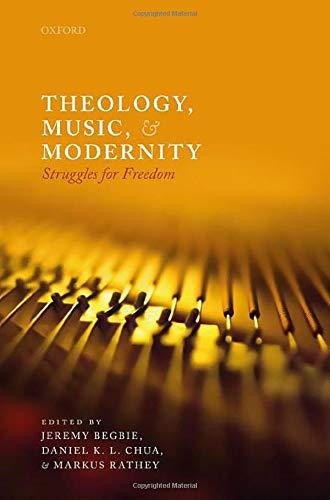
Edited by JEREMY BEGBIE DANIEL K. L. CHUA MARKUS RATHEY
1
Great Clarendon Street, Oxford, OX2 6DP, United Kingdom
Oxford University Press is a department of the University of Oxford. It furthers the University’s objective of excellence in research, scholarship, and education by publishing worldwide. Oxford is a registered trade mark of Oxford University Press in the UK and in certain other countries
The moral rights of the authors have been asserted
First Edition published in 2021
Impression: 1
All rights reserved. No part of this publication may be reproduced, stored in a retrieval system, or transmitted, in any form or by any means, without the prior permission in writing of Oxford University Press, or as expressly permitted by law, by licence or under terms agreed with the appropriate reprographics rights organization. Enquiries concerning reproduction outside the scope of the above should be sent to the Rights Department, Oxford University Press, at the address above
You must not circulate this work in any other form and you must impose this same condition on any acquirer
Published in the United States of America by Oxford University Press 198 Madison Avenue, New York, NY 10016, United States of America
British Library Cataloguing in Publication Data Data available
Library of Congress Control Number: 2020940553
ISBN 978–0–19–884655–0
DOI: 10.1093/oso/9780198846550.001.0001
Printed and bound by CPI Group (UK) Ltd, Croydon, CR0 4YY
Links to third party websites are provided by Oxford in good faith and for information only. Oxford disclaims any responsibility for the materials contained in any third party website referenced in this work.
Imogen Adkins studied music at the University of York, and musicology and theology at the University of Cambridge. Her PhD, overseen at Cambridge by Jeremy Begbie and Ben Quash, brought musical perception into conversation with kenotic theology. She teaches Philosophy and Religion at Stowe School and has written an interdisciplinary textbook with Richard Bourne, entitled Full-Bodied Theology: Experience and Encounter (Bloomsbury: T&T Clark, 2020). She is currently co-editing, with Stephen Garrett, the T&T Clark Companion to Theology and the Arts.
Awet Andemicael is Associate Dean of Marquand Chapel and Assistant Professor (adj.) of Theology at Yale Divinity School and the Institute of Sacred Music. An award-winning soprano, she has performed across North America, Europe, and Japan, and led music master classes and workshops in the US and France. As a theological scholar, she has served as a Visiting Lecturer at Yale University and the Université Chrétienne Bilingue du Congo (DRC), and a Visiting Scholar at Stellenbosch University, South Africa and the School of Theology, University of the South. Awet’s current research focuses on the second-century theologian Irenaeus of Lyons as a resource for contemporary theologies of glory and transformation. Publications include essays in the Anglican Theological Review, Worship, Pneuma, The Christian Century, and Forced Migration Review, as well as chapters in several edited volumes. Awet holds degrees from Harvard University, UC Irvine, the University of Notre Dame, and Yale University. For further information, visit: www.awetandemicael.com.
Charrise Barron is Assistant Professor of Africana Studies and Music at Brown University. She earned her PhD from Harvard University in African and African American studies, with a secondary field of study in ethnomusicology. She subsequently held postdoctoral fellowships at Yale University’s Institute of Sacred Music (ISM) and at Brown University. Additionally, she holds a Master of Divinity summa cum laude from Yale Divinity School, where she was also a student in the ISM. While her research, writing, and presentations have explored a range of topics in African American religion, music, and history, her current book project centres on contemporary gospel music. She is a Forum for Theological Exploration (FTE) Doctoral Fellowship alumna and a member of the Harvard University Society of Horizons Scholars.
Jeremy Begbie is Thomas A. Langford Research Professor in Theology at Duke Divinity School. He is also a Senior Member at Wolfson College, Cambridge, and an Affiliated Lecturer in the Faculty of Music at the University of Cambridge. He is Founding Director of Duke Initiatives in Theology and the Arts and his books include A Peculiar Orthodoxy: Reflections on Theology and the Arts, Redeeming Transcendence in the Arts: Bearing Witness to the Triune God, Theology, Music and Time, Resounding Truth: Christian Wisdom in the World of Music, and Music, Modernity, and God. He is an ordained minister of the Church of England and a professionally trained musician who has performed extensively as a
pianist, oboist, and conductor. He tours widely as a speaker, specializing in multimedia performance-lectures. Recent engagements have included preaching, speaking, and performing in universities and churches in North America, Hong Kong, and Australia.
Daniel K. L. Chua is the Mr and Mrs Hung Hing-Ying Professor in the Arts and Professor of Music at the University of Hong Kong. Before joining Hong Kong University to head the School of Humanities, he was a Fellow and the Director of Studies at St John’s College, Cambridge, and later Professor of Music Theory and Analysis at King’s College London. He is the recipient of the 2004 Royal Musical Association’s Dent Medal. He is currently the President of the International Musicological Society (2017–22). He has written widely on music, from Monteverdi to Stravinsky, but is particularly known for his work on Beethoven, the history of absolute music, and the intersection between music, philosophy, and theology.
John Hare is Noah Porter Professor of Philosophical Theology at Yale University. He has published a hundred articles and seven books, including The Moral Gap (Oxford 1996), which develops an account of the need for God’s assistance in meeting the moral demand of which God is the source, and God’s Command (Oxford 2015), which develops an account of how God’s command is differently seen in Christianity, Judaism, and Islam, but how all three faiths tie this command to moral obligation. His interests extend to ancient philosophy, medieval Franciscan philosophy, Kant, Kierkegaard, contemporary ethical theory, the theory of the atonement, medical ethics, and international relations (he has worked in a teaching hospital and for the Foreign Affairs Committee of the U.S. House of Representatives) and aesthetics (he is a published composer of church music). He received his BA from Oxford, and his PhD from Princeton, and he has taught at Lehigh University, University of Michigan, and Calvin College.
Julian Johnson is Regius Professor of Music at Royal Holloway, University of London, having formerly been Fellow and Tutor in Music at St Anne’s College, Oxford University (2001–7) and Lecturer in Music at the University of Sussex (1992–2001). In the early part of his career he combined research into musical aesthetics with working as a professional composer, an experience that continues to shape his thinking. His writing on music history has focused particularly on musical modernism but he has published widely on music from Beethoven through to contemporary music, in relation to philosophy, literature, visual art and landscape. His books include Out of Time: Music and the Making of Modernity (OUP, 2015) and After Debussy. Music, Language, and the Margins of Philosophy (OUP, 2019).
Patrick McCreless is Professor of Music, and formerly Chair of the Yale Department of Music (2001–7). Previously he taught at the Eastman School of Music, the University of Chicago (visiting appointment), and the University of Texas at Austin. His early work was on Wagner and the chromatic music of the later nineteenth century. He has also published on the history of music theory, rhetoric and music, performance and analysis, musical gesture, and the music of Shostakovich, Elgar, and Nielsen. He is a former President of the American Society for Music Theory, and was the keynote speaker at its annual conference in 2010. His work in sacred music is not scholarly, but practical: he has been Music Director and Organist at the First Presbyterian Church of New Haven since 1999.
Michael O’Connor, STL (Gregorian), D.Phil (Oxford), is Associate Professor, Teaching Stream, at the University of St Michael’s College in the University of Toronto, where he teaches in the Christianity and Culture programme. A former Warden of the Royal School of Church Music (RSCM), he is a Board member of RSCM Canada. His scholarship concerns early modern Christian intellectual culture, and contemporary debates on music, ritual, and liturgy. He is author of Cajetan’s Biblical Commentaries (Brill 2017) and co-editor, with Hyun-Ah Kim and Christina Labriola, of Music, Theology, and Justice (Lexington 2017). He is active as a choral conductor and occasional composer.
Markus Rathey is the Robert S. Tangeman Professor in the Practice of Music History at Yale University. His research focuses on the relationship between music, religion, and politics during the Enlightenment. His books include a study on C.P.E. Bach’s political compositions (Olms 2009), an introduction to J.S. Bach’s Major Vocal Works (Yale University Press 2016) and an extensive study of Bach’s Christmas Oratorio (Oxford University Press 2016). He has published numerous articles on music by Bach, Mozart, Schütz, Buxtehude, and their contemporaries in scholarly journals such as Eighteenth-Century Music, Early Music, Early Music History, Journal of Musicological Research, Bach-Jahrbuch, and SchützJahrbuch. He frequently serves as a commentator on J.S. Bach and on the relationship of music and religion for a number of major media outlets, including The Wall Street Journal, The Economist, BBC Radio, and Swedish Radio. Rathey is President of the American Bach Society and past President of the Forum on Music and Christian Scholarship. He currently serves on the editorial boards of BACH: Journal of the Riemenschneider Bach Institute and the Yale Journal of Music and Religion.
Stephen Rumph is Associate Professor of Music at the University of Washington. He has published two books with the University of California Press, Beethoven after Napoleon: Political Romanticism in the Late Works (2004) and Mozart and Enlightenment Semiotics (2011). He is completing The Fauré Song Cycles, also for UC Press, and is co-editing Fauré Studies for Cambridge University Press. He has published articles on Beethoven, Mozart, Fauré, eighteenth-century semiotics, and the musical philosophy of Vladimir Jankélévitch in the Journal of the American Musicological Society, Journal of the Royal Music Association, Music & Letters, 19th-Century Music, and other journals, and has chapters in Mozart Studies 2 and Mozart in Context (CUP) and the Oxford Handbook of Topic Theory. Stephen also performs regularly as a lyric tenor in opera, concert, and oratorio.
Chris Tilling is Graduate Tutor and Senior Lecturer in New Testament Studies at St Mellitus College. Chris co-authored How God Became Jesus (Zondervan, 2014) and is the editor of Beyond Old and New Perspectives on Paul (Cascade, 2014). Chris’s first book, the critically acclaimed Paul’s Divine Christology (Mohr Siebeck, 2012), is now republished by Eerdmans (2015). He is presently co-editing the T&T Clark Companion to Christology (forthcoming, 2019), and writing the NICNT commentary on the Second Epistle to the Corinthians (Eerdmans, forthcoming). Chris has published numerous articles on topics relating to the Apostle Paul, Christology, justification, the historical Jesus, Paul S. Fiddes, Karl Barth, the theology of Hans Küng, and more besides. He has appeared as a DVD media figure for Biologos, GCI, and HTB’s School of Theology and he co-hosts the popular podcast, OnScript. He enjoys playing golf and chess, and now works as an editor for a couple of chess publishing houses. He is married to Anja and has two children.
R. Larry Todd is Arts & Sciences Professor at Duke University. His books include Mendelssohn: A Life in Music, ‘likely to be the standard biography for a long time to come’ (New York Review of Books), and Fanny Hensel: The Other Mendelssohn, which received the Slonimsky Prize. A Fellow of the Guggenheim Foundation, he edits the Master Musician Series (OUP). He studied piano at the Yale School of Music and with Lilian Kallir, and issued with Nancy Green the cello works of the Mendelssohns (JRI Recordings). He has recently co-authored with Marc Moskovitz Beethoven’s Cello: Five Revolutionary Sonatas and Their World
Bettina Varwig is University Lecturer in Music at the University of Cambridge and Fellow of Emmanuel College. Previously she was Senior Lecturer in Music at King’s College London, where she also took her undergraduate degree. She gained her doctorate from Harvard University in 2006, and subsequently held a Fellowship by Examination at Magdalen College, Oxford (2005–8) and a British Academy Postdoctoral Fellowship at the University of Cambridge (2008–9). Her research focuses on seventeenth- and eighteenthcentury German musical culture, considering issues of musical performance and listening, musical expression, and histories of the body and the emotions. Her monograph Histories of Heinrich Schütz appeared with Cambridge University Press in 2011. Her work was awarded the Jerome Roche Prize of the Royal Musical Association in 2013 and the William H. Scheide Prize of the American Bach Society in 2016.
Norman Wirzba is Gilbert T. Rowe Distinguished Professor of Christian Theology at Duke Divinity School and a Senior Fellow at Duke’s Kenan Institute for Ethics. He pursues research and teaching interests at the intersections of theology, philosophy, ecology, and agrarian and environmental studies. He has published The Paradise of God: Renewing Religion in an Ecological Age, Living the Sabbath: Discovering the Rhythms of Rest and Delight, Way of Love: Recovering the Heart of Christianity, From Nature to Creation: A Christian Vision for Understanding and Loving Our World (with Fred Bahnson) Making Peace with the Land: God’s Call to Reconcile with Creation, and Food and Faith: A Theology of Eating. He is currently directing a multi-year project on rethinking academic disciplines in light of the Anthropocene.
Introduction
Jeremy Begbie, Daniel K. L. Chua, and Markus Rathey
What can the world of music bring to a theological reading of modernity? It was with that question in view that a group of theologians, musicologists, and music theorists met in 2015 under the auspices of Duke Initiatives in Theology and the Arts at Duke University, and the Institute of Sacred Music at Yale. We had little idea in advance of what the meeting would yield, but we soon realized that the benefits were going to be considerable. We were being pressed beyond our own comfort zones to think about familiar issues in fresh and highly fruitful ways, and we discovered multiple synergies we could never have predicted. A project began to take shape, and in due course was given the name ‘Theology, Music, and Modernity’ (TMM). We gathered for three major meetings over four years, and shared each other’s work for comment, encouragement, and criticism. We corresponded regularly and met in smaller groups when needed. The essays which follow are the result of those rich and fecund conversations.
We were not, of course, starting from scratch. The interplay between Christian theology and music has become increasingly lively and energetic in recent years, issuing forth in a growing stream of conferences, monographs, articles, and essays. It has taken a variety of forms. For example, there have been a number of attempts to adopt a theological perspective oriented toward the Scriptures, confessions, and traditions of the Church, and ask how this wisdom might ‘play out’ (or has already been played out) in the making and reception of music.1 Some of this writing is focused on particular musicians and their output, or specific musical periods,2 others on more general issues (e.g. the theology of song, music in worship).3 Others, while still operating within a Christian orientation, have
1 For example, Albert L. Blackwell, The Sacred in Music (Cambridge: Lutterworth Press, 1999); Jeremy S. Begbie, Resounding Truth: Christian Wisdom in the World of Music (Grand Rapids, MI: Baker Books, 2007).
2 For example, Andrew Shenton, Messiaen the Theologian (Farnham: Ashgate, 2010); Markus Rathey, Johann Sebastian Bach’s Christmas Oratorio: Music, Theology, Culture (New York: Oxford University Press, 2016). Chiara Bertoglio, Reforming Music: Music and the Religious Reformations of the Sixteenth Century (Berlin and Boston: Walter de Gruyter, 2017).
3 For example, Michael O’Connor, ‘The Singing of Jesus’, in Resonant Witness: Essays in Theology and Music, ed. by Jeremy S. Begbie and Steven R. Guthrie (Grand Rapids, MI: Eerdmans, 2011), pp. 434–53; Gordon Graham, ‘The Worship of God and the Quest of the Spirit: “Contemporary” versus
moved in the other direction, from music back to theology: how might the resources of music fruitfully enrich theological inquiry, help theologians do their job more effectively, perhaps even free them from some of their worst bad habits?4 Still others in the field find themselves motivated by cultural and apologetic concerns. For example, many claim to hear ‘rumours of transcendence’ in the world of music, and often in music far beyond the Church or any overtly Christian setting. This, it is said, provides a striking opportunity for creative dialogue with a culture often resistant to the overt articulation of the Christian faith.5 Likewise, some have sought to show that music with no explicit theological resonances can nonetheless give voice to searching questions, deeplyfelt existential drives and passions that call out for theological responses.6
TMM overlaps with all of these (and other) approaches. But the project has quite specific foci and interests in view. As we signalled at the start, the central question being posed is: how can the study of music contribute to the theological reading of modernity? It is a question that has received remarkably little attention to date. Among the leading scholarly studies of the theological trajectories of modernity—many of which we draw upon in this volume—music is largely overlooked. As one might expect, the influence of the natural sciences receives enormous attention, along with perspectives from philosophy, economics, politics, and sociology. Of the arts, fictional literature and poetry may make brief illustrative appearances, visual art may be given a passing glance, perhaps even film. But music—especially music without lyrics or specific textual references—is conspicuous by its absence. Central to the essays in this book is the conviction that the making and hearing of music, and the discourses surrounding music, can bear their own kind of witness to the theological dynamics that have characterized and shaped modernity, and especially with respect to modernity’s ambivalent relation to the God of the Christian faith. Music, that is to say, can provide a distinctive ‘theological performance’ of some of modernity’s most characteristic impulses and orientations.
This should not strike us as a particularly strange idea. Music has, after all, been ubiquitous in modern social life, and of considerable importance in framing and articulating ethnic, political, and economic identities. It has been intimately
“Traditional” Church Music’, in God’s Song and Music’s Meanings: Theology, Liturgy, and Musicology in Dialogue, ed. by Ben Quash, James Hawkey, and Vernon White (London: Routledge, 2020), pp. 81–93.
4 For example, Alastair Borthwick, Trevor Hart, and Anthony Monti, ‘Musical Time and Eschatology’, in Resonant Witness, pp. 271–94; Chelle Stearns, Handling Dissonance (Eugene, OR: Pickwick Publications, 2019); Clive Marsh, Cinema and Sentiment: Film’s Challenge to Theology (Milton Keynes: Paternoster Press, 2004); Jeremy S. Begbie, Theology, Music and Time (Cambridge: Cambridge University Press, 2000).
5 See, for example, David Brown and Gavin Hopps, The Extravagance of Music (Basingstoke: Palgrave Macmillan, 2018); Férdia StoneDavis, Music and Transcendence (Farnham: Ashgate, 2015).
6 Clive Marsh and Vaughan Roberts, Personal Jesus: How Popular Music Shapes Our Souls (Grand Rapids, MI: Baker Academic, 2012); Tom Beaudoin (ed.), Secular Music and Sacred Theology (Collegeville, MN: Liturgical Press, 2014).
intertwined with many of modernity’s most significant ideological upheavals and dilemmas, and its practitioners have at various times been pivotal agents of cultural change. The modern age has generated a vast corpus of scholarly writing on music, much of it engaging with some of life’s most momentous challenges. Moreover, given the pervasiveness of Christianity in shaping the language and culture of the modern West, theological issues of one sort or another have been heavily implicated in these musicalcultural interactions, even when not identified and acknowledged as such.
We have just spoken of music’s ‘own kind of witness’. This implies that music is possessed of a certain irreducibility. This may seem remarkably obvious, but in an age when reductionisms of all sorts are rife, it is worth underlining. Scott Burnham summarizes the point well:
precisely because music is musical, it can speak to us of things that are not strictly musical. This is how we hear music speak: not by reducing it to some other set of circumstances—music is simply not reducible to any other circumstances, whether cultural, historical, biographical, or sexual, and any attempt to make it so has only a cartoonish reality—but by allowing it the opacity of its own voice, and then engaging that voice in ways that reflect both its presence and our own, much as we allow others a voice when we converse with them.7
When those whose business it is to allow music ‘the opacity of its own voice’ find themselves meeting with theologians, there are inevitably going to be pointed and awkward questions which they ask of each other, and this will in turn often expose weaknesses and fragilities on both sides. In the long run, however, this is bound to be beneficial—as we have repeatedly found in our conversations. For the theologian: by engaging with the music and musical discourses of modernity, some of the most intractable theological dilemmas and pathologies of our time are laid bare, pathologies that have all too often disfigured modern theological writing. What is more, in some cases the world of music can provide means by which those very pathologies can be circumvented, perhaps even met and healed.
For those involved in the creation and understanding of music: by its very nature, theology will press us to penetrate down to the fundamental assumptions and presuppositions that shape a cultural phenomenon such as music, along with its theoretical disciplines. Facing these can only profit musicians, musicologists, and music theorists in the long term. And again, the benefits can go further: some of the most troublesome aporias and dilemmas surrounding music begin to look far less intractable when viewed theologically. All of this we hope will be clear from the essays in this collection.
7 Scott Burnham, How Music Matters: Poetic Content Revisited (Oxford: Oxford University Press, 2009), p. 215.
I. Modernity and Freedom
Inevitably, we have had to work with at least a minimal understanding of the much contested word ‘modernity’. For our purposes, the term is taken as referring primarily to a cluster of norms and mindsets inextricably bound up with social and cultural practices, that include, for example, particularly strong and prominent concepts of autonomy and human freedom; the notion of humans as ‘disembedded’ from, and standing over against, their physical environment; linear understandings of time and associated notions of progress; the privileging of a distinctive form of reasoning allied to bureaucratization, technological mastery, and industrialization; and an inclination to favour postreligious, even antitheological ‘metanarratives’.8 Many of these are especially associated with the eighteenthcentury intellectual current known as the Enlightenment, but they are by no means limited to that particular movement. Needless to say, modernity can be (and often is) understood in a related, secondary sense as naming a chronological phase or period—as in ‘the modern era’. There has been much dispute about where the border between premodern and modern should be taken as lying, and even more about where the socalled ‘postmodern’ or ‘late modern’ might begin. Here it is enough to say that the decisive changes of outlook evident with the advent of the Renaissance in the fourteenth and fifteenth centuries, carried forward in the sixteenthcentury Reformation, can usefully be interpreted as marking a shift from premodern to modern.
In what follows, we will deploy the term ‘modernity’ in both these senses, depending on the context. In any case, among the most farreaching of the developments associated with modernity is a distinctive imagination of freedom, and this is the major reason for choosing freedom as a coordinating theme for this book. Few passions characterize modernity more potently than humanity’s aspiration to freedom—and freedom of a very particular kind. As David Bentley Hart puts it,
the one grand cultural and historical narrative we as modern persons tend to share, and that most sharply distinguishes us from a premodern vision of society, is the story of liberation, the story of the ascent of the individual out of the shadows of hierarchy and subsidiary identity into the light of full recognition, dignity, and autonomy.9
8 As such, modernity should be clearly distinguished from what music historians speak of as ‘modernism’, a stylistic term used of music that first took shape in the late nineteenth and early twentieth centuries, associated especially with innovative figures such as Arnold Schoenberg (1874–1951) and Igor Stravinsky (1882–1971).
9 David Bentley Hart, ‘Christianity, Modernity, and Freedom’, in Tradition and Modernity: Christian and Muslim Perspectives, ed. by David Marshall (Washington, DC: Georgetown University Press, 2012), pp. 67–78 (p. 67).
In addition to its centrality to modernity, there are two related reasons why this concentration on freedom is especially appropriate for our purposes. First, as many studies have shown, the ways in which freedom is conceived in modernity have been inextricably linked to modernity’s negotiation of the Christian God. In intellectual history, divine and human freedom have persistently implicated each other, and perhaps never more so than in the last five hundred years. Debates continue to swirl around the question of the theological origins of the modern imagination of freedom, but few would deny that a theological genealogy is crucial to its rise. Second, music—both in theory and practice—has been deeply intertwined with the growth and elaboration of modern conceptions of freedom, as will become abundantly clear in the essays that follow.
Although we have just spoken of a ‘modern imagination of freedom’, it comes in numerous versions. Common to most, however, is a stress on freedom from, on being liberated from some form of constraint (tradition, the material world, our physical nature, other humans, or whatever), and with this often goes the assumption that freedom reaches its highest expression in the unfettered choice of the individual. As we will discover, music has often been enlisted to ‘sound out’ this kind of vision, and perhaps, in some cases, to shape and advance it. What needs to be borne in mind here is how much it diverges from most classical and medieval conceptions. In earlier, premodern traditions, freedom makes little sense without a telos or end in view (freedom for): freedom names the power that enables an entity to realize its true being, which in turn presupposes some kind of transcendent good or end to which that entity is properly directed. In this outlook, ‘We are free . . . not because we can choose but only when we choose well.’10 The capacity to choose lies not at the centre of what it is to be free, but serves a much higher and richer end: the actualization of one’s true end and purpose, a purpose inseparable from our relation to others—and, supremely, to God. As a number of our essayists make clear, this alternative vision resonates deeply with the Scriptural texts of the Christian faith, in contrast to the individualist and negative notions of liberty that have come to dominate so many modern discussions. Furthermore, as we shall see, music can offer its own kind of witness to these richer theological perspectives; musicians and writers on music have by no means always been captive to modernity’s more problematic traits.
To keep the discussion manageable, historically, we have chosen to concentrate on the years 1740–1850, and this for a number reasons. First, to state the obvious, this was a period when freedom—especially religious and political freedom— became a burning matter of concern in virtually every stratum of European society, as well as a focus of intense philosophical labour (Immanuel Kant (1724–1804) being perhaps the most towering figure in this respect). Second, during these years we witness considerable upheavals in the world of theology, involving an
10 Bentley Hart, ‘Christianity, Modernity, and Freedom’, p. 68.
often severe questioning of the central tenets of the Christian faith, not only in the Church, but also in newly developing scholarly circles (the founding of the University of Berlin in 1810 proved to be one of the most important events of the nineteenth century for virtually every field of enquiry). And many of these theological upheavals were bound up with influential emerging philosophies of freedom. Third, the period also sees no less momentous developments in the world of music. It covers the passage from what historians have come to call the Baroque, through the Classical, and eventually to the Romantic style. These innovations and transformations in European music did not occur in a vacuum, but—as we have already noted—were interwoven with (among other things) the profound negotiations of freedom that marked the social and cultural life of the time. They were also steeped in moral and metaphysical assumptions that by their very nature were theologically freighted. Finally, we have chosen 1740 rather than 1750 because, from a musicalhistorical perspective, the year 1740 roughly marks the transition from the Baroque to the preClassical era. While older historiographies have often chosen 1750 as a cutoff date (coinciding with the death of J.S. Bach in that year), more recent work has located the shift rather around 1740, with the music of composers such as C.P.E. Bach, Carl Heinrich Graun, Johann Joachim Quantz, and Franz Benda.
II. Freedom, Scripture, and New Creation
Theologically, the TMM project has been marked by a number of distinctive orientations—in the belief that more is learned by deliberately limiting and focusing a conversation like this than by attempting to be comprehensive. (This does not of course preclude other fruitful theological approaches.) The reader will find frequent recourse to the Christian scriptures. Curiously, many theological readings of modernity pay scant attention to the normative texts of Christianity. There seems to be a reluctance to consider not only the cultural impact of developments in biblical interpretation that mark the modern age, but also the benefits of attending afresh to particular texts without being wholly bound to the apparatus of Enlightenment and postEnlightenment hermeneutics. In this collection, the reader will find a number of attempts to show what a ‘Scriptural imagination’ might contribute to a fresh reading of modernity (in the company of musicians), one that includes, but goes beyond, historical commentary and analysis, and in so doing opens up fresh and perhaps more culturally hopeful possibilities for the future. In particular, the theological orientation of TMM is toward the concept of ‘New Creation’, a major current in the writings of St Paul, but implicit in virtually every book of the New Testament, and deeply rooted in the Hebrew Bible.11 Not
11 Key texts include Is. 65:17; Gal. 6:11–18; 2 Cor. 5:11–21; Rom. 8:18–25. For discussion, see, for example, Richard B. Hays, The Moral Vision of the New Testament (New York: HarperCollins, 2007); T. Ryan Jackson, New Creation in Paul’s Letters: A Study of the Historical and Social Setting of a Pauline
every contributor to this collection explicitly cites the theme, but it informs the overall shape and orientation of much of what follows. The New Creation, in biblical terms, speaks of God’s action to heal and remake the created order. It centres on the person of Jesus of Nazareth, in whom God’s future is believed to have broken into the present. The bodily raising of the crucified Jesus from the dead is the supreme act of the New Creation, a transformation of created matter in the midst of history, enacting a promise of the ultimate recreation of all things. What has happened in Christ, according to this outlook, has made possible a new life for humans in the present, a radical renewal of human nature that anticipates its final and complete renewal beyond death. Through the agency of God’s Spirit, this new life, inherently relational and corporate, can begin now: a New Creation in the midst of the old.
The New Creation theme is especially apt for our purposes. It is remarkably comprehensive and synthetic—gathering together a wide range of key motifs in biblical and classical Christian faith. It is geared towards the future, thus pressing one to think about ends—not least, the ends (and end) of human freedom. It is an inherently communal concept, countering the tendency to let our thinking about freedom circulate around the unimpeded agency of the individual. It has obvious resonances with artistic creativity. Not least, it goes very naturally with a host of musical procedures—the transformation of themes, resolution of dissonance, and so forth.
III. ‘Secularization’?
One further matter needs to be highlighted. We are dealing with a period that has often been associated with the phenomenon of ‘secularization’. This has received enormous attention in scholarly engagements with modernity, and the debate about its nature, its theological origins, and significance are hotly contested—as are the numerous terms associated with it (‘disenchantment’, ‘secularity’, and so on). Most are agreed that the social processes of differentiation, individualization, and privatization have radically shaped the form and outlooks of modern societies, encouraging, among other things, a waning influence of religion in shaping public affairs (as evinced, for example, in the notion of the ‘secular state’). On the musical front, modernity has been marked by a widespread emancipation of music from religious patronage, and in recent times, a reluctance on the part of ‘mainstream’ composers to deal with overtly religious subjectmatter. Today, matters of religion and theology are rarely engaged with in any depth by musicologists and music theorists, except perhaps when historical contextualization is required. Referring to our contemporary climate, Charles Taylor has written of
Concept (Tübingen: Mohr Siebeck, 2010); Mark D. Owens, As It Was in the Beginning: An Intertextual Analysis of New Creation in Galatians, 2 Corinthians, and Ephesians (Eugene, OR: Pickwick Publications, 2015).
the emergence of what he calls the ‘the immanent frame’, when ‘we come to understand our lives as taking place within a selfsufficient immanent order’,12 with no need to refer to any kind of transcendent power or presence. It is not hard to find extreme versions of this, closed form of ‘secularity’ that are hostile to religion of any kind.
On the other hand, there are some secularization narratives that are hard to sustain, and this needs to be borne in mind in what follows. The notion that the advances of industrial modernization inevitably issue in the progressive decline (and eventual disappearance) of religion is now widely regarded as untenable. Unfortunately, narratives of this kind have led many to overlook significant manifestations of religion in unexpected places. They have also wrongly implied that we are dealing with some steady trajectory towards stark unbelief rather than with something much more complex: a pluralization and reformation of religious commitments. Certainly, in the period we are examining, the kind of stark naturalism of the sort that denies the presence, activity, or even existence of any extraworldly reality, is relatively rare. (The French Enlightenment and the anticlerical French Revolution are often wrongly taken as standing for the Enlightenment as a whole.) Indeed, there is ample evidence of widespread and astonishing religious vitality as the seventeenth and eighteenth centuries take their course, even if such vitality was highly diverse, and by no means always recognizably Christian. What is more, there is also considerable evidence of the arts playing crucial roles in generating and furthering this ferment: this can range from offering periodic compensation for a felt loss of divine transcendence, through to providing a surrogate religion, complete with an overarching metaphysics. Music—as we will be reminded especially in Part II—could readily be enlisted to play a quasireligious role. It was often invoked for its seemingly immense theological potency in a world bewitched by the ascendance of scientific, instrumental reason. What kind of weight we give to these accounts of music depends very much on the kind of theology we bring to the table. But that music did function in this way is undeniable, and much can be learned from this about the roles music might be playing, or could play in our own day.
IV. Arrangement
The book is arranged into four parts, each taking a particular musical work or corpus of music as its major reference point. In Part I, the theme of ‘revolutionary freedom’ is taken up and explored, with particular reference to Beethoven’s Eroica symphony. Part II takes its cue from the journey of Bach’s St. Matthew Passion out of its original church setting in 1727 to the concert hall of Berlin’s Singakademie
12 Charles Taylor, A Secular Age (Cambridge, MA: Harvard University Press, 2007), p. 543.
in 1829, examining the way in which fundamentally different concepts of freedom were implicated. Attention turns in Part III to the theme of justice, in particular to the social and political freedom embodied in the life and music of Richard Allen (1760–1831), founder of the African American Methodist Church, the first independent black denomination in the United States. And in the final group of essays, Part IV, with reference to Haydn’s Creation, the focus is on music’s relation to language, specifically on the extent to which music can mediate a distinctive kind of freedom, one which an overreliance on certain kinds of language can easily eclipse.
Our debts of gratitude are immense. TMM has been generously funded by the McDonald Agape Foundation, whose vision for the project has been unstinting from start to finish. The Foundation’s Vice Chairman and President, Peter McDonald, has attended all of our main meetings and been consistently supportive. Yale’s Institute of Sacred Music was kind enough to host several of the gatherings as well as provide generous financial support. We are especially grateful to its Director, Martin Jean, for his probing questions and gracious hospitality, as well as to Kristen Forman for her superlative administration. At Duke, the Associate Director of Duke Initiatives in Theology and the Arts, Daniel Train, has provided wise advice on numerous fronts, along with considerable administrative assistance, and Hillary Train has handled numerous practical matters with her customary grace and diplomacy. TMM is part of a larger project, ‘Theology, Modernity, and the Arts’, whose Steering Group has offered valuable advice at every stage. In particular, the work of poet Micheal O’Siadhail, The Five Quintets, has proved crucial for inspiring the overall shape of the enterprise. We would also like to thank Tom Perridge of Oxford University Press for his support at every stage of the publishing process. Finally, Alice SoulieuxEvans and Louise McCray have taken on the lion’s share of the editing and formatting: without their endless patience and determination this book would never have seen the light of day.
Jeremy Begbie
Daniel K. L. Chua
Markus Rathey
Bibliography
Beaudoin, Tom (ed.), Secular Music and Sacred Theology (Collegeville, MN: Liturgical Press, 2014).
Begbie, Jeremy, Theology, Music and Time (Cambridge: Cambridge University Press, 2000).
Chua, and Rathey
Begbie, Jeremy, Resounding Truth: Christian Wisdom in the World of Music (Grand Rapids, MI: Baker Books, 2007).
Bentley Hart, David, ‘Christianity, Modernity, and Freedom’, in Tradition and Modernity: Christian and Muslim Perspectives, ed. by David Marshall (Washington, DC: Georgetown University Press, 2012), pp. 67–78.
Bertoglio, Chiara, Reforming Music: Music and the Religious Reformations of the Sixteenth Century (Berlin; Boston: Walter de Gruyter, 2017).
Blackwell, Albert L., The Sacred in Music (Cambridge: Lutterworth Press, 1999).
Borthwick, Alastair, Trevor Hart, and Anthony Monti, ‘Musical Time and Eschatology’, in Resonant Witness: Essays in Theology and Music, ed. by Jeremy S. Begbie and Steven R. Guthrie (Grand Rapids, MI: Eerdmans, 2011), pp. 271–94.
Brown, David and Gavin Hopps, The Extravagance of Music (Basingstoke: Palgrave Macmillan, 2018).
Burnham, Scott, How Music Matters: Poetic Content Revisited (Oxford: Oxford University Press, 2009).
Graham, Gordon, ‘The Worship of God and the Quest of the Spirit: “Contemporary” versus “Traditional” Church Music’, in God’s Song and Music’s Meanings: Theology, Liturgy, and Musicology in Dialogue, ed. by Ben Quash, James Hawkey, and Vernon White (London: Routledge, 2020), pp. 81–93.
Hays, Richard B., The Moral Vision of the New Testament (New York: HarperCollins, 2007).
Jackson, T. Ryan, New Creation in Paul’s Letters: A Study of the Historical and Social Setting of a Pauline (Tübingen: Mohr Siebeck, 2010).
Marsh, Clive, Cinema and Sentiment: Film’s Challenge to Theology (Milton Keynes: Paternoster Press, 2004).
Marsh, Clive, and Vaughan Roberts, Personal Jesus: How Popular Music Shapes Our Souls (Grand Rapids, MI: Baker Academic, 2012).
O’Connor, Michael, ‘The Singing of Jesus’, in Resonant Witness: Essays in Theology and Music, ed. by Jeremy S. Begbie and Steven R. Guthrie (Grand Rapids, MI: Eerdmans, 2011), pp. 434–53.
Owens, Mark D., As It Was in the Beginning: An Intertextual Analysis of New Creation in Galatians, 2 Corinthians, and Ephesians (Eugene, OR: Pickwick Publications, 2015).
Rathey, Markus, Johann Sebastian Bach’s Christmas Oratorio: Music, Theology, Culture (New York: Oxford University Press, 2016).
Shenton, Andrew, Messiaen the Theologian (Farnham: Ashgate, 2010).
StoneDavis, Férdia, Music and Transcendence (Farnham: Ashgate, 2015).
Taylor, Charles, A Secular Age (Cambridge, MA: Harvard University Press, 2007).
PART I
REVOLUTIONARY FREEDOM
Few composers are associated with human freedom as closely as Ludwig van Beethoven (1770–1827). His third Eroica Symphony, in particular, has been widely linked to a distinctively modern notion of freedom (inspired especially by the French Revolution): the freedom of the ‘heroic’ individual subject driven by an indomitable will. It is hard to deny the enormous influence of such a notion in almost every sphere of culture, even though it appears in many forms. It has had a significant part in shaping modern Christianity, but in much recent writing has come under heavy theological fire, especially on biblical grounds. In his opening essay, Daniel Chua gives an account of ‘revolutionary’ freedom as a potent confluence of agency and style, one that was given philosophical impetus by the work of Immanuel Kant (1724–1804), and enacted in the epic struggles of Beethoven’s third symphony. Chua views this autonomous, non-relational freedom as, in effect, a secularized theology, and contrasts it sharply with the freedom of the ‘new creation’ of the New Testament (even though he detects a ‘twist’ in the Eroica that gestures towards a far more gracious, love-oriented notion of freedom). John Hare sees Kant in a rather more sympathetic light, and explores Beethoven in relation to the philosopher’s theologically grounded account of the sublime, a concept rather more complex than is often thought, and integrally bound up with Kant’s understanding of freedom. Hare contends that in Beethoven’s ‘A Major Piano Sonata’ of 1796, as well as in the first movement of the Eroica, we can discern musical dynamics that are highly consonant with what Hare calls Kant’s ‘optimistic’ sublime. Chris Tilling presents an account of freedom in the thought of Paul the Apostle that contrasts with the ‘revolutionary’ tradition described by Chua. For Paul, authentic human freedom centres not on the capacities of the singular human will, but on what has been made possible through God’s climactic work in the life, crucifixion, and resurrection of Christ. To be free is not so much to assert as to receive; more fully: to participate by the Spirit in Christ’s own risen life, the one in whom the ‘dark mesh of evil powers’ that enslave us have been
decisively defeated. Such participation means inhabiting a new realm—a ‘new creation’. This is inherently relational and communal: it entails belonging to Spirit-formed communities characterized by an other-directed love rooted, ultimately, in the triunity of God. Tilling goes on to reflect on the implications of this vision for a theological-musical engagement with modernity. Taking her cues from the other three essayists, Imogen Adkins exposes the zero-sum thinking (‘the more of God, the less of us’) that she believes pervades much discussion of freedom in modernity, and especially when the ‘revolutionary’ model is in view. She argues that the aural phenomenon of simultaneously sounding tones offers a powerful means of re-imagining freedom, opening up the relational character of freedom of the sort outlined by Tilling. In particular, she proposes that, understood from this perspective, music can enhance our understanding of Christ’s expression of divine freedom as a ‘kenotic’ emptying of self for the sake of the other.
It is clear that the main protagonists in this account of revolutionary freedom— Beethoven and Kant—left an ambivalent legacy. On the one hand, they (and their works) can be regarded as enacting a revolutionary fervour, commending a kind of freedom uprooted from Christian theological soil; on the other hand, they can be regarded as defenders of the faith, attempting to modernize theological concepts. (The Eroica itself betrays such an ambivalence, with Napoleon’s name on the dedication page of the autograph score scratched out by Beethoven.) These essays are embedded in the interplay of this complex situation. They may not resolve all the tensions, but they do offer a musico-theological diagnosis of modern freedom, and the possibility of re-imagining freedom’s most basic shape.
1
Revolutionary Freedom
An Image of Musical Autonomy in Beethoven
Daniel K. L. Chua
This chapter defines the freedom of the French Revolution through its aesthetics because this ugliest of freedoms was also one of the most beautiful. The pandemonium it caused was directed by the most disciplined principles of form. To define revolutionary freedom through its images and sounds is therefore to understand the fabrication of the aesthetic as an authentic mode of being that still defines what human freedom means today.
I. Im-Posing
The French Revolution (1789) replaced an absolute monarch with what G. W. F. Hegel (1770–1831) called ‘Absolute Freedom’. It was the most abstract of freedoms, a general will that wreaked havoc in obedience to a principle as indifferent as ‘chopping the head of a cabbage’.1 Its cutting-edge virtues were terrifying, meting out death equally and liberally under its sovereign rule. Despite its effect, such sovereignty, as Jean-Jacques Rousseau (1712–78) noted, could not be represented.2 Or rather, it was beyond representation; absolute freedom was sublime in the magnitude of its historical task and ineffable as a universal force. Its identity could not be pinned down by the pockets of gratuitous violence that dotted the landscape of France because there was no human perspective to view the revolutionary spectacle on the vast stage of history. And yet it had to be staged. Like the absolute body of Louis XIV, absolute freedom needed a body to enter the social imaginary.3 Its abstract, metaphysical ideals had to be dressed up
1 G.W.F. Hegel, Phenomenology of Spirit, trans. by A.V. Miller (Oxford: Clarendon Press, 1977), p. 360 (§590).
2 Jean-Jacques Rousseau, Social Contract, in The Social Contract and Discourses, trans. by G.D.H. Cole (London: Dent, 1993), p. 266.
3 See Charles Taylor, Modern Social Imaginaries (London and Durham, NC: Duke University Press, 2004).
and turned into a theatrical act, with gestures as ceremonial as the Catholicism it denounced and as grandiose of the grand operas of the ancien régime. And so it was that absolute freedom became a style, or, more precisely, a fashion icon that gave a glimpse of its transcendence through the chaos that followed its wake. The unrepresentable became a pose to be adopted by its disciples, a revolutionary act that was as aesthetic as it was political, and as beautiful as it was terrifying.4
But it would be a mistake to regard it as merely a pose or only a style, as if the Revolution dressed up liberty with a beauty spot, for the late eighteenth century was the age of style itself. The neoclassicism that shaped the period was not simply a matter of appropriating the classical models of the past as a façade, but staged its style as the very substance of experience.5 It was what Foucault would call a ‘technology of the self’, enabling individuals to reconfigure themselves as objects of knowledge.6 Style was identity. The pose had agency. And freedom— the identity of the revolutionary agent—was the perfect pose and the ultimate style. In this sense, the pose was less a fashion statement than a secularized theology—an imitation of Christ—except that it was no longer Christ, but the revolutionary hero who, in modelling freedom, became the image for humanity. Just as the Christian had to ‘put on Christ’, the revolutionary hero had to put on freedom as ‘a new creation’. Akin to a type of spiritual armour, freedom was a permanent identity that hardened as the exoskeleton of the new man, so that his style was more than just skin deep: it was structural. The external pose spoke of an inner power for a spiritual battle against the forces of the world.7
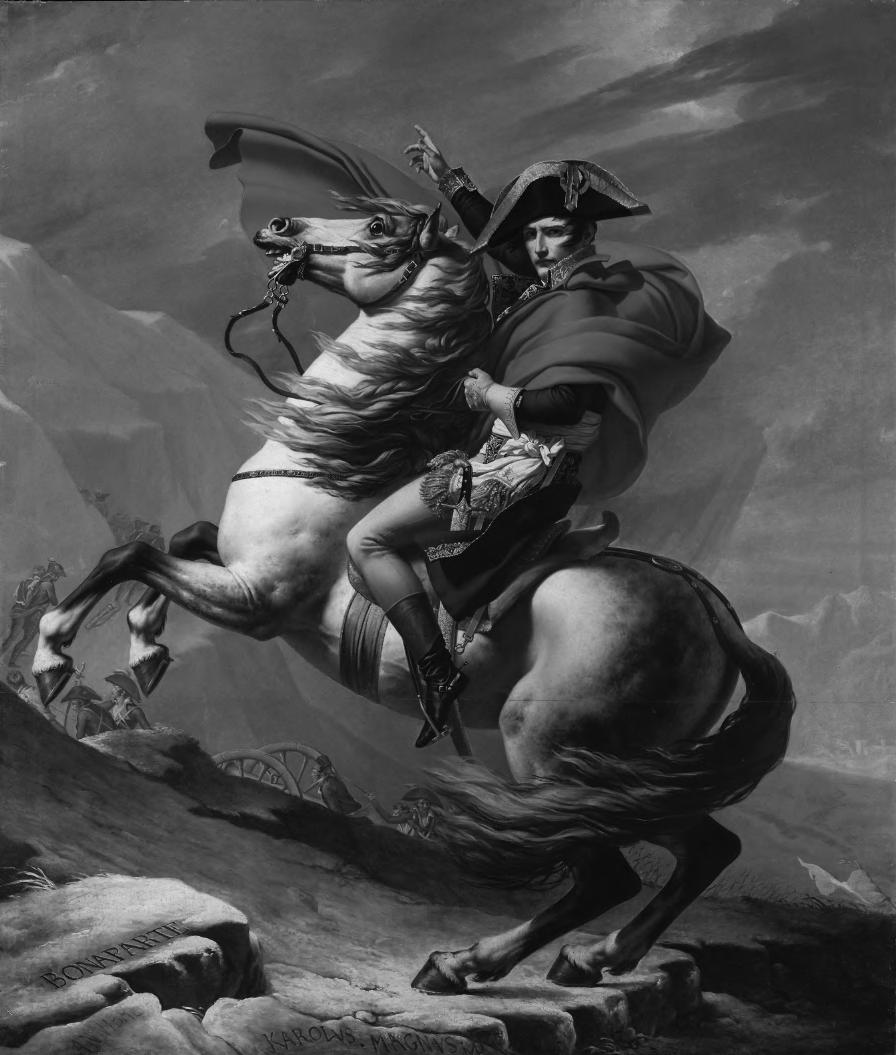
What did this revolutionary pose look like? Ironically, the model for such a heightened sense of historical progress was more ancient that the ancien régime: the Roman Republic was the neoclassical style designed to capture the spirit of modern freedom. Jacques-Louis David (1748–1825) was the master of depicting these revolutionary poses. He animated on canvas the virile, impenetrable bodies of heroes, striking perfectly structured poses of liberty: these men were lean, mean statuesque machines. Take Napoleon Crossing the Alps (1801–5), for example (Figure 1.1).
4 See Paul Friedland, Political Actors: Representative Bodies and Theatricality in the Age of the French Revolution (Ithaca: Cornell University Press, 2011).
5 François Hartog, Régimes d’historicité: Présentisme et experiences du temps (Paris: Le Seuil, 2004); Reinhart Koselleck, Futures Past: On the Semantics of Historical Time, trans. by Keith Tribe (New York: Columbia University Press, 2004). The period witnessed a new sense of time, a struggle between the experience and expectations of progress; the stylization of the past was not so much nostalgia, as an attempt to make present a new identity that could enact this new sense of history.
6 Michel Foucault, Technologies of the Self: A Seminar with Michel Foucault (Amherst: University of Massachusetts Press, 1988). Initially these technologies of self-intervention were religious practices, but in the context of the French Revolution and its aftermath, these practices were modernized and secularized in aesthetic terms, as this chapter will make clear. On music as a ‘technology of the self’, see Tia De Nora, Music in Everyday Life (Cambridge: Cambridge University Press, 2000).
7 See Rom. 13:14, Gal. 3:27, Eph. 4:24, Col. 3:10.
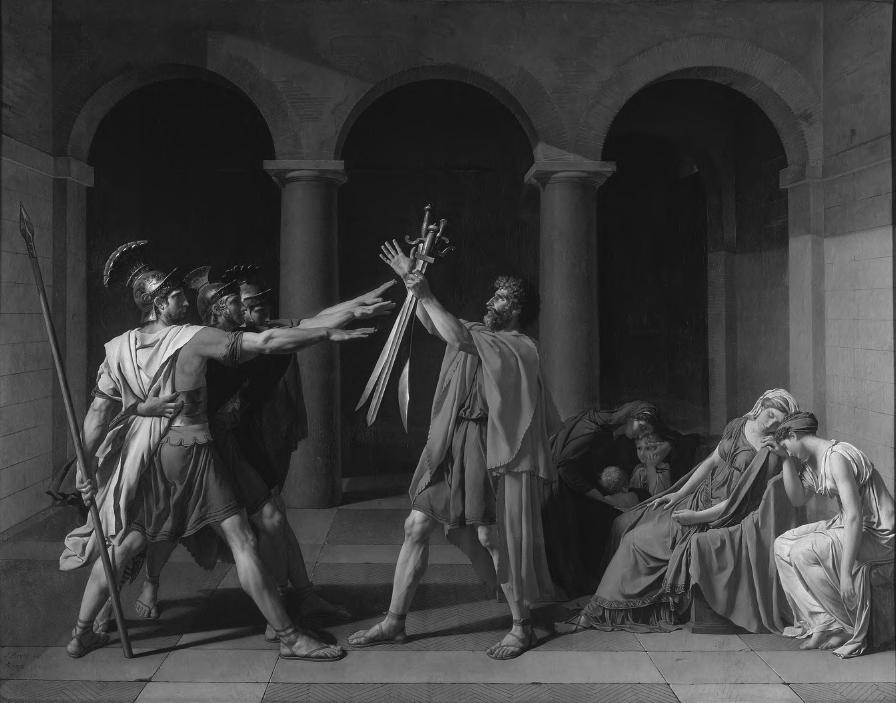
Frozen almost in mid-air, Bonaparte rears his stallion at speed, as if flying with the wind across the treacherous terrain; he poses with a balletic grace that speaks of total mastery. His troops, in contrast, appear more pedestrian, as if down-trodden by the hooves of the hero’s horse in the foreground, their boots seemingly clogged up by the ground on which they trudge, and their bodies swallowed up by the rocks that loom around them. They are the moving backdrop of circumstance for the Napoleonic ‘still’ to transcend as a heroic monument. Or take the three brothers in the Oath of the Horatii (1784); they swear their allegiance unto death not so much with words as with their taut angular bodies
standing erect, displaying an architectural indifference that contrasts with the collapsed curves of women swooning in the corner as if their reaction represented a by-gone aesthetic of sentimentality (Figure 1.2).
Revolutionary freedom defines itself as the unmoved against the moved; it is about action as opposed to re-action, masculine resolve as opposed feminine feeling. It is a freedom that divides through discipline, defining itself by excluding the weak and unprincipled. This binary contrast is sharply delineated in David’s portrayal of The Death of Socrates (1787). Freedom is an internal scaffold within the philosopher’s body; it tightens his torso with a stoical force that sits the philosopher up at right-angles to the swirling commotion around him. The heroic will is staged without movement. The blind e-motion of his disciples, who can barely watch the act of self-execution, contrast with the motionless gaze of their master as he takes the cup of death for a higher cause. Socrates points out this cause with his left hand (Figure 1.3), gesturing to some unrepresentable will ‘up there’ that organizes an invisible will within his body.
All these poses are predicated on a contradiction. Revolutionary freedom flaunts its power through a kind of heroic posturing that, for all its death-defying antics, is an act of monumental rigor mortis; the pose is a ‘still’, designed to capture the immortal moment in which the hero changes the course of the world. In seizing history, he seizes up as a perfect form that immortalizes his act in the