TheUSNavyandtheNationalSecurity Establishment:ACriticalAssessmentJohnT. Hanley
https://ebookmass.com/product/the-us-navy-and-the-nationalsecurity-establishment-a-critical-assessment-john-t-hanley/
Instant digital products (PDF, ePub, MOBI) ready for you
Download now and discover formats that fit your needs...
Critical Security Studies in the Digital Age: Social Media and Security Joseph Downing
https://ebookmass.com/product/critical-security-studies-in-thedigital-age-social-media-and-security-joseph-downing/
ebookmass.com
The British Navy in Eastern Waters: The Indian and Pacific Oceans John D. Grainger
https://ebookmass.com/product/the-british-navy-in-eastern-waters-theindian-and-pacific-oceans-john-d-grainger/
ebookmass.com
The Palgrave Handbook Of National Security 1st Edition Michael Clarke
https://ebookmass.com/product/the-palgrave-handbook-of-nationalsecurity-1st-edition-michael-clarke/
ebookmass.com
EuroTragedy: A Drama in Nine Acts Ashoka Mody
https://ebookmass.com/product/eurotragedy-a-drama-in-nine-acts-ashokamody/
ebookmass.com
Power and Liberty: Constitutionalism in the American Revolution Gordon
S. Wood
https://ebookmass.com/product/power-and-liberty-constitutionalism-inthe-american-revolution-gordon-s-wood/
ebookmass.com
Pathologie générale : enseignement thématique. Biopathologie tissulaire, cellulaire et moléculaire (3ème édition) Le cours - Exercices corrigés. Jean-François
Emile https://ebookmass.com/product/pathologie-generale-enseignementthematique-biopathologie-tissulaire-cellulaire-et-moleculaire-3emeedition-le-cours-exercices-corriges-jean-francois-emile/ ebookmass.com
Computing Possible Futures: Model-Based Explorations of “What if?” William B. Rouse
https://ebookmass.com/product/computing-possible-futures-model-basedexplorations-of-what-if-william-b-rouse/
ebookmass.com
Possess Me: A Dark Mafia Romance (Masters of Corsica) Jane Henry
https://ebookmass.com/product/possess-me-a-dark-mafia-romance-mastersof-corsica-jane-henry/
ebookmass.com
The Vanished Days Susanna Kearsley
https://ebookmass.com/product/the-vanished-days-susanna-kearsley-4/
ebookmass.com
https://ebookmass.com/product/international-business-in-australiabefore-world-shaping-a-multinational-economy-simon-ville/
ebookmass.com
The US NAVY and the National Security Establishment
The US NAVY and the National Security Establishment
A Critical Assessment
John T. Hanley, Jr.
Published in the United States of America in 2023 by Lynne Rienner Publishers, Inc.
1800 30th Street, Suite 314, Boulder, Colorado 80301 www.rienner.com
and in the United Kingdom by Lynne Rienner Publishers, Inc.
Gray’s Inn House, 127 Clerkenwell Road, London EC1 5DB www.eurospanbookstore.com/rienner
© 2023 by Lynne Rienner Publishers, Inc. All rights reserved
Library of Congress Cataloging-in-Publication Data
Names: Hanley, John T., Jr., author.
Title: The US Navy and the national security establishment : a critical assessment / John T. Hanley, Jr.
Other titles: United States Navy and the national security establishment
Description: Boulder, Colorado : Lynne Rienner Publishers, Inc., [2023] | Includes bibliographical references and index. | Summary: “To explain why the US Navy seems ill-suited to face today’s global challenges, the author explores how the navy has negotiated its place in the broad national security establishment in the decades since World War II”— Provided by publisher.
Identifiers: LCCN 2023007689 (print) | LCCN 2023007690 (ebook) | ISBN 9781685858520 (hardcover) | ISBN 9781685856489 (ebook)
Subjects: LCSH: United States. Navy—History. | Sea-power—United States—History. | National security—United States—History—21st century. | Naval strategy—History.
Classification: LCC VA58.4 .H3624 2023 (print) | LCC VA58.4 (ebook) | DDC 359/.030973—dc23/eng/20230414
LC record available at https://lccn.loc.gov/2023007689
LC ebook record available at https://lccn.loc.gov/2023007690
British Cataloguing in Publication Data
A Cataloguing in Publication record for this book is available from the British Library.
Printed and bound in the United States of America
The paper used in this publication meets the requirements of the American National Standard for Permanence of Paper for Printed Library Materials Z39.48-1992.
5 4 3 2 1
Dedicated to Lieutenant Jack J. Hanley, US Navy Chief Engineer, USS Spruance (DDG 111)
Tables and Figures
Table
5.11990s Acquisition Reforms209
Figures
1.1Extended Schelling Influence Framework9
2.1Prussian System of Military Instruction34
2.2Navy Society for Naval Influence and Campaign of 56 Learning Before World War II
2.3Methods Involved in the Navy Campaign of 57 Learning Before World War II
3.1The Navy Ecosystem During the Cold War 96
3.2Society of Learning for Submarine Force Development106
3.3Submarine Force Campaign of Learning107
3.4Navy Society That Produced the 1980s Maritime Strategy109
3.51980s Maritime Strategy Campaign of Learning 116
4.1Process for Naval Warfare Innovation 138
4.2Naval War College–SSG–Naval Warfare Development 158 Command Relationships
4.3Intended SSG–Naval Warfare Development 161 Command Interactions
6.1Features of Complex Adaptive, Nonlinear Dynamic 221 Security Ecosystem
6.2Robust Layered System 224 ix
x Tables and Figures
6.3Conflicting Government-Contractor Incentives 235
6.4Conflicting MICE Incentives235
6.5Conflicting Objectives Within the DoD236
6.6Readiness, Regional Engagement, and 242 Retaining Advantage Architecture
7.1Adapting Paradigms 302
The US Naval Ecosystem
How should the US Navy adapt to an age of information and artificial intelligence? In particular, what actions will enhance resilience and diminish fragility in competition with China in both the near and the long term?
To understand where one stands, one must appreciate how one arrived where they are. To understand what the navy should be and do, one must understand why the United States established and maintains a navy, and how the navy has evolved as an agent in a changing national security ecosystem.
The substance of the navy emerges from interactions among a broad set of agents, including the president as commander in chief of the armed forces, Congress, industry, individuals and organizations in the national security establishment within the executive branch, and agents within the navy that affect the building blocks that form the navy. These building blocks consist of materiel platforms and systems that evolve with technology, organizations that direct the operations of those platforms and systems along with their personnel, and the organizations responsible for evolving the navy to remain fit for its roles and survive as the security environment changes.
Combat provides the ultimate test. How well the navy and the national security establishment perform in combat depends not only on materiel force structures but also on the state of their environment and intellectual preparation. The major occupation of the US Navy over the centuries has been to influence events around the globe to mitigate others’ motives that lead to combat and to enhance the likelihood of success should combat ensue. Success in dealing with Chinese ambitions
2 The US Navy and the National Security Establishment
requires examining the paradigm of war and peace as a finite game, and influence as an infinite game.
Over the five decades prior to World War II, the navy evolved into a learning organization, resulting in the construction of forces and operational schemes and the intellectual preparation of leaders that provided the foundations for winning the war. Changes in the national security establishment following the war led to fewer interactions among the agents within the navy that had constituted that learning society. Analytical paradigms that had emerged from operations research in World War II morphed into techniques for analyzing costs and benefits of alternative materiel systems. This intellectual foundation for equipping US military forces became embedded during the Cold War and has persisted, but it is ill suited for an age dominated by information and artificial intelligence and has led to fragilities that jeopardize the navy and the national security establishment.
The imperative of adapting to rapidly emerging threats from China and others has resulted in recent initiatives to resurrect learning in the navy and the national security establishment. This book highlights practices that have led to successful learning societies and offers frameworks for evolving an antifragile national security environment where small investments provide high returns.
The Enduring Roles and Posture of the US Navy
Article 1, Section 8 of the US Constitution grants Congress the power to provide and maintain a navy. The United States maintains a navy because it learned early that it needs one to protect its interests, short of declaring war. Achieving peace with Britain following independence removed the threat of the Royal Navy, but it also left US merchant ships without its protection.
When Algerian corsairs seized two US ships in 1785 and enslaved twenty-two crewmen, Thomas Jefferson, who was stationed in Paris as minister to France, proposed to John Adams that they build a fleet with 150 guns. Though he had not had the votes to defeat a $1.4 million navy budget in 1798, while campaigning for president at the head of a fiercely anti-navalist Republican Party in 1800 Jefferson declared himself in favor of “such a naval force only as may protect our coasts and harbor.”1 Then, in May 1801, shortly after becoming president, Jefferson decided to send a navy squadron to the Mediterranean to protect American merchant ships. Republicans abandoned their anti-navalism
after the small US fleet shocked and humbled the mightiest navy the world had ever known in the War of 1812. 2 Madison continued operations against the Barbary pirates immediately after the war. Paraphrasing Jefferson, from its founding, the US Navy has existed to provide justice in international relations, defend American honor, and procure international respect to safeguard US interests.3
In 1787, Jefferson’s nemesis Alexander Hamilton had also argued for a navy. In Federalist No. 11, “The Utility of the Union in Respect to Commercial Relations and a Navy,” Hamilton highlighted the important relationship between a navy and the economic success of a nation, the need for a navy as a “resource for influencing the conduct of European nations toward us,” and the navy’s domestic relationship with the people of the United States. “Before anyone proposed a State Department to conduct foreign affairs or suggested other mechanisms of national security, Hamilton first believed that the United States needed a strong navy.”4
Over its entire history, the navy has deployed and maintained squadrons and, after World War II, fleets of ships around the world.5 It maintained a squadron in the Mediterranean, deployed ships to the eastern Atlantic and Caribbean, and had a frigate deployed to the Pacific through 1815. From 1841 through 1898, with the exception of the Civil War, it had squadrons in East India/Asiatic, the Pacific (South American coast), Brazil/South Atlantic, Africa (Gulf of Guinea), and the Mediterranean. It maintained the Asiatic squadron even during the Civil War. A buildup of foreign navies in the later nineteenth century presaged a renewal of great power competition. The prominent naval officer and strategist Alfred Thayer Mahan promoted concentrating the fleet for a decisive battle. The navy reorganized into Asiatic and European squadrons, with a US Fleet and Special Service Squadron. This remained the basic structure until World War II, during which it organized into Atlantic and Pacific Fleet commands, with subordinate numbered fleets, under commander in chief and chief of naval operations Admiral Ernest King. Following World War II, fleets rather than squadrons deployed to geographic areas around Eurasia, with excursions to promote US influence around the globe.
Balancing and Aligning Symbiotic Navy Strategies
The navy and the national security establishment employ mutually dependent readiness, engagement, and equipping strategies for applying available resources to objectives. Readiness strategies involve mentally
4 The US Navy and the National Security Establishment
preparing personnel through education and training, and organizing and maintaining existing forces for combat. The navy employs engagement strategies to exert its influence. Clarifying the terms engagement, influence , and presence is also important. Forward stationed and deployed naval forces are commonly referred to as providing presence. Engagement connotes the interactions necessary to exert influence, whereas presence does not. Concepts for how to influence the prevention of war and to prevail in war provide the foundations for assessing readiness. Equipping strategies modernize materiel to sustain fitness as the security environment evolves. Where the readiness and engagement strategies address how to apply naval capabilities to advance national interests, the equipping strategy addresses how to apply fiscal and administrative resources to provide those naval capabilities that provide the means for executing the readiness and engagement strategies. The process for evolving the organizational relationships among the agents within the navy is under the purview of the chief of naval operations (CNO). Each CNO tinkers with the organization to align with his (or in the future, her) priorities. The secretary of the navy has greater influence over equipping than readiness and engagement strategies. Just as the strategies are mutually dependent, the secretary and the CNO are dependent upon each other for the success of the institution.
Beginning in the 1970s, CNO Admiral Elmo Zumwalt began to question whether the navy could defeat the Soviet navy, as his budget required retiring large numbers of World War II–era ships without replacements. The result was an active fleet of fewer than 500 ships while the Soviets continued expanding their navy and merchant fleets.6 In the 1980s, President Ronald Reagan’s administration with Secretary of the Navy John Lehman called for building the navy back up to 600 active ships.7 At the end of the Cold War in 1990, chairman of the Joint Chiefs General Colin Powell proposed reducing the navy to 400 ships.8 Following the election of Bill Clinton to president, his secretary of defense Les Aspin conducted a Bottom-Up Review to examine defense strategy, force structure, and other aspects driving the defense budget. Aspin’s 1993 review included overseas presence as a sizing requirement for military forces. It recommended a fleet of 346 ships by 1999.9 CNO Admiral Frank Kelso tasked his staff to include presence as a mission area and to study the issue. He also had his 1993–1994 Strategic Studies Group study the value of forward presence and look for ways to sustain it in support of regional interests and policy goals.10 In September 2000, Washington Post journalist Dana Priest wrote a series of articles on how the regional combatant commanders (then called commanders in chief) had become proconsuls with
their own foreign policies, similar to the Roman empire.11 Concerns grew over how to sustain the general intent of Jefferson’s and Hamilton’s roles for the Navy with fewer ships in a post–Cold War environment, as well as the roles of the regional combatant commanders.
Sensing a hiatus from expected major combat operations, Andrew Marshall (director of net assessment in the Office of the Secretary of Defense [OSD]) encouraged thinking about a revolution in military affairs, similar to the years between the world wars that produced navy underway refueling, and amphibious and carrier air warfare.12 In 1995, CNO Admiral Jeremy “Mike” Boorda changed the mission of the CNO Strategic Studies Group (SSG) to revolutionary naval warfare innovation. 13 In 2001, Secretary of Defense Donald Rumsfeld reached out to president of the Naval War College Vice Admiral Arthur Cebrowski (father of netcentric warfare) to lead an Office of Force Transformation in OSD aimed at implementing the kinds of efforts that led to the innovations between the world wars.14
Commenting on these changes, Tom Hone noted, “The Navy does not have enough money to do everything it knows it should do: support the existing forward-deployed force, finance research into likely valuable future technologies, recruit and train personnel suited to a high technology military world, and modernize.”15 And yet the navy was being tasked to innovate the way that it had before and during World War II, to deal with potential future challenges that were developing more rapidly than the Japanese had between the US opening of Japan in 1853, when swords and sailing ships dominated Japan’s military, and when Japan defeated the Russian Fleet in 1904. Hone goes on to state two reasons that the navy was not conducting the kind of experimentation that it did between the world wars: One is that the regional combatant commanders must be able to deploy ready forces for a wide range of contingencies. The second is that they, with allies, need to demonstrate to potentially hostile leaders the implications of war. “The trade-off isn’t just between deploying (or readiness) and innovation (or experimentation). It also is between deterring a potential opponent and investing in the future.” Hone’s statement that “the enemy is not the other tribe in the Pentagon” does not fully capture the motivations of those sponsoring particular platforms and preparing budgets for their services.
By 2010, the Center for Naval Analyses questioned whether the navy was at a tipping point as the number of ships had decreased 18 percent over a decade but the number of ships deployed had remained constant. Changing policy allowed “for longer, more frequent deployments and doubling the percentage of the fleet assigned to the Forward
6 The US Navy and the National Security Establishment
Deployed Naval Force (FDNF) since 1998.” 16 Bryan Clark and Jesse Sloman at the Center for Strategic and Budgetary Assessments followed the tipping-point theme with a detailed assessment of alternative shipbuilding plans under different budget scenarios in 2015. 17 Supporting the value of forward presence, Jerry Hendrix at the Center for a New American Security pointed out how much time CNO Admiral Jon Greenert (who had been a fellow on the SSG during their 1993–1994 study of naval crisis response and influence) had devoted to sustaining naval forces forward.18 Hendrix’s colleague Elbridge Colby, formerly at the Center for a New American Security, took a different view suggesting that the navy needs to reduce its presence operations and spend more time on fleet theater warfighting skills to counter China’s military buildup and Russia’s military modernization.19 Thomas Mahnken, Center for Strategic and Budgetary Assessments president, followed with an analysis proposing an alternative fleet posture and architecture. He would employ the use of more survivable vessels, including uninhabited and those that would not severely jeopardize fleet battle readiness for naval influence, while carrier strike groups would focus more on the kinds of “fleet problems” the navy employed between the world wars.20 Navalists have proposed returning to more independent service structures to address the challenges presented by the operating tempo of current forces. Colonel Phillip Ridderhof, USMC, has proposed establishing a Maritime Functional Combatant Command to replace the current Joint Staff/Secretary of Defense global force management system for the positioning of naval forces. 21 Steven Wills has gone a step further suggesting a reduction in the roles of regional combatant commanders as drivers of naval forward presence operations, and reinstating an Admiral King–like naval command.22 John T. Kuehn has argued for abolishing the secretary of defense and returning the service chiefs to the president’s cabinet.23
Returning to first principles and exploring new developments helps sort through this cacophony of what the navy should be and how it can accomplish everything it needs to do.
The Yin and Yang of Naval Influence in Peace and War
Article 1, Section 8 of the US Constitution grants Congress the power to declare war, thereby distinguishing between a state of war and a state of peace. More broadly, Western tradition emphasizes the differences between preparation for war and war proper, as Clausewitz did in writ-
ing of the difficulties of war and of strategy in war.24 The Chinese tradition differs. Instead of dwelling on the difficulties, it seeks to avoid them by preparing the environment in advance. “Chinese strategy aimed to use every possible means to influence the potential inherent in the forces at play to its own advantage, even before the actual engagement, so that the engagement would never constitute the decisive moment, which always involves risk.”25
As some US strategists look for ways to reduce US naval influence operations to concentrate on war with China, the Chinese have rapidly accelerated the People’s Liberation Army Navy (PLAN) global presence and diplomacy. Like the Soviets, the Chinese are fully aware of the geostrategic advantage the United States enjoys from remaining forward stationed in facilities surrounding Eurasia that it occupied at the end of World War II, as they are aware of the far-reaching consequences that China’s maritime geostrategic relationships will have for the development of its naval strategy.26 In 2008, the PLAN conducted its first sustained out-of-area deployment to carry out antipiracy operations around the North Arabian Sea. Twelve years later, as one task group was relieved by another after four months of operations, it spent another two months conducting naval diplomacy and exercises with foreign navies. Multiple Chinese task groups have conducted operations in the Mediterranean, the Baltic, the west and east coasts of Africa, the Indian Ocean, Australia, New Zealand, and Oceania. 27 They now have a base in Djibouti and are constructing others to support their global operations, adopting a practice for which they previously criticized the United States, as violating the Five Principles of Peaceful Coexistence. They also invest in managing commercial ports capable of supporting their navy as they expand their maritime power around the world. The Chinese have become a major maritime power more quickly than did the Japanese in the nineteenth century.
Captain Alfred Thayer Mahan’s book The Influence of Sea Power upon History 1660–1783 remains a classic.28 His intellectual contributions saved the newly established Naval War College and motivated the rapid growth and organization of the US Navy in the early twentieth century. Chinese authors writing on naval matters frequently cite Mahan. As Mahan’s title suggests, the US military can only influence but not determine the outcome of war as the enemy decides when it is sufficiently compelled to accept terms. Similarly, the United States loses opportunities to promote justice in international relations, defend American honor, and safeguard American interests when it employs inappropriate instruments of national power to influence events in international affairs.
8 The US Navy and the National Security Establishment
Hamilton recognized the interdependent and complementary roles of the navy in war and in peace. Naval influence is part of a continuum—the yin and yang of interdependent and complementary positive and negative incentives that the navy provides across the spectrum from fighting wars to providing security assistance and conducting humanitarian operations. War is a subset of influence operations.
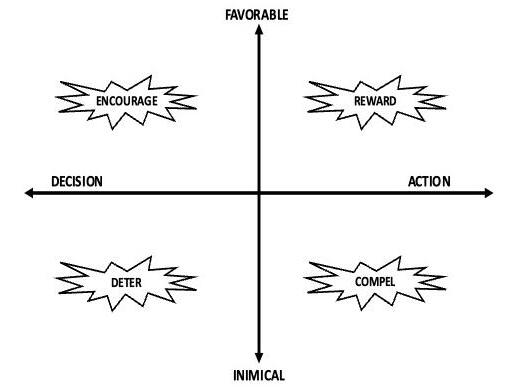
In his book Arms and Influence Thomas Schelling outlined a model for interaction between the decisionmaking processes and actions of the United States and others.29 Written at a time when the United States was facing a growing arsenal of Soviet nuclear weapons, he focused on deterring others’ decisions to take actions inimical to US interests and compelling the reversal of such actions. However, even in Cold War rivalry, US and Soviet interests in controlling nuclear weapons and managing incidents that could lead to direct combat resulted in agreements. All states and nonstate actors, even rivals like the United States and China and allies like the United States and United Kingdom, have interests on which they agree (if not the approaches for addressing them) and on which they agree to disagree. Talks on some important subjects are difficult to arrange, such as talks with Chinese authorities on nuclear weapons and norms for cyber and space operations. Extending Schelling’s framework to include encouraging others’ decisions and rewarding actions favorable to US interests provides a means for mapping these to formulate comprehensive policies and strategies (see Figure 1.1).
Naval influence actions range from encouraging and rewarding through naval diplomacy and port visits, military-to-military exchanges, arms sales, and training exercises to freedom of navigation operations and peacekeeping that encourages friends and deters potential enemies, to peace enforcement, sanction support (interdicting illegal arms and drug trafficking, etc.), surgical strikes, and surging for combat operations to compel changes in behavior. Comprehensive strategies align naval influence with economic, political, moral, informational, and cultural instruments of national power. Discordant objectives and actions among US government agencies create noise in the signals that naval forces send, thus requiring naval commanders to be as harmonious with other US government agencies as possible.
The paradigm for war is winning and losing. The United States loses wars when it mistakes finite “games” that it can win with primarily military means, such as World War II, for what are infinite games where one victory merely leads to the next set of challenges and opportunities. The object in infinite games is to survive and grow stronger. Even in World War II, US terms for “unconditional surrender” were not
Figure 1.1 Extended Schelling Influence Framework
met as the Japanese retained enough influence to keep their emperor. Influence ultimately prevails. Political violence and international competition, such as exercised by China in controlling fishing and turning geographic features into fortifications in the South China Sea, have characteristics of wicked problems that are infinite games.30
The Navy as an Ecosystem
The roles of the navy have remained as originally conceived by the nation’s founders, as has the navy’s engagement strategy favoring forward operations. However, as the navy grew and evolved from the age of sail to the age of steam and through the nuclear age, its readiness and equipping strategies adapted with the character of its adversaries and technology. Success in World War II and the Cold War froze the US approach for equipping its armed forces, leaving them fragile in an age of information and artificial intelligence. Rapid adaptation is imperative.
Admiral Bradley Fiske, an influential leader and author, synthesized his wide-ranging ideas on naval warfare in his book The Navy as a
10 The US Navy and the National Security Establishment
Fighting Machine, published in 1916.31 As the world transitions from an industrial age to one dominated by information and artificial intelligence, we have yet to understand the implications of emerging societal systems and technology for the navy and the national security establishment as the United States seeks to enhance an international order that it created with like-minded nations in the aftermath of World War II. Employing industrial age paradigms and practices has led to sclerosis in the navy and the national security establishment. Changing the paradigms and practices that were suited for industrial age machines to information age ecosystems offers promise for accelerating the processes needed for survival and enduring strength.
In 1935 Arthur George Tansley (1871–1955) coined the term ecosystem as a community of organisms in conjunction with their environment, interacting as a system.32 The constituent organizations of the US Navy form such a community, operating in the environment of the national security establishment and the nation’s politics, industry, economy, and international challenges and opportunities. 33 The national security establishment forms a higher-level ecosystem.
The mathematician and philosopher Alfred North Whitehead (1861–1947) used the term society rather than community as “an environment or structured field of activity for its constituent actual entities. . . . The society also changes in its basic structure or form in and through the interplay of its constituent actual entities.” 34 Whitehead notes that substance emerges from the interactions among the constituent entities of the society. Atoms emerge from the interactions among electrons, neutrons, and protons. Similarly, molecules emerge the interaction of atoms, cells emerge from molecules, organs from cells, and so on up to interactions among organisms, and organizations, to the cosmos.
When the navy was established, the national security establishment consisted of the Departments of the Navy and War with their secretaries reporting directly to the president. As the navy grew, a panel of navy officers was formed to advise the secretary, which evolved into directors of bureaus to oversee various functions. The shift from the age of sail to the industrial age with ships powered by engines and advancements in armaments beginning with the US Civil War required additional organizations to oversee new technologies and processes. Following the Spanish-American War, the need to plan for war and oversee naval operations led to the establishment of a CNO as the senior officer in the navy reporting alongside the bureau chiefs directly to the secretary of the navy, with similar developments in the Department of War.
As the nation and the navy grew, both the societies comprising the national security establishment and those within the navy evolved to meet the challenges and opportunities of the age. World War II led to a punctuated evolution of the national security establishment in its aftermath that directly affected secretary of the navy and CNO authorities, organization, and operations.
In the case of the navy and the national security establishment, each society includes the interaction of personalities and organizations that employ a variety of methods to advance their interests in a changing environment. These entities are often referred to as actors when considering their roles, as actors in a play, or agents when considering the traditions, laws, and procedures that ascribe the decisionmaking authorities of each. These interactions create a complex adaptive ecosystem where organizations fit for environmental change flourish, and the unfit decline or perish just as organisms do. Expanding interactions among the agents within the navy and the national security establishment have made the hierarchical system more complex as more layers and organizations have been added.
The range of disciplines employed to study and understand the behavior of organic complex adaptive ecosystems covers anthropology for language and culture, philosophy, history, political science, international relations, and hard sciences. Each discipline focuses on particular subject matter and has its standards for what questions are suitable and what constitutes evidence. Each deals with challenges of being (what is) and becoming (emergence) as it attempts to order knowledge. The ancient Greeks’ quest for order and stability raised the challenges of dealing with change, leading Heraclitus (ca. 540–480 BCE) to emphasize ceaseless change, famously stating that “you can never step in the same river twice.” Parmenides (ca. 515–450 BCE) challenged Heraclitus, claiming that change was the illusion rather than permanency. He argued that when living things die, they never become nothing. Though our imperfect eyes and ears observe change and transformation, our reason realizes that reality never changes since we live in a world where “No Thing” can never exist.35
The disciplines and analytic paradigms employed to drive interactions within societies have consequences. Inorganic societies, such as the fundamental particles that form an atom and the cosmos, admit Newtonian physics to provide many useful calculations. This led to beliefs in the Age of Reason that mathematics was superior to scripture as it demonstrated God’s order in the universe and was less subject to interpretation than scripture. This led to a “vogue of military mathematics” in the eighteenth century that attempted to treat war as an exact science.
12 The US Navy and the National Security Establishment
Prussians who fought Napoleon recognized such efforts as fraudulent and developed campaigns of learning to deal with the genius of Napoleon and the wicked problems that politics and war present. Following the successes of operations research during World War II, Secretary of Defense Robert McNamara introduced systems analysis for acquiring military systems, quantifying costs and benefits as a basis for determining how much was enough. This led to a second vogue of military mathematics that has created “robust, yet fragile” navy and national security ecosystems. Recent research into multilayer complex adaptive systems has produced techniques better suited to a wicked world of becoming (emergence) and suggests approaches for making these ecosystems resilient. Resilient systems that learn and adapt become antifragile.36
Learning how to deal successfully with interacting demands for providing justice in international relations, defending American honor, and procuring international respect to safeguard American interests, while financing research into likely valuable future technologies, recruiting and training personnel suited to a high technology military world, and modernizing the force to deter, and if necessary defeat, increasingly capable foreign adversaries, requires strategic, operational, tactical, and organizational innovation through revisiting paradigms that are losing their validity. Doing so requires a deeper appreciation of the evolution of the navy, its development, and its influence in the context of a multilayered complex adaptive ecosystem.
One approach to gain a deeper perspective on such a complex set of issues is to examine the evolution of the navy’s ecosystem that resulted in its emergence as the most capable navy in the world, and its subsequent evolution. Learning and innovation are constant themes. Campaigns of learning that the navy adopted and adapted beginning with the efforts of Stephen B. Luce play a major role in the navy’s emergence and how it has sustained the rationale for its existence as articulated by Jefferson and Hamilton.
Outline of the Book
The ability of the navy and other US armed services to influence events ultimately relies on their ability to prevail in combat. Chapter 2 addresses how, building upon the Prussian system, the US Navy led by the reformer Stephen B. Luce created a campaign of learning beginning in the nineteenth century that resulted in victory at sea in World War II.
World War II punctuated the equilibrium in the world order and led to the punctuated evolution of the US national security establishment following the war. Organizational changes in the national security establishment combined with competition for resources among the services led to divisive equipping, readiness, and engagement strategies. Chapter 3 addresses the effects of this punctuated evolution on the Department of Defense and the navy during the Cold War, with special attention to learning societies within the navy.
The end of the Cold War provided another opportunity for the national and international security establishment to adapt the security, trade, and financial organizations created after World War II to meet emerging challenges and opportunities of the globalizing world order. Though it was in the US interests to do so, as we would come to represent a smaller fraction of the world’s population and wealth over the coming decades, the hubris of Cold War “victory” led to inaction. Chapter 4 addresses missed opportunities and entrenchment of misguided paradigms that led to sclerosis in the navy and the national security establishment.
Chapter 5 addresses challenges and opportunities for growing an information age navy. It introduces unsuccessful efforts to revise the navy’s equipping strategy, traces the evolution of capability-based planning, provides details on Rumsfeld’s failed systems analysis and subsequent acquisition reforms, and discusses how the navy staff organization responsible for systems analysis adopted its own interpretation to suit its purposes resulting in the current fragile navy force structure.
Chapter 6 suggests what is required for the navy and the national security enterprise to evolve from its current “robust, yet fragile” state to become resilient and antifragile. The navy and the Department of Defense (DoD) began to move toward net-centric warfare beginning in the 1990s, in the context of networking sensors, commanders, and shooters. Now is the time to frame the navy more broadly as a component of a hierarchal networked complex adaptive ecosystem. This chapter explains fundamental concepts of undergirding “robust, yet fragile” and antifragile systems and suggests approaches for employing that paradigm for readiness, engagement, and equipping strategies for the navy, the DoD, and the military, industrial, congressional enterprise (MICE). It applies these concepts to Chinese strategy and the changing character of armed conflict as key to successful competition with the Chinese and other adversaries.
Chapter 7 addresses adaptations needed to prevail in an information age of great power competition. As learning is fundamental to
14 The US Navy and the National Security Establishment
antifragility and readiness, it begins with the imperative for military education. It then goes on to suggest adapting intelligence, analysis, and operational and material readiness, engagement, and equipping strategies, focusing on schemes that the secretary of the navy and the CNO can either control or influence. Reinvigorating navy campaigns of learning and nurturing a learning culture are essential. Success requires adapting paradigms that no longer serve the navy well. The book concludes with a set of paradigms that hold, and new paradigms to replace misguided ones.
Notes
1. Ian W. Toll, Six Frigates: The Epic History of the Founding of the U.S. Navy (New York: W. W. Norton, 2006), 162.
2. The Navy has worked in an environment of partisan politics since its inception.
3. In writing to Adams, Jefferson stated his several reasons for a navy as: “1. Justice is in favor of this opinion. 2. Honor favors it. 3. It will procure us respect in Europe, and respect is a safeguard to interest.” Toll, Six Frigates , 162.
4. Benjamin Armstrong, “American Naval Dominance Is Not a Birthright,” U.S. Naval Institute Proceedings 147, no. 9 (2021), www.usni.org/magazines /proceedings/2021/september/american-naval-dominance-not-birthright.
5. Peter M. Swartz and E. D. McGrady, U.S. Navy Forward Deployment 1801–2001 (Alexandria, VA: CNA Center for Strategic Studies, 2001).
6. Elmo R. Zumwalt, On Watch (New York: Quadrangle/New York Times Book Company, 1976).
7. John F. Lehman, Oceans Ventured: Winning the Cold War at Sea (New York: W. W. Norton, 2018).
8. Lorna S. Jaffe, The Development of the Base Force 1989–1992 (Washington, DC: Office of the Chairman of the Joint Chiefs of Staff, Joint History Office, 1993).
9. Eric V. Larson, David T. Orletsky, and Kristin J. Leuschner, Defense Planning in a Decade of Change: Lessons from the Base Force, Bottom-Up Review, and Quadrennial Defense Review MR-1387-AF (Santa Monica, CA: RAND Corporation, 2001).
10. Francis J. McNeil, “Letter to Admiral Frank B. Kelso II, USN,” September 17, 1993 (SSG archives sent to Naval Heritage and History Command).
11. Jeffrey A. Bradford, Proconsuls and CINCs from the Roman Republic to the Republic of the United States of America: Lessons for the Pax Americana (Fort Leavenworth, KS: US Army Command and General Staff College, 2001).
12. Andrew F. Krepinevich and Barry D. Watts, The Last Warrior: Andrew Marshall and the Shaping of Modern American Defense Strategy (New York: Basic Books, 2015). The Soviets had been writing about a military-technical revolution. Marshall changed the name to a revolution in military affairs to encourage thinking more about operational and organizational concepts rather than focusing on technology.
13. Hon. Robert J. Murray describes the original intent of the CNO SSG using Winston Churchill’s phrase “Captains of War” in Robert J. Murray, “A War-Fighting Perspective: An Interview with Robert Murray,” U.S. Naval Institute Proceedings