3
Oxford University Press is a department of the University of Oxford. It furthers the University’s objective of excellence in research, scholarship, and education by publishing worldwide. Oxford is a registered trade mark of Oxford University Press in the UK and certain other countries.
Published in the United States of America by Oxford University Press 198 Madison Avenue, New York, NY 10016, United States of America.
© Oxford University Press 2021
All rights reserved. No part of this publication may be reproduced, stored in a retrieval system, or transmitted, in any form or by any means, without the prior permission in writing of Oxford University Press, or as expressly permitted by law, by license, or under terms agreed with the appropriate reproduction rights organization. Inquiries concerning reproduction outside the scope of the above should be sent to the Rights Department, Oxford University Press, at the address above.
You must not circulate this work in any other form and you must impose this same condition on any acquirer.
Library of Congress Cataloging-in-Publication Data
Names: Schoppa, R. Keith, 1943– author.
Title: The twentieth century : a world history / R. Keith Schoppa. Description: New York, NY : Oxford University Press, [2021] | Series: New Oxford World history series | Includes index.
Identifiers: LCCN 2020058375 (print) | LCCN 2020058376 (ebook) | ISBN 9780190497354 (hardback) | ISBN 9780190497361 (paperback) | ISBN 9780190497385 (epub) | ISBN 9780197571958
Subjects: LCSH: History, Modern—20th century.
Classification: LCC D421 .S337 2021 (print) | LCC D421 (ebook) | DDC 909.82—dc23
LC record available at https://lccn.loc.gov/2020058375
LC ebook record available at https://lccn.loc.gov/2020058376
DOI: 10.1093/oso/9780190497354.001.0001
1 3 5 7 9 8 6 4 2
Paperback printed by LSC Communications, United States of America
Hardback printed by Bridgeport National Bindery, Inc., United States of America
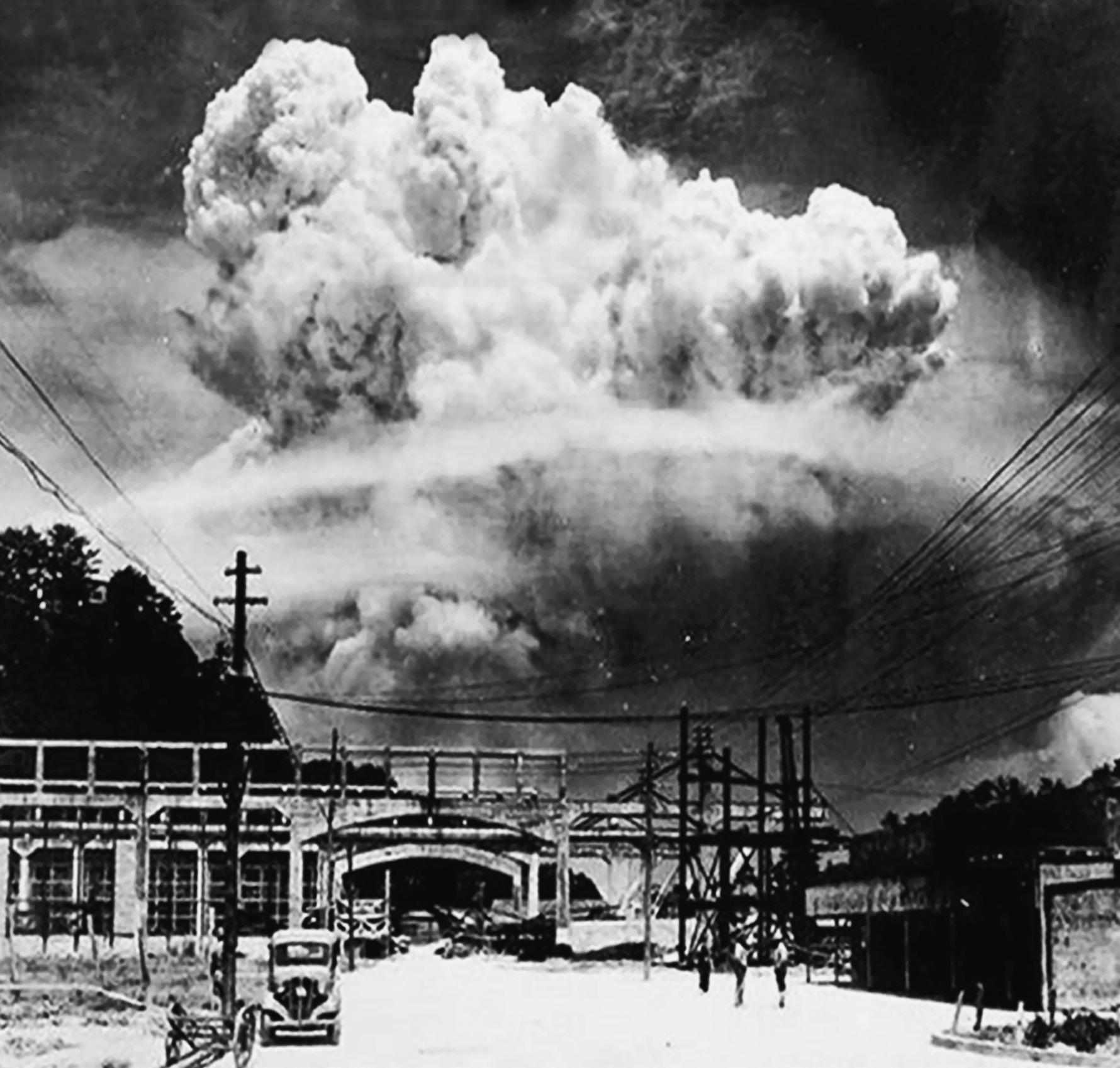
Frontispiece: The bombing of Nagasaki, August 9, 1945. World History Archive/Alamy Stock Photo EC80X4
For you, dear grandchildren, Laurel, Noah, Luke, and Eli My wish is that you can help transform the spirit of your century—the twenty-first to bring unity that values diversity, where people, above all, are humane, and where the environment is honored as a harmonious and protected space for productive lives well-lived.
Editors’ Preface ..............................
Chapter 1 The Great War and Social Change, 1900–1919 ......13
Chapter 2 Claustrophobia: Totalitarianism and the Great Depression, 1920–1936 ........................32
Chapter 3 Worlds Blown Apart, 1937–1949 ................51
Chapter 4 A New Day? Revolution, Cold War, and Decolonization, 1950–1965 .....................71
Chapter 5 Struggling for Equality, Freedom, and Peace, 1966–1979 .................................93
Chapter 6 Bright Triumphs, Dark Disasters, 1980–1991 ......111
Chapter 7 Written on the Darkest Pages of Human History, 1991–2000 ................................130
Introduction
Until 1900, no century in history had known the continually accelerating rate and scope of change experienced in the twentieth century. Its revolutionary discoveries, technological inventions, political realignments, and scientific advances brought radical changes to almost every arena of life. The year 1900 looked very different from 2000. In 1900, there were no antibiotics, few homes with electricity, no airplanes, and very few cars; global life expectancy was about 31 years, and the global literacy rate was less than 30 percent. In contrast, in 2000, global life expectancy grew to 66.4 years—with some countries reaching over 80 years—and the literacy rate soared to 81.9 percent. Though the story of the world in the twentieth century trumpets the triumphs of technology, space exploration, and the miracles of medical science, it is above all the story of men and women, individuals and masses, creating and building, working and playing, scheming and destroying, and constructing and reconstructing their identities through their life experiences. Each individual chose and exuded his or her own identities and were, in turn, accorded identities by others.
An individual has many different identities: biological, spatial, social, political, economic, relational, vocational, habitual, and on and on. Identity can be approached with the question: What defines a person? That is, what values, beliefs, social relationships, and cultural issues are most important to the person? As life moves forward, identities may not be stable; they can shift and change to go along with new experiences, interests, or focal points. One other important consideration is what identities have been ascribed to the person by others and how similar were those attributions. This book focuses on questions of identity with special attention to three personal-political identities that were especially important in the trajectory of the twentieth-century world: the individual and the local, nation-state, and global communities. The range
of people’s identities in specific historical contexts and situations could often produce a clash of identities. Such a clash often became one of the crucial dynamic and motivating factors in historical change. In each chapter, generally five men and women are highlighted; some of them were major historical figures on the world stage, yet the majority were not. Whatever their political, social, and economic status, in the end, all forty individuals from twenty-three countries around the world, who are covered in some detail, acted through their own particular identities to contribute significantly to their world.
A historical vignette from Southwest Africa (specifically, the present state of Namibia) at the beginning of the twentieth century opens this study’s focal themes: identity, its meaning, its power, and its roles; violence in various physical and psychological guises; social and cultural change and trends; and the meeting of race, ethnicity, nationalism, and globalization.
They were two very powerful Namibian men, Samuel Maharero of the ethnic Herero tribe and Hendrik Witbooi of the ethnic Nama group. When Maharero first became a paramount chief, even the Herero people found him to be something of a joke: he appeared a spineless and dependent loser. He was a heavy drinker, if not an alcoholic, his rum supplied by the Methodist missionaries before whom he groveled. Witbooi, the paramount chief of the Nama, in contrast, was proudly individualistic and independent, intelligent, well-versed in several languages, and wrote poetry. His people saw him as a charismatic leader and an expert in guerrilla warfare. He raised the ire of the German colonizers by refusing German protection—and what that meant: their domination. When all the other chiefs and paramount chiefs (including Maharero) had given in to the Germans, Witbooi still held out. In his diary, he wrote: “I refused to surrender that which is mine alone, to which I have right; I would not surrender my independence.”1 In the end, he engineered a brief rebellion against the Germans (which he lost), after which he pragmatically capitulated to the Europeans.
Both men became victims of the twentieth century’s first gruesome genocide, engineered and executed by the German colonizers in the 1904 to 1907 German-Herero War. Though the word genocide was not coined until 1944 (from the Greek genes, meaning tribe or race, and cide, from the Latin for killing), it has rightfully been used retroactively to describe the Namibian nightmare and the Armenian atrocity a decade later. Here is the story of how the Namibian genocide unfolded. From roughly 1800 until 1907, Herero and Nama faced each other in almost continual warfare for control of the area. In 1892, their
leaders Maharero and Witbooi made peace at last. Ironically, 1892 was also the year that the first German colonizer-settlers arrived to begin farming—though Germany had started the colonization process with missionaries (in the 1840s), trader-merchants (in the early 1880s), and the military (in 1888). When Germany annexed its Southwest Africa colony in 1902, the population was about 200,000, with the native population making up 97.8 percent of the total while the Germans accounted for just 1.3 percent.
The thirty-year experience with imperialistic Germany, from 1885 to 1915, was a nightmare for the Herero. German farmer-settlers needed and wanted two things for their work—land and cattle—and it turned out they were determined to do anything to obtain what they wanted. The Hereros’ large territory held some of the colony’s best farmland, and they owned the largest herds of cattle—in 1890, an estimated 200,000 head. Indeed, the life and culture of the Herero were focused on cattle. A Herero man’s life goal was to increase and preserve his herd. Even more culturally significant, his identity, values, and lifestyle all centered on cattle. The Herero language included over one thousand words to describe markings and colors on cattle.2 When a baby was named, he or she had to ritually touch the head of a calf, traditionally the ethnic community’s birth gift. At a Herero’s death, his shroud was made from the skin of his favorite ox, the bleached skull of which was hung on a tree near the grave. Cattle were never killed for food; killing cattle, if it was not on a religious or festive occasion, was sacrilege. In the years 1889 to 1897, a tragic rinderpest (cattle plague) raked over the African continent; it killed hooved animals within days, and some Herero herds lost up to 90 percent of their cattle, ultimately leaving about 90,000 head, a tremendous economic and mythic loss.
From the beginning, the Germans neither understood the culture and actions of the tribesmen nor did they attempt to do so: to the Germans the Herero were simply “black savages,” “baboons,” “bloodthirsty,” and their tribes were castigated as “bands of robbers.” The Germans displayed at least two levels of racism. One was an underlying, openly displayed, continuing irritation and downright condemnation of Africans acting as Africans, a bitter, whining “Why-can’t-they-bemore-like-us?” A captain on Lieutenant General Lothar von Trotha’s military staff complained: “What makes the Herero so revolting is the fact that their way of thinking is completely different from ours. Their logic is not like our logic. How can we communicate with people whose vocabulary does not even contain words such as ‘gratefulness,’ ‘obedience,’ ‘patriotism’ ‘loyalty’ ”? A common German attitude toward the
blacks echoed the racist words of General Trotha: “I know the tribes of Africa. . . . They are all alike. They only respond to force. It . . . is my policy to use force with terrorism and even brutality.”3
The second level of racism was outright physical and psychological abuse—actions that supported the Germans’ belief that African tribesmen were not human and, simply put, were worthless. The Germans commandeered one John Cloete, a tribesman in the area (neither Herero nor Nama) to serve as a guide. On their way, they rested at a waterhole. Cloete described what happened.
While there, a German soldier found a little Herero baby boy about nine months old lying in the bush. . . . The soldiers formed a ring and started throwing the child to one another, catching it as if it were a ball. The child was terrified, hurt, and crying loudly. . . . After a time, they got tired of this and one of the soldiers fixed his bayonet on his rifle and said he would catch the baby. The child was tossed into the air towards him and, as it fell, he caught it and transfixed the body with the bayonet. The child died in a few minutes, and the incident was greeted with roars of laughter by the Germans, who seemed to think it was a great joke. I [Cloete] felt quite ill and turned away in disgust, because, although I knew they had orders to kill all, I thought they would have pity on the child. I decided to go no farther with the Germans.4
Psychological abuse clouded most everyday relationships between colonizers and colonials. The German disdain for the tribesmen on the streets, in stores, or in business dealings was shown openly and rudely. For individuals, the German use of flogging, as the major form of “light” punishment, brought both pain and psychological damage. The fact that any German on a whim could flog a black nearly to death without any official approval whatsoever broadcast to the Herero and Nama that their lives were at all times in the hands of the unpredictable whites. Nothing pointed more starkly to the marginalization and powerlessness of the natives than flogging. For the whites, flogging trumpeted their dominance and power. For the blacks, it underscored their racial subordination. It was the whites who decided that the race issue would always be a zero-sum game: “Leniency toward the native is cruelty to whites,” said Professor Karl Dove, who served as chair and board member of two German agencies focused on colonialism.5 Many Germans and other foreigners regarded Dove as the leading authority on Namibia in the last decade of German rule (1905–1914).
As for rampant German disrespect for tribal cultural values and beliefs, two powerful examples suffice; both went to the heart of what the Herero felt was sacred. Both also come from sworn affidavits from Hosea Mungunda, headman of the Herero at Windhoek.
[We set aside] [o]ur burial places . . . as sacred and holy ground. We selected green trees to build groves [in these graveyards] . . . all those trees were holy and consecrated. No Herero would dare to damage or cut [those] trees. Our two greatest leaders . . . were buried together near Okahandja under beautiful green trees on the river’s bank. It was the most sacred place in the whole country [for] all Hereros . . . . [When] the Germans came, they cut down all the beautiful trees; and turned the sacred burial place into a vegetable garden. They appropriated the place as private property, and no Herero could go there as he would be prosecuted for trespassing. We were terribly upset at this and protested against what we regarded as sacrilege. Our chiefs complained to the authorities, but no notice was taken.6
Mungunda’s second example of what can be called “cultural genocide” (actions that obliterated one’s cultural heritage and tradition) focused on what the Germans did with the cattle. In the 1890s German farmer-settlers and many merchants began to target Herero cattle; outright German theft and various schemes of granting predatory credit began to thin Herero herds. Since most Herero had little, if any, cash, the merchants and settlers usually demanded repayment of monetary loans in cattle. As one arrogant German colonizer put it: “The natives must realize that they cannot have it their way.”7 Governor Theodor Leutwein hit upon a clever scheme to steal cattle. He proposed drawing boundaries (which had never existed) to define clearly the southern “border” of Hereroland. Those cattle that crossed the new unmarked, open boundary were to be impounded; but, instead of returning the cattle to the Herero, the government sold them, with the government and the paramount tribal chief splitting the money.8
The German cultural “crime” in these scenarios was that they disregarded completely the Herero tradition of dividing the cattle into “sacred” (or holy) cattle and “secular” cattle. Sacred cattle were inherited patrilineally, from older brother to younger and then from father to son; these cattle were inherited gifts from the ancestors to be passed on to their descendants. Secular cattle, in contrast, were inherited matrilineally from the mother’s brother to her sister’s son.9 The sacred cattle’s status necessitated that they be retained as a group set apart from all the other cattle.
The Germans obviously had no such categorization as sacred and secular as it applied to cattle. If they stole cattle from the Herero, they could tell no difference between the cattle. With Leutwein’s southern border-making, there was no way to know whether sacred or secular cattle crossed the new unmarked border. The Germans had no idea of such a religious-based system, and the Herero would have had no idea that the Germans were unaware of their reality. In his affidavit, Hosea Mungunda first asserted the link between some cattle and sacredness and then argued that the Germans targeting cattle as secular objects was sacrilegious. He said:
The Germans took sacred cattle and mixed them with private cattle, quite regardless of our customs and organization. We protested and complained bitterly, but the Germans took no notice. Sometimes we persuaded them to return our holy cattle, but then we had to give them three or four ordinary cattle in exchange . . . it greatlydiminished our stock.10
This policy had at least two unfortunate, if not calamitous, cultural impacts on the Herero. First, the boundary, in essence, changed the Hereros’ spatial world, giving it a new sense of boundedness and therefore a new, less expansive identity. For the wealthiest tribe in the area, this sense of geographical and psychological downsizing was difficult to tolerate. Second, Leutwein’s scheme became the mechanism by which more and more cattle disappeared; this process shattered the link that tied many Herero to their ancestors and thus wiped out a chief cornerstone of their cultural traditions.
The issue of land was crucial for German colonizers—even more so than the numbers of cattle. According to local ethnic customs, land was held in common: no one could purchase this land. Ethnic community members could sell the “use” of a tract of land but not the land itself. Germans scoffed at such a longtime conception of property ownership and simply, in no uncertain terms, demanded that land be turned over to them. By 1885, Nama tribal chiefs had sold on German demand the Atlantic coastal region from the Orange River in the south to the Kunene River in the north (the borders of present-day Namibia). From the beginning, the Germans perpetrated land fraud on ethnic leaders. The treaties specified that the German-controlled land would extend twenty miles inland from the coast; the ethnic leaders, who had had some experience with the British before the Germans came, took that as being in English miles, which was about 1.5 kilometers. The total
distance inland from the coast, tribal leaders figured, was to be about 30 kilometers. However, the Germans used the now-obsolete “geographical” or “German” mile, which was pegged at 7.4 kilometers. Under the German calculations, 20 miles equaled 148 kilometers, or about 91 miles.11 Through German sleight of hand, the Nama in this case unknowingly gave up a lion’s share of their land.
When Africans sought legal protection from German land seizures, they were met by uncooperative, do-nothing officials, whereas the German government quickly sanctioned any settler action no matter what it was. Thus, for the Africans, there was no recourse if they were wronged. There was little objective law as practiced: law was what the Germans said it was. Since there were no established courts in the colony until 1903, the police chief was the one and only judicial administrator: he arrested people, served as jailer, and then as judge. Sentences were handed down on the basis of race. Natives who committed murder invariably received the death penalty; Germans who killed a native were sometimes acquitted, sometimes got several months, or at most (and rarely) received a three- to five-year sentence.12
Small rebellious incidents invariably led to more seizures of land and cattle, but for the Herero the largest and most serious theft was their identity. An imperial ordinance in April 1898 established “native reserves,” small tracts of land both for keeping natives hemmed in and to facilitate their surveillance. The Germans seized land so the farmer-settlers would have it to farm; but, just as important, they took possession “to deny black Namibians access to the same land, thereby denying them [entry] to commercial agricultural production and forcing them into wage [labor].”13 The goal: completely overturning the identity and culture of the Herero by making a wealthy people impoverished and making independent and selfdirected people totally dependent on servitude to foreign farmer-settlers.
Native ethnic groups also lost traditional lands through the construction of railroads in the region. In the two railroad lines constructed in northern Namibia, farming was not allowed 12.4 miles on either side of the tracks. One of the lines directly struck the Hereros’ livelihood. The railroad tracks ran 235 miles through the heart of Herero farmland, taking a 25-mile strip of excellent farmland that they could no longer cultivate. In addition, all the water rights in that strip went to the railroad. The construction of this railroad line was the catalyst for a Herero rebellion from January to August 1904: the railroad project took 27 percent of all Herero land—3.5 million hectares out of a total of 13 million hectares.14 The Nama followed up with their own
insurrection from October 1904 to November 1905. Both insurrections were put down by German armies, and, in the end, the wars provided Germans the pretext for seizing all the land in the colony.
In the German-Herero War, victory in the initial battles went to the Herero, but German firepower rapidly stopped that winning streak. While Governor Leutwein expressed his hope that the warfare could be ended through negotiations, Berlin lambasted that line as too lenient. He was replaced in June 1904 with Lothar von Trotha, a belligerent racist. His obsessive goal was not to simply defeat the Herero but literally wipe them off the face of the earth. He saw the struggle as a “race war, aimed not at the surrender of the Herero but at the destruction of the social core of their existence.”15 He categorically refused any negotiations with the Herero and ordered that his troops never take male prisoners.
Trotha had a genocidal strategy of three different methods to accomplish his goal of killing all the Herero. The first strategy was military extermination. Germany was indeed the victor at the decisive battle of the war (August 11, 1904). But not all the Herero were killed, and several thousand of their troops were not defeated. The second strategy was to drive the remaining Herero deep into the desert, where they would starve or, more likely, die of thirst. Many did. Written in 1909, the official Foreign Office’s succinct analysis of the action stated that the war against the Herero, conducted by General Trotha, was one of extermination; hundreds—men, women, and children—were driven into desert country, where death from thirst was their end.16
From June through September, it generally does not rain in the Omaheke Desert, and there is very little rain until January. The temperature rises in September to 86°F on average, in October to 91°F, and in November to 92°F. Months of no rain followed by months of extreme heat brought tens of thousands of the marooned Herero to their deaths. Yet Trotha apparently felt no empathy or sympathy for the Herero. He reported on September 13, 1904, that Herero women and children came in large numbers to ask for water, and Trotha gave immediate orders to chase them back by force.
Where possible, the German army blocked water holes so that the Herero could not drink from them. They also poisoned the water holes as they progressed into the desert; any Herero trying to return would find no drinkable water. The rationale from the kaiser via the Imperial Colonial Office: “[We must] thoroughly poison their water supply. After all, we are not fighting against an enemy respecting the rules of fairness, but against savages.”17 On October 2, Trotha issued his
infamous extermination orders: “The Herero people will have to leave the country. If the people refuse, I will force them with cannons to do so. Within the German boundaries, every Herero . . . will be shot. I won’t accommodate women and children anymore. . . . I shall give the orders to shoot . . . them.”18
The final solution for those still alive was to send them to notorious concentration and death camps marked by intolerably brutal conditions; historians have seen them, rightly or not, as the likely models for the Nazi death camps established three decades later. In Namibia, two were in the northern interior—at Windhoek, the capital, and at Okahandja, built by the Herero, who made it their main base. The Windhoek camp had five thousand prisoners for whom the daily food allowance was a handful of uncooked rice, with some salt and water. But the two coastal camps in ports on the Atlantic Ocean were far worse in the extent of prison labor, lack of supplies and medical care, and the cruelty and brutality of overseers and guards. At the port of Swakopmund, for example, from February to May 1905, no fewer than 40 percent of the prisoners died.
But the worst fate was for those sent to Luderitz in the far southwest corner of the country, where 80 percent of the prisoners died. An eyewitness account illustrates the realities of the death camp located on the small Shark Island in the harbor. The writer was Samuel Kariko, a Herero schoolmaster who was a son of Daniel Kariko, an important Herero under-chief:
I went to . . . my old home, and surrendered. We then had no cattle left, and more than three-quarters of our people had perished. . . . There were only a few thousands of us left, and we were walking skeletons, with no flesh, only skin and bones. . . . I was sent down with others . . . to Luderitz [where] there were thousands of Herero and Hottentot [Nama] prisoners. We had to live there. Men, women, and children were all huddled together. We had no proper clothing, no blankets, and the night air on the sea was bitterly cold. The wet sea fogs drenched us and made our teeth chatter. The people died there like flies that had been poisoned. . . . No day passed without many deaths.19
In this first genocide in the twentieth century, 81 percent of the Herero were killed in battle, in the desert, and in death camps. In two of the other larger ethnic communities, population losses totaled 51 percent and 57 percent. The total number of natives killed just in these three localized ethnic holocausts was over 92,000. And in a fiendishly
sadistic and vengeful knock-out blow to traditional Herero identity and culture, the Germans forbade the Herero to own any cattle or land in the future.
Of the three-tiered identities—local, national, and global—the local is most common here, especially for the Herero who had neither a national nor a global identity but a shared identity with their ethnic group. They also had regional linkages with South Africa. Germans were obviously eager to identify with their relatively new nation-state (established in 1871) and carry its goals forward. A latecomer to colonization, Germany wanted to be seen as a global force among other colonizers: German conduct, then, in Southwest Africa was important for its image (identity) in the eyes of the global community. That was why the kaiser stepped in to end the Trotha genocide.
The overarching storyline in the history of the Herero tribe and Germany’s Southwest African colony was how, in imperialist mode, Germany went about destroying the Hereros’ identity. Generally, identity changes incrementally over time. The Germans first set out to detract from and then destroy the traditional powerful identity of the Herero and Nama chiefs and paramount chiefs, defeating most in battle. Then through manipulation, trickery, and downright criminal activity, they took the Hereros’ and Namas’ sources of livelihood, without which their traditional identities were gutted. Through the pressures of that process, they created a “new more white-appropriate identity” for ethnic Namibian groups: their sole role was to be servants to white Europeans “without recourse to legal rights,” unable to support themselves either by pasturing cattle or farming, subject at any time to German euphemistic “parental chastisement” via flogging, and paid a meagerly inadequate wage.
Of the three personal political identities, perhaps most important was the individual whose locality served as a focal point in the late eighteenth-century Enlightenment. This focus exalted positive aspects of individualism, defined as “the habit or principle of being independent and self-reliant” and also as “freedom of action for individuals over collective or state control.”20 Clearly Hendrik Witbooi and Lothar von Trotha filled that bill. The premise of individualism is that the individual’s interests are or ought to be ethically paramount over others in society and that individuals best serve the public interest by following their own interests. This was the guiding German outlook: they could individually determine their relationship with their subordinate Herero, whether and how to steal his cattle, when to have him flogged, and how far to drive him into the desert. For the Herero and Nama,
individualism, apart from Witbooi’s earlier willfulness, only brought unwanted attention to the eyes of the enemy; thus, for society’s subordinate, individualism was probably not the game to play. Individualism, unchecked, could have a pernicious effect on society and nation by threatening and eroding the cohesion and harmony of families, groups, and the nation-state. Individualism could create great tensions and affect in complex ways the relationship between the individual and the state and the individual or any other individual. An individual’s identification with a particular race or ethnicity or with certain goals and outlooks was potentially a fertile soil for germinating conflict between indigenous groups and Germans.
A second significant twentieth-century identity was the nation— the political-social-cultural unit through which humans saw and understood their roles in society and the world and the territorial unit that they identified as their native land. Nation-states have not always been the standard territorial-political unit; before the sixteenth and seventeenth centuries, there had been city-states, dynastic states, tribal states, and multiethnic empires. But by the nineteenth and twentieth centuries, the nation-state manifested itself as the basic politicalgeographic unit, emerging everywhere around the globe. Nationalism, like local power bases, was also a potential negative force; nations often became provocateurs of international tensions and fears and the main instigators of and combatants in wars. Nations frequently acted like self-interested bullies, belittling other nations, and taking advantage of opportunities to risk their people’s lives for money, power, and bragging rights.
The other territorial “unit” that increasingly flourished was the global. Globalization developed under the empires of various Western Europeans in the seventeenth and eighteenth centuries and in the growing world network of trade and interchange in the nineteenth century. Partly from heightened literacy in the world and partly from the communication and transportation revolutions, in the twentieth century, people’s contextual awareness increased: they understood more fully how their lives fit in (or did not fit in) with society, with the presence and actions of the other, and with aspects of globalization.21
Beginning in the late twentieth century, Gro Harlem Brundtland served as prime minister of Norway (1981, 1986–89, 1990–96), head of the UN’s World Commission for Environment and Development, director-general of the World Health Organization (WHO), and UN special envoy for climate change. She spoke about the centrality of globalization for the present and future. “If globalization is to realize its
potential as a force for good, we have to look more closely at the means by which we handle our growing interdependence. We do not have a world government, but we do have an increasingly complex network of institutions that are concerned with global governance. They are central to our future and international human rights law.”22
In the early twenty-first century, there seems an ebb and flow among these three political loyalties, with each territorial level vying for greater control and power vis à vis the others. Was this a reflection of what the world experienced in the twentieth century? Or were the experiences of the twentieth century a mere prelude or period of preparation for what may be a central theme and structure for crucial developments in the twenty-first century? In the end, what roles did the twentieth century play that were most important in setting the twenty-first century on the paths it would follow?
The Great War and Social Change, 1900–1919
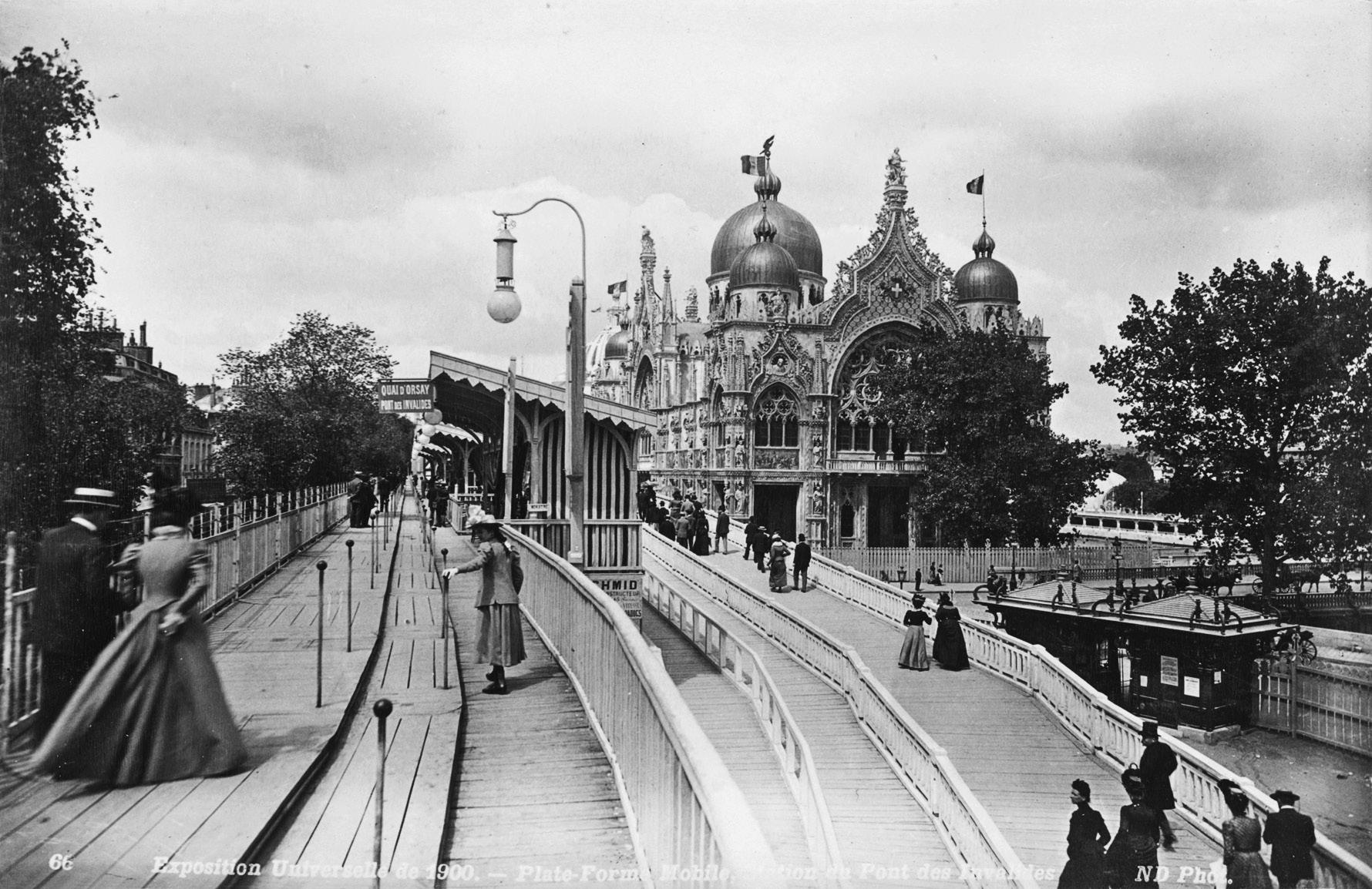
The more than fifty million people who visited the 1900 Paris World’s Fair arrived on foot or in horse-drawn buggies. But like the Time Traveler in H. G. Wells’s 1895 novel The Time Machine, they entered an unforeseen universe of X-ray machines, wireless telegraphy, sound-synchronized movies, diesel engines, and huge electrical generators. These dynamos powered the breathtaking Palace of Electricity, with its five thousand multicolored incandescent lamps and eight massive searchlights. Visitors rode a two-mile moving walkway (with three speeds) and escalators. An American historian, Henry Adams, overwhelmed by this technology, wrote that “his historical neck [was] broken by the sudden irruption of forces totally new.”1
For the rapidly industrializing peoples of Western and Central Europe and the United States, the opening years of the century brought both the exhilaration of the scientific and technological revolution and fears of the uncharted realities into which they were being led. Some were particularly apprehensive that new technological forces might alter life patterns and assumptions. As Adams recognized, the values of modern culture could challenge traditional moral values and the social and cultural guideposts that had shaped life’s direction. As for the masses, the most immediately useful inventions were the wireless, cinema, gramophone, and the internal combustion engine. But the era’s most momentous long-range scientific discoveries did not resonate until mid-century: the detection of the electron (1897), the development of quantum theory (1900), and the theory of relativity (1905).
Over the preceding six decades, northwestern European nations had led the march into industrialization, creating global empires from which they imported raw materials and to which they exported and merchandised finished products. In the midst of technological and demographic changes, society and politics in industrializing Europe were
The moving sidewalk was a highlight of the 1900 World’s Fair in Paris. It ran a 3.5-kilometer circle using two parallel moving platforms: one running at full speed (8 kilometers per hour), the other at half speed. Brown Digital Repository, Brown University Library
also rapidly changing. As peasants from rural society flooded the cities, those centers of industrialization generated an increasingly demanding laboring class. At the same time, the landed elites in the countryside were anxious and uncertain about their future. North America achieved rapid industrialization, but exports were still mainly agrarian products and raw materials. Asia, Latin America, Africa, and Oceania were almost exclusively agrarian, but they did export a range of animal, agricultural, and raw mineral materials: natural rubber, raw sugar cane, coconut and palm oils, guano, seal oil and leather, salt, tea, rice, wheat, cotton, and flax, to name a few. Trade was tying the world’s regions together through “globalization,” with increasing economic interdependencies and growing political interconnections, leading, in turn, to broadening cultural exchanges. Studies have shown that for the main imperialist powers in their global roles (France, Germany, the Netherlands, the United Kingdom, Spain, and the Unites States) from 1870 to 1913, merchandise exports became a greater and greater share of their economies (as percentage of GDP).2 This was a clear indication that economically advanced countries were selling modern products manufactured starting in the Industrial Revolution and making the world a global
marketplace. The period of globalization from 1870 to World War I might be called the first age of globalization in the modern world.
The vast population migrations in the period from 1860 to 1914 also underscored the march of globalization. Most migrants enjoyed relatively free mobility when crossing borders, in part because of the lack of overbearing state regulations. Decisions to migrate resulted from multiple hopes: for land and higher incomes; for political, religious, or social control of their lives; and for the opportunity to gain freedom from conscription, taxation, or a claustrophobic social system. Labor markets were a major lure. The transatlantic migration was mammoth: 52 million emigrants left Europe for the Americas with 72 percent (37 million) heading to North America and 21 percent (11 million) to South America. Persecution—as in the Russian state pogroms against the Jews—was a potent force prompting migration; between 1899 and 1914, 1.5 million Russian and Polish Jews fled to the United States.
Attendees at the World’s Fair could also see some of the 1900 Olympic Games, held concurrently with the Fair. The roster of participating Olympic nations in 1900 suggested a different world reality from the 1896 Games in Athens. In Greece, 85.7 percent of the participants were European, but in 1900, only 58 percent were Europeans. The Eurocentric vision of the world was very slowly beginning to change. Instead, the early twentieth-century global reality placed Western imperialistic globalists in charge of empires made up of their colonies. In the 1900 Olympics two participating units were colonies: India (Great Britain) and Cuba (briefly, the United States). The Netherlands and France highlighted their colonies in national pavilions. The first displayed a model of a Buddhist temple from the Dutch East Indies (today’s Indonesia). France exhibited “human zoos” of natives in dioramas simulating the natural surroundings of its African colonies. Racist imperialism was the context for their depiction of the natives: primitive, inferior, exotic, and learning obediently what the whites had to teach.
One of the most challenging tensions at the individual level was the rising visibility and demands of women, who were allowed to participate in the Games for the first time. Their emerging condition, by and large, reflected economic changes: in some Western European countries, they had gained the right to own property and to earn and keep their wages (though they were about half what men earned). Women in large numbers were able to get an education; many non-Catholic countries legalized divorce; laws were enacted to “limit” wife-beating. Some men resented the growth of women’s power, seeing it as implicitly