https://ebookmass.com/product/the-syntax-of-mainland-
Instant digital products (PDF, ePub, MOBI) ready for you
Download now and discover formats that fit your needs...
Mass Challenge: The Socioeconomic Impact of Migration to a Scandinavian Welfare State 1st Edition Tino Sanandaji
https://ebookmass.com/product/mass-challenge-the-socioeconomic-impactof-migration-to-a-scandinavian-welfare-state-1st-edition-tinosanandaji/ ebookmass.com
The Oxford Handbook of Experimental Syntax Jon Sprouse
https://ebookmass.com/product/the-oxford-handbook-of-experimentalsyntax-jon-sprouse/
ebookmass.com
Questions of Syntax Richard S. Kayne
https://ebookmass.com/product/questions-of-syntax-richard-s-kayne/ ebookmass.com
The Weather Thesaurus: A Fiction Writer's Sourcebook of Words and Phrases to Describe the Weather Dahlia Evans
https://ebookmass.com/product/the-weather-thesaurus-a-fiction-writerssourcebook-of-words-and-phrases-to-describe-the-weather-dahliaevans-2/ ebookmass.com
Craniomandibuläre Dysfunktion - Interdisziplinäre Diagnose- und Behandlungsstrategien 4. Edition Paul Ridder
https://ebookmass.com/product/craniomandibulare-dysfunktioninterdisziplinare-diagnose-und-behandlungsstrategien-4-edition-paulridder/
ebookmass.com
Bands and Photons in III-V Semiconductor Quantum Structures Igor Vurgaftman
https://ebookmass.com/product/bands-and-photons-in-iii-vsemiconductor-quantum-structures-igor-vurgaftman/
ebookmass.com
Atkins’ Physical Chemistry 12th Edition Peter Atkins
https://ebookmass.com/product/atkins-physical-chemistry-12th-editionpeter-atkins/
ebookmass.com
The Kamogawa Food Detectives (Kamogawashokudo) Hisashi Kashiwai
https://ebookmass.com/product/the-kamogawa-food-detectiveskamogawashokudo-hisashi-kashiwai/
ebookmass.com
Giovanni: (The Cougars and Cubs Series, Book 3) Gigi Meier
https://ebookmass.com/product/giovanni-the-cougars-and-cubs-seriesbook-3-gigi-meier/
ebookmass.com
https://ebookmass.com/product/scientific-american-environmentalscience-for-a-changing-world-third-edition/
ebookmass.com
TheSyntaxofMainlandScandinavian TheSyntaxofMainland Scandinavian JANTERJEFAARLUND GreatClarendonStreet,Oxford, , UnitedKingdom
OxfordUniversityPressisadepartmentoftheUniversityofOxford. ItfurtherstheUniversity’sobjectiveofexcellenceinresearch,scholarship, andeducationbypublishingworldwide.Oxfordisaregisteredtrademarkof OxfordUniversityPressintheUKandincertainothercountries
©JanTerjeFaarlund
Themoralrightsoftheauthorhavebeenasserted
FirstEditionpublishedin
Impression:
Allrightsreserved.Nopartofthispublicationmaybereproduced,storedin aretrievalsystem,ortransmitted,inanyformorbyanymeans,withoutthe priorpermissioninwritingofOxfordUniversityPress,orasexpresslypermitted bylaw,bylicenceorundertermsagreedwiththeappropriatereprographics rightsorganization.Enquiriesconcerningreproductionoutsidethescopeofthe aboveshouldbesenttotheRightsDepartment,OxfordUniversityPress,atthe addressabove
Youmustnotcirculatethisworkinanyotherform andyoumustimposethissameconditiononanyacquirer
PublishedintheUnitedStatesofAmericabyOxfordUniversityPress MadisonAvenue,NewYork,NY ,UnitedStatesofAmerica
BritishLibraryCataloguinginPublicationData
Dataavailable
LibraryofCongressControlNumber: ISBN ––––
PrintedandboundinGreatBritainby ClaysLtd,ElcografS.p.A.
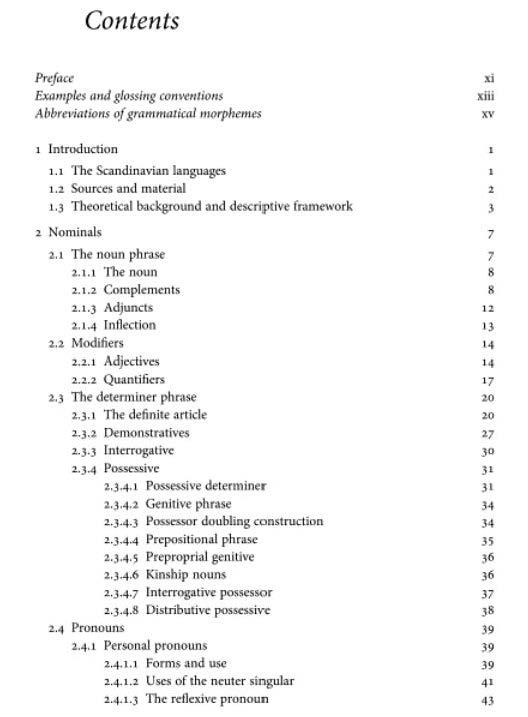
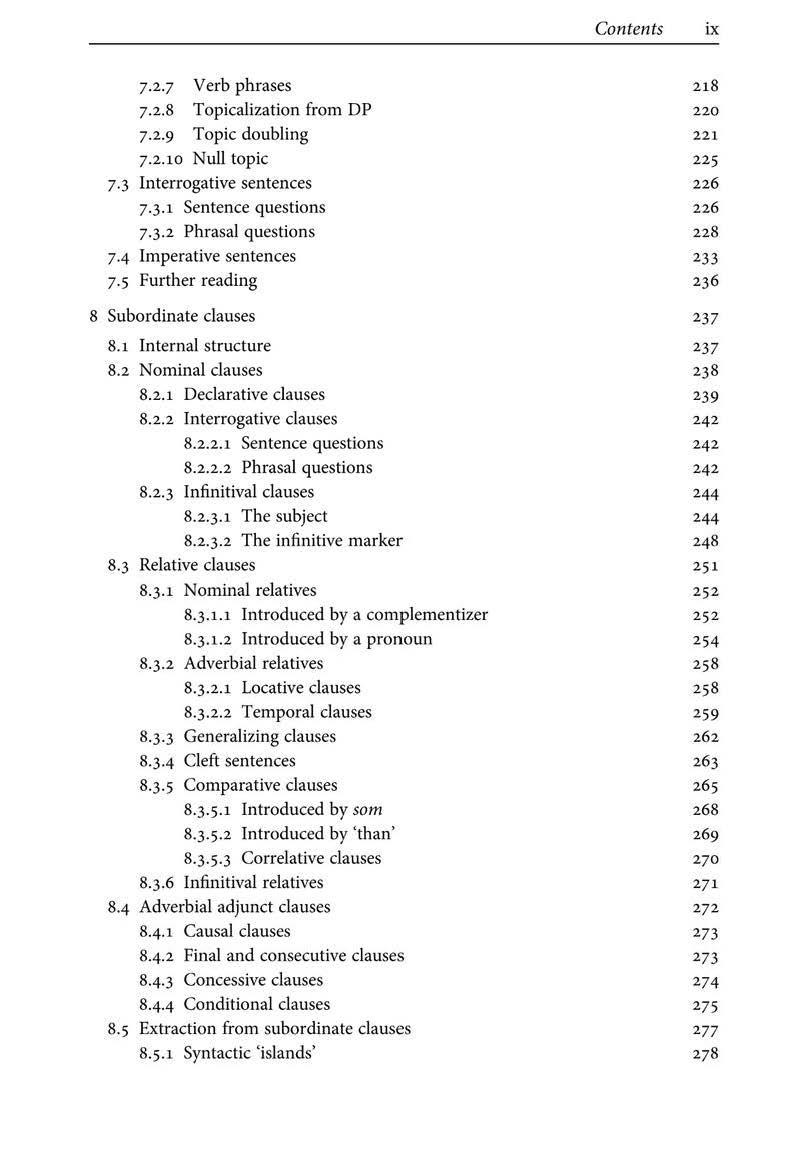
Co nten ts Prtfacr
Examples 1111J glo<i/11g co,r w,111/ons
Abbreviations ofgrn1t1ma1ic,tl 111orphe.mes
1 Introduction
1 , The Samdin.--ian language<
1. 2 So urce. and moltrial
1.3 Theorellcal bockground and d escri;pllve fo1mcwork
2 Nomin:tls
2.1 The noun phrase
2.1. 1 Th e n oun
2. 1 .2 Co mpl cmc.nc s
2.1.3 Adjuncts
2 . 1.4 InOectlon
2.2 ModiJim
2.2. 1 Adjective,;
2.2.2 Quantlficn
2.3 The detennlner phro,e
2.3. 1 Th e d efin ite ortide
1.3.2 Demon5tr.ltlves
1..3.3 [1\ trrrogativc
1.3.4 Posscssi,·c
2.3 .4 . 1 Possessive detenniner
2 .3.4 ,2 ~illlve phrise
2.3.4.J Possesso r doubling construction
1.3.44 Preposi lional phrusc
2.•1..4,S Preproptlal genill\'e
2 .3 .4.0 Kinship nouns
2.3.4.7 ln1orrogativc (l<)s<scssor
2.3.4.8 Distributive posscssiv,,
2 .4 Proa owtS
2.4. 1 Personal pronouns
2.,1,1 1 Forms and use
2,4. 1.2 Uses or t h e neuter singular
2..4. 1.3 The rc.flcxive pronoun
2.4 2 Interrogative pronouns
2.4.3 Indefin ite pronouns
2.4-4 Prono m ina l phrases
2.5 Relative c lauses
2.5,1 Restrictive rela tive clauses
2.5.2 Non -restrictive r elative cla uses
1.5.3 Infiniti val relatives
2.6 Predeterminers
2.6.1 U niversal qua nti fiers
1.6.2 Focusing clements
2.6.3 Demo nstratives
2.7 Further reading
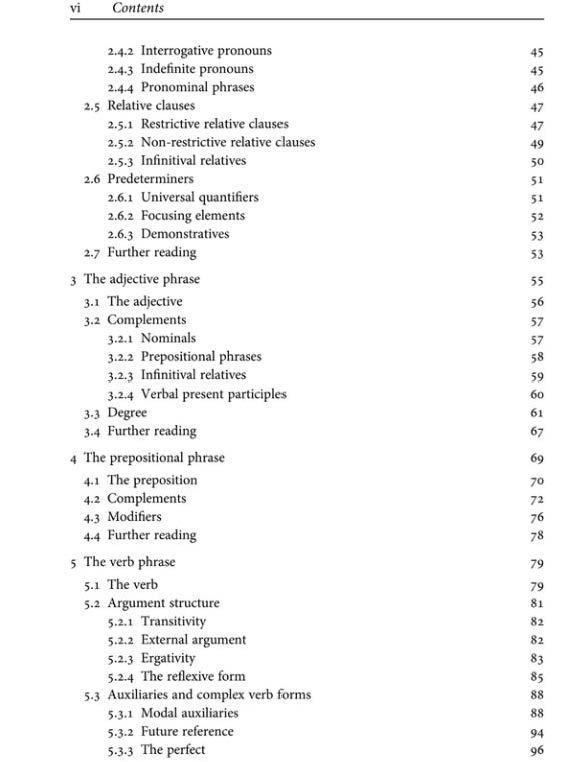
3 The adjective phrase
3.1 The adjective
3.2 Complem en ts
3.2. 1 Nominals
3.2.2 Prepos itional phrases
3.1.3 Infinitival r ela ti ves
3 .2.4 Ve r bal present part iciples
3.3 Degree
3.4 Further reading
4 The preposit iona l p h rase
4.1 The preposi ti on
4.1 Complemen ts
4.3 Modifiers
4.4 Further reading
5 The verb phrase
5.1 The verb
5.2 Argume.i 11 structure
5.2. 1 Trans it iv;ty
5.1.2 External argument
5.2.3 Ergativity
5.2-4 '!be reflexive form
5.3 Awciliarics and comp lex verb forms
5.3 . 1 Moda l auxilia ri es
5.3.2 Future reference
5.3.3 The perfect
5.4 Complements of lexical verbs
5,4.1 Nom inals
5.4. 2 Clauses
5.4.3 Prepositional objects
5. 5 Small clauses
5.5,1 Infinitive
5.5 1.1 Ver bs of percep tion
5.5,1.2 Verbs of cognition
5.5.1.3 The ver b of ordering and r equest
5.5 . 1-4 The verb of permission
5.5.2 Predicate complements
5.5 . 2.1 Subject-oriented predica te complements
5.5.2.2 Objec t -oriented predic:ate complements
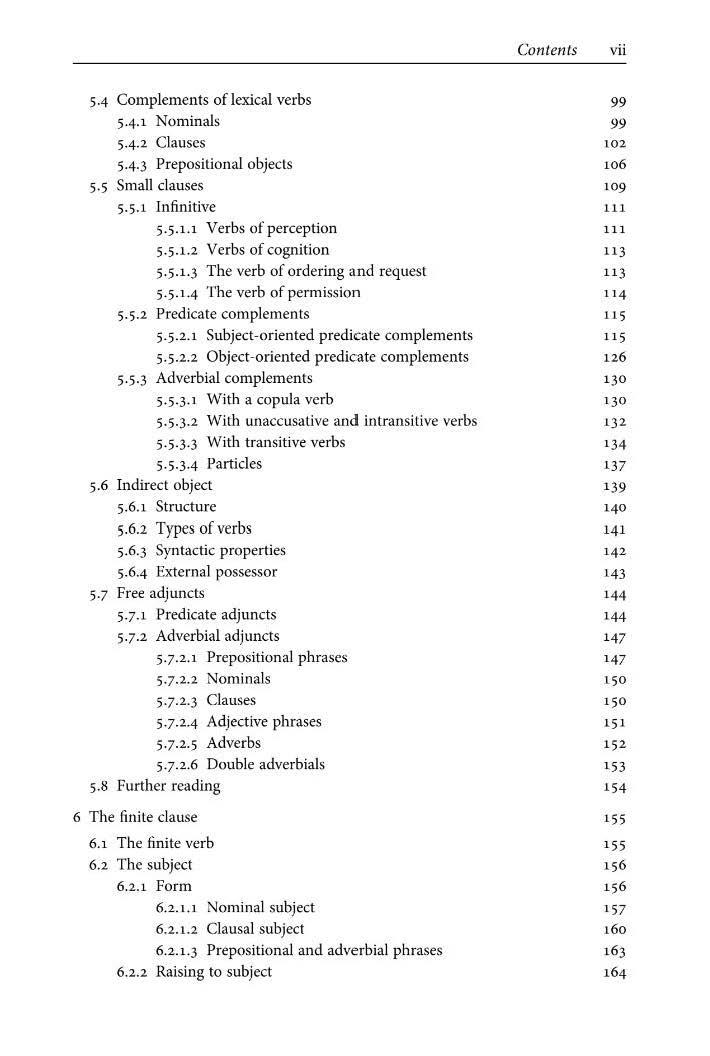
5 5.3 Adver bi al complements
5.5 3. 1 W ith a copula verb
5.5.3.2 With unaccusalive and intransitive verbs
5.5 . 3.3 W ith transi ti ve verbs
5.5.3.4 Particles
5.6 Indfrect object
5 .6.1 Structure
5 6.2 Tn,es of verbs
5.6.3 Syntactic properties
5.6.4 Externa l possessor
5.7 Fre.e adj uncts
5 .7.1 Predicate adjuncts
5.7.2 Adverbial adjuncts
5.7.2.1 Prepos itional p hrases
5.7.2.2 Nominals
5.7.2.3 Clauses
5.7 2.4 Adjective phrases
5 7.2 5 Adverbs
5-7-2.6 Double adver bials
5.8 Further reading
6 The fini te clause
6. 1 T he finite verb
6.2 T he subject
6 2.1 Form
6.2 1. 1 Nom in a l sub ject
6.2.1.2 Clausa l subject
6.2 1.3 Prepos itional and adverbia l p h rases
6.2.2 Raising to subject
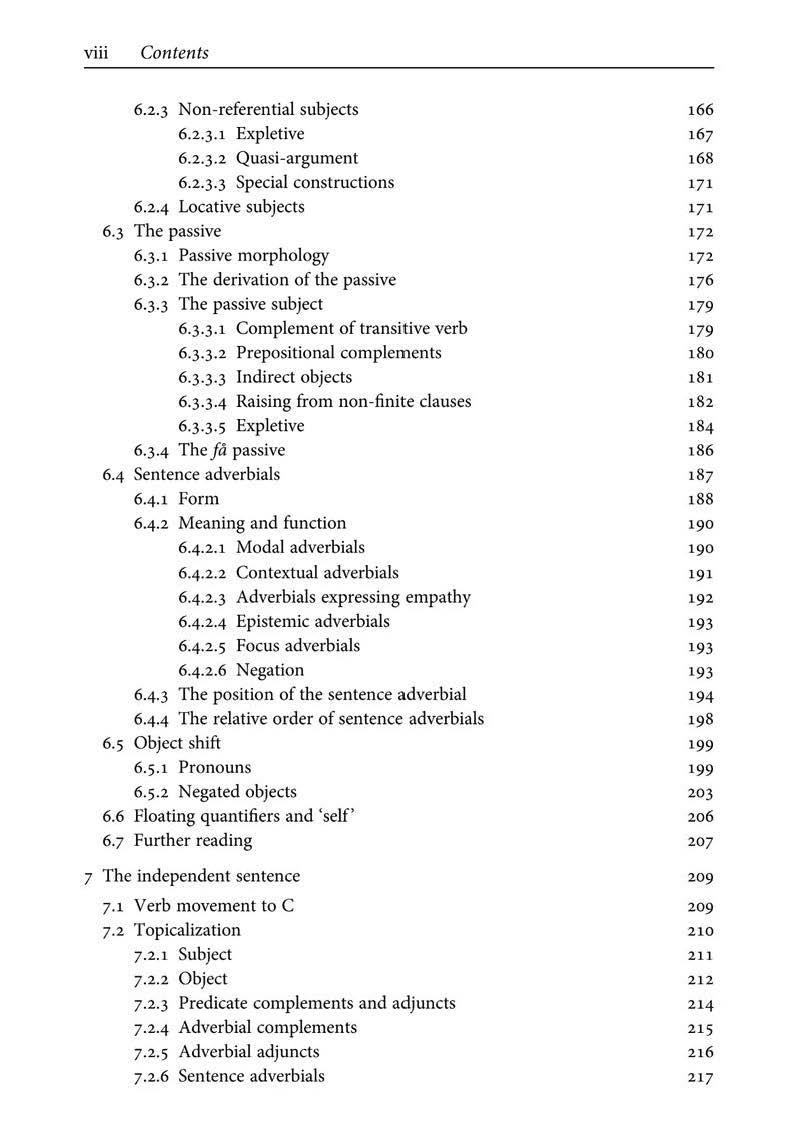
6.2.3 Non-referential subjects
6.2.3.1 Expletive
6.2.3.2 Quasi-argument
6 .2.3.3 Special constructions
6.2-4 Locative subjects
6.3 The passive
6.3.1 Passive morphology
6.3 2 The derivation of the passive
6. 3. 3 The passive subject
6 .3 .3.1 Complement of transitive verb
6 3.3.2 Prepositional complements
6.3.3.3 Indirect objects
6 .3.3.4 Raising from non-finite cla u ses
6.3.3.5 Exp letive
6.3-4 The fa passive
6.4 Sentence adverbials
6-4.1 Form
6-4-2 Meaning and function
6-4-2.1 Modal adverbials
6-4.2.2 Contextual adverbials
6-4.2.3 Adverbials expressing empathy
6-4.2 .4 Epistemic adverbials
6-4.2. 5 Focus adverbials
6-4-2.6 Negation
6-4-3 The pos ition of the sentence adverbial
6.4-4 The relative order of sentence adverbials
6. 5 Object shift
6.5.1 Pronouns
6.5.2 Negated objects
6.6 Floating quantifiers and 'self '
6 .7 Further reading
7 The independent sentence
7.1 Verb movement to C
7.2 Topicalization
7.2.1 Subject
7.2.2 Object
7.2.3 Predicate complements and adjuncts
7.2.4 Adverbial complements
7.2.5 Adverbial adjuncts
7.2.6 Sentence adverbials
7-4
7
8.1
8.2
7.2.7
8.4
8-4.1
8-4.2
8-4
8-4.4
8.5
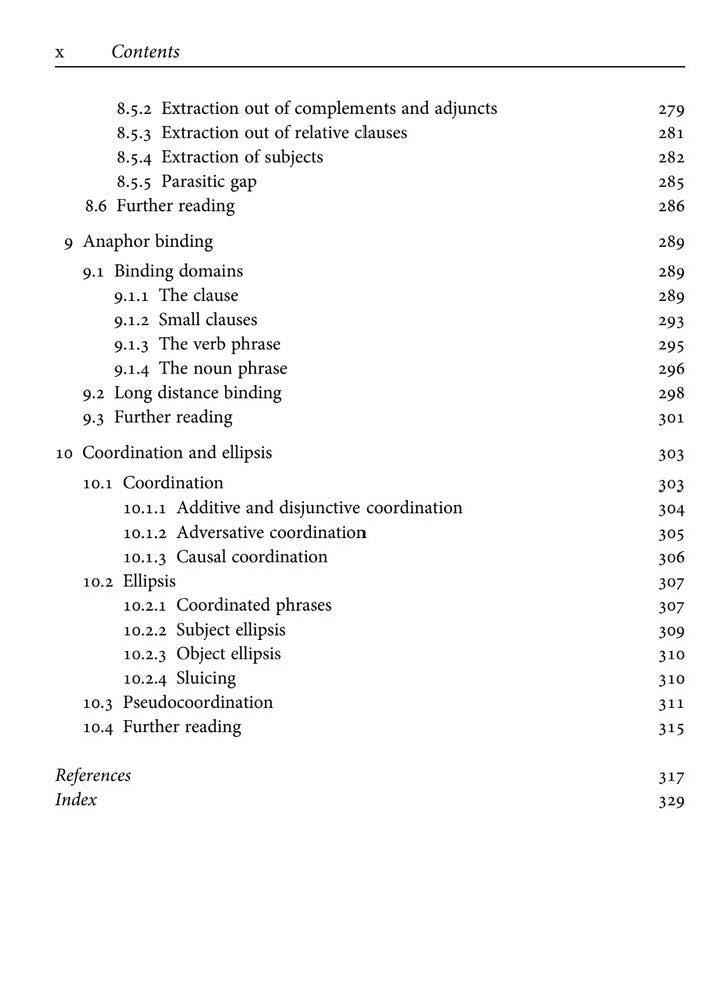
8.5.2 Extraction out of complements and adjuncts
8.5.3 Extraction out of relative dauses
8.5-4 Extraction of subjects
8.5.5 Parasitic gap
8.6 Further reading
9 Anaphor binding
9.1 Binding domains
9.1.1 The clause
9.1.2 Small clauses
9.1.3 The verb phrase
9.1.4 The noun phrase
9.2 Long distance binding
9.3 Further reading
10 Coordination and ellipsis
1 0.1 Coordination
10.1.1 Additive and disjunctive coordination
10.1.2 Adversative coordination
10.1.3 Causal coordination
10.2 Ellipsis
10.2.1 Coordinated phrases
10 2 2 Subject ellipsis
10.2.3 Object ellipsis
10.2-4 Sluicing
10.3 Pseudocoordination
10-4 Further reading
Preface TheobjectlanguageofthisbookisMainlandScandinavian,consideredasone language.ThejustificationforthisisthefactthattheNorthGermaniclanguagesof Denmark,Norway,Sweden,andFinlandmakeupacontinuumofmutuallyintelligiblevarieties,andthesyntaxofMainlandScandinavianformsanaturalgrammatical unit.Sincetheword ‘language’ isnotonlyalinguistic,butalsoapoliticaland geographicalterm,eachofthevarietiesofScandinavianusedinDenmark,Norway, andSwedenarealsoreferredtoas ‘languages’.Thisisausagethatwillalsobe sometimesfoundinthisbook,mainlyforconvenience.
TheScandinavianlanguagesarewelldocumentedandresearched,andtheirsyntax hasbeenthoroughlydescribedbynativegrammarians,butuntilthestartofrecent projectslike ScanDiaSyn andthe NordicAtlasofLanguageStructures ,whichdescribe asetofsyntacticfeaturesacrossScandinavia,moststudieshavefocusedonjustoneof thenationalvarieties.Thisbookwillpresentasynthesisofthesharedfeaturesofthe syntaxofMainlandScandinavian,aswellaswhatisspecifictoeachstandardvariety. Thereareinterestingandimportantcontrastsamongthestandardlanguages,aswell aswithinregionsanddialectsofeachcountry,whichhasmadeScandinaviaafavorite areaforthestudyofmicro-parametersandsyntacticmicro-variation.
Thepresentationinthisbookismostlylimitedtothestandardlanguages,but Ihaveincludedsomenon-standardphenomenathatarefairlywidespreadorthat representparticularlyinterestingsyntacticfeatures.Itismainlydescriptive,witha minimumoftechnicalformalitiesandtheoreticaldiscussion.Thetheoreticalbackgroundisgenerativegrammarinitscurrentversion,knownas ‘minimalism’.The minimalistprogramisdevelopingfastandindiversedirections,butformypurpose hereasimpli fiedmainstreamor ‘ average ’ versionwilldo.Thatsaid,Ihavefeltfreeto adoptaratherunorthodoxapproachonseveralpoints.Ihavenotfeltcommittedto anyparticulartheoreticaltrends,academicenvironments,orauthorities.Theresultis ahighlypersonalviewonsyntacticanalysisandthedescriptionofScandinavian.
IstartedtoresearchandwritethisbookwhileIwasamemberoftheCenterforthe StudyofMindinNatureattheUniversityofOslo.Iamgratefultotheleadershipof theCSMNforprovidingconvenientworkingconditionsandaninspiringenvironment,aswellasasmallgrantwhichmadeitpossibletohireanassistant.Iamvery gratefultoMariaWestervoll,myassistant,whohasprovidedmewithanoverviewof recentresearchliteratureonScandinaviansyntax,kepttrackofreferences,prepared the finalreferencelistandtheindex,andhelpedwithvariousdetails.
Ihavebeenfortunateenoughtohavegoodandhighlycompetentcolleagueswho havevolunteeredtoreadandcommentoneachsinglechapterofthebook.Theyare
CathrineFabriciusHansen,KariKinn,IdaLarsson,HelgeLødrup,andTerjeLohndal. Iowethemallgreatthanks.Theyhavenotalwaysagreedwithmyanalysesand solutions,andIhavenotalwaysagreedwithalltheirsuggestions,sodon’tblameany ofthemifyou findoutrageousclaimsaboutsyntaxhereandthere.Thosewillallbemy own.Butallinall,theirinputhasbeenabsolutelyvitaltothequalityofthebook. Withoutthem,thisbookwouldscarcelyhavebeenworthyofputtingonthemarket. Lastbutnotleast,IwanttothankHanneSiriforherencouragementandrelentless convictionthatIwouldlivelongenoughto finishthisproject,andforhertimely remindersthatthereareotherthingstolifethanlinguistics.
Examplesandglossingconventions Asfaraspossible,Ihavetriedtoillustrateeachsyntacticphenomenonwithone examplefromeachoftheScandinavianlanguages.Examplesentenceswiththesame numberillustratethesamephenomenon.Generally,thelanguagesarepresentedin alphabeticalorder.Theyareindicatedbyalettertotheleftoftheexample:
D=Danish
N=Norwegian(bothvarieties)
Nb=Norwegianbokmål
Nn=Norwegiannynorsk
S=Swedish
-d=dialect,regional,ornon-standard
Scandinavianwordsintherunningtextarealsoprecededbyoneormoreofthese letters(orbynoneofthemifthewordisspeltthesameinallthevarieties).
Examplesentencesgenerallyconsistofthreelines.The firstlinegivestheexample inthespellingofoneofthefourwrittenvarietiesofmodernMainlandScandinavian. Thesecondlineisamorphemebymorphemetranslationoftheexample.Inflectionalmorphemesaregenerallyglossedonlywhentheyareanecessaryelementfor theinterpretationorforthesyntacticanalysisofthesentence;pureagreement markers(uninterpretivefeatures)arethusnotglossed.CategoriesthataremorphologicallymarkedinEnglish,suchastenseandnumber,andthecaseofpronouns,are notglossed.The nd personaccusativeisglossedas you.; you withoutacasegloss isnominativesingular.WheneveritisnotclearfromthecontextwhethertheEnglish verbformisin finitiveorpresent,itisglossed,otherwisenot.Inflectionalmorphemes areneverthelessglossedwhenthegrammaticalcategoryisthephenomenonunder discussion.
ThethirdlineisanidiomaticEnglishtranslation.Thislinemaybeomittedwhen theidiomatictranslationiswordbywordidenticaltothetranslationinthesecond line,orwhenafollowingexampleunderthesamenumberhasthesamemeaning. Thetranslationisalsoomittedwithsomeungrammaticalstrings.
Abbreviationsofgrammatical morphemes ACCaccusative
Ccomplementizer
CGcommongender
COMPcomparative
DEFdefinite
Ffeminine
FUTfuture
GENgenitive
IMinfinitivemarker
INFinfinitive
Mmasculine
MPmodalparticle
Nneuter
NOMnominative
Pparticle
PASpassive
PLplural
PRESpresent
PRETpreterite
PSSpossessive
RCrelativecomplementizer
REFLreflexive
SGsingular
SUBsubjunctive
SUPsupine
SUPLsuperlative
Introduction TheScandinavianlanguages TheScandinavianlanguages,alsoknownasNordic,makeupthenortherngroupof theGermaniclanguages.Historically,NorthGermanichasbeendividedintoWest Nordic(NorwegianandIcelandic,alsoknownasOldNorse),andEastNordic (SwedishandDanish).Fromacontemporaryperspectivethisdivisionisnolonger adequate.Basedontheirstructureandmutualintelligibility,theScandinavian languagesoftodaymaybedividedintotwomajorgroups,InsularScandinavian (IcelandicandFaroese),andMainlandScandinavian(Danish,Norwegian,and Swedish).Ofthetwogroups,InsularScandinavianisthemoreconservativeone, havingkeptcaseinflectioninnounsandperson/numberagreementinverbs.Those featureshaveallbeenlostinMainlandScandinavian.ThelexiconofMainland Scandinavian,ontheotherhand,isstronglyinfluencedbyLowGerman,incontrast tothepuristiclexiconofIcelandic.
Theterm ‘MainlandScandinavian’ coversthethreelanguagesDanish,Norwegian, andSwedish,withatotalof millionspeakers.Theyaretheofficiallanguagesof Denmark,Norway,andSweden,andoneoftwoof ficiallanguagesofFinland.These languagevarietiesaretoalargedegreemutuallyintelligible.Thereisacontinuumof dialectsstretchingfromsouthernDenmarktowesternFinland.1 Besidesthestandard languages,thereareregionalvarietieswithineachcountry,andwithineachregion theremaybelocaldialects.Thestatusofregionalaccentsandlocaldialectsdiffersa lotamongthefourcountries.InDenmarkastandardlanguageisgenerallyused everywhereinpublic;localdialectsaremostlyusedinthehomes.InSwedenthe standardlanguageisalsogenerallyusedinpublic,althoughoftenwithregional accents.InNorwayregionalvarietiesandlocaldialectsareusedfreelyinthemedia andonallsortsofpublicoccasions.Informalwritingalsooftenshowsdialect features,e.g.insocialmedia.
1 ThedialectofÄlvdaleninSweden,knownas Övdalian,apparantlydoesnotbelongtothiscontinuum. Becauseofitsverydistinctstructure,itisnowarguedtobeaseparatelanguage(Garbacz ).
TheSyntaxofMainlandScandinavian.Firstedition.JanTerjeFaarlund. ©JanTerjeFaarlund
byOxfordUniversityPress.
ThenationalvarietiesoftheMainlandScandinavianlanguageshavetheirown differenthistoriesandbackgrounds.Ineachofthecountries,thewrittenlanguages werestandardizedduringthe th and th centuries,inSwedenstartingeveninthe th century.ThestandardlanguagesofDenmarkandSwedenarebasedonthe politicalandeconomiccentersofeachcountry,namelythecapitalsCopenhagenand Stockholm,respectively.ThestandardSwedishofFinlandistoalargeextentsimilar tothatofSweden,butwithafewlocalFinnishfeatures.InNorway,thesituationis different.NorwaywaspartoftheDanishkingdomandwasruledfromCopenhagen for years( th – th century).Duringthisperiod,Danishwasestablishedasthe officiallanguageofNorway.Duringthe th century,theDanishusedbyNorwegians wasgraduallyNorwegianized,andbecamewhatistodaycalled bokmål.Parallelto thisdevelopment,aneedwasfeltforaproperNorwegianlanguage,andawritten standardwasestablishedonthebasisoftheNorwegiandialects,whichhadsurvived theDanishperiod.Thisstandardisnowknownas nynorsk. 2
Althoughtherearedifferencesinphonology,grammarandlexicon,whichsometimesmaypresentachallengetointer-Scandinaviancommunication,theMainland Scandinavianlanguagesshouldbetreatedlinguisticallyasonelanguage.Unitssuch asDanish,Swedish,andNorwegianarepoliticallydefined.3 Thecontrastsamongthe variousdialectsandstandardsareseenmostlyinthephonologyandorthography, andinin flectionalmorphology.Syntacticdifferencesdoexist,buttheyhardlyever poseproblemsforunderstanding.
.
Sourcesandmaterial Themainsourcesusedinthisbookarethethreemajorreferencegrammarspublishedduringthelastcoupleofdecadesinourrespectivelanguages: Norskreferansegrammatikk (Faarlund,Lie,andVannebo ), SvenskaAkademiensgrammatik (Teleman,Hellberg,andAndersson ),and GrammatikoverdetDanskeSprog (HansenandHeltoft ).Researchpapers,articles,anddissertationsdealingwith thesyntaxofthethreelanguageshavealsobeenconsulted(seetheReferences section),inadditiontotheauthor ’sowninvestigationsandcorpussearchesspecificallyforthisbook.Theexamplescomefrommanydifferentsources,whicharenot identifiedforeachexample.Theymaybetakenfromapublicationthatisreferredto
2 ForahistoricalsurveyoftheScandinavianstandardlanguages,seeE.Haugen(: –),and Vikør().ForthepresentsituationinFinland,seeReuter(),andinNorway,seeJahr(),and Trudgill(: –).
3 Despitethis,Iwillsometimesforconveniencerefertotheseas ‘languages’,meaningthenthe respectivevarietiesofMainlandScandinavian.ThetwoNorwegianvarieties,nynorskandbokmål,are usuallynotreferredtoasdifferentlanguages.
Theoreticalbackgroundanddescriptiveframework
inthegivencontext,theymaybefromoneofthereferencegrammars,fromthe internet,or(inthecaseofNorwegian)theymayhavebeenconstructedbytheauthor. AlthoughMainlandScandinaviancanbeconsideredonelanguage,thereisno unifiedorthography.Eachofthefourwrittenstandardshastheirownspelling conventions.Therefore,therewillbeexamplesfromeachlanguage,evenincases wherethereisnosyntacticdifferencebetweenthem.Eachexamplesentence,and eachScandinavianwordintherunningtext,ispreposedbyaletterindicatingthe language.Thelanguagesaregenerallylistedinalphabeticalorder.
Theoreticalbackgroundanddescriptiveframework Thetheoreticalbackgroundforthisbookisgenerativegrammarinitscurrent version,knownas ‘minimalism’,whichthenformsthebook’sdescriptiveframework. Thebasicprincipleinthisversionofsyntaxistheoperation merge,wherebytwo elementsarecombinedintoone,forminganorderedpair.Oneorbothofthetwo membersofthepairmaybetheresultofanearliermerge,calledphrases.Byrepeated mergeoperations,abinaryhierarchicalstructureiscreated.Abasictypeofmergeis thecombinationofaheadanditscomplement,wheretheheadisasinglelexicalitem orafunctionalcategory,andthecomplementanotherlexicalitem,oraphrase createdbypreviousmergeoperations.Aphraseofthiskindislabeledbyitshead. Thebasicoperationofmergecanbeillustratedasin(). (
HereAandParelexicalheads(adjectiveandprepositionrespectively).Aisthehead ofAP(adjectivephrase),andittakesaPP(prepositionalphrase)asitscomplement. PistheheadofthatPPandtakesthenoun John asitscomplement.4
Itisabasicprincipleofminimalismthatnewitemscanonlybeaddedtothetopof theexistingstructure.Withreferencetoatreestructuresuchastheonein(),this meansthatanAPcanbecreatedfrommergingAandPPonlyafterPPhasalready beencreated.Thetree ‘ grows ’ fromthebottomup.
4 Ontherathercomplexstructureofnominals(whichisignoredhere),seechapter
Therearetwoothermergeoperationstobeconsidered.Oneistheadditionofa specifier totheleft,yieldingatraditionalX-barstructure.
()MarylovesJohn VP
In(),Vistheheadlabelingtheentirephrase,whichisaverbphrase.Thehigher nominalisthespeci fier,andtheheadVplusitscomplementNmakeupan intermediatelevel,labeledV′,todistinguishitfromVP.
Anotheroperationis adjunction,wherebyanextranodeiscreatedaboveanother node,andgiventhesamecategorylabelastheoriginalnode.Fromthisnewnode, anotherbranchisconstructed.Adjunctionmaybetotheleftortotheright.For example,byrightadjunctionofanadverbial,thestructurein()isexpandedasin().
()MarylovesJohnintensely VP
Singleitemsarerecruitedfromthelexicontobeinsertedintotheendnodesinthe treestructure.Thisiscalled externalmerge.Buttheitemtobeinsertedcanalsobea phraseoraheadwhichisalreadypresentinthestructure.Thisis internalmerge , wherebyacopyiscreatedoftheitemtobeinsertedhigherupinthestructure,and thenoneofthecopies,usuallythelowerone,isdeleted.Internalmergeisequivalent towhatistraditionallycalled ‘movement’,andforconvenienceIwillusethisterm, togetherwiththeverb ‘ move ’,andthedeletedcopywillsometimesberepresentedby a_.Itfollowsfromthebottomupprincipleofmergethatmovementcanonlybe upwardsinthestructure.
Asanillustration,considerapassivesentence,wherethesubjectreallyisthe complementoftheverb.
Thenoun people is firstmergedwiththeverb arrested,andisassignedtheroleof patientfromthatverb.Subsequently,itismergedagain,thistimeinternally,withT′ , whilekeepingitssemanticroleofpatient.
Theitemsthatareinsertedfromthelexiconareoftwokinds,theymaybelexical words,ortheymaybefunctional(i.e.grammatical)categories.Lexicalwordsare verbs,nouns,adjectives,orprepositions.Theyformtheheadsofphrases,VP,NP, AP,andPP.Functionalcategoriesmaybewords,morphemesorgrammatical features,suchasTense,Determiner,Complementizer,etc.,whichmayheadfunctionalprojectionslabeledTP,DP,CP,etc.
ThecomplementizerheadstheCP,ortheclause,whichisthelargestandthemost complexphrase.Theclausemaybedividedintothreelayers,or ‘domains’.The lowestlayeristheVP,whichisthelexicaldomain.Thisiswherelexicalwordsare firstinserted,andwherewe findthelexicalcontentofthesentence.Thenextlayeris theT-domain,whichisthegrammaticaldomain.Ontopoftheclausestructureisthe C-domain,whichcontainselementsthatarerelevantforthepositionorfunctionof thesentenceinthewidercontext.
Thisbookisorganizedaroundthosedomains,withseparatechaptersorsubchaptersdealingwitheachofthephrasetypes,startingwiththelexicalphrases.Chapter dealswiththenounphraseandthedeterminerphrase.Chapters – dealwithlexical phrasetypeswithadjectives,prepositions,andverbsastheirheads.Chapter deals withthe finiteclause(theTP),andchapter withtheindependentsentence(theCP). Thelastthreechaptersdealwithmorespecifictopics,subordination,anaphor binding,andconjunctionandellipsis.
2 Nominals Thischapterdealswiththedeterminerphraseanditsvariouslayers.Thelowestlayer isthelexicaldomain,thenounphrase(NP).Ontopofthenounphrase,thereisa grammaticaldomain,calledinflectionalphrase,whichcontainsthenominalinflectionalcategoriesofnumberanddefiniteness.Thehighestdomainisthereferential domain,thedeterminerphrase(DP).
. Thenounphrase
Thenounphraseisheadedbyanoun,whichmaybeprecededandfollowedby variouskindsofelements.Theremaybeaspeci fierintheformofapossessive,and left-adjoinedmodi fiersintheformofadjectivesandquanti fiers.Elementsthatfollow thenounareofmanydifferentcategoriesandsemanticfunctions.Theyareeither complementsoradjuncts.Complementsarepostnominalphrasesthatbearsome sortofargumentrelationorotherclosesemanticrelationtotheheadnoun,and whichdonotnormallyallowotherelementsbetweenthemandthenoun(except possessives).Adjunctsareright-adjoinedtoNP,andthusnormallyfollowcomplements.Thedistinctionbetweencomplementsandadjunctsisbynomeansclear-cut, especiallysincetherelativeorderofpostnominalphrasesmayberatherfree.Noris thisdistinctiondescriptivelyimportant;itismainlyoftheoreticalconcern,since thereisroomforonlyonecomplementinthenominalprojection,whilethereisno principledlimittothenumberofadjoinedphrases.
Thestructureofanounphrasewithapossessorandacomplementisasin(). ()Dminbogomgrammatik mybookaboutgrammar
.. Thenoun
TheScandinaviannounhasinherentgender.InstandardDanishandSwedishnouns areeithercommongenderorneuter.InNorwegiannynorskandmostNorwegian dialectstherearethreegenders,masculine,feminine,andneuter.Norwegianbokmål comesindifferentvarieties,allowingeitheratwo-genderorathree-gendersystem. Countnounsareinflectedfornumber,singularandplural.Thereisnocaseinflection innounsinthestandardlanguages.Thereisapossessivesuffix –s,butthisisno longeracasesuffix,itisrathertobeconsideredaphrasalclitic(see ).
Scandinavianhasadefinitearticlewhichisexpressedasasuffixonthenoun(see ).Thisarticleagreeswiththenounforgenderandnumber.
TheScandinaviannounthushasfourdifferentforms:
sg.indef.sg.def.pl.indef.pl.def.Gloss CgDkvindekvindenkvinderkvinderne ‘ woman ’ FNnjentejentajenterjentene ‘girl’ NSbarnbarnetbarnbarnen ‘child’
NotethatinDanishandSwedishthedefinitesuffixisaddeddirectlyontothe singularorpluralindefiniteformofthenoun,likeaclitic,whileinNorwegianthe singularstemorthepluralsuffixmaybemodifiedbytheadditionofthedefinite article,whichthenismoreaffix-like:N jente+a>jenta;jenter+ne>jentene.1
.. Complements
NounsderivedfromtransitiveverbsmaytakeacomplementintheformofaPPwith theprepositionD af NS av ‘of ’,whethertheydenotetheactionortheagent.
()Dødelæggelsenafozonlaget destruction. ofozone.layer. ‘thedestructionoftheozonelayer’ Nbsalgetavvin sale. ofwine ‘thesaleofwine’
Svinnarenavhögstavinsten winner. ofhighestprize. ‘thewinnerofthehighestprize’
Ifthecomplementcorrespondstoaprepositionalobject(see ..),thesame prepositionisnormallyusedwiththenounaswiththeverb.
1 Foradiscussionofthemorphologicalstatusofthesu fixedde fi nitearticle,seeFaarlund()and WetterlinandLahiri().InthefollowingIwillusethetermsuf fixforthepostnominalde finite article.
Thenounphrase
()
DNkampenforfred(cf.kæmpefor) struggle. forpeace ‘thestruggleforpeace’
Nbfortellingeromgamledager(cf.fortelleom) talesaboutolddays ‘talesabouttheolddays’
Slängtanefterhavet(cf.längtaefter) longingaftersea. ‘longingforthesea’
Acomplementcorrespondingtoarecipientoranindirectobjectisintroducedbythe prepositionDN til S till ‘to’ .
()Denpåmindelsetilosalle aremindertousall ‘aremindertoallofus’
Nneimeldingtildeltakarane amessagetoparticipants. ‘amessagetotheparticipants’
Sengåvatilluniversitetet agifttouniversity. ‘agifttotheuniversity ’
Nounsderivedfromadjectivesalsotakecomplements.
()Dglædenvednaturen delight. bynature. ‘thedelightinnature’
Nntryggleikpåsegsjølv confidenceon self ‘self-confidence’
Sfrihetfrånansvar freedomfromresponsibility
Certainnounsmayhaveaverbalcontentwithoutbeinglexicallyderivedfromverbs, andthereforestilltakecomplementswithanobjectrole.
()Ddirektørenfordethele manager. forthewhole ‘themanagerofitall’
Nbokaomkrigen book. aboutwar. ‘thebookaboutthewar’