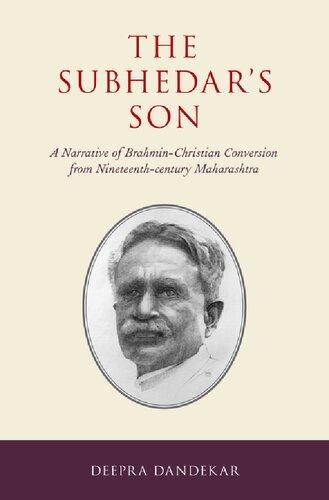
The Subhedar’s Son
A Narrative of Brahmin-Christian
Conversion from Nineteenth-century Maharashtra z
DEEPRA DANDEKAR
Oxford University Press is a department of the University of Oxford. It furthers the University’s objective of excellence in research, scholarship, and education by publishing worldwide. Oxford is a registered trade mark of Oxford University Press in the UK and certain other countries.
Published in the United States of America by Oxford University Press 198 Madison Avenue, New York, NY 10016, United States of America.
© Oxford University Press 2019
All rights reserved. No part of this publication may be reproduced, stored in a retrieval system, or transmitted, in any form or by any means, without the prior permission in writing of Oxford University Press, or as expressly permitted by law, by license, or under terms agreed with the appropriate reproduction rights organization. Inquiries concerning reproduction outside the scope of the above should be sent to the Rights Department, Oxford University Press, at the address above.
You must not circulate this work in any other form and you must impose this same condition on any acquirer.
Library of Congress Cataloging-in-Publication Data
Names: Dandekar, Deepra, author. | Savarkar, Dinkar Shankar, 1867–1952. Subhedārāchā putra. English.
Title: The subhedar’s son : a narrative of Brahmin-Christian conversion from nineteenthcentury Maharashtra / Deepra Dandekar.
Description: New York, NY : Oxford University Press, [2019] | Series: AAR religion in translation | Includes bibliographical references and index.
Identifiers: LCCN 2018021629 (print) | LCCN 2018044297 (ebook) | ISBN 9780190914059 (updf) | ISBN 9780190914066 (epub) | ISBN 9780190919863 (online resource) | ISBN 9780190914042 (hardcover : alk. paper)
Subjects: LCSH: Marathi literature. | Marathi language—Texts. | Conversion in literature.
Classification: LCC PK2418.S358 (ebook) | LCC PK2418.S358 S8313 2019 (print) | DDC 891.4/634—dc23
LC record available at https://lccn.loc.gov/2018021629
1 3 5 7 9 8 6 4 2
Printed by Sheridan Books, Inc., United States of America
Dedicated to the charismatic memory of my most beloved father Dibyendu Kanti Bhattacharya.
An Introduced and Annotated Translation of The Subhedar’s Son (Subhedārāchā Putra), originally written in Marathi by: Rev. Dinkar Shankar Sawarkar, 1895.
Bom B ay Trac T and Book Socie T y, D. B. Padmanji’s Victoria Printing Works, Bombay
Preface
i wa S par T ially reared as a Christian. My mother’s family was among the early upper-caste Christian convert families from Maharashtra, with ancestors who converted in the first half of the nineteenthcentury, in the Anglican missions of Nasik. Typically, my mother’s family also retained their Brahmin caste status despite conversion, and this reflected the family’s tradition of having exercised intellectual and religious/ church leadership—a position typically accorded upper-caste and Brahmin converts within colonial missions. Accordingly, Brahmin leadership in native mission churches assumed that upper castes who were viewed as upholders of Hinduism, would provide other castes with an example of breaking with ancestral religion. This fulfilled the larger missionary goal of breaking Hinduism itself and making space for the missionary presence in Indian society. Analysing conversion as part of missionary goals alone is, however, a perspective that is internal to modern nationalism, a political movement that is postdated to these earliest conversions by several decades. Early converts pandered to no such missionary agenda especially as they were racially segregated within the mission itself. Instead, they converted for personal, emotional, and intellectual reasons that expressed their individualism. Their vernacular writings strengthened a remodelled emphasis on their Brahmin status and ancestry and strong vernacular nativism that later became yoked to nationalism (especially among secondgeneration converts). While converts became individualists, who selected crosshatched aspects and facets of social identity to benefit themselves and the Brahmin nationalist cause in Maharashtra, European and American missions failed to enter upper-caste Indian society, undercut by their own racism and their entrenchment within the larger colonial discourse. However, nineteenth-century Protestant missions (British, Scottish, and American) dominated the religious and cultural scene for Marathi Christians until independence. Christianity in rural and semiurban
Maharashtra has only recently moved towards Pentecostal evangelism and charismatic praying that mingles evangelism together with Marathi local religious practices to produce a consolidated modern native Marathi Christianity, characterized by trance and healing. But apart from Mukti Mission that promulgated Pentecostal Evangelism imported by American missionaries (Suarsana 2013) in the early twentieth century (Minnie F. Abrams imported Pentecostal evangelism to Mukti Mission in 1905, introducing Paṇḍitā Ramabai and the other inmates of Mukti to ‘revival’), modern Pentecostal evangelism in Maharashtra today, with its social base in mostly rural, semiurban, and lower-caste fellowship, does not follow from a history of nineteenth-century missions.
While it was Europeans who headed nineteenth-century missions, Brahmins and other upper-caste converts dominated leadership within native missionary churches, counterbalancing accusations of perpetuating colonialism levied against them in Indian society by expressing deep nationalism and Marathi nativism. The Dalit accusation of Brahmin Christians propagating upper-caste nationalism cannot be challenged, but perhaps, and naturally so, it lacks empathy for Brahmin converts, who suffered from double-edged ostracism. While missionaries elicited Brahmin and upper-caste conversion, they discriminated against ‘native’ converts as lesser Christians. This allowed Hindu Brahmins more latitude in discriminating against Brahmin converts as lesser Brahmins. The separation between Christian devotion and anticolonialism combined with passionate Marathi belonging and a penchant for vernacular literature produced Brahmin Christians as an interstitial social group that was subject to multiple fragmentation. I grew up being influenced by an extremely devout, Christian mother, who spoke movingly about the family’s Chitpāvan (Konkani Brahmin) identity, and her deep loyalty and love for Indian nationalism, as we read endlessly together about the revolt of 1857 and Rani of Jhansi, the Maratha warrior. My mother taught me to recite chapters from the Bhagavat Gita learned by heart, and it was also my mother who taught me the Lord’s Prayer in Marathi.
This book emerges from my personal experiences of fragmentation between religious and ethnic identities, and this fragmentation accords the writing of this book with a subject position that I explore in the following few pages with the help of somewhat interconnected themes. First, there is an alleged ‘rupture’, brevity, or truncation of family history that convert families (such as mine) were accused of causing, and connected with this is the vicariously lived momentous nature of conversion or rupture that is
sought to be consumed as a new experience. Further associated with the ostracism are questions of why Marathi Brahmin families needed to convert and whether they were in fact Marathi or Brahmins at all, if they had converted. While convert families such as mine have always battled social discrimination, ‘academic’ interrogations of Brahmin conversion is a foil that perpetuates the same discrimination, since assumptions underlying such questions remain as hegemonic as notions held by those who perpetuate discrimination on the grounds of normalising the Hindu Marathi and Brahmin body, and assigning the proper belonging of religion to race. I outline some of the personal reasons for Brahmin conversion in this book by positing nineteenth-century vernacular Christian literature as the basis of conversion hermeneutics, which demonstrates the nonmomentous and personal nature of conversion in contrast to voyeuristic interests that seek to consume it as outside the ordinary.
This historical analysis of conversion also constitutes self-evaluation. Can a person from a convert family write academically about conversion? Personal association with the subject of research is a question that haunts postcolonial researchers, even though this question has an internal catch. It is obvious that research from without and above cannot replace a history of experience written from within and below; as advocates who are critical of the latter could hardly be supporting the cause of inadequate research. Though I do not seek leadership in any academic domain that researches conversion, the current translation provides a valuable insider’s view to the subject, since its author, Dinkar Shankar Sawarkar (DS; 1867–1952), is my great-grandfather. DS wrote The Subhedar’s Son in 1895 as a novelized biography of his father Shankar Balwant’s conversion to Christianity in 1849 based on the latter’s Christian witness, personal family anecdotes, and other Marathi Christian literature. My subsequent research interest in the convert Shankar Nana (DS’s father) was born out of empathy for his social isolation. His words leaped out at me from archival records, from old and withered papers written with faded ink, comforting me with his meticulous recounting of small and everyday tasks in the mission.
It is not as if I did not find DS’s political views (on religion and caste) problematic. His views are indeed unacceptable in 2018. However, DS and his views that were rather common in nineteenth-century Maharashtra do not detract from the historical significance of Brahmin conversion. Many ‘liberal’ publishers who rejected this translation were afraid that I was perpetuating Savarkar-ite ideology. Not only is this untrue, but the bias towards reading and writing history originating from a postdated judgement
that clouds the past constitutes a deliberate and reductionist erasure of history. Such biases preclude the existence of only one ‘Savarkar’ and further assumes that all ‘Savarkars’ are globally linked with only one subscription of ‘Savarkar’ thought: “thought: Hindutva” Hindutva. A refusal to speak about the existence of many ‘Sawarkars’ and different political opinions among people of the name (and this one about Christian conversion) has transformed the name Sawarkar/Savarkar into a Voldemort phenomenon: a disconnected symbol produced by historical bias that refuses to accommodate the history of Christian conversion associated with the name. The transformation of the Savarkar/Sawarkar name into a Voldemort phenomenon creates a piquant situation, wherein no one speaks of ‘that’ name but constantly senses its omnipresence. Apart from this paranoia that can henceforth be disregarded, this book clarifies not only how Rev. Shankar Balwant Sawarkar, the original convert and subject of this book, led a different individual life but that his Christian conversion was exactly what Hindutva denounced.
Writing about not just Brahmin conversion but ‘Sawarkar conversion’ became a battle for me, as I struggled to find an academic starting point for publishing a translation that would contribute to historical research about Maharashtra without being colonized by a bias that reduced all Sawarkars/Savarkars to Hindutva. I therefore especially thank John Nemec (University of Virginia), series editor for the AAR Religion in Translation Series, who provided me with unceasing encouragement and guidance to write this book. I also want to thank Jon Keune (Michigan State University) for all his helpful suggestions and encouragement for this project. Finally, I thank both my anonymous reviewers, who read my manuscript closely and whose extremely helpful comments helped me to tackle many earlier dissonances in my text. I am, of course, solely responsible for the ones that remain.
One of the most poignant themes of conversion—an emotional difficulty that my mother’s family also confronted—is the experience of conversion as ‘rupture’ resulting in genealogical brevity. Convert families are usually unable to access family genealogy beyond the point of conversion. While first-generation converts deeply engage in autobiographical endeavours, in the form of Christian testimonies and witnesses, secondgeneration conversion accounts are mostly documented by the convert’s family members and colleagues. For example, Devadutt Narayan Tilak and Ashok Devadatt Tilak wrote prolifically about their parents’ and grandparents’ (Narayan Vaman Tilak and Lakshmibai Tilak) conversion in 1895 in
the United Provinces (Ṭiḷak 2000). However, such ‘family writings’, based on autobiographies, Christian witnesses, archival literature, and personal encounters typically locate conversion within discourses of compensation. Descendants or junior colleagues writing about convert ancestors or elders, narratively compensate for conversion by positing it as a rupture. The brevity encountered within clan genealogy is narratively compensated by highlighting the intellectual contributions made by converts within an environment of social exclusion and ostracism from the Hindu clan.
Although I belong to a ‘convert’ family myself, I still ponder the momentousness of Protestant conversion: whether Protestant conversion can be considered momentous at all, since it is only its compensatory narrative reconstruction that portrays it as a dramatic rupture counterbalanced with the intensity of the convert’s social contribution, mired in nonrecognition. While researching this book, I encountered many autobiographical and very detailed Marathi conversion narratives that documented nonmomentous Protestant conversion of the heart, and an almost banal everyday piety. Neither did the language of Protestant Christian piety ever deviate from traditional vernacular tropes of devotion or Bhakti outside Christianity. If it were not for specific references to Krista (Christ) or Dharmaśāstra (Holy Bible) most convert piety would be unremarkable and nondifferentiated from Marathi Hindu piety in the literatures of the time. While nineteenth-century Marathi Christian converts expressed Christian Bhakti as natural and internal, they applied its transformative agency to the experiences of conversion. And this was not momentous; Kristabhakti, assuming almost a natural flow with other Bhakti(s) of the time, reserved the same intensity for other life-changing events in the convert’s life, such as the family’s exodus to a city. Convert Bhakti for Krista could in fact compare with the pious expressions of many Hindu Bhakti protagonists of Maharashtra, who were known to have left home to follow in the Bhakti way or mārg. Therefore, Tilak’s devotional Christian poetry using vārkarī Bhakti tropes is contiguous with an internal experience of Christian devotion that enjoys a larger historical and sociocultural base in Maharashtra. Conversion constructed as momentous (or curious, if banal) on the other hand runs into the orientalist trap of racializing religion: the Indian body as Hindu and the European body as Christian. These racialized conflations reduced Marathi converts to a prism of ambivalence—an ambivalence that remodelled the understanding of conversion as procolonialism. To reduce Indian Christians to the propogation of colonial machinery may even be plausible, if its underlying assumptions had not been preposterous enough
to suggest that other Indian Hindus and Muslims, especially upper castes, never supported colonialism or gained educational or professional benefit from it. Not only does the reduction of religion to the racialized body disallow Europeans from being read as Hindus or Muslims, but it produces the conversion of Hindu upper castes as a rupture. Family writings about ancestral conversion reveal the internalized guilt of causing rupture to clan and society as biographies recounting conversion brim over with the desire to reconnect with the original Hindu clan. The original Hindu clan is in this context imagined as symbiotic and monolithic entity, suffused with a glow.
That Hindu Brahmin clans were never monolithic, as also demonstrated by The Subhedar’s Son, is evidenced by the presence of conversion within its folds, as dissatisfied family members left home to begin their individual lives and convert to/follow their own Bhakti. Clan accusations of betrayal were therefore convenient, since these portrayed converts as scapegoats and universalized the Hindu clan at the convert’s expense. This side-stepped the truth and mystified the Hindu clan, constructing it as a fallacious Hindu nationalist entity, especially since this fallaciousness was evidenced by the existence of conversion. Since conversion and the idea of the united Hindu clan cannot co-exist structurally, Brahmin conversion and upper-caste Christian leadership deconstructed the idea of an unambiguous Hindu clan. Other Marathi Brahmin family histories suffered moreover from equal brevity, despite recorded family genealogies or kuḷavṛutānta. Current generations hardly access great-grandparental experiences, opinions, and emotions in Maharashtra (unless of national/ international importance), and they do not experience this absence of emotional access as rupture or brevity. Nor does this same brevity become spectral for betrayal. It is only conversion constructed as a ‘rupture’ that produces genealogical loss within Marathi families. In this book, I have therefore treated conversion as ordinary by attempting to showcase how Christian biographies by second-generation converts project it as rupture, in contrast to first-generation autobiographies and Christian witnesses. I have also highlighted how the cultural and literary production of conversion in nineteenth-century Maharashtra straddles convert nationalism, Christian piety, vernacular nativism, and the nostalgia for Brahmin ancestry. Also, keeping respectfully to the wishes of the convert Shankar Nana, whom this book is about (encountered in his Christian witness), who left Hinduism and his Hindu clan to join the Christian mission, I have not historicized family history beyond the convert. I have desisted from excavating the convert’s earlier or collateral Hindu clan connections
and have instead projected the writing of Brahmin conversion as a religious, cultural, literary, nationalist, and genealogical activity—a penumbra constituted by the pain and shame of discrimination and racialization, woven around diverse individual truths resulting from ordinary but transformative individual piety.
I briefly present my position on two omnipresent and nagging questions surrounding Brahmin conversion in my own family. How can Christians be Marathi (how could I be Marathi if I were Christian)? And why did Brahmins need to convert at all (why did my mother’s ancestors need to convert) if they were really Brahmins? The first question—the linkage between the Marathi body and the Christian body—remains mired in various toxic assumptions that promote the discursive production of conversion as hegemonic, exemplified by the Goanese Catholic-Portuguese inquisition. According to this view, since conversion can only be forced (like in Goa), Marathi individuals cannot become Christians (since Maharashtra was not colonized by the Portuguese). While this question remains in denial of the history of nineteenth-century Protestant missions in Maharashtra, where conversion among Brahmins was an act of individual free will and agency, the question continues to perpetuate the myth that all Marathi Christians are Goanese Catholics, who migrated later to Maharashtra, and whose ancestors were forced to convert. Not only do Hindu ideas about religion invalidate forced conversion, but these ideas are also subject to a tautology that denies the presence of freely chosen conversion: How can someone convert without being forced? And if conversion is forced, how can it be true? Apart from propagating a deeply Protestant belief applied to the imagination of freely chosen Hinduism, it is untrue that enforced religion is invalid. If it had indeed been so, then political religion in Ancient India (Buddhism and Jainism included) would have been invalid too. Therefore, since there was no inquisition in Maharashtra (like in Goa), those Maharashtrians (many of them Brahmins) who converted to Protestant Christianity are valid Marathi Christians; and both forced and unforced conversion are authentic.
Second is the question of why Brahmins converted at all. This question is based on another fallacious assumption that Christian conversions took place primarily among Dalits and the poor, who gained money and status from the mission and escaped caste oppression. This argument again evidences Hindu denial that, moreover, reveals disrespect for Dalit conversion. The argument could have even been plausible, if upper-caste Hindus had relinquished Hinduism as inauthentic, once they gained from it. But
since upper-caste Hindus gaining from Hinduism nevertheless remained staunch Hindus, converts (Dalits included) gaining from Christianity were valid Christians too. Also, there is an assumption that Brahmins gain universally from Hindu society (and Dalits do not) and that the united Hindu clan always fulfils all individual Brahmin needs. This is untrue. All Brahmin individuals did not gain universally from Hindu society and clan—a feature that this translation highlights, as the author in his preface invites all individually dissatisfied and disempowered Hindu Brahmins to convert to Christianity. Brahmins instead gained enormously from Christian conversion, the mission accelerating their intellectual and emotional growth, despite colonial and racial oppression. And neither did all Dalits convert.
Indeed then, if Protestant conversion is individual and ordinary, even if transformative, and cannot be treated uniformly as a distinguishable and universal process, the translation of biography and autobiography remains the only available research method for exploring individual and historical objectives underlying religious transformations and conversion. In addition to thanking all those who have used the biographical method to present converts in their own words,1 I would recommend biographical recounting and translation as the only research method that goes as close as possible to the bone of transformative personal experience. These reveal that there is no ‘one’ structuralist answer to ‘why Brahmins converted’. The answers for why persons convert can only be disclosed after an exploration of autobiographical texts narrating conversion that reveals a multiplicity of personal and historical reasons, contextualized within a network of individual social, emotional, religious, and intellectual needs.
A bottleneck of identities squeeze upon a once prolific and intellectually vibrant community of Brahmin converts in Maharashtra, whose vernacular writings have gradually lost historical resonance. It is my aim to explore this vernacular Christian literary domain by projecting Marathi Brahmin Christians as an ostracized group with overlapping identities struggling for ethnic (Marathi) and caste rights—a small and semi-endogamous community at the interstices of being Marathi, being Brahmin,
1. Apart from Kosambi (2000) who wrote beautifully of Paṇḍitā Ramabai in her own words, I especially enjoyed Tanika’s Sarkar’s (1999) annotated and edited translation of Rashsundari Debi that discusses various interesting subjects surrounding women’s education. I also enjoyed Shakuntala Peter’s (2004) research on a Tamil Christian family surviving the Second World War in Burma.
and being Christian. Brahmin Christians were a group defined by their struggle against racialized reductionisms that essentialized Brahmins as Hindus and Christians as European, while challenging the interpretation that all conversion between racialized categories is anomalous. Writing about conversion in my mother’s family therefore explores the same variables as research on the production of other political minorities in nineteenth-century Maharashtra, filling the historical lacuna for a less researched topic. Though I did not find too many opportunities for presenting this research within academic forums, since I was unemployed at the time I researched this book, I did present some of my ideas in Professor Margrit Pernau’s colloquium (Center for the History of Emotions, Max Planck Institute for Human Development, Berlin) and received some helpful feedback from Kedar Kulkarni, offered with characteristic bluntness. I also thank Professor Hans Harder, in whose colloquium at the Department of South Asian Languages and Literatures, South Asia Institute, Heidelberg, I presented a part of this work, and I remain grateful to Professor Amiya Sen for discussions on religion and intellectual history.
Since I began working with my mother’s family history and how it constituted a starting point for this book, I provide some factual details that will help to contextualize the reading of The Subhedar’s Son and my subsequent analysis. My mother’s family history of conversion began with the story of her paternal great-grandparents Shankar Balwant Sawarkar and his wife Parubai, who left home in 1849 to join the Church Missionary Society (CMS) at Nasik. Shankar Nana became deacon at the Anglican Church later, while serving as native Marathi pastor at Malegaon. On my mother’s maternal side, the first conversion in her mother’s family can be traced to her great-grandfather Vasudev Dongre (and his two children Krishnarao and Subhadrabai Dongre). Vasudev Dongre was Paṇḍitā Ramabai Dongre’s cousin; his father was Ramabai’s father Ananta Shastri Dongre’s younger brother. Vasudev Dongre converted to Christianity and came to Mukti Mission with wife, children, and a few other family members after Ramabai won them over while preaching the gospel at Mal Heranji where Ananta Shastri’s family lived (near Mangaluru). The precise date for their conversion is unavailable, but from a personal letter published by Rajas Dongre and Patterson (Rajas Dongre was Krishnarao Dongre’s daughter) in 1963, the conversion seems to have taken place in 1894. On the other side, lay the conversion of my mother’s maternal great-grandfather Narayan Balkrishna Gadre, who arrived from
Preface
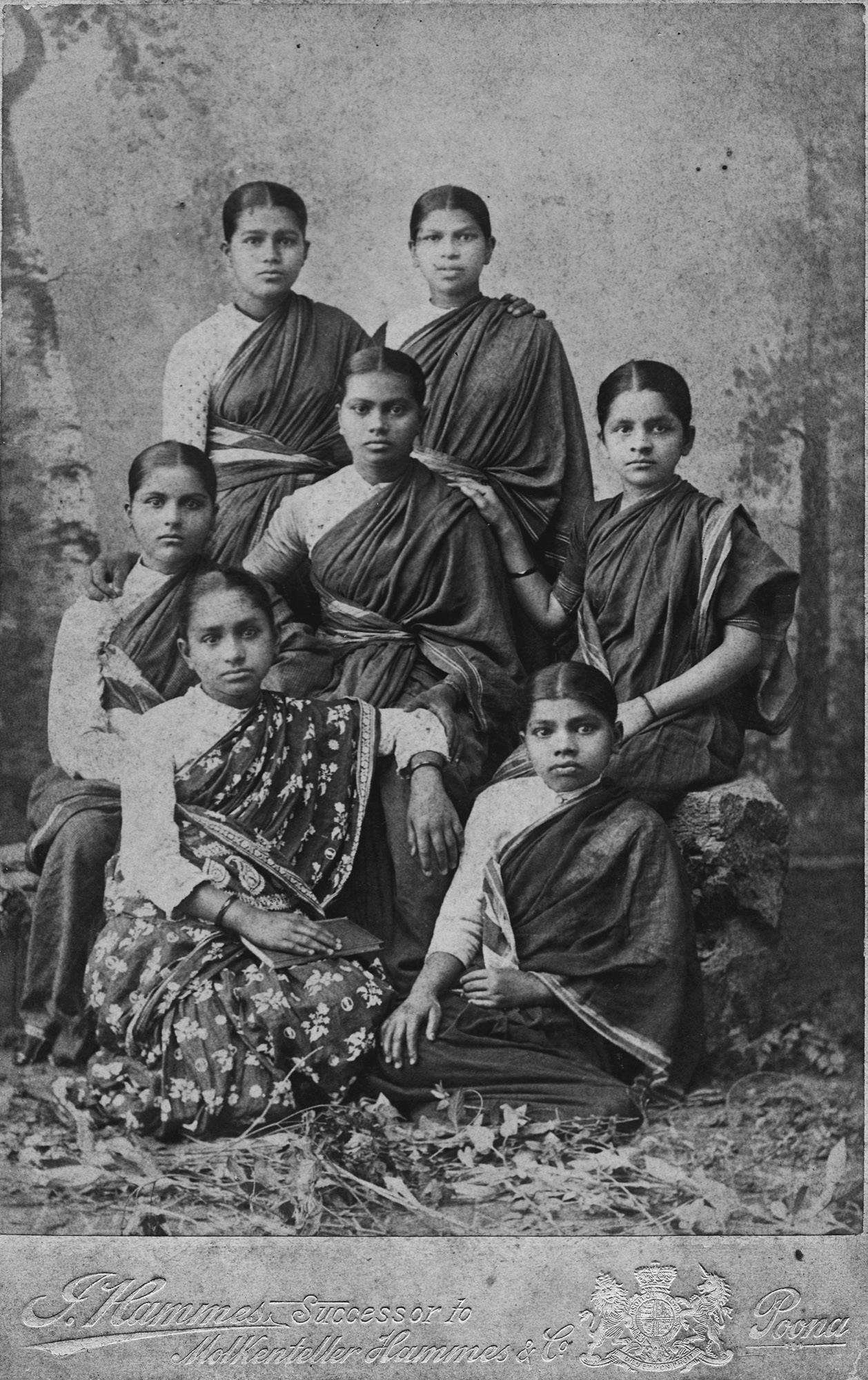
Palshet (Konkan) to convert to Christianity at the Money School in Bombay in 1857 and served the American Free Methodist Church at Yevatmal (then Berar) as native Marathi pastor. Encouragement for this book has lain in some of these early family writings reconstructing conversion. I thank Rajas Krishnarao Dongre for writing about the Dongre side of conversion in 1963 and Mohan Balwant Gadre for writing about the Gadre side of conversion in 2008 (a book I deeply enjoyed). The Sawarkar side of conversion was unwritten before I undertook the enterprise. The following is a picture of Subhadrabai Dongre with her friends, while growing up in Mukti Mission.
Subhadrabai Dongre (middle row, far right) with a few girlfriends at Paṇḍitā Ramabai’s Mukti Mission in Kedgaon, date unavailable. (Image courtesy Pratibha Bhattacharya)
I found and procured a copy of the biographical novel The Subhedar’s Son written in 1895 by Dinkar Shankar Sawarkar (Shankar Nana’s son) that detailed family history and conversion from the India Office Records and Private Papers, at the British Library in London. I thank them for making their copy available to me for translation. Later, a copy of the same novel turned up in our household collection of books, and, though the book was fragmented, my cousin Ajay A. Sawarkar provided me with careful scans of many of its pages.
o n reading T he novel for the first time, I considered it opiniated and hybrid, straddling various issues that were considered important by the convert’s son but not necessarily by the convert himself. I missed the convert’s voice. Although I initially consoled myself and prepared to translate a reconstructed recounting of conversion, it made me uncomfortable to propagate DS’s political opinion. My translations stalled for a while, as I searched for the convert. I finally found Shankar Nana’s papers at the CMS archives, housed at the Cadbury Research Library in Birmingham. His history gleaned from archival records now counterbalances DS’s literary production of Shankar Nana’s conversion. It was indeed thrilling for me to encounter Shankar Nana’s handwriting and signature, and I remain indebted to the staff of the Cadbury Research Library in Birmingham for allowing me access into the catalogues of CMS documentation.
But this wasn’t all. Since I had also developed a sneaking doubt about DS midway through the translation, since DS was hardly seventeen years old at the time his father, Shankar Nana, passed away, I wondered whether he had known his father well enough to have written such a graphic conversion narrative. I then proceeded to compare The Subhedar’s Son with many other Christian autobiographies and biographies of DS’s time to compare the literary production of DS’s narrative; and indeed, I found many parallels. I am grateful to the Niedersächsische Staatsbibliothek Göttingen and the Library of the Freie Universität Berlin for helping me with various interlibrary loans in the UK and United States. Finally, I express gratitude to the congregation and management at St. Paul’s Church, Malegaon (Nasik district) for opening their doors and hearts to me. It is after travelling there one extremely hot afternoon that I found Shankar Nana and Parubai’s graves.
I thank my aunt Vijaya Ramalingam (née Sawarkar) for providing me with her unpublished translation and commentary on DS’s autobiography (Ayuṣyāchi Kahāṇi) published posthumously in 1967, which provided additional details about Shankar Nana’s ancestry. I also thank Dr. Shivaji
Ramalingam, my uncle, for his unceasing support, hospitality, and countless breakfast-appams. I want to express my deep gratitude to my grandparents, Balwant Dinkar Sawarkar and Manorama Sawarkar, as well as to my aunts and uncles for embodying this very special family for me, and for teaching me through gentle examples that our Christian piety was indeed natural and Marathi. I also thank Uday Arun Khisty (DS’s greatgreat-grandson) for providing me with interesting family documents.
My special gratitude goes to my mother Dr. Pratibha Bhattacharya (née Sawarkar). My mother provided me with constant support, encouraging my research with infinite prayers, apart from engaging in full- blooded discussions about conversion. My mother taught me compassion for Shankar Nana, whom I had hitherto viewed only as a scientific resource. This compassion for Shankar Nana made me initially uncomfortable and afraid, especially since I feared that emotions would interfere with research, making my writing unscientific and earning me further criticism for alleged hagiography writing. But I was mistaken. Without empathy for our historical subjects, it is hardly fair to write their history. I don’t know whether I really came to like Shankar Nana, or DS, but at the least I connected with my mother’s empathy for them, and this helped me lose my fear of writing critically about their lives. Writing dispassionately and ‘scientifically’ about family is never easy. I was afraid of offending everyone in the family and feared that I would insult them by disregarding their views on Christianity and conversion. My father, Dr. D. K. Bhattacharya, who unfortunately did not live to see this book completed, taught me the courage of a researcher, who would use her scientific capacity fearlessly and to her best, while analysing the historical and literary material at hand. Finally, I thank my husband Torsten Tschacher. I felt that Torsten would go to the end of the world for making this book possible, photographing research materials at every library possible and spending all his additional funds on international library visits and fees, since Shankar Nana’s documents no longer lay in India. He helped me write this book and demonstrated limitless academic patience as I rambled on about it for the five years before I wrote it.
List of Illustrations xxi
Note on Translation xxiii
Introducing the Novel xxv
Part I. The Context of The Subhedar’s Son 1
Part II. Multiple Narratives in the Novel 23
Part III. Shankar Nana, Parubai, and the Author, Dinkar Shankar Sawarkar 39
The Subhedar’s Son (Subhedārāchā Putra): An Annotated Translation 61
A. Preface 61
B. Announcement 62
C. Table of Contents 62
D. Preparing for Battle 63
E. A Stranger among Friends and Relatives 70
F. Enlightened Times 77
G. Two Sons in 1200 Rupees 84
H. A Favour Is Never Wasted 92
I. A Barrage of Losses 102
J. Life’s First Disappointment 110
K. ‘I have no doubt that truth will be revealed!’ 120
L. Family Pride 129
M. The Fiery Tongue Is an Abode of Injustice 138
N. The Sadasatśodhak Mandaḷī 145
O. Lurching in a Sea of Suspicion 154
P. Reaching Harbour 163
Q. Ramaa 170
R. Scenes from Life 178
Afterword and Concluding Thoughts