published in the oxford philosophical concepts series
Efficient Causation
Edited by Tad Schmaltz
Sympathy
Edited by Eric Schliesser
The Faculties
Edited by Dominik Perler
Memory
Edited by Dmitri Nikulin
Moral Motivation
Edited by Iakovos Vasiliou
Eternity
Edited by Yitzhak Melamed
Self-Knowledge
Edited by Ursula Renz
Embodiment
Edited by Justin E. H. Smith
Dignity
Edited by Remy Debes
Animals
Edited by G. Fay Edwards and Peter Adamson
Pleasure
Edited by Lisa Shapiro
Health
Edited by Peter Adamson
Evil
Edited by Andrew Chignell
Persons
Edited by Antonia LoLordo
Space
Edited by Andrew Janiak
Teleology
Edited by Jeffrey K. McDonough
The World Soul
Edited by James Wilberding
Powers
Edited by Julia Jorati
The Self
Edited by Patricia Kitcher
forthcoming in the oxford philosophical concepts series
Modality
Edited by Yitzhak Melamed
Human
Edited by Karolina Hubner
Love
Edited by Ryan Hanley
The Principle of Sufficient Reason
Edited by Fatema Amijee and Michael Della Rocca
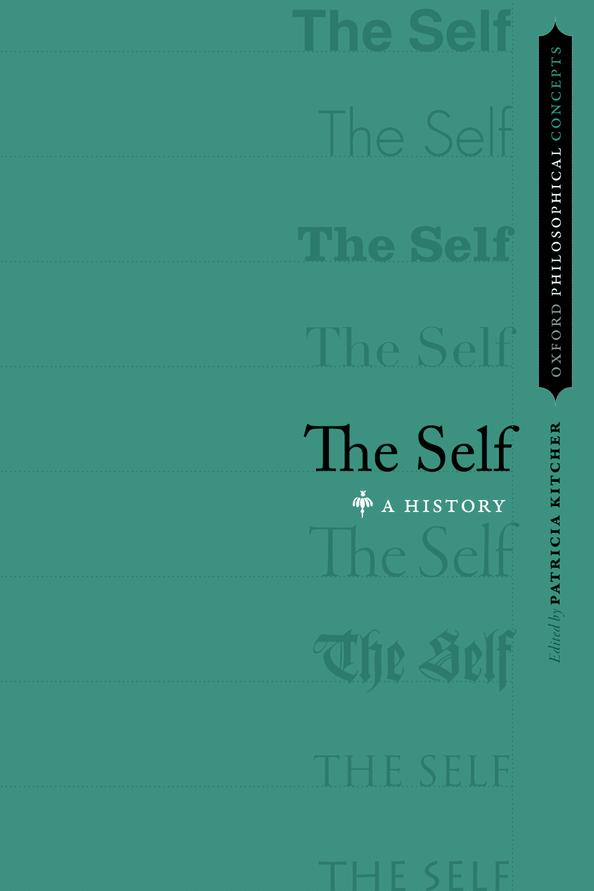
The Self
A History
Edited by Patricia Kitcher
1
Oxford University Press is a department of the University of Oxford. It furthers the University’s objective of excellence in research, scholarship, and education by publishing worldwide. Oxford is a registered trade mark of Oxford University Press in the UK and certain other countries.
Published in the United States of America by Oxford University Press 198 Madison Avenue, New York, NY 10016, United States of America.
All rights reserved. No part of this publication may be reproduced, stored in a retrieval system, or transmitted, in any form or by any means, without the prior permission in writing of Oxford University Press, or as expressly permitted by law, by license, or under terms agreed with the appropriate reproduction rights organization. Inquiries concerning reproduction outside the scope of the above should be sent to the Rights Department, Oxford University Press, at the address above.
You must not circulate this work in any other form and you must impose this same condition on any acquirer.
Library of Congress Cataloging-in-Publication Data
Names: Kitcher, Patricia, editor.
Title: The self : a history / edited by Patricia Kitcher. Other titles: Self (Oxford University Press)
Description: New York : Oxford University Press, [2021] | Includes bibliographical references and index.
Identifiers: LCCN 2020058296 (print) | LCCN 2020058297 (ebook) | ISBN 9780190087265 (hardback) | ISBN 9780190087258 (paperback) | ISBN 9780190087289 (epub)
LC record available at https://lccn.loc.gov/2020058296
LC ebook record available at https://lccn.loc.gov/2020058297
DOI: 10.1093/oso/9780190087265.001.0001
1 3 5 7 9 8 6 4 2
Paperback Printed by Marquis, Canada
Hardback printed by Bridgeport National Bindery, Inc., United States of America
Series Editor’s Foreword vii
Acknowledgments ix
Contributors xi
Introduction—Self: History of a Concept 1
Patricia Kitcher
1 Augustine on Cogitation and Self- Constitution: Drawing from and Surpassing the Plotinian Stance 28
Pauliina Remes
2 The Heritage of Ibn Sīnā’s Concept of the Self 55
Jari Kaukua
3 Aquinas and “I”: A Medieval Concept of Self 73
Therese Scarpelli Cory
4 Descartes on Subjects and Selves 99
Vili Lähteenmäki
5 Locke on Being Self to My Self 118
Ruth Boeker
6 Leibniz on the Idea and Concept of the Self : Inner Sentiment, Self-Knowledge, and the Awakening of Metaphysical Ideas 145
Christian Barth
Reflection: Metacognition and the Self- Concept 172
Janet Metcalfe
7 The Idea of Self in Hume’s Treatise 179
Don Garrett
8 Diderot, the Self, and the Science of Dreaming 212
Charly Coleman
Reflection: Caravaggio’s Self-Regard 233
Maria H.
Loh
9 Kant on the Unity of Self- Consciousness and Moral Agency 240
Patricia Kitcher
10 Self-Awareness and the “I” in the Phenomenological Tradition 267
Sacha Golob
Reflection: “You Are an I”: Elizabeth Bishop’s “In the Waiting Room” 287
Gary Ostertag
11 Self and Self-Representation in the Long Twentieth Century: A Critical Discussion 295
Christopher Peacocke
Reflection: Spontaneous Neural Activity and the Self: A Neuroscience Perspective 317
Alison Hanson and Rafael Yuste
12 Rethinking the Self within an African Philosophical Paradigm 326
Antjie Krog
349
Series Editor’s Foreword
Oxford Philosophical Concepts (OPC) offers an innovative approach to philosophy’s past and its relation to other disciplines. As a series, it is unique in exploring the transformations of central philosophical concepts from their ancient sources to their modern use.
OPC has several goals: to make it easier for historians to contextualize key concepts in the history of philosophy, to render that history accessible to a wide audience, and to enliven contemporary discussions by displaying the rich and varied sources of philosophical concepts still in use today. The means to these goals are simple enough: eminent scholars come together to rethink a central concept in philosophy’s past. The point of this rethinking is not to offer a broad overview, but to identify problems the concept was originally supposed to solve and investigate how approaches to them shifted over time, sometimes radically. Recent scholarship has made evident the benefits of reexamining the standard narratives about western philosophy. OPC’s editors look beyond the canon and explore their concepts over a wide philosophical landscape. Each volume traces a notion from its inception as a solution to specific problems through its historical transformations to its modern use, all the while acknowledging its historical context. Each OPC volume is a history of its concept in that it tells a story about changing solutions to its well- defined problem. Many editors have found it appropriate
to include long-ignored writings drawn from the Islamic and Jewish traditions and the philosophical contributions of women. Volumes also explore ideas drawn from Buddhist, Chinese, Indian, and other philosophical cultures when doing so adds an especially helpful new perspective. By combining scholarly innovation with focused and astute analysis, OPC encourages a deeper understanding of our philosophical past and present.
One of the most innovative features of OPC is its recognition that philosophy bears a rich relation to art, music, literature, religion, science, and other cultural practices. The series speaks to the need for informed interdisciplinary exchanges. Its editors assume that the most difficult and profound philosophical ideas can be made comprehensible to a large audience and that materials not strictly philosophical often bear a significant relevance to philosophy. To this end, each OPC volume includes Reflections. These are short stand-alone essays written by specialists in art, music, literature, theology, science, or cultural studies that reflect on the concept from their own disciplinary perspectives. The goal of these essays is to enliven, enrich, and exemplify the volume’s concept and reconsider the boundary between philosophical and extraphilosophical materials. OPC’s Reflections display the benefits of using philosophical concepts and distinctions in areas that are not strictly philosophical, and encourage philosophers to move beyond the borders of their discipline as presently conceived.
The volumes of OPC arrive at an auspicious moment. Many philosophers are keen to invigorate the discipline. OPC aims to provoke philosophical imaginations by uncovering the brilliant twists and unforeseen turns of philosophy’s past.
Christia Mercer
Gustave
M. Berne Professor of Philosophy
Columbia University in the City of New York
Acknowledgments
This book has been a long time in the making—longer than it should have been. Work started in earnest at a conference at Columbia University in March 2014. Because the focus of the book shifted from a greater concentration on seventeenth- and eighteenth- century figures to a longer historical arc, I was unable to include some of the excellent papers that were presented on that occasion. Since the authors, Desmond Hogan, Udo Thiel, and Falk Wunderlich made many helpful contributions to the lively discussions of other papers, their work is also represented in this book, though not in the form I originally intended. Steve Fleming (then at NYU neuroscience, now at UCL) also read a paper on the neuroscience of metacognition at the conference; some of his contributions are part of the basis of Janet Metcalf’s Reflection. Although a lively participant at the conference, Ed McCann was not able to be a part of this book, and I’m very grateful to Ruth Boeker for stepping in at the last minute with an outstanding essay on Locke. I am also grateful to all the contributors for their patience and, most of all, for their highly original and illuminating essays on our topic. I have learned much from them and I hope that readers will too.
Thanks too to Connie Wang for her careful and efficient editorial work and for preparing the Index.
The series editor, Christia Mercer, has been enormously patient with the fits and starts of this book and has provided a great deal of help as well. Christia had a very good idea for this series and she has worked hard to realize it—especially with this book —and I would like to dedicate it to her in admiration and friendship.
New York City, September 2020
Contributors
Christian Barth is a member of the Philosophy Faculty at the Humboldt University in Berlin. Besides his historical work on, among other topics, “Leibniz and Consciousness,” he has contributed to contemporary philosophy of language and mind and is the author of Objectivity and the Language-Dependence of Thought (Routledge).
Ruth Boeker is Assistant Professor in Philosophy at University College Dublin and a member of the UCD Centre for Ethics in Public Life. She is the author of Locke on Persons and Personal Identity, 2021.
Therese Scarpelli Cory is John and Jean Oesterle Associate Professor of Thomistic Studies, and Director of the History of Philosophy Forum, at the University of Notre Dame. In 2013, she published Aquinas on Self-Knowledge (Cambridge University Press).
Charly Coleman is Associate Professor of History at Columbia University. He is the author of numerous studies of the self, including The Virtues of Abandon: An Anti-Individualist History of the French Enlightenment
Don Garrett is Silver Professor of Philosophy at New York University. He is the author of Cognition and Commitment in Hume’s Philosophy, Hume, and Nature and Necessity in Spinoza’s Philosophy.
Sacha Golob is Senior Lecturer in Philosophy at King’s College, London. His work is on modern French and German philosophy: he is the author of Heidegger on Concepts, Freedom and Normativity (Cambridge University Press,
2014), and the editor of the Cambridge History of Moral Philosophy (Cambridge University Press, 2017).
Alison Hanson is a medical resident in the Department of Psychiatry at the Columbia University Irving Medical Center and a member of Rafael Yuste’s laboratory.
Jari Kaukua is a researcher at the University of Jyväskylä in Finland. He has written extensively on Islamic philosophy, including Self-Awareness in Islamic Philosophy: Avicenna and Beyond (Cambridge University Press).
Patricia Kitcher is Roberta and William Campbell Professor of Humanities and Professor of Philosophy at Columbia University. She has written two books on the relation between Kant’s theories of cognition and of the self.
Antjie Krog is an Afrikaans poet, writer, and professor in the Faculty of Arts at the University of the Western Cape. Apart from twelve volumes of poetry, she has published Country of My Skull, on the South African Truth and Reconciliation Commission; A Change of Tongue, about the transformation in South Africa after ten years of democracy, and Begging to Be Black, on learning to live within a black majority.
Vili lähteenmäki is an Academy of Finland Research Fellow at the University of Helsinki and Senior Lecturer at the University of Oulu. He has written several essays in the history of philosophy of mind, including “Orders of Consciousness and Forms of Reflexivity in Descartes” and “Cudworth on Types of Consciousness.”
Maria H. Loh is Professor of Art History at Hunter College, City University of New York. She has published three books on Titian and on portraiture. Her current research is on representations of the early modern sky.
Janet Metcalfe is Professor of Psychology at Columbia University. Her current research is focused on metacognition—how humans know that they know.
Gary Ostertag is Affiliated Associate Professor of Philosophy at the City University of New York Graduate Center and Chair of the Philosophy Department at Nassau Community College. He works on philosophy of language and the history of analytic philosophy.
Christopher Peacocke is Johnsonian Professor of Philosophy at Columbia University and Fellow of the Institute of Philosophy in the School of Advanced Study in the University of London. His most recent book is The Primacy of Metaphysics.
Pauliina Remes is Professor of History of Philosophy at Uppsala University in Sweden. Among other works on ancient philosophy, she has published Plotinus on Self (Cambridge University Press).
Rafael Yuste is Professor of Biological Sciences at Columbia. He studies neural circuits in the mammalian cortex and also in cnidarians.
The Self
oxford philosophical concepts
Introduction
Self: History of a Concept
Patricia Kitcher j
1 “I Think Therefore I Am”
No philosophical dictum is better known than Descartes’s assertion about the intimate relation between thinking and existing. What remains unknown is how we are to understand the “I” who thinks and exists. This book is about the ways that the concept of an “I” or a “self” has been developed and deployed at different times in the history of western philosophy. It also offers a striking contrast case, the “interconnected” self, who appears in some expressions of African philosophy. Appealing to philosophy to illuminate the concept of a “self” may seem unnecessary. Anyone who can read this book is a self, so why
can we not just tailor a concept to fit what we already know about ourselves? This objection has considerable force and provides a constraint on efforts to fashion a self-concept. Although there is a sense of “selfknowledge” in which it is said to require a lifetime of serious effort to achieve (and which is the topic of another volume in this series), what is at issue here is simply knowing that one is a self.1 Each of us uses “I” to refer to herself or himself; seemingly, we must have a reasonably good idea of what we are talking about. Further, the most common theme across western philosophical accounts of the self is that selves are self-conscious. As self-conscious selves, readers would have a special vantage point from which they can assess the appropriateness of self-concepts, as opposed to, for example, concepts of “efficient causation” or “space” that are examined in other volumes. Does the proposed self-concept capture what I know to be true of selves by being a self? Although the unique ability of readers to engage with theories of the self constrains philosophers, it also empowers them. Descartes impressed his theory on the minds of his readers so forcefully in part by inviting them to reason along with the meditator, so that when the meditator concludes “I am, I exist is necessarily true whenever it is put forward by me or conceived in my mind” (AT VII 24; CSM II 17), so do readers.2
2 Who Am I?
Although we can inquire about the reasons for using any concept, the question is pressing for the self-concept. We classify ourselves biologically as “human beings” and morally and politically as “persons”
1 In chapter 1 here, Pauliina Remes discusses texts where self-knowledge as something difficult to achieve has not yet been clearly differentiated from simple self-consciousness of one’s own states.
2 References to Descartes’s works are to René Descartes, Œuvres de Descartes, ed. Charles Adam and Paul Tannery, 12 vols. (Paris: Vrin, 1964–76) (cited as AT). Translations are from The Philosophical Writings of Descartes, 2 vols., trans. and ed. John Cottingham, Robert Stoothoff, and Dugald Murdoch (Cambridge: Cambridge University Press, 1984) (cited as CSM).
(bearers of responsibilities and rights), so why do we need still a third concept—“self”—to refer to ourselves? The chapters that follow will present an extensive answer to that question, but the brief answer is evident from Descartes. We think. Tragically, there are cases of human beings who are alive, but who cannot think or who can think no longer. In the latter cases, we could say that the human being had a property, thinking, that she now lacks, but that seems completely inadequate. Relatives and friends are more inclined to feel that, although the bodily shell remains, the individual herself is gone. Often they say that the “person” is gone, so perhaps we could get by just with “human being” and “person.” This option is worth exploring, but it has two prima facie weaknesses. Given its “forensic” (Locke) character, the “person” designation seems too broad. Corporations and countries also have legal rights and responsibilities and so are sometimes described as “persons,” but they seem to lack the unity of consciousness that has been taken to be the hallmark of human persons in the western tradition. More importantly, characterizing a subject of thought as a “person” blocks fruitful lines of inquiry into the relations between being a thinking self and being a morally and politically responsible agent (see the chapters on Locke and Kant).
This volume presents many reasons for using a self- concept, but it is not exhaustive. Despite their differences, the chapters on western philosophy are largely in agreement on the centrality of unity and of selfconsciousness to being a self. A different, but still western, approach to the self- concept might focus on self- control. With that emphasis, a volume might start with Plato’s attempt to explain failures of selfcontrol through his tripartite theory of the self, turn to Stoic theories of overcoming desires, and highlight Freud’s hypotheses about warring mental systems. Although the capacity to exercise self- control is a major reason for the importance of the self- concept in western philosophy, I did not choose that path, because I think that self- control is a property of being a self rather than what it is to be a self. What a self is—what you most fundamentally are— at least according to
most of the chapters that follow, is a unified self- conscious subject of thoughts.
3 Self- Consciousness, Activity, and Unity
If western philosophy is just a series of footnotes to Plato, then this history of the self-concept seems to start about five hundred years late. As we see in Pauliina Remes’s study, although our first author, Plotinus (204–270 ce), begins from several Platonic and Aristotelian assumptions, he raises considerations about the self that were either absent from or peripheral to these important predecessors but which have been dominant themes in later discussions. For example, Aristotle observes that those who perceive that they do,3 but he does not make the reflexive or self-conscious character of perception central to his account. By contrast, Plotinus tries to analyze the self-reflexive and transparent character of thinking. The Intellect that thinks that it thinks and is aware of its thinking.
Remes notes a second distinctive feature of selves that Plotinus introduces against the background of the ontological realism of Plato and Aristotle. They take the objects of knowledge to precede the knowledge, but do not have an ontological classification of a self. Although Augustine carries this thought much further, Plotinus seems to recognize that the most important aspects of a self are not the sensations that it receives through the body, but its activities. Two of those activities are uncovering the core self and making oneself into something better. For this reason, Remes believes that Plotinus offers a protoconstitutivist account of the self: The metaphor of a statue that must be uncovered suggests a preexisting self, but choosing to emphasize one aspect of oneself rather than another allows selves to constitute themselves, to make themselves what they are.
3 Aristotle, De anima, trans. J. A. Smith, in The Basic Works of Aristotle, ed. Richard McKeon (New York: Random House, 1941), 3.4.425b 12–25.
Augustine (334–430 ce) extends Plotinus’s line that it is not what the mind receives through the senses that is crucial to being a mind or self but its activities in relation to them. The mind calls up various materials that are stored in memory, and then acts on them, by connecting them in coherent wholes. We can think of the storehouse of memory as having one unity—some items are stored there whereas others are not—and the connections among those items produced by calling them up and putting them together, cogitating, as a different unity, one produced by thinking. One self will differ from another both in terms of her memories and in terms of what she has done with them. Even in the former case, Augustine encounters himself. Items stored in the vast reaches of his memory are not mere perceptions of things but of things having been experienced by him. Augustine also encounters himself in images of future actions, where he draws on memories and his own creative imagination to plot the way forward. In wandering the spaces of his mind, Augustine connects his past to his future through his cogitation, his current activities of connecting perceptions to each other. For Augustine as for Plotinus, much of the point of exploring the mind’s recesses is to make oneself into a better self, but the richness of their discoveries leads many later scholars to focus on what they have found, in particular, to wonder about the nature of this partially self-made self.
4 What Am I?
More than five hundred years after the death of Augustine, the Islamic scholar Ibn Sīnā (Latin: Avicenna, 980–1037) makes a dramatic advance in western philosophical treatments of the self. As with Plotinus and Augustine, Ibn Sīnā’s focus is on the self-awareness and activity that is distinctive of thought. Ibn Sīnā takes advantage of his readers being selves and invites them to participate in a Gedanken experiment: Imagine that you have just come into existence with no prior bodily sensations or thoughts; just through thinking, you are still
conscious of yourself as something, as existing. Jari Kaukua explains that Ibn Sīnā tries to establish several crucial theses through what was later called the “flying” or “floating” man thought experiment. Selfawareness is both a primitive and a constant feature of thought. The primitive character is brought out through the conditions of the experiment. No prior content, neither sensation nor thought, is needed for self-awareness. Simply by imagining or thinking about yourself as existing, you are conscious of yourself as existing. Although minds can reflect on their thoughts and sensations, selves do not become selfaware through reflection. If a self can affirm itself through a thought or action, then that can only be because the thought or action is (already) the thought or action of that self, prior to reflection. Since this primitive sense of mineness is at least tacitly present in all thought and action, it seems to the subject that she is a constant I across different thoughts and across different activities, for example, thinking and acting. It is the same I that sees an apple, believes it would be good to eat, and reaches for it.
Ibn Sīnā has a further important task for the flying man thought experiment. It is supposed to show that the self is incorporeal: It is a human soul. The reader who performs the thought experiment affirms the existence of herself, without affirming the existence of any body. Kaukua observes that some contemporary readers objected that this inference is too strong. Seemingly, Ibn Sīnā has shown only that a self could exist without a body, not that it does.
Therese Scarpelli Cory explains how Aquinas (1225–1274), despite his lack of a special vocabulary for “selves” or “I”s, synthesizes the insights of Augustine and Ibn Sīnā about self-consciousness and then develops them in ways that run contrary to their original uses. The flying man seemed to have established a self-presence thesis, the thesis that the mind knows itself through its own essence and so may be incorporeal. But Aquinas understands self-consciousness differently. He agrees with Ibn Sīnā that self-consciousness is not a second order or reflective act but analyzes it into two aspects, a disposition to
be self-conscious and particular acts of self-consciousness. As a disposition of the human individual, self-conscious mental activity is not a matter of constituting a new individual (thus pushing back against Augustine); as an act of being conscious of something, it is dependent on that thing (contrary to Ibn Sīnā’s claim for the lack of dependence of self-consciousness on anything).
Aquinas also resists Ibn Sīnā’s assumption that the self-conscious individual is incorporeal. As Cory notes, his position is not what one might expect from a medieval theologian. The human intellect is an incorporeal power—that is shown by the fact that it is wholly and unerringly conscious of itself in a way that a body could never be—but it is nonetheless a power of an individual human. Aquinas’s ontology of a human individual with an incorporeal intellect and a body leads to the odd result that while the self-conscious soul can survive death, the individual person, who is the ensouled human, cannot.
Descartes’s dedication of the Meditations on First Philosophy presents its twin goals: Prove the existence of God and the immortality of the soul (AT VII 1–2; CSM II 3). Further, as Vili Lähteenmäki observes, Descartes’s understanding of what a self is has often been taken to be straightforward. Since thinking establishes the existence of an I, an I must be a thinking thing. From a slightly different angle, Descartes’s focus is on certainty in knowledge, and what he can know with absolute certainty is very minimal: I am a thinking thing right now. Putting these together, Descartes’s incredibly influential doctrine seems similar to Ibn Sīnā’s: A self is, and can be known to be, a thinking, immortal thing, a soul or mind. Lähteenmäki pushes back against these readings by noting that Descartes also identifies the self with the union of the mind and body. Bodily aspects must be included in the self, because most thoughts are about perceptions and feelings and not about mere abstractions. Hence feelings and perceptions are the primary constituents of the human mind; further, they are what inform the individual of what she needs or should avoid. Even if there are excellent reasons to believe that there is an indubitable thinking thing, which would be
a self, and also very strong reasons to identify a self as the union of a mind and a body, it would seem that Descartes cannot have it both ways without falling into vicious ambiguity.
Lähteenmäki argues that, contrary to appearances, Descartes’s dual usage is sound, because he is not concerned with the metaphysics of the self—it is the union of a mind and body as opposed to an immaterial mind—but with the question of how subjects use “I” to refer to themselves. They use “I” to refer to a subject of experience, a subject who is aware of her thoughts. Since those thoughts can be about abstractions or about sensations, a self/subject of experience can be either just a mind or the union of a mind and body. Although a self may not understand her metaphysical nature, as a subject of experience, she has what has recently been characterized as a “first-person perspective” on her experience. For example, she knows not only that she is aware of a cat but also how he seems to her, for example, large and ginger-colored.
Lähteenmäki also rejects the traditional reading of Descartes as maintaining that consciousness always involves self-consciousness. Young children might represent a pain but have no representation of the self. Lähteenmäki reads Descartes as offering an explanation for the phenomenology noted by Ibn Sīnā and Aquinas. The vast majority of mental states do include a self-representation, but that is only because they involve attitudes toward contents. Not having been born yesterday, an adult would represent a snarling cat as something to avoid. If Descartes is right, then the self-representation would not be primitive but would be at least partially explicable in terms of attitudes taken toward contents.
5 How Can a Self Represent a Self?
Locke (1632–1704) endorses the cogito argument (“I think, therefore I am”) but, noting its limitations, introduces an important new way of understanding selves. Locke agrees with Descartes that in every act of thinking or sensing or doubting an I is conscious of her own existence
with absolute certainty (Essay IV.ix.3).4 As Ruth Boeker explains, Locke sees that this indubitable proof reveals nothing about the nature of the self and that it establishes the existence of an I only in the moment of thought. In a momentary thought, a self is a self to herself— she is conscious of herself as thinking now—but Locke thinks that a self is also conscious of more. The consciousness of the present thought extends back to past thoughts and also forward to possible future pains or pleasures (as Augustine also observed). From the point of view of a subject of experience, “the first personal perspective,” selves have duration. Locke’s great innovation comes in his controversial account of the enduring self.
Boeker cites Locke’s argument that thinking requires some substance in which it inheres: Subjects do not experience thoughts as selfsubsistent; in philosophical terminology, they take them to be actions or modes (properties) of some substance to which they are necessarily connected. Since humans have no idea of the nature of that substance, even whether it is corporeal or incorporeal, the sameness of the enduring self cannot be grounded in sameness of substance. Locke invites his readers to consider thought experiments where successive selves might inhabit the same substance or where the same self might change substances. He also considers a hypothetical case where the souls of a prince and a cobbler switch bodies. As Boeker explains, the inability of either selves or philosophical accounts of the self to locate the enduring self in an enduring substance or in an enduring human being raises a major ethical and religious problem for Locke. How can civil or divine rewards and punishments be correctly assigned to the doer of a deed? It is for these reasons, she argues, that Locke takes the concept of a “self” to be that of a “person,” which is a “forensic” term indicating moral and legal beings.
4 References to the Essay are to John Locke, An Essay Concerning Human Understanding (1690), ed. P. H. Nidditch (Oxford: Clarendon Press, 1975); hereafter cited in the text as “Essay” followed by book, chapter, and section number.