https://ebookmass.com/product/the-rise-of-english-globalpolitics-and-the-power-of-language-rosemary-salomone/
Instant digital products (PDF, ePub, MOBI) ready for you
Download now and discover formats that fit your needs...
Will China’s Rise Be Peaceful?: The Rise of a Great Power in Theory, History, Politics, and the Future Asle Toje
https://ebookmass.com/product/will-chinas-rise-be-peaceful-the-riseof-a-great-power-in-theory-history-politics-and-the-future-asle-toje/
ebookmass.com
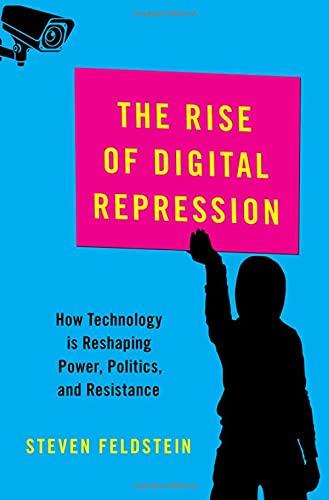
The Rise of Digital Repression: How Technology is Reshaping Power, Politics, and Resistance 1st Edition Steven Feldstein
https://ebookmass.com/product/the-rise-of-digital-repression-howtechnology-is-reshaping-power-politics-and-resistance-1st-editionsteven-feldstein/
ebookmass.com
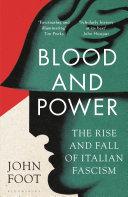
Blood and Power: The Rise and Fall of Italian Fascism John Foot
https://ebookmass.com/product/blood-and-power-the-rise-and-fall-ofitalian-fascism-john-foot/
ebookmass.com
(eBook PDF) Experiencing the World’s Religions 8th Edition
By Michael Molloy
https://ebookmass.com/product/ebook-pdf-experiencing-the-worldsreligions-8th-edition-by-michael-molloy/
ebookmass.com
Business and Professional Ethics 9th Edition Leonard J. Brooks
https://ebookmass.com/product/business-and-professional-ethics-9thedition-leonard-j-brooks/
ebookmass.com
Woman, Captain, Rebel: The Extraordinary True Story of a Daring Icelandic Sea Captain Margaret Willson
https://ebookmass.com/product/woman-captain-rebel-the-extraordinarytrue-story-of-a-daring-icelandic-sea-captain-margaret-willson/
ebookmass.com
Reliability Investigation of LED Devices for Public Light Applications 1st Edition Edition Raphael Baillot And Yannick Deshayes (Auth.)
https://ebookmass.com/product/reliability-investigation-of-leddevices-for-public-light-applications-1st-edition-edition-raphaelbaillot-and-yannick-deshayes-auth/ ebookmass.com
Test Bank for Compensation Sixth Canadian Edition (6th) Margaret Yap
https://ebookmass.com/product/test-bank-for-compensation-sixthcanadian-edition-6th-margaret-yap/
ebookmass.com
Public Relations: The Profession and the Practice, 4th edition 4th Edition, (Ebook PDF)
https://ebookmass.com/product/public-relations-the-profession-and-thepractice-4th-edition-4th-edition-ebook-pdf/
ebookmass.com
A History of Genomics across Species, Communities and Projects Miguel García-Sancho
https://ebookmass.com/product/a-history-of-genomics-across-speciescommunities-and-projects-miguel-garcia-sancho/
ebookmass.com
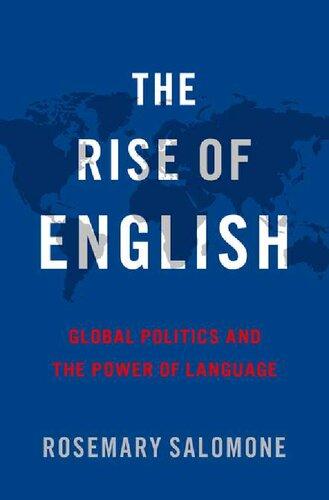
The Rise of English
Global Politics and the Power of Language
ROSEMARY SALOMONE
Oxford University Press is a department of the University of Oxford. It furthers the University’s objective of excellence in research, scholarship, and education by publishing worldwide. Oxford is a registered trade mark of Oxford University Press in the UK and certain other countries.
Published in the United States of America by Oxford University Press 198 Madison Avenue, New York, NY 10016, United States of America.
© Rosemary Salomone 2022
All rights reserved. No part of this publication may be reproduced, stored in a retrieval system, or transmitted, in any form or by any means, without the prior permission in writing of Oxford University Press, or as expressly permitted by law, by license, or under terms agreed with the appropriate reproduction rights organization. Inquiries concerning reproduction outside the scope of the above should be sent to the Rights Department, Oxford University Press, at the address above.
You must not circulate this work in any other form and you must impose this same condition on any acquirer.
CIP data is on file at the Library of Congress ISBN 978–0–19–062561–0
DOI: 10.1093/oso/9780190625610.001.0001
Printed by Sheridan Books, Inc., United States of America
In memory of my parents
Preface ix
Acknowledgments xi
CONTENTS
1. The English Divide 3
INTRODUCTION
PART I MULTILINGUAL EUROPE
2. Myth or Reality? 21
3. A High- Stakes Movement 53
4. Shakespeare in the Crossfire 73
5. Headwinds from the North 107
PART II SHADOWS OF COLONIALISM
6. The “New Scramble” for Africa 137
7. Adieu to French 165
8. Redress and Transformation 195
9. Confronting the Raj 231
10. Defining the Deficit 265
11. Reframing the Narrative 287
12. A Revolution in the Making 307
13. Marketing Language 335
14. Looking Back, Moving Forward 371
Notes 381 Index 457
PREFACE
The metaphor of a journey is often used to describe the process of researching and writing a book. For me this book has been an especially long and winding expedition, taking me across four continents and through the parallel universe of a global pandemic that only science fiction writers could envision. It began in 2013 with several commentaries that I wrote involving legal disputes in Italy and France over the use of English to teach university courses. I soon realized that unpacking those debates meant delving into the impact of globalization, international education, and the knowledge economy as shaped by neoliberalism and the force of English as the dominant lingua franca. Once I set on that course, the bigger project began to take shape.
Along the way, I encountered the work of activists, political philosophers, jurists, economists, linguists, and literary icons, within and beyond the Western canon, who guided me through conflicts over the power of language in shaping the identity of nations and their people. A visit to Ravenna, Italy, to engage with one hundred cittadini (local citizens) reciting verses from Dante Alighieri’s La Divina Commedia before the master of the vernacular’s tomb, followed by a procession through the streets and a live performance of the Inferno, made palpable the enduring force of language in defining a community. I also carried with me personal experiences. I grew up in a community where multiple languages were spoken. As a young adult, I worked in the world of language learners—teaching French to elementary school children; developing French-Haitian, Italian, and Spanish bilingual programs across the grades; teaching English to international university students—before turning to the law and entering the legal academy.
My initial plan was to write a book on the value of language in the global economy, examining winners, losers, and resisters on both sides of the Atlantic. The deeper I dug into the research and the more world events evolved, the more I viewed the issues through a wider global lens and the clearer the connections to educational equity, identity, and democratic participation appeared. I also came
to understand the role that France historically has played in pushing back on English dominance and Anglo-American influence, and the more recent competition from China in using the “soft power” of language, especially in Africa. Selecting other countries to explore beyond Europe and the United States grew organically from history, politics, and the disputed role that English has played over time in diverse settings.
Searching for distinctly relevant stories, I looked toward French-speaking Rwanda in resolving the genocide and Morocco in navigating its Arab roots, South Africa in its struggle to move beyond apartheid, and India in undoing the caste system against longstanding religious and linguistic conflicts. A court case in the Netherlands, where English has been widely embraced, gave more texture by way of contrast to the French and Italian debates on higher education. From there, the storm of global anxiety over English versus the calm of Anglophone satisfaction quickly took hold. Drawing on a vast store of interdisciplinary research, interviews, court decisions, political commentary, literature, and popular culture from around the globe and in multiple languages, I then faced the task of weaving together all that I had learned into a coherent discussion on English and its kaleidoscopic effects both past and present.
The book began with my sights on Europe and especially on Italy. And so it poignantly ended. In the final year of completing the manuscript, I watched with alarm as the global pandemic took a horrific toll initially on Italy and subsequently on countries, including my own, that I had spent these years closely exploring. Through that time, I touched base with many of my contacts in those settings and shared our common angst and fears. My deepest hope is that by the time the book goes to press, like Dante being led by his guide Virgil up and out of the Inferno, we too will have exited the darkness to see all that is beautiful in the heavens and “riveder le stelle” (“once again see the stars”).1
ACKNOWLEDGMENTS
In the course of researching and writing this book, I came to know dozens of professors, university administrators, lawyers, and advocates—at conferences, in virtual meetings, and through email correspondence—who shared with me their scholarship and their historical understandings and views on debates within their own and related countries. I am especially grateful to Annette de Groot, Hans de Wit, Catherine Baylin Duryea, Mekki Ebdari, Christine Hélot, Kathleen Heugh, Francis Hult, Fabrice Jaumont, Anton Kok, Peter Kraus, Anik Nandi, Timothy Regan, Gregg Roberts, Arundhati Satkalmi, Robert Slater, Margaret Winters, Marie de Briey Wyatt, and Richard Wyatt for generously reading various chapters and for their incisive comments and corrections. My thanks also go to Peter Kwikkers and Gisela Langé who answered endless questions with patience and detail on the Netherlands and Italy, respectively. Video conferencing, email, or telephone correspondence with Rama Agnihotri, Mathilde Anquetil, Alana Bailey, Alessandro Balducci, Presley Bergen, Marina Cavallini, Sherry Spiegel-Coleman, Dan Davidson, Janneke Gerards, Hermann Giliomee, Michele Giovannini, François Grin, Kristina Hultgren, Felix Huygen, Mercy Kannemeyer, Ralph Mociket, Christine Musselin, Daniela Poli, Olivia Ramsey, Danie Rossouw, Emmanuel Saint-Martin, Ad Verbrugge, and Quentin Williams offered additional direction. Frederick Schaffer wisely suggested that I dust off my decades-old student copy of Dante’s Inferno for clarity and hope. Weekly conversations with Natalie Nicolai throughout the early years of the project provided invaluable insights into French education, history, and contemporary culture while sharpening my French and uplifting my spirits. I am especially grateful to Emilio Matricciani for providing me with a wealth of court documents from the Milan Polytechnic Institute litigation, and to the professors, administrators, and students at the institute, including legal counsel Maria Agostina Cabiddu, who welcomed me into their classrooms and their world.
The arguments advanced here evolved over the course of seven years and several prior publications, portions of which I have incorporated into this work. Chapter 2, “Myth or Reality?” is a significant update and expansion of “Multilingualism and Multiculturalism: Transatlantic Discourse on Language, Identity, and Immigrant Schooling,” previously published in Notre Dame Law Review 87, no. 5 (2012): 2031–62. Chapter 3, “A High Stakes Movement,” and Chapter 4, “Shakespeare in the Crossfire,” are revised and updated versions of “The Rise of English: Challenges for English-Medium Instruction and Language Rights,” previously published in Language Problems and Language Planning 39, no. 3 (2015), 245–68. Symposia presentations at the University of Teramo, the University of Trento, the Université de Montréal, the Université Catholique de l’Oeust, Princeton University, and annual symposia sponsored by the Study Group on Language and the United Nations in New York provided opportunities to gather useful perspectives on the research as it evolved. I thank Humphrey Tonkin and his band of language advocates for welcoming me into the group and sharing their passion for linguistic diversity.
Throughout the writing, I benefited from a succession of dedicated and talented student research assistants from St. John’s University School of Law, including Courtney Morgan (’14), Melissa Brown (’16), Marie-Alexis Valente (’16), Mackenzie Brennan (’18), Allison Cabibbo (’19), Mollie Galchus (’19), and Brent Bomkamp (’21). I thank Caroline Fish (’18) who used her semester in The Hague to help move the Netherlands research forward. I especially thank Eva-Maria Ghelardi (’21), whose multilingual skills proved invaluable, and Eric Zang (’21), who never failed at finding just the right data. Both of them diligently and cheerfully plowed through the manuscript text and notes despite all the uncertainty and upheaval of the COVID-19 pandemic beginning in spring 2020. I most especially thank the dean of St. John’s University School of Law, Michael Simons, for his generous support through numerous summer research and travel grants and a sabbatical leave. I also thank Associate Dean and Director of the Law Library Courtney Selby and staff, particularly Christopher Anderson and Saadia Iqbal, for repeatedly finding the most obscure historical documents and news reports in multiple languages from the four corners of the world. No words can express my heartfelt thanks to Janet Ruiz-Kroll, who skillfully mastered translation software, however imperfect, providing me with a steady stream of articles and reports in seven languages and helped format the chapters and final manuscript. The depth of the research owes much to her work. My thanks go to Hallie Stebbins, who originally offered me the opportunity to publish the book with Oxford University Press, to my editor Meredith Keffer for steadfastly seeing the project through to completion, to Macey Fairchild and Helen Nicholson who smoothed the way to production, and to my publicist Gretchen Crary for launching the book on to the world with great care and thought. On a personal
note, I thank my friends and family members who indulged my distraction and never ceased to ask how the book was coming along.
Most importantly, I owe a deep debt of gratitude to my husband Joseph Viteritti, who read and commented on individual chapters and, most of all, withstood the many evenings, weekends, and summers when I was buried in this project. I likewise owe immeasurable thanks to my son, Andrew Viteritti, who initially planted the seed in my head that there was a book to be written on the rise of English. Over these years, I have benefited greatly from his keen understanding of the world economy and politics and his tirelessly sharing that with me. Finally, I dedicate the book to my parents, Louise Sansone Salomone and Albert Salomone, who each nurtured my love of language.
The English Divide
In 1794, while hiding from the Jacobins during the French Revolution, the Marquis de Condorcet wrote his landmark work, The Progress of the Human Mind. 1 Condorcet, an advocate of educational reform and equal rights, believed that the key to social equality was equality in the use and learning of language. Condorcet’s concern was that Latin had held a monopoly over claims to truth until vernacular languages made the sciences “more popular” and widely available. If Latin had continued, he said, it “would have divided men into two classes, would have perpetuated in the people prejudices and errors, [and] would have placed an insurmountable impediment to true equality . . . to an equal knowledge of necessary truths.”2 Condorcet’s thoughts on language echoed those expressed several centuries earlier by Dante Alighieri, the Italian poet and moral philosopher, whose epic poem, La Divina Commedia, set aside the elitism of Latin to create an Italian vernacular more accessible to “the people.”3
Inasmuch as Condorcet endorsed vernacular languages, he also believed that “politics in the vernacular” was merely a “transitional phase.” Universal education ultimately would lay the ground for “cosmopolitan democracy” in a very simplified universal language that all could read, like the language of algebra, with “similar facility” as the language of one’s own country. Condorcet obviously underestimated the inability or reluctance that many people have in learning another language. He also could not foresee the nineteenth-century rise of nationstates and the link between language and national identity.4
Leap forward to 2001 when an article in Bloomberg Businessweek put a twentyfirst-century turn on Condorcet’s cautionary words. The title of the article, “The Great Divide: In Europe, Speaking the Lingua Franca Separates the Haves and the Have-Nots,” is as evocative now as it was in 2001, and as it would have been back in 1794. The accompanying illustration is even more so. It depicts three men in business suits. Two are large, broad-shouldered, and powerful-looking figures, smiling at each other as they forcefully stride ahead apparently on a cloud. One with his arm on the back of the other asks, “Speak English?” The
other responds, “Of course!” The third man, a small figure (about a third of their size) is frantically running after them on the ground. He holds an open book in his right hand and clutches another closed book under his left arm. Other books are falling from his grasp. The books have words, pictures, or titles that represent learning English. In the background is a church with a steeple, representing a European town or city. The message is clear. English is the sine qua non of happiness and power (“Of course!”). It gives you entrée to a world of colleagues with a similar state of mind and professional stature. Without it, you’re left behind. You’re insignificant. You’re desperately trying to catch up.
With a string of examples, the article goes on to explain that English had become “firmly entrenched nearly everywhere as the international language of business, finance, and technology.” Even more so, it was becoming the “binding agent for Europe.” English had already become “Europe’s language.” It was an “imperative.” Though British and American managers working in Europe would be wise to develop bilingual skills, “new forces,” including the internet, were “pushing Europe toward a common language.” The article warned that while speaking English was bringing Europe together in some ways, it also was dividing the continent into “haves” and “have-nots.” Only 29 percent of Europeans were able to carry on a conversation in English.5 That was two decades ago. By 2012, the last date of an official European language survey, a majority of EU citizens (56 percent) spoke English as a first or second language.6 Setting aside the loss of first language speakers since the United Kingdom’s departure from the European Union, and not considering levels of fluency, the figure on second language speakers especially among young people is presumably higher today but certainly nowhere near universal.
In the intervening years, English has become not just the “language of Europe;” it has become the dominant lingua franca of the world. It is an official language of the United Nations, the World Trade Organization, the International Criminal Court, and NATO. Yet just as in Europe, English divides the world population in complex ways and creates cultural strains across the globe. As we will see, the ongoing impact in any setting has much to do with history, politics, and economics, which shape decisions over language choices and policies, most notably in education from primary school through the university. Those decisions, in turn, determine “opportunities and access” that socially include or exclude certain groups.7 English governs the books young people read, the films and television programs they watch, the cultural values they absorb, and their career options. As that reality has intensified in recent years, it has spawned loosely connected debates with decidedly common themes that continue to engage scholars, educators, policymakers, and the courts across continents.
In the postcolonial world, despite distinct histories, the debate typically revolves around the place of local and regional languages in the schools, the
unequal allocation of English, and overlapping justifications for officially adopting English—from economic mobility in India and Morocco to the added push toward redress and transformation in South Africa and, to some extent, in Rwanda. In Europe, aside from the growing use of English in European Union institutions, it generally centers on educational quality and access in higher education, the burdens on students and faculty, and the preservation of national languages and identity, with an occasional reference to less privileged students, many of whom are immigrants. The Nordic countries and the Netherlands, which have long embraced English, now question whether they have gone too far, especially in higher education. That rethinking affirms concerns within other European countries including France and Italy. France, above all, resolutely strives to preserve its national language and its international status, particularly in Africa, where English is weakening France’s grip. China has jumped onto the African bandwagon and into the fray of Anglo-French rivalries, assertively using its language to gain an economic foothold on the continent. At the same time, language advocates in the United States and the United Kingdom argue that the unstoppable spread of English is not a win-win for anglophone countries. It’s isolating them in a way that harms their economic and political interests. It’s also denying their children essential linguistic skills and intercultural understandings.
Lingua Franca Old and New
In confronting the rise of English it’s tempting to compare English to Latin, the most prominent though not the only lingua franca of another era. Certainly Greek, Arabic, and even Phoenician had their day. Whether and when English eventually will meet the fate of Latin in particular is the subject of much speculation. Like Latin as both Condorcet and Dante viewed it, English holds a monopoly on knowledge, especially in the sciences. In some cases, it can be an obstacle to democratic participation, particularly for less privileged classes. Yet beyond those unsettling commonalities, the comparison between the two languages breaks down on a number of counts. Latin did not threaten clearly formed national identities tied to a common national language, neither of which then existed. Spoken languages, though related to Latin in different ways, were also fluid and diverse. Writing in the early 1400s, Dante described in his De Vulgari Eloquentia at least fourteen regional Italian vernaculars and perhaps one thousand sub-varieties.8 And though Latin remained the language of science long after the fall of the Roman Empire in the fifth century, the invention of the printing press in the 1500s made scientific knowledge and literature more widely accessible to the educated classes. At that point, vernacular languages, most prominently French and German, slowly began to replace Latin. English
has operated in the reverse, marginalizing those same vernacular languages and overtaking others.
Latin did not have modern technology, and particularly the internet, nor high-speed air travel to more widely spread and solidify its status as a common means of communication. For the Romans to cross over the Alps by foot or by beast was an arduous endeavor, while communicating through live messengers was time consuming beyond current imagination. And so Latin could not encompass the globe and fuel a world economy as English has done. It was rather confined geographically to the Roman Empire, extensive though it was, with Greek dominating its eastern end. Nor did Latin have compulsory education and a system of government schools to calibrate its influence, either promoting or resisting it.
It remains to be seen whether English will be the “last lingua franca,” as Nicholas Ostler predicted a decade ago.9 Even so, it is still not likely to follow the trajectory of Latin into the realm of a “dead” language anytime soon. With mounting urbanization, a growing middle class, and the increase in multinational business, English simply has too much social and economic force behind it to inadvertently lead us back to the Babel of mutually unintelligible languages. Of course, national loyalties will continue to deter countries from adapting English as their “mother tongue” and justifiably so.10 English may further lose its gloss over time as other languages become globally or regionally more significant. The extent of that loss depends on the vicissitudes of global politics and especially on the direction the United States takes for the short and long term to preserve its dominance and redeem its reputation on the world stage.
All that being said, the term lingua franca itself is not neutral. English is not the “universal” language that Condorcet may have envisioned or an artificial language like Esperanto. Nor is it simply a recent geopolitical phenomenon. It still bears the imprint of its colonial past and its modern-day clout tied to anglophone countries, particularly the United Kingdom and the United States. Its global spread began with the British Empire, which at its height extended over a quarter of the world. English was a powerful sorting mechanism that detached the colonized from their familiar frames of reference. A core strategy of colonialism was to control language, which became a means of establishing “truth,” “order,” and “reality.”11 Devaluing local languages and knowledge preserved the colonial myth that these languages lacked depth and complexity to function beyond everyday life. The system of government, education, and worldview that English, like other colonial languages, carried left a lasting linguistic and cultural legacy in countries from Asia, to Africa, to the Caribbean, not to forget North America, Australia, and New Zealand. At the point of independence, despite high levels of multilingualism, many of these countries retained English as a national or official language. Accepting the western European notion of one
nation, one language, yet politically unable or unwilling to choose among many indigenous languages, the English-speaking elite cast the deciding vote to protect their own status.
The rise of the United States as a world leader in the mid-twentieth century, just when the British Empire was unraveling and Europe was struggling to recover from the ravages of war, gave the global weight of English a new and more expansive life. With the seeds that Britain had sown with its military might, the United States was able to further grow the appeal and importance of English through political, economic, and cultural influence. For many years, multinational corporations and international development organizations helped drive the spread of English in the postcolonial world. The International Monetary Fund, the World Bank, the British Department for International Development, the British Overseas Development Association, the British Council, and the United States Agency for International Development all imposed a pro-English agenda that effectively suppressed native languages and cultures. In different degrees they promoted English through scholarships, training, textbooks, curricular experts, program designers, and research reports. With the rationale of bringing countries into the anglophone arena, the aim was to increase social advancement but also to open trade opportunities for mutual benefit. UNESCO stood alone in steadfastly producing studies and reports to advance mother tongue instruction notably in the early years of schooling.12 More recently the World Bank and the British Council have come around to recognize that a “second language is learned best when a first language is learned well.13
That being said, relying solely on English to the exclusion of indigenous languages has been a dangerous blind spot in the developing world. As a 2018 report revealed, languages have generally low priority in development work—few NGOs have language policies, and they typically lack staff speaking the languages of the communities they serve. The report found, moreover, that the UK Department for International Development (DfID), the government agency leading the United Kingdom’s work to end poverty, only accepted funding proposals submitted in English. The inevitable result was that many communities and groups were unable to participate fully in project design and were foreclosed from seeking funding in the first place. Even where they could hire someone to write the application, they could not check the quality of the application or understand the reasons why it might have been rejected.14
To fully comprehend the rise of English over the past half century is to recognize it as both the product and the engine of three interrelated forces: globalization, basically the flow of people, goods, capital, and services shaped by an integrated world economy and information technology; internationalization, that is, policies and programs used in response to globalization; and a knowledgebased economy, in which the production and use of knowledge (rather than
goods or services) are primary and in which language and languages have become “strategic economic assets” in themselves.15 Tying these forces together are market-driven neoliberal principles promoting individual competition and outputs at the expense of equalizing opportunities through government intervention. Though the terms themselves are somewhat ambiguous and intellectually overworked, the trends they describe have had profound consequences for language and education.
Each of these factors has generated scholarship and commentary, mostly critical and far too vast for this discussion.16 Suffice it to say that the backlash against globalization and its homogenizing effects on language and culture, its negative impact on domestic industries and jobs, and its role in heightening economic inequalities have been credited with a rise in populist nationalism that works against international mobility and academic cooperation directly related to English as a lingua franca. Meanwhile, neoliberalism is critiqued for having distorted the values underlying education for democratic citizenship and for human flourishing. It specifically has fostered the false belief that one’s ancestral identity and home language impede personal advancement and should be set aside in favor of a more economically valuable and “neutral” language like English.17
In recent years, the demands of the knowledge-based economy along with political unrest, economic turmoil, and advances in technology have triggered an unprecedented migration worldwide. Though the effects on the nation-state have not been as fatal as predicted, together these forces have blurred national borders, allegiances, and ideas of citizenship, transforming the social construction of language into a less fixed idea. Non-dominant language speakers— whether regional, immigrant, or indigenous—have further weakened the link between language and nationalism with increased calls for legal recognition. Weaving through these developments is the seemingly unstoppable force of English, which complicates even well-intentioned attempts to establish workable policy solutions within and across countries. These factors overall not only highlight the stresses of linguistic pluralism; they also focus attention on the intrinsic and extrinsic value of language, tied to education, for individuals and for communities.
Dominance and Appeal
English is no longer solely a language for ethnic or national identification as languages are conventionally considered. For better or for worse, it is an economic skill, a marketable commodity, and a form of cultural capital. English is the most marketable language in today’s globalized economy. It is more sought-after than
any conventional commodity traded in the market, pervading the entire range of social and business relations in which it is used and discussed.18 It implicates accent, register, and levels of native fluency, which all carry economic value as markers of social class and educational background. It is the language of global communication, both driving the knowledge economy and gaining from it. It is the language in which the Brazilians speak to the Dutch and the Japanese speak to the Italians. There are now more nonnative speakers of English in the world than native speakers. Of the 1.5 billion (20 percent) of the earth’s population of 7.7 billion who speak English, fewer than 400 million (less than 25 percent) use it as their first language. As English progressively morphs by locality and function into diverse “World Englishes” (e.g., Singlish in Singapore) or Business English and myriad other hybrid and fluid varieties, it is argued that anglophone countries, and particularly the United States and the United Kingdom, no longer “own” English, as traditionally thought. And so they don’t have the right to determine the standards for what is authentic or acceptable. English now belongs to the world.
While English, like other colonial languages, initially spread by “conquest, conversion, and commerce,” a fourth process—“collusion”—has added greater momentum. The world is chasing after English for the opportunities it presumably offers.19 Everywhere you turn, from the boulevards of major cities to the narrow streets of country towns, English language schools dot the landscape. The value of English on the global market is tied to its social appeal. Over the past half century, English has promoted what Joseph Nye coined America’s “soft power” in shaping preferences and values to reinforce the country’s economic and political stature as a world leader. Much of that attraction is related to American popular culture as idealized in film, TV, music, and fashion and a consumerist lifestyle, initially filtered through the lens of Hollywood and now readily accessible through social media and the internet. English has come to represent modernity, cosmopolitanism, and technological progress, especially in the imaginations of young people no matter where they live or what language they commonly speak.20 Bucking attempts to turn back the clock on globalization, the first global generation shaped by the internet has come of age, and it passionately embraces English and the status and mobility it carries. Young people across the world are avid consumers of everything “American.” Even when their English is halting at best, they pepper their conversations with English words to look “cool.”
The popular appeal of English crosses generational, geographic, and class bounds. Walk through airports and down streets in any major city in the world, from Reykjavik to Rio de Janeiro, from Manila to Mexico City, and you will be bombarded with advertisements and signage in English. Take a taxi in Tokyo and it’s likely to bear an “English Certified Driver” sticker. Visit a café-bar in
any remote Italian hill town and you’ll hear “American” pop music streaming into the piazza. Even some Paris theaters have acceded to showing English language films in the original with French subtitles. Bjork, an Icelander, sings in English. Korean mothers move their children to anglophone countries to learn in English. Dutch universities teach in it. ASEAN countries collaborate in it. Political activists tweet in it.
During the uprisings in North Africa in 2011, while protestors used French and Arabic to engage the local community, as one activist noted, they switched to English because “that’s where we go when we want to influence the world.”21 In 2021, in the wake of the military coup in Myanmar, English dominated slogans, placards, and social media as young anti-coup protesters tried to gain the support of the international community. Messages like “Justice for Myanmar” and “We want democracy” were pervasive, even carved into rows of watermelons by chefs, despite exceedingly low levels of English among the overall population.22 One can only wonder if the vaccine against COVID-19 could have been developed with such unprecedented speed without a common language for global collaboration. The first vaccine rolled out in Europe and North America was the product of partnering between the US pharmaceutical company Pfizer and the German biotech company BioNTech with two German scientists, the offspring of Turkish immigrants to Germany, playing a key role in development. This was globalization at its finest.
Around the globe, English makes headlines in the press, is the topic of talk show discussions, and is the preferred language of academic conferences and scholarly journals. Much of scientific knowledge is now disseminated in English in both print and digital form. More people of all ages now study English than any other language. In a growing number of countries it’s compulsory, in some cases beginning in primary school. English accounts for over 60 percent of internet content.23 Individuals who have access to both English and high-quality internet service enjoy entrée to a wide source of information and communicate with a sizeable public. Accessing news from anglophone and other countries via the internet and social media, they more clearly understand the competing interests and values that drive those countries. The more they utilize the language online, the more proficient they become. The more English savvy they become, the more they can move beyond their immediate surroundings and tap into cultural and economic capital worldwide. At the same time, as a new generation of world leaders become more skilled in English, they directly reach out to a larger political audience beyond their own constituents.
The global elite of all ages has almost a “mystical reverence” for the Economist and the Financial Times. French president Emmanuel Macron and his strategic use of English is a prime example of this “aspirational class” of cosmopolitan citizens.24 Though Macron crusades to raise the international profile of French,
he also recognizes the pragmatic importance of English to the French economy. While his official talks in other countries are often in French, he relies on the global value of English to communicate informally with world leaders and to establish his leadership on a world stage as he did at the World Economic Forum Meeting in Davos, Switzerland, in January 2018.
Though languages like French, Chinese, and Spanish carry weight in certain markets, and German is said to be gaining ground in Europe, English is becoming sufficiently unhinged from its national moorings, in perception if not totally in fact, to remain a vital force in driving global communication and the global economy. As the British Council noted back in 2013, English provides a “strong competitive advantage in culture, diplomacy, commerce, media, academia, and IT. It means a place at the heart of the global network.”25 That is still the case despite the Brexit debacle and four turbulent years of Trumpism having dimmed the “Anglo-American” glow. The long-term effects of those turns remain to be seen especially given a new administration in Washington. The United States is undeniably the biggest winner, but it is not the sole beneficiary. Other anglophone countries and their speakers have gained from the “English effect.” The unspoken question is, “At what price?”
Can English Do It All?
Notwithstanding this worldwide flux, native English speakers tend to take the “rise of English” not just as a positive change but as an organic evolution. They can travel internationally for work or leisure with greater ease. Their political leaders can directly engage with foreign counterparts without interpreters. Business interests can make their way in the global economy without the burden of translation. Researchers can collaborate with foreign colleagues and present their findings in foreign venues. Students can enroll in European study-abroad and graduate programs offered totally in English and at a much lower cost than in the United States. From this vantage point, it is easy for Americans, along with the British, Canadians, Australians, and others, to conclude that other languages are not worth the effort. If the world is speaking English, then why bother learning other languages? There is a sense of English “exceptionalism” or privilege, an implicit belief that English is just part and parcel of globalization and progress. Any downside is simply “not their problem.” Yet it is their problem. The dominance of English is fueling a debate on language with implications that impact anglophones and not just others.
Hidden beneath all the self-serving satisfaction lies the question of whether English can do it all. Or is there still a need, especially for anglophones but also for others, to speak other languages? Back in 2012, former Harvard University