Gerhard Sauter, Rheinische Friedrich-Wilhelms-Universität Bonn
Susan E. Schreiner, University of Chicago
John Van Engen, University of Notre Dame
Geoffrey Wainwright, Duke University
Robert L. Wilken, University of Virginia
GREGORY OF NAZIANZUS ON THE TRINITY AND THE KNOWLEDGE OF GOD
In Your Light We Shall See Light
Christopher A. Beeley
THE JUDAIZING CALVIN
Sixteenth-Century Debates over the Messianic Psalms G. Sujin Pak
THE DEATH OF SCRIPTURE AND THE RISE OF BIBLICAL STUDIES
Michael C. Legaspi
THE FILIOQUE
History of a Doctrinal Controversy
A. Edward Siecienski
ARE YOU ALONE WISE?
Debates about Certainty in the Early Modern Church
Susan E. Schreiner
EMPIRE OF SOULS
Robert Bellarmine and the Christian Commonwealth
Stefania Tutino
MARTIN BUCER’S DOCTRINE OF JUSTIFICATION
Reformation Theology and Early Modern Irenicism
Brian Lugioyo
CHRISTIAN GRACE AND PAGAN VIRTUE
The Theological Foundation of Ambrose’s Ethics
J. Warren Smith
KARLSTADT AND THE ORIGINS OF THE EUCHARISTIC CONTROVERSY
A Study in the Circulation of Ideas
Amy Nelson Burnett
READING AUGUSTINE IN THE REFORMATION
The Flexibility of Intellectual Authority in Europe, 1500–1620
Arnoud S. Q. Visser
SHAPERS OF ENGLISH CALVINISM, 1660–1714
Variety, Persistence, and Transformation
Dewey D. Wallace, Jr.
THE BIBLICAL INTERPRETATION OF WILLIAM OF ALTON
Timothy Bellamah, OP
MIRACLES AND THE PROTESTANT IMAGINATION
The Evangelical Wonder Book in Reformation Germany
Philip M. Soergel
THE REFORMATION OF SUFFERING
Pastoral Theology and Lay Piety in Late Medieval and Early Modern Germany
Ronald K. Rittgers
CHRIST MEETS ME EVERYWHERE
Augustine’s Early Figurative Exegesis
Michael Cameron
MYSTERY UNVEILED
The Crisis of the Trinity in Early Modern England
Paul C. H. Lim
GOING DUTCH IN THE MODERN AGE
Abraham Kuyper’s Struggle for a Free Church in the Netherlands
John Halsey Wood Jr.
CALVIN’S COMPANY OF PASTORS
Pastoral Care and the Emerging Reformed Church, 1536–1609
Scott M. Manetsch
THE SOTERIOLOGY OF JAMES USSHER
The Act and Object of Saving Faith
Richard Snoddy
HARTFORD PURITANISM
Thomas Hooker, Samuel Stone, and Their Terrifying God
Baird Tipson
AUGUSTINE, THE TRINITY, AND THE CHURCH
A Reading of the Anti-Donatist Sermons
Adam Ployd
AUGUSTINE’S EARLY THEOLOGY OF IMAGE
A Study in the Development of Pro-Nicene Theology
Gerald Boersma
THE GERMAN AWAKENING
Protestant Renewal after the Enlightenment, 1815–1848
Andrew Kloes
THE SYNOD OF PISTOIA (1786) AND VATICAN II Jansenism and the Struggle for Catholic Reform
Shaun Blanchard
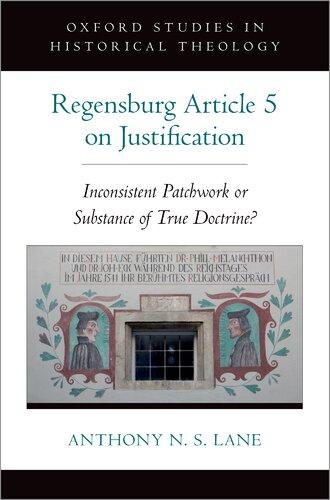
REGENSBURG ARTICLE 5 ON JUSTIFICATION
Inconsistent Patchwork or Substance of True Doctrine?
Anthony N.S. Lane
Regensburg Article 5 on Justification
Inconsistent Patchwork or Substance of True Doctrine?
ANTHONY N. S. LANE
3
Oxford University Press is a department of the University of Oxford. It furthers the University’s objective of excellence in research, scholarship, and education by publishing worldwide. Oxford is a registered trade mark of Oxford University Press in the UK and certain other countries.
Published in the United States of America by Oxford University Press 198 Madison Avenue, New York, NY 10016, United States of America.
All rights reserved. No part of this publication may be reproduced, stored in a retrieval system, or transmitted, in any form or by any means, without the prior permission in writing of Oxford University Press, or as expressly permitted by law, by license, or under terms agreed with the appropriate reproduction rights organization. Inquiries concerning reproduction outside the scope of the above should be sent to the Rights Department, Oxford University Press, at the address above.
You must not circulate this work in any other form and you must impose this same condition on any acquirer.
Library of Congress Cataloging-in-Publication Data
Names: Lane, A. N. S., author.
Title: Regensburg article 5 on justification : inconsistent patchwork or substance of true doctrine? / by Anthony N. S. Lane.
Description: New York, NY, United States of America : Oxford University Press, 2019. | Includes bibliographical references.
Identifiers: LCCN 2019018493 | ISBN 9780190069421 (hardback) | ISBN 9780190069438 (updf) | ISBN 9780190069445 (epub) | ISBN 9780190069452 (online)
Subjects: LCSH: Justification (Christian theology)—History of doctrines—16th century. | Regensburg Colloquy of 1541 (1541 Regensburg, Germany)
Classification: LCC BT764.3 .L365 2019 | DDC 234/.7—dc23 LC record available at https://lccn.loc.gov/2019018493
1 3 5 7 9 8 6 4 2
Printed by Integrated Books International, United States of America
To Daniel, David, and Emmanuel
Preface
I began this study in the early 2000s, and at that stage, geography was a crucial factor. I was (and am) fortunate to have easy access to the British Library, the Cambridge University Library, and the Bodleian Library. Almost all the sixteenth-century volumes to which I needed access were available at these three. I am particularly grateful to Lord Acton for collecting books relating to this theme, which are now in the Cambridge University Library, without which I would not have been able to embark on this project. I am also grateful to the staff of the Rare Books Reading Room there for their helpfulness, especially in providing photocopies. After an interval of some ten years, I returned to this study in 2014 and discovered that, with very few exceptions, every sixteenth-century volume that I needed could now be downloaded from the Internet. This is thanks overwhelmingly to two bodies—the Bayerische Staatsbibliothek in Munich and Google Books.1
Thanks are also due to a number of individuals. Colin Smith, one of my first two research students, worked on “Calvin’s Doctrine of Justification in Relation to the Sense of Sin and the Dialogue with Rome.” It was he who first kindled my interest in the present topic. I am also grateful to Kevin Vanhoozer and Dennis Okholm for invitations to speak on justification by faith in Catholic-Protestant dialogues at Trinity Evangelical Divinity School and Wheaton College respectively. Out of these lectures emerged the book Justification by Faith in Catholic-Protestant Dialogue: An Evangelical Assessment, 2 and this led on naturally to the present study.
The late Vincenz Pfnür wrote extensively on the colloquies in general and justification in particular. He offered me encouragement and kindly let me have photocopies and transcripts of Eck’s and Melanchthon’s drafts of Article 5. I am grateful that we had the opportunity to meet. The late Thomas Mayer in an extensive email exchange offered valuable help with Pole’s letters, including sharing the material before it was published and a proposed
1 The delay has also meant that I have been able to use three significant new editions: BSELK, ADRG, and MBWT.
2 London: T & T Clark (Continuum), 2002.
translation of a tricky passage. Again, I am glad that I once had the opportunity to meet him. I have corresponded with Reinhard Braunisch, who very kindly responded to my queries and generously supplied me with copies of a number of his works. As a research student and a Gasthörer at Tübingen, I enjoyed taking part in a seminar on Augustine’s De spiritu et littera, run by the late Karl-Heinz zur Mühlen. Thereafter we met repeatedly at conferences run on the reception of the Fathers in the fifteenth and sixteenth centuries. We did not get to discuss the present topic, but I am grateful to him for all his work in producing the invaluable Akten der deutschen Reichsreligionsgespräche im 16. Jahrhundert, of which I have made heavy use. I enjoyed nearly twenty years of working with the late Wilhelm Neuser on the Presidium of the International Congress on Calvin Research, which he founded. I take issue with him on his assessment of Article 5, but that does not lessen my warm appreciation of all that he did and of our times together.
I am also greatly indebted to those who kindly read and commented on drafts of this book. Robert Kolb commented on the Luther and Melanchthon material in particular, as did Gordon Jensen, and Brian Lugioyo commented on the Bucer and Gropper material. In many places I have added material in response to their questions and suggestions. Christopher Malloy scrutinised the relevant material from a Tridentine perspective, and I have interacted with his comments in a few places. Dermot Fenlan also read and commented on my material. I am especially indebted to Robert Kolb for engaging with the material in great detail, and for giving me many helpful leads, though he is not, of course, responsible for the line I have taken. In the course of our ongoing and detailed dialogue, he asked many penetrating questions, and these repeatedly forced me to sharpen and clarify my argument, on occasion substantially (Prov 27:17). I am very grateful to him for this.
I am also grateful to Alister McGrath, for our helpful discussions of the topic of justification over a period of some thirty years and for his magisterial Iustitia Dei.
In working with the original texts, I received help with specific queries concerning Latin (Steve Motyer, David Wright), Italian (Lisbet Diers, David Payne, and Emily Smuts) and German (Annette Glaw, Nathalie Hallervorden, Markus Wriedt, Berndt Hamm, and Joachim Schmid). I am also grateful to David Payne and Richard Sturch, who provided me with draft translations of the longer Latin documents in the Appendixes. I have revised these for myself, and the responsibility for the final interpretations and translations lies with me. The aforementioned folk are not to be held responsible for any
defects that remain. I am also very grateful to my colleague Conrad Gempf, who has over many years offered me unstinting help on computer matters, particularly related to the production of this book.
During the later stages of writing the book, I have frequently enjoyed the pleasant distraction of spending time with my grandchildren. This book is dedicated to my three grandsons, Daniel, David, and Emmanuel Djabbarov, who have helped to keep me grounded in today’s world as I wander the highways of the 1540s.
Abbreviations
ADRG Akten der deutschen Reichsreligionsgespräche im 16. Jahrhundert, 3 vols., ed. K. Ganzer and K.-H. zur Mühlen (Göttingen: Vandenhoeck & Ruprecht, 2000–2007).
ARC Acta Reformationis Catholicae Ecclesiam Germaniae Concernentia Saeculi XVI, 6 vols., ed. G. Pfeilschifter (Regensburg: F Pustet, 1959–74).
ARG Archiv für Reformationsgeschichte
ASD Opera Omnia Desiderii Erasmi Roterodami (Amsterdam: 1969ff.).
BSELK Die Bekenntnisschriften der Evangelisch-Lutherischen Kirche, ed. I. Dingel (Göttingen: Vandenhoeck & Ruprecht, 2014).
BSELK QuM1 Die Bekenntnisschriften der Evangelisch-Lutherischen Kirche: Quellen und Materialen, Band 1, ed. I. Dingel (Göttingen: Vandenhoeck & Ruprecht, 2014).
CC Corpus Catholicorum (Münster: W. Aschendorf, 1919ff.).
CO Ioannis Calvini Opera Quae Supersunt Omnia, ed. G. Baum, E. Cunitz, and E. Reuss (Braunschweig: Schwetschke, 1863–1900).
COR Ioannis Calvini Opera Omnia denuo recognita et adnotatione critica instructa notisque illustrata (Geneva: Droz, 1992ff.).
CR Corpus Reformatorum. Philippi Melanthonis Opera Quae Supersunt Omnia, ed. C. G. Bretschneider and H. E. Bindseil (Braunschweig and Halle: Schwetschke, 1834–60).
CT Concilium Tridentinum. Diariorum, Actorum, Epistularum, Tractatuum Nova Collectio, edidit Societas Goerresiana (Freiburg: Herder, 1901–76).
CTS Selected Works of John Calvin, ed. H. Beveridge, Calvin Translation Society Edition (Grand Rapids, MI: Baker, 1983).
DTC Dictionnaire de Théologie Catholique, ed. A. Vacant, E. Mangenot, et al. (Paris: Letouzey & Ané, 1923–50).
DVRC M. Bucer, De vera ecclesiarum in doctrina, ceremoniis, et disciplina reconcilatione et compositione (Strassburg: Wendel Rihel, 1542).
FSKR T. C. Schlüter, Flug- und Streitschriften zur “Kölner Reformation” (Wiesbaden: Harrassowitz, 2005).
Abbreviations
Herminjard A. L. Herminjard, Correspondance des Reformateurs dans les pays de langue française (Geneva and Paris: H. Georg and M. Levy, 1866–97).
JGB R. Braunisch, Johannes Gropper Briefwechsel (Münster: Aschendorff, 1977, 2006).
Kolb and Wengert, R. Kolb and T. J. Wengert (eds.), The Book of Concord: The Confessions of the Evangelical Lutheran Church (Minneapolis: Fortress, 2000).
LB Desiderii Erasmii Opera Omnia (Leiden: Vander, 1703–1706).
LC43 P. Melanchthon, Loci Communes 1543 (Saint Louis, MO: Concordia, 1992).
LCC 22 John Calvin, Theological Treatises, ed. J. K. S. Reid, Library of Christian Classics 22 (London and Philadelphia: SCM and Westminster Press, 1954).
LT43 P. Melanchthon, Loci theologici recens recogniti (Wittenberg: Peter Seitz, 1543).
LW M. Luther, Luther’s Works (St Louis, MO: Concordia, 1955ff.).
MBB Martin Bucer (1491–1551) Bibliographie, ed. H. Pils, S. Ruderer, and P. Schaffrodt (Gütersloh: Gütersloher Verlagshaus, 2005).
MBDS Martin Bucer, Martin Bucers Deutsche Schriften (Gütersloh: Gütersloher Verlagshaus [Gerd Mohn], 1960ff.).
OS P. Barth et al. (eds.), Johannis Calvini Opera Selecta (Munich: Chr. Kaiser, 1926–68 - 1st–3rd editions).
PL Patrologia Latina Cursus Completus . . . , ed. J. P. Migne (Paris: Migne, 1844–55).
Regesten Gasparo Contarini, Regesten und Briefe, ed. F. Dittrich (Braunsberg: von Huye’s Buchhandlung (Emil Bender), 1881).
Tappert T. G. Tappert (ed.), The Book of Concord: The Confessions of the Evangelical Lutheran Church (Philadelphia: Fortress, 1959).
WA D. Martin Luthers Werke. Kritische Gesamtausgabe (Weimar: H. Böhlau, 1883–2009).
WA Br. D. Martin Luthers Werke. Kritische Gesamtausgabe: Briefwechsel
WA Tr. D. Martin Luthers Werke. Kritische Gesamtausgabe: Tischreden. ZKG Zeitschrift für Kirchengeschichte.
Introduction
The Regensburg Colloquy of 1541 is famous for one thing above all—Article 5 on justification. What makes the colloquy remarkable is the fact that six leading theologians, three Protestant and three Roman Catholic, in a few days drew up a brief article on which they could all agree, at least for a short time. It was a historic event, comparable to the 1999 Joint Declaration on the Doctrine of Justification. Yet despite this hopeful start, the colloquy soon descended into sharp disagreement, and its eventual failure led to an emphasis on polemics above conciliation, which meant that there was relatively little ongoing interest in Article 5. As Peter Matheson notes, “its importance has seldom been sufficiently recognised.”1
From the very beginning, there were two rival views of Article 5. Some (especially Luther) saw it as an inconsistent patchwork of contradictory views. Others (including Calvin) saw it as a consistent statement containing the substance of true doctrine. Furthermore, these two views survive down to the present day. Which is correct? This book will seek to answer that question by a careful analysis of the article, interpreting it through the writings of its contemporaries. Pride of place goes to those who took part in the colloquy: Melanchthon, Bucer, Pistorius, Gropper, Eck, and Pflug, who drew up the article; Contarini, who was the papal legate at the colloquy; and Calvin and Pighius, who were also present at the colloquy. I will also draw upon Luther, who was not present but was kept informed about events and occasionally other contemporaries who have a relevant contribution to make, such as Pole and Sadolet. Finally, I also compare Article 5 with the Tridentine Decree on Justification that was to follow a few years later. With all of these I have concentrated mostly on the primary sources, with only limited reference to the secondary literature. When I refer to sixteenth-century commentators I put their name in bold at the beginning of each section of material. Thus a reader wanting to know, for example, Contarini’s take on Article 5 can easily identify the relevant material.
The heart of the book lies in chapter 5, where there is a sentence by sentence commentary on the article drawn especially from the writings of those mentioned. The earlier chapters set the context for this. Chapter 1 sets the article in the context of the colloquy itself and what led to it. Article 5 was not created ex nihilo, but was preceded by four drafts. The Appendix contains the text of these, together with translations of three of them, as well as the text and translation of the final version. Chapter 2 describes the different responses to Article 5, both by its contemporaries and in recent times. Chapter 3 looks at the aftermath of the colloquy—the literary debate concerning the article; the attempted Cologne Reformation involving many of the same participants; the Second Colloquy of Regensburg (1546), which also involved the topic of justification; and, finally, the Tridentine Decree on Justification. If the teaching of Article 5 can be summarised in a brief phrase it would be “double righteousness” or “twofold righteousness” (duplex iustitia). Chapter 4 looks at the varied usage of this term, both before and after the colloquy, and at the related term “double justification” (duplex iustificatio), with which it has often been confused. After chapter 5, the concluding chapter 6 reassesses the teaching of the article and returns to the question posed at the outset: Was Article 5 an inconsistent patchwork or the substance of true doctrine? considering it from the respective perspectives of Bucer, Calvin, Melanchthon, Contarini, Gropper and Pflug.
As I was in the final stages of writing this book, the term “fake news” came into prominence. Article 5 has been subject to more than its fair share of fake news, or misinformation.2 One of the aims of this work is to unmask such errors. Among these are the following:
• Article 5 teaches double justification.
• The definitive article teaches the same as the original Worms draft of the article.
• Gropper’s Enchiridion is the source of Article 5’s teaching on double righteousness.
So what? Why does the meaning of a dead document of some 850 words matter? Does it merit a book of about half that number of pages? In fact, the
2 “Fake news” is, of course, a recent term. The word “misinformation” by contrast goes back at least to the sixteenth century. The word “disinformation” originated in the 1950s, derived from the title of a KGB department. Disinformation implies the deliberate intention to deceive, whereas misinformation refers to the inaccuracy of the information, whatever the intention. I am not accusing any of the scholars involved here of wilful disinformation, only of unintentional misinformation.
book sheds light on far more than this single short document. It sheds light, in some cases new light, on the doctrines of justification of key figures such as Gropper, Contarini, Pole, and Calvin, examining them from the specific perspective of their stances on Article 5.
This is a highly ideological topic, pitting Catholic against Protestant, ecumenical against polemical approaches, historians against theologians, and so I owe it to the reader to declare my interests. I am aware of the historical and political dimensions of the colloquy and have sought to heed recent scholarship; but I am primarily interested in the theological issues and am convinced these are not merely pretexts for power struggles.3 I write as an Evangelical (of a more Reformed than Lutheran persuasion) who believes in the Protestant doctrine of justification, but I have made every effort to be fair to other views. Finally, I read Article 5 with an openness to formulations that safeguard the concerns of both sides, and not with a hermeneutic of suspicion that is satisfied with nothing less than total surrender by the other side.4
When I started this study, a prime resource was volume 4 of the Corpus Reformatorum. For many (but by no means all) of the texts this has been superseded by the Acta Reformationis Catholicae Ecclesiam Germaniae, the Akten der deutschen Reichsreligionsgespräche im 16. Jahrhundert, and the Melanchthons Briefwechsel. I have continued to give references to CR 4 since some readers will have access only to that, and more importantly, all the twentieth-century literature is based on it. It is important for the reader to know precisely which texts these older works were citing. There are often differences in spelling and punctuation between the different editions. I have not drawn attention to such differences when quoting from them. I have cited such works by volume and page number, not giving the item number. The one exception is the Melanchthons Briefwechsel, where the text itself is in one volume (which I cite by pages only) but the summary is in a different (Regesten) volume, for which the item number is given.5
3 Elizabeth Gleason, in her magisterial study of Gasparo Contarini, notes that some interpretations of the Regensburg Colloquy fail to take full account of the political factors involved (Gasparo Contarini, 212 n. 110). Matheson refers to the “somewhat disembodied treatment of the professional historians of doctrine,” without denying the value of such work (Cardinal Contarini at Regensburg, 174).
4 For the issue of the concerns of each side, see Lane, Justification by Faith in Catholic-Protestant Dialogue, 10–13, 98–99, 104, 112–13, 130–34, 148, 154, 160, 171–74, 183–84, 192–94, 201–203, 207–209, 211–14, 220–21, 226–28.
5 For the value of this edition, see Graybill, “Melanchthons Briefwechsel as a Biographical Source,” 295–305. There are addenda to the Regesten volumes in MBW 9. There are also Nachträge to the Text
I have previously published five chapters related to this topic in different books:
• Justification by Faith in Catholic-Protestant Dialogue: An Evangelical Assessment (London : T & T Clark, 2002), 45–85.
• “Cardinal Contarini and Article 5 of the Regensburg Colloquy (1541),” in Otmar Meuffels & Jürgen Bründl (eds.), Grenzgänge der Theologie (Münster: Lit Verlag, 2004), 163–90.
• “Calvin and Article 5 of the Regensburg Colloquy,” in Herman J. Selderhuis (ed.), Calvinus Praeceptor Ecclesiae (Geneva: Droz, 2004), 233–63.
• “Twofold Righteousness: A Key to the Doctrine of Justification? Reflections on Article 5 of the Regensburg Colloquy (1541),” in Mark A. Husbands and Daniel J. Trier (eds.), Justification: What’s at Stake in the Current Debates (Downers Grove, IL: IVP, 2004), 205–24.
• “A Tale of Two Imperial Cities: Justification at Regensburg (1541) and Trent (1546–1547),” in Bruce L. McCormack (ed.), Justification in Perspective: Historical Developments and Contemporary Challenges (Grand Rapids, MI: Baker, 2006), 119–45.
There is inevitably a limited amount of verbal overlap between what is written in these books and the present book. I am grateful to the publishers for permission to reuse this material.
When the Reformers defined justification in forensic terms,6 referring to God’s attitude to us (in the belief that this is the Pauline meaning of the term) they did not mean to imply that forensic justification exhausts the meaning of Christian salvation. Yet that was how their teaching was often interpreted by their contemporary opponents (whether sincerely or for polemical ends), and they were accused of teaching that Christian conversion leads to forgiveness, but not to inner transformation. That misunderstanding has persisted to modern times. The distinguished Catholic philosopher Étienne Gilson stated that, “For the first time, with the Reformation, there
6 McGrath, Iustitia Dei (2005), 212–13 correctly identifies the definition of justification as a “forensic definition” as one of the three characteristic features of Protestant doctrines of justification between 1530 and 1730. Calvin twice uses the word “forensic” (forensis) of justification (Institutio 3:11:11 [1559]), though it is, of course, possible to teach forensic justification without using the actual word.
appeared this conception of a grace that saves a man without changing him, of a justice that redeems corrupted nature without restoring it, of a Christ who pardons the sinner for self-inflicted wounds but does not heal them.”7 The view that Gilson is attacking would not have been recognised by any of the mainstream Reformers. Justification may be limited to our standing before God, but the totality of salvation is most certainly not. They held to justification by faith alone, and yet also held that good works are necessary for salvation.8 As Reinhard Flogaus put it, the Formula of Concord advocates a purely imputative doctrine of justification, but not a purely imputative understanding of the righteousness of the justified.9 Or, to put it differently, when the Reformers distinguished between forensic justification and transformative sanctification, to say that justification is forensic amounted to little more than the statement that “the forensic side of salvation is forensic.”
In the interests of accessibility, all the material in the body of the text is translated into English, except for a few technical terms, which are set out in the “Glossary of Latin Terms.”10 (But in chapter 5, where a sentence of Article 5 is being discussed, I sometimes quote the Latin of the article without translation, since each sentence of the article is followed by an English translation.) Sometimes, I have also included the original, either in the text or in the footnotes. Those who know only English will be able to read the body of the text, though not all of the footnotes. The translations are mine, except where indicated. In my translations of the primary sources are many instances when my rendering of a passage is very close to being a precise quotation, but I have forborne from using quotation marks because my translation is not completely precise. I hope I have not too often justified the charge of traduttore, traditore or of fordítás, ferdítés.
Some words about translation. The Latin words iustitia and iustificatio are obviously closely related. Catholic scholars usually bring this out by translating them as “justice” and “justification.” I have opted to use the words “righteousness” and “justification,” despite the fact that it potentially obscures the link between them.
There are many references in this discussion to duplex iustitia and duplex iustificatio. How should duplex be translated? Some refer to “twofold
7 Gilson, The Spirit of Medieval Philosophy, 421.
8 For more on this see chapter 5, below, on §10 of Article 5.
9 Flogaus, “Luther versus Melanchthon?,” 43.
10 The aim is not to insult the intelligence of established scholars but to widen access to those without the languages.
righteousness” and “double justification.” There are two problems with such a policy. It obscures the fact that the identical Latin word is being used. Also, the English words “twofold” and “double” have different nuances. The former lays more stress on the unity between the two items; the latter more firmly stresses their duality. Where justification is concerned, the literature refers to “double justification” rather than “twofold justification”; there is not the same consensus about “twofold righteousness.” After long deliberation and having discussed the issue with a number of folk, I have decided in the interest of consistency to refer to “double justification” and “double righteousness,” except of course when quoting people who refer to “twofold righteousness.”
The term iustitia inhaerens is normally translated inherent righteousness/justice. Christopher Malloy argues rather for the translation inhering, in order to avoid “the problematic implication of being something ‘native’ or ‘intrinsic’ to the human person.”11 I fully applaud the motive of avoiding Pelagian implications, but since that does not appear to be a significant danger in the debates discussed in this book, I have opted to retain the more common translation.
The Latin word poenitentia can be translated “repentance” or “penance,” with rather different connotations. The English speaker is forced to make a binary choice that the original authors did not face. I toyed with the idea of using the word “penitence,” thus retaining some of the ambiguity of the original and maintaining a consistency in translation, but to translate poenitere as “be penitent” is rather stilted. Instead, I have stayed with the words “repentance” and “repent,” unless it is clear that the sacrament of penance is being referred to.12 Some of the time I also give the Latin word.
Finally, I have translated caritas, dilectio, and amor alike as “love.” I have not discerned any theological significance in the use of one rather than another of these words in the debates surrounding Article 5.
The literature (especially the older literature) sometimes refers to the location of the colloquy as Ratisbon, based on the Latin name Ratisbona. In keeping with most contemporary scholarship, I use the modern German name of the city, Regensburg. I also refer to the city of Strassburg, rather than Strasbourg, as a reminder that it was at that time still a German city. I likewise
11 Malloy, Engrafted into Christ, 103.
12 This decision was confirmed by reading Thomas Aquinas, Summa Theologiciae, vol. 60. In the translation of 3, qq. 84–90, the word poenitentia is translated variously as “penance,” “penitence,” and “repentance” in a way that obscures the fact that Thomas is using the same word throughout.
refer to the Flemish city of Leuven, to distinguish it clearly from the nearby Louvain-la-Neuve.
As is normal, when a volume has numbered pages, these are given without the use of “p.” or “pp.” When it is the folios that are numbered, references will be to these with “a” and “b,” signifying the recto and verso sides, without the use of “fol.” or “fols.” When neither pages nor folios are numbered or the numeration is erratic, references will be to the printer’s signatures, with the use of “sig.” and “sigs.”
With biblical references, sometimes the numeration differs between the Vulgate and modern English versions, and not only in the numbering of the Psalms. I have aimed to follow the modern English numeration in every case, even in the Latin texts in the Appendix, since giving different references for the same verse would be confusing.
Finally, many contemporary letters are cited. Where no year is indicated, these are from 1541.
1 The Regensburg Colloquy
Background
During the early years of the Reformation, the doctrine of justification was subjected to considerable scrutiny. It was, of course, one of the major emphases of the Reformers in their protest against late medieval Roman Catholicism. The latter had well-defined positions on many doctrines, such as the Eucharist, which left little or no room to manoeuvre when these doctrines were challenged by the Reformers. It was different with justification. The Reformers presented the doctrine in a new light, posing new and hitherto unanswered questions. This created a problem for their opponents as there was no consensus in the Catholic Church on the doctrine of justification; more importantly, there had been no authoritative pronouncements.1 Individual Roman Catholic theologians were free to develop their doctrines in different ways, and these varied from uncompromising hostility to the Protestant doctrine to almost complete agreement with it. Genuine dialogue was possible between the two sides as the Roman response to the Protestant doctrine was not predetermined.
Among those in the Roman Catholic Church most sympathetic to Luther’s doctrine was an Erasmian reforming group in Italy, known as the spirituali, which included leading cardinals.2 One of these, Gasparo Contarini, underwent a conversion experience, which he described in a private letter of 1511, and which has affinities with Luther’s (later) Tower Experience (Turmerlebnis).3 In Germany, a significant group of Catholic humanists
1 For a brief survey of Catholic opinion in the early years of the Reformation, see Jedin, History of the Council of Trent, 2:167–71. For a fuller account, see Laemmer, Die vortridentinisch-katholische Theologie des Reformations-Zeitalters, 137–99; Pfnür, Einig in der Rechtfertigungslehre?, 272–384.
2 Spirituali was a contemporary term, on which see Gleason, Gasparo Contarini, 191 n. 23. On the group, see Fenlon, Heresy and Obedience in Tridentine Italy; Firpo, Juan de Valdés and the Italian Reformation
3 Contarini to Giustiniani (24 April [1511]) in Jedin, “Contarini und Camaldoli,” 62–65 (53–60 for introduction to the letters); Gleason (ed.), Reform Thought in Sixteenth-Century Italy, 24–28. On the letter and the parallels and differences between Contarini’s experience and Luther’s, see Jedin, “Ein ‘Turmerlebnis’ des jungen Contarini.” Cf. Ross, “Gasparo Contarini and His Friends,” esp. 204–17.
were also seeking reform within the Roman Catholic system. Noteworthy among these was Johann Gropper, who in 1538 published his highly influential Enchiridion, a handbook for the reform of the diocese of Cologne, which set out a mediating doctrine of justification.4 Gropper shared Luther’s theological concerns and embraced such ideas as the awareness of ongoing sin in the justified.5 Among such Catholic humanists, there was widespread sympathy for the Protestant idea that Christ’s righteousness is imputed or reckoned to us. This was because in many ways, these reforming humanist Catholics shared a similar spiritual background to the Reformers. Yarnold notes that “the sense that the converted Christian still needs to throw himself on the mercy of God seems to have been in the air independently of Luther.”6 This concern was in line with much patristic and medieval piety.7 Gropper and Contarini shared the Reformers’ conviction about the imperfection of our inherent righteousness and so were willing to embrace the concept of imputed righteousness.8 Because our inherent righteousness is imperfect, Christ’s righteousness needs to be imputed to us in order for us to be acceptable to God. Gropper, as an Erasmian humanist, believed in going “back to the sources” (ad fontes), these being the Bible and the early Fathers. This provided a common ground for discussion with Protestants, but there was one critical difference between them. Gropper did not accept the idea of Scripture as the final criterion, a “norma normans non normata.” He was not open to the idea of questioning and testing the tradition, teaching, or structure of the Roman Catholic Church in the light of Scripture.9
From 1530 there was a series of colloquies10 aimed at reconciling the two sides in Germany—to avert civil war and to enable a common front against the Turkish threat. At the beginning of January 1539, Bucer and the former Lutheran Georg Witzel debated one another at Leipzig and produced fifteen
4 On Gropper’s Enchiridion and its doctrine of justification, see chapter 4 below, n. 46.
5 Lipgens, Kardinal Johannes Gropper 1503–1559, 109.
6 Yarnold, “Duplex iustitia,” 207–13, quotation on 213. The theme of the perpetual need for God’s mercy runs throughout Yarnold’s chapter. See also Rivière, “Justification”; Ives, “An Early Effort toward Protestant-Catholic Conciliation.”
7 Zumkeller, “Das Ungenügen der menschlichen Werke bei den Deutschen Predigern des Spätmittelaters,” documents this in detail.
8 I am grateful to Smith, “Calvin’s Doctrine of Justification in Relation to the Sense of Sin and the Dialogue with Rome,” for first drawing my attention to this point. For others in Venice and Italy sharing Contarini’s sense of the ongoing need for mercy, see Logan, “Grace and Justification.”
10 On the colloquies in general, see especially Jedin, History of the Council of Trent, 1:372–91; Augustijn, De Godsdienstgesprekken tussen Rooms-katholieken en Protestanten and other works listed in the bibliography.
agreed articles.11 The first of these concerned the transition from original sin to grace and righteousness: “How people move from inborn corruption to the grace of God, piety and bliss.”12 Luther looked favourably upon the Leipzig articles as a step forward for the current Roman Catholic territories, and unfavourably on them as a formula for all Germany, including the current Protestant territories. Augustijn notes that the great significance of Leipzig was that it showed that such a colloquy could succeed in producing agreement.13 In the light of 450 years of sharp confessional divide, this hope appears naive and unrealistic, but in 1540 the lines had not yet hardened.
The greatest chance of success came in three gatherings that were held in 1540 and 1541. These began with a colloquy at Hagenau (relocated from Speyer for health reasons) in June and July 1540, but some of those expected to attend failed to appear and the two sides could not agree on how to proceed.14 The colloquy was adjourned to Worms, where it met in November, this time with a good line-up of theologians.15 On the Catholic side were Eck, Cochlaeus, Gropper and Pighius; on the Protestant side were Bucer, Capito, Calvin, Melanchthon, and others.16 On 9 and 10 November there were preliminary talks on justification, followed later by other topics.17 After
11 Cardauns, Zur Geschichte der kirchlichen Unions- und Reformsbestrebungen von 1538 bis 1542, 1–24; Fraenkel, Einigungsbestrebungen in der Reformationszeit, 7–29; Augustijn, De Godsdienstgesprekken tussen Rooms-katholieken en Protestanten, 16–24; Fuchs, Konfession und Gespräch, 388–409; MBDS 9/1:13–22; Ortmann, Reformation und Einheit der Kirche, 49–78; Greschat, Martin Bucer: A Reformer and His Times, 168–70; Lugioyo, Martin Bucer’s Doctrine of Justification, 137–47.
For the text of the articles, see Bucer, Ein christlich ongefährlich bedencken (1545), B1a–G1a; also MBDS 9/1:23–51. There was a later Latin translation of the articles (ARC 6:1–17). In 1562 Witzel published a very brief Warer Bericht von den Acten der Leipsischen und Speirischen Collocution zwischen Mar. Bucern und Georg. Wicelien
On Melanchthon’s brief role at the event, see Beumer, “Zwei ‘Vermittlungstheologen’ der Reformationszeit,” 514–17.
12 “Wie der Mensch von dem Angebornen verderben zůr gnaden Gottes frombkeyt und seligkeyt komme” (Bucer, Ein christlich ongefährlich bedencken, B1a–2a; ARC 6:2–3; MBDS 9/1:23–25). Bucer commented on it in Ein christlich ongefährlich bedencken, G3a–4a. On this article, see Lexutt, Rechtfertigung im Gespräch, 75–79.
13 Augustijn, De Godsdienstgesprekken tussen Rooms-katholieken en Protestanten, 24.
14 Augustijn, De Godsdienstgesprekken tussen Rooms-katholieken en Protestanten, 36–45. For the documents relating to Hagenau, see ADRG 1/I–II.
15 Augustijn, De Godsdienstgesprekken tussen Rooms-katholieken en Protestanten, 46–58. For the documents relating to Worms, see ADRG 2/I–II.
16 On Calvin’s role in the colloquies, see Neuser, “Calvins Beitrag zu den Religionsgesprächen von Hagenau, Worms und Regensburg”; Stolk, Johannes Calvijn en de godsdienstgesprekken tussen roomskatholieken en protestanten in Hagenau, Worms en Regensburg
It is going beyond the evidence to claim that Calvin, in the French national interest, did all that he could to thwart theological agreement. Nestler, “Vermittlungspolitik und Kirchenspaltung auf dem Regensburger Reichstag,” 397, following Pastor, Die kirchlichen Reunionsbestrebungen während der Regierung Karls V, 230.
17 Neuser (ed.), Die Vorbereitung der Religionsgespräche von Worms und Regensburg, 116–39 (Frecht’s diary and Wolfgang Musculus’s minutes for 9 and 10 November 1540); ADRG 2/