Introduction
This work has been created against the backdrop of constructs of monolithic cultural unity, political equilibrium, and the traditionalization of Indian culture. It is also in the context of certain political hues that project an essentialist view of Indian culture and try to valorize ‘indigenous’ society in a variety of ways without looking closely at the relation between caste, gender, and the state.
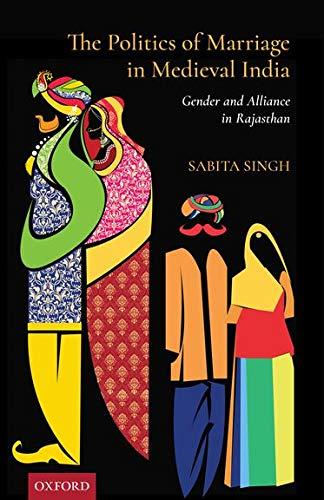
The Politics of Marriage in Medieval India: Gender and Alliance in Rajasthan: the title of this book requires an explanation of mainly two aspects—the significance of studying the institution of marriage and the time frame of ‘medieval India’ as I understand and use this category.
The study of marriage as an institution helps us understand some basic aspects of society. It is an institution that defines much about a person’s present and future. In fact, marriage practices are revealing of various aspects of the society and its attitudes, as marriage is a social act, involving more than two individuals hedged in by laws and customs. These laws and customs are never static and undergo subtle transformations all the time. Both marriage and family are near universal social arrangements that vary from group to group and change over time. Since marriage carries many social and legal consequences, it simply must be a public act and cannot be a private pact between husband and wife.
It may seem that there is nothing more natural than the family as a social unit. But if that were indeed the case, it would have stayed in an immutable form throughout history. Instead, we have seen the structure of the family change from clan to joint to single parent. Some societies like the Spartans dispensed with the family altogether, with the children and the elderly becoming a collective responsibility.
ThePoliticsofMarriageinMedievalIndia:GenderandAllianceinRajasthan.
Sabita Singh, Oxford University Press (2019). © Oxford University Press. DOI: 10.1093/oso/9780199491452.001.0001
The history of marriage must be viewed at two levels. It is a piece of social history related to the whole pattern of customs, laws, relations, and aspirations that lie at the centre of the history of family life. But it is at every point deeply affected by the inner life full of variety—tragic and comic, romantic and very unromantic, and a tale of joy, suffering, and humdrum—most of it hidden from the historian’s eye. Therefore, for the study of the institution of marriage, there are varied aspects that need to be looked into, which will help reconstruct regional social structures and cultures. The specificity of regional social reality persists, adapts, and innovates, despite textual scriptural normative ordering and historical upheavals. Two dimensions clearly emerge in this process. First, we need to focus on the regional construction as distinct, but as a part of wider holistic constructs of Indian society. Second, we need to look at the significance of constructing a history based on actual folk reality and actual documents, revealing the ongoing process of different social groups of intra- and inter-relational levels.
Also, the time frame for defining ‘medieval’ needs an explanation. For defining the period as medieval, there are no specific dates that can be used for earmarking the beginning and end of the period, as social and cultural histories cannot be defined by specific dates. But by medieval India, I largely mean the India contemporaneous to the preSultanate and Sultanate, Mughal and post-Mughal period. Therefore, it would approximately date from the eighth to the eighteenth centuries.
One of the most significant cultural legacies of around a thousand years stretches in Indian history between the seventh and eighth centuries and the eighteenth century. Medieval India, as it is constituted now, is a large number of histories. The tripartite division of Indian history based largely on dynastic history to the debate on feudalism with its conceptualization of early medieval India, in some ways, expands the temporal domain of medieval India, but more importantly, it emphasizes the search for transition in the socio-economic sphere. Important and comprehensive developments during this period laid the foundation of much that was to characterize medieval Indian social and economic structures and to a large extent even state formation. The 1990s brought Indian historiography on the verge of another threshold with emphasis on social and cultural profiles, power relations manifest in everyday life within the family, interpersonal relationships, ideas about gender, and the study of space and time in historical contexts.
These problems by their very nature defy tight, temporal straitjackets. Explanations along these lines may lead to a far more effective questioning of the tripartite division than has hitherto been possible. Also, historical changes are not uniform or identical in space and time. Therefore, it not only requires us to re-examine our notions of periodization, but it also does not allow any easy periodization. Transitions often carried over features from one society to another. Therefore, generalization about the nature of society in any given area is a very complex matter. Hence, regional studies as well as studies covering variations within the region are important.
The existing historiography regarding the social history of this period and this region is extremely meagre. In fact, no work has been done on the institution of marriage as such. There are some works in which references have been made to marriage practices. As far as the secondary sources are concerned, reference can be made to G.N. Sharma’s Social Life in Medieval Rajasthan 1500–1800, the only modern work where a broader study of the society of this region is attempted. But his work is more of a simple portrayal of social life based on caste. Besides, the author hardly throws any light on the middle and lower castes. He has made some general statements, which are not empirically corroborated. Moreover, his account of marriage is quite sketchy and therefore not very useful.
Shashi Arora’s Rajasthan mein Nari ki Stithi (1600–1800) is an attempt to study the position of women of various sections of the society. She has used copious archival data as corroborating evidence. Despite this, she has tended to accept what G.N. Sharma has to say and has not put forth any new concepts. She certainly has dealt with marriage in a detailed manner, but only so far as it affected the position of women, and does not go into the details of other aspects of the institution of marriage.
Rekha Mishra’s Women in Mughal India 1526–1748 has also touched on some aspects of marital alliances. Although she devotes one chapter to the position of middle- and lower-class women, her main emphasis is on the upper-caste women, and the information available to her is not very satisfactory.
Another work on Rajasthan dealing somewhat with this aspect is the book by Shanta Rani Sharma, Society and Culture in Rajasthan c. 700–900. Her chapter, ‘Social Structure and Family, Marriage
and Position of Women’, although useful, follows more of a narrative style and deals largely with the early medieval period.
The latest publication of Hembala Bhargav, Royalty, Feudalism and Gender, as Portrayed by Foreign Travelers, does tackle the topic of marriage in Chapter 2. This is merely a general survey of social institutions and trends rather than a work of historical rigour based on sufficient evidence. Chapter 3, ‘Gender and Status of Women’, follows the same pattern. Although dealing largely with the eighteenth and nineteenth centuries, it does not throw any new light on either marriage or the status of women. Also, important issues such as sati and jauhar have just been touched upon.
Here, it would not be out of place to go into the European writings on the history of marriage. History of marriage has long been characterized by the great variety of approaches made to it. Why has the study of the history of marriage become so popular in the West? This results largely from the search for relevance in history. The rapid and sensational changes in Western marriage customs and domestic upheavals have turned historians to look at the past. This obviously helps in putting the present world in perspective.
Social and cultural history plays the role of a master link between the various elements in what is now a diverse discipline. We have long been aware of the fascinating parallel studies of marriage by anthropologists. In recent years, an eminent anthropologist Jack Goody has brought these studies into the historical arena in his fundamental work, The Development of Family and Marriage, in Europe.
From Mary Wollstonecraft onwards, one can discern a stream of critical feminist writing, focusing successively on married women’s property rights, access to divorce, and right to work and vote. Professor Stone’s work, Family, Sex and Marriage in England 1500–1800 (London), was a monumental work, vivid in style but with relative absence of investigation.
The study of the history of marriage has been particularly illuminated in two recent books by George Duby, Medieval Marriage and The Knight, the Lady and the Priest. They are among the most influential works of one of the best known social and economic historians. His books are enchanting, full of rich and brilliantly presented evidence.
Of course, for the English and French historians, the evidence and material is vaster and is almost readily available in a chronological order,
whereas, for us, the material is extremely scattered. But these limitations can be turned into an advantage when one realizes that there is sufficient material to turn scattered evidence into reconstructing some orderly picture of the past.
The institution of marriage has to be viewed by examining such things as the hallmark of medieval marriage. What were the political and economic considerations and cultural determinants in the marriage practices of our period, reflecting the style of life, behaviour, norms, etiquette, and so on?
This work has been divided into five chapters in which I have tried to deal with various significant aspects of marriage. In the first chapter, a study has been made of the political and social structure of medieval Rajasthan. Social and cultural history has to be related to the political structure, as changes in polity lead to changes in society. I have handled the phenomenon of emergence of Rajputs, as they have contributed significantly to the distinctiveness of Rajasthan. Also, I have examined how the emergence of the early Rajput clans led to the redefining and reorganization of the political and social structure. State formation being an ongoing process developed through distinct stages, and these developments affected the social substructure of the region. Study of these developments helps us understand the marriage network among the clans.
The process of integration and transformation continued right up to the fourteenth and fifteenth centuries, with the possibility of the resurgence of the erstwhile groups as well as their own kinsmen always remaining. Besides, the rulers of various kingdoms also had to deal with the Muslim rulers of Gujarat, Sultans of Delhi, and finally with the Mughals, who conquered and conciliated them. To what extent this altered the state structure has also been looked into. Whereas during the early period of state formation, caste boundaries were quite blurred, by the fifteenth–sixteenth centuries, caste distinctions acquired importance both for marriage purposes and for systematization of administration as reflected in the land revenue system.
A study of the caste structure of this region makes it clear that it cannot be seen in terms of the fourfold varnas (castes). For the Rajputs, it was the clan structure that was more significant and this governed the marriage rules. Besides the Rajputs, the other dominant castes such as Brahmins, Bhats, and Charans have been studied. The significance
of the role played by the trading community in this region throughout the period has been examined. Role of other caste groups such as the Jats and Kayasthas has also been examined and so has the role of the tribals such as the Bhils and the Meenas. Ultimately, how the state emerged stronger and started playing a significant role in maintaining the caste boundaries of the society becomes evident.
In Chapter 2, ‘Socio-Political and Economic Aspects of Marriage’, the motive behind marriage has been investigated, as this can change from one historical period to another. This chapter largely pertains to the elite and ruling class, for whom the motive behind marriage was largely political. The political aspect of marriage was most predominant as compared to the socio-economic aspect. Throughout the period we get examples of political marriages, although in the initial period of state formation, when marriages were used for enlarging one’s territory, ending enmity, and for increasing power and status, this aspect was more evident. The reaction of women to such alliances, to what extent familial relations were subordinated to political considerations, and how such considerations led to the institutionalization of the practice of polygamy have also been looked into. Also, we look into how in a period of incessant warfare, the victor compelled the widows and other women of the subjugated family to marry them—a way of exercising power. How far did the notions of honour motivate matrimonial alliances? What motivated the families to give their daughters to the Muslim rulers despite the fact that by then they had started adhering to strict caste endogamy? How did political marriages come to play a significant role in the consolidation of Mughal rule? Lastly, what was the degree of social acceptability of such marriages, and here again the notion of honour played an important part in the degree of opposition to the Mughal alliance. The major source that I have used for this chapter is the Vat and Khyat (chronicles) which largely focuss on the Rajputs. This has been done not by choice, but by the nature of information available. Sources for the alternate castes are not available.
Despite the predominance of political motives, the rituals were always observed. Chapter 3 has been divided into separate sections under different headings such as ‘Interpretation of Marriage Rituals in Medieval Rajasthan’. Under this, I have tried to examine how the ceremonies and rituals of marriage helped in maintaining the caste identity of the families, how the authority and superiority of a particular
segment could be demonstrated through ceremonies and rituals on such social occasions, and the continuities and additions to the marriage samskars (lifestyles). An attempt has been made to look into the rituals followed by various castes and also to analyse their significance.
Under the subheading of ‘Marriage Customs and Practices in Medieval Rajasthan’, the significance of the engagement ceremony has been looked into, such as notions of honour attached to it, especially among the Rajputs, and how breaking of the engagement was perceived by the people of different communities. I have also examined the age of marriage in medieval Rajasthan, which has varied considerably from period to period and caste to caste during the same period.
I have examined the concept of stridhan (gifts given to the bride) and dowry and the effect these practices had on women in the subsection on ‘Dowry’. I have tried to understand the complexity of the marriage gift in its historical perspective. What are the changes that have occurred in the concept of dowry? What were the actual things given as dowry, as it must have varied according to the status of the family? Did the amount of dowry affect the status of the woman at her in-laws’ place? What happened in cases of inability to pay dowry? Why did dowry keep gaining increasing popularity? Another significant aspect that I have looked into is the tension and conflict that the payment of dowry may have generated within the family of the bride, taking us to the realm of interpersonal relationships. Besides this, the other customs and practices which have been examined, with special emphasis on the ruling class (that is, Rajputs), are practices such as ‘hypergamy, polygamy, and concubinage. What were the factors that were linked to it and what were the various implications of such practices?
No work on the institution of marriage in Rajasthan would be complete without reference to the practice of sati and widowhood as, even today, Rajasthan continues to have the dubious reputation of having cases of sati or bride burning. In Chapter 4, ‘Sati, Widowhood, and Remarriage’, an attempt has been made to understand phenomena like sati and jauhar in their historical context, as well as the much talked about taboo on widow remarriages as these are seen as institutional forms of women’s oppression. I have tried to locate sati in its historical context, from the time of its earliest mention to its practice in our region during our period. What did the term sati denote? How was the practice of sati in Rajasthan different from that in other
regions? Which were the castes that practiced sati? Was it voluntary or obligatory? Did it adhere to the ideal of sati savitri (a virtuous woman) or were there other dimensions to it? An attempt has been made to find out the actual political, social, economic, and religious factors responsible for this rite. Examples of women becoming sati can be seen throughout our period. What motivated these women to commit sati? Were these individual acts or products of a sociocultural environment? What kind of life did the widow lead during the medieval period? To what extent was widow remarriage prevalent among various castes? How did the state and society perceive remarriages? Did the widows live like socially marginalized victims, as is made out in most works of social anthropologists, or does the position of widows appear to be any different from the general perception? What were the property rights exercised by the widows, a crucial aspect in determining their position?
In the last chapter, the study of marital and sexual morality in medieval Rajasthan has been taken up. I have tried to show how sexuality is defined by the society and culture. Was there was any religious philosophy that marriages in medieval Rajasthan sought to convey? Was there any moral or textual injunction that religion or the state upheld for married men and women? What was the relationship between law and social practice one of the ideal and the aberrant? How were the marital disputes settled at that time? What were the legal and other devices available, what was the extent to which it was resorted to and the attitude with which it was viewed? What were the notions of sexuality, marital and extramarital sex, and shame and honour? Besides the case of fidelity between husband and wife, I have also looked into the cases of domestic violence, rape, and incest. The cases of deviant sexual behaviour were generally referred to as chamchori (deviant sexual behaviour) and an attempt has been made to study cases of chamchori between same caste people, men of upper caste with lower caste women, and vice versa; the reaction of the state in each case; the forms of punishment meted out; and how the society perceived these acts.
EVALUATION OF SOURCE MATERIAL
In view of the availability of copious archival and literary material it has been possible to throw light on the institution of marriage in
medieval Rajasthan. The emergence of archival records from the midseventeenth century onwards for the first time, including sustained village-level revenue data, has been very helpful in reconstructing the history of the period. Of course there are several gaps that remain, given the wide time frame and scope and nature of the work.Yet, it has been possible, to some extent, to construct a picture of the institution of marriage during our period.
The archival material consists of the ‘Byah Bahis’, which record the marriage of Rajput princess and aristocracy of all the states of Rajasthan except for Jaipur. The bahis maintained by the merchant community also record the marriage practices. These Byah Bahis are therefore important sources of direct evidence.The Kagad Bahis record what was happening in the village and was reported to the state. Any offence being committed in the villages including deviations from the norms of marriage were reported.
The ‘Adsattas’ are a pargana-wise record of ledgers of receipts and disbursements and basically provide all the information to the Diwan’s office regarding the revenue realization from all sources in the pargana. They also give us information on the taxes realized by the state on marriage and fines imposed in case marriage norms were flouted. These documents throw immense light on the role of the state in regulating social and marital norms.
The ‘Chithiyats’ are official letters, which contain information on many matters including marriage negotiations and disputes. While reporting disputes, the genesis of the dispute is also mentioned and, hence, it is extremely useful in constructing a more detailed picture.
The ‘Sanad Parwana Bahi, Jodhpur’ contains official orders passed on various matters reported to the state and they contain decisions on important social issues including marriage. Whereas the ‘Adsattas’ give us limited information, the ‘Sanad Parwana Bahis’ go into details of these issues and we get a wider range of information. Jodhpur Rajya ki Dastur Bahi, published and edited by Vikram Singh Rathore, is also rich in information. This gives us a great deal of information on marriage customs and practices.
Besides these archival documents, there are several works of literature, which can be used in order to reconstruct the history of the period. But the use of literature as historical evidence is not safe unless one has meditated a little on their nature and purpose and studied their
status as documents and evidence. Hence, it is imperative to evaluate and examine the nature of the literary evidence used.
Literature, whether written or oral, when used as a historical source, may not provide what some historians tend to call ‘hard facts’. But these sources do illumine our perspectives and historical assumptions. The texts carry the perceptions of the past and of their authors, and these perceptions frequently indicate contemporary concerns. Analyses of these sources are likely to provide the kind of insights into social history that may enable us to understand our past and, therefore, our present better.
The literary source that I have used to the greatest extent is the Khyat of Muhnot Nainsi.1 The Khyat, though not purely a literary source, is a part of historical narratives. Writing of the Khyat has been an old tradition in Rajasthan. Seeing that the Mughal emperors used to get their tawarikh (histories) written, the Rajput rulers also introduced the task of Khyat writing. Very soon, most rulers had Khyats written under their patronage but some Khyat-kars did write of their own inspiration, but the number of such Khyats was few. Fortunately, many historians edited the Khyats and made our task easier.
Also, historians have generally been sceptical about genealogies and have rightly maintained that they are not to be taken literally unless there is other evidence to support them. Nevertheless, medieval studies of genealogies indicate that genealogical patterns can be read as way of representing society. Genealogies record social forms. They assume importance at times of historical change and are often used to legitimize the present.2
The writings of Muhnot Nainsi are considered to be the first among the historical works of Rajasthan. His works are unique, and although he followed the line of Abul Fazal, his treatment of the historical events and the policies of the rulers is more objective than that of Abul Fazal. Besides narrating the dynastic histories of all the ruling Rajput families
1 Muhta Nainsi, Nainsiri Khyat, ed. Badri Prasad Sakariya, 3 Vols. (Jodhpur: Rajasthan Oriental Research Institute, 1984). The Khyat was first published in 1962.
2 Romila Thapar, ‘Clan, Caste and Origin Myths in Early India’, Nihar Ranjan Ray Memorial Lecture, Indian Institute of Advanced Study, Simla. (New Delhi: Manohar Publications, 1992), p. 5.
of medieval Rajput states since their origin, his Khyat contains valuable information about the social structure and polity of the seventeenthcentury Rajput states of Rajasthan.
Nainsi rose to the position of pradhan (village official) in 1658. But he was less remembered as an able administrator and more for the texts he penned. These are known as Munhot-Nainsi ri Khyat (completed 1665) and Marwar-ra-Pargana-ri-Vigat. In fact, the Khyat is an unparalleled text in throwing light on the royalty of Rajasthan. In the Khyat, Nainsi has given sometimes detailed and sometimes summarized description of Mewar, Dungarpur, Banswara, Devaliya (Pratapgarh), Marwar, Bundi, Jaisalmer, and Sirohi, and of the Rajput families associated with them. Out of these, the post-fourteenth century descriptions are more reliable than that of the earlier period. But as far as the Rathore clan of Jodhpur is concerned, it neither gives a chronological history nor does it throw light on all rulers. But this is done in the Vigat (literary account of the past, a kind of a gazetteer).
There was also a tradition of writing Vigat in Marwar. The first work of this nature, Marwar ra Pargana ri Vigat, was written by Muhnot Nainsi in the latter half of the seventeenth century during the reign of Raja Jaswant Singh. There is no doubt that this work was written on the pattern of Ain-i-Akbari. Besides recording a systematic parganawise account of Marwar, he gives details of the history of their ruling families. As the Khyat does not provide complete chronological history of Jodhpur, this lacuna is more than made up by the information provided in the Marwar ra Pargana ri Vigat in three volumes—an incomparable piece of work. It is a gazetteer of Rajasthan in which details of various villages in a pargana are given in such a way that it is not available even in a modern gazetteer. The geographical, historical, economic, and political and social information that we find here is not only useful from a historical perspective but is also helpful in the study of several modern problems.
As drawn extensively from the Khyat and Vigat, I feel it necessary to provide some more details about Nainsi and the perspective with which he has written his work. Nainsi was the Diwan of Jaswant Singh, who was a contemporary of Shah Jahan. Nainsi’s father Jaimal was also an important official during the time of Gaj Singh. Jaimal too reached the rank of Diwan and it is possible that besides his own experience Nainsi derived information from his father.The three volumes of Khyat
cover a period between eighth and seventeenth centuries, almost the entire period that I have taken up for study. Covering such a vast time frame means that considerable part of the work must partly be based on hearsay and partly on experience. But the salvaging factor is that Nainsi is very clear about the information that he gives, whether it is hearsay, parampara (tradition), or historical fact.
Also, Nainsi wrote for self-satisfaction rather than royal patronage, therefore, to a large degree, the information that he gives us is objective. He does not hesitate to uncover or highlight the dark facts of Rajput life either. We must remember that when Abul Fazal wrote his text, he had several texts at his disposal from where he could study and write, whereas Nainsi was largely busy with administrative tasks.
The Khyats of Nainsi are extremely significant as they describe numerous incidents pertaining to the Rajput elite family. Besides, there is also discussion on the political activities in the Khyats. There is information on polygamy among the rulers, the rivalry between co-wives, on sati and widow remarriage, and even on sexual morality. Although Nainsi basically confined himself to the Rajput aristocracy and their customs and practices, he does give reasonable information about the other sections of the society. In fact, his Khyat is in the form of a catalogue, and it is for us to analyse his narrative.
Another important source is the ‘Report Mardumshumari’, which is an official compilation of customs and practices prevalent among various castes and communities, including the tribals, who were residing in Marwar. This was written in the beginning of nineteenth century. Although it is not contemporary, it has very useful and reliable information on various customs and practices followed by each and every caste residing in the state of Marwar. It also contains plenty of information on nata and gharecha (remarriages).
James Tod, the first British agent appointed to Mewar, towards which he was favourably inclined, is known as the chronicler of Rajput history, but it is the Mewar interpretation of Rajput–Mughal relationship that is reflected in his monumental volumes, Annals and Antiquities of Rajasthan. Tod’s account of the legend of Rana Pratap reflects the literary sources and oral traditions current in Mewar in the early nineteenth century. The Annals contain a stringent denunciation of those Rajputs who bartered away their daughters and their ‘honour’ for Mughal power and wealth. Rana Pratap by contrast is glorified for his refusal in the
face of adversity or temptation to sacrifice the independence of Mewar or to submit to the degradation of uniting his family to the Tarter. The intensity of the moral feeling in Mewar had come to be associated with the issue of Mughal Rajput marriages as well, reflecting in Tod’s gloating account of Mewar’s renewal of marriage alliances with Jodhpur and Amber.3
It is ironic that ever since their publication in 1829–32, Tod’s Annals which were translated into Hindi in 1925 and are very widely known in Rajasthan, have been regarded as a primary source concerning question of Rajput history and tradition. However, the pervasive inaccuracy of Tod’s historical account usually is not recognized, nor is the Mewar orientation of the Annals generally perceived as such. The continued influence of the Annals is a major factor shaping twentieth-century Rajput attitude towards the Mughal–Rajput marriage alliances.
The Mewar tradition also shapes the writing of Vir Vinod by Shyamaldas, often termed as the first modern historian of Rajasthan, for its use of contemporary documents.4 However, Shyamaldas was also an official in the Mewar court and he tried his best to get information from other Rajput states. He also drew heavily (and uncritically) from the literary sources, and incorporated the legend of Rana Pratap and similar material extensively into his volumes. Shyamaldas’s discussion of Mughal–Rajput marriages is defensive and not entirely consistent.
So long as the Rajputs and those who identify with them consider events of sixteenth century to have a direct bearing on their own standing, and so long as the marriage of their daughters to Muslims is seen as dishonourable, the successful diplomacy of the Amber, Bikaner, or Jodhpur Rajas, who were Akbar’s contemporaries, is likely to have few modern Rajput defenders, even among the direct descendents of Rajasthan. In such circumstances, a dispassionate examination and interpretation of the historical record is difficult.The facts are grounded too firmly to be denied entirely, but no matter how extensive the documentation, there still will be many who regard the Mughal–Rajput marriage alliances as shameful skeletons in the closet of Rajput history
3 James Tod, Annals and Antiquities of Rajasthan, vol. 1–2 (New Delhi: Rupa and Company, 1997), pp. 264–5, pp. 26–7. Henceforth Annals.
4 Rajkavi Shyamaldas, Vir Vinod—Mewar ka Itihas, 2 Vols, Udaipur Rajantralaya,V.S. 1943/1886. Subsequently published in Delhi in 1986.
to be shut away and forgotten.5 But relying too heavily on these literary texts would invariably limit the reconstruction of the past, as these literary texts largely give us information about the politically dominant class. Also, these texts contribute largely to the invisibility of women which is now increasingly concerning historians.
The Rajwadi Lokgeet, edited by Laxmi Kumari Chundawat, besides throwing light on contemporary social situation and feudal culture, also gives voice to women. In fact, the sentiments highlighted through these songs have not been understood by historians and littérateurs. As an illustration, one can take up the story of Roothi Rani Umade Bhatiani, daughter of Rao Loonkaran of Jaisalmer, who was married to Rao Maldev of Jodhpur.Throughout her married life, she remained aloof from her husband as she was upset over something, and this was perceived as a matter of honour and Rajput pride. Nobody understood her anguish, which is brought out in songs when she gives message to other women: ‘[S]isters, please don’t bear grudges against your husband for so long. I remained unhappy with my lover and all my life my heart burnt, compared to this the fire of the funeral pyre is cool.’ These lines were spoken when she was committing sati for her husband.6
Rajasthan Vat Sangrah, which is a purely literary source, draws our attention to the Rajasthani environment.The Vat reflects the life of the people of North Rajasthan and Gujarat. Its special importance lies in the fact that it sheds light on the social history of the region. We can get a picture of the period earlier than eighteenth century in which political, social, religious, and economic matters have been described.
Another significant fact about the information provided by the Vat is that it does not contain any communal bias; if there were any battles, the reasons were purely political and whoever participated in the battle fought for their master and not in the name of any community. The feudal culture, the valorization of certain values, the attitude of
5 Frances H. Taft, ‘Honour and Alliance: Reconsidering Mughal Rajput Marriages’, in Idea of Rajasthan, Explorations in Regional Identity, vol. 2, ed. Karine Schomer, Erdman, Joan L. Deryck O’ Lodrick, and Rudolph Llyod (New Delhi: Manohar Publications, American Institute of Indian Studies, 1994), pp. 232–3.
6 Laxmi Kumari Chundawat, Rajwadi Lokgeet (Jaipur: Sheetal Printers, 1985), p. 9.
avenging their honour, all these are reflected in the marriage practices of the Rajputs. Of course the Vat largely gives information on the Rajputs, but we also get information on the life of the Mahajans and the Charans who had a very significant relationship with the Rajputs and played an important part in the construction of Rajput society.7
I have also gone into the local sayings, that is, Rajasthani Kahawate Although one cannot situate the sayings and proverbs in a specific time frame, they remain extremely significant as they give us an idea of a specific region, its people, traditions and customs, and ideals and social organization.
Besides these, there is also the folklore or folk literature, which help us to join the past with the present. RajasthanVirgatamak Pavarhe Sarachana Ewam Lok Parampara by Usha Kasturiya mirrors the culture of that period and region. The main stream in the story is average incidents and traditions. Any one historical event can absorb many geographical local and cultural changes and then reach its present shape. What in England can be called folklore can be called lokvarta in Rajasthan. Lokvarta, however, is clearer in the picture it presents and is more emotive.
In fact, the Pavarhes can somewhat be compared to the English ballad, basically meaning songs that were sung along with dancing. Pavarhes can also be sung but their story line is not simple and has several stories strung together, therefore they are lengthy. In fact, some Pavarhes are so long that they are even called Lok Mahakavya. The main points of the Pavarhes are historical and because it was a part of oral tradition, some historical facts were added on to it. When dealing with women, centrality is given to her satitva (loyalty to her husband). Most of the stories revolve around sacrifices made by the women. The newly-wed wife of Galalang, Gogaji’s wife Kelamde, and Sultan’s wife Nehalde are unforgettable characters. In fact, the story of Sultan and Nehalde belongs to the fourteenth century when Muslim names became prevalent among the Hindus and are all mentioned in the Pavarhe. The new sources and the reinterpretation of the old has enabled us to know about the marriage practices of a wider social group.
7 Manohar Sharma and Shri Lal Nathmalji Joshi (ed.), Rajasthan Vat Sangrah (Sahitya Academy, 1984), p. 12.