This series presents a forum for new interpretations of Greek settlement in the ancient Mediterranean in its cultural and political aspects. Focusing on the period from the Iron Age until the advent of Alexander, it seeks to undermine the divide between colonial and metropolitan Greeks. It welcomes new scholarly work from archaeological, historical, and literary perspectives, and invites interventions on the history of scholarship about the Greeks in the Mediterranean.
A Small Greek World Networks in the Ancient Mediterranean
Irad Malkin
Italy’s Lost Greece
Magna Graecia and the Making of Modern Archaeology
Giovanna Ceserani
The Invention of Greek Ethnography
From Homer to Herodotus
Joseph E. Skinner
Pindar and the Construction of Syracusan Monarchy in the Fifth Century B.C.
Kathryn A. Morgan
The Poetics of Victory in the Greek West Epinician, Oral Tradition, and the Deinomenid Empire
Nigel Nicholson
Archaic and Classical Greek Sicily
A Social and Economic History
Franco De Angelis
Myth, Locality, and Identity in Pindar’s Sicilian Odes
Virginia M. Lewis
The Politics of Identity in Greek Sicily and Southern Italy
Mark R. Thatcher
The Politics of Identity in Greek Sicily and Southern Italy
z
MARK R. THATCHER
Oxford University Press is a department of the University of Oxford. It furthers the University’s objective of excellence in research, scholarship, and education by publishing worldwide. Oxford is a registered trade mark of Oxford University Press in the UK and certain other countries.
Published in the United States of America by Oxford University Press 198 Madison Avenue, New York, NY 10016, United States of America.
All rights reserved. No part of this publication may be reproduced, stored in a retrieval system, or transmitted, in any form or by any means, without the prior permission in writing of Oxford University Press, or as expressly permitted by law, by license, or under terms agreed with the appropriate reproduction rights organization. Inquiries concerning reproduction outside the scope of the above should be sent to the Rights Department, Oxford University Press, at the address above.
You must not circulate this work in any other form and you must impose this same condition on any acquirer.
Library of Congress Control Number: 2021940309
ISBN 978–0–19–758644–0
DOI: 10.1093/oso/9780197586440.001.0001
1 3 5 7 9 8 6 4 2
Printed by Integrated Books International, United States of America
To my grandfather, Curt Roy, whose passion for history taught me to be a lifelong learner, to always be curious, and to keep wanting to learn more.
List of Figures ix
Maps xi
Acknowledgments xiii
List of Abbreviations xvii
1. Introduction 1
Scope of Research 6
Theorizing Identity 9
A Typology of Identities 16
Seeking Identities in Antiquity 28
2. Becoming Achaean in Italy 32
The First Achaeans 34
Croton: Athletes and Heroes 40
Metapontion: Insiders and Outsiders 64
Conclusion 83
3. Syracusan Tyranny and Identity Politics 85
The Tyrant’s House and Syracusan Identities 87
Greeks and Barbarians 110
Responses to Tyranny 125
Conclusion 131
4. Ruling Grain-Rich Sicily 133
Myth and Cult 136
Sicilian Politics 156
Conclusion 176
5. Shifting Identities in Thucydides’s Sicily 178
Kinship Diplomacy 181
Camarina’s Polis Identity 188
Rhetoric and Identity 200
Conclusion 210
6. Continuity and Change in the Third Century 212 Greeks and Barbarians in Southern Italy 213 Being Syracusan in the Third Century 227
Conclusion 245
Conclusion
Bibliography
List of Figures
1.1. A hierarchy of identities in Thebes. 26
1.2. Non-hierarchical identities in Syracuse. 27
1.3. Malkin’s visualization of identities in Syracuse. 27
1.4. Overlapping identities in Syracuse. 28
2.1. Stater of Croton, c. 550–530. Tripod, incuse. 47
2.2. Stater of Croton, c. 420. Obverse: Heracles as oikist. Reverse: Apollo and Pytho with tripod. 51
2.3. Stater of Sybaris, c. 530–510. Bull, incuse. 67
2.4. Distater of Thurii, c. 410–330. Obverse: Athena with Scylla. Reverse: Bull. 68
2.5. Stater of Metapontion, c. 530–510. Ear of barley, incuse. 76
2.6. Map of the chora of Metapontion. 82
3.1. Map of Syracuse. 98
3.2. Tetradrachm of Syracuse, c. 500–485. Obverse: Quadriga. Reverse: Head of Arethusa in incuse square. 100
3.3. Tetradrachm of Syracuse, c. 482–480. Obverse: Quadriga with flying Nike. Reverse: Head of Arethusa with dolphins. 100
4.1. Litra of Enna, c. 450. Obverse: Demeter riding a chariot holding a torch. Reverse: Demeter sacrificing. 140
4.2. Terracotta figurine with piglet and torch, from Catania. 147
5.1. Map of allies in Sicily, 427–424. 185
5.2. Map of southeastern Sicily. 189
5.3. Map of Camarina. 196
5.4. Didrachm of Camarina, c. 415. Obverse: River Hipparis. Reverse: Nymph Camarina on a swan. 197
6.1. Stater of Syracuse, c. 274–216. Obverse: Philistis. Reverse: Quadriga. 237
6.2. Stater of Syracuse, c. 344–335. Obverse: Athena. Reverse: Pegasus. 241
Maps
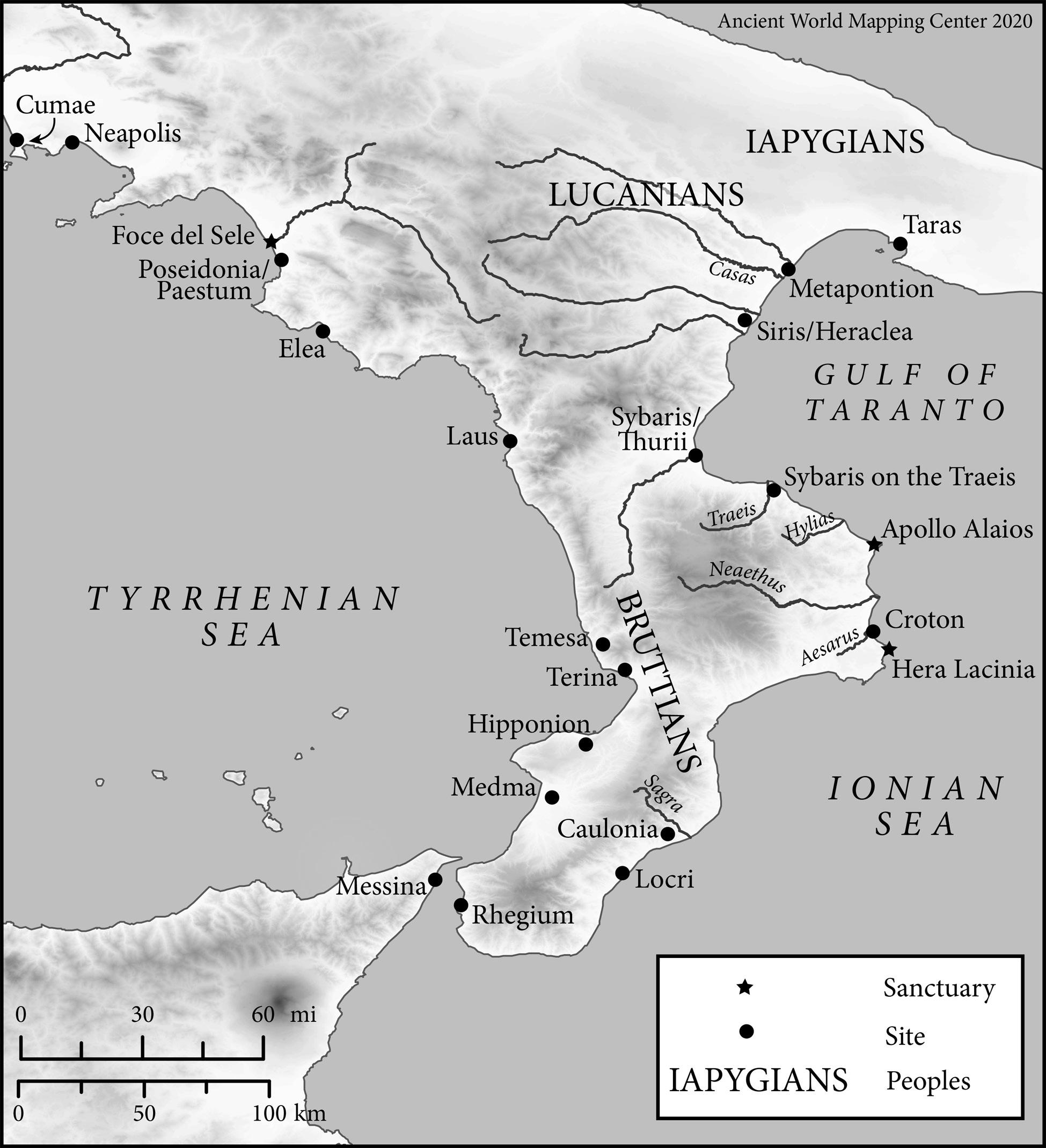
Fig. 0.1 Map of southern Italy. By the Ancient World Mapping Center.
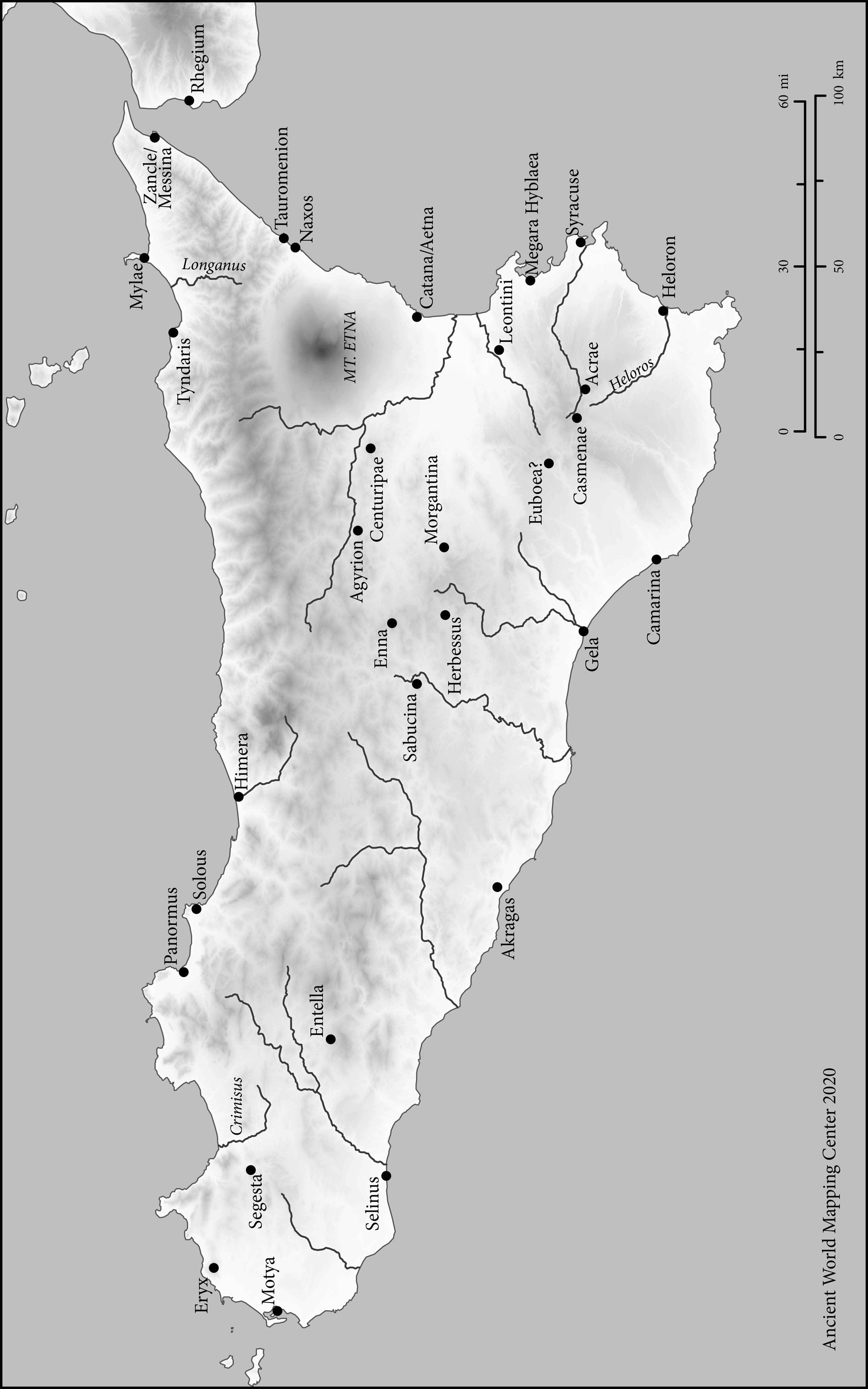
0.2 Map of Sicily. By the Ancient World Mapping Center.
Fig.
Acknowledgments
This book has been shaped by innumerable teachers, colleagues, and friends over the last two decades, beginning with my first teachers: my parents, Cathy and Steve Thatcher, and my grandfather, Curt Roy. My interest in Sicily was first piqued by my trip with the Intercollegiate Center for Classical Studies in Rome in the fall of 2002; one view of the lights of Messina across the Straits from Reggio, and I never looked back. This project began as a dissertation at Brown University, and I am grateful to my committee members, Sue Alcock and David Konstan; Chris Witmore also gave helpful advice on archaeological matters. Thanks are due above all to my adviser and mentor, Kurt Raaflaub, whose generous willingness to read drafts, provide expertise, and offer advice was critical both during the dissertation process and ever since. The dissertation became a book only through the support of Carla Antonaccio, who believed in this book even before I did, and Stefan Vranka at Oxford University Press, who was willing to wait for it. Both of them gave much-needed assistance and advice over the years. I am grateful also to the anonymous readers for the press, whose critical eyes vastly improved the final product.
Writing is a lonely endeavor, and so the conversation, companionship, and support of my colleagues in the Boston College Department of Classical Studies, especially Kendra Eshleman, Gail Hoffman, and Chris Polt, were and are particularly important. I similarly benefited from the warm encouragement of past colleagues and friends at the University of Arizona, Creighton University, The Ohio State University, and Brown University. The twiceannual meeting of junior faculty in New England known as MACTe has been a source of friendship and advice; several chapters were workshopped with this group and emerged better for it.
On the other hand, writing is also a collaborative process. I am grateful to Carla Antonaccio, Radcliffe Edmonds, Virginia Lewis, Dominic Machado, Brian McConnell, Kathryn Morgan, Nigel Nicholson, Kurt Raaflaub, and Carrie Sulosky Weaver, who have all been valuable interlocutors over the years
Acknowledgments
and whose comments on various parts of the project at different stages were useful. Hanne Eisenfeld also read virtually every word of this book, often many times, and always with helpful suggestions. Needless to say, all remaining errors are my own. Brian McConnell was kind enough to welcome me onto his excavation team at Palikè, Sicily, in 2017, an experience from which I learned a lot, and to assist in many other ways. Finally, I owe a considerable debt to my teachers, especially Charles Fornara, Jinny Jensen, and Robert Wallace, who were not involved in this project but have nevertheless deeply influenced my approach to the ancient world.
Generous support for this project was given by the Dean’s Office of the Morrissey College of Arts and Sciences at Boston College and by the Behrakis Endowment for Hellenic Studies. I particularly thank Mary Crane for her uncanny ability to find untapped pots of money, and both Kendra Eshleman and Gail Rider for further assistance in this area. A Tytus summer fellowship at the University of Cincinnati supported early progress. Two separate stays at the Fondation Hardt in Vandoeuvres, Switzerland, one of which was funded by a bursary, vastly accelerated the revisions to the manuscript, and a semester of leave from teaching through BC’s Faculty Fellowship program enabled its completion.
Critical assistance in securing the images was given by Gioconda Lamagna, Laura Maniscalco, Brian McConnell, Antonella Pautasso, Chris Strauber, and Carrie Sulosky Weaver. Lindsay Holman and her team at the Ancient World Mapping Center drafted the area maps, and Daniel Weiss drew the city plans. Although I have drawn on the relevant Loeb volumes and other widely used translations, especially Verity 2008 and Hammond 2009, all translations are my own unless otherwise noted. Portions of chapter 3 previously appeared in somewhat different form in the Bulletin of the Institute of Classical Studies, as Thatcher 2012.
Special thanks are due to Gail Rider, administrator extraordinaire, who makes the thorniest practical problems easy, and to the Interlibrary Loan Department at the Boston College Libraries, whose staff never failed to find the most obscure books and articles. This book was completed during the COVID-19 pandemic, and I want to thank the Boston College staff members in particular for their valiant work in keeping the libraries open and academic work continuing under these most difficult circumstances.
Acknowledgments
My deepest thanks are due to my family. Our beloved cat, Isabel, sustained me with her warm and fuzzy presence during the writing process; while she did not live to curl up on the final product, she contributed greatly to its progress. Above all, Hanne Eisenfeld, my partner in life and in work, gave constant companionship and support during the entire gestation of this project. It is a cliché to say this in acknowledgments but true nonetheless: I couldn’t have done it without you.
List of Abbreviations
The abbrevia T ions of ancient authors and works follow the Oxford Classical Dictionary. The abbreviations for journals follow the conventions of L’Année Philologique
BNJ Worthington, I., ed. 2007. Brill’s New Jacoby. Leiden: Brill Online.
CAH2 IV Boardman, J., N. G. L. Hammond, D. M. Lewis, and M. Ostwald, eds. 1988. Cambridge Ancient History, Vol. 4: Persia, Greece, and the Western Mediterranean, c. 525–479 BC. 2nd ed. Cambridge: Cambridge University Press.
CAH2 V Lewis, D. M., J. Boardman, J. K. Davies, and M. Ostwald, eds. 1992. Cambridge Ancient History, Vol. 5: The Fifth Century BC. 2nd ed. Cambridge: Cambridge University Press.
CAH2 VI Lewis, D. M., J. Boardman, S. Hornblower, and M. Ostwald, eds. 1994. Cambridge Ancient History, Vol. 6: The Fourth Century BC. 2nd ed. Cambridge: Cambridge University Press.
CAH2 VII.1 Walbank, F. W., A. E. Astin, M. W. Frederiksen, and R. M. Ogilvie, eds. 1984. Cambridge Ancient History, Vol. 7, Part 1: The Hellenistic Age. 2nd ed. Cambridge: Cambridge University Press.
CAH2 VII.2 Walbank, F. W., A. E. Astin, M. W. Frederiksen, and R. M. Ogilvie, eds. 1990. Cambridge Ancient History, Vol. 7, Part 2: The Rise of Rome to 220 BC. 2nd ed. Cambridge: Cambridge University Press.
CT Hornblower, Simon. 1990–2008. A Commentary on Thucydides. 3 vols. Oxford: Clarendon Press.
DK Diels, H., and W. Kranz. 1952. Fragmente der Vorsokratiker. 6th ed. Berlin: Weidmann.
List of Abbreviations
FGE Page, D. L., ed. 1981. Further Greek Epigrams Cambridge: Cambridge University Press.
FGrH Jacoby, F., ed. 1923–1958. Die Fragmente der griechischen Historiker. 3 vols. Berlin: Weidmann.
HCT Gomme, A. W., A. Andrewes, and K. J. Dover. 1945–1981. A Historical Commentary on Thucydides. 5 vols. Oxford: Clarendon Press.
IACP Hansen, M. H., and T. H. Nielsen, eds. 2004. An Inventory of Archaic and Classical Poleis. Oxford: Oxford University Press.
IG Inscriptiones Graecae. 1873–. Berlin: De Gruyter.
TrGF V Kannicht, R., ed. 2004. Tragicorum Graecorum Fragmenta, Vol. 5. Göttingen: Vandenhoek & Ruprecht.
West West, M. 1989–1992. Iambi et Elegi Graeci. 2nd ed. Oxford: Oxford University Press.
Introduction
i den T i T y is everywhere in the twenty-first century. From the halls of Congress to small towns and major cities, identities are a driving force of political polarization. Bitter debates about what it means to be an American have become commonplace. Identity has been used as a tool of oppression; it has also been a force for change, when protesters take to the streets as a way of taking pride in their identities and empowering their communities. In an age of globalization, the desire to promote local cultures in many countries— Scottish in the United Kingdom, Basque in Spain, or indigenous peoples in Mexico—is fueled by a sense of separate identities. Hollywood films such as Black Panther and Crazy Rich Asians (both released in 2018) center the experience of underrepresented groups and enable artists and audiences alike to take pride in the particularities of their own identities. We all know what identity is, though it is rather hard to pin down, and it seems an inherent feature of the modern world. It was also central to the experience and the politics of ancient Greeks, including, as this study will demonstrate, those who lived in Sicily and southern Italy.
1. E.g., Will 1956; Just 1998; Purcell 2005; Boardman 2006; Gruen 2011.
ethnos sometimes comes close to the last).2 But in reality, identities mattered to people in antiquity just as much as they do today and deeply affected their outlook on the world. Although ethnicity and identity are concepts developed and defined by modern scholars, they nevertheless correspond to an essential aspect of the lives of ancient Greeks. While Greeks did not analyze these concepts abstractly, they did discuss them in more concrete terms, by asking what it meant to be Athenian or Greek or Dorian. In other words, rather than developing abstract theories of ethnicity or identity, they articulated, communicated, and debated the particular factors that made up their identities.
A close look at Syracuse, the largest and most powerful Greek city in Sicily, reveals some of the various identities that were relevant there. In the aftermath of their victory over Carthage at Himera in 480 BCE, Syracusans emphasized that they were Greeks, victorious over the barbarian invaders. Pindar’s Pythian 1, for instance, celebrates Himera in specifically Hellenic terms, declaring that the battle had “rescued Greece from harsh slavery” (75), rhetoric reminiscent of contemporary recollections of the Persian Wars. The poem thus encourages its audiences to privilege their identities as Greeks over other possible self-perceptions. The prominence of Hellenic identity did not emerge naturally, moreover, but rather was promoted from the top. The tyrants of the Deinomenid family—first Gelon (485–478) and then Hieron (478–467)— found Greekness a useful tool for shoring up their support and creating legitimacy for their regime.3 Later kings and tyrants, such as Dionysius I (405–367) and Hieron II (269–215), did something similar.
But like all Greek colonies, Syracuse was also an independent polis, separate from all other Greeks, and Syracusans emphasized a number of factors that made it distinctive. For example, two unique topographical features of the city—its island citadel Ortygia and its spring of Arethusa—appear in several passages of Pindar and are reflected figuratively on its coinage.4 No other city could boast these features. Its people were fiercely proud of being Syracusan and guarded their polis identity closely. The Syracusans also claimed to be Dorian, because of their origin as a Corinthian colony and their claim to a legacy that went back to the mythical Dorian Invasion. One of Thucydides’s speakers, a Syracusan statesman named Hermocrates, expressed his pride in those Dorian and Peloponnesian origins (6.77.1), and centuries later, a Syracusan character in Theocritus did the same (Id. 15.89–93). Pindar, too,
2. Hall 1997, 34–36; cf. Renfrew 1998; McInerney 2001; Morgan 2003, 9–10.
3. The Deinomenids made use of other identities as well; see chapters 3 and 4.
4. Pind. Ol. 6.92–94; Pyth. 2.5–7; Pyth. 3.68–70; Nem. 1.1–6; for the coins, see Kraay 1976, 210.
celebrates the eunomia and social order that this Dorian heritage supposedly bestowed (Pyth. 1.60–66). Because of its focus on shared origins and kinship with other Dorians, this identity should properly be understood as a form of ethnicity.
During the Peloponnesian War, however, a different way of thinking came to prominence: regional identity. In 424, nearly all of the Sicilian poleis were at war with one another, and Athens had sent the so-called First Sicilian Expedition to intervene. At a peace conference that year, the same Hermocrates spoke successfully in favor of uniting against the Athenians. “We are all of us neighbors,” he said, “fellow dwellers in one land, in the midst of the sea, all called by the single name of Sikeliotai” (Thuc. 4.64.3). This idea of a pan-Sicilian regional identity that brought together all inhabitants of the island was not new—half a century earlier, Pindar had described the whole island of Sicily as Zeus’s gift to Persephone, suggesting a conception of Sicily as a unity (Nem. 1.13–18)—but Hermocrates’s appeal brought it to new prominence, and it was this sense of shared identity that caused the Syracusans, along with other Sicilian Greeks, to change their policies, make peace with one another, and force out the Athenians. Thus, the Syracusans identified themselves variously as Syracusan, Dorian, Sicilian, and Greek. These four types of identity are all part of the complex and multilayered idea of what it meant to be Syracusan.
The coexistence of these multiple collective identities, adopted by a single community, raises a number of questions. How did these identities relate to one another in the minds of the Syracusans? Were they seen as totally separate or as overlapping in various ways? What are the differences between various identities, and how should each be defined? How did each sense of identity develop originally, and how did they change over time? The evidence presented so far makes it clear that there was no chronological progression from one identity to another; rather, all of these identities were constantly available, ready to be deployed as desired. So what factors led the Syracusans to emphasize one in one situation and another in a different context? What mechanisms and media did they use to articulate and proclaim these identities, and what sources can we use to recover and understand them? In the short outline above, I cited epinician poetry, historiography, myths, and coinage, but many others were available, such as inscriptions, material culture, religious practices, and visual evidence. How did each contribute to the complex world of identity in the Greek West?
Moreover, these multiple identities clearly made a significant impact on Syracusan politics. How did various tyrants and leaders use identities for political gain? A great many Sicilian leaders, from the Deinomenids to the tyrant
Dionysius I in the fourth century and King Hieron II in the third, derived some of their legitimacy from the rhetoric of identity. What techniques were involved, and were different identities susceptible to different uses? Did the claims of political elites affect how ordinary people viewed their own identities? Events in the realm of politics certainly were able to shape and reshape identities; a familiar example is the drastic remodeling of Hellenic identity at Athens in the decades following the Persian Wars. But the reverse also happened: political decision-making was often informed and conditioned by multiple identities. Politics and identities thus shaped and reshaped each other in a reciprocal cycle that has the potential to substantially affect our understanding of Greek political history.
This study explores the intersection of politics and identity in Greek Sicily and southern Italy. It advances two main arguments. First, the multiple identities claimed by the western Greeks cannot be understood individually or separately; instead, they are deeply intertwined, full of overlapping strands that must be untangled and analyzed together. Each of these strands is important in itself (which makes it worthwhile to distinguish them clearly), but their interactions make the whole far more complex, in ways that have not been fully understood. Second, identity played a far greater role in Greek politics than is usually recognized. Identity was often created through conflict and was reshaped as political conditions changed; it created legitimacy for kings and tyrants and contributed to the decision-making processes of poleis. Identity and politics among the western Greeks were deeply entangled.
Three examples, drawn from the case studies that make up this volume, will help to set out these rather broad propositions in more detail. The first concerns Croton in southern Italy, where Achaean ethnicity was intertwined with polis identity in a more complex manner than previously appreciated (see chapter 2). Croton’s foundation myths, a key tool for articulating identity, traced the city’s origins to the northern Peloponnese via the founder Myscellus and thereby defined it as ethnically Achaean. But the stories of Myscellus were not shared by other Achaean cities such as Metapontion and Sybaris. Rather, they also served to define Croton’s polis identity by articulating elements that make Croton distinctive, such as its local landscape and its great success in athletics. Other mechanisms for constructing identity, such as coins, myths of heroes, and the major cult of Hera Lacinia, display a similar pattern. Thus, Croton’s expressions of Achaean ethnicity were also at the same time expressions of its polis identity, and neither type of identity can be fully understood without the other. Further, these entangled identities arose out of political conflicts, especially in the sixth and fifth centuries. Croton and other Achaean cities fought a series of wars against their non-Achaean (but Greek) neighbors, including
Locri, Siris, and Taras, which collectively led to the articulation of Achaean ethnicity defined in contrast to those Others. Political competition was thus central to the creation of Achaean identity.
Next, a strategy frequently used by Sicilian kings and tyrants to create legitimacy for their rule was mobilizing their subjects’ sense of Greekness. We have already seen the Deinomenids’ use of the memory of the Battle of Himera in 480 for this purpose. Almost a century later, in 397, Dionysius I of Syracuse launched another war against Carthage, calling on Sicilian Greeks to defend the Greekness of their island, in order to shore up his power (chapter 3). Even in the Hellenistic period, the man who became King Hieron II secured power in the 270s by trumpeting his victories over the Mamertines, a group of nonGreek Campanian mercenaries who had seized Messina (chapter 6). These are all classic cases of the creation of unity within a group through contrast with an Other, deployed for political purposes, and this strategy remained prominent over more than two centuries. Yet it is also clear that Greekness was not always at the forefront of Sicilian thinking. These same leaders fought numerous wars against other Greeks, as did those Sicilians and Italian Greeks not ruled by tyrants. Conversely, they often enjoyed friendly relations with their nonGreek neighbors, and under the right circumstances, the native inhabitants of Sicily could be considered Sikeliotai alongside the Greeks (chapter 4). Thus, appreciating the real significance of Greekness in the West requires a carefully calibrated approach that takes other identities into account as well.
Finally, during the Peloponnesian War, not only Syracuse but a number of Sicilian poleis made momentous decisions of war and peace that were informed by their identities (chapter 5). In the early 420s, most of the Sicilian poleis aligned into two ethnic blocs—the Dorians were fighting the Chalcidians (a Sicilian term for Ionian)—and it appears that a strong preference for siding with members of one’s own ethnic group guided these decisions. Only one city, Camarina, failed to follow these ethnic boundaries, siding with the Chalcidians despite being Dorian. I argue that it acted on the basis of its unique conception of its polis identity, which had been shaped by centuries of hostility from its mother city, Syracuse. The war concluded, as we have already seen, with peace among the Sikeliotai on the basis of regional identity (chapter 4). In each of these phases of the war, the protagonists were not forced by identity into any particular decision, nor was identity their only consideration; nevertheless, identity was a key lens through which they viewed their options. Moreover, across the island, politicians were guided by a whole series of different identities and moved from one to another quickly and easily. Analyzing the role of ethnicity alone, or of separate polis identities, would not give a complete picture of these political dynamics.
Scope of Research
As these examples suggest, this study will range widely. Nevertheless, identity is far too large a topic to cover comprehensively in a single monograph, and I therefore limit my discussion in several ways. I focus on four types of identity:
• a separate civic or polis identity for each polis;
• sub-Hellenic ethnicities (such as the Dorians, Ionians, and Achaeans) that brought some cities together while separating them from others;
• regional identities, particularly the Sikeliotai or Greeks of Sicily; and
• an overarching sense of Greekness.
Ethnicity and polis identity are not the same thing, nor are Hellenic and regional identities. Instead, each of these types of identity was defined in different ways (I discuss these definitions at length below), and they all had significant but qualitatively different impacts on the communities that adopted them.
These were not, of course, the only identities available to western Greeks. The networks among Corinthian, Spartan, and Phocaean colonies analyzed by Irad Malkin and others, for instance, were important sources of identities for those cities.5 Various intra-polis communities may also have been quite important, such as the deme, genos (clan), and phyle (tribe, or subdivision of the citizen body) identities that were prominent at Athens.6 But in the West, much less is known about such smaller groups,7 and instead my investigation will focus on the various identities available to any polis as a whole. Moreover, this is a study of communities, not individuals, and of collective identity rather than personal identity. Communities are, of course, made up of individuals, and— notwithstanding my blithe use of generalizations like “the Syracusans”—it is clear that not all members of a community thought in lockstep. But the sources for the Greek West are rarely fine-grained enough to investigate the attitudes of individuals or of dissident groups within a community. Instead,
5. Malkin 1994; Malkin 2011; Dominguez 2004.
6. On the Attic demes, see Osborne 1985, 72–74; Whitehead 1986, 223–234; Kellogg 2013; cf. the idea of small-scale “community identity” discussed by Mac Sweeney 2011. On phylai outside Athens, see Grote 2016.
7. The evidence is collected by De Angelis 2016, 136–141.
I will explore the ways in which entire communities formed themselves and articulated their identities.
Furthermore, this study focuses on the substantial diversity among the western Greeks themselves. They had arrived from many parts of Greece, and they had established many separate poleis across wide swaths of territory.8 Only rarely did they think of themselves primarily as Greeks. Much important work has been done in recent decades on the varied relationships between Greeks and non-Greeks in the West and on the strategies of opposition and accommodation that created the region’s diverse ethnic landscape.9 This study focuses instead on relationships, accommodations, and contrasts between Greeks and other Greeks.
Apart from these limitations, however, the scope of this study is quite broad: two large and populous regions and a period of some four hundred years, c. 600–200 BCE. This lengthy chronological range does not match the standard scholarly division of Greek history into Archaic, Classical, and Hellenistic periods. Instead, this study attempts to bridge the gulf between Archaic and Hellenistic historians and between Hellenists and Romanists.
The Greek West often falls through the cracks as neither a geographically nor chronologically central part of Greek history (especially in the fourth and third centuries) nor an essential component of Roman history.10 But in Sicily and southern Italy, the same cities and the same regions remain players across the whole chronological spectrum, and there is much continuity between different periods. Taking the long view allows us to observe what changes and what stays the same over a lengthy period. I do not begin with colonial foundations in the eighth and seventh centuries but rather with the moment when their identities began to take recognizable forms (due especially to the state of the evidence; see further in chapter 2). At the other extreme, Hannibal’s invasion of Italy gave the Greeks of Italy the opportunity to express their identities through independent political action for, as it turned out, the last time. While the Greeks of Italy under the later Roman Republic and Empire continued to express their identities,11 the context of that expression was sufficiently different from that of earlier times that I have chosen to close my study there.
8. For general accounts, see Dunbabin 1948; Boardman 1999; Dominguez 2006a; Tsetskhladze 2006-2008; Lyons, Bennett, and Marconi 2013; Lomas forthcoming.
9. See, e.g., Purcell 1994; Malkin 1998; Cordano and Di Salvatore 2002; Hall 2002, 90–124; Antonaccio 2003; Antonaccio 2004; Giangiulio 2010; Shepherd 2011; Shepherd 2014; Frasca 2015.