French Reflections of the Safavid Empire in Early Modern France
SUSAN MOKHBERI
Oxford University Press is a department of the University of Oxford. It furthers the University’s objective of excellence in research, scholarship, and education by publishing worldwide. Oxford is a registered trade mark of Oxford University Press in the UK and certain other countries.
Published in the United States of America by Oxford University Press 198 Madison Avenue, New York, NY 10016, United States of America.
All rights reserved. No part of this publication may be reproduced, stored in a retrieval system, or transmitted, in any form or by any means, without the prior permission in writing of Oxford University Press, or as expressly permitted by law, by license, or under terms agreed with the appropriate reproduction rights organization. Inquiries concerning reproduction outside the scope of the above should be sent to the Rights Department, Oxford University Press, at the address above.
You must not circulate this work in any other form and you must impose this same condition on any acquirer.
CIP data is on file at the Library of Congress
978–0–19–088479–6
Printed by Integrated Books International, United States of America
For Emud, Xavier, and Darius
CONTENTS
Acknowledgments ix
Introduction to the Mirror 1
1. Missionaries, Travelers, and the Case of Jean Chardin 8
2. Persia: A Courtly East in the French Imaginaire 26
3. Against All Odds: The Diplomatic Mission of Pierre-Victor Michel to Persia, 1706–1708 44
4. The Persian Embassy to France in 1715: Conflict and Understanding 64
5. Images of Mohammad Reza Beg: Fashioning the Ambassador 86
6. Images of the Persian Visit: Connections Between the Safavid and Bourbon Crowns 112
7. The Absolutist Mirror 133
Epilogue: The Beg and the Persian Letters 146
Notes 153
Selected Bibliography 195
Index 213
ACKNOWLEDGMENTS
This book developed under the direction of Kathryn Norberg. Over the years she has read countless drafts of this project, and I am grateful for all the time and dedication she has devoted to my work. This project was made possible by the support of my graduate committee: David Sabean, Malina Stefanovska, and Sanjay Subrahmanyam. David Sabean encouraged my project from its inception and continued to help me develop new and original research ideas. Malina Stefanovska provided sharp and detailed criticism that helped refine my arguments. This book would not have been possible without Sanjay Subrahmanyam’s extensive interdisciplinary knowledge; he helped me pursue world history and develop a methodology that examines early modern Europe and its interactions with the Middle East.
Many faculty members at UCLA offered encouragement and advice, especially Lynn Hunt, who inspired me as an undergraduate and provided continual guidance over the years. I thank Teo Ruiz for supporting my work in Paris and always including me in his class excursions and dinners.
Several fellowships, grants, and funds made the research and travel for this book possible: the UCLA Department of History, the William J. Fulbright Foreign Scholarship Board, the École des Hautes Études en Sciences Sociales, the UCLA Graduate Division, the UCLA Department of Art History and the Edward A. Dickson Fellowship, and the Clark-Huntington Joint Bibliographical Fellowship sponsored by the William Andrews Clark Memorial Library and the Huntington Library. Jacques Revel deserves special mention for graciously acting as my host for my grant at the École des Hautes Études for a year. This book is also funded by a generous subvention from the Rutgers University Research Council.
A portion of Chapter 4 was published as an article in the Journal of Early Modern History and I extend my thanks to Brill Academic Publishers for permission to republish. Access to the vast collections at the Bibliothèque Nationale de France, the Archive du Ministère des Affaires Étrangères, the Archives Nationales de France, the William Andrews Clark Memorial Library, and the Huntington Library made this work possible.
Parts of this book have been presented at various conferences such as the Western Society for French History and the Society for French Historical Studies Conference. Thanks to Makhroufi Ousmane Traoré and Indravati Félicité for organizing “International Relations, Diplomacy and Violence from the Medieval to the Early
Modern Era: Towards a Global Approach,” where a piece of this book was presented. Feedback was also provided by the Lees Seminar at Rutgers Camden. I thank Rudi Matthee for graciously commenting on my paper and pointing me to new sources and ideas. I am indebted to Meredith Martin who brought many materials to my attention and provided generous feedback.
Many friends have provided warm companionship in the French libraries and various conferences. I am thankful to Darcie Fontaine and Aaron Walker for hosting me in their apartment in Paris while I researched there and for their long friendship. Darcie has been an invaluable friend and colleague throughout the research and writing of this book. Dana Polanichka and Robin Wasserman kept me company in France. Elizabeth Everton has been a great partner in Paris archives and several panels in which I delivered parts of this book.
At the Rutgers-Camden history department, I am surrounded by incredible colleagues who not only encourage my intellectual growth but are a pleasure to work with, especially Laurie Bernstein, Wayne Glasker, Janet Golden, Nick Kapur, and Emily Marker. Andrew Lees provided guidance and generous funding for the Lees Seminar, from which this book has benefited. I thank Katherine Epstein, Wendy Woloson, and Lorrin Thomas for their sage advice and companionship while writing this book. I extend my gratitude to Andrew Shankman for his astute comments on various sections of the manuscript and for his encouragement and continual support along the way. Sharon Smith deserves my thanks for all her work and constant cheer.
This book would not be possible without Nancy Toff. She has encouraged the evolution of this project from the beginning and has provided invaluable advice and criticism on writing and publishing over the years. I am appreciative of Elizabeth Vaziri’s assistance in preparing this manuscript early in the publication process and, Lena Rubin, who stepped in to bring the book to production. Thanks to the entire production team, especially Prabhu Chinnasamy and Sue Warga. I am grateful to Oxford University Press for their interest in and publication of this story of France and Persia.
Oxford University Press provided me with two anonymous readers, who carefully read the book and provided new sources and ideas. I thank them for their astute comments, which especially helped the manuscript advance its interdisciplinary approach.
Finally, this book recognizes Naomi Taback and Jacob Collins for their many hours of reading, commenting, and editing of the manuscript over the past decade. They have been my best friends and companions in the archives, on research trips, and in coffee shops, and their contribution to this book is immeasurable.
I would like to make a special mention to my teacher and professor of the Persian language, Latifeh Hagigi, who inspired me with the beauty of Persian conversation and literature. I will always fondly remember studying everything Persian with Roxana Taghavi, Somy Kim, and Sanaz Asgharzadeh. I am thankful for Kim Setoodeh’s continual friendship and encouragement of my interests in Persia and France from my first days in college.
Family has shaped my scholarly interests in France and Iran. It was my mother, Linda Kaplan, a Francophile, who pushed me to learn and voyage to France at a young age. My grandparents, Addie and Joseph Liss, also cheered on my studies of France. My brother,
Alex Kaplan, accompanied me on exchange adventures with French families and was the first to explore Paris with me. My father, Herbert Kaplan, was an inspiration for my studies. He loved history and I wish he were alive today to share in its discussion.
My in-laws, Fatemeh Shafa and Mohammad Mokhberi embraced me as their daughter and through them I learned to love Persian culture, food, and language. I deeply regret that Mohammad is not with us to read this book as I know it would have given him great pleasure. I am forever thankful for my mother-in-law’s tireless help. Her frequent visits and help with her grandchildren helped make this book possible. I am also grateful for the support of my brothers and sisters-in-law: Mahsa, Omid, Navid, and Shadi.
Emud Mokhberi has always been a part of this project, and I thank him for his comments, editing, ideas, and love. This book is as much his as mine. I am beholden to him for his boundless support which has manifested itself in ways that are too numerous to mention. This book is dedicated to Emud and our two sons, Xavier and Darius.
Introduction to the Mirror
In 1666, Jean Chardin, a French Protestant jeweler, celebrated for his travels and writings on Persia, witnessed a remarkable event: the coronation of the eighth Persian shah of the Safavid dynasty. Chardin details the ceremonies in Le couronnement de Soleïmaan troisiéme, roy de Perse (The coronation of Soleiman III, king of Persia), published in France in 1671 with a preface that laid out the parallels between the French and Persian monarchies. Chardin portrays a filial bond between the two monarchies. The Persian shah, he declares, calls “Your Majesty [Louis XIV] his brother” due to their shared grandeur. Chardin proclaims, “The King of France is the greatest Emperor in Europe as he [the shah] is the most powerful Prince in Asia.”1 He emphasizes his admiration for Persia and its likeness to France: “Of all the vast Empires of the Orient . . . there is not one that should not yield to Persia, for the temperature of the air, for genius that is more reasonable than other places and is closest to our own, and for all the excellent and rare things that are found there in abundance.”2
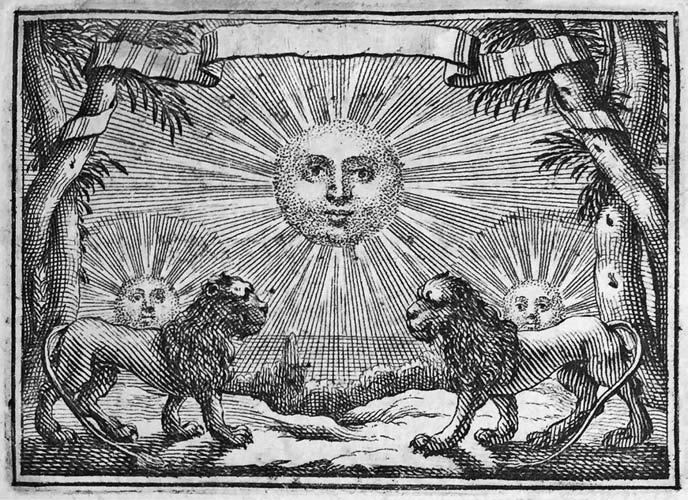
Chardin then proceeds to identify the uncanny similarity between the French and Persian royal insignias: “The Sun is the Emblem of great Kings: Everyone knows that the entire body of the Sun is the device of our great Monarch, and all that have visited Persia . . . . cannot ignore that the Sun rising behind a Lion is the hieroglyphic of the Princes who reign.”3 Chardin’s book, in fact, opens his dedication to the king of France with an illustration of the combined crests. In the print (see Figure I.1), a large sun sits in the center, symbolizing Louis XIV; it is flanked on either side by a lion with a rising sun behind it, representing the Safavid Empire. The emblem of the sun linked the Safavids and Bourbons. When Mohammad Reza Beg, the Persian ambassador to France in 1715, paraded through the Paris streets, his entourage proudly carried the Safavid flag, with its lion-and-sun symbol. Prints of the Beg’s parade illustrated this flag, and the Safavid motif’s relation to France’s Sun King would not be lost on its viewers. Once Chardin established the connection between the two monarchies, he moved between praise for the Persian shah and the Safavid government and criticism of them, setting Persia up as a model of comparison or “mirror” for France. Montesquieu, again, in his Persian Letters of 1721 would use Persia to reflect on France.
Except for a handful of travelers such as Chardin, missionaries, and a few diplomats, France and the Safavid Empire had relatively little contact throughout the seventeenth century. Yet Chardin was not alone in his strong comparison of France and Persia. Missionaries had noted affinities in the early seventeenth century. By the dawn of Louis XIV’s personal reign in 1661, Persians had become central to the crown’s image when Charles Le Brun,
Figure I.1 Louis XIV, the French “Sun King,” is represented by the large sun in the center. The lion and sun, symbolic of the Persian Safavid Empire, sit on each side. Louis XIV often performed as Apollo the Sun God in his ballets. The Safavid symbol’s origins can be traced to ancient Mesopotamia. The William Andrews Clark Memorial Library, University of California, Los Angeles
the royal painter, chose them to illustrate the crown’s virtues in his painting, “The Queens of Persia at the Feet of Alexander.” Just as the Sun King’s reign opened with Le Brun’s allusions to Persia, it closed with another momentous occasion linking the two monarchies: Louis XIV’s final act of grandeur was the reception of the Persian ambassador to France in 1715. At the meeting, Louis XIV echoed Chardin’s image of similar monarchy as he sat on the throne borrowing luxurious effects of the shah’s court.
In the seventeenth century Frenchmen drew parallels between themselves and Persians that helped them analyze their own kingdom. The Persian Mirror illuminates our understanding of early modern France by revealing how France defined itself in relation to Persia. It shows how the French developed a distorted vision of Persia, one shaped by the aspirations of missionaries, travelers, courtiers, diplomats, and the Sun King himself.
This long French preoccupation with Persia explains why the Enlightenment author Montesquieu, like other French philosophes, would have selected Persia as a way to think about the issues confronting ancien régime France. Previous studies of Montesquieu focus on his 1721 Persian Letters as a starting point for his critique of French monarchy and society. However, a long history predated Montesquieu’s use of Persia as a mirror of France. An investigation of the cultural, intellectual, and political context that shaped the French imagination of Persia transforms our understanding of
the period before the Persian Letters. Moreover, the examination of the distinctive role Persia played in molding French identity is key to considering new approaches to early modern East-West relations.
Seventeenth-century France and Persia were connected through diplomatic contacts, images, material objects, and texts, which together laid the basis for an imagined comparison.4 “Connected histories” and new global histories shed light on historical topics through an approach that transcends national borders.5 Through these methods, we learn how people, information, merchandise, artistic techniques, and myths flow across political and cultural boundaries.6 Yet in our turn toward global topics, we may forget the role that national concerns, ambitions, and tastes play in understanding crosscultural encounters and their resulting representations.7
The pages that follow describe intersections between France and Persia spearheaded through efforts of the French state to collect Oriental manuscripts, establish trade agreements, and bolster the image of Louis XIV through diplomatic spectacles. In turn, the Persian Empire itself played a role in French conceptions of Persia by sending an ambassador to Versailles to negotiate an unlikely alliance. The relationship between France and Persia illuminates how the French perceived a foreign nation and themselves.8 A national history with global dimensions offers an alternative vantage point from which to survey interactions between East and West as well as Bourbon France itself.9
Early Modern Representations of the East
Scholars have long tried to understand how western European countries formed ideas about a foreign country or the exotic.10 Most influential has been Edward Said’s idea of Orientalism, which, broadly speaking, examines how Western countries have constructed a distorted image of the Orient, often bound up with colonial domination. For the early modern period, it has become clear that while some facets of Said’s theory of Orientalism hold true, many do not. In the seventeenth century, the French constructed a Persia largely based on their image of France itself. To the extent that their knowledge of Persia was distorted and self-referential, it confirms Said’s theory. Yet representations of the Orient in the early modern period are not necessarily tied to imperial projects.11
In early modern French relations with Persia, the power/knowledge dynamic is at play, but power is directed toward domestic statecraft. Jean-Baptiste Colbert, Louis XIV’s chief minister, collected information on Persia for the royal library as part of his program to build the French state.12 He sponsored the travels of young scholars to learn Persian, including François Pétis de la Croix, who became an eminent interpreter of Persian, translated diplomatic documents and numerous manuscripts, and wrote the popular One Thousand and One Days.
Studies of economics, military technology, and culture have changed our assumptions about the perceived superiority of Europeans over Asians in the early modern period. For European states such as France, military subjugation of Asians was in most cases beyond reach. Louis XIV regarded Persia as a worthy competitor, especially when it came to monarchical splendor. Seventeenth-century French state servants and scholars often compared Bourbon France to Safavid Persia, and they found as much to admire as to
denigrate. Whereas some modern scholars see the study of the exotic as solely negative, a means of marginalizing the “other,” seventeenth-century French writers used the exotic to connect themselves to Persians. Frenchmen saw in Persia a version of themselves that revealed their own strengths and weaknesses.
European representations of the Orient can be understood through texts, diplomatic encounters, and material culture. Sanjay Subrahmanyam, Nicolas Dew, Michele Longino, Madeleine Dobie, Ina Baghdiantz McCabe, Nabil Matar, and Faith Beasley are only a handful of scholars among many who have uncovered novel approaches to exchanges between Europe and the East.13 The case study in this book shows how Frenchmen created an image of Persia that evolved over the course of the seventeenth century. Ideas of the Orient emerged to match French interests, tastes, and politics, and had an impact on French identity.
Foremost, the connections between France and Persia question the way the Orient in the early modern period has been treated as a monolithic entity. The focus on Persia in seventeenth-century France seeks to tease out differences between Asian countries in European representations. Scholars have recently shown the complexity of representations of the Orient during the early modern period.14 Yet most studies on early modern French contacts with the East continue to conflate Asian countries—for instance, the Ottoman Empire and Persia.15 The Franco-Persian case uncovers different possible layers of meaning in literature, art, diplomatic exchanges, and material culture through which the French formed a particular vision of Persia that clearly distinguished it from other countries in Asia.
On the flip side, the French association with Persia counters the view of a monolithic Occident. The seventeenth-century French image of Persia developed in tandem with changes in politics, society, and even material culture peculiar to France. French ties to Persia could not have been reproduced by another European country.16
The Mirror
Designating Persia as an “other” does not convey the complexities of the image of Persia for the French. Instead, the mirror, defined as a model of comparison that connected foreign places, is a metaphor that better conveys the nuances of the relationship. As the case of Persia shows, Asian countries invited an intricate set of comparisons in early modern Europe that could present different mirrors, sometimes positive and at other times negative, both real and imaginary for their individual viewers.
The Persian mirror was not static but changed over time. It also did not necessarily reflect the same image for all Frenchmen.17 Furthermore, it was a distorting mirror, offering a reflection of Persia that varied based on the identity of the viewer, the viewer’s use of it, and the circumstances of the particular moment. For instance, Jean Chardin, the French Huguenot traveler, and the Baron de Breteuil, a courtier who served as the introducteur des ambassadeurs for the Persian ambassador in 1715, shared certain notions that Persia was similar to France in monarchy, politesse, and luxury; at the same time, the two men recognized that Persia was different from France socially, religiously, and politically. These similarities and differences could be positive or negative—for example, the notion of luxury was both a source of French pride and a target for criticism.
And while Chardin used knowledge of Persia to criticize French politics and customs, Breteuil wielded his information to defend court protocol and prestige against the demands of the Persian ambassador. French individuals, in other words, developed different representations of Persia based on their personal or professional experience.
In the seventeenth century, the French sometimes compared themselves to another Middle Eastern power: the Ottoman Empire. Yet Persia served a different function in the French imagination than the Ottomans did. Frenchmen interacted more frequently and therefore were more familiar with the Ottoman Empire than with the more distant Persian Safavid Empire. Since the sixteenth century, the French monarchy had diplomatic ties and shared an intermittent alliance with the Ottomans against their mutual enemy the Hapsburgs.18 The French knew comparatively little about Persia and could envision the world they wanted. The remoteness of the relationship between the French and the Safavids allowed for fabrication, exaggeration, and an imagined sense of kinship, and it suggests the possibility of a different kind of relationship between Asian and European countries.
As noted, the French of the seventeenth century invented a Persia that corresponded to their own political and cultural circumstances. Persia thus provided a foil by which the French could both criticize their own monarchy and define French identity. Discussions of Persia especially mirrored debates over French luxury and despotism. French writers used the relationship with Persia, like the relationship with the Ottoman Empire, to criticize facets of French society. However, the French also saw Persia as a country that, like France, was a center of culture, civility, and sophistication. Just as in France, the Persian court was a place of refined manners and practices. The Persian mirror reflected the savoir vivre of the French court, a special kinship that is not present in the Turkish case.
For seventeenth-century Frenchmen, images of Persia abounded with similarities to France. And while, as we have seen, many of these similarities were imagined in the service of various aims, actual parallels did exist. For example, when in 1708 Pierre-Victor Michel, a French diplomat, visited the Persian court, he admired the Safavid dynasty’s mirrored hall and the shah’s glittering diamond-studded suit. Seven years later, Louis XIV, wearing his own spectacular suit embedded with diamonds, greeted Mohammad Reza Beg, the visiting Persian ambassador, in his own Hall of Mirrors. And both the Safavid and Bourbon monarchs expressed their power and favors through rituals, ceremonies, and proximity to the king.19 This shared love of monarchical pomp and precedence especially shone during diplomatic meetings between France and Persia. French courtiers and ambassadors were quick to draw upon this similarity during negotiations and used it to shape their relationship to Persia.
Physical diplomatic contacts made similarities and differences between France and Persia particularly apparent. Art historians have emphasized the importance of the study of works of art and artifacts involved in diplomatic contacts.20 Embassies resulted not just in writings on Persia but also in illustrated prints and consumer goods, which deserve more scholarly attention to understand their effect on the conception of the exotic.21 This volume’s analysis of the material culture surrounding the 1715 visit of Mohammad Reza Beg to Louis XIV’s court illustrates the tensions inherent in defining the exotic. Frenchmen’s decisions about what was “Persian,” or foreign, and what was “French” were affected by shifts in politics and also by shifts in the public’s tastes and interests over the course of the seventeenth century. The analysis of prints depicting
Mohammad Reza Beg shows how artists styled him as exotic but, at the same time, familiarized him as French through his clothing and material goods. The images of Mohammad Reza Beg blurred the lines between what was considered Persian and what was considered French.
In the end, diplomacy between France and Persia had little political and economic impact, and treaties between the two countries were never seriously followed up by Louis XIV or the Safavids. Nevertheless, diplomacy did have lasting effects on French notions of Persia and on French identity. Diplomatic contacts reveal how the French both distinguished themselves from a far-off place and linked themselves to that place.22 Particular diplomatic contexts shaped different versions of Persia for Frenchmen. Examinations of embassies between France and Persia reveal that diplomatic actors tried to overcome barriers and find commonalities that not only facilitated negotiation but also shaped French understanding of Persia and, above all, itself. Even if the result of embassies was not always political success, diplomatic encounters provided watershed moments in the evolution of French identity.
The seventeenth-century relationship between France and Persia, told here, begins with descriptions of the Safavid Empire by missionaries who imagined that Shiite Persians were ripe for conversion to Christianity. Later, in the 1660s, Louis XIV’s finance minister, Jean-Baptiste Colbert, encouraged the study of Oriental languages, including Persian, and the translation of Oriental texts. A group of translators and scholars devoted to studying Persia came into existence in the course of the seventeenth century thanks to the patronage of the state. Some of these writers, such as Jean Chardin, drew affinities between France and Persia that fed a comparison of the two far-flung countries. For Chardin, the Persian court provided an instructional mirror for French elites.
French-language versions of Persian texts also reveal how France reinvented Persia to suit its own notions. Although labeled “translations,” seventeenth- and eighteenthcentury French Oriental texts were often loose adaptations, with many invented French elements or, in some cases complete fabrications. Du Ryer’s “translation” of the Persian classic The Rose Garden suggested to French readers that Persia, like France, stood out in civility and courteous behavior. Another example is Pétis de la Croix’s “translation” of the One Thousand and One Days. This book of fairy tales set in Persia claimed to be based on a Persian text, but in fact it was Pétis’s own creation, a French work more than an Oriental one. The stories presented a magical picture of Persia, an image that was sustained well into the eighteenth century by the popularity of the fairy tale in French elite circles. And in the visual arts, Charles Le Brun’s painting of Persian queens at Alexander’s feet invoked Persia in an allegory that highlighted the ideal princely virtues that Louis XIV wished to project.
France’s connection to Persia developed through diplomacy as well as through literature and painting. The descriptions of the French embassy to Persia in 1705 reveal the challenges that the ambassador Pierre-Victor Michel faced in navigating Persian political factions and in dealing with a French rival, a woman named Marie Petit. Michel’s memoirs outline his efforts to find common ground between France and Persia that might serve as the basis of a treaty concerning commercial and religious affairs.
Michel’s experience as a French diplomat in Persia can be examined in conjunction with the numerous examples of foreign diplomats in France, especially that of the Persian ambassador to France. The diplomatic visits from Ottoman, Muscovite, Siamese, and Moroccan ambassadors were handled differently than the more frequent diplomatic visits from European ambassadors. The visits of the Asian representatives produced many ceremonial difficulties but also generated tremendous curiosity in Asia, which Louis XIV used to his advantage. The crown took special care to turn the audiences with those ambassadors into spectacular events to promote the Bourbon monarchy.
The last magnificent display of Louis XIV’s reign, the visit of Mohammad Reza Beg in 1715, deserves special attention. Information concerning this event is abundant and can be found in prints, administrative documents, journal descriptions, and eyewitness testimony by, among others, the Duc de Saint- Simon, the famed courtier-memoirist. The most insightful source is the firsthand, behind-the-scenes account of this visit in the multivolume memoirs of Louis XIV’s introducteur des ambassadors, the Baron de Breteuil. Surprisingly, Breteuil was a culturally sensitive host. He prepared for the visit by contacting French scholars of Persia and reading travel literature. While this knowledge proved useful, it was not enough to manage the proud Persian, who upset French protocol and proved a demanding guest. Breteuil’s attempts to deal with the “culture clash” generated by the visit shows that conflict, in the end, arose out of conceptions in common between France and Persia.
The Beg’s visit left an abundant visual record. A host of engravings were struck at the time, proof that Parisians were curious about the visitor and eager to purchase prints of foreigners. The images emphasized the exotic and depicted the Beg as a curiosity. Yet at the same time the prints tempered his foreign qualities to make him recognizable and accessible to the French people. In the prints, the Beg also functioned as a symbol of Louis XIV’s power. The analysis of the images and material culture surrounding the Beg’s visit reveals the complex relationship between the exotic, French identity, and royal propaganda.
In the aftermath of the visit and the death of Louis XIV, Persia and the Beg took on new meaning under the succeeding French government. During the regency of Louis XV, comparisons between the French crown and Persia often highlighted the injustices of the monarchy, which were increasingly coming under attack in France. Fictional texts such as Amanzolide used the tale of Persia to discuss the tensions between civility and despotism in France.
News of the sudden fall of the Safavid Empire altered the Persian mirror. With the collapse, positive associations became harder to draw, and Persia could no longer serve as a flattering comparison to the French monarchy. Descriptions of the horrific siege of Isfahan in 1722 and the loss of power of the Safavid dynasty shocked Enlightenment authors such as Montesquieu and Voltaire, who grappled to explain the demise of a civilized, polite, luxurious empire akin to France and to consider the implications for France itself. In the wake of Persia’s collapse, the Persian mirror, once used to represent the brilliance of the Sun King’s France, more than ever highlighted the growing criticism of Bourbon rule.
1 Missionaries, Travelers, and the Case of Jean Chardin
France’s relationship to Persia can only be understood in the context of its ties to Persia’s rival, the Ottoman Empire. Official French foreign policy sought to counteract the power of the Hapsburgs and their allies.1 Since the Ottomans posed a threat to the Hapsburgs, the French sought an alliance with the Turkish power, while other European powers, such as Venice and the Hapsburg Empire, looked for allies against the Ottomans.2 While most of Catholic Europe looked for an opportunity to ally with Safavid Persia against the Ottomans, the French crown took little interest in Persia and remained loyal to the idea of an alliance with the sultan from the reign of Francis I through that of Louis XV.3 However, the dévots, French devout Catholics who were a marginalized group within France, objected to the politics of the French state and pushed for a pro-Catholic foreign policy that would ally with fellow Catholics, such as the Hapsburgs, and look to Persia for support against the Ottomans.4 This tension between the official policies of the French state and the campaign for anti-Turkish diplomacy by the dévots made France unique in its view of the Ottoman enemy, Persia.
Through the efforts of the Catholic parties, Frenchmen absorbed literature that portrayed Persia as tolerant toward Christians and even imagined the conversion of the Safavid Empire and its shah to Christianity. As contacts between France and Persia increased during the seventeenth century, missionaries and travelers began to compare and even liken Persia to France. Jean Chardin, the French merchant-traveler and authority on Persia, especially connected Persia to France, launching the Safavid Empire as a model for comparison for the Bourbon state.
Missionaries and Persia
Some of the first influential European contacts with Persia came through Catholic missionaries in the late sixteenth and early seventeenth centuries. In the Catholic imagination, Persia became a suitable ally for Christian states against the Ottomans. Catholics painted Persia as open to Christianity because it was an enemy of the Turks. Persians appeared more likely to move away from Islam and embrace Christianity due to their profession of Shiism and break from Sunnism. The Portuguese, who were the first to establish official missionaries and contacts in Persia, promoted this image. As early as
1509, the Portuguese governor in India, Afonso de Albuquerque, dreamed of an alliance with the Persian shah through which the Arab world would be divided between the Persians and Christian princes and Jerusalem would be free from Ottoman control.5
By the end of the fifteenth century, travelers distinguished between the Ottomans and Persians and intimated opportunities for Europeans in Persia.6 By the early sixteenth century, news of the establishment of a new Persian dynasty, the Safavids, opened European eyes to the possibility of an alliance with Persia. The charismatic leader of the Shiite Sufis, Ismail, from Ardabil in Azerbaijan, won the support of Turkish tribes and soon conquered all of the Persian Plateau. Ismail became the first shah of the Safavid Empire (1501–24), named after Sheikh Safi, an ancestor of Ismail and the founder of the Safaviyeh order.7 Conflicts with Persia’s Sunni neighbors, the Ottomans, ensued. Rumors in Europe even spread that Shah Ismail was in fact a Christian and that the Spanish Franciscans in the Holy Land had baptized him.8
The reign of Shah Abbas, ruler of the Safavid Empire from 1587 to 1629, opened doors to Europeans in Persia and further cultivated the image of Persia as a potential ally. He pursued a policy of religious tolerance to foster a diplomatic relationship with Christian Europe. The shah planned to strengthen the Persian Empire against Ottoman and Uzbek attacks and improve it economically through trade. The vast Ottoman Empire separated Europe from Persia and had left the Safavid Empire isolated from contacts with the West through the sixteenth century. Shah Abbas encouraged Christians to come to his recently constructed capital city, Isfahan, by allowing them to practice their faith and establish places of worship.9 The Augustinians, Dominicans, Carmelites, and Capuchins took advantage of the shah’s open attitude and established churches in the Persian capital in the early seventeenth century. The Jesuits were the last Catholic group to arrive in Isfahan, in 1653.10
The Portuguese established the first missions under Shah Abbas. In 1602, they sent three Augustinian missionaries, António de Gouveia, Jerónimo da Cruz, and Cristofero do Spirito Santo, to Isfahan. The shah gave them permission to construct a church and a convent. In turn, Abbas used his Portuguese visitors to establish European diplomatic contacts.11 In 1609, he sent António de Gouveia to the court of Philip III of Spain and to Pope Paul V in Rome to promote trade between the Safavid Empire and the joint crown of Spain and Portugal; thereby, de Gouveia became the first official European diplomat in Persia. However, his mission failed due to attacks on the Portuguese ports in Hormuz and Bahrain. The shah sought his arrest, and de Gouveia had to return to Europe. Shah Abbas requested a new diplomatic representative from the Portuguese, and they sent Don Garcia de Silva y Figueroa, whose endeavors at the Persian court also failed.12
At the same time, the pope made his bid for a coalition against the Turks and an alliance with Persia. The papacy hoped to return Ottoman lands to Christianity and unite the Christian churches there under the guidance of the Roman Church. Further, the Church wished to convert Armenians, members of the Greek Orthodox Church, and other Christian groups to Roman Catholicism, and they also hoped to convert Muslims. However, it could only accomplish this with a defeat of the Ottoman Empire, which necessitated a strong ally in the Ottoman region. In 1592, Pope Clement VIII sent a letter to Shah Abbas requesting him to join a Christian league against the Ottoman Empire. Shah Abbas responded to Rome’s invitation by sending ambassadors to negotiate an alliance against the Turks. He sent Sir Anthony Sherley, an Englishman, and
Hussain Ali Beg, a Persian, to Rome to obtain military aid for his battles against the Turks.13 Abbas also desired European artillery to fight the Ottomans, who had superior technology.14 The endeavors of Anthony Sherley and his brother Robert did not succeed in securing military aid for Persia but did foster closer relations between Persia and both Catholic and Protestant nations, including England.15
France’s diplomatic ties to the Ottoman Empire meant it had little incentive to pursue a relationship with the enemy of their Turkish ally, Persia. As a result, France’s interest in Persia was slower to develop than was the case with its European neighbors. While the Portuguese had regular contact with Persia through the sixteenth century, the English had unsuccessfully tried to set up a trade route to Persia through Russia.16 France, however, did not establish formal contact with Persia until the establishment of the first French Capuchin mission in 1628.17 The first informal contacts between France and Persia came through earlier Catholic missionaries, who desired to take advantage of Shah Abbas’s open policy and establish missions in Isfahan. The dévots, who did not agree with French foreign policy, supported these missionaries. This extreme Catholic group pushed for anti-Protestant policies, closer relations with Catholic powers, and a relationship with the Persians against the Turks.18
The ultra-Catholics reached the height of their power during the French Wars of Religion of the sixteenth century. Under Henri IV, their position waned, although they remained a strong minority voice as the following century progressed.19 They found royal protection under the two regencies of Marie de Medici and Anne of Austria but never managed to influence state foreign policy, which aimed at undermining France’s primary political opponent, the Hapsburg Empire.20 Although the missionaries and the dévots during the late sixteenth and early seventeenth centuries advocated for a Persian alliance, they were swimming against the political tide. France’s foreign policy objective since Francis I in the sixteenth century had been to gain ascendancy over the Hapsburgs. In the early seventeenth century under Louis XIII and his first minister, Cardinal Richelieu, it became clear that religion would play a role only in domestic policies, as the crown sought to remove Protestant strongholds within France that threatened the power of the crown.21 This definitively ended the dream of the dévots for a pro-Catholic foreign policy.22
However, from the late sixteenth to the early seventeenth century, when the dévots were still at the height of their power, they were receptive to literature from Catholic states, such as Rome and Portugal, that spread the image of Persia as an ally of Christianity and called for an alliance with Persia against the Ottoman Empire. One example is the work of António de Gouveia, who promoted the Catholic missionary movement in Persia and spread knowledge of Shah Abbas’s court through his writings. Translated into French in 1609, his work Histoire orientale des grans procès de l’église catholique . . . brought the successful missionary work of the Augustinians to the attention of the French Catholics.23 In his text, de Gouveia encouraged the view of Shah Abbas as friendly to Christianity and even repeated the rumor that the shah had been baptized.24
News about Persia also spread through pamphlets that carried a Catholic, antiTurkish, pro-Persian message advocating an allegiance with Persia in a crusading spirit against the Ottomans.25 Although some of these pamphlets were originally written in French, many take ideas from, or are translations of, earlier missionary writings from
Rome and Portugal, as well as English texts that pointed to Shah Abbas’s embrace of Christianity to promote trade relations.26 The French pamphlets show that Europeans interpreted Shah Abbas’s overtures to Christian Europe as an actual conversion opportunity, and they deemed Persia a suitable partner for missionaries and merchants.27 And while the shah’s overtures became meshed with the religious divisions within Europe— Europeans could interpret the open attitude of the shah toward Christianity as a partiality for either Protestantism or Catholicism, depending on the context—the French pamphlets, most of which are by unknown authors, reveal the French ultra-Catholic party’s embrace of the image of Persian Shiites as an ally against the Ottomans. They unequivocally contain ideas professed by French missionaries and the powerful dévot party and can be viewed as propaganda to critique the French state’s foreign and domestic policies. Because the leaflets send the same message, this chapter will focus on five examples to avoid repetition.28
An anonymous leaflet printed in Paris, titled La Grande Defaite des Turcs par Saich Ismaël Sophi Roy de Perse, l’an 1580. Et la cause de la haine, & guerres d’entre ces deux grands Monarques (The grand defeat of the Turks by Shah Ismail, king of Persia, in the year 1580 and the cause of hatred and war between these two great monarchies), parallels the sentiments of the French missionaries and the dévots at the time, who sympathized with Persia against the Ottomans; therefore, the authorship of this pamphlet can be traced to this extreme Catholic party. The pamphlet, however, shows that the French ultra-Catholics viewed the wars between the Turks and the Persians through the lens of their own religious struggles. It begins with a description of the cause of the wars between the two Muslim empires, noting, “This almost immortal war that is going on between the Turks and the Persians . . . is rooted in the diversity of opinion of the interpreters of the Koran and its ill-fated law.”29 It recognizes that the Turks view the Persians as heretics: “The Turks believe that they follow the true religion and the Persians (regarded as heretics by the others) claim to have the true intelligence of the will of Mohammad their false prophet.”30 This French reading of the religious conflicts mirrors the situation in France between the Protestants and the Catholics: the Persians resemble the Protestants in that they are viewed as heretics who broke away from Ottoman Islam.31 While the Persians’ role as heretics (akin to that of the Protestants) may initially seem an obstacle to an alliance with the Catholics, it was this very role that positioned them as possible allies.
According to the pamphlets, the idea of an alliance with Persia seemed impossible while the French nobility was embroiled in its own religious civil war. One pamphlet from 1586 is titled Discours, De la bataille Nouvellement Perdue par le Turc, Contre le Roy de Perse: Ou il y a une remonstrance, à la Noblesse de la Chrestienté, & principalement a celle de France, pour l’inciter, de laisser leur guerre civile, affin de liuvrer au Turc ennemy Capital des Chrestiens (Discourse of the battle recently lost by the Turk against the king of Persia: where there is a remonstrance to the Christian nobility, and principally to those of France, to incite them to end their civil war in order to deliver the capital of the Christians from the Turkish enemy).32 This pamphlet is dedicated to Henri de Lorraine, the Duc de Guise and leader of the French Catholic League, who fought to prevent the Protestant heir to the throne, Henry of Navarre, from becoming king.33 The leaflet calls upon the French nobility to stop fighting one another, end their civil war, and unite against the Turks to free Jerusalem.34 The pamphlet makes a plea to the French to seize
the opportunity presented by the military strength of Persia and its wars against the Ottomans. The leaflet notes that the Persians “defeated a great number of the Turkish army” in the last battle fought, advertising the strength of Persia as a potential ally.35
Another anonymous pamphlet found at the Bibliothèque Nationale, La Nouvelle conversion du roy du Perse avec la defaite de deux cens mil Turcs après sa conversion (The recent conversion of the king of Persia with the defeat of two hundred thousand Turks after his conversion), printed in Angers in 1606, relates the rise of the Safavid Empire and names its ancestral leaders who had diplomatic relations with Europe. It tells the story of Ismail, the first king of the Safavid Empire, and the rise of Shiism in Persia: “The first who made a change to the Coran was a certain Ismail, who came from the race of Uzun Hasan.”36 This refers to Ismail’s Turkish ancestor Uzun Hasan, who had contact with Europeans in the fifteenth century. Uzun Hasan ruled the Aqquyunlu Empire, formed by Turkmen clans. During his rule, from 1453 to 1478, the Aqquyunlu and its allies sent a diplomatic mission to European courts for an alliance against the Ottoman sultan.37 In 1463, Venice proposed an alliance with Uzun Hasan, who responded by sending an ambassador to Venice and to the Vatican to coordinate an attack on the Ottomans.38
This pamphlet also shows that the struggles between the French Catholics and the Protestants continued to color the ultra-Catholic party’s interpretation of Ottoman Sunnism and Safavid Shiism into the seventeenth century.39 “It was he [Ismail] himself who caused the revolt of the empire of Persians and who invaded it in approximately the year [1500] because he entered it deceitfully while pretending to announce and preach the law of Mohammad, saying that until now it has been misunderstood.”40 Ismail appears as a heretic who moved away from the mainstream Islam of the Ottomans, spreading a new religion; the analogy with the Protestants is clear.
The pamphlet notes that Ismail seized many areas of the Persian kingdom and convinced his subjects to take up this new religion, which he learned from a Turkish monk, reputed as a great prophet himself.41 The pamphlet describes how Ismail made his subjects convert to his new branch of Islam through an edict, and also how he “acquired this great empire.”42 Further, he took the name of Sofi, a title his successors would hold, which signified an interpreter of God.43 Finally, Ismail emblematized his new religion by the wearing of a red cap: “After, he took off the white turban . . . that the Turks wore, and made them wear a red turban that one could only wear in Turkey if one came from the race of Mohammad.”44
The pamphlet further explains how Ismail’s actions enraged the Ottomans: “This new change in religion engendered such a great hate among the infidels, that the Turks judged that God found it more gratifying when they exterminated one Persian than when they killed seventy Christians.”45 In the French accounts, the religious differences between the Ottomans and the Persians inspired great hatred and violence, paralleling contemporary French struggles over religion.
The French description of the Persians’ allegiance to their faith, Shiism, also deserves examination. The Persians, who broke away from Sunni Islam, just as the Protestants split from Catholicism, are portrayed as wavering in their religion—and thus more likely to convert to Christianity than other Muslims. The pamphlet notes that Ismail was on the verge of rejecting Islam in favor of the Christian faith: “Ismael, or this new Sofi, was at this time on the brink of embracing the faith of our Good Lord Jesus Christ, and of destroying entirely the faith of the false prophet, if the emperor Maximilian, King Louis
XII, and the Venetians had wanted to enter into a league with him.”46 The pamphlet sends the message that the Christian princes missed their opportunity to convert the wavering ruler of Persia by not entering into an alliance with him at the right moment. The pamphlet ends by suggesting that the contemporary king of Persia and successor to Ismail, Shah Abbas, desires to convert himself and his entire kingdom to Catholicism. In fact, the pamphlet fabricates the story that Abbas sent Pope Clement VIII an embassy in the year 1601 to “enter into a confederation against the Emperor of the Turks.”47 It also claims that Christianity “touched the heart of the Great Sofi to cause him to have himself baptized along with all his people.”48 The pamphlet fantasizes that the dream of converting Muslims was partially realized when Ismail decided that his entire kingdom should be baptized, and ousted all those who refused. The king of Persia, “his heart already touched and pushed by a secret goad from the heavens, commanded all his princes and officers to assemble.”49 He revealed his plan “to baptize them, telling them that in addition to the health of their souls, through this plan, they could ruin the empire of the Turks, their enemy, and join with the Christian princes.”50
According to the leaflet, there was no objection to the Persian king’s plan, since most of the princes “were already Christian in their souls and the others were afraid of displeasing their prince.”51 According to the anonymous author, Ismail and his people were baptized and the cross was placed in all his provinces, and the king “commanded all those who did not wish to be baptized to leave his empire.”52 This text conjures the fantasy of a Christian Persia. Above all, the pamphlet emphasizes that the Persians, now free from Ottoman Islam, are ready for Christianity, sending the message that conversion efforts in Persia are not in vain and missionaries should receive support.
Another anonymous leaflet further advertised the overtures made by Shah Abbas toward Christian princes. In L’Entree Solemnelle Faicte a Rome Aux Ambassadeurs du Roy de Perse, le cinquiesme Auril, 1601. Envoyez à N. S. Pere le Pape pour contracter ligue contre le Turc, & moyenner le reduction de son Royaume à la Religion Catholique apostolique & Romaine (The solemn entry in Rome for the ambassadors of the king of Persia, the 5th of April 1601. Sent to our Holy Father the pope to form a league against the Turk and to Roman Catholicize his realm), the shah makes promises to allow Catholics to practice in Persia and build churches if they will aid him in the war with the Turks.53 In this account the shah appears open to Christianity, encouraging the prospect of his own conversion:
In this court [Rome], there are two ambassadors of the King of Persia, who came to encourage the Christians to go to war advisedly with the Turks, promised to contribute an army of one hundred fifty thousand horses and sixty thousand foot soldiers, and wished that we promise him not to make any peace treaty with the Turks. . . . He offers as well free commerce to Christians in his kingdoms and permission to build churches and convents and to exercise their religion freely, giving good hope to the prospect of joining the union of the Catholic faith.54
Thirty years later, another pamphlet, Relation de ce qui s’est passé entre les armees du grand Seigneur & du Roy du Perse . . . (A relation of what transpired between the armies of the Grand Seigneur [Ottoman sultan] and the king of Persia . . .) from 1631 shows that