Electrocardiography of Arrhythmias-A Comprehensive Review-A Companion to Cardiac Electrophysiology, 2e (Mar 8, 2021)_(032368050X)_(Elsevier).pdf Mithilesh Kumar Das
Oxford University Press is a department of the University of Oxford. It furthers the University’s objective of excellence in research, scholarship, and education by publishing worldwide. Oxford is a registered trade mark of Oxford University Press in the UK and certain other countries.
Published in the United States of America by Oxford University Press 198 Madison Avenue, New York, NY 10016, United States of America.
All rights reserved. No part of this publication may be reproduced, stored in a retrieval system, or transmitted, in any form or by any means, without the prior permission in writing of Oxford University Press, or as expressly permitted by law, by license, or under terms agreed with the appropriate reproduction rights organization. Inquiries concerning reproduction outside the scope of the above should be sent to the Rights Department, Oxford University Press, at the address above.
You must not circulate this work in any other form and you must impose this same condition on any acquirer.
Library of Congress Cataloging-in-Publication Data Names: Penry, S. Elizabeth, author.
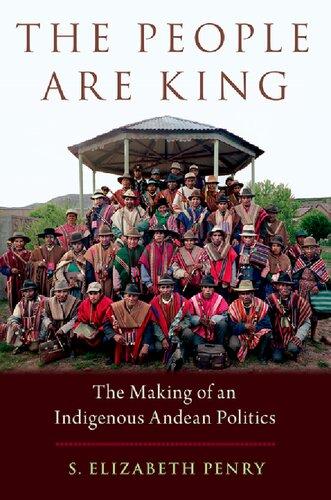
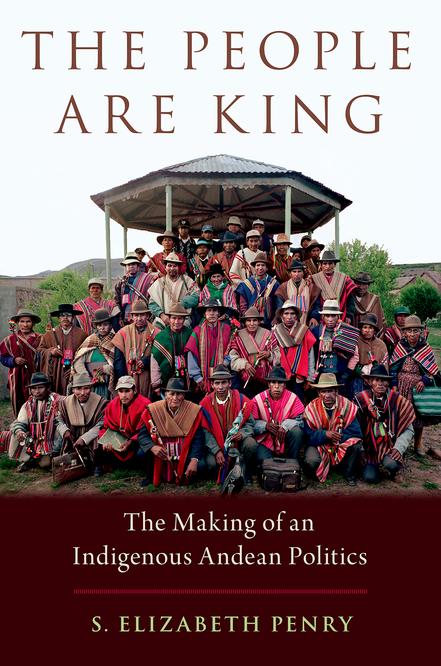
Title: The people are king : the making of an indigenous Andean politics / S. Elizabeth Penry. Description: New York : Oxford University Press, 2019. | Summary: “The People Are King traces the transformation of Andean communities under Inca and Spanish rule. The sixteenth century Spanish resettlement policy, known as Reducción was pivotal to this transformation. Modeled on the Spanish ideal of República (self-government within planned towns) and shared sovereignty with their monarch, Spaniards in the Viceroyalty of Peru forced Andeans into resettlement towns. Andeans turned the tables on forced resettlement by making the towns their own, and the center of their social, political, and religious lives. Andeans made a coherent life for themselves in a complex process of ethnogenesis that blended preconquest ways of life (the ayllu) with the imposed institutions of town life and Christian religious practices. Within these towns, Andeans claimed the right to self-government, and increasingly regarded their native lords, the caciques, as tyrants. A series of microhistorical accounts in these repúblicas reveals that Andeans believed that commoner people, collectively called the común, could rule themselves. With both Andean and Spanish antecedents, this political philosophy of radical democracy was key to the Great Rebellion of the late eighteenth-century. Rather than focusing on well-known leaders such as Tupac Amaru, the book demonstrates through commoner rebels’ holographic letters that it was commoner Andean people who made the late eighteenth-century a revolutionary moment by asserting their rights to self-government. In the final chapter the book follows the commoner-lead towns of the Andes from the era of independence into the present day of the Plurinational State of Bolivia. Ayllu, Reducción, ethnogenesis, Peru, Bolivia, cacique, Tupac Amaru, comunero, revolution, microhistory”—Provided by publisher.
Identifiers: LCCN 2019015748 | ISBN 9780195161618 (paperback) | ISBN 9780195161601 (hardback) | ISBN 9780190073923 (epub) | ISBN 9780199721900 (updf)
Subjects: LCSH: Indians of South America—Relocation—Andes Region. | Indians of South America— Andes Region—Politics and government. | Indians of South America—Cultural assimilation— Andes region. | Power (Social sciences)—Andes Region—History—18th century. | Andes Region— Politics and government—18th century. | Spain—Colonies—America—Administration.
LC record available at https://lccn.loc.gov/2019015748
1 3 5 7 9 8 6 4 2
Paperback printed by Marquis, Canada
Hardback printed by Bridgeport National Bindery, Inc., United States of America
To the people of the markas and ayllus of the Andes, the heirs of the comuneros
CONTENTS
Acknowledgments ix
A Note on Terminology xiii
Introduction: The Genesis of an Andean Christianity and Politics 1
PART I INCA AND EARLY SPANISH PERU
1. Inca and Asanaqi in Qullasuyu 29
2. Spanish República and Inca Tyranny 43
3. Resettlement: Spaniards Found New Towns for “Indians” 53
PART II THE ANDEANIZATION OF SPANISH INSTITUTIONS AND CHRISTIANITY
4. Andeans Found Their Own Towns: The Andeanization of Reducción 79
5. Cofradía and Cabildo in the Eighteenth Century: The Merger of Andean Religiosity and Town Leadership 101
6. Rational Bourbons and Radical Comuneros: Civil Practices That Shape Towns 124
7. Comunero Politics and the King’s Justice: The Común Takes Moral Action 145
8. A Lettered Revolution: A Brotherhood of Communities 167
Conclusion. The Resilience of the Común and Its Legacy 200
Notes 221 Bibliography 261 Index 281
ACKNOWLEDGMENTS
With a project that has taken so many years to complete, I have incurred many debts and have many, many people to thank. At the University of Miami where I wrote the dissertation that this book is based on, Noble David Cook, Guido Ruggiero, and the late Robert Levine were helpful in the foundation of the project. Above all, this has been a labor of years spent in archives and poring over documents, and the much too infrequent moments of sharing tidbits and interpretive angles with other researchers at those archives and in conferences.
First, I would like to thank the wonderful staff at the Archivo y Biblioteca Nacionales de Bolivia (ABNB). I was fortunate to begin my research with the late Don Gunnar Mendoza, director extraordinario. His over forty years of dedication to cataloging and organization of the archive made the ABNB one of the finest archives in the world. The late Dr. Josep Barnadas, who followed Don Gunnar as director of the ABNB and was the first director of the Archivo y Biblioteca Arquidiocesanos de Sucre (ABAS) was also instrumental in guiding my research. Archivists Sra. Judith Terrán, formerly associate director of the ABNB and the late Doña Anita Forenza were generous with their time and great expertise. They and other members of the ABNB staff were my surrogate family during my time in Sucre. Fellow researchers in the ABNB, especially Ana María Presta, Emma Sordo, and Heather Thiessen-Reilly (whose time in Sucre overlapped with much of mine) and others who worked for briefer times, including David Garrett, the late Catherine Julien, Karen Powers, Cynthia Radding, and the late Ward Stavig, all made the sometimes lonely experience of archival research more rewarding. Especially appreciated were the monthly potluck dinners sponsored by anthropologist Verónica Cereceda and her late husband Gabriel Martínez which brought together historians and anthropologists working in the Sucre area for dinner and some very animated discussions.
Over many research trips in twenty years of working in the Archivo General de Indias in Seville, the archival staff have been incredibly helpful. Living in Seville
is a privilege, and I was fortunate that in my first time there I was introduced to Andalusian life in the Santa Cruz neighborhood home of Doña Carmen Moguel, who treated me as her daughter. It was also while living in Spain that I realized how many things that I took to be “Andean” had multiple roots.
I have also been fortunate to have been able to spend a significant amount of time in Buenos Aires working in the Archivo General de la Nación. Helpful archivists, staff, and friends there made my time more productive than it otherwise would have been. I wish to thank Ana María Presta of the Universidad de Buenos Aires, and her team of researchers, especially María Carolina Jurado, for their help.
The Archivo del Arzobispal de Lima houses a wealth of documentation on local indigenous communities, and I was privileged to work there during research trips to Peru. Director of the archive, Srta. Laura Gutiérrez, was especially helpful. I also thank Pedro Guibovich, who introduced me to Srta. Gutiérrez. His great knowledge of Peruvian archives facilitated my research there.
During a year at the John Carter Brown Library as a National Endowment for the Humanities Fellow I completed early drafts of chapters 4 and 5. I have fond memories of the weekly lunches and talks given by other fellows. Former Director Norman Fiering was helpful in many ways during my time in Providence.
There are many other individuals, institutions, and archives that have helped me in countless ways as I worked to understand the lives of the comuneros. A special thanks to Cristina Bubba who provided me with a copy of the document of the foundation of Tolapampa. Anthropologist Krista van Vleet graciously allowed me to accompany her to her field site near Pocoata where we witnessed a tinku battle. I also thank three wonderful historians, now retired, who offered support and encouragement at key moments in my work, historians of Spain Richard Kagan and the late Helen Nader, and historian of Mexico William B. Taylor. Although the list is far from complete, among the many others who provided help in myriad ways through informal chats, or comments at conferences as fellow panelists or audience members, or who shared their work with me are Kenneth Andrien, Jovita Baber, Kathryn Burns, Juan Cobo, Natalie Cobo, Noble David Cook, Mercedes del Rio, Simon Ditchfield, Lee Douglas, María Elisa Fernández, David Garrett, Karen Graubart, Pedro Guibovich, the late Olivia Harris, Tamar Herzog, Alex Huerta, Christine Hunefeldt, Amy Huras, Marta Irurozqui, the late Sabine MacCormack, Jane Mangan, Kenneth Mills, Scarlett O’Phelan Godoy, Karen Powers, Tristan Platt, Susan Ramírez, Joanne Rappaport, Silvia Rivera Cusicanqui, Gilles Riviére, Stuart Rockefeller, Rafael Sánchez, Lynn Sikkink, Irene Silverblatt, Karen Spalding, Patricia Spyer, and Sinclair Thomson.
A special thank you to Akira Saito of the National Museum of Ethnology (Osaka, Japan) who invited me to participate in two long-term interdisciplinary
projects reevaluating reducciones. My deep appreciation goes to the team of international researchers involved in the reducción projects, especially Tetsuya Amino, John Charles, Alejandro Diez Hurtado, Luis Miguel Glave, Clara López Beltrán, Jeremy Mumford, Stella Nair, Parker VanValkenburgh, Steve Wernke, Guillermo Wilde, Marina Zuloaga, and Paula Zagalsky. Discussions over many years with these historians, anthropologists, art historians, and archaeologists working on the reducciones projects were key in helping me to refine my own interpretation of resettlement.
My colleagues in the history department at Fordham University have been very supportive, above all Kirsten Swinth, who as chair was instrumental in bringing the book to publication. Colleagues, especially Barbara Mundy and the late Chris Schmidt-Nowara, in the Latin American and Latino Studies Institute at Fordham have provided a warm intellectual home. I also wish to thank the students, both graduates and undergraduates at Fordham University, from whom I have learned so much.
I have had extraordinarily generous support for research and writing from many sources. I thank the Wenner-Gren Foundation for Anthropological Research (Grant # 5634); Fulbright/IIE; the National Endowment for the Humanities Dissertation Fellowship; the Albert J. Beveridge Grant for Research in the Western Hemisphere from the American Historical Association; the Lewis Hanke Award from the Conference on Latin American History; the Advanced Study Center and International Institute at the University of Michigan; the Fulbright Senior Research Award; the National Endowment for the Humanities Senior Scholar Fellowship at the John Carter Brown Library; the Program for Cultural Cooperation between Spain’s Ministry for Culture and US Universities; the Short-Term Research Grant from the International Seminar on the History of the Atlantic World at Harvard University; and the National Ethnology Museum, Osaka, Japan. Also thank you to the generous offers of fellowships that I had to decline due to time conflicts: the Charlotte W. Newcombe Doctoral Dissertation Fellowship of the Woodrow Wilson National Fellowship Foundation, and the American Fellowship from The American Association of University Women. Thank you to Fordham University for Faculty Fellowships (2002–2003; 2009–2010) and Faculty Research Grants (1998, 2000, 2001, 2015), for time away from teaching obligations and funds to travel to archives.
Chapter 8 contains material originally published in Colonial Lives: Documents on Latin American History, 1550–1850 edited by Richard Boyer and Geoffrey Spurling, 2000, and has been reproduced by permission of Oxford University Press. An early version of parts of chapter 4 was published in The Council of Trent: Reform and Controversy in Europe and Beyond, (1545–1700): Vol.3 Between Artists and Adventurers, edited by Wim François and Violet Soen, 2018, and has been reproduced here by permission of Vandenhoeck and Ruprecht
GmbH & Co.KG, Göttingen, Germany. Chapter 4 is a revised version originally published in Reducciones: la concentración forzada de las poblaciónes indígenas en el Virreinato del Perú, edited by Akira Saito and Claudia Rosas Lauro, 2017, and has been reproduced here by permission of Fondo Editorial de la Pontificia Universidad Católica del Perú and the National Museum of Ethnology, Osaka, Japan. Portions of the introduction have been revised from material originally published in Collective Identities, Public Spheres and Political Order: Latin American Dynamics edited by Luis Roniger and Tamar Herzog, 2000, and have been reproduced here by permission of Sussex Academic Press.
Susan Ferber, my editor at Oxford University Press, has been extraordinarily supportive every step of the way and, fortunately for me, never gave up on this very long-term project. Her encouragement and editing made this book much stronger.
Much of the final draft was completed in Toro, Spain. I thank my dear friends there for their support. Evenings spent in Javier and Frans’s patio, or on the plaza with Marisol, Fernando, and Tony or Consuelo and Ata are priceless and a much-appreciated distraction from work. Nicola, who welcomed us into her home as family, is truly a force of nature.
Finally, I thank Tom Abercrombie, my partner in life, my soul’s companion, and fellow Andeanist, whose own work is an inspiration to me. Tom generously offered his time and expertise to read and comment on many drafts of this account of the comuneros. To my great sorrow Tom did not live to see the final product of our many conversations, yet I feel his presence on every page. I also thank Tom’s students who enveloped me in their love as an extended family in the painful time after his death, especially Ulla Berg, Lee Douglas, Sandra Rozental, Augusta Thomson, and Alex Huerta who graciously proofread parts of the final manuscript. The remaining faults and shortcomings in the book are my own.
A NOTE ON TERMINOLOGY
In The People are King, I use the terms “Andeans,” “indigenous people,” and “Indian” to refer to the native people of the Andes, aware that, to varying degrees, these are problematic terms. Creole Spaniards born in the Andes, were also “Andeans.” “Indigenous people,” a nineteenth-century term, is anachronistic and when invented carried a racial stigma as a “scientific” means of categorizing humans. Today “Indian” in Spanish (indio) is an insult term, and was sometimes used as such in the colonial period.
Other terms are also problematic. Some scholars have used “natural,” a common colonial term, but it carried the same racial significance as “Indian” for Spaniards. Other scholars have used runa , (Quechua: “human” or “people”) but there is little evidence that colonial or contemporary Andeans referred to themselves as runa or the Aymara language equivalent, jaqi . Since the Bolivian agrarian reforms of the mid- twentieth century, which sought to efface racial terms, campesino , or “peasant” has been the preferred term. Although campesino is plainly a euphemism for Indian, it is unquestionably a more polite term. However, it suggests an economic interpretation that is anachronistic; Andeans were not uniformly subsistence farmers, and Spaniards (or Creoles) were not always targeted as economically oppressive colonizers. Just as importantly, contemporary indigenous people of Bolivia object to the term because it also diminishes their “identity as a ‘people.’ ” 1
Given all these problems with the typical nomenclature, and although some Andeans are now proudly reclaiming the name Indian for themselves, in the chapters where I treat the early colonial period, I will generally use the terms
1 Albó, “Our Identity,” 24.
“Andean” or “indigenous.” When writing from a Spanish colonial viewpoint, I will use the term “Indian.” For the chapters dealing with the eighteenth century, where I can be certain that words deriving from “común” were used with frequency, I opt to use the only terminology that derives from words I know eighteenth-century rebels used for themselves: comunero.
The People Are King
Introduction
The Genesis of an Andean Christianity and Politics
The night of October 14, 1774 was clear and cold, and the moon had risen early, illuminating San Pedro de Condocondo, an indigenous town nuzzled against the mountains on the edge of the high Andean plain in the Spanish viceroyalty of Peru. Gregorio Llanquipacha, cacique (native hereditary lord) and governor for the Spanish crown of the town of Condocondo and its vast municipal jurisdiction, had retired early for the evening. Llanquipacha had premonitions of trouble, for he had asked a half dozen men of the village to sleep at his home that night.1 Two seemingly separate events had led Llanquipacha to take this precaution. That afternoon a dispute had erupted into a bloody fight between two elected town leaders. Llanquipacha’s relations with these men, Julián Taquimalco but especially Ignacio Rudolfo Choque, were as strained as their relationship with each other. The previous year town authorities had accused Llanquipacha of stealing tax money.2 However, as governor and highest authority of Condocondo, Llanquipacha would be compelled to intervene the next day to settle the dispute between the two men, whatever its nature.3
Another incident that afternoon had also left Llanquipacha with a sense of disquiet. Father Joseph Espejo, the widely respected priest of Condocondo who had served the parish for over thirty years, had abruptly left on muleback to move to the neighboring town of Toledo. Llanquipacha had a history of conflict with the priest, but he also knew that the townspeople revered Father Espejo. Llanquipacha openly suspected that the priest had conspired with elected town officers to accuse him of stealing tax money, and so townspeople blamed Llaquipacha for forcing Father Espejo to leave. Whatever the case, a large group of townspeople had walked with the priest to the nearest town on his journey, crying and begging him to stay with them in Condocondo. Only a few months earlier the assistant priest, who had served as schoolmaster for the parish for sixteen years, had likewise left Condocondo; his move, too, was widely understood
by townspeople as being made at the demand of Llanquipacha. These events led governor Gregorio Llanquipacha to be on his guard.
Vicente Nina, a twenty-six-year-old Condocondo resident, was one of those whom Llanquipacha had asked to sleep in his house that night and who later gave sworn testimony to Spanish officials of what ensued. Sometime during the night, Nina said, he was awakened by the sound of a large rock hitting the door.
Jumping from [my] bed [I] put [my] body against the door to support it from the inside. However, they continued to pound the doors furiously and they forced them open. Immediately, [I] recognized Cruz Yana, Damaso Yana and Ignacio Rudolfo Choque [current and former town councilmen] . . . and many more people, men, women, young boys, so that they were more than a 100 people gathered together in a mad rush, entering the room with different weapons, stones, whips and clubs.4
At that point someone struck Nina in the chest with a club, knocking him to the floor. Struggling to get up, he saw women carrying flaming straw torches approach Llanquipacha, who, already bloodied, stood next to his bed clad only in his night shirt, waving his sword. “Get out Indians!” Llanquipacha screamed at his attackers, using the insulting term Spaniards applied to native Andeans. With that the already enraged crowd surged toward him, and inflicted blows to his head and body. Nina testified that one of the women, María Lenis, the wife of Damaso Yana, took her weaving tool (a wichuña, a sharpened llama bone) and repeatedly stabbed Gregorio Llanquipacha in the ear until the point broke off in his brain. Meanwhile, others in the mob looted Llanquipacha’s office, taking his papers. Then, with the vigilantes screaming “Let’s go kill the other thief!” they ran to the home of Andrés Llanquipacha, Gregorio’s brother and his second in command, who met them with gun in hand and managed to shoot one of the mob before they murdered him.
In the days immediately following the murders, a large contingent from Condocondo traveled the 70-odd miles of mountain roads and llama trails to the seat of the regional Spanish colonial government in La Plata to present their version of events. News of the murders arrived via mail before they did. When Spanish officials realized that more than thirty people from Condocondo were waiting inside the patio of the courthouse to plead their case, they quickly had them arrested and jailed. The Condocondo prisoners offered an explanation of the crimes that the Spaniards neither expected nor believed: the murders came about in response to what they reckoned to be the forced ouster of their priest, Father Espejo. Moreover, they contended, because the común of Condocondo as a whole had killed the indigenous cacique and his second in command, it was impossible to assess any individual blame. When pressured by incredulous
Spanish officials to offer a fuller explanation for the murders, one representative to the Condocondo town council, an accused leader of the mob, declared:
It is a crime to take justice into [my] own hands, and to reprimand [my] cacique or Governor, whom [I] well know ought to be obeyed if he is good, but not if he is bad and his works unjust, as was the case with the deceased. [Former town councilmen] Ignacio Rudolfo Choque and Damián Lenis taught this doctrine. And also [I] know that if the común ordered [me] to do one thing and [my] Governor another, [I] ought to obey the común. 5
What was the común? This book is an effort to answer that question. In Spanish language dictionaries of the era, común can refer to common property, common pastures, or more importantly the collective people of a place. Put simply, común was the Andean voice of popular sovereignty and an exclusionary term that referred solely to the common people, putting the hereditary nobility outside the bounds of their community. But the people of the Andes had not always used the term común and had not always opposed rule by their hereditary lords. The Andean community that prized commoner rule over their caciques had come into being over the course of the long colonial period, from the late sixteenth to the late eighteenth centuries. * * *
The People Are King is a history of how ordinary Andeans in the Audiencia of Charcas, a vast region of the viceroyalty of Peru, came to define themselves by reinterpreting colonial institutions and ideas, and their efforts to govern themselves and acquire full rights during the nearly three hundred years that they were subjects of the Spanish Crown. It demonstrates how Andeans moved from a politics of hereditary nobility, the caciques, to a hybrid form of participatory democracy, with the town council at its heart, that had roots in both the Andean and Spanish worlds. Andeans publicly articulated a political philosophy that not only questioned their political, economic and social subordination to their own hereditary lords, but presented a thesis on popular sovereignty that would threaten the structures of Spanish colonial domination. This new politics was undergirded by Andean ideas about a redistributive justice in which mountains, fields, and animals participated, as well as Christian and Spanish notions of natural rights and God-given sovereignty.
Spaniards imposed new kinds of town life, commoner-led town councils, and Christian patron saints and festivals in the sixteenth century, but these impositions did not replace pre-Conquest Andean social forms. Indeed, at the center of these new ideas about legitimacy and governance was the ayllu, the
Andean kin and landholding group that predated both the Spaniards and the Incas and that during the colonial period (1532–1825) came to be linked to Andean towns through the town council and saints’ celebrations. Andeans selectively appropriated Spanish religious and political impositions and combined them with pre-Conquest understandings of reciprocal and moral obligations, and justice in a complex synthesis that Andeans called the común. Then, in the eighteenth century, Andean communities across the viceroyalty of Peru took collective action, deposing and, in some cases, executing abusive hereditary lords, all the while claiming they were operating in the name of the común. No one person could be named responsible for these political coups: the “común de Indios” had acted. In the 1780s as revolutionary uprisings accelerated in the Audiencia of Charcas (modern Bolivia), this political discourse spread through the mails, with indigenous communities writing back and forth to their “Amantíssimos hermanos comunes,” their “Beloved Común Brothers.”6
What led to this shift in how Andeans understood their political community? Where did this strong sense of collective life come from? To answer these questions, The People Are King offers an overview of the pre- Conquest Andes and sixteenth-century Spanish ways, and then turns to an in-depth examination of how grass roots-level political power was exercised by colonized Andeans in two broad historical periods, times that roughly bookend the long colonial era. The first runs from the late 1500s to roughly 1650, the era of the Spanish invasion and creation of the early colony, when Spain was governed by the Hapsburg dynasty. The second runs roughly from 1750 to the end of Spanish hegemony in 1825, frequently referred to as the era of Bourbon Reforms because of economic and political changes introduced by the Bourbon dynasty, which acceded to the Spanish throne in 1700. Close analysis of these two time periods reveals the changes that occurred over the long colonial era in Andean politics.
The setting for this study is the Audiencia of Charcas (see Figure I.1), an administrative unit of the Spanish Indies, with its capital in La Plata (today Sucre, Bolivia). Until 1776, the Audiencia of Charcas was part of the viceroyalty of Peru, headquartered in Lima; after that it was incorporated into the new viceroyalty of Rio de la Plata, with Buenos Aires as its capital. Within the Audiencia, the primary focus is the territory of what were two pre-Conquest federations, what Spaniards called “nations,” the Killaka, of which Condocondo was part, and its neighboring federation, the Karanqa. The contiguous core areas of these two federations covered approximately thirty thousand square miles in the highland Andes, an area roughly three times the size of the state of Massachusetts. The average altitude for the core region is over twelve thousand feet, with mountain peaks reaching twenty thousand feet above sea level. It is a cold, windswept, and dry plain of austere beauty. In this highland area, people have herded llamas and
alpacas and cultivated the highland crops of potatoes and quinoa for thousands of years. The full extension of the territories of Killaka and Karanqa, taking in their “discontinuous but interconnected” outlier communities in distant, productive valleys to the east, where maize and coca were grown, and oases near the Pacific Ocean in the west, reached eighty thousand square miles, roughly the size of the states of Kansas or Utah.7 Within that region, the study concentrates on five highland towns, refounded with Christian patron saints in the late sixteenth
Figure I.1 Map of Study Area. Map by Erin Greb Cartography.
and early seventeenth centuries: San Pedro de Condocondo, Santa Bárbara de Culta, Todos Santos de Tomave, Santiago de Tolapampa, and San Pedro de Totora. It also treats distant valley outliers belonging to the Killaka and Karanqa to which highland people made annual trips with llama caravans for foodstuffs. These valley settlements, nearer to the Audiencia capital of La Plata and within the core territory of the Qaraqara people, particularly the town of San Juan de Pocoata, were convenient resting places when traveling to the capital on community business.
From the sixteenth century re-foundation of these Andean communities until the independence of this region from the Spanish Empire, representatives from these towns regularly traveled to the Audiencia capital to meet with lawyers and put forward the aims of their communities. When they did so, they went with a particular understanding of the nature of the human collectivity they represented, and of its rights, based on both in their historical domination over lands they possessed and the sovereignty granted to them as people. Such ideas were grounded in Spanish law as well as in Andean moral frameworks.
The Spanish civilizational project, which had at its heart the creation of selfgoverning resettlement towns for indigenous people, resulted from the Spanish Crown’s recognition of Indians’ essential humanity and fundamental right of dominium, that is, “ownership” of themselves and their property, and by extension the right to govern themselves.8 These plans for indigenous self-government were forged during an era when the nature of sovereignty was understood as something granted by God to “the people.” These ideas had played out in Spain shortly before the invasion of the Inca empire in Castile’s 1520–1521 Revolution of the Communities. But going beyond the idea of the sovereignty of the people was the proposition that the people had a right to take sovereignty back when their leaders became tyrants. Spaniards used these ideas to justify their overthrow of the Inca “tyrants.” Then, these political ideas were made explicit to indigenous Andeans when Spaniards moved them into resettlement towns designed to “civilize” Andeans. This book reveals how Andeans came to understand such things and to adopt the institutions imposed on them by colonizing Spaniards to speak back to power and to serve their own ends.
Andean Community Life and the Introduction of Reducciones
Conquered by the Inca around 1460, less than one hundred years before the Spanish invasion, the region of this study was the most densely populated and wealthiest of the Inca Empire. It was also home to the village that would
become San Pedro de Condocondo, where, just over three hundred years later, the común would kill Gregorio Llanquipacha. Condocondo was part of a collectivity known as Asanaqi, which in turn was part of the Killaka federation. The Asanaqi population was concentrated in the high plateau of the Andes mountains, living in small, scattered villages to the east of Lake Poopó. The Incas were attracted to the region by the large llama herds of the Asanaqi and neighboring “nations,” the fertile and irrigable fields of the Cochabamba valley, and the enormous silver deposits of the region.
The Inca conquest brought benefits to the Asanaqi: peace prevailed across the region, and their sophisticated agricultural methods and transport meant that there was a surplus of food in the enormous state warehouses along the Inca highway system that could be distributed to those in need. Incas imposed their imperial religion of sun and moon worship on all, but their subject populations were allowed to keep local gods. The Asanaqi had limited say in their political life; they were ruled by a hereditary elite at local, regional and empire-wide levels whose right to rule was grounded in their descent from deities. Like their neighboring ethnic groups and larger federations, the Asanaqi held property collectively; the only privately held property were the large estates of the Inca elite. The Incas were enormously successful in funneling wealth upward from local commoners to the ruling elite. Asanaqi commoners, for instance, were drafted by the Inca to grow maize in the Inca fields of Cochabamba, work in the Inca silver mines of Porco, and help build and maintain the highways on which llama caravans moved their goods to regional storehouses, and from there to the Inca capital in Cuzco. In 1532, when Spaniards entered the territory that would become the viceroyalty of Peru, they recognized this efficient transfer of wealth that sustained the Inca nobility and hoped to channel it into their own coffers to ennoble themselves and enrich their king.
While the Spanish admired the wealth generated by the Inca Empire, they believed that Andeans lacked the essentials of civilized life: Christianity, of course, but almost as importantly, town life. The Inca Empire did hold some impressive cities, but aside from the capital Cuzco (and a few others), they were primarily administrative centers staffed with temporary laborers. With the Spanish invasion, many of the temporary workers fled, returning to their home villages. For Spaniards, neither these administrative centers, nor the small villages in which most Andeans lived, were adequate to foster the kind of intensive interpersonal and collective sociality that Spaniards identified as necessary for civilized life. For Spaniards, the town was the república, the basis of civilized life; the municipality guaranteed rights to its citizens and brought about proper moral, religious, and political behavior. There was no national guarantee of rights and citizenship; all political life was vested in the town-republic. The most basic political identification for Spaniards was their natal town, their patria chica, or
little fatherland. In the Americas, then, Spaniards immediately founded towns for themselves in order to legitimate their dominion.9
Under Viceroy Francisco de Toledo, who arrived in Peru in 1569, Spaniards insisted on resettling Andeans from their small hamlets into new Spanishstyle towns in order to introduce them to life in a town-based republic and the institutions of church and state that supported that life. Known as reducciones, from the verb reducir, to reduce, these resettlement towns would concentrate the population into towns with a uniform grid-pattern design that Spaniards believed would help bring civilization to the people of the Americas. In this, Spaniards were inspired by the plazas and squares of Roman architect Vitrivius, whose firstcentury work was first published in Spanish in the late fifteenth century, and that of the Renaissance Italian humanist and architect Alberti, in imaging the ideal city design. The new resettlement towns, informed by Renaissance ideals that considered the social effects of buildings and city design, were an early modern attempt at social engineering. From the Spanish viewpoint, without the orderly pattern of life, the buena policía, or “good customs,” of the Spanish-styled municipality, the people of the Andes were estranged from civilization and Christian life. Orders governing the layout of towns issued by King Philip II called for a large plaza and straight streets that would give physical expression to buena policía. The straight streets and rectangular plazas of resettlement towns would make indigenous Andeans into “true men.”10
With the creation of resettlement towns, Spaniards renewed and intensified efforts to convert Andeans to Christianity, a requirement for buena policía. Each resettlement town was named for a saint or other Christian advocation, and a lay religious brotherhood to celebrate the saint was established for Andeans. Condocondo, which had existed under the Inca empire, was “founded” as a reducción town under Viceroy Toledo as San Pedro de Condocondo, with Saint Peter as its patron. Asanaqi people, like other Andeans, quickly took up and adapted these brotherhoods dedicated to the saints. The brotherhoods, called cofradías, clothed the image of their patron saint in elaborate textiles and, on his feast day, marched in processions through their town, carrying their saint’s image on their shoulders on platforms laden with flowers and candles. Before the end of the sixteenth century, church officials sought to limit the numbers of indigenous founded cofradías, fearing that they could be a cover for a return to pre-Conquest religious practices. Despite Spanish efforts to halt their numbers, the new town based cofradías flourished, helping to give meaning to and create ties of sentiment to the new reducción towns. Certain aspects of Christianity, in particular the focus on the brotherhood between fellow members of cofradías who collectively served the saints, along with generosity, humility, and charity, but also Christianity’s sacrificial metaphors linking persons and domesticated animals, were well-attuned for the emergence of a commoner-collective
political ethics in communities like San Pedro de Condocondo whose livelihood depended on herd animals.
Building on Spanish concepts of God-given, community based popular sovereignty, Viceroy Toledo also created a model for self-government within the resettlement towns, the elected town council or cabildo that was to share authority with the hereditary cacique. This concept of divided rule was clearly modeled on the Spanish pattern of dual government by aristocrats and plebeians. The town councils were made up mainly of annually elected taxpaying plebeians; the nobility was specifically restricted from monopolizing offices. Town council officers would be charged with helping collect tax payments and recruiting labor, in addition to governing. Toledo’s orders also compelled them to assist the priest in conversion and teaching Christian doctrine. As town council members led celebrations for the town’s saints, they publicly engaged in actions that underscored their legitimation by tapping into pre-Conquest roots where leaders’ political duties and their leadership of religious practices had been inseparable.
Within a short time, Andeans adapted the imposed civil and religious institutions and practices and made these resettlement towns their own. More than that, commoner Andeans began to create new towns modeled on the Spanish resettlement towns. In many cases, Andeans were returning to their preConquest hamlets, but re-founding them with town councils and the celebration of the saints, now melded with Andean social forms. Asanaqi people originally settled by Viceroy Toledo in Condocondo would create three new towns in the early seventeenth century, carved out of Condo’s territory. Sometimes appealing to the local archbishop, other times going to the viceroy, the highest civil official in the Americas, commoner Andeans sought legal permission for their new towns. With these new town foundations, indigenous social and political life was transformed from systems of hereditary kingdoms and chiefdoms to town based communities, with a concomitant reworking of concepts of legitimate political leadership from rule by hereditary lords to self-government by elected town councils made up of commoners.11 Andeans created a sophisticated hybrid of pre-Conquest and Spanish political and religious ideas and practices that came together to form the común.
From Caciques to the Común
While caciques continued to be regarded as the traditional authority in Andean towns, by the eighteenth century, and earlier in some cases, they were being supplanted by another set of authorities, the town council, known as the cabildo.12 Toledan ordinances describe in detail the process for electing cabildo officers,