TheOxford ReferenceGuide toLexicalFunctional Grammar
MARYDALRYMPLE
JOHNJ.LOWE LOUISEMYCOCK
GreatClarendonStreet,Oxford, ox26dp, UnitedKingdom
OxfordUniversityPressisadepartmentoftheUniversityofOxford. ItfurtherstheUniversity’sobjectiveofexcellenceinresearch,scholarship, andeducationbypublishingworldwide.Oxfordisaregisteredtrademarkof OxfordUniversityPressintheUKandincertainothercountries ©MaryDalrymple,JohnJ.Lowe,andLouiseMycock 2019
Themoralrightsoftheauthorshavebeenasserted
FirstEditionpublishedin 2019
Impression: 1
Allrightsreserved.Nopartofthispublicationmaybereproduced,storedin aretrievalsystem,ortransmitted,inanyformorbyanymeans,withoutthe priorpermissioninwritingofOxfordUniversityPress,orasexpresslypermitted bylaw,bylicenceorundertermsagreedwiththeappropriatereprographics rightsorganization.Enquiriesconcerningreproductionoutsidethescopeofthe aboveshouldbesenttotheRightsDepartment,OxfordUniversityPress,atthe addressabove
Youmustnotcirculatethisworkinanyotherform andyoumustimposethissameconditiononanyacquirer
PublishedintheUnitedStatesofAmericabyOxfordUniversityPress 198 MadisonAvenue,NewYork,NY 10016,UnitedStatesofAmerica
BritishLibraryCataloguinginPublicationData
Dataavailable
LibraryofCongressControlNumber: 2018965641
ISBN 978–0–19–873330–0 Printedandboundby CPIGroup(UK)Ltd,Croydon,CR04YY
LinkstothirdpartywebsitesareprovidedbyOxfordingoodfaithand forinformationonly.Oxforddisclaimsanyresponsibilityforthematerials containedinanythirdpartywebsitereferencedinthiswork.
Preface
Thisbookisbasedonwork rstpublishedbyDalrymple(2001).Somechapters fromthatbookappearinthisone,althoughtheentiretexthasbeenoverhauled andrevised.SomeofthechaptersinPartIIofthisbookareentirelynew.Allinall, thisisnotaneweditionofthe 2001 book,butanewbookwhichincludespartsof thepreviousone.
Asusual,theLFGcommunityhasbeenincrediblysupportiveofourwork inproducingthisbook,andwearegratefultothemanypeoplewhoprovided comments,feedback,andsupport.WebeginbyconveyingourthankstoLuke Carr,JamieFindlay,andMiltiadisKokkonidisforhelpfulcommentsonDalrymple (2001).
Wewouldliketosingleoutthreeheroicindividualsforspecialpraisefortheir dedicationandthoroughnessinreadingandcommentingonmultipleversionsof thesecondeditionasittookshape.BozhilHristov,AdamPrzepiórkowski,and AmandaThomaseachreadthroughseveralversionsoftheentirebook,giving valuablecommentsandfeedbackeachtime.Wehavebeenparticularlyimpressed byAdam’sabilitytodetectproblemsfromthemicroscopictothemacroscopiclevel. Wehopetheywillfeelthatthe nalversionofthebookre ectstheirhardwork andthehelpfulcommentsandsuggestionsthattheymade.
Wearealsogratefultothoseofourreaderswhocommentedindetailonentire sectionsofthebook.FordetailedandhelpfulcommentsonthechaptersinPartI, wearegratefultoAshAsudeh,AlexBiswas,KenKahn,LeslieLee,JoeyLovestrand, AgnieszkaPatejuk,LiselotteSnijders,andMartinTrpovski.ForcommentsonPart II,wearegratefultoAshAsudeh,AlexBiswas,LeslieLee,andJoeyLovestrand.
Wearealsogratefultoreaderswhoprovidedcommentsonindividualchapters ofthebook.InPartI:MiriamButtforChapter 1 (Backgroundandtheoretical assumptions);IWayanArka,AgnieszkaPatejuk,andIdaToivonenforChapter 2 (Functionalstructure);IdaToivonenforChapter 3 (Constituentstructure);Oleg BelyaevandRonKaplanforChapter 5 (Describingsyntacticstructures);andRon KaplanforparticularlydetailedandhelpfulcommentsonChapter 6 (Syntactic relationsandsyntacticconstraints).InPartII:MiriamButtforChapter 7 (Beyond c-structureandf-structure:linguisticrepresentationsandrelations)andChapter 9 (Argumentstructureandmappingtheory);TinaBögel,StephenJones,and AditiLahiriforChapter 11 (Prosodicstructure);andMiriamButt,LouisaSadler, andAndySpencerforChapter 12 (Theinterfacetomorphology).InPartIII: DougArnold,AshAsudeh,andAndyMorrisonforChapter 13 (Modi cation); DagHaugforChapter 14 (Anaphora)andChapter 15 (Functionalandanaphoric control);DougArnold,OlegBelyaev,DagHaug,JohnLamping,LouisaSadler, andVijaySaraswatforChapter 16 (Coordination);DougArnold,AshAsudeh, RonKaplan,andLouisaSadlerforChapter 17 (Long-distancedependencies);Ash Asudeh,AaronBroadwell,KerstiBörjars,RonKaplan,PeterSells,NigelVincent, andAndyWayforChapter 18 (Relatedresearchthreadsandnewdirections);and
LiselotteSnijdersforthebibliography.Thisbookhasbeenlonginthemaking,and weapologizeifwehaveomittedreferencetoanyonewhosecommentswehave bene tedfrombutwhoisnotmentionedhere.
Foradministrativesupport,wegratefullyacknowledgetheFacultyofLinguistics,Philology,andPhoneticsattheUniversityofOxford.WethankJuliaSteerand VickiSunterofOUPforveryhelpfuladvice,andfortheirpatienceoverthelong courseofthegestationofthisbook.
MaryDalrympleisgratefultothefollowingorganizationsforresearchsupport: 2011–14:MinisteriodeCienciaeInnovación,GobiernodeEspaña:“Thesyntax andinformationstructureofunboundeddependencies,”principalinvestigator Prof.AlexandreAlsina,UniversitatPompeuFabra,Barcelona); 2012:British AcademySmallGrant“PluralsemanticsinAustronesian”; 2012–13:Leverhulme ResearchFellowship“Plurals:MorphologyandSemantics,”RF-2012-295; 2017–2018:CentreforAdvancedStudyattheNorwegianAcademyofScience andLetters,“SynSem:FromFormtoMeaning—IntegratingLinguisticsand Computing,”principalinvestigatorsProf.DagHaugandProf.StephanOepen. SheisalsogratefultoKenKahnforallkindsofsupport,andtohersisterMatty forbeinganinspirationasawriter.
JohnLoweisgratefultothefollowingorganizationsforresearchsupport: 2012–15:LeverhulmeEarlyCareerFellowship(ECF-2012-081); 2013–14:Ministeriode CienciaeInnovación,GobiernodeEspaña:“Thesyntaxandinformationstructure ofunboundeddependencies,”principalinvestigatorProf.AlexandreAlsina,UniversitatPompeuFabra,Barcelona); 2016:JillHartFundforIndo-IranianPhilology, UniversityofOxford.Heisalsogratefultohisfamilyforbeingasourceofstrength andinspiration,especiallytoHelen,Henry,andWilfred.
LouiseMycockisgratefultothefollowingforresearchsupport: 2013–14:MinisteriodeCienciaeInnovación,GobiernodeEspaña:“Thesyntaxandinformationstructureofunboundeddependencies,”principalinvestigatorProf.Alexandre Alsina,UniversitatPompeuFabra,Barcelona).Sheisalsogratefultoherfamily fortheirongoingsupport:herhusbandChiLunPang,hergrandparentsIrisand Brian,herdadDave,hersistersKathrynandFionaandtheirpartners,hernephew Charlie,andherniecesLilyandMaisie.
Backgroundandtheoretical assumptions
LexicalFunctionalGrammar(LFG)isanontransformationaltheoryoflinguistic structurewhichassumesthatlanguageisbestdescribedandmodeledbyparallel structuresrepresentingdi erentfacetsoflinguisticorganizationandinformation, relatedtooneanotherbymeansoffunctionalconstraints.
1.1Historicalroots
Thetheoryhaditsbeginningsinthe 1970s,atatimeofsomeupheavalinthetheory ofgenerativegrammar.Earlytransformationalgrammarproposedtheexistenceof “kernelsentences”(Chomsky 1957),basicsimpledeclarativeclausesgeneratedby asimplephrasestructuregrammar.Morecomplexsentenceswerederivedfrom thesesimplesentencesbyvarioustransformations:forexample,passivesentences werederivedfromtheiractivecounterpartsbymeansofapassivetransformation, describedintermsofpropertiesofthephrasestructuresoftheinputandoutput sentences.Thein uenceofthetransformationalviewpersiststothepresentday intheprocess-orientedterminologycommonlyusedforvariousgrammatical phenomena:wh-movement,passivization,dativeshi ,andsoon.
Intime,however,thelackofgeneralityoftheearlytransformationalapproach begantobeseenasproblematic.Itwasnoteasytoseehowtheveryspeci ctransformationsthathadbeenproposedcouldcapturecrosslinguisticgeneralizations. Forexample,asdiscussedbyPerlmutterandPostal(1977),thereseemedtobe nowaytogiveauniformstatementoftransformationalrulesacrosslanguages withdi erentphrasestructuraldescriptionsforobviouslysimilartransformations suchasPassive.Itbecameincreasinglyclearthatthegeneralizationsunderlying manytransformationalrulesdependnotonphrasestructurecon guration,but ontraditionalabstractsyntacticconceptssuchassubject,object,andcomplement. Ifrulescouldbestatedintermsoftheseabstractconcepts,acrosslinguistically uniformstatementofgeneralizationsaboutsuchruleswouldemerge.
Atthesametime,itwasnotedthatalargeclassoftransformationswere “structure-preserving”(Emonds 1976: 3):
Atransformationaloperationisstructure-preservingifitmoves,copies,orinsertsanodeC intosomepositionwhereCcanbeotherwisegeneratedbythegrammar.
TheOxfordReferenceGuidetoLexicalFunctionalGrammar.Firstedition.MaryDalrymple,JohnJ.Lowe,andLouise Mycock.©MaryDalrymple,JohnJ.Lowe,andLouiseMycock 2019.Firstpublished 2019 byOxfordUniversityPress.
Theexistingtransformationalframeworkwouldnothaveledtothepredictionthat transformationswouldoperateinthisway.Sincetransformationswerenotconstrainedastotheoutputstructuretheyproduced,itwassurprisingthattheywould producestructureslikethosethatthebasicgrammarcouldotherwisegenerate. Thisimportant ndinghadwide-reachingimplications:thebasicphrasestructure oflanguagesisinvariant,andtheapplicationofparticulartransformationsdoes notalterthisbasicphrasestructure.
Whyshouldsomanytransformationshavebeenstructure-preservinginthis sense?Bresnan(1978)madethekeyobservation:allstructure-preservingtransformationscanbereformulatedas lexicalredundancyrules.Accordingtothisview, operationsontheabstractsyntacticargumentstructureofalexicalitemproduce anewsyntacticargumentstructure,withasurfaceformthatisrealizedinan expectedwaybyabasicphrasestructuregrammar.Thisallowedanabstractand uniformcrosslinguisticcharacterizationofargumentalternationsliketheactivepassiverelation,whilealsoallowingforatheoryofcrosslinguisticsimilaritiesand di erencesinthephrasalexpressionofthedi erentalternations.
Withthis,theneedemergedforatheoryallowingsimultaneousexpression ofboththephrasalconstituencyofasentenceanditsmoreabstractfunctional syntacticorganization.TheformalinsightsleadingtothedevelopmentofLexicalFunctionalGrammararoseoriginallyfromtheworkofWoods(1970),who exploredmethodsforrepresentingthesurfaceconstituentstructureofasentence togetherwithmoreabstractsyntacticinformation.Buildingonthiswork,Kaplan (1975a,b, 1976)realizedthatplacingcertainconstraintsontherepresentationof abstractsyntacticstructureanditsrelationtosurfacephrasalstructurewould leadtoasimple,formallycoherent,andlinguisticallywell-motivatedgrammatical architecture.Basedontheseformalunderpinnings,therelationoftheabstract functionalsyntacticstructureofasentencetoitsphrasestructurecouldbefully explored.Moreinformationaboutthehistoricaldevelopmentofthetheoryis providedbyDalrympleetal.(1995a)andBresnanetal.(2016).
1.2“Lexical”and“Functional”
Thenameofthetheory,“LexicalFunctionalGrammar,”encodestwoimportant dimensionsalongwhichLFGdi ersfromothertheories.First,thetheoryis lexical andnottransformational:itstatesrelationsamongdi erentverbaldiathesesin thelexiconratherthanbymeansofsyntactictransformations.In 1978,whenthe theorywas rstproposed,thiswasafairlyradicalidea,butintheinterveningyears ithascometobemuchmorewidelyaccepted;itisafundamentalassumptionof CategorialGrammar(Moortgat 1988;Morrill 1994;Steedman 2001)aswellasof Head-DrivenPhraseStructureGrammar(PollardandSag 1994;Sagetal. 2003; Levine 2017),ConstructionGrammar(Kay 2002;BoasandSag 2012),Simpler Syntax(CulicoverandJackendo 2005),andsomeworksinthetransformational tradition(Grimshaw 1990).
Unlikesomeothertheoriesofsyntax,then,thelexiconisnotmerelyarepositoryforexceptions,aplaceinwhichsyntacticallyorsemanticallyexceptional
structureofthebook3
informationisrecorded.SinceLFGisalexicaltheory,regularitiesacrossclasses oflexicalitemsarepartoftheorganizationofarichlystructuredlexicon,and anarticulatedtheoryofcomplexlexicalstructureisassumed.Workonlexical issueshasbeenanimportantfocusofLFGfromthebeginning,andthisresearch continueswithworktobedescribedinthefollowingpages.
TheseconddimensionthatdistinguishesLexicalFunctionalGrammaristhatit is functional andnotcon gurational:abstractgrammaticalfunctionslikesubject andobjectarenotde nedintermsofphrasestructurecon gurationsorofsemanticorargumentstructurerelations,butareprimitivesofthetheory.LFGshares thisviewwithRelationalGrammar(PerlmutterandPostal 1977)andArcPair Grammar(JohnsonandPostal 1980),aswellaswithConstructionGrammar(Kay 2002;BoasandSag 2012)andSimplerSyntax(CulicoverandJackendo 2005).
LFGassumesthatfunctionalsyntacticconceptslikesubjectandobjectare relevantfortheanalysisofeverylanguage:thatthesamenotionsofabstract grammaticalfunctionsareatplayinthestructureofalllanguages,nomatterhow dissimilartheyseemonthesurface.Ofcourse,thisdoesnotimplythatthereareno syntacticdi erencesamonglanguages,oramongsentencesindi erentlanguages thathavesimilarmeanings;indeed,thestudyofabstractsyntacticstructurein di erentlanguagesisandhasalwaysbeenamajorfocusofthetheory.Justas thephrasestructureofdi erentlanguagesobeysthesamegeneralprinciples (forexample,inadherenceto X-bartheory;see§3.3.2),inthesamewaythe abstractsyntacticstructureoflanguagesobeysuniversalprinciplesoffunctional organizationanddrawsfromauniversallyavailablesetofpossibilities,butmay varyfromlanguagetolanguage.Inthissense,thefunctionalstructureoflanguage issaidtobe“universal.”
Inworkonthetheoryoflinkingbetweensemanticargumentsandsyntactic functions,similaritiesanddi erencesamonggrammaticalfunctionshavebeen closelyanalyzed,andnaturalclassesofgrammaticalfunctionshavebeenproposed. Toanalyzethesesimilarities,grammaticalfunctionslikesubjectandobjectare decomposedintomorebasicfeaturessuchas +restricted,asdescribedin§9 4 1 Onthisview,grammaticalfunctionsarenolongerthoughtofasatomic.Even giventhesedecompositions,however,thegrammaticalfunctionsofLFGremain theoreticalprimitives,inthattheyarenotderivedorde nedintermsofother linguisticnotionssuchasagenthoodorphrasalcon guration.
1.3Structureofthebook
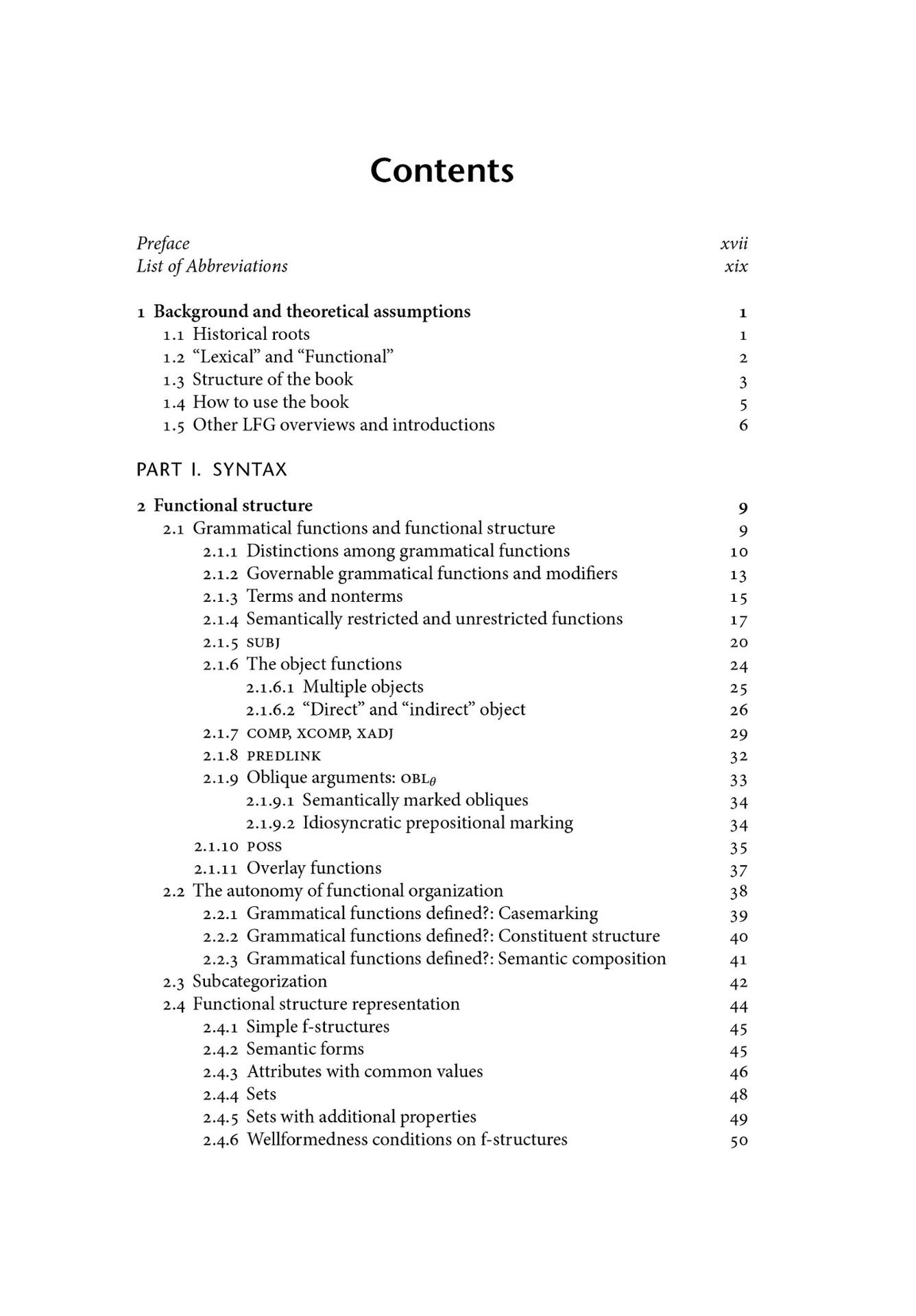
Thebookconsistsofthreeparts.Inthe rstpart,Chapter 2 (Functionalstructure), Chapter 3 (Constituentstructure),andChapter 4 (Syntacticcorrespondences) examinethetwosyntacticstructuresofLFG,the constituentstructure andthe functionalstructure,discussingthenatureofthelinguisticinformationtheyrepresent,theformalstructuresusedtorepresentthem,andtherelationbetween thetwostructures.Chapter 5 (Describingsyntacticstructures)andChapter 6 (Syntacticrelationsandsyntacticconstraints)outlinethe formalarchitecture of LFGandexplainhowtodescribeandconstraintheconstituentstructure,the
4backgroundandtheoreticalassumptions
functionalstructure,andtherelationbetweenthem.Aclearunderstandingofthe conceptspresentedinChapter 5 isessentialforthediscussionintherestofthe book.Chapter 6 isbestthoughtofasacompendiumofrelativelymoreadvanced formaltoolsandrelations,andmaybemostpro tablyusedasareferencein understandingtheanalysespresentedintherestofthebook.
ThesecondpartofthebookexploresnonsyntacticlevelsoflinguisticstructureandthemodulararchitectureofLFG.Chapter 7 (Beyondc-structureand f-structure:Linguisticrepresentationsandrelations)setsthesceneforourexplorationofotherlinguisticlevelsandtheirrelationtoconstituentstructureand functionalstructure,presentingLFG’s projectionarchitecture andoutlininghow di erentgrammaticallevelsarerelatedtooneanother.Chapter 8 (Meaningand semanticcomposition)introducestheLFGviewofthesyntax-semanticsinterface andsemanticrepresentation,accordingtowhichthemeaningofanutterance isdeterminedvialogicaldeductionfromasetofpremisesassociatedwiththe subpartsoftheutterance.Chapter 9 (Argumentstructureandmappingtheory) discussesthecontentandrepresentationof argumentstructure,itsrelationto syntax,anditsroleindeterminingthesyntacticfunctionsoftheargumentsofa predicate.Chapter 10 (Informationstructure)introducesthelevelof information structure,thestructuringofanutteranceincontext,andexplorestherelationof informationstructuretootherlinguisticlevels.Chapter 11 (Prosodicstructure) introducesthelevelof prosodicstructure,whichanalyzesthestringinparallelwith constituentstructure,butwithrespecttoprosodicunitsratherthanphrasalunits. Chapter 12 (Theinterfacetomorphology)discussestheplaceofmorphologyin thearchitectureofLFG,showinghowarealizationaltheoryofmorphologycanbe integratedinanLFGsetting.
Thethirdpartofthebookillustratestheconceptsofthetheorymoreexplicitly bypresentingaseriesofsketchesofthesyntaxandsemanticsofarangeofrepresentativelinguisticphenomena.Wepresentthesyntacticaspectsoftheanalyses separatelyfromthesemanticaspects,soreaderswhoarenotinterestedinformal semanticanalysisshouldstillbeabletopro tfromthesyntacticdiscussioninthese chapters.Inthispart,weo enleaveasideanalysisoftheinformationstructure, prosody,andmorphologyofthesephenomena,thoughwesometimesincludean analysisoftheseotheraspectsaswell,inlinewiththeincreasingawarenessofthe importanceofadoptingaholisticapproachandtakingaccountoftheinterplay oflinguisticmodulesinafullaccountofthedata.Chapter 13 (Modi cation) discussesthesyntaxandsemanticsofmodi ers,particularlyconcentratingon modi cationofnounsbyadjectives.Chapter 14 (Anaphora)presentsatheory ofthesyntaxandsemanticsofanaphoricbinding,includingbothintrasentential andintersententialanaphora.Chapter 15 (Functionalandanaphoriccontrol) discussesconstructionsinvolvingcontrol,wherethereferentofthesubjectofa subordinateclauseisdeterminedbylexicalorconstructionalfactors.Chapter 16 (Coordination)presentsananalysisofaspectsofthesyntaxandsemanticsofcoordination,andChapter 17 (Long-distancedependencies)discusseslong-distance dependenciesintopicalization,relativeclauseformation,andquestionformation.
The nalchapterofthebook,Chapter 18 (Relatedresearchthreadsandnew directions),discussesLFG-basedworkinareasnotcoveredelsewhereinthebook, aswellasnewdevelopmentsinthetheoryofLFG,includingworkinhistorical
linguisticsandlanguageacquisition,computationalandalgorithmicresearchin parsingandgeneration,LFG-basedtheoriesoflanguageacquisition,andOptimalityTheory-basedwork.
Thebookconcludeswiththreeindexes:anindexofcitedauthors,alanguage index,andasubjectindex.Thelanguageindexcontainsinformationaboutthe linguisticfamilytowhicheachcitedlanguagebelongs,aswellasaroughcharacterizationofwherethelanguageisspoken.
ThisbookconcentratesprimarilyonthetheoryofLFGasithasdevelopedsince itsinceptioninthelate 1970s.Theanalyseswepresentarefocusedonsyntactic andnonsyntacticrelationsandstructureswithinthesentence;wewillhavefar lesstosayaboutthestructureoflargerunitsofdiscourseortherelationsbetween sentences.
1.4Howtousethebook
Mostofthebookshouldbeaccessibletoupper-levelundergraduateorgraduate studentswhohavesomebackgroundinsyntax.PartIisconcernedsolelywith syntaxanditsrepresentationbyLFG’sconstituentstructureandfunctionalstructure.InPartII,wewidenthediscussiontoothermodulesofgrammar,including semantics,argumentstructure,informationstructure,prosodicstructure,andthe morphologicalcomponent,andtheirgrammaticalinterfaces.Forthosewhose primaryinterestisinsyntax,thechaptersinanyoftheseareasinPartIIcanbe skipped.PartIIIprovidessyntacticandsemanticanalysesofarangeoflinguistic phenomena;itshouldbepossibletofollowthesyntacticdiscussionwithonly thebackgroundprovidedinPartI,butforthesemanticdiscussionsinPartIII, familiaritywiththematerialcoveredinChapter 8 ofPartIIwillalsobenecessary. TheintroductiontoPartIIprovidesmoreinformationaboutdependenciesamong thechaptersinPartIIandPartIII.
SomeofthechaptersinPartIIandPartIIIwillbeeasiertofollowforreaders withsomebackgroundintheareasthatarediscussed.
•ForthesemanticschapterinPartII(Chapter 8)andthesemanticssectionsof thechaptersinPartIII,Gamut(1991a,b)andParteeetal.(1993:Chapter 7) provideusefulbackground.
•Chapter 10 discussesinformationstructure,itsrepresentation,anditsplace intheoverallLFGarchitecture.Thereissomediscussionofinformation structureinChapter 17,butitshouldbepossibletofollowalmostallofthe discussioninChapter 17 evenwithoutfamiliaritywiththematerialpresented inChapter 10.Foranoverviewandintroductiontoinformationstructure,see Lambrecht(1994)andErteschik-Shir(2007:Chapters 1–3).
•Thecontentandrepresentationofprosodicstructureisdiscussedin Chapter 11,butdoesnot gureintheanalysespresentedinPartIII.For anintroductiontotheconceptsdiscussedinChapter 11,seeSelkirk(1984), NesporandVogel(2007),andLadd(2008).
•TheanalysespresentedinPartIIIalsodonotincludemorphologicalanalysis, andsothemorphologychapterinPartII(Chapter 12)canbeskippedby
6backgroundandtheoreticalassumptions
thosewhoarenotconcernedwithmorphologyanditsinterfacewiththerest ofthegrammar.Spencer(2004)andHaspelmathandSims(2011)providea solidintroductiontomorphology,andStewart(2015)providesanoverview ofcontemporarymorphologicaltheories.Stump(2001:Chapter 1)isan introductiontoissuesinmorphologicaltheorywithafocusonthewordand-paradigmmodel,providingatheoreticalunderpinningforthefamilyof realizationaltheorieswhichthatchapteradopts.
1.5OtherLFGoverviewsandintroductions
Bresnan(2001c),Falk(2001b),andKroeger(2004)continuetoprovideinvaluable introductionstoLFGfromdi erentperspectivesandfordi erentaudiences.Bresnan(2001c)andFalk(2001b)bothcameoutinthesameyearasDalrymple(2001), onwhichmuchofthisbookisbased,andeachprovidesanexcellentpedagogicallyorientedintroductiontothetheory,includingusefulexercises.Kroeger(2004) isalucidintroductiontosyntactictheoryfromanLFGperspective,suitablefor anintroductorysyntaxcourse.Bresnanetal.(2016)isanewlyrevisededition ofBresnan(2001c),updatingthetreatmentspresentedinthe rsteditionand providingdetaileddiscussionandinsightsinmanynewareas.
Besidesthesebook-lengthintroductions,anumberofshorterarticlesprovide overviewsofthetheoryfromvariousperspectives.RecentworksincludeDalrymple(2006),Butt(2008),Lødrup(2011a),Börjars(2011),NordlingerandBresnan (2011),Carnie(2012a),Sells(2013),Broadwell(2014),AsudehandToivonen (2015),ButtandKing(2015a),andDalrympleandFindlay(2019).Theon-line proceedingsoftheLFGconferences(ButtandKing 1996–)arealsovaluable repositoriesofLFGresearch.KuiperandNokes(2013),Frank(2013),andMüller (2016)provideanoverviewandcomparisonofLFGtoothergrammaticalframeworks,andSchwarzeanddeAlencar(2016)provideacomputationallyoriented introductiontoLFGwithafocusonFrench.
ThefoundationalpapersintheBresnan(1982b)collectionprovideasnapshotof LFGattheearlieststagesofthetheory’sdevelopment.Overviewsandsummariesat varioussubsequentstagesincludeSells(1985),WescoatandZaenen(1991),Neidle (1994),Kaplan(1995),Kiss(1995),Neidle(1996),Sadler(1996),Buttetal.(1999), andAustin(2001).ThesectionintroductionsinDalrympleetal.(1995b)provide ahistoricalperspective(fromthevantagepointofthemid-1990s)inanumberof areas:FormalArchitecture,NonlocalDependencies,WordOrder,Semanticsand Translation,andMathematicalandComputationalIssues.