Oxford University Press is a department of the University of Oxford. It furthers the University’s objective of excellence in research, scholarship, and education by publishing worldwide. Oxford is a registered trade mark of Oxford University Press in the UK and certain other countries.
Published in the United States of America by Oxford University Press 198 Madison Avenue, New York, NY 10016, United States of America.
All rights reserved. No part of this publication may be reproduced, stored in a retrieval system, or transmitted, in any form or by any means, without the prior permission in writing of Oxford University Press, or as expressly permitted by law, by license, or under terms agreed with the appropriate reproduction rights organization. Inquiries concerning reproduction outside the scope of the above should be sent to the Rights Department, Oxford University Press, at the address above.
You must not circulate this work in any other form and you must impose this same condition on any acquirer.
Library of Congress Cataloging-in-Publication Data
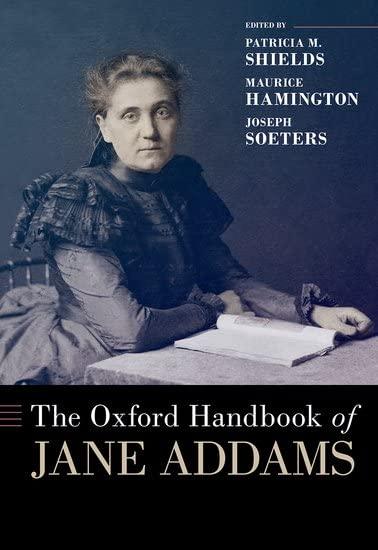
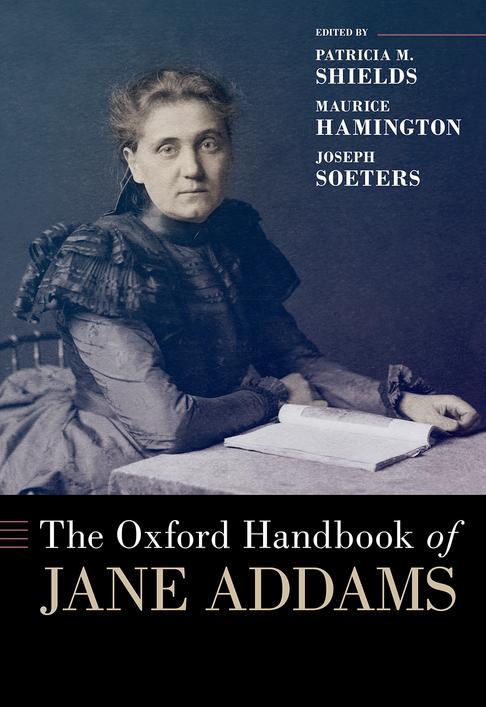
Title: Te Oxford handbook of Jane Addams / edited by Patricia M. Shields, Maurice Hamington, and Joseph Soeters.
Description: New York, NY : Oxford University Press, [2023] | Series: Oxford handbooks series | Includes bibliographical references and index. | Identifers: LCCN 2022040654 (print) | LCCN 2022040655 (ebook) | ISBN 9780197544518 (hardback) | ISBN 9780197544549 | ISBN 9780197544532 (epub)
Subjects: LCSH: Addams, Jane, 1860-1935. | Women political activists—United States—History. | Women social reformers—United States—History. | Women social workers—United States—History. | Women pacifsts—United States—History.
LC record available at https://lccn.loc.gov/2022040654
LC ebook record available at https://lccn.loc.gov/2022040655
DOI: 10.1093/oxfordhb/9780197544518.001.0001
Printed by Marquis Book Printing, Canada
Dedications
Patricia Shields dedicates this volume to future Addams scholars. Please fnd inspiration in your scholarly journey.
Maurice Hamington dedicates this volume to the Jane Collective of the Society for the Advancement of American Philosophy, a community of scholars that since 2006 has encouraged research on issues in feminist thought as they occur in American philosophies, including their intersections with people of undervalued and oppressed identities.
Joseph Soeters dedicates this volume to those who sufer(ed) immensely from the acts of dominating people and whose fate tends to be forgotten; a typical case, but surely not the only one, being the Indigenous people in the United States of America.
Acknowledgments
Charlene Haddock Seigfried About the Editors
List of Contributors
INTRODUCTION
1. On the Maturation of Addams Studies: A Figure of Vital Intellectual and Practical Signifcance
Patricia M. Shields, Maurice Hamington, and Joseph Soeters
PART I. AD DAMS, DEMOCRACY, AND SOCIAL THEORY
Edited by Patricia M. Shields
3.
5. Jane Addams and Richard Rorty: Te Philosophy and Practice of Pragmatist
Chris Voparil
6. Labor Unions as a Factor in a Caring Democracy
Maurice Hamington
PART II. AD DAMS AND HER CONTEMPORARIES
Edited by Joseph Soeters
7. Te Complementary Teory and Practice of Jane Addams and George Herbert Mead: Bending Toward Justice 129
Barbara J. Lowe
8. Legacies of Jane Addams and W. E. B. Du Bois: Lessons for Scholarship on Diversity and Inclusion in Organizations 149
Obie Clayton Jr., June Gary Hopps, Chris Strickland, and Shena Brown
9. Jane Addams and John Dewey 169
Shane J. Ralston
10. Jane Addams and William James on Sport and Recreation 187
Erin C. Tarver and Shannon Sullivan
11. Jane Addams and Mary Parker Follett’s Search for Cooperation 205 Joseph Soeters
12. Hull House Social Change Methodology and New Deal Reforms 223
Judy D. Whipps
13. Intersections of Race, Gender, and Class in Jane Addams’s Political Friendships 241
Wynne Walker Moskop
PART III. AD DAMS ACROSS DISCIPLINES
Edited
by Maurice Hamington
14. Inhabiting Reality: Te Literary Art of Jane Addams 261
Katherine Joslin
15. A Biographer’s Angle on Jane Addams’s Feminism 279
Louise W. Knight
16. Jane Addams and Public Administration: Clarifying Industrial Citizenship 305
Patricia M. Shields
17. Jane Addams on Play, Education, and Ethical Teaching 327
Nuria Sara Miras Boronat
18. Dialogue, Liminality, and a Spatial Ethic of Reciprocity in Diference: Jane Addams’s Social Ethics at the Confuence of Feminism and Pragmatism 345
Amrita Banerjee
19. Public Administration and Social Equity: Catching Up to Jane Addams 371
Nuri Heckler
20. Was Jane Addams a Sociologist? 389
Kaspar Villadsen
PART IV. AD DAMS, PEACE, AND INTERNATIONAL RELATIONS
Edited by Joseph Soeters
21. Peace Pragmatism and the Women, Peace, and Security Agenda 413
Jacqui True
22. Jane Addams, Expansive Masculinity, and the Fragility of the War Virtues 427
Tadd Ruetenik
23. Jane Addams and the Noble Art of Peaceweaving 441
Patricia M. Shields and Joseph Soeters
24. Strange Encounters?: Contemporary Field Researchers and Six Lessons from Jane Addams 459
Chiara Ruffa and Chiara Tulp
25. Jane Addams and Twenty-First Century Refugee Resettlement: Toward the Substitution of Nurture for Warfare 479
Tess Varner
PART V. AD DAMS ON KNOWLEDGE AND METHODS
Edited by Maurice Hamington
26. Addams’s Methodologies of Writing, Tinking, and Activism 501 Marilyn Fischer
27. Hull House Maps and Papers, 1895: A Feminist Research Approach to Urban Inequalities by Jane Addams and Florence Kelley 525 Núria Font-Casaseca
28. Jane Addams, Social Design, and Wicked Problems: Designing In, With, and Across 545
Danielle Lake
29. Jane Addams’s Use of Narrative in Sociological Research: “As no one but a neighbor can see” 567
Patricia Madoo Lengermann and Gillian Niebrugge
30. Jane Addams and the Return to Settlement Sociology: Inspiration for How to Help Others in the Digital Age 585
Erik Schneiderhan and Kaitlyn Quinn
31. Jane Addams’s Pragmatist Feminist Toughts and Actions for and with Ill and Disabled Women 603
Claudia Gillberg
32. Making the Jane Addams Papers Accessible to New Audiences 625
Cathy Moran Hajo
PART VI. AD DAMS AND SOCIAL PRACTICE
Edited
by
Patricia M. Shields
33. Jane Addams and Settlement Sociology 645
Ann Oakley
34. Social Ethics for Ecological and Community Resilience: Jane Addams and the Environment 663
Heather E. Keith
35. Jane Addams’s Education, Hull House, and Current-Day Civic-Engagement Practices in Higher Education: Coming Full Circle 683
Belinda M. Wholeben and Mary Weaks-Baxter
36. Jane Addams and Epistemic Agency in Contemporary Social Work 705
Heidi Muurinen and Aino Kääriäinen
37. Afect and Emotion in Jane Addams’s Tought 723
Clara Fischer
38. Epilogue: Jane Addams’s Contemporary Relevance 737 Joseph Soeters, Patricia M. Shields, and Maurice Hamington
Index 749
Acknowledgments
We would like to thank Cecily Berberat, Assistant Editor, and Anthony (Toby) Wahl, Senior Acquisitions Editor, at Oxford University Press. Both facilitated the process with good cheer and fabulous advice. Tey were patient with our endless questions and always responsive. We also appreciate the work and dedication of Afrose A, Project Manager of Newgen Knowledge Works, who supervised the critical task of copyediting this handbook.
Marilyn Fischer was instrumental to the success of this project. Her encouragement and willingness to fnd authors came at a critical time. It helped set us on the road to success. Judy Whipps also provided invaluable support throughout the process. We appreciate that these two senior Addams scholars gave so generously of their time.
Foreword
Charlene Haddock Seigfried
Te casual attribution of Jane Addams as “a classical American philosopher,” in a recent talk marks a recognition inconceivable only a few decades ago. When I frst encountered her life and work, she wasn’t even recognized as a philosopher, let alone as a member of the founding generation of pragmatists. Women’s absence from the standard narratives of pragmatist philosophy was pointed out some years earlier, but the revival of interest in Addams can be dated roughly to 2002, with the publication by the University of Illinois Press of the frst volumes of a series dedicated to reissuing most of her books. With the exception of Twenty Years at Hull-House, they were all out of print at the time. New introductions were commissioned to alert a new generation of readers to their continuing relevance.
Te Oxford Handbook of Jane Addams is a testament to how quickly her revival as a distinctive feminist voice in pragmatist philosophy has entered into the scholarship of multiple disciplines including a signifcant role in sociology. It is also a tribute to the cogency and challenge of her work. Tis volume exhibits Addams’s trajectory from a world-renowned social activist and spokesperson for a community of women reformers central to the late nineteenth and early twentieth century progressive movement to her rediscovery in the twenty frst century as an engaged pragmatist feminist philosopher who exemplifed the interaction of theory and practice. Her participatory model of empowering those less well of in the immigrant community of Chicago stretched to include those devastated by war in Europe as she interpreted pacifsm as an active transformation of the conditions inimical to it.
Te extent of such boundary-crossing is illustrated in the disciplines that trace their origins to the work of the women at the Hull House settlement she headed. Tese include sociology, social work, education, public administration, and occupational science. Addams’s own boundaries, as well as those of the residents, were permeable, as she makes clear in Twenty Year at Hull House. She recounts the impact that the people they served had in challenging the residents’ middle-class perceptions and values. Addams’s interactions with the other settlement women were not only mutually benefcial in developing a multi-perspectival outlook, but multiplied their efectiveness immeasurably. Many of the disciplines infuenced by Hull House are rediscovering and claiming their origins as they develop a more consensual, justice-based, client-centered, compassionate version of their guiding theories.
All of these trends and more are represented in the contributors to this volume. Tey include scholars who participated in the initial recovery of Addams’s writings and those who are just now discovering her. I was one of those who discovered Addams early on and have yet to run out of ideas she has inspired or to have found her lacking in useful insights into whatever issues I currently want to address. It is gratifying to fnd that so many of my initial insights and those of others who discovered Addams for themselves continue to take root and expand in new scholarly writings.
Addams was a woman for her time just as this handbook is a book for our time. Her appeal endures because she approached the massive late nineteenth century social upheavals with a willingness to question her own biases, an unswerving confdence in persons of diverse backgrounds and aspirations, a willingness to work together in common causes, and an insatiable thirst for a just and fair society that would emerge from people’s lives and not be imposed on them. Tere have been voluminous articles and encyclopedias devoted to the nature and importance of feminist and pragmatist thought, but this volume on Addams’s theories and practices shows how much she infuenced the development of both and how much she transformed the meaning and aims of both.
Addams was acutely aware of the multiplicity of ways that persons interact in the world. Her goals didn’t include spreading the truth or the right values as she understood them, but instead she sought to facilitate their co-constitution with others, especially those who were marginalized. It was an on-going, never-ending process, always open to revision as circumstances and understanding changed. Te need to make democracy a vital way of life was a constant theme for Addams and one that challenges us yet again.
Addams understood that democracy itself was under threat when prejudices against immigrants explode into violence, when employers exploit their workers, and when ethnicity or race determines a person’s worth. Te seeds of its demise can be found when healthcare, food, and housing are withheld from those unable to aford them; when women are not allowed to choose their way of life; and when facts and interpretations are distorted for the purpose of privileging one faction over others. Democracy is also the antithesis of waging war because war ignores the underlying causes of disputes and peaceful means of resolving them.
Tis volume testifes to the resourcefulness of Addams’s approach by concretely demonstrating the multifaceted ways that her insights are continuing to motivate new generations as they are revised, utilized, and expanded.
About the Editors
Patricia M. Shields is a Regents’ Professor in the Department of Political Science at Texas State University. Her scholarship includes works on peace, pragmatism and public administration, democracy, gender, military studies, and research methods. She has edited the journal Armed Forces & Society since 2001 and is a fellow of the National Academy of Public Administration. She began studying Jane Addams as part of an efort to link pragmatism and public administration. In the process, she found that Addams’s work could be applied to peace studies and peacekeeping in particular.
Maurice Hamington is Professor of Philosophy, and Afliate Faculty in Women, Gender, and Sexuality Studies at Portland State University. In addition to being an Addams scholar, he is a feminist care ethicist who publishes on both the theory and application of care. Bringing those two research arcs together, Hamington views Addams as a forerunner of today’s feminist care ethics. Te author or editor of ffeen books, he serves as a Fulbright Specialist and enjoys giving invited lectures on his research areas. Hamington has been fortunate enough to receive university awards for teaching, advising, and scholarship.
Joseph Soeters has been a Professor at the Netherlands Defense Academy, afer which he accepted a position at Tilburg University, where he taught organizational sociology. Now he is an emeritus professor. He has published extensively on the military and peacekeeping, including issues of human resources management, diversity, and (international/inter-organizational) cooperation. His work has been published in ten languages. Today, he works on a voluntary basis with refugees and asylum seekers (including language training).
List of Contributors
Amrita Banerjee, Associate Professor of Philosophy, Indian Institute of Technology
Bombay
Shena Leverett Brown, Assistant Professor, Clark Atlanta University
DeLysa Burnier, Professor, Ohio University
Obie Clayton Jr., Professor and Director, Clark Atlanta University
Clara Fischer, Vice Chancellor Illuminate Fellow, Queen’s University Belfast
Marilyn Fischer, Professor Emerita, University of Dayton
Núria Font-Casaseca, Assistant Professor, University of Barcelona
Claudia Gillberg, Senior Research Associate, Jönköping University
Cathy Moran Hajo, Editor and Director of the Jane Addams Papers Project, Ramapo College of New Jersey
Nuri Heckler, Assistant Professor, University of Nebraska Omaha
June Gary Hopps, Professor of Family and Children Studies, University of Georgia
Katherine Joslin, Professor Emerita, Western Michigan University
Aino Kääriäinen, Senior University Lecturer, University of Helsinki
Heather E. Keith, Executive Director of Faculty Development and Professor, Radford University
Louise W. Knight, Visiting Scholar, Northwestern University
Danielle Lake, Director of Design Tinking and Associate Professor, Elon University
Patricia Madoo Lengermann, Research Professor of Sociology, Te George Washington University
Barbara J. Lowe, Associate Professor, St. John Fisher University
Núria Sara Miras Boronat, Associate Professor Moral and Political Philosophy, University of Barcelona
Wynne Walker Moskop, Professor of Political Science, Saint Louis University
Heidi Muurinen, Senior Specialist, Finnish Institute for Health and Welfare
Carol Nackenof, Richter Professor Emerita of Political Science, Swarthmore College
Gillian Niebrugge, Professorial Lecturer, Te George Washington University
Ann Oakley, Professor of Sociology and Social Policy, University College London
Scott L. Pratt, Professor of Philosophy, University of Oregon
Kaitlyn Quinn, Assistant Professor, University of Missouri-St. Louis
Shane J. Ralston, Dean, Woolf University
Tadd Ruetenik, Professor, St. Ambrose University
Chiara Rufa, Professor, Centre for International Relations, Sciences Po Paris
Erik Schneiderhan, Associate Professor, University of Toronto Mississauga
Chris Strickland, Doctoral Candidate, University of Georgia
Shannon Sullivan, Professor of Philosophy and Health Psychology, University of North Carolina
Erin C. Tarver, Associate Professor of Philosophy and Humanities Division Chair, Oxford College of Emory University
Jacqui True, Professor and Director, Monash University
Chiara Tulp, Independent scholar
Tess Varner, Assistant Professor, Concordia College
Kaspar Villadsen, Professor, Copenhagen Business School
Chris Voparil, Graduate Faculty, Union Institute & University
Mary Weaks-Baxter, Andrew Sherratt University Professor and Director of the Jane Addams Center for Civic Engagement, Rockford University
Judy D. Whipps, Professor Emerita, Grand Valley State University
Belinda M. Wholeben, Professor Emerita and Founding Director of the Jane Addams Center for Civic Engagement, Rockford University
INTRODUCTION
Chapter 1
On the Maturation of Addams Studies
A Figure of Vital Intellectual and Practical Significance
Patricia M. Shields, Maurice Hamington, and Joseph Soeters
Introduction
This handbook is a selective collection of original analyses ofered by an international group of social and political theorists who have contributed to the burgeoning feld of Addams studies. As late as the 1980s, academics in sociology, philosophy, and social work would be surprised at the prospect of a scholarly handbook devoted to Jane Addams as a prominent theorist and intellectual. However, much has changed over the last thirty years. Scholars in sociology, philosophy, political science, history, and rhetoric have recovered Addams as a critical intellectual force of the late nineteenth and early twentieth centuries. Furthermore, interest in Addams has emerged as a global phenomenon exemplifed by the many international contributors to this volume.
Tis introduction situates Addams as infuential in scholarly disciplines and felds of practice. Afer a concise introduction to Addams’s life, an overview of her infuence on sociology is followed by an overview of her place in philosophy. Ten Addams’s role in public administration and social work is ofered. Te introduction concludes with a brief explanation of the volume’s organization.
Jane Addams was born in 1860 in Cedarville, Illinois, to a prominent family. Her father, Illinois state senator John Huy Addams, owned the town mill and ran the bank. Jane Addams was the youngest of fve living children. Her mother, Sarah Weber Addams, died during premature labor when Addams was two. As a result, she had a
very close relationship with her father. An average elementary school student, Addams thrived at Rockford Female Seminary (now Rockford University) as class president, valedictorian, and editor of her college’s newspaper. In 1881, she graduated from Rockford and her father died, leaving her a sizable inheritance. She spent several years traveling Europe, where she visited the British settlement house, Toynbee Hall. Tis experience inspired her (and friend Ellen Gates Starr) to found Hull House, a progressive-era settlement community in an impoverished, immigrant Chicago neighborhood (1889). Hull House fourished, as did Addams. She became a prominent spokesperson and author, publishing infuential books and articles in popular magazines.
Along with the progressive community at Hull House, Addams led reform eforts addressing dangerous workplaces, child labor, unhealthy city streets, juvenile justice, and much more. She subsequently became active in the peace movement, leading the frst women’s peace conference in Te Hague (1915) and establishing the Women’s International League of Peace and Freedom. She was honored with the Nobel Peace Prize for this efort. She died in 1935 at the age of seventy-fve. See Table 1.1 for highlights of her critical life events and the books she authored.
Table 1.1 Key events and works in the Life of Jane Addams
Year Events and key works
1860 Born to Sarah and John Huy Addams, Cedarville, Illinois
1881 Father dies and leaves her a sizable inheritance
1883–1888 Two extended trips to Europe— visited Toynbee Hall and uses it as a model for Hull House
1889 Moves to Chicago with Ellen Gates Starr. Establishes Hull House
1889–1920s Hull House expansion (art gallery, coffee house, public bath, gymnasium, daycare, meeting rooms, variety of clubs, labor museum, cooperative boarding club for girls, playgrounds, speaker series)
1891 Florence Kelley moves to Hull House—inspires Addams’s activist orientation
1894 Pullman Strike
1895 Hull House Maps and Papers (co-authored with the Residents of Hull House) Garbage inspector
1896 First of fve American Journal of Sociology articles. Meets with Tolstoy during trip to Europe
1901 Co-founded Juvenile Court Committee
1902 Democracy and Social Ethics
1905–1909 Served Chicago School Board
Year Events and key works
1907 Newer Ideals of Peace
1909 The Spirit of Youth and the City Streets
Founding member—National Association for the Advancement of Colored People
1910 Twenty Years at Hull House
1912 Publishes “A Modern Lear”
1914 World War I begins
1915 Establishes Women’s Peace Party
Presides International Congress of Women at the Hague Led peace delegation to capitals of warring countries Women at the Hague (edited with Balch and Hamilton)
1916 US enters WWI
The Long Road of Women’s Memory
1917–1919 Spokesperson—Department of Agriculture Food Relief Program
1919 Founder – Women’s International League of Peace and Freedom
1920 Founding member American Civil Liberties Union
1922 Peace and Bread in Time of War
1923 A New Conscience and an Ancient Evil
1930 The Second Twenty Years at Hull House
1931 Nobel Peace Prize (shared with N. M. Brown)
1932 The Excellent Becomes the Permanent
1935 My Friend Julia Lathrop Died in Chicago
Unlike her social theorist contemporaries such as Weber or Durkheim, Addams lacked university-afliated status and sufered from the intellectual sexism of the era. However, Addams’s infuential scholarship stemmed from direct experience at Hull House (e.g., Schneiderhan, 2011). She engaged in social amelioration by living in proximal relations and being a good neighbor. She and the residents of Hull House were dedicated to aiding in “the solution of the social and industrial problems which are engendered by the modern conditions of life in a great city” (Addams 1910, 68). Settlement progressive methodology involved breaking down social barriers that separated individuals from appreciating the plight of others.
Addams is remembered as a social reformer and peace activist. Accordingly, the intellectual legacy found in her books, essays, journal articles, and speeches has seldom received its scholarly due. Moreover, progressive ideals regarding social progress waned afer World War I. Her peace advocacy in the face of rising United States jingoism and nationalism contributed to widespread suspicion and alienation of Addams and her progressive approach.