Program Development and Grant Writing in Occupational Therapy: Making the https://ebookmass.com/product/program-development-and-grant-writingin-occupational-therapy-making-the/
Oxford University Press is a department of the University of Oxford. It furthers the University’s objective of excellence in research, scholarship, and education by publishing worldwide. Oxford is a registered trade mark of Oxford University Press in the UK and certain other countries.
All rights reserved. No part of this publication may be reproduced, stored in a retrieval system, or transmitted, in any form or by any means, without the prior permission in writing of Oxford University Press, or as expressly permitted by law, by license, or under terms agreed with the appropriate reproduction rights organization. Inquiries concerning reproduction outside the scope of the above should be sent to the Rights Department, Oxford University Press, at the address above.
You must not circulate this work in any other form and you must impose this same condition on any acquirer.
Library of Congress Cataloging-in-Publication Data
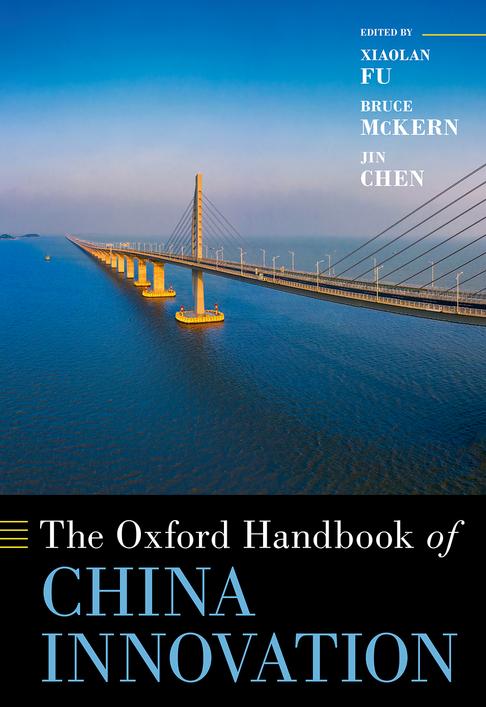
Names: Fu, Xiaolan, 1967- editor. | Chen, Jin, editor. | McKern, Bruce, editor. Title: The Oxford handbook of China innovation / [edited by] Xiaolan Fu, Jin Chen, and Bruce McKern.
Description: New York : Oxford University Press, 2021. | Series: Oxford handbooks series | Includes bibliographical references and index. | Identifiers: LCCN 2021002732 (print) | LCCN 2021002733 (ebook) | ISBN 9780190900533 (hardback) | ISBN 9780190900564 | ISBN 9780190900540 | ISBN 9780190900557 (epub)
LC record available at https://lccn.loc.gov/2021002732
LC ebook record available at https://lccn.loc.gov/2021002733
DOI: 10.1093/oxfordhb/9780190900533.001.0001
1 3 5 7 9 8 6 4 2
Printed by Sheridan Books, Inc., United States of America
Contributors
Introduction: China’s Journey to Innovation
Xiaolan Fu, Bruce McKern, and Jin Chen
PART I. THE DEVELOPMENT OF INNOVATION IN CHINA: THEORY, POLICY, AND PRACTICE
1.1. Capabilities Accumulation and Development: What History Tells the Theory 29
Giovanni Dosi and Xiaodan Yu
1.2. China’s Industrial Development Strategies and Policies 56
Justin Yifu Lin and Jianjun Zhou
1.3. The Development of Innovation Studies in China 73
Rongping Mu, Jin Chen, and Rebecca Wenjing Lyu
1.4. China’s Science and Technology Progress through the Lens of Patenting 90
Gary H. Jefferson and Renai Jiang
PART II. BUILDING CHINA’S INNOVATION
2.1. China’s National and Regional Innovation Systems 115 Lan Xue, Daitian Li, and Zhen Yu
2.2. The Great Dialectic: State versus Market in China
Loren Brandt and Eric Thun
2.3. Entrepreneurship and Innovation of Small and Medium-Sized Enterprises in China
Jin Chen and Liying Wang
2.4. Financing for Innovation in China 168
Changwen Zhao and Xiheng Jiang
2.5. Innovation and Entrepreneurship Education and Its Implications for Human Capital Development in China 187 Fang Lee Cooke
PART III. NATIONAL INCENTIVES FOR AN INNOVATION- DRIVEN ECONOMY
3.1. System Reform, Competition, and Innovation in China 205 Weiying Zhang
3.2. Reforms of the Science and Technology Management System 241
Zhijian Hu, Zhe Li, and Xianlan Lin
3.3. Mass Entrepreneurship and Mass Innovation in China 254
Jian Gao and Rui Mu
PART IV. DEVELOPING INNOVATION- FAVORING INSTITUTIONS AND ECOSYSTEM
4.1. The Role of Clusters in the Development of Innovation Capabilities in China 275 Tuoyu Li and Jiang Wei
4.2. China’s Science-Based Innovation and Technology Transfer in the Global Context 315
Jizhen Li, Ximing Yin, and Subrina Shen
4.3. Science Parks and High-Tech Zones 337
Susan M. Walcott
4.4. Venture Capital, Angel Capital, and Other Finance, IPOs, and Acquisitions 354
Lin Lin
4.5. Intellectual Property Rights Protection 370 Can Huang and Naubahar Sharif
4.6. Innovation Elements in Traditional Chinese Culture 384 Jin Chen and Qingqian Wu
PART V. OPENNESS AND THE ACQUISITION OF TECHNOLOGY AND CAPABILITIES
5.1. Innovation Strategies of Multinational Corporations in China and Their Contribution to the National Ecosystem 397
Bruce McKern, George S. Yip, and Dominique Jolly
5.2. Foreign Technology Transfers in China 415
Xiaolan Fu and Jun Hou
5.3. China’s International Migration: Status and Characteristics 441 Huiyao Wang
5.4. Chinese Outward Foreign Direct Investments and Innovation 467
Vito Amendolagine, Xiaolan Fu, and Roberta Rabellotti
5.5. Internationalization of Chinese Research and Development 486
Max von Zedtwitz and Xiaohong Iris Quan
5.6. International Innovation Collaboration in China 502
Kaihua Chen, Ze Feng, and Xiaolan Fu
5.7. Open Innovation for Development in China 525
Jin Chen and Yufen Chen
PART VI. INNOVATION WITH CHINESE CHARACTERISTICS
6.1. Chinese Cost Innovation, the Shanzhai Phenomenon, and Accelerated Innovation 539
Peter J. Williamson
6.2. Global Supply Chains as Drivers of Innovation in China 554
Michael Murphree and Dan Breznitz
6.3. Market Demand, Consumer Characteristics, and Innovation in Chinese Firms 573
Hengyuan Zhu and Qing Wang
6.4. Chinese Firms’ Move to the Forefront in Digital Technologies 593
Jiang Yu and Yue Zhang
6.5. China’s Financial Innovation: Process, Drive, and Impacts 610
Liqing Zhang
6.6. The Puzzle of the Underdog’s Victory: How Chinese Firms Achieve Stretch Goals through Exploratory Bricolage 625
Peter Ping Li, Shihao Zhou, and Monsol Zhengyin Yang
PART VII.
INNOVATION CAPABILITY TRANSITION AND UPGRADING FOR AN INCLUSIVE AND SUSTAINABLE
INNOVATION SYSTEM
7.1. Green Innovation in China 649
Ping Huang and Rasmus Lema
7.2. Innovating for the Poor: The Inclusive Innovation System in China 675
Xiaobo Wu and Linan Lei
7.3. Manufacturing Power Strategy: Advanced Manufacturing 696
Jörg Mayer and Huifeng Sun
7.4. Facing the Future of China’s Science and Technology Development 714
Jiaofeng Pan, Guanghua Chen, and Xiao Lu
PART VIII. CONCLUSION AND IMPLICATIONS FOR POLICY
8.1 Conclusion: Innovation in China: Past, Present, and Future Prospects 735
Xiaolan Fu, Bruce McKern, Jin Chen, and Ximing Yin
8.2 Policy and Managerial Implications for China and Other Countries 759
Xiaolan Fu, Bruce McKern and Jin Chen
Index 777
Contributors
Vito Amendolagine
Department of Economics
University of Foggia
Foggia
Italy
Loren Brandt
Department of Economics
University of Toronto
Toronto ONT
Canada
Dan Breznitz
Munk School
University of Toronto
Toronto ONT
Canada
Guanghua Chen
Institutes of Science and Development, Chinese Academy of Sciences
Beijing China
Jin Chen
School of Economics and Management
Research Center for Technological Innovation
Tsinghua University
Beijing China
Kaihua Chen
Institutes of Science and Development, Chinese Academy of Sciences
Beijing China
Yufen Chen
School of Statistics and Mathematics, Zhejiang Gongshang University, Hangzhou, China
Fang Lee Cooke
Department of Management
Monash University
Melbourne VIC
Australia
Giovanni Dosi
Institute of Economics
Sant’Anna School of Advanced Studies
Pisa
Italy
Ze Feng
Department of Public Policy and Management
University of the Chinese Academy of Sciences
Beijing China
Xiaolan Fu
Technology and Management Centre for Development, Department of International Development, University of Oxford, Oxford, UK
Jian Gao
Department of Innovation, Entrepreneurship and Strategy
Tsinghua University
Beijing China
Jun Hou
Lincoln Business School
University of Lincoln
Lincoln
United Kingdom
Zhijian Hu
Chinese Academy of Science and Technology for Development
Beijing China
Can Huang
Department of Innovation, Entrepreneurship and Strategy, School of Management
Zhejiang University
Hangzhou China
Ping Huang
Center for International Environment and Resource Policy, The Fletcher School, Tufts University, Boston, United States
Gary H. Jefferson
Department of Economics
Brandeis University
Waltham MA United States
Renai Jiang
School of Economics and Finance
Xi’an Jiaotong University
Xi’an China
Xiheng Jiang
China Center for International Knowledge on Development Beijing China
Dominique Jolly
Webster University Geneva Geneva Switzerland
Linan Lei
Zhejiang University, International Business School Hangzhou
China
Rasmus Lema
Department of Business and Management
Aalborg University
Copenhagen Denmark
Daitian Li
School of Management and Economics
University of Electronic Science and Technology of China
Chengdu
China
Jizhen Li
School of Economics & Management
Tsinghua University Beijing China
Peter Ping Li
IBM, Nottingham University Business School (NUBS)
University of Nottingham Ningbo China
Ningbo
China
Tuoyu Li
Institute of China’s Science, Technology and Education Policy
Zhejiang University
Hangzhou
China
Zhe Li
Chinese Academy of Science and Technology for Development, Beijing, China
Lin Lin
Faculty of Law
National University of Singapore
Singapore
Justin Yifu Lin
Institute of New Structural Economics
Peking University
Beijing China
Xianlan Lin
Department of Public Management
Hubei University
Wuhan
China
Xiao Lu
Institutes of Science and Development, Chinese Academy of Sciences
China
Jörg Mayer
Division on Globalization and Development Strategies
United Nations Conference on Trade and Development
Geneva
Switzerland
Bruce McKern
UTS Business School
University of Technology Sydney
Sydney
Australia
Rongping Mu
School of Public Administration
University of Chinese Academy of Sciences
Beijing China
Rui Mu
Entrepreneurship Research Center on G20 Economies
Tsinghua University
Beijing China
Michael Murphree
Sonoco International Business Department
University of South Carolina
Columbia SC
United States
Jiaofeng Pan
Institute of Sciences, Chinese Academy of Science
Beijing China
Xiaohong Iris Quan
Lucas College and Graduate School of Business
San Jose State University
San Jose CA
United States
Roberta Rabellotti
Department of Political and Social Sciences
University of Pavia
Pavia
Italy
Naubahar Sharif
Division of Public Policy
Hong Kong University of Science and Technology
Hong Kong
Subrina Shen
Department of Management
McCombs School of Business, The University of Texas at Austin
Austin TX
United States
Huifeng Sun
General Manager of CCID Consulting Company Limited, Beijing, China
Eric Thun
Saïd Business School
University of Oxford
Oxford
United Kingdom
Max von Zedtwitz
Department of International Economics, Government, and Business
Copenhagen Business School
Frederiksberg
Denmark
Susan M. Walcott
Geography, Environment, and Sustainability
University of North Carolina at Greensboro
Greensboro SC
United States
Huiyao Wang
Department of Development Studies
Center for China and Globalization
Southwestern University of Finance and Economics
Beijing
China
Liying Wang
China Institute for SMEs in Zhejiang University of Technology
Hangzhou
China
Qing Wang
Warwick Business School
The University of Warwick
Coventry
United Kingdom
Jiang Wei
Department of Innovation, Entrepreneurship and Strategy
Zhejiang University
Hangzhou
China
Rebecca Wenjing Lyu
Initiative on the Digital Economy
Massachusetts Institute of Technology
Cambridge MA
United States
Peter J. Williamson
Judge Business School
University of Cambridge
Cambridge
United Kingdom
Qingqian Wu
School of Economics and Management
Tsinghua University
Beijing China
Xiaobo Wu
Department of Innovation, Entrepreneurship and Strategy
Zhejiang University
Hangzhou China
Lan Xue
School of Public Policy and Management at Tsinghua University
Beijing China
Monsol Zhengyin Yang
Shantou Development and Planning Institute
Shantou
China
Ximing Yin
School of Management and Economics
Beijing Institute of Technology
Beijing
China
George S. Yip
Imperial College Business School London, and D’Amore-McKim School of Business, Northeastern University
Boston, MA
United States
Jiang Yu
Institutes of Science and Development, Chinese Academy of Sciecnes
Beijing China
Xiaodan Yu
LUISS, Rome and Nottingham University Business School, University of Nottingham Ningbo China
Ningbo
China
Zhen Yu
School of Public Policy and Management
Tsinghua University
Beijing China
Liqing Zhang
School of Finance and Center for International Finance Studies
Central University of Finance and Economics
Beijing China
Weiying Zhang
National School of Development, Peking University
Beijing China
Yue Zhang
Institutes of Science and Development, Chinese Academy of Sciecnes
Beijing China
Changwen Zhao
Department of Industrial Policies
Development Research Center of the State Council
Beijing China
Jianjun Zhou
Renmin University of China
Beijing China
Shihao Zhou
Department of Marketing and E-Commerce
Nanjing University
Nanjing China
Hengyuan Zhu
Department of Innovation, Entrepreneurship and Strategy
School of Economics & Management
Tsinghua University
Beijing China
Introduction China’s Journey to Innovation
Xiaolan Fu, Bruce McKern, and Jin Chen
The development of China’s economy since the market-oriented opening after 1978 has been a phenomenon of extraordinary historical significance. The pattern of China’s development and the forces driving it have been of profound interest to policymakers and scholars alike, and research has been undertaken from a number of perspectives. Explanations of the nation’s economic growth path during the years subsequent to the adoption of the reforms have been largely concerned with the macroeconomic and political environment. The perspectives of this work range from the historical to the economic, social, cultural and, to a lesser extent, business. Only recently have scholars looked into the microeconomic factors in China’s growth, of which a critical force has been the steady drive for innovation, recognized by its government early as a necessary condition for economic development.
In its early days China’s development path followed the well-established shift of underemployed labor from agriculture to more productive manufacturing, a sequence well documented for other countries, particularly the nations of Southeast Asia. In shifting away from state ownership of the means of production, China implemented market-oriented microeconomic policies through a pragmatic process of trial and error. Its national government has maintained the direction of development through taxation and spending policies, supported by a high level of savings and by allocating funds according to key priorities expressed in a series of five-year plans. Adopting market reforms from 1978 was an important step and it was recognized over time that the state-owned enterprise (SOE) sector needed to yield space to the private sector for the markets to function efficiently. Although SOEs still account for some 26% of output and 42% of assets,1 the implementers of innovative services and products have increasingly been private sector firms. From a few years after the beginning of the reforms, a leading official priority has been the creation of a national innovation ecosystem.
1 Fan Gang and Nicholas C. Hope, “The Role of State-Owned Enterprises in the Chinese Economy,” in US China Relations in the Next 10 Years: Towards Deeper Engagement and Mutual Benefit, chap. 18. Hong Kong: China-United States Exchange Foundation, 2013.
Academic interest in the role of national innovation systems in a country’s economic growth and its competitiveness in international trade originated in the developed world, especially the United States and Europe.2 In this work, academic attention was paid to both the macroeconomic and the microeconomic environment, the latter including the interaction of government policies with the development of both SOEs and the private sector.3 These ideas have been useful in understanding the important role of innovation systems in the growth of developing countries and specifically in China.
Even more recently, serious academic attention has been paid to the development of innovation and entrepreneurship in China and the important role of business sector innovation in productivity and economic growth. This work includes a good number of journal articles but surprisingly few serious volumes. Among those with a specific microeconomic focus on China are Zeng and Williamson (2007),4 Breznitz and Murphree (2011),5 Fu (2015),6 and Yip and McKern (2016).7
It is important, however, to explain China’s much faster innovative success relative to other large countries, such as India. Are there factors specific to the Chinese context that explain this phenomenon?8 China employed well-established policies to facilitate the shift from agriculture and to encourage savings and capital formation. But the shift from a stateowned system of production to a market-based system was a critical step in creating private sector incentives. These interacted with cultural factors to liberate a wave of entrepreneurship in a rapidly expanding private sector, but to a much lesser extent in the state-owned sector.
While the impact of the microeconomic and business elements in fostering innovation are the main concern of this Handbook, they can be properly understood only in the context of the institutional environment and government policy framework underlying China’s economic development. Although innovation is undertaken primarily at the level of the business firm, it cannot be isolated from the Chinese government’s long-term vision for the country, its growth-oriented macroeconomic policy, and its indispensable role in establishing the physical infrastructure and the innovation ecosystem, which together underpin the country’s economic strength today. Also, since innovation depends on entrepreneurship and human capabilities, it is also essential to address other “soft”
2 Richard R. Nelson (Ed.), National Innovation Systems: A Comparative Analysis. Oxford: Oxford University Press, 1993.
Lundvall, B-Å. (Ed.), National Innovation Systems: Towards a Theory of Innovation and Interactive Learning. London: Pinter, 1992. Freeman, C. 1995. The National Innovation Systems in historical perspective. Cambridge Journal of Economics, 19(1): 5–24.
3 Porter was one of the pioneers of postclassical microeconomic explanations of national competitiveness between countries. Porter, however, placed little emphasis on the role of government. See Michael E. Porter, The Competitive Advantage of Nations. New York: Free Press, 1990.
4 Ming Zeng and Peter J. Williamson, Dragons at Your Door: How Chinese Cost Innovation Is Disrupting Global Competition. Boston: Harvard Business School Press, 2007.
5 Dan Breznitz and Michael Murphree, Run of the Red Queen: Government, Innovation, Globalization, and Economic Growth in China. New Haven, CT: Yale University Press, 2011.
6 Xiaolan Fu, China’s Path to Innovation. Cambridge: Cambridge University Press, 2015.
7 George S. Yip and Bruce McKern, China’s Next Strategic Advantage: From Imitation to Innovation. Cambridge, MA: MIT Press, 2016
8 We are grateful to one of the reviewers of the book outline for stressing the importance of this issue.
factors that contribute to the development of an innovative society, including education, culture, and demographics. Recognizing the potential relevance of this Handbook for other countries, we have attempted to address in several chapters the interaction of these contextual factors, both cultural and institutional, in stimulating the role played by private firms.
Equally important is explaining the rapid development of the private sector in response to the opportunities presented by burgeoning demand, in turn stimulating the creation of innovative capabilities in private sector companies. With the private sector today far more significant in China’s economy than when the shift to a market-oriented system was begun, the balance between the roles of the private sector and the state-owned sector has tilted substantially. We cover the evolution of the private sector role, its future prospects, and the changing balance between the state and the market.
The Handbook includes discussions of the research dealing with all of these elements of the national innovation ecosystem in China. It includes a review of China’s development policies, the place of innovation within national priorities, the specific components of the national innovation system, and the resources required for effective innovation. It gives detailed attention to the elements of the system that provide incentives and support for companies in China. Since innovation in the modern age depends to a great extent on science and technology (S&T), we put emphasis on the factors contributing to a technologically sophisticated society—the consistently expressed goal of Chinese administrations since the 1980s.
Openness to foreign influence and investment has also been a distinguishing characteristic of China’s development in the early era of reform. This important influence is also addressed, along with the evolution of policy toward foreign know-how, patent protection, open innovation, and foreign direct investment. Further, since sectoral differences are significant (as addressed in an earlier volume, The Oxford Handbook of Innovation),9 we include attention to important sectors that demonstrate China’s specific approach to development. These include digital technology, “green” technology, financial innovation, advanced manufacturing (the latter relevant to many sectors), and China’s private and public policies toward automobiles, construction equipment, and machine tools. In a chapter concerned with the role of clusters and regional agglomerations, a contrast is drawn between two clusters, one traditional (textiles) and one new (software).
China’s business enterprises have developed capacities for innovation that provide the basis for competitive success, not only in their own country, but also increasingly outside China. Awareness of their capabilities and strategies is of critical importance to firms operating in the Chinese market, to scholars of China’s economy and business, and to policymakers worldwide. Several of the chapters include examples of those successful business corporations that have become world-class innovators.
In conceiving the Oxford Handbook of China Innovation, we were motivated by the belief that it should provide comprehensive and authoritative views of state-of-the-art research on the role of innovation in China’s rise, including the broad range of topics outlined earlier.
9 Jan Fagerberg, David C. Mowery, and Richard R. Nelson (Eds.), The Oxford Handbook of Innovation Oxford: Oxford University Press, 2004. This provides a thorough discussion of innovation in general and is recommended background for readers of the Handbook of China Innovation
Accordingly, the Handbook consists of chapters written by experts from universities and research institutions who were asked to provide an exposition of the state of the art in a particular area, with criticism and suggestions for further research. New research was not specifically requested, but some of the authors have chosen to present new work, and all the authors have provided original viewpoints on their topics.
Outline of the Handbook
The work is in seven sections, beginning with macroeconomic development strategy and theory and progressing to microeconomic policies, followed by institutions and enabling policies and other factors; external openness; China-specific characteristics of indigenous innovation; recent policy shifts; environmental, social, and demographic challenges; and the likely future trajectory of science, technology, and innovation in China.
The seven sections are as follows:
Part I. The Development of Innovation in China: Theory, Policy, and Practice
Part II. Building China’s Innovation Capabilities
Part III. National Incentives for an Innovation-Driven Economy
Part IV. Developing Innovation-Favoring Institutions and Ecosystem
Part V. Openness and the Acquisition of Technology and Capabilities
Part VI. Innovation with Chinese Characteristics
Part VII. Innovation Capability Transition and Upgrading for an Inclusive and Sustainable Innovation System
In what follows we provide a short overview of each section and an outline of the chapters. These short statements are not meant to discuss the authors’ ideas in depth; rather, they are intended as a reader’s guide to the issues considered in each chapter.
Part I. The Development of Innovation in China: Theory, Policy, and Practice
This section outlines the themes of the Handbook and provides a theoretical introduction to the concept of innovation, emphasizing the necessity to view innovation as a multidimensional phenomenon. This is followed by a historical view of the importance of innovation in China’s recent industrialization and its impact on the country’s growth, by comparison with its former world leadership in many fields of science and technology (S&T) during the dynastic era. It describes the evolution of the country’s macroeconomic and microeconomic development strategy and the key elements of policy. The evolution of innovation studies as a field of investigation is also examined. The current position of China relative to other countries and its efficiency in innovation are considered, by evaluating China’s remarkable performance in patenting.
1.1. Capabilities Accumulation and Development: What History Tells the Theory
Giovanni Dosi and Xiaodan Yu
In this chapter, the authors provide a theoretical basis for understanding concepts of innovation as a key factor in economic development, in terms of capabilities. They consider the historical lessons of economic development, of which China, in their view, is the most striking. They describe its development as a Great Transformation, which entails a process of accumulation of knowledge and capabilities, at the level of both individuals and organizations. They see this as a major shift of the technological paradigm; they explain that concept and ascribe crucial importance to “ensembles” of industrial policies and institutionbuilding efforts that nurture capabilities accumulation and industrial development.
The authors see the evolution of a paradigm in a nation in terms of three co-evolving sub-systems or “domains”:
1. The system of scientific knowledge and technologies
2. The “economic machine,” comprising the mechanisms determining production, investment, income distribution, and structural change
3. The system of social relations and institutions, including those governing labor, financial and goods markets, and public agencies and policies
This implies path dependence for national innovation systems, and difficulty for any country seeking to make significant and rapid paradigm shifts. The authors raise an important question for our understanding of China: given these constraints, how was China able to shift to a new paradigm of technological change, and how did these three domains interact in that transformation?
The authors agree that such capability creation builds partly on education and formally acquired skills. However, they consider that capabilities have to do with problem-solving knowledge that is embodied in organizations—such as production technologies, the technical and social division of labor, labor relations, and “dynamic capabilities” of search and learning.
The authors develop the concept of the technological paradigm and that of a prevailing paradigm of “best practice.” They illustrate the concept with graphical examples depicting the shifts in the distribution of labor productivity in China as compared to France and Italy (as relatively advanced economies). These illustrate their view that the theory predicts persistent asymmetries among countries in the production processes that they are able to master.
Further, the process of development and industrialization in a country is strictly linked to the inter- and intra-national diffusion of “superior” techniques. At any point in time, there is likely to be only one or very few best-practice techniques of production that correspond to the technological frontier. In the case of developing economies, the process of industrialization is thus closely linked with the acquisition, imitation, and adaptation of established technologies from more advanced economies. These asymmetries are reflected in differences in the abilities of countries to copy new products and in different time lags in producing them and catching up. The authors describe the mechanisms and institutions
that have been used historically by other nations in the catchup process, some entailing altering market signals to promote one sector over another.
The authors consider the specific case in China in relationship to their theoretical approach. They provide interesting views on where China’s development appears consistent with that approach and where its experience appears to be exceptional. They pose interesting challenge for the future, noting that “catching up is quite different from maintaining and exploiting technological leadership.”
1.2. China’s Industrial Development Strategies and Policies
Justin Yifu Lin and Jianjun Zhou
In this chapter, the authors address an issue of central importance: compared with the industrialization efforts undertaken by China before 1949, what were the actions China adopted toward its industrialization after 1949, especially after the reform and opening up in 1978? They point out that China did not suffer from a systemic crisis as did the former Soviet Union and Eastern Europe economies during their transition from centrally planned economies to market economies. This was primarily due to the pragmatic reform approach that China adopted. The authors provide an overview of China’s economic development and the evolution of its policy approach, with emphasis on the post1978 period. They describe the market-oriented opening and the early role of foreign direct investment, industrial policy and learning by doing, the challenges to the process, and the policy responses.
The authors argue that industrialization was essential to the country’s ambition to develop from a low-income nation to a moderately prosperous one, especially in the upgrading of industrial structure and the advancement of industrial technology. This view is consistent with the theoretical approach put forward by the authors of the previous chapter. They are critical of the Washington Consensus prescription for transition policy, which in their view caused Russia and the Eastern European countries to fall into the “middle-income trap.” China adopted market liberalization, but not political liberalization, and the authors note that China’s approach allowed the market system to flourish without social upheaval. They explain the cautious and incremental approach employed by China, in which reforms could be applied, tested, and revised based on experience gained. Industrial policies were widely used by the government from the 1980s as a means of moving toward market-oriented activities. The industrial strategy of the “Five-Year Plans” and the research and development (R&D) support of specific industries were integral parts of its industrial policy. The authors provide a detailed account of the policies used and their impact, not least in the creation of the innovation ecosystem. They note that the use of industrial policy is not unique to China: it has been widely used at various times by both developed and developing countries. They conclude that China’s controlled and gradual approach to adoption of a market economy has minimized the risks of its transition.
1.3. The Development of
Innovation Studies in China
Rongping Mu, Jin Chen, and Rebecca Wenjing Lyu
This chapter is a discussion and review of the scholarly approaches to innovation studies in China and their contribution to the understanding of China’s social and economic development policies since the early 2000s. The authors argue that due to the unique cultural and social context in China, managerial and innovation practices in domestic firms cannot be understood simply in terms of Western innovation theories. Thus, starting from “Chinesespecific” innovation theories, Chinese scholars have been attempting to make contributions to innovation studies, some of which are less “Chinese specific” than “Chinese contextual.” However, they note that none of this research is yet ground-breaking, and they provide a comprehensive framework for the field, ranging in scope from the systemic or macro level, through the sectoral and regional (meso) level, to the level of the firm and individual creativity.
1.4. China’s Science and Technology Progress through the Lens of Patenting
Gary H. Jefferson and Renai Jiang
This chapter focuses on the significance of innovation in China by reference to patenting activity, with the view that patent statistics are meaningful indicators of innovation performance. The chapter brings together and analyzes extant research on appropriate measures of China’s technological innovation capabilities and performance. The authors carefully survey the existing research and investigate the following fundamental questions:
• What accounts for China’s patent surge and what are its implications for patent quality?
• Does the nature of patenting reveal China’s S&T direction and its comparative advantage?
• How has the international sector affected China’s patent production?
• What has been the role of the government—the central, provincial, and local governments— in shaping patent production?
• How heterogeneous is China’s regional patent production, and are patenting capabilities diffusing across China?
The authors provide a detailed examination of China’s patenting activity and the reasons for the surge in recent years. They evaluate patent quality by examining citations and patenting in specific sectors, as well as the international dimension (Chinese patent filing in foreign offices and international research collaboration). They analyze the role of local universities and the government and assess the impact of patenting on regional disparities and technological diffusion.
Part II. Building China’s Innovation Capabilities
This section considers in more depth the factors that have been instrumental in the development of the innovation ecosystem in China, beginning with the role of the state in shifting the nation from a centrally planned economy to a market-oriented one. It includes the government’s role in creating the national physical infrastructure and its innovation system, along with its evolving S&T policies. It also considers the all-important role of China’s rapidly expanding domestic market in stimulating the development of small private sector enterprises. Two key contributing factors, education and finance, are also addressed. (These topics are addressed in greater depth in later chapters of the Handbook.)
2.1. China’s National and Regional Innovation Systems
Lan Xue, Daitian Li, and Zhen Yu
The authors of this chapter describe in detail the evolution of the Chinese national innovation ecosystem from the pre-reform period to the present era of innovation-driven development. They detail the difficulties of making substantial changes to S&T policy as the country adopted a market-oriented development strategy. They explain the changing roles of the central government ministries and the various provincial, municipal, and city governments, as well as the public research institutions, universities, and corporations, both state-owned and private. The authors provide a critical assessment of China’s progress today in S&T, and in considering the future, they raise issues for improvement in its administration, as well as the need for a greater international role for China in issues of S&T governance.
2.2. The Great Dialectic: State versus Market in China
Loren Brandt and Eric Thun
In this chapter, the authors raise an issue that is central to the themes of this Handbook: should the state play the dominant role in directing and shaping innovation efforts, or should market forces be the main drivers? As discussed in many of the chapters in this book, in China the role of the state has been regarded by most scholars as critical. This chapter analyzes the track record of economic reform in China with the objective of understanding how and where the most growth has occurred.
The authors then seek an explanation of why sectors that have been more open to competition have produced more vibrant and innovative Chinese firms. They focus on the role of China’s domestic market, contrasting various sectors with differing conditions. They note that in the 10 to 15 years prior to the global financial crisis, total factor productivity improvements in Chinese firms contributed half of the total national increase in output and value. The authors examine factors that contributed to these differences, including the prevalence of private companies versus SOEs, the domestic versus foreign market focus, and supply-side factors such as finance. Contrasts between sectors are also considered. For
example, the automobile and the construction equipment industries provide contrasting examples of success and failure. The wind turbine and mobile phone sectors provide additional examples of contrasting industry structures and their performance.
In the later sections of the chapter, the authors consider China’s recent focus on independent capabilities in light of the research evidence discussed earlier, offering interesting conclusions for policy.
2.3. Entrepreneurship and Innovation of Small and Medium-Sized Enterprises in China
Jin Chen and Liying Wang
This chapter brings together the existing research in what has been a somewhat neglected area—innovation in Chinese small and medium-sized enterprises (SMEs)—and outlines areas for further investigation. It covers in detail the extent of new SME formation in China, emphasizing their importance for employment. The chapter covers the policies developed for fostering SMEs and their contribution to stimulating SME growth; SME innovative capacity; and SME success rates and contributions to the economy. The chapter makes a careful analysis of the policies developed to strengthen the intellectual property (IP) of SMEs and concludes with suggestions for further improvement.
2.4. Financing for Innovation in China
Changwen Zhao and Xiheng Jiang
This chapter is concerned with the Chinese financial system, specifically the role of state and private financing for innovation, the traditional dominance of the state banks, and the development of new institutions and financing mechanisms. The chapter provides a detailed description of Chinese financial entities, both public and private. As the authors note, S&T innovation is underpinned by a combination of public and commercial finance, as well as a hybrid of fiscal, taxation, and financial policies.
The authors consider the wide range of Chinese fiscal policies, instruments, and new financial institutions such as venture capital and private equity and explain the role of each in promoting the development of S&T and innovative new enterprises. They argue that by combining fiscal and taxation policies with market capital, China has put in place its own investment and financing system for S&T innovation and in so doing has effectively improved the risk-return structure in traditional financial services.
2.5. Innovation and Entrepreneurship Education and Its Implications for Human Capital Development in China
Fang Lee Cooke
In this chapter the author explores the question of how China’s education system is responding to the country’s need for entrepreneurship and creativity. The chapter discusses