The Leading Economic Indicators and Business Cycles in the United States: 100 Years of Empirical Evidence and the Opportunities for the Future John B. Guerard
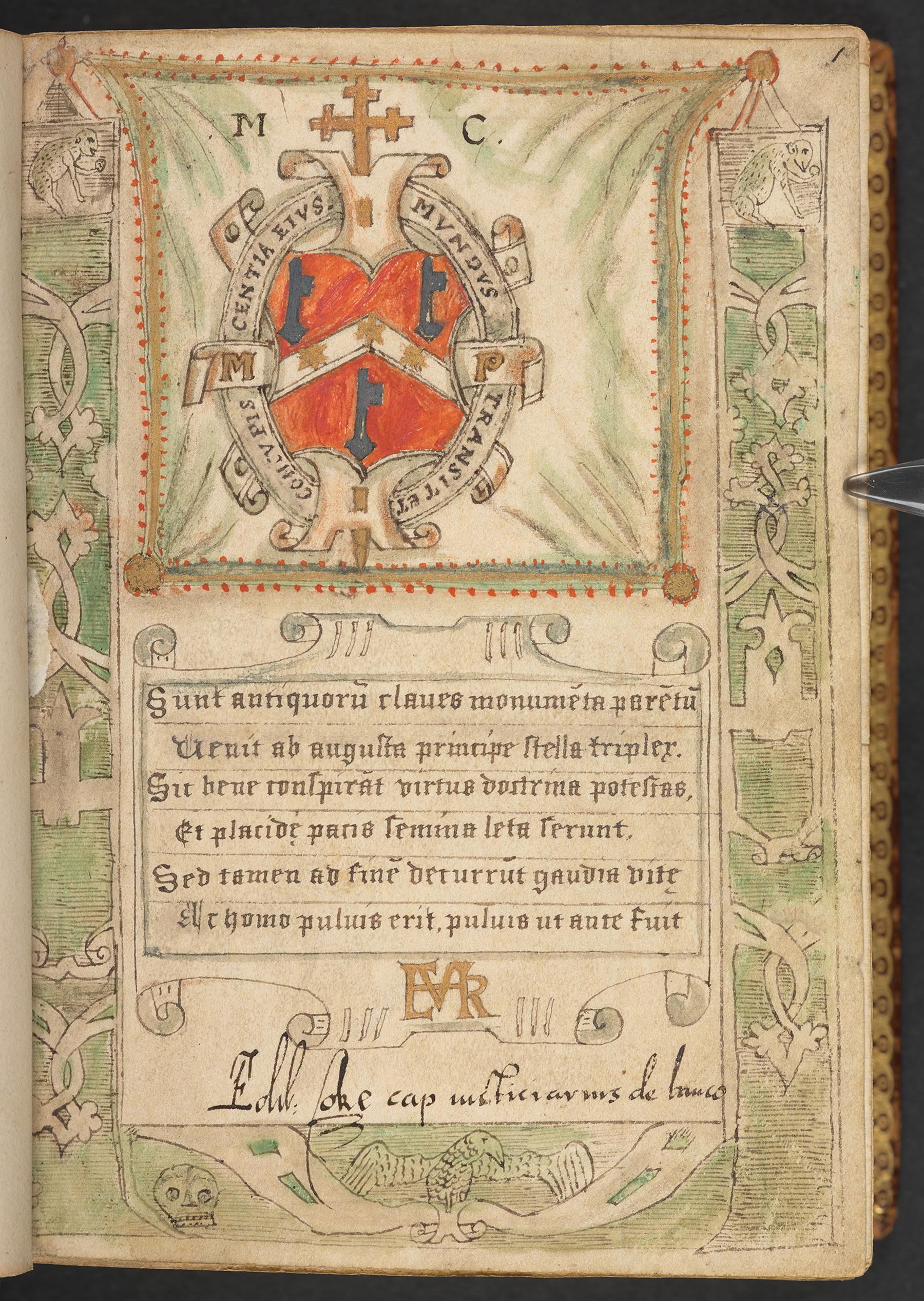
London, BL, MS. Add. 49366, fo. 3r: the elaborate frontispiece commissioned by Matthew Parker, archbishop of Canterbury, when he acquired this late twelfthcentury legal compilation of unknown provenance. The book consists of a copy of Quadripartitus, amplified in the twelfth century with other materials. It was highly unusual for Parker to provide a frontispiece for one of his medieval manuscripts. The poem which is featured on the frontispiece was written by Walter Haddon, a civil lawyer, Latin poet, and associate of Parker. It is identified and printed below, p. 340 n. 45. The book later came into the hands of Sir Edward Coke, whose flamboyant signature is scrawled across the bottom of Parker’s frontispiece. It remained in his library at Holkham Hall until the twentieth century, and is often referred to as the Holkham Book. Reproduced by permission of the Trustees of the British Library.
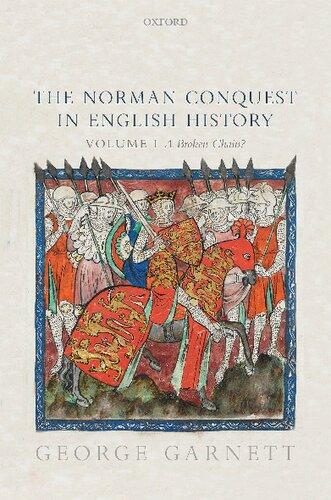
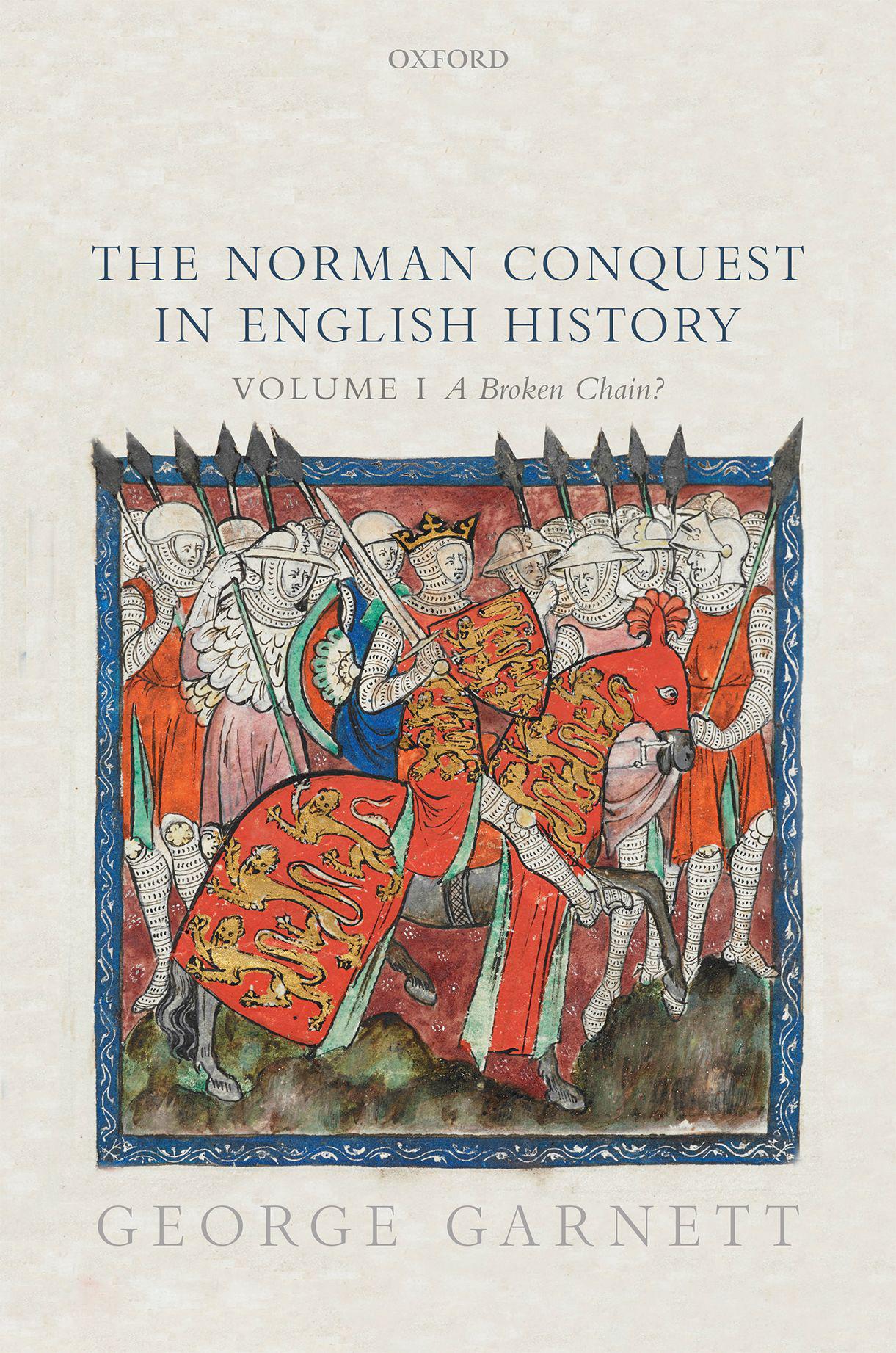
The Norman Conquest in English History
Volume I: A Broken Chain?
GEORGE GARNETT
1
Great Clarendon Street, Oxford, OX2 6DP, United Kingdom
Oxford University Press is a department of the University of Oxford. It furthers the University’s objective of excellence in research, scholarship, and education by publishing worldwide. Oxford is a registered trade mark of Oxford University Press in the UK and in certain other countries
All rights reserved. No part of this publication may be reproduced, stored in a retrieval system, or transmitted, in any form or by any means, without the prior permission in writing of Oxford University Press, or as expressly permitted by law, by licence or under terms agreed with the appropriate reprographics rights organization. Enquiries concerning reproduction outside the scope of the above should be sent to the Rights Department, Oxford University Press, at the address above
You must not circulate this work in any other form and you must impose this same condition on any acquirer
Published in the United States of America by Oxford University Press
198 Madison Avenue, New York, NY 10016, United States of America
British Library Cataloguing in Publication Data Data available
Library of Congress Control Number: 2020937355
ISBN 978–0–19–872616–6
Printed and bound by CPI Group (UK) Ltd, Croydon, CR0 4YY
Links to third party websites are provided by Oxford in good faith and for information only. Oxford disclaims any responsibility for the materials contained in any third party website referenced in this work.
Acknowledgements
This book could never have been undertaken without the support of the Leverhulme Trust, which elected me to a Major Research Fellowship in 2008. The Fellowship afforded me the time to familiarize myself with periods and sources of which I then knew a lot less than I do now. Without support on that scale it would not have been possible for me to extend my range in such a way, mid-career.
Not only has the Trust been generous, its officials have also administered the process with the lightest of bureaucratic touches, quite out of keeping with the spirit of the age. The Trustees appear to have been content to wait patiently for the fruits, which have been far slower in appearing than my ludicrously optimistic original plans envisaged. I hope that this book will enable them to feel that their investment has at last begun to pay off.
When I began working on this subject I could not have anticipated how relevant it would become to contemporary national politics. The medieval history of England has again begun to be invoked in current political debate, if not (yet) to the same extent as it was in the seventeenth century. It has done so because the crux of that debate has become the constitution, as it was in the seventeenth century. Interpretation of the Conquest is fundamental to that of the constitution. Nigel Farage’s sporting of a Bayeux Tapestry tie when canvassing in the Rochester and Strood by-election in 2014 created the year’s most improbable fashion accessory. On 17 May 2016, during the European Union Referendum campaign, Boris Johnson accused the Remain campaign of ‘the biggest stitch-up since the Bayeux Tapestry.’1 On 17 September 2018 he suggested in his Daily Telegraph column that agreeing to the proposals recently made at Chequers by the then Prime Minister would have amounted to a pusillanimous acquiescence in foreign rule of a kind not seen ‘since 1066’.2 As Prime Minister himself, on 10 September 2019 he chose to be filmed participating in a lesson at Pimlico Primary School on the subject of the Conquest. On a more scholarly level, the eighth centenary of Magna Carta in 2015 celebrated in grand style an English exceptionalism sometimes defined, as it was in 1215, in terms of a restored, mythically autonomous pre-Conquest past and a reaffirmed aboriginal law. That was so in the seventeenth century too.
2 The Daily Telegraph, 17 September 2018; cf. G. Garnett, ‘Did English Leaders “Deliberately Acquiesce” in 1066’, BBC History Magazine Extra, September 2018; D. Hannan, ‘The Norman Conquest was a Disaster for England. We Should Celebrate Naseby, not Hastings’, The Daily Telegraph, 14 October 2016.
In 2019 seventeenth-century precedents have been invoked repeatedly.3 Some of them have followed common law tradition in assuming a law of immemorial antiquity, untouched by the Conquest. That was implicit in the judgment of the Supreme Court handed down on 24 September 2019, on the unlawfulness of the recent purported prorogation of Parliament—a purported prorogation choreographed to conclude on the anniversary of the battle of Hastings. The reasoned section of that judgment began by invoking Sir Edward Coke’s report of the socalled Case of Proclamations, already relied upon by Lord Pannick QC in his advocacy before the court, and in the antecedent proceedings.4 I hope that the following detailed account of development in English understanding of the Conquest in historiographical, legal, and political discussion over half a millenium may offer a more nuanced perspective on the very long history of this peculiarly persistent English mode of political legitimation.
Anyone familiar with the work of my second doctoral supervisor, Jim Holt, will realize that an important part of the inspiration came from two of his essays on the English constitutional tradition, and from the opening chapter of his Magna Carta, which approaches his subject retrogressively, from a seventeenth-century, legal vantage point. His supervisor, V.H. Galbraith, took a very dim view of his doing so—‘a dreadful start . . . stupid, anachronistic mis-understanding’5—but Holt stuck to his guns, in my view rightly so. Although he discussed my original plans with me, and supplied one of my letters of reference (though refusing point blank to do so in the required email format), the resulting book is the poorer in that it has not benefited from what would have been criticism as forthright as that he had received from his own supervisor.
The book has, however, at every stage, from initial conception to final draft, been discussed and read by my fellow Holt pupil and closest intellectual collaborator, John Hudson. His suggestions are frequently acknowledged in the footnotes
3 On 18 March 2019 the Speaker of the House of Commons cited a precedent from 2 April 1604 (Commons Journals (1547–1628), p. 162) to justify refusing to allow the Government to bring forward a motion for a third time in a single parliamentary session for a so-called meaningful vote on the Brexit deal negotiated between the Government and the EU: T. Erskine May, Parliamentary Practice, 24th edn (London 2011), p. 397.
4 R (Miller) v. Prime Minister; Cherry v. Advocate General of Scotland [2019] UKSC 41, paras 32, 41; it was also given pride of place in the summary of the judgment. Cf. Lord Pannick, counsel for the appellant in UKSC 2019/0192, and in R (Miller) v. Prime Minister [2019] EWHC 2381 (QB). Coke’s 12 Reports, fos. 74–6 (Proclamations, Mich. 8 Jac. I; The Reports of Sir Edward Coke, Knt. In Thirteen Parts, ed. J.H. Thomas and J.F. Fraser, 13 Parts in 6 vols (London 1826), vi). It is not a report of a court case, but of an opinion delivered by Coke when it was solicited by the Lord Chancellor and sundry other law officers. Coke records himself concluding that ‘the King hath no prerogative, but that which the law of the land allows him’. In support of this, he reports citing, amongst other authorities, Sir John Fortescue’s De laudibus legum Anglie, c. 9, one of Fortescue’s key discussions differentiating a king who ruled ‘politically and regally’ from one who ruled simply ‘regally’; for the implications of this distinction for understanding of the Conquest, see below, pp. 273–4. I should like to thank Mike Macnair and David Pannick for help with this note.
5 Private letter commenting on a late draft of Holt’s book, and dated ‘?3 September [1964]’: Holt Archive, University of St Andrews.
below, but they give a very inadequate impression of the extent of his contribution. I am unsure whether he will interpret this as an unalloyed compliment, but for me he has come to fill Jim’s shoes, though some of the hobnails seem to have been removed.
I must also acknowledge the continuing influences on my approach of my first supervisor, Walter Ullmann, several of whose few works on English subjects proved fecund in the development of the argument, and that of Quentin Skinner, whose Special Subject remains formative forty years after I took it. For me, an important lesson of the latter was that many early modern thinkers continued to frame their arguments in medieval terms—a lesson with an obvious bearing on the current project. Like many of those who taught me in that golden age of the Cambridge History Faculty—Jonathan Riley-Smith and Brendan Bradshaw leap to mind—Walter and Quentin inculcated a belief that trying to understand what people thought, and how thought informed action, is the most interesting and rewarding challenge in historical inquiry.
It is also a pleasure to record the importance of my time as a Title A (Research) Fellow of St John’s College, Cambridge. Toby Milsom and Peter Linehan were both then Fellows, and Peter was working on a book about the history and historiography of medieval Spain which bears some similarities to what I have attempted.
My role as convenor for the Oxford History Faculty’s Special Subject on the Norman Conquest of England has required me to reflect on all sorts of aspects of the topic. John Blair and I continue to disagree in our overall interpretation of the Conquest, but listening to his developing views on architecture has led me to appreciate its significance in ways which I would not have done otherwise, and I am grateful.
At the weekly class, Stephen Baxter and I now put on public disputations reminiscent of those in which I once engaged with James Campbell and Patrick Wormald. From these I learn much. With respect to this book, however, I am even more indebted to Stephen for inviting me to deliver a lecture at King’s College, London in 2009, in memory of Patrick. It prompted me to begin to hone my thoughts at an early stage of the project.
Years of argument with Patrick forced me to refine my understanding of English legal matters. Much of what follows could not have been written without the foundations laid by his The Making of English Law, which will endure as one of the great works of scholarship on Anglo-Saxon history. Whereas Patrick was interested in the twelfth-century legal compilations for the light they might throw on pre-Conquest law, I have tried to use them as evidence of how pre-Conquest law was understood (and fabricated) in the twelfth century, and of how that reconstructed (or invented) law was exploited thereafter. Indeed, Quadripartitus and the various apocryphal codifications of Old English law with which it became associated are the most obvious thread running through the long period covered by this book. It remains a cause of great regret that I have had to do my best to
formulate and voice Patrick’s objections for him—though I could never hope to replicate the piercing, patrician insistence of his tone.
Still more important than Richard Sharpe’s classes on writs and charters and his published scholarship has been a series of early evening drinks with him, post class. Ruminating on some of his comments made me realize how I could tie together architectural transformation and the resurrection of English historical writing. In Durham Cathedral that realization became an epiphany.
Even after decades of teaching the Special Subject, tutorial discussion of the sources each year continues to prompt fresh insights, some of which I hastily jot down. It may not be invidious if I single out one fairly recent pupil, George Molyneaux, because he has had the generosity and patience to subject much of what follows to a forensic critique.
One of the advantages (or disadvantages) of attempting to cover such a long timescale, across several different fields, is that I have been obliged to give myself crash courses in subjects of which initially I knew little or almost nothing. In order to do so, I have unashamedly solicited the assistance of authorities. I have already mentioned Richard Sharpe, who has responded with an exacting patience to numerous inquiries on palaeographical and codicological matters, and has read much of the book in draft. The constructively unforgiving quality of his criticism is reminiscent of that of Jim Holt—there seems to be something distinctive about medieval historians who hail from Yorkshire (a view shared by Galbraith, another Yorkshireman).
I must also thank John Baker, who has been generous, encouraging, and instructive by turns, as I have attempted to grapple with English common law in the later middle ages and early modern period. Others who have read and commented on portions include Paul Brand, Hugh Brodie, Hugh Doherty, Elinor Garnett, Adam Leach, Katie McKeogh, John Pocock, Magnus Ryan, Liesbeth van Houts, and George Woudhuysen. The prospect of John Gillingham’s relentless scepticism has been an important discipline. At the very beginning, Barbara Harvey gave me much needed orientation in later medieval English history. In the final stages, Gregory Garnett acted as computer technician. I have tried to acknowledge all other assistance in the footnotes.
I am indebted to the many librarians whose patience I may from time to time have tried, most often through electronic ineptitude. These include the staffs of the Bodleian Library (perhaps especially Isabel Holowaty, its History Librarian, who seems willing to answer queries at any time of any day or night), of Cambridge University Library, of the Manuscripts Reading Room in the British Library, and last but most, of St Hugh’s College. Nora Khayi, the College’s Librarian, and her recent locum Marjory Szurko, have been as receptive to suggestions for recondite acquisitions as they have been willing to turn a blind eye to borrowing in grotesque excess of any prescribed limits.
I am grateful to St Hugh’s and my other Oxford college, Lady Margaret Hall, for allowing me periods of sabbatical leave, and to my tutorial colleagues over the last decade, especially Jon Parkin and Grant Tapsell, for covering for me while I have taken it. Other colleagues in the wider Oxford History Faculty who deserve a special thank you are Rana Mitter, Julia Smith, and John Watts, who collectively persuaded the University to award me an extra term’s leave in order to put the finishing touches to the typescript. In addition, John quietly made 2018 the Faculty’s 1956.
It is a pleasure to acknowledge the nurturing I have received from Stephanie Ireland, Cathryn Steele, and Katie Bishop, my editors at OUP.
Finally (in chronological terms), I am indebted to another taker of the Special Subject, Kerrith Davies, who responded to a last-minute plea for help by agreeing to compile the index. That he was willing to do so even after indexing an earlier book of mine is a sign of true friendship.
I have yet to mention the one person who has not only read the whole more times than she will wish to remember, but also ended up living with it on a daily basis, even on successive Cretan holidays. Helen Pike covered drafts of every part with characteristically purple (in literal more than metaphorical terms) criticism, and buoyed me up through the darker intervals, repeatedly advising that close study of Quadripartitus was bound to be deleterious to health. That it seems in the event not to have proved to be so is thanks to her, and to Elinor, Edmund, and Gregory. They have all supported, diverted, and delighted me, the last three tolerating the Broken Chain rattling in the background for almost half their lives.
This book is for Helen.
Oxford 14 October 2019
1. The Early Twelfth-Century Perspective in English Historical Writing 13
2. The Audiences for English History in the Early Twelfth Century 81
3. The Excavation, Reconstruction, and Fabrication of Old English Law in the Twelfth Century 104
4. Edward the Confessor: From Critical Standard to Patron Saint 132
5. The Conquest in Historical Writing from the Late Thirteenth Century 173
6. The Conquest in Later Medieval English Law I: Jurisprudence and Forensic Practice in the Thirteenth Century 209
7. The Conquest in Later Medieval English Law II: Edward II’s Reign and After
8. The Preservation of the Sources for English Medieval History in the Sixteenth Century 286
9. Elizabethan Study of Old English Law and Its Post-Conquest Endorsement
10. The Printing of Twelfth-Century English Historiography, and the Integration of Law with History 360
List of Plates
Between pp. 234 and 235.
1. London, BL, MS. Yates Thompson 26, fo. 1v: Bede kissing the feet of St Cuthbert. Reproduced by permission of the Trustees of the British Library.
2. Malibu, J. Paul Getty Museum, MS. Ludwig XI. 6, fo. 44v: a portrait of Eadmer writing. Reproduced by permission of the Trustees of the J. Paul Getty Museum.
3. London, BL, MS. Cotton Vespasian B. xx, fo. 95v: from Book 1 of Goscelin of St-Bertin’s account of the translatio of St Augustine’s relics. Reproduced by permission of the Trustees of the British Library.
4. London, BL, MS. Yates Thompson 26, fo. 2r: Bede writing. Reproduced by permission of the Trustees of the British Library.
5. William of Jumièges presenting his history to William the Conqueror: Rouen, BM MS. 1174 (714), fo. 116r. Reproduced by permission of the Bibliothèque Municipale de Rouen.
6. A watercolour by Charles Stothard of the coronation of St Edward from walls of the Painted Chamber of Henry III (1263–72), in the medieval Palace of Westminster. Reproduced by permission of the Society of Antiquaries.
7. Cambridge, UL, MS. Ee. 3.59, fo. 29r: death and reception of St Edward in heaven, illustrated in La Estoire de Seint Ædward le rei. Reproduced by permission of the Syndics of Cambridge University Library.
8. The interior left wing of the Wilton Diptych, which depicts a kneeling Richard II, flanked by Edmund of East Anglia, Edward the Confessor, and John the Baptist. Reproduced by permission of the Trustees of the National Gallery.
9. Statues on the ruined, thirteenth-century west end of Crowland Abbey church. Reproduced by permission of Crowland Abbey.
10. London, BL, MS. Cotton Cleopatra D. ix, fo. 51r: an excerpt from the early fourteenthcentury Lichfield Chronicle. Reproduced by permission of the Trustees of the British Library.
11. Cambridge, Corpus Christi College, MS. 258, fo. 1r: Mirror of Justices, title page. Reproduced by permission of the Master and Fellows of Corpus Christi College.
12. William Lambarde, portrait in oils by an unknown artist, c. 1600. Reproduced by permission of the Trustees of the National Portrait Gallery.
13. London, BL, MS. Add. 62540: a self-portrait sketch by Laurence Nowell. Reproduced by permission of the Trustees of the British Library.
List of Abbreviations
Acta, ed. Sharpe Acta of William II and Henry I, ed. R. Sharpe: http://actswilliam2henry1.wordpress.com/
AM Annales monastici, ed. H.R. Luard, 5 vols, RS (1864–69)
ANS Anglo-Norman Studies
ASE Anglo-Saxon England
Bede, HE Bede, Historia ecclesiastica gentis Anglorum (BI)HR (Bulletin of the Institute of) Historical Research
BL British Library
Bracton Bracton on the Laws and Customs of England, ed. G.E. Woodbine, trans. and rev. S.E. Thorne, 4 vols (Cambridge, MA, 1968–77)
CBMLC Corpus of British Medieval Library Catalogues
CCC Corpus Christi College
CCCM Corpus Christianorum, continuatio medievalis
CCR Calendar of Charter Rolls, 6 vols (London 1903–27)
CM Matthaei Parisiensis, monachi Sancti Albani, chronica majora, ed. H.R. Luard, 7 vols, RS (1872–83)
Cod Codex Iustiniani
CREE Chronicles of the Reigns of Edward I and Edward II, ed. W. Stubbs, 2 vols, RS (1882–83)
CRR Curia Regis Rolls preserved in the Public Record Office: Richard I – 1250, 20 vols (London 1922–2007)
CRSHR Chronicles of the Reigns of Stephen, Henry II and Richard I, ed. R. Howlett, 4 vols, RS (1884–89)
C&S I Councils & Synods, with Other Documents Relating to the English Church, I, ad 871–1204, Parts i and ii, ed. D. Whitelock, M. Brett, and C.N.L. Brooke (Oxford 1981)
C&S II Councils & Synods, with Other Documents Relating to the English Church, II, ad 1205–1313, Parts i and ii, ed. F.M. Powicke and C.R. Cheney (Oxford 1964)
Davis, MC G.R.C. Davis, Medieval Cartularies of Great Britain and Ireland, rev. C. Breay, J. Harrison, and D.M. Smith (London 2010)
DB Domesday Book, 4 vols, ed. A. Farley (London 1783–1816)
Dig. Digestum Iustiniani
EcHR Economic History Review
Eadmer, HN Eadmeri historia novorum in Anglia, ed. M. Rule, RS (1884)
edn edition
EHR English Historical Review
Foedera Foedera, conventiones, litterae et cujuscunque generis acta publica, ed. T. Rymer, new edn, 4 vols. in 7 parts (Record Commission 1816–69)
xviii List of Abbreviations
Fulman, Scriptores Scriptores Rerum Anglicarum scriptores veteres, ed. W. Fulman (Oxford 1684)
Gesetze F. Liebermann, Die Gesetze der Angelsachsen, 3 vols (Halle 1903–16)
GG William of Poitiers, Gesta Guillelmi, ed. M. Chibnall and R.H.C. Davis (Oxford 1998)
Glanvill
The Treatise on the Laws and Customs of the Realm of England commonly called Glanvill, ed. G.D.G. Hall, rev. M.T. Clanchy (Oxford 1993)
GND The Gesta Normannorum ducum of William of Jumièges, Orderic Vitalis, and Robert of Torigni, ed. E.M.C. van Houts, 2 vols (Oxford 1992–95)
GP William of Malmesbury, Gesta pontificum Anglorum, ed. M. Winterbottom, 2 vols (Oxford 2007)
GR William of Malmesbury, Gesta regum Anglorum, ed. R.A.B. Mynors, R.M. Thomson, and M. Winterbottom, 2 vols (Oxford 1998)
HA Henry, Archdeacon of Huntingdon, Historia Anglorum, ed. D. Greenway (Oxford 1996)
HNa William of Malmesbury, Historia novella, 2nd edn, ed. E. King, trans. K.R. Potter (Oxford 1998)
HSJ Haskins Society Journal
JEH Journal of Ecclesiastical History
JW The Chronicle of John of Worcester, ed. R.R. Darlington and P. McGurk, 3 vols (Oxford 1995–)
Ker, MLGB
N.R. Ker, ed., Medieval Libraries of Great Britain. A List of Surviving Books, 2nd edn (London 1964); Supplement to the Second Edition, ed. A.G. Watson (London 1987)
LECf Leges Edwardi Confessoris
LHP Leges Henrici primi, ed. L.J. Downer (Oxford 1972)
Litt. T. Littleton, Tenures novelli, first edition c. 1481
LMA London Metropolitan Archives
LP Letters and Papers, Foreign and Domestic, of the Reign of Henry VIII, ed. J.S. Brewer et al., 21 vols in 33 (London 1862–1932)
MGH Monumenta Germaniae Historica
ODNB
H.C.G. Matthew and B. Harrison, eds, Oxford Dictionary of National Biography (Oxford 2004); and electronic supplements: http://www. oxforddnb.com/view/article
OV Orderic Vitalis, Historia ecclesiastica, ed. M. Chibnall, 6 vols (Oxford 1969–80)
PBA Proceedings of the British Academy
PL Patrologiae cursus completus, Series Latina, ed. J.P. Migne, 221 vols (Paris 1844–65)
P&M F. Pollock and F.W. Maitland, The History of English Law before the Time of Edward I., 2nd edn, 2 vols, reissued with a new introduction by S.F.C. Milsom (Cambridge 1968)
Potthast A. Potthast, ed., Regesta pontificum romanorum (1198–1304), 2 vols (Berlin 1874–75)
PQW Placita de quo warranto, temporibus Edw. I, II, & III, Record Commission (1818)
PRS Pipe Roll Soc
RCR
Rotuli curiae regis, ed. F. Palgrave, 2 vols, Record Commission (1835)
Reg Regesta regum Anglo-Normannorum: The Acta of William I, 1066–1087, ed. D. Bates (Oxford 1998)
repr. reprinted
RH
Rotuli hundredorum, 2 vols, Record Commission (1812–18)
RP Rotuli parliamentorum, 6 vols (London 1767–77)
RS Rolls Series
S.
Seipp
P.H. Sawyer, Anglo-Saxon Charters: An Annotated List and Bibliography (London 1968), revised and updated at http:// www.esawyer.org.uk/
D.J. Seipp’s Abridgement, which indexes all Year Book reports printed for all the years between 1268 and 1535, and many of the reports printed only in alphabetical abridgements: www. bu.edu/law/faculty-scholarship/legal-history-the-year-books/ ser. series
Soc. Society
SR Statutes of the Realm, 11 vols (London 1810–28)
TCBS
Tite, Records
Transactions of the Cambridge Bibliographical Society
C.G.C. Tite, The Early Records of Sir Robert Cotton’s Library. Formation, Cataloguing, Use (London 2003)
TRHS Transactions of the Royal Historical Society
VSD Vita Sancti Dunstani
VSW
Vita Sancti Wulfstani, in William of Malmesbury, Saints’ Lives. Lives of SS. Wulfstan, Dunstan, Patrick, Benignus and Idract, ed. M. Winterbottom and R.M. Thomson (Oxford 2002), pp. 1–155
Walt. Cov. Memoriale fratris Walteri de Coventria, ed. W. Stubbs, 2 vols, RS (1872–73)
WAM Westminster Abbey Muniments
Wormald, Legal Culture
Wormald, Making
P. Wormald, Legal Culture in the Early Medieval West. Law as Text, Image and Experience (London 1999)
P. Wormald, The Making of English Law: King Alfred to the Twelfth Century, Vol. I, Legislation and its Limits (Oxford 1999)
Introduction
From 1066 successive Norman kings of the English presented themselves as the Old English royal line continued. They came close to glossing over the fact that the kingdom had been conquered at all. Their legitimacy as kings was founded on an official version of certain key events, or rather alleged events, primarily of the 1050s and 1060s. Very quickly, this version of recent history became intrinsic to the operations of the new regime. This was already the case prior to the first extant written statement of Duke William’s claim to the throne of England, in William of Jumièges’s Gesta Normannorum ducum, c. 1071. In the name of continuity with Edward the Confessor’s England, this version of events played an important part in shaping the way in which the kingdom was brutally transformed: most fundamentally in terms of who held land on what terms, and most visibly in terms of architecture. Domesday Book was the monumental written consummation of the tendentious premise that nothing had changed since King Edward’s day, at least so far as tenurial structure was concerned. Many of the individual tenants, clerical as well as lay, might be different, but they all held as successors of Edwardian antecessores, and the tenurial system was presented as unaltered. The Book purported to be an objective record of facts, most importantly the corresponding facts for any particular tenancy at two fixed points: ‘now’, in 1086, and ‘in the time of King Edward’, meaning on 5 January 1066, the day of Edward’s death. This chronological framework, first formulated many years before the Domesday Survey had been conceived, meant that the Book embodied an official history which was already deeply entrenched by 1086. The consequences of the transformation in the kingdom of England which had been administered by reference to that interpretation of the past were so fundamental that they continued to set the context of politics in the twelfth century, and in some respects long afterwards.
Twenty years after 1066, Domesday Book was the most substantial early treatment of change over the Conquest, but change disguised as continuity with the Old English past. This study addresses many subsequent treatments in different forms of the same issue, over a far longer time scale. It considers the roles that the Norman Conquest played in English historical writing, in English law, and in English political argument, over a period from c. 1090 to c. 1700. The subject has
The Norman Conquest in English History: Volume I: A Broken Chain? George Garnett, Oxford University Press (2021).
proved to be so vast that it has been necessary to divide the study into two volumes. This first volume takes the story up to the point in the early seventeenth century when the bulk of what were then recognized as the most important sources on the Conquest and what had preceded it had become widely available in print. The second volume will begin a little earlier than the end of the first. It will examine the use made of these materials in scholarship and in political debate from the later years of Elizabeth’s reign into and through the seventeenth century, when the Conquest rapidly became an even more contested issue than it had been in the twelfth.
This first volume opens by showing how and why, within forty years of 1066, a number of writers suddenly and almost simultaneously began to write Latin histories not just of their own monastic houses, but of England. Almost all of them were demonstrably monastic precentors, so in charge of libraries, recordkeeping, and liturgy in their communities. Ex officio, they found themselves at the nub of establishing and demonstrating continuity over the Conquest. They were obliged to play a key part in dealing with the implications of the comprehensive rebuilding of the kingdom’s major churches, most pressingly establishing which saints’ relics merited translation from the old into the new churches. They also had to ensure that their institutions’ titles to estates were reliably documented, in a context where traditional titles to land, like traditional claims to sanctity, were subject to newly intense, sceptical scrutiny. The scale of the demolition and construction work which surrounded them must have constituted an even more insistent daily reminder of transformation than the intermittent threats to ancient landed possessions. In diverse locations around the kingdom, these writers appear to have recognized that it was necessary to reconstruct, or more accurately to construct, a history of England which traversed the Conquest and reached back at least as far as the conversion to Christianity of the Angles and Saxons—collectively termed the English—at the very end of the sixth century and beginning of the seventh. In doing so they were well aware that they were resurrecting a literary genre which to most intents and purposes appeared to have died out in this island with the demise of Bede, the great historian of the conversion, almost four centuries before. Bede’s shadow fell on each of them in a different way, but they were all acutely conscious that they were writing in it. Each after his own fashion sought to provide an historiographical continuation (or in Geoffrey of Monmouth’s revealingly exceptional case, prologue) to Bede’s Historia ecclesiastica gentis Anglorum, which the intervening centuries had lacked. They did not work in isolation; many of them were demonstrably aware of what their peers were up to. Precentors in different houses were obliged to correspond with each other by one of their official duties: the commemoration of the dead.
William of Malmesbury, by his own estimation and that of posterity the preeminent member of this select group, and certainly the most learned in classical literature, neatly formulated the point in a metaphor he adapted from the late
antique model provided by the preface to Justinus’ epitome of the otherwise lost histories of Pompeius Trogus. English historical writing was a chain which had been broken with the death of Bede. William and his contemporaries—Eadmer of Canterbury, Florence and John of Worcester, Symeon of Durham, and the secular canon and archdeacon Henry of Huntingdon being the most prominent at the time and subsequently—were attempting to forge a long new section of chain, to be linked to what had been left dangling in 735.
For reasons discussed below in Chapter 1, it seems likely that they were right to think that Latin historical writing in England had all but died out after Bede. Why this should have happened here, in striking contrast to West and later East Francia, to Italy and Iberia, is a very interesting question which has scarcely been touched upon by modern historians of the AngloSaxon period.1 An obvious factor is likely to have been the continuing and unique importance of the written vernacular throughout the various kingdoms of England. This was still very much the case after the English kingdom had been formed in the early tenth century. Indeed, it remained so until the half century after the Conquest, when written Old English quickly became obsolescent as a language of legislation, administration, and devotion. But why the role of the vernacular might have made English monks disinclined to write history in Latin is not immediately apparent. History was an antique genre, so it was probably difficult to conceive of writing it—as distinct from the rudimentary and often shambolic vernacular annals of the various manuscripts of the Anglo-Saxon Chronicle, initiated at the end of the ninth century—in anything other than an antique language. The explanation for history’s postBedan demise in England is unlikely to be simple. To provide a fully satisfactory one for this particular instance of English exceptionalism would require a quite different book from that which follows.
The question arises because the sudden efflorescence of English historiography about England at the start of the twelfth century threw into striking relief the long, antecedent hiatus, which William of Malmesbury sought to characterize in the metaphor he borrowed and adapted from a Roman historian of the later Empire. That dramatic and in the event collaborative outburst, which burned most brightly in the second quarter of the century, is the subject of the opening two chapters. In the view of William and his contemporaries, writing the history of England and the English necessarily involved filling the postBedan gap, and in most cases also recapitulating in summary form much of Bede’s Historia ecclesiastica. Several of them also suggested that the Norman Conquest had represented some sort of break in the course of English history, as distinct from English historical writing. The Conquest was generally interpreted as a rupture of a magnitude exceeding that caused by any earlier invasion. But in so far as they felt the
1 J. Campbell, ‘Some TwelfthCentury Views on the AngloSaxon Past’, repr. in his Essays in AngloSaxon History (London 1986), pp. 209–28, at 216; J. Campbell, ‘Placing King Alfred’, in T. Reuter, ed., Alfred the Great. Papers from the Eleventh-Centenary Conferences (Aldershot 2003), pp. 3–23, at 21.
need to repair it, to trace connections with what had preceded it, they were obliged to mend the historiographical chain which had been broken many centuries before it. Almost all of them were members of institutions which had survived it, and most were charged with establishing and recording aspects of the continuous life of their churches stretching back into the distant past. For this reason a study of the Conquest’s role in the germination of English historiography about England necessarily involves a consideration not only of the treatment of the Conquest itself by these historians, but also of their awareness that they were writing up for the first time most of English history in the interval between the death of Bede and the immediate aftermath of the Conquest. Mending the historical chain involved mending the historiographical chain.
It is striking that one difference between Eadmer’s Historia novorum, the earliest of these works, and those which followed was that he did not attempt to mend the latter chain. He was concerned with explaining what the Conquest had changed, and why, not with writing a sequel to Bede, though he was acutely conscious of the Bedan model of ecclesiastical history. He opened his account not in the early eighth century but in the second half of the tenth, in the reign of Edgar. In his view it offered a model of equable collaboration between king and prelacy, in counterpoint to the tension which had come to prevail in the aftermath of the Conquest. Things had begun to go awry long before, shortly after Edgar’s death, with the sacrilegious outrage of the assassination of his son and immediate successor, Edward the Martyr. That abomination had brought God’s wrath down on the heads of the English. The Conquest had been the latest and most devastating in a succession of divinely ordained afflictions. There could be no certainty that it would turn out to be the last. Eadmer’s immediate historiographical successors expressed enormous admiration for his book, and drew on it. Some of them evidently sympathized with his assessment of the Conquest as providential punishment for sin, Old Testamentstyle. But none of them borrowed his starting point. Although, like him, they were attempting to explain the Conquest, unlike him this prompted them in their various ways to try to mend the broken historiographical chain.
Their research excavated and preserved most of what we know about Old or AngloSaxon England, and organized it in a fashion which has proved definitive ever since. In that sense, preConquest English history was largely created from a postConquest perspective, with the inevitable consequence of reading current early twelfthcentury preoccupations back into the AngloSaxon past. We are all familiar with the ‘Beyond’—meaning the retrospective extrapolation—of Domesday Book;2 something similar is more selfconsciously true of the great historians of England who wrote in the half century after the Book’s production.
2 F.W. Maitland, Domesday Book and Beyond. Three Essays in the Early History of England (Cambridge 1897).
In parallel with this intense, concentrated historiographical phenomenon— unparalleled in medieval Europe, and, in terms of analytical influence, throughout subsequent English history—was a simultaneous attempt to unearth, preserve, translate, and to a considerable extent to invent, Old English royal law, conventionally termed, after the Conquest, the ‘law of King Edward’ (Chapter 3). This William the Conqueror was said and shown, by and large, to have endorsed— much like other aspects of the Edwardian status quo. It was a further manifestation of continuity with Old England. The research project into preConquest law was much more focused in terms of subject than that into preConquest history. It was, however, less concentrated in terms of duration: it was still in train in the thirteenth century. By contrast with the historiographical project, the names of the scholars who engaged in it are unknown, or can only be guessed at. But it reached back just as far into the Old English past, and it was animated by similar imperatives. Sometimes its products appeared in the same manuscripts as the histories; sometimes they were clumsily spliced into the very text of the histories; often they were written up in law books which contained no accompanying historical narrative. Precentors who were charged with record keeping and drafting documents were likely to be sensitive to legal matters, and were also likely to appreciate that they sometimes required awareness of an historical dimension. But those who engaged in this highly specialized type of research and fabrication are unlikely to have been precentors, because precentors’ professional responsibilities did not involve the use of royal legislative texts (as distinct from royal charters and writs). They may have needed to consult from time to time the glossaries of Old English technical terms which were compiled in the twelfth century, partly on the basis of the codes. But that is a quite different matter from compiling, translating or confecting codes, which in any case say almost nothing about land law.
The resulting collections of genuine and apocryphal Old English codes, often translated with varying levels of competence into Latin, together with various codified versions of what purported to be the Conqueror’s legislation, are conventionally judged to have been quite rapidly superseded by the results of a series of new legal procedures invented in the later twelfth century. It is these new procedures which we now see as the origins of English common law. They are generally considered to have represented a fresh start, and not in any sense to be dependent on the antiquated and moribund legislative relics of Old England, or what in the early twelfth century was considered to have been Old English law. One of the claims advanced below is that many of the collections, most especially what purported to be the laws of King Edward which William I was said to have endorsed— imaginatively reconstructed in a number of pseudocodes, one of which is the earliest extant law code in French—continued to be recognized as an important foundation of current law, and therefore to exert influence throughout the rest of the middle ages and later. These texts, still revered and consulted for current