TheMechanicsofHydrogels:MechanicalProperties, Testing,andApplications(ElsevierSeriesin MechanicsofAdvancedMaterials)1stEditionHua Li(Editor)
https://ebookmass.com/product/the-mechanics-of-hydrogelsmechanical-properties-testing-and-applications-elsevierseries-in-mechanics-of-advanced-materials-1st-edition-huali-editor/
Instant digital products (PDF, ePub, MOBI) ready for you
Download now and discover formats that fit your needs...
Mechanics of Materials 9th Edition
https://ebookmass.com/product/mechanics-of-materials-9th-edition/
ebookmass.com
Mechanics Of Materials 7th Edition Beer
https://ebookmass.com/product/mechanics-of-materials-7th-edition-beer/
ebookmass.com
ISE Statics and Mechanics of Materials (ISE HED MECHANICAL ENGINEERING) 3rd Edition Ferdinand P. Beer
https://ebookmass.com/product/ise-statics-and-mechanics-of-materialsise-hed-mechanical-engineering-3rd-edition-ferdinand-p-beer/
ebookmass.com
Politics For Dummies 3rd Edition Ann Delaney
https://ebookmass.com/product/politics-for-dummies-3rd-edition-anndelaney/
ebookmass.com
Questions of Syntax Richard S. Kayne https://ebookmass.com/product/questions-of-syntax-richard-s-kayne/
ebookmass.com
The Benefit of Hindsight Susan Hill
https://ebookmass.com/product/the-benefit-of-hindsight-susan-hill/
ebookmass.com
Sturdevant's Art & Science of Operative Dentistry: Second South Asia Edition V. Gopikrishna
https://ebookmass.com/product/sturdevants-art-science-of-operativedentistry-second-south-asia-edition-v-gopikrishna/
ebookmass.com
Eastern Front 1945: Triumph of the Soviet Air Force 1st Edition William E. Hiestand
https://ebookmass.com/product/eastern-front-1945-triumph-of-thesoviet-air-force-1st-edition-william-e-hiestand/
ebookmass.com
Gordon's Lost Mittens (Found by Daddy Book 7) Della Cain & Kaytea Kat
https://ebookmass.com/product/gordons-lost-mittens-found-by-daddybook-7-della-cain-kaytea-kat/
ebookmass.com
Legally Mated (MM Gay Mpreg Romance) (Mercy Hills Pack Book 5) Ann-Katrin Byrde [Byrde
https://ebookmass.com/product/legally-mated-mm-gay-mpreg-romancemercy-hills-pack-book-5-ann-katrin-byrde-byrde/
ebookmass.com
TheMechanicsof Hydrogels MechanicalProperties,Testing,and Applications
Editedby
HuaLi
SchoolofMechanicalandAerospace Engineering,NanyangTechnologicalUniversity, Singapore
VadimSilberschmidt
WolfsonSchoolofMechanical,Electricaland ManufacturingEngineering,Loughborough University,Loughborough,UnitedKingdom
WoodheadPublishingisanimprintofElsevier
50HampshireStreet,5thFloor,Cambridge,MA02139,UnitedStates TheBoulevard,LangfordLane,Kidlington,OX51GB,UnitedKingdom
Copyright © 2022ElsevierLtd.Allrightsreserved.
Nopartofthispublicationmaybereproducedortransmittedinanyformorbyanymeans, electronicormechanical,includingphotocopying,recording,oranyinformationstorage andretrievalsystem,withoutpermissioninwritingfromthepublisher.Detailsonhowto seekpermission,furtherinformationaboutthePublisher’spermissionspoliciesandour arrangementswithorganizationssuchastheCopyrightClearanceCenterandthe CopyrightLicensingAgency,canbefoundatourwebsite: www.elsevier.com/permissions.
Thisbookandtheindividualcontributionscontainedinitareprotectedundercopyrightby thePublisher(otherthanasmaybenotedherein).
Notices
Knowledgeandbestpracticeinthis fieldareconstantlychanging.Asnewresearchand experiencebroadenourunderstanding,changesinresearchmethods,professional practices,ormedicaltreatmentmaybecomenecessary.
Practitionersandresearchersmustalwaysrelyontheirownexperienceandknowledgein evaluatingandusinganyinformation,methods,compounds,orexperimentsdescribed herein.Inusingsuchinformationormethodstheyshouldbemindfuloftheirownsafety andthesafetyofothers,includingpartiesforwhomtheyhaveaprofessionalresponsibility.
Tothefullestextentofthelaw,neitherthePublishernortheauthors,contributors,or editors,assumeanyliabilityforanyinjuryand/ordamagetopersonsorpropertyasamatter ofproductsliability,negligenceorotherwise,orfromanyuseoroperationofanymethods, products,instructions,orideascontainedinthematerialherein.
ISBN:978-0-08-102862-9
ForinformationonallWoodheadPublishingpublicationsvisitourwebsiteat https://www.elsevier.com/books-and-journals
Publisher: MatthewDeans
AcquisitionsEditor: DennisMcGonagle
EditorialProjectManager: TomMearns
ProductionProjectManager: AnithaSivaraj
CoverDesigner: MatthewLimbert
TypesetbyTNQTechnologies
ElsevierSeriesinMechanicsofAdvanced Materials Editor-in-Chief
VadimV.Silberschmidt LoughboroughUniversity,UK
SeriesEditors
ThomasB€ ohlke KarlsruheInstituteofTechnology,Germany
DavidMcDowell GeorgiaInstituteofTechnology,USA
ChenZhong NanyangTechnologicalUniversity,Singapore
Listofcontributors MarkAhearne DepartmentofMechanical,ManufacturingandBiomedicalEngineering,SchoolofEngineering,TrinityCollegeDublin,TheUniversityofDublin, Dublin,Ireland;TrinityCentreforBiomedicalEngineering,TrinityBiomedicalSciencesInstitute,TrinityCollegeDublin,TheUniversityofDublin,Dublin,Ireland
XingGao ResearchCentreforMedicalRoboticsandMinimallyInvasiveSurgical Devices,ShenzhenInstitutesofAdvancedTechnology,ChineseAcademyofSciences,Shenzhen,Guangdong,China
K.B.Goh SchoolofEngineering,MonashUniversityMalaysia,BandarSunway, Selangor,Malaysia
MohammadR.Islam DepartmentofOphthalmology,UniversityofPittsburgh, Pittsburgh,PA,UnitedStates
J.JinchengLei InternationalCenterforAppliedMechanics,StateKeyLaboratory forStrengthandVibrationofMechanicalStructures,Xi’anJiaotongUniversity,Xi’an, Shaanxi,China
HuaLi SchoolofMechanical&AerospaceEngineering,NanyangTechnological University,Singapore,RepublicofSingapore
ZiqianLi InternationalCenterforAppliedMechanics,StateKeyLaboratoryfor StrengthandVibrationofMechanicalStructures,Xi’anJiaotongUniversity,Xi’an, Shaanxi,China
QiminLiu SchoolofCivilEngineeringandArchitecture,WuhanUniversityof Technology,Wuhan,Hubei,PRChina
ZishunLiu InternationalCenterforAppliedMechanics,StateKeyLaboratoryfor StrengthandVibrationofMechanicalStructures,Xi’anJiaotongUniversity,Xi’an, Shaanxi,China
TongqingLu StateKeyLaboratoryforStrengthandVibrationofMechanicalStructures,InternationalCenterforAppliedMechanics,DepartmentofEngineering Mechanics,Xi’anJiaotongUniversity,Xi’an,Shannxi,China
LianhuaMa CollegeofQualityandTechnicalSupervision,HebeiUniversity, Baoding,PRChina
YinggangMiao JointInternationalResearchLaboratoryofImpactDynamicsand ItsEngineeringApplications,SchoolofAeronautics,NorthwesternPolytechnicalUniversity,Xi’an,Shaanxi,China
x Listofcontributors
MichelleL.Oyen DepartmentofBiomedicalEngineering,WashingtonUniversity inSt.Louis,St.Louis,MO,UnitedStates
Zhi-JunShi CollegeofLifeScienceandTechnology,HuazhongUniversityofScienceandTechnology,Wuhan,Hubei,China
VadimV.Silberschmidt WolfsonSchoolofMechanical,ElectricalandManufacturingEngineering,LoughboroughUniversity,Leicester,UnitedKingdom
EmrahSozumert WolfsonSchoolofMechanical,ElectricalandManufacturing Engineering,LoughboroughUniversity,Leicester,UnitedKingdom
WilliamToh SchoolofMechanicalandAerospaceEngineering,NanyangTechnologicalUniversity,Singapore,Singapore
XingquanWang DepartmentofEngineeringMechanics,FacultyofMaterialsand Manufacturing,BeijingUniversityofTehnology,Beijing,PRChina
TaoWu SchoolofMechanics,CivilEngineeringandArchitecture,Northwestern PolytechnicalUniversity,Xi’an,Shaanxi,PRChina;MIITKeyLaboratoryofDynamicsandControlofComplexSystems,Xi’an,Shaanxi,PRChina
ShuaiXu InternationalCenterforAppliedMechanics,StateKeyLaboratoryfor StrengthandVibrationofMechanicalStructures,Xi’anJiaotongUniversity,Xi’an, Shaanxi,China
QingshengYang DepartmentofEngineeringMechanics,FacultyofMaterialsand Manufacturing,BeijingUniversityofTehnology,Beijing,PRChina
JianxunZhang StateKeyLaboratoryforStrengthandVibrationofMechanical Structures,SchoolofAerospaceEngineering,Xi’anJiaotongUniversity,Xi’an, Shaanxi,China
QiangZhang SchoolofElectricPower,CivilEngineeringandArchitecture,Shanxi University,Taiyuan,Shanxi,China
WenleiZhang StateKeyLaboratoryforStrengthandVibrationofMechanical Structures,InternationalCenterforAppliedMechanics,DepartmentofEngineering Mechanics,Xi’anJiaotongUniversity,Xi’an,Shannxi,China
Wei-WeiZhao SchoolofMechanicalandElectronicEngineering,WuhanUniversityofTechnology,Wuhan,Hubei,China
ShoujingZheng InternationalCenterforAppliedMechanics,StateKeyLaboratory forStrengthandVibrationofMechanicalStructures,Xi’anJiaotongUniversity,Xi’an, Shaanxi,China
YifanZhou StateKeyLaboratoryforStrengthandVibrationofMechanicalStructures,InternationalCenterforAppliedMechanics,DepartmentofEngineering Mechanics,Xi’anJiaotongUniversity,Xi’an,Shannxi,China
Preface Inrecentyears,hydrogels oneoftheadvancedmaterials haveattractedincreasinglymoreattentionthankstotheirsuitabilityforawiderangeofemergingapplications.Forexample,hydrogelsareadoptedinvariousbiologicalsystemsduetotheir uniquepropertiessuchasbiocompatibilityandbiostability,biomimeticapplications suchassoftrobots,aswellasmedical/pharmaceuticalapplicationssuchasdrug deliverysystems,articularcartilage,biomaterialscaffolds,cornealreplacement,and tissueengineering.However,acommonandseriousconcernregardinghydrogelsis theirmechanicalproperties.Alargeamountofinterstitialwaterwithinnetworked structureofcross-linkedhydrophilicpolymerchainsresultsinthehydrogels’ soft mechanicalbehavior.Thisoftenbecomesanobviouslimitationtotheirvariousapplications,especiallyinbiologicalandmedical fields.Assuch,itiscriticallyimportantto developthemechanicsofhydrogels,inordertoobtainadeepunderstandingofthe fundamentalmechanismsofdeformation,damageandfracture,mechanicalcharacteristicsofsofthydrogels,andalsotoprovideabridgebetweenthemechanicaland biologicalperformanceofhydrogelssoastopushthemechanicalapplicationofhydrogelsbeyondtheircurrentboundaries.
Thisbookispreparedbyagroupofleadingacademicsandexpertsfromdifferent institutionsandcountries,includingthemostactiveresearchersgloballyintheareaof hydrogelmechanics.Theirresearchinterestscoveralmostallrelevanttopicsinthemechanicsofhydrogels,fromtheoreticalmodelingandnumericalsimulationtoexperimentaltestsandfurthertovariousapplications,frommicrotomacroscales. Examplesoftheresearchtopicsincludemechanicalcharacterizationofhydrogelat differentscales;elasticandinelasticbehaviorsofhydrogels;rheologicalcharacterizationofhydrogels;fatigueandfractureofhydrogels;indentationtestingofhydrogels; phasetransitionsinhydrogels;responsesofsmarthydrogelstovariousenvironmental stimuli;mechanicalpropertiesofcellularlyresponsivehydrogels;multiscalemodeling ofhydrogels;applicationsofhydrogelsincornealreplacementandartificialmuscles; softrobots;andmanufacturingofhydrogelswithcontrolledmechanicalproperties. Thesetopicsarecoveredinthiscollectionofsuchcontributions,witheachwritten byworld-leadingexpertsintherelevantresearchareas.Thevolume’scontributors notonlypresenttheirownpioneeringworkintheirresearch fields,butalsoprovide valuableliteraturereviewsandrecommendthesignifi cantfuturework.
Therefore,thisbookcoversthemostadvancedknowledgeonthemechanicsof hydrogels,makingitinformativereadingforexperts;concurrently,itcanserveasa richreferencesourceforgraduatestudentsintendingtoworkinthisarea.Itwillbe
Preface
alsousefulforscientistsandengineersinthebroadareasofpolymermaterialsscience, mechanicsofmaterials,biomaterialsengineering,biomedicalengineering,biosensors/ actuators,microelectro-mechanicalsystem(MEMS)andbioMEMS,artificialmuscles andsoftrobotics,microfluidiccontrol,physics,chemistry,biophysics,biochemistry, andbioengineering.Itwillbeespeciallyusefulformedicalpractitionersandbiomedicalcompaniesasareferencesourcewithbenchmarkresultstocompareandverify theirexperimentaldataagainstthemechanicalpropertiesofhydrogels.Thebook alsoprovideskeyguidanceformedicalpractitionersplanningtoconductfurther studiestoextendtheirworkintopracticalmechanicalapplicationsofsoftmaterials anddesignaswellastooptimizevariousapplicationssuchashydrogel-basedsoftrobots,orperformnumericalstudies,wheretheknowledgeofmechanicalpropertiesis crucial.
SchoolofMechanicalandAerospaceEngineering NanyangTechnologicalUniversity RepublicofSingapore
VadimV.Silberschmidt WolfsonSchoolofMechanical,ElectricalandManufacturingEngineering LoughboroughUniversity UnitedKingdom
Mechanicalcharacterizationof hydrogels 1 MohammadR.Islam 1 andMichelleL.Oyen 2
1DepartmentofOphthalmology,UniversityofPittsburgh,Pittsburgh,PA,UnitedStates;
2DepartmentofBiomedicalEngineering,WashingtonUniversityinSt.Louis,St.Louis,MO, UnitedStates
1.1Introduction
Hydrogelsarepolymericmaterialsconsistingofasparsenetworkofpolymerchains embeddedinanaqueousmedium.Hydrogelscanretainlargeamountsofwaterwithin theirintermolecularspaceduetostronghydrophilicityofthepolymerchainsandlarge porosity.Assuch,hydrogelscanundergosignifi cantswellinginwater,from10%to 1000timesoftheirdryweight[1].Thepolymernetworkdoesnotdissolveinwater asinterchaincross-linkingprohibitswater flowatscaleslargerthannetworkpore size,preservingthestructuralintegrityofthematerial.Hydrogelstructureandswelling behaviorlargelydependonpolymercomposition,natureofcross-linking,fabrication routes,andexternalenvironment,makinggelpropertiesexquisitelytunableovera broadrange.Thisdiversityinhydrogels’ chemical,physical,andmechanicalpropertiesoffersanexcitingavenueofsoftmaterialdesignformultidisciplinaryapplications. Hydrogelsareubiquitousaroundus.Theextracellularmatrix(ECM)ofmostsoft tissuesinourbodysuchascartilage,cornea,heartvessels,andskintissueareessentially fibroushydrogelcomposites,consistingofahydratedproteoglycangelreinforcedwithbiopolymer(i.e.,collagenorelastin) fibers.Bacterialbiofi lmsarealso hydrogels[2]andmarineplanttissues(i.e.,kelp)are fiber-reinforcedpolysaccharide gels[3].Gelatin,agar,andalginategelshavebeenusedinfoodindustryfordecades [4].Beyondthesetraditionalhydrogels,thetechnologicaladvantageofsynthesizing hydrogelsasengineeringmaterialswasnotrealizeduntil1960.WichterleandLim [5] fi rstdevelopedahydrogelforsoftcontactlensesbypolymerizingpoly(2hydroxyethylmethacrylate)(polyHEMA)withcross-linkingagentsinthepresence ofwaterandothersolvents.Sincethisimportantdiscovery,alargevarietyofhydrogels withintriguingchemical,physical,andmechanicalpropertieshavebeendeveloped. Buwaldaetal.[6]presentedasystematicreviewofthishistoricalevolutionofhydrogelasmaterial.
Hydrogelshavefounddiverseandrapidlyincreasingapplicationsinrecentyears. Theyarewidelyusedinconsumerproductssuchascontactlenses,cosmeticimplants, hairgels,anddiapers[7].Hydrogelsloadedwithpharmaceuticallyactivecompounds areusedasdrugcarrierstoachievecontrolledandtargeteddrugreleaseintohuman body[8].Hydrogelsactasdebridingagentandprovideamoistconditioninwound
dressingstofacilitatewoundhealing[9].Intissueengineering,hydrogelsarecultured withcellsandgrowthfactorstobeusedasarti ficialscaffoldsfordamagedtissuerepair andregeneration[10,11].Hydrogelsareusedasurinarycathetercoatingstoprevent bacterialcolonizationonthesurface[12].Hydrogelsarealsoincreasinglyusedfor invitroexperimentstostudytheroleofmatrixelasticityonstemcelldifferentiation [13 15].Severalbiomimeticmachinesandfunctionaldevicesarealsodeveloped fromhydrogelsbyleveragingtheiruniquepropertiesandstimuliresponsivecharacteristics.Examplesincludehydrogelactuators[16],stretchablehydrogelelectronics[17], hydrogelvalvesformicro fluidics[18],color-tunablehydrogelcolloidalcrystals[19], andartifi cialmuscles[20].
Advancementinhydrogeltechnologyhasalsodrawnconsiderableresearchinterest onhydrogelmechanics.Inseveralimportantapplications,ahydrogelactsasaprimary load-bearingcomponent,whichoftenrequiresanoptimalcombinationofelasticity, strength,andtoughnessasamaterial.Forexample,hydrogelscaffoldsforcartilage replacementmustpossessbothhighstrengthandfracturetoughness[21].Arti ficial skinsmadefromhydrogelsneedtosustainlargestrainwithoutdamage[22].Hydrogel actuators,suchasroboticarms,oftenfunctionunderrepeatedcyclicloading[23].Mechanicalpropertiesofhydrogelsarealsoimportantforfunctionalapplications.Incell culturestudies,ithasbeenobservedthatthestiffnessofhydrogelsubstrateaffectscell behavior,includingproliferation,migration,anddifferentiation[13].Mechanicalcharacterizationofhydrogelsunderinsituloadingconditionsisthereforeanimportant considerationindesignofhydrogelmaterials.
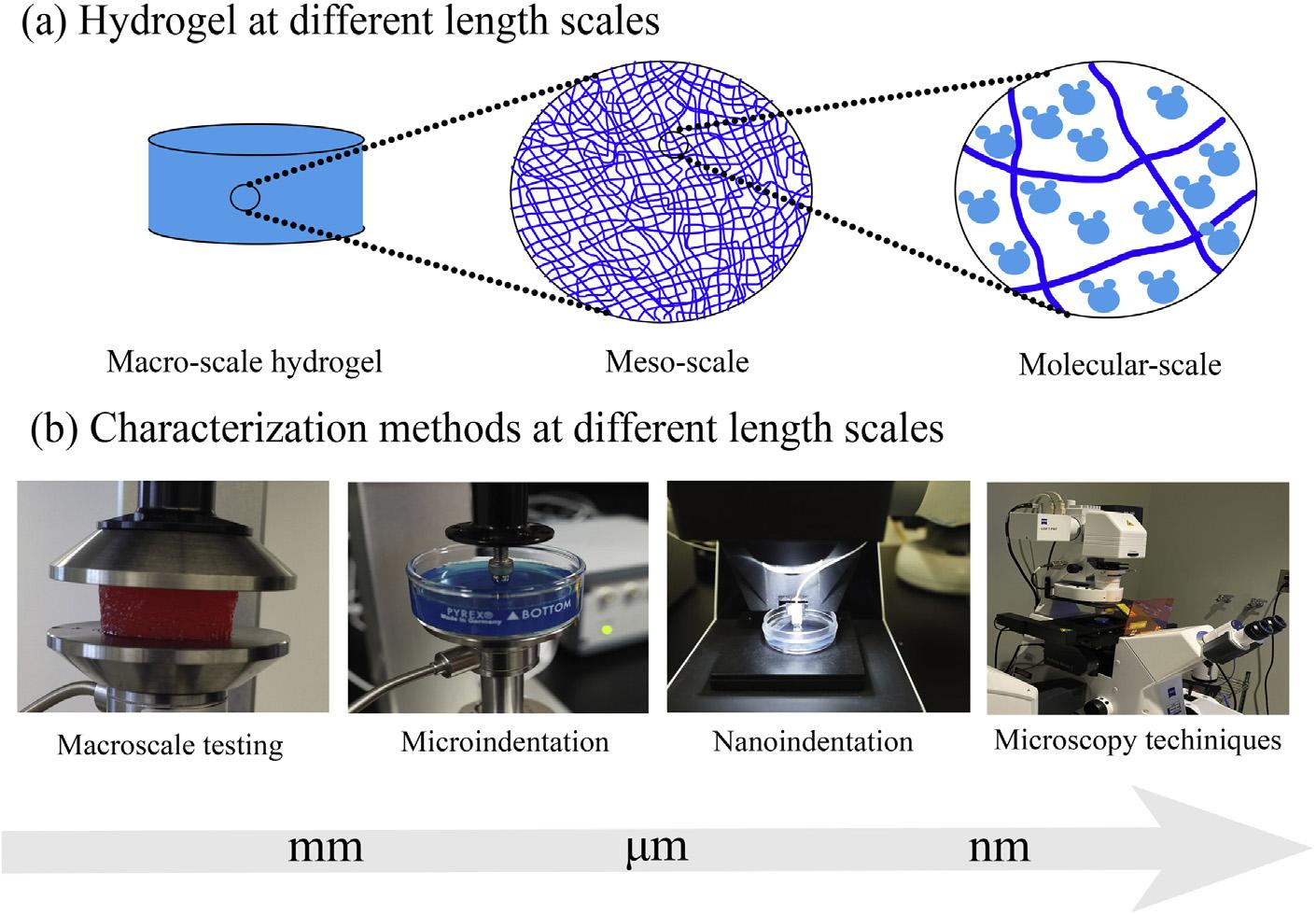
Hydrogelsaremultiphasecompositematerialsconsistingofanaqueousmatrixreinforcedbysolidpolymernetwork. Fig.1.1 illustratesschematicallythestructureof hydrogelsatdifferentlengthscales.Atmacroscale,theyresemblecontinuumsolids withde finedshapedespitelargewatercontent.Microscopically,hydrogelsarediscrete randomnetworksof flexibleorsemiflexiblepolymerchains.Atmolecularscale,they allowdiffusionofsolutemoleculesjustlikepureliquid.Hydrogelmechanicsisalso stronglymultiscale.Whensubjectedtofar fieldloading,individualpolymerchains deforminamannerdependentonbulkpolymerproperties,connectivitywiththe neighboringchains,interactionwithsolventmolecules,andthetestenvironment. Thecollectivedeformationofallsuchchainsleadstoanonuniformdeformationat thenetworkscale,andtherebyanonlinearstress strainbehavioratthemacroscale. Whiletheliquidmatrixdoesnotsupportanyload,itintroducesanincompressibility constraintthatpreventslateralcontractionofthepolymernetworkunderstretch. Hydrogelsdemonstratestrongtime-dependentrelaxationbehaviorthatinvolvestwo distinctmechanismsassociatedwithviscoelasticandporoelasticdeformation[24]. Viscoelasticrelaxationoccursduetotopological fl uctuationsof flexiblepolymer chainsunder fixedstrain,whereasporoelasticrelaxationemergesfromthemigration ofliquidovertime.Poroelasticityofhydrogelsisstronglydependentonmaterial length-scale,whereasviscoelasticityislargelylength-scaleindependent[25].
Multiscalestructureandmechanicsofhydrogelsnecessitateevaluationoftheirmechanicalpropertiesatdifferentlength-andtime-scalesaswell.Alargevarietyofmechanicaltestingmethodsareusedforhydrogelsdependingonthemateriallength-scale andmechanicalpropertyofinterest(Fig.1.1b).Elasticandfractureproperties(i.e., 2TheMechanicsofHydrogels
Mechanicalcharacterizationofhydrogels3
Figure1.1 Multiscalecharacterizationofhydrogels;(a)hydrogelmorphologyatdifferent length-scalesand(b)thecorrespondingmechanicalcharacterizationmethodsatdifferent length-scales.
strengthandfracturetoughness)arecommonlyevaluatedusingauniversaltestingmachine.Macroscaletestingisgenerallyperformedeitherinuniaxialtensionorcompression.Indentation-basedtechniqueswithpositionalprecisionareadvantageousforlocal measurementsintherangeofmillimetertonanometerespeciallyfortime-dependent properties.Liquid-like flowpropertiessuchasdiffusioncoef ficientandpermeability canbemeasuredthrough fluorescencerecoveryafterphotobleaching(FRAP)ordynamiclightscattering(DLS).Thisgamutofcharacterizationtechniquesforhydrogels obviouslyrequiremultidisciplinaryexpertise,whichiswhyithasfascinatedscientists withdiversebackgroundsrangingfrommaterialssciencetoengineeringtobiophysics.
Mechanicalcharacterizationofhydrogelsposesuniquechallengesduetotheir multiphasecomposition.Hydrogelsarecharacterizedbyasmallelasticmodulusin theorderofkilopascals(kPa)duetothelargewatercontent,whilemostmechanical testingmachinesaredesignedforhardmaterialslikemetalsorceramicswithmodulus rangeofmegapascals(MPa)togigapascals(GPa)[26].Gelsarenoteasytoholdduringuniaxialandfracturetesting,especiallyunderfullyhydratedconditions.Hydrogels tendtotakeupwaterintensionandlosewaterincompression[27].Thistension compressionasymmetryintroducesadditionaltime-andstrain-ratedependencerelated to flowofwater.Incharacterizinggelproperties,itisthereforecriticaltodistinguish betweentensileandcompressivetesting.Fracturetestingintroducesadditionalcomplexitiessincehydrogelspredominantlyfailatlargestrainswherefractureprocesses arealsobothrate-andtime-dependent[28].Alltheseissuesemphasizethefactthat
mechanicalcharacterizationofhydrogelrequirecarefulpreparationoftestsamplesand optimizationoftestsetupandtestconditions.
Thischapteraimstoprovidethereaderacandidoverviewofhydrogelcharacterization frommechanicsperspectivewhilethesubsequentchapterselaborateonspecifictopics. Thischapterisorganizedasfollows. Section1.2 providesaclassificationofhydrogels basedonstructure,composition,andfabricationmethods. Section1.3 focusesongeneric protocolsforhydrogeltestingandtheimportantmechanicalpropertiesacrossdifferent length-scales. Section1.4 presentsacomparativeanalysisofmechanicalpropertiesfor awidevarietyofhydrogelsfollowedbyconcludingremarksin Section1.5.
1.2Classi ficationofhydrogels 1.2.1Source
Hydrogelsareclassi fiedasnaturalorsyntheticgelsbasedonpolymersource.Natural hydrogelsaremadeofbiologicalpolymerssuchasproteins,denaturedproteins,and polysaccharides.Themostcommonnaturalhydrogelsarecollagen,gelatin,agar, andalginatehydrogels.Syntheticgelsaredevelopedfromengineeredpolymersand theirderivatives;examplesincludepoly(ethyleneoxide)(PEO),poly(2hydroxyethylmethacrylate)(poly-HEMA),poly(-vinylalcohol)(PVA),andpoly(acrylamide)(PAAm).
1.2.2Polymercomposition Hydrogelsaredividedintohomopolymericandheteropolymericgroupsbasedonthe compositionofindividualpolymerchains.Ifpolymerchainsinahydrogelconsistof singletypeofmonomer(molecularrepeatingunitofindividualpolymerchain),those gelsarereferredashomopolymerichydrogels.Thesehydrogelsaremadeofsame monomer,butdegreeofpolymerization,polymernetworkarchitecture,andnature ofcross-linkingvaryfromonesystemtoanother.Heteropolymerichydrogelsare madeoftwoormoretypesofmonomers.Speci fically,hydrogelsthatarecomposed oftwomonomersarecalledcopolymerichydrogels.Thepropertiesofheteropolymeric hydrogelsdependonthefractionofindividualmonomersandthearrangementof differentmonomers(i.e.,alternating,blockandgraftconfigurations)inthechain [26].Beyondmolecularcomposition,hybridhydrogelscanalsobeformedbasedon interpenetratingnetworksoftwopolymers,calleddoublenetworkhydrogels[29]. Bothnaturalandsyntheticpolymerscanbecombinedtoproducehybridhydrogels.
1.2.3Polymernetworkconfiguration Hydrogelsareclassi fiedasamorphous,semicrystallineorcrystallinegelsaccordingto thephysicalstructureoftheirpolymernetwork.Amorphoushydrogelshaverandom networkswhichdonotexhibitanycrystallineregions(regionsofpreferentialchain alignment).Semicrystallinehydrogelsconsistoffewcrystallineregionsinwhich 4TheMechanicsofHydrogels
polymerschainsarepreferentiallyarranged(i.e.,parallel),whiletheremainderofthe networkdomainisamorphousinnature.Largenumberofpreferentiallyorientedregionsareobservedincrystallinehydrogels,whichapproximatelyformaninterconnectednetworkthroughoutthehydrogeldomain.Mostsynthetichydrogelsare amorphousingeneral.Additionalchemicalprocessingorfunctionalizationisnecessarytoachievecrystallinityinmanyhydrogels.Forexample,repeatedfreeze thaw cyclesenhancecrystallinityinPVAhydrogels[30].Hydrogelsconsistingofcrystallinedomainsinliquidstatealsodemonstratecrystallinityingelform.Synthesisof hydrogelswithcrystallinegroups(i.e.,micellesormicrogels)alsoleadstohighlycrystallinehydrogels[31].
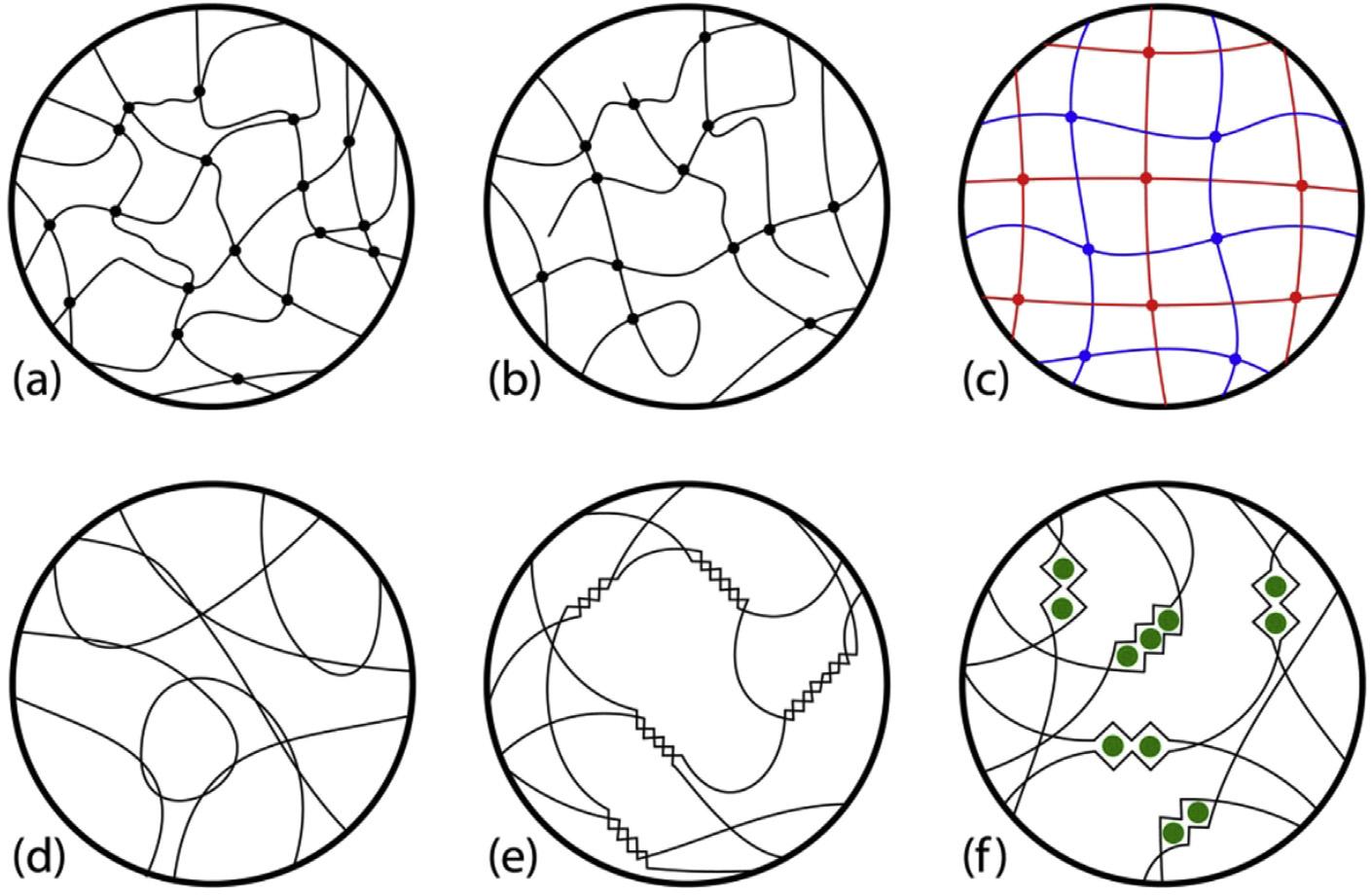
1.2.4Typeofcross-linking Hydrogelsarecalledchemicalorphysicalgelsbasedonwhetherthepolymernetwork isformedbychemicalorphysicalcross-linkingamongpolymerchains.Whilecovalentcross-linksinchemicalgelsarepermanentandimmobile,thecross-linksinphysicalgelsareoftenreversibleanddynamicbytheoppositeactionofthegoverning stimuli.Physicalcross-linksarealsoformedovera finiteregion,unlikepoint-like chemicalcross-links[26]. Fig.1.2 illustratesaseriesofchemical(Fig.1.2a c)and
Figure1.2 Schematicmicrostructuresofvarioustypesofphysicalandchemicalgels:(a)ideal cross-linkednetworkwithuniformcross-linkdistribution;(b)nonidealcross-linkednetwork includingmolecularendsandloops;(c)idealcross-linkeddouble-networkgel;(d)physically entanglednetwork;(e)physicallyentanglednetworkwithhelixformation;(f)alginate-like networkwithdivalentcalciumionsforminglocalbridgesbetweenadjacentchains. FigurefromRef.[26]. Mechanicalcharacterizationofhydrogels5
6TheMechanicsofHydrogels
physical(Fig.1.2d f)hydrogels.Thenetworkstructureofchemicalgelscanbe ideallychemicallybondedwithuniformcross-linkdistributionandnodangling ends(Fig.1.2a);non-ideallychemicallybonded,withpolymerchainself-loopsand danglingends(Fig.1.2b),oradoublenetworkgel,inwhichtherearetwodistinctnetworks,eachonlycovalentlylinkedto “like” chainsandforminganinterpenetrating doublenetworkstructure(Fig.1.2c).Forphysicalgels,thepolymernetworkcansimplybeentangled(Fig.1.2d)wheretheindividualchainscannotcrosseachotherdueto theexcludedvolumeeffect.Physicalnetworksmayalsocontainhelicaljunctions (Fig.1.2e).Forionichydrogelslikealginate,divalentcations(mostcommonly Ca2þ)formcomplexesjoiningtheguluronicaciddomainsinthepolysaccharidechains (Fig.1.2f).
Chemicalgelsarecommonlypreparedbythreemethods[2]:(i)copolymerization ofmonomerandmultifunctionalcross-linker;(ii)radiationinducedcross-linkingof thepolymersolutions;and(iii)cross-linkingofpolymersbychemicalreactionwith complementaryagents.Forexample,copolymerizationofHEMAwiththecrosslinkerEGDMAresultsinpolyHEMAhydrogel[5].PEOandPVAhydrogelscan bepreparedbyirradiatingtheiraqueoussolutionsusingelectronbeamaccelerator [32].Collagengelsarepreparedbyaddingglutaraldehyde(GTA)togelsolutionwhere thecross-linkinginvolvesreactionofthealdehydegroupsofGA(II)withthee-amine groupsoflysineorhydroxylysineresidues[33].
Physicalgelsareformedbyexploitingthepolymerresponsetoenvironmentalstimulisuchastemperature,pH,andsolventcomposition.Applicationorchangeinsuch stimulitriggersphysicalcross-linkingthroughchainentanglement,hydrogenbonding, orionicinteraction.Forexample,PEO-PPO-PEOblockcopolymerdissolvedinwater formhydrogelwiththeapplicationofheat[34].Polymersolutionsofagaroseand gelatinformhydrogelsasthesolutionsarecooleddowntoroomtemperature[35]. PVAsolutionundersuccessivefreeze thawcyclesproducesstablehydrogelsby physicalcross-linkingandformationofcrystallineregions[36].Aqueoussolution ofPECandPAAcformshydrogen-bondedgelwithreductioninsolutionpH[2].Polyelectrolytesolutionofsodiumalginateformsionichydrogelinpresenceofdivalent ionsofoppositecharge,suchasCa2þ [37].
1.3Mechanicaltestingofhydrogels 1.3.1Macroscaletesting Macroscopicpropertiesofhydrogelsarecommonlymeasuredusingauniversaltesting machine(UTM)oruniversaltestframe.AUTMisaversatiletestingmachinewhich canperformawiderangeofmechanicaltesting,includinguniaxialtensionand compressiontests,fracturetests,cyclicloadingtests,andtime-dependentcreepor stressrelaxationtests.AUTMtypicallyconsistsofastiffloadframetosupportthe machine;aloadcellforforcemeasurement,aprogrammablecrossheadtocontrol themovement,andtest fixturesforholdingspecimensofdifferentshape.Most
universaltestersareuniaxialwithsingledegreeoffreedomintermsofmotionand forcemeasurement,althoughbiaxialmachineshavebecomemorepopularinrecent years[26].
Mechanicaltestingofhydrogelsinuniversaltestersrequireseveralcustomizations oftherigandtestingprotocols.Hydrogelsaresoftmaterialsbutcansustainlargedisplacements,oftenmorethan100%oftheirinitiallength.Thisdemandssmallloadcells (oftenintheorderof10 100N)andlargecrossheaddisplacementlimits.Theselectionofstrainrateisalsocriticalsincehydrogelpropertiesvarysigni ficantlywith loadingtime-andlength-scales.Ingeneral,thestrainrateshouldbefastwithrespect tointrinsicrelaxationtimes-scalesofthehydrogelinordertoevaluatetheirtimeindependentmechanicalresponse.Hydrogeltestingneedsdelicatecontroloftestenvironmenttopreventwaterlossduringexperiment.Waterlosschangesthegelstructure andsigni ficantlyimpactsthetestresults.Tominimizewaterloss,hydrogelsareoften coatedwithpetroleumgelsorsiliconvacuumgreasebeforetesting[38].Measurementsundersubmergedconditionsalsorequireseparatewaterproof fixturesandclosed chambersfortesting.Samplegrippingisalsochallenginggivenhydrogelsarehighly compliantandhydratedmaterials.Toachievegoodgripping,samplesareoftentaped orgluedtothetest fixtures.Inthefollowing,generictestingprotocolsarediscussedfor threefundamentalmacroscaletests:tension,compression,andfracturetests.
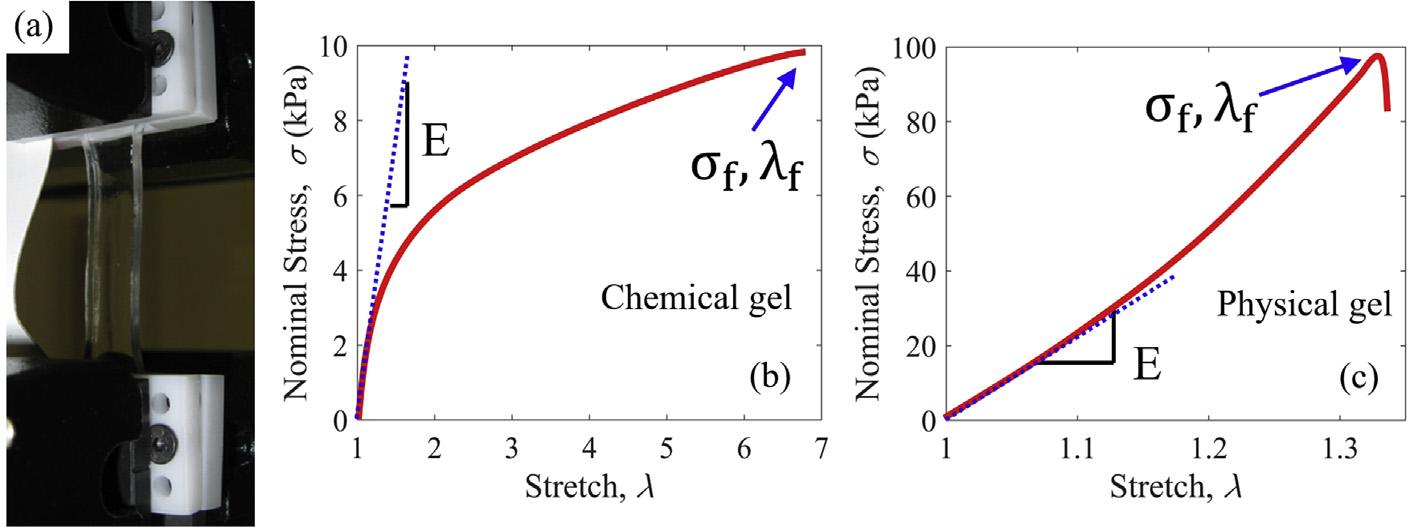
1.3.1.1Tensiontest Inauniaxialtensiontest,adumbbell-shapedtestspecimenisclampedbetweenthetensilegripsasshownin Fig.1.3a andstretcheduntilthesamplereachesultimatefailure. Tensiontestsofhydrogelsaregenerallyperformedunderdisplacementcontrolto avoidthesharptransitionfromlineartononlinearregimeunderload-controlledtests. Force displacementdataarerecordedduringthetestandconvertedtosuitablemeasuresofstressandstrain.Inthesimplestcase,nominalstress stretchmeasuresare
Figure1.3 Uniaxialtensiontestofhydrogels:(a)illustrationoftensiletestspecimenattachedto thetestingmachine,representativestress stretchcurvesfor(b)chemicalgel(14wt%PAAm) and(c)physicalgel(3wt%alginategel).Theassociatedmechanicalproperties(E, sf , lf )as computedfromthestress stretchcurvearealsoillustrated.
(a)AdoptedfromRef.[39].(b)AdoptedfromRef.[40].(c)AdoptedfromRef.[41]. Mechanicalcharacterizationofhydrogels7
usedwherethenominalstress(s)iscalculatedastheforcedividedbythecross-section areaoftheundeformedspecimenandstretch(l)ismeasuredasaratioofdeformedand undeformedlengths.Lateralstrainsinthehydrogelsamplecanalsobemeasured throughanextensometerorimagingofdeformedconfi gurations.Tensiletestscan beperformedbothindryandhydratedconditions.
Fig.1.3bandc showstress straincurvesofachemicalandphysicalgelunderuniaxialtensionasmeasuredindrycondition(fi guresadoptedfromRefs.[40]and[41], respectively).Thechemicalgeliscross-linkedpolyacrylamidegelwith14wt%polymerfractionandthephysicalgelis3wt%alginategel.Ingeneral,thestress strain relationislinearatsmallstrainforbothhydrogelswithsmallYoung’smodulus(E) wherethehydrogelnetworksdeformeasilyduetoamorphousstructurealongwith highdegreeoftortuosityinpolymerchains.Atlargerstrain,tortuouspolymerchains graduallybecomestraightandalignalongtheloadingdirection.Assuch,hydrogels demonstrategradualstrainhardeningwithincreasingstrain.Forpolyacrylamidegel, astrain-softeningregimeisobservedatlargestrainwhichisassociatedwiththe breakageofirreversiblechemicalbonds.Thefailureofthehydrogelspecimenischaracterizedbytwoparameters:themaximumstressimmediatelybeforethebreakage called “failurestress(sf )” andthecorrespondingstretchiscalled “failurestrain(lf ).”
Here,theelasticmodulusvaluesofthepolyacrylamideandalginategelsare approximately8and24kPa,respectively.Thefailurestrainforalginategelissmall (lf z 1.3)whichisexpectedgivenitisaphysicalgelwithweaknoncovalentbonds. Incontrast,covalentlycross-linkedpolyacrylamidegelbreaksatstretch lf z 7,meaningthegelcanbestretchedatleastsixtimesofitsoriginallengthwithoutfailure.The fracturestressforpolyacrylamidegel(sf z 10kPa)ismuchsmallercomparedtoalginategel(sf z 100kPa).Clearly,tensilestress strainbehaviorisquitedifferentfor thetwogels.Butitisimportanttonotethatthedifferencedoesnotsolelyoriginate fromthetypeofpolymersincemechanicalpropertiessuchaselasticmodulusandfracturestress strainofhydrogelsalsodependonseveralfabricationvariables.
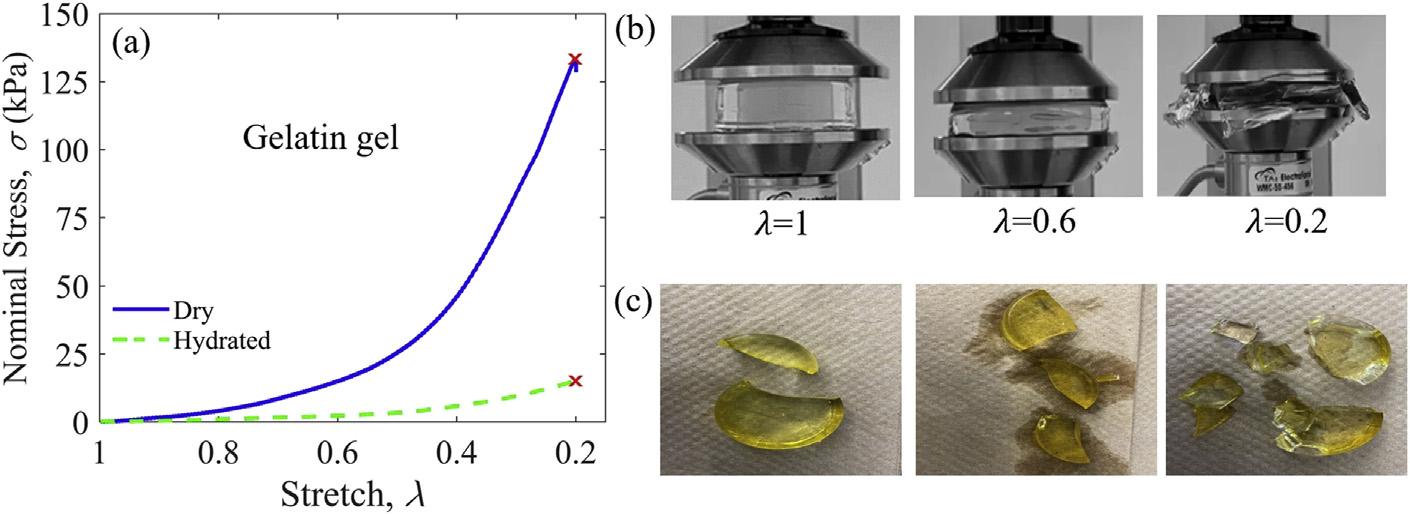
1.3.1.2Compressiontest Thecompressiontestisconductedbyapplyingcompressivepressureonacylindrical specimenusingparallelplatensonauniversaltestingmachine.Thesamplecanbeunconfinedandcompressedbetweentwononporousplatensorconfinedtoadishandcompressedbyaporousplaten.Inunconfinedtests, fluideffluxoutofthesampleisignored althoughitimpactsthehydrogelresponsetothecompressionloading.Inconfinedtests, the fluid flowoutofthesampleisconservedandhence,itallowsthedeterminationofthe poroelasticpropertiesofthehydrogel.Compressiontestrequires flatsurfacestoapply uniformcompression.Duringtestinginliquid,thespecimenisgluedtothebottomsurfacetoprevent floatingintheliquid.Platensshouldbelubricatedorcoveredwithsandpapertoachievenonadhesivecontactbetweentheplatenandthesamplesurface. Uniaxialcompressiontestsareperformedtodeterminethecompressivemodulus andstress strainresponseofthehydrogel. Fig.1.4a showsrepresentativestress straincurveof5wt%gelatingelunderuniaxialcompressionasmeasuredinboth dryandhydratedstates(testedinliquid).Thehydratedsamplewasleftinliquid 8TheMechanicsofHydrogels
Figure1.4 Uniaxialcompressiontestofhydrogels:(a)representativestress stretchcurvesfor 5wt%gelatingelindryandhydratedcondition;(b)snapshotsofdeformedconfigurations(dry specimen)atdifferentstretchlevels(l ¼ 1,0.6,0.2)levels;(c)snapshotsoffailedspecimensas testedinhydratedcondition.
(deionizedwater)for24handtheswellingratio(i.e.,percentageincreaseintheweight ofthehydrogelduetowaterabsorption)wasmeasuredtobe35%beforethetesting. Hydrogelresponseissignificantlysofterinthehydratedconditionwheretheelastic modulusvaluesare18and3.6kPaindryandhydratedcondition,respectively.The compressivefailurestressdropsfrom133to15kPaduetoswellingofthehydrogel althoughthefracturestrainisnotaffectedbythegelswelling. Fig.1.4b showssnapshotsofthedryspecimenatdifferentstretchlevels.Thefailureindryhydrogelstypicallyinvolvesgelcrushingasseeninthe figure(lastsnapshotat l ¼ 0.2).Therupture ismorecomplexinhydratedconditionasshownin Fig.1.4c.Therupturecanoccurby thepropagationofone(left)ormultiple(middle)macroscalecracksandbytheformationofseveralmicroscalecracksleadingtoamorediffusefailure(right).Thisvariabilityinhydrogelbehaviorinliquidmakestheinterpretationofhydrated measurementsachallengingtask.
1.3.1.3Fracturetest Fracturetoughness,whichimpliesmaterial’sabilitytoresistcrackpropagationor enlargementunderappliedload,isanimportantmechanicalpropertyforhydrogels. Failurestressasmeasuredbyuniaxialtestsonlyprovidesaroughindicationoffracture toughness,notanaccuratequantitativeestimationsinceitvariessignifi cantlywith specimensizeandshape[28].Fracturetestingisingeneralnotlimitedbyspecimen sizeorgeometry.Itistypicallyperformedinuniversaltesterwhereakeyrequirement isthepresenceofa finitesizedcrackinthespecimen.Theessentialgoalistomeasure thecriticalcorrelationofappliedload,cracksize,andmaterialresistance(i.e.,fracture toughness)thatwillinitiateandpropagatethecrackgrowth.
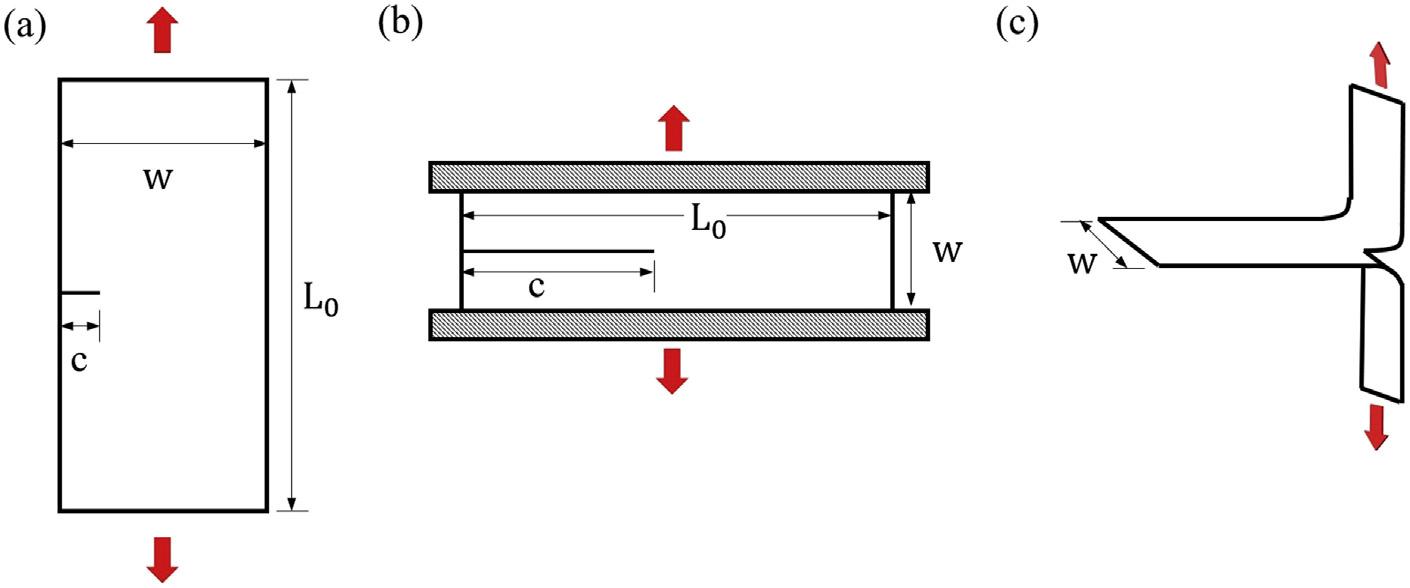
Experimentalconfi gurationsthatarecommonlyusedforfracturetestingofhydrogelsincludesingle-edge-notch(SEN)test,pureshear(PS)test,andtearingtest.All threetestsareperformedusingalongthinspecimenwithwidth(w)muchsmaller thanthelength(L0)asillustratedin Fig.1.5.InaSENtest(Fig.1.5a),anedgecrack
Figure1.5 Schematicillustrationsoffracturetestspecimenandloadingdirectionforhydrogels: (a)single-edge-notch(SEN)test,(b)pureshear(PS)test,and(c)tearingtest.
withlength c isintroducedalongthewidthdirectioninthemiddleplane.Ontheother hand,thecrackinaPStestspecimen(Fig.1.5b)liesalongthelongitudinaldirection andthecracklengthissufficientlylargecomparedtowidth, c » w.Atearingtest,also knownastrousertest,involvesatwo-armedprecutspecimenasshownin Fig.1.5c.In SENandPStests,thespecimenissubjectedtotensilestrainperpendiculartothecrack planesuchthatthecrackisdeformedinopeningmode(ModeI).Inthetearingtest,the twoarmsofthespecimenarepulledinoppositedirectionstoinducetearingofthe specimenwherethecrackissubjectedtoout-of-plane(ModeIII)loading.
Fracturetoughnessofhydrogelsiscommonlycharacterizedusingenergybalance approach[42].Stressintensitycriterionisinappropriatesincedeterminationofthe stressanddisplacement fi eldsnearthecracktipisdifficultforhydrogelsundergoing largedeformation.Theenergeticapproach,asdevelopedbyGrif fith[43]andIrwin [44],usesenergyreleaserate G asthefundamentalmetrictomeasurefracturetoughness.Itisdefinedastheinstantaneouslossoftotalpotentialenergyperunitcrack growtharea.Crackgrowthoccurswhen G reachesacriticalvalue, G ¼ Gc.Physically, Gcrepresentsfractureenergyofthematerialwhichmustbeovercomebysuppliedpotentialenergy(intermsof G)duetoappliedloadtoproducecrackextension[45]. Gcis ameasureoffracturetoughnesswhichisdeterminedexperimentallybyallthethree confi gurations(Fig.1.5).
Greensmith[46]derivedtheexpressionof G forSENtestwith c L0 andsimilar expressionsforPSandtearingtestsaredevelopedbyRivlinandThomas[47].The expressionsaregivenby
Mechanicalcharacterizationofhydrogels11
Inallthreecases, U isthestrainenergydensityfarawayfromthecracktipwhere materialdeformationcanbeassumedelasticanduniform. l isthetensilestretchratio ofthespecimen(SENandPStest)orthearm(tearingtest).Fortearingtest, F isthe appliedforcetothearmsand t isspecimenthickness.Inpractice,thetestspecimenis stretcheduntilrapidandunstablecrackgrowthoccursatcriticalstretchratio lc .Fracturetoughness Gcisthencalculatedfrom Eq.(1.1) bysetting l ¼ lc .Tomeasure U(lc )forSENandPStests,anuncrackedsampleisstretchedtosame lc andthe areaunderthestress stretchcurveprovides U(lc ).Fortearingtest, U(lc )iscalculated basedonanuncrackedspecimenwithdimensionsequivalenttothearm.TheSENtest islimitedtosmallcracklengths c L0 andrelativelysmalltomoderatestrain.Both PSandtearingtestareindependentofcracklength,whichisadvantageouscompared toSENtest.Forthetearingtest,ifthearmscanbeassumedtobeundeformed(l ¼ 1), Gccanbeapproximatedas Gc ¼ 2F/t,whichdoesnotrequirecalculationofthestrain energydensityaswell.
Itisnotedthattheenergeticapproachdiscussedhereisoriginallydevelopedfor elasticsolidswithinalinearelasticfracturemechanics(LEFM)framework.Thebasic assumptionofLEFMisthattheglobalbehaviorofthematerialiselastic,andthe nonlineareffectsordamageisconfinedinasmallregionsurroundingthecracktip. Theassumptionisvalidforbrittlehydrogelsbutdoesnotapplyfortoughgelssuch asdoublenetworkhydrogelsinwhichthedamagezonecanbeverylargeandeven comparabletospecimendimensions.Severalnonlinearmodelshavebeenproposed recentlytoaccountforlargedamagezonesintoughgels[48,49].
1.3.2Indentationtesting Indentationisamultiscalemethodforprobingmechanicalpropertiesofhydrogels frommillimetertonanometer.Indentationwasoriginallydevelopedforcharacterizing hardmaterialsthatundergoelastic-plasticdeformation[26].Rapidadvancementin sensitivityandresolutionofinstrumentshasalsoenabledsuccessfulindentation testingofsoftmaterialslikehydrogels.Inaclassicalindentationtest,arigidprobe ofdefinedgeometryispressedintothetestsamplewithprescribedloadordepth andthecorrespondingload(P),indentationdepth(h),andtime(t)arerecorded. Theforce depth time(P h t)dataareanalyzedviaempiricalconstitutive modelstoidentifyseveralimportantmaterialproperties.
Thereareseveraladvantagesofusingindentationtestingforhydrogelcharacterization.Itrequiresminimalsamplepreparationandspecimensofanyshapecanbeused giventhespecimenhasa fl atsurface.Hydrogelscanbetestedaspreparedina containerwithoutbeingattachedtotheinstrument,whichisamajorchallengefor macroscaletensionorcompressiontesting.Measurementscanbeperformedrapidly witharelativelysmallvolumeoftestmaterial,whichisextremelyusefulsincehydrogelsdegradequicklyinambientcondition[50].Further,gradedorheterogeneous hydrogelswithlargespatialvariabilityofmaterialpropertiescanbecharacterizedefficientlyusingascanningtechniqueacrossthesamplesurface[26].Finally,itisstraightforwardtotestgelsamplesinahydratedconditionwithoutsignifi cantlossofwater.
12TheMechanicsofHydrogels
Indentationtestsarecalledmicroindentationornanoindentationbasedonthelength scaleofindentationdepth.Microindentationtestsareperformedonthemillimeter scale,whereasnanoindentationcanbeperformedonthelength-scalefrommicrometer tonanometer.Universaltestingmachinescanbeadaptedformicroindentationas shownin Fig.1.1b.However,itrequirescustomizedprobe fixturestoattachtheprobe tothecrossheadandrelativelysmallloadcellsintheorderof5 10N.Ontheother hand,nanoindentationisperformedoncustombuiltandcommercialmachinesas shownin Fig.1.1b.Amodernnanoindenterhasaworkingforcerangeofabout 100nN 500mNandadisplacementrangeof1nm 200 mm[51].Indentationdepth ismonitoredthroughcapacitanceorinductance-basedsensorsandforceactuationis achievedthroughapiezoelectricelement,magneticcoil,orelectrostaticforcegeneration[52].Anautomatedsamplestageisusedtomovethesampleinx yplaneanda cameraoropticalmicroscopeisprovidedforvisualization.
Experimentaldesignofindentationtestsforsofthydrogelsrequiresseveralimportantconsiderations.Itiscriticaltoperformthetestindepth-ordisplacement-control sincecomplianthydrogelscanundergolargeelasticdisplacementalthoughtheapplied forcemaybesmall[50].Samplesurfacedetectionischallengingbasedonthecriteria offorceorstiffnesschangesincethegelcanundergolargedisplacementbeforethe instrumentreachesthe “zeropoint.” Sphericalor flat-punchtipsaremoresuitablesince sharp,pyramidalBerkovichtipscanpenetratethesampleorinducestressconcentrations.Thesizeoftheindentertipanddepthofindentationmustbeoptimizedto achievesatisfactorycontactarea,toensurethemeasuredforce displacementvalues arewithintheworkingrangeoftheinstrument.
Severalcriticalmechanicalpropertiescanbedeterminedbasedonindentationtests. Inthesimplestcase,theelasticmodulus(E)ofhydrogelcanbedeterminedbyindentingthegeltoaprescribeddepth(h)andrecordingthecorrespondingreactionforce(P). Unlikebulkmechanicaltesting,theload-displacementdatacannotbemappeddirectly tostress strainmeasures,rathertheyare fittedtoanalyticalmodelstodeterminethe elasticmodulus(E).Themostwell-knownanalyticalmodelisHertzcontactmodel [53],whichisoriginallydevelopedfortwoelasticspheresincontact.Foraspherical indenter,theHertzmodelcanbeappliedifoneassumesthesphericalindentertobea rigidsphere(infinitestiffness)andthehydrogeltobeanelasticsphereofzerocurvature(elastichalf-space).AccordingtotheHertzmodel,thecorrespondingindentation force displacementrelationisgivenas
where R isthetipradiusofsphericalindenter, Ehiselasticmodulus,and V isthe Poisson’sratio.Theelasticmoduluscanbedeterminedby fitting Eq.(1.2) tothe experimentaldata.Sinceindentationisperformedinrelativelyshorttimescales,itis oftenreasonabletoassumethehydrogeltobeincompressible(V ¼ 0.5)inthislimit.It isimportanttonotethatHertzmodelisonlyvalidforsmallstrains.Experimentaland theoreticalstudieshavefoundthatthevalidityofHertztheorybreaksdownbeyond indentationstrain(definedas ˛h ¼ 0 2 h=R p )of0.05.
Indentationisaversatilemethodforcharacterizingtime-dependentbehaviorof hydrogels.Hydrogelssubjectedtoconstantindentationdisplacementdemonstratea gradualdecreaseinthereactionforceatshorttime-scalebeforeconvergingtoan equilibriumstateatlongtime-scale.Thebehavioriscalledload-relaxation,where thedegreeandrateofrelaxationprovideimportantinformationabouthydrogel’s time-dependentcharacteristics.Time-dependentbehaviorcanalsobecharacterized bymonitoringthedisplacementevolutionwithtimeunderconstantload,whichis referredtoascreep.Thediscussionisrestrictedtoloadrelaxationbehaviorhere althoughthegoverningmechanicsisfunctionallyequivalent(seeRef.[54]).
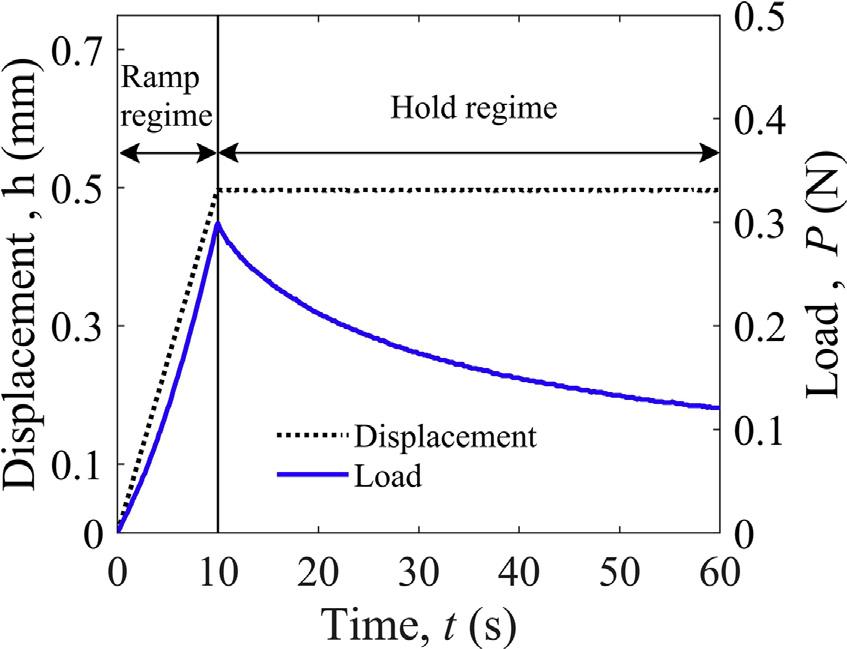
Fig.1.6 showsevolutionofdisplacementandloadasafunctionoftimeasmeasured inanindentation-basedloadrelaxationtestofagargelinhydratedcondition.Thetest consistsoftwodistinctphases:arampphaseandaholdphase.Duringtherampphase, thegelisindentedtoamaximumdepth(hmax ¼ 0.5mm)followingalinearrampfunction.Theloadincreasesinanonlinearfashionandreachesamaximumvalue (Pmax ¼ 0.3N)attheendoframpphase.Thedurationoframpphaseiscalledramp time(tR ¼ 10s)whichimplieshowfastorslowtheindentationisperformed.The holdphaseisinitiatedoncethemaximumdepth(hmax)isreached.Duringthisstage currentdepthorpositionoftheindenterismaintainedandloadrelaxationismonitored withtime.Itisobservedthattheagargelexhibitssignificantrelaxationwheretheload relaxesfrom0.3to0.12Noveraholdtime(th)of50s.
Loadrelaxationinhydrogelscaninvolvebothviscoelasticandporoelasticmechanisms.Assuchitisimportanttoanalyzetherelaxationbehaviorwithinbothframeworks.Underarbitraryprescribedstrain(˛(t)),viscoelasticrelaxationofhydrogels isanalyzedbasedonBoltzmannsuperpositionprinciple[55]givenby
where sðt Þ isthestressthatdecayswithtimeduringtheholdphaseand E(t)denotesthe time-dependentrelaxationmodulus.Forindentation-basedloadrelaxationwith
Figure1.6 Representative displacement time(leftaxis)and load time(rightaxis)responseof 3wt%agargelasmeasuredinan indentation-basedloadrelaxation test.
incompressibilityassumption(v ¼ 0.5),theequivalentBoltzmannequationisgivenby Ref.[55]
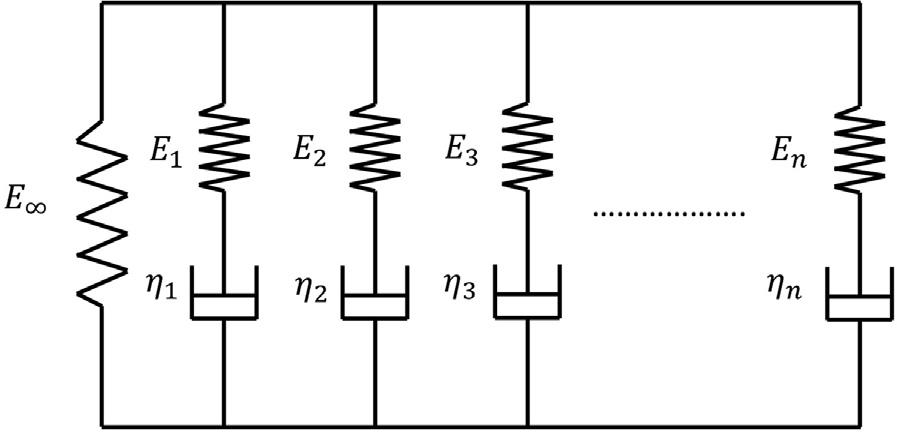
Fordisplacementcontrol,theBoltzmannintegralequation(Eq.1.4)isrequiredto besolvednumericallybyassumingaconstitutiveformof E(t).Itisobservedthatlinear viscoelasticmodelsmadeupofspringsanddashpotsadequately fittheexperimental loadrelaxationcurvesformosthydrogels.Forexample,ageneralizedMaxwellmodel consistingofalinearspringand n numberofMaxwellunits(parallelconnectionofa linearspringandadashpot)isshownin Fig.1.7.Thecorrespondingrelaxation modulus E(t)isdefi nedintermsof finitePronyseries
where EN isthemodulusofthelinearspringwhichrepresentstheequilibrium modulusand En isthestiffnessofthespringin nth Maxwellelement. sn isthecharacteristicrelaxationtimeof nth Maxwellelementanditisdefinedastheratioof viscosityoverthespringstiffness,i.e., sn ¼ hn =En .Theequivalentloadrelaxation functioncanbederivedas
Eq.(1.6) isdirectly fi ttedtotheexperimentalrelaxationcurve(Fig.1.6,hold regime)byusinganoptimizationalgorithmthatvariestheconstants(A0, An, sn )to minimizetheerrorbetweenpredictedandexperimentalresponse.Theconstantsof Eqs.(1.5)and(1.6) areapproximatelyrelatedasfollows: EN ¼ AN h3=2 max 16=9 Rp (1.7)
Figure1.7 Schematic illustrationofageneralized Maxwellmodelconsistingof n Maxwellelementsinparalleland anisolatedspringtorepresentthe equilibriummodulus.
Mechanicalcharacterizationofhydrogels15
where(RCFn)istherampcorrectionfactorwhichaccountsfor finiteramptime[55] anditisdefi nedas
Theparameters(EN , En, sn )collectivelydefinetheshapeofloadrelaxationcurve buttheydonotrepresentanyphysicalquantityrelevanttothematerial.Ingeneral, viscoelasticityofhydrogelsischaracterizedbytwomaterialconstants instantaneous modulus(E0 ¼ EN þ Sn En)andequilibriummodulus(Eeq ¼ EN ). E0 referstothe initialelasticresponseofhydrogelbeforetheinitiationofrelaxationand Eeq isthe long-termmodulusafterthehydrogeliscompletelyrelaxed.Theratiooftwomoduli (f ¼ Eeq/E0)indicatesdegreeoftime-dependence,where f ¼ 1representsaperfectly elasticsolidwithnorelaxationand f ¼ 0representsaviscousliquid.
Time-dependentbehaviorofhydrogelshasalsobeendescribedusinglinearporoelastictheory[24,56].Poroelasticrelaxationassociatedwithliquidmigrationistypicallycharacterizedbythreeconstants:elasticmodulus(E),Poisson’sratio(v),and hydraulicpermeability(K). K isrelatedto fluidviscosity(h)andintrinsicpermeability (k)as k ¼ k h.Theintrinsicpermeabilityisalsorelatedtoeffectiveporesize(x)ofthe polymernetworkas k ¼ c x2 wherecisaconstant.Poroelasticmodelsdirectlycharacterizethemultiphasenatureofhydrogelsandtheassociatedconstantsarelinkedto materialmicrostructure,notjustempirical fittingparametersoftypicalviscoelastic models.Determinationofporoelasticconstantsfromloadrelaxationtestsischallengingsincethegoverningequationsarecoupledandclosedformanalyticalsolutions donotexistformostmechanicaltestingspeciallyindentation[50].Theconstantsare typicallyevaluatedbyformulatinganinverseproblemwhichisoftensolvednumericallyorbydevelopingempiricalconstitutiverelationsormastercurvesbasedon nondimensionalgroups.
Gallietal.[24]developedanumericaloptimizationframeworkbasedonaporoelastic finiteelement(FE)modeltodeterminetheconstants.Theoptimizationalgorithm iterativelyadjuststheporoelasticconstants(E, v, k)intheFEmodeluntilasatisfactory agreementbetweenthemodelpredictionandexperimentsisachieved.Numericaloptimizationisarobustapproachfordeterminingtheporoelasticconstantssinceitisnot restrictedtoanyspeci ficindentergeometryoranyothertestparameter.Themajor drawbackisthatthemethodiscomputationallyexpensive.GalliandOyen[57]proposedamastercurveapproachbasedonnondimensionaltime displacementindentationresponse.Themastercurvedatabasewasgeneratedbasedonaparametricstudy usingFEmodelandsubsequently,thedatabasewascoupledwithanestedoptimizationalgorithmtodeterminetheporoelasticconstants.Huetal.[56]developedcurve- fit expressionsfornondimensionalrelaxationloadasafunctionofporoelasticconstants byrunningextensiveFEsimulationsforindenterswithdifferentgeometryandsize.
1.3.3Microscopy-basedtesting Measurementsofhydrogelpropertieshavealsobeenperformedusingmicroscopyinstrumentsbeyondtraditionalmechanicaltestingequipment.Themostcommon exampleisatomicforcemicroscopy(AFM)whichisawell-establishedtooltoperform nanomechanicaltestsofhydrogels[58].Toperformindentationtest,atypicalAFM instrumentusesasharptipattachedtotheendofasensitivecantileverbeamtopress againstthegelsurface.ThemajordifferencewithnanoindenteristhatAFMdoesnot directlyactuatetheprobeintothesample,ratherusesthedeflectionofcalibratedcantileverbeamtomeasuretheforcevaluesbasedoncontactmechanicstheoryandbeam equations[26].
Physicalpropertiesofhydrogelshavealsobeenmeasuredusingnoncontacttechniqueswithoutdeformingthesample.Forexample,dynamiclightscattering(DLS) iswidelyusedtomeasurethediffusivityofhydrogels[59,60].Forlightscatteringexperiments,alightbeam,usuallyalaser,isshotintothesampleandtherecordedscatteredlightisprocessedtoconstructanintensityauto-correlationfunction.Itis observedthatforahomogenoussample,thecorrelationfunctionisasingleexponentialandtheassociateddecayrateisdirectlyrelatedtodiffusioncoef ficientas[59]
Fluorescencerecoveryafterphotobleaching(FRAP)isalsoapopularmicroscopy techniquetoanalyzemoleculardiffusionthroughhydrogels[61].First, fluorescently labeledmoleculesaredissolvedinthepolymersolutionbeforeformingthehydrogel. Next,multiplemicroscopyimagesareobtainedwithlowlightleveltosetupthereference fluorescence,andthenahighleveloflightisshotontoasmallspotofinterestto bleachthelabeledmolecules.Finally,anothersetofimagesareobtainedwithlowlight leveltoidentifytheredistributionofmoleculesviarecoveryof fluorescence. AssumingaGaussianprofileofthebleachingbeam,thediffusioncoef ficientcanbe calculatedfromRef.[62]
¼ b2 sR (1.11) where b istheradiusofthesmallspotand sR istherecoverytime.
1.4Keymechanicalproperties 1.4.1Elasticproperties
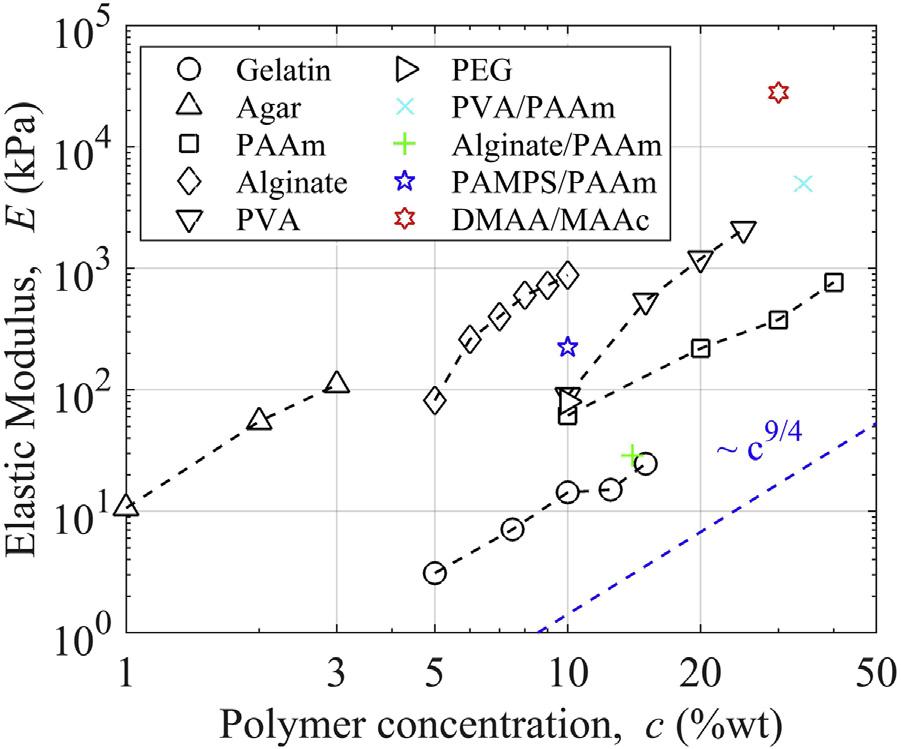
Elasticmodulus(E)isthemostwidelystudiedmechanicalpropertyofhydrogelinthe literature. Fig.1.8 illustratesthevariationof E withgelconcentration(c)foralarge varietyofhydrogels.Speci fically,modulusdataarecompiledforhomogeneousgels suchasgelatin[63],agar[35],polyacrylamide(PAAm)[64],alginate[65],polyvinyl 16TheMechanicsofHydrogels
G ¼ Dq2 (1.10)
Ds
Mechanicalcharacterizationofhydrogels17
Figure1.8 Variationofelastic modulus(E)withpolymer concentration(c)foralargeset ofhydrogelsincluding homogeneousandhybridgels. Theabbreviationsareexplained intext.
Dataarecompiledfrom Refs.[29,35,40,63 68].
alcohol(PVA)[66],andpolyethyleneglycol(PEG)[65].Inaddition,modulusvalues ofhybridgelssuchasPVA-PAAm[67],Alginate-PAAm[40],poly(2-acrylamido-2methylpropanesulfonicacid)(PAMPS)-PAAm[29],anddimethylacrylamide (DMAA)-methacrylicacid(MAAc)[68]arealsoplotted.Asexpected,therangeof gelelasticmodulusissignifi cantlylargefromkPatoMPaeventhoughthesolidpolymerfractionofthegelsis30%orless.Thedataalsoindicategelmodulusishighly tunablebasedontheselectionofthepolymer.Forexample,with10%gelconcentration,themoduluscanbetunedfrom14.3 880kPabasedonthetypeofsolidpolymer. Elasticmodulusashighas28MPacanbeobtainedwithhybridDMAA-MAAcgel. Elasticmodulusalsodemonstratesstrongdependenceongelconcentration wherethehomogeneousgelsroughlyfollowtheoreticalscalinglawofrubberelasticity (c9/4)[69].Thesimilarscalingrelationsarenotdevelopedforhybridgelswhichwould beusefultodistinguishthecriticalcontributionofindividualgelcomponent.Itis importanttonotethatthemodulusvaluesreportedin Fig.1.8 werenotmeasuredby sametestingprotocolbutbyeitheruniaxialtension/compressionorindentationtest. Whileitisrecognizedthatbothtestsetupandprotocolcriticallyimpactthegel response,effortstocomparethegelresponseunderidenticalconditionarelimited. AsindicatedbyOyen[26],thisleadstolargescatterinmeasuredvaluesforthe samegelconcentration.Assuch,itiscriticaltotesthydrogelsinequivalentconditions ifoneintendstocomparemechanicalproperties.
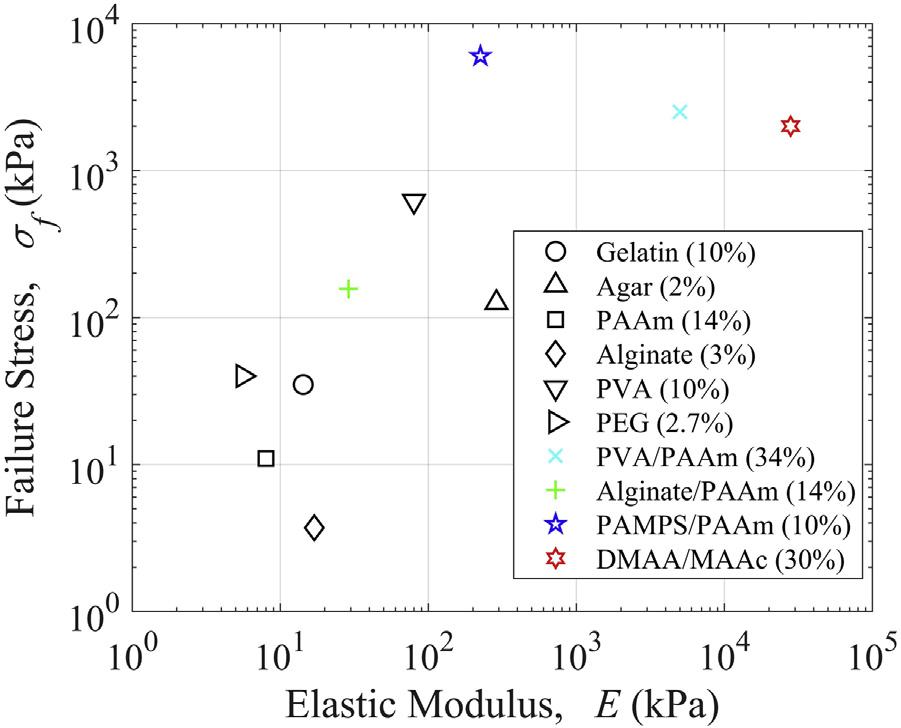
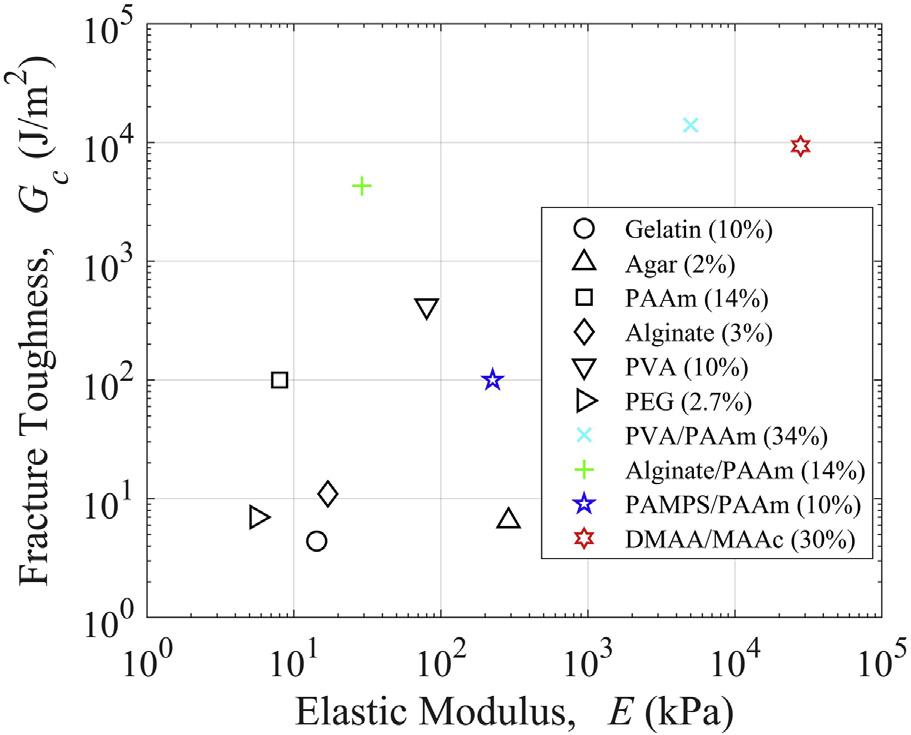
1.4.2Failurestressandfracturetoughness Figs.1.9and1.10 showthefailurestress(sf )andfracturetoughness(Gc),respectively, asafunctionoftheirelasticmodulusforthesamesetofhydrogelsin Fig.1.8.Itis notedthatthefracturetoughnessofhydrogelsasmeasuredfromstandardfracturetests (Section1.3.1.3)isconsideredhere,unlikethematerialtoughnesswhichismeasured astheareaunderthestress straincurve.Itisobservedthatmostphysicaland
18TheMechanicsofHydrogels
Figure1.9 Variationoffailure stress(sf )withelasticmodulus (E)foralargesetofhydrogels includinghomogeneousand hybridgels(samesetas Fig.1.8).
Datacompiledfrom Refs.[29,40,63,67,68,70,71].
Figure1.10 Variationof fracturetoughness(Gc)with elasticmodulus(E)foralarge setofhydrogelsincluding homogeneousandhybridgels (samesetas Fig.1.8).
Datacompiledfrom Refs.[29,40,63,67,68,70,71].
chemicalgelsareweakandbrittlewithfailurestressintheorderof10 100kPaand fracturetoughness10 100J/m2.Forexample,10wt%gelatingelhasafailurestress of35kPa,whereas13.6wt%PAAmgelhasfailurestressofonly8kPa.Fracture toughnessofthegelsare4.4and100J/m2.Thisisprimarilyduetounderlyingpolymer networkswhicharelooselyconnectedandstronglynonuniforminspatialorganization.TheonlyexceptionisPVAgelwhichhasafailurestressintheorderof 1MPaandfracturetoughnessof420J/m2 duetopresenceofcrystallineregionsin thepolymernetwork.
DNgelswithtwointerpenetratingpolymernetworksdemonstratefailurestressas highas20MPaandfracturetoughness(w1000J/m2).Forexample,DNgelof PAMPS-PAAmhasafailurestressof17.2MPaandfracturetoughnessof1000J/m2 Suchhighstrengthandfracturetoughnessresultfromthecoexistenceofahighly