THE APPEARANCE of a second edition of this book only after a first lasting 20 years needs some explaining. Nowadays, most books aspiring to interpret a subject from a compelling new vantage point either beget new editions with some alacrity or gather dust on library shelves as noble experiments without a sustained audience. In the present case, the rapid consolidations that occurred in the publishing world during the 1990s sawthis collection reissuedin rapid succession under three different corporate imprints, and only in the custody of Routledge did the book settle into a steady period of supply and critical acclaim. And, intruth, theeditor wasapproached fairly early in Routledge's management about a new edition, but kept deferring the matter because of over-commitments elsewhere. But, with substantial and accumulating evidencethat the bookwas meetinga genuine need, hefinallyagreed to undertakea revised edition.
It is important to locate this work within the large, interdisciplinary arena that might be called American landscape studies. Ever since the continent was colonized by Europeans, there have been recorders, interpreters, and critics of American landscapes. In the realm of scholarship,longtraditionshavedevelopedinthewritingofarthistory and literary criticism intrigued by social and individual perceptions of landscape in America, as well as commentary from designers concerned with the practical and creative needs of land use planning and landscape architecture. But these fields, concerned primarily as they arewithperceptionandpractice, havetouchedonlyincidentally onthe broadandcomplexhistoricalforcesthathaveshaped wholelandscapes themselves. It is in the work of architectural historians, cultural geographers, archaeologists, and folklorists that most direct writing about the actual provenance of cultural landscapes in the United States is to be found. And, not wishing to slight the valuable contributions of an:: cognatefield,itisneverthelessintheliteratureofculturalandhistorica: geography that a consistent commitment is found to interpreting c·.::tural landscapes as comprehensive, intertwined, regionally dishnc�·---= Vll material expressions of human settlement history on the groun.:: ,-__ 0
Preface to the Second Edition
literature is what has made this book feasible, although a quickglance at the notes and bibliography will demonstrate how completely interdisciplinaryis thecontributors'appreciationfor anddependenceonall relevant historicalresearch.
This book has its roots in the fertile bicontinental traditions oflandscape study nurtured by William G. Hoskins and JohnBrinckerhoff Jackson, and it was written at the outset in the belief that nothing quite like it yet existed in the American literature, and that there was a place for it.But its intellectual genealogy is as gnarled and sinewy as the weatherbeaten oaks that cling to the windy Cheviot foothills of England's Northumbria where the editor grew up.When he began serious exploration of the countryside and small market towns of his native region, first with his father and then on his own, Hoskins' The making of the English landscape was a brand new book.As time passed, that volume became, for this editor, a classic statement of the humane interest all civilized souls should have in their surroundings, reaching within an historical framework for a judicious blend of understanding and appreciation of the varied ways people have marked and shaped thelandstheyhavecalledhome.
Discovery of, and eventualcommitment to, life inAmerica involved the editor in a strenuous encounter with the American landscape, not immediately through formal study but through a geographer's awareness of and interest in its significance. With Hoskins in the blood, as it were, the overly socioeconomic emphasis of graduate training struck him as ultimately somewhat narrow, andJ.B.Jackson's pungent writings on the visible American scene came as a wholly welcome native infusion, reflecting as they did the pulse and robustness of this continent and its people. However, during the 1970s no one seemed ready to write the kind of overview of the historical forces that had shaped the cultural landscapes of the United States in the disciplined sort of way Hoskins had done for England. Transatlantic ties tugged further. An invitation from the editor of the Geographical Magazine of London to conceive and guest edit a twelve-part series of short articles on the American landscape provided the editor with the necessary impetus, and the "Fashioning of theAmerican landscape" series, featuring contributions from a dozen American geographers, duly appeared in that journaleachmonthbetweenOctober 1979andOctober 1980.
Despite the subsequent appearance of interesting interpretations by John Stilgoe, Walter Sullivan, and the contributors to an anthology on vernacular architecture edited by Dell Upton andJohn Vlach, there remained at that time, it seemed, a need for a concise but systematic treatment ofthemajor historicalthemesinthemakingof theAmerican landscape.Andso, atthe-againtransatlantic-behestofaBritishpublisher whosensedthebroadeningscholarly interestinlandscape inthe United States, this wholly new, more ambitious, and more integrated vm collection becameourattempttofillthegap.
Preface to the Second Edition
In a critical appraisal of the style and influence of Hoskins and JacksoninEnglish-languagelandscapestudythatappearedin The interpretation of ordinary landscapes (1979), Donald Meinig drew attention to the contrast and complementarity between the two writers: Hoskins' emphasis on history, documentation, and the longevity of many landscape features; Jackson's preoccupation with landscape in terms of the way we live in it, and with change and the modern scene, approached through the power of intuitive thinking. It is hoped that this book's authorsrepresent collectively atleastsomefusionofthese virtues.
Themajorfocusis onthe48 contiguousstates of the union, although Hawaii and Alaska, while in many respects worlds unto themselves, are included implicitly to the extent that they reflect the diffusion to thosedistantshoresof anumber ofclassicAmericanculturallandscape interventions. We harbor no illusion that the volume treats the grand topiccomprehensivelyorintheonlyplausibleway.Theauthors,including some veterans from the magazine series, were given wide latitude to contribute original chapters that strongly display their individual perspectives shaped by years of field and archival work. The editor makesnoapology forlimiting the authorship inthis particular book to historical geographers, because that has resulted in a certain valuable consistency of outlook and premise, notwithstanding the diversity of formal training and employment, and the irrepressible individualism apparent in the writing. The cardinal concern in involving them has been their abilitynot onlytolook, but to see.
The book aims at an unabashedly evolutionary interpretation of the American landscape. It draws attention to remnants from the past embedded in today's scene (to counter the oft-encountered cliche that obsolescenceleads quickly to replacement and effacement). And it carries themes roundly to the present, where appropriate. To these goals theeditor hasaddedfurtherpurpose: abiasintheillustrationstowards modern views that remind the reader how detectable historical forms can be in today's landscapes, and an insistence on documentation that carries arguments beyond mere assertion and opens them to assessment and further reformulation. The editor is pleased to acknowledge the inspiration of W. G. Hoskins through the title of this book and, in this otherwise truly American initiative, that ofJ.B. Jackson, who contributed aclosingchapter to the first edition.
Revisions for this second edition sought to broaden even further the range of themes addressed, especially those important in the last half-century of landscape evolution. The table of contents hints at these concerns. The deaths of two authors prompted some rethinking about coverage and balance, some re-shuffling of assignments and the welcome addition of Charles Aiken, Susan Hardwick, Joe Wood, andBret Wallach to the volume. Each has written extensively on their respective themes, but not with the sweep, brevity, and punch asked of them here. In addition to expanding and updating coverage of the
Preface to the Second Edition
unique transformation of Southern plantation landscapes, it seemed imperative to create individual and complementary chapters covering landscapes of civil society andreligious expression. The editor tried to adhere to the rule that authors could contribute only one chapter, but Wilbur Zelinsky'srecent major studyofreligionintheurbanlandscape, together with his career-long record of tramping through countless rural cemeteries, made him the odds-on favorite for the new chapter on religion. While the urban and automobile chapters deal with large modernstructures, the editorfelt anewchapteronmegastructuresand the widespread theming of consumption was warranted. As a replacement for Brink Jackson's highly personal chapter on the nature of the American house in the first edition, Bret Wallach's new reflections on the conflicted utopian strivings of Americans as revealed in their contemporary landscapes provides perhaps an even more appropriate coda for this edition.
Debtsintellectualandpracticalareowedinthiseffortasinallothers. Acknowledgement of scholarly stimulus we confine to the Notes for individual chapters. It is impractical in a multi-authored work such as this to record all debts of a practical nature, but those to a crucial few must be mentioned. The editor is grateful for the unstinting help givenfor the revised editionby research assistants Diana Rehfeldt and Daphne Yin with library checking, word processing, and color-image clean-up during editorial work on the manuscript. Kathleen Neils Conzenhas livedwith this book in variousways for over 20 years and offered countless comments and suggestions along the way; to her the editor's deep appreciation for her interest and knowledge. David McBride, former Senior Editor at Routledge, and Stephen D. Rutter, Social Sciences Publisher at Routledge, gamely endured all the complications that a long-gestating book like this can throw up, and through it all maintained, at least for the benefit of the editor, an amazing confidence in the ultimate success of the venture. To both for their faith and creativity we are deeply indebted. Had Stephen realized how the enticing offer of color illustrations would challenge and complicate the contributors' and editor's revisions, he might have withdrawnit for a fastercompletion. Butwearegladhedidnot, andhopetheendproduct justifieshis extraordinarypatience.
MichaelP. Conzen Chicago, Illinois, 2009
Acknowledgements
Photo credits
Michael P. Conzen: Figs. 1.5, 1.6, 1.14, 2.5, 2.6, 2.7, 2.10, 2.13, 2.14, 3.2, 3.3, 3.9, 4.3, 4.6, 4.7, 4.8, 4.9, 5.5, 5.7, 5.9, 5.10, 5.13, 7.4, 7.8, 8.1, 8.7, 9.8, 9.13, 9.14, 9.15, 10.2, 10.6, 10.12, 11.6, 11.7, 11.8, 11.9, 11.11, 11.13, 11.16, 11.17, 12.3,12.4,12.5, 12.6,12.7,12.8,12.9,12.10,12.11, 12.13,12.14, 12.15, 12.19, 12.20, 13.1, 13.2, 13.4, 13.5, 13.6, 13.7, 13.10, 13.11, 13.13, 13.15, 13.18, 14.1, 14.2, 14.4, 14.5, 14.6, 14.8, 14.9, 14.12, 14.13, 14.14, 14.15, 14.17, 14.18, 15.1, 15.4, 15.6, 15.7, 15.9, 15.10, 15.11, 15.12, 15.13, 15.16, 15.17, 16.9, 16.10, 16.11, 16.12, 16.16, 17.1, 17.11, 17.13, 18.1, 18.4, 18.5, 18.6, 18.9, 19.1, 19.4, 19.6, 19.7, 19.9, 19.10, 19.11, 19.12, 19.13, and 20.2. United States Soil Conservation Service: Figs. 1.7, 1.8, 1.9, and 1.12. Stanley W. Trimble: Figs.1.10 and 1.11.KarlW.Butzer: Fig. 2.11. David Hornbeck: Fig. 3.9. Peirce F.Lewis: Figs. 5.2, 5.3, 5.4, 5.6, 5.8, 5.14, and 15.14. Charles S. Aiken: Figs. 6.3, 6.4, 6.6, 6.12, 6.13, 6.14, 6.15, and 6.17. Sam B.Hilliard: Fig. 6.5. GeorgiaDepartmentofArchivesand History: Fig. 6.9. Hildegard B. Johnson: Fig. 7.6. Wisconsin Historical Society: Fig.7.7.ForestHistorySociety PhotographicCollection: Figs.8.9a, 8.9b, 8.9c, and8.9d.JohnC. Hudson: Figs. 9.2, 9.3, 9.4, 9.6, 9.7, 9.9, 9.10, 9.11, 9.12, and 9.16. Library of Congress: Fig. 9.5. United States Bureau of Reclamation: Figs. 10.4 (E. E. Herzog), 10.9, 10.11, and 10.13. James L Wescoat, Jr.: Figs. 10.5 and 10.7. Samuel A.Smith: Fig. 10.10. Susan W. Hardwick: Figs. 11.1, 11.2, and 11.14. Hubert G. Wilhelm: Fig. 11.10. City of Rocklin, California: Fig. 11.12.Erin H. Fouberg: Fig. 15. Wilbur Zelinsky:Figs.12.1, 12.12, 12.16,12.18,15.5,and15.15.DavidR.Meyer: Fig. 13.8. Bethlehem Steel Corporation: Fig. 13.9. Bowater Southern PaperCompany(LavoyStudio):Fig.13.12.AMAX,Inc.(MickeyPrimm. Manley Commercial Photography): Fig. 13.14. Burlington lndustrie::: Fig. 13.16.SanJose (Calif.) RedevelopmentAgency: Fig.13.17. Ed,\-a.rL� K.Muller: Fig.14.3.CarnegieLibraryofPittsburgh: Figs.14.7and 1-U:. Temple University Urban Archives Center: Fig. 14.11. P. Blake: F:.: 14.16. Joseph S. Wood: Figs. 16.1, 16.2, 16.3, 16.4, 16.5, 16.6, 16.:-. > � xz 16.13, 16.14, 16.15,and16.17.WilliamK.Wyckoff: Figs. 17.2. r:-...; �--:::.
Acknowledgements 17.6b, 17.7, 17.8, 17.12, and 17.14. Lawrenceville School Archives: Fig. 17.3.CartierJewelers: Fig.17.10.JohnA.Jakle: Figs.18.2,18.3,18.7,and 18.8. Bret Wallach: Figs.20.1,20.3,20.4,and 20.5.
Sources for other illustrations
Cover image: Minnesota Historical Society Art Collection: Location no. AV1981.354.6. Negative no. 37266. By permission. Front map: U.S. Geological Survey, "The Geographic Face of the Nation-Elevation," National Elevation Dataset, http://ned. usgs.gov. Back map: U.S. Geological Survey, "The Geographic Face of the Nation-Land Cover of the Conterminous United States, 1992," http://memory.lac.gov/cgibin/map_item.pl. Imprint page: Village map: Northwest Publishing Co., Plat book of Carver County, Minnesota. Minneapolis: Northwest Publishing Co., 1898. Fig. 1.1: Michael P. Conzen. Fig. 1.1: Michael P. Conzen, adapted from Glenn T. Trewartha, Arthur H. Robinson, and Edwin H. Hammond, Elements of Geography, 5th ed. New York: McGraw-Hill Book Company, 1967. Fig. 1.2: Stanley W. Trimble, after United States Geological Survey Circular 44. Fig.1.3: Michael P. Conzen,adaptedfrom the National Atlas ofthe United States ofAmerica. Fig. 1.4: From Erwin Raisz, 1939. Fig. 2.1: Karl W. Butzer, simplified vegetation patterns of grassy woodlandparkland-versus closed forest are based on evaluation of all published end-glacial pollen profiles, after Porter 1983, Bryant and Holloway 1985.Fig. 2.2: KarlW.Butzer,based onDriver 1961,Jennings1978, Kehoe 1981, and Sturtevant 1978. Fig. 2.3: Karl W. Butzer, urban featuresbasedinpartonFowler1978,andGregg1975,abandonedchannel chronography afterYerkes 1987. Fig. 2.4: Karl W. Butzer,modifiedafter FinlaysonandPihl1980.Fig. 2.8:KarlW.Butzer,modifiedafterMidvale 1968, Masse 1981, and Nicholas and Neitzel 1984. Fig. 2.9: Karl W. Butzer,afterFig.6inWoodandMcAllister1984,withpermission.Fig.2.12: Karl W. Butzer, based on Driver 1961, Jennings 1978, Kehoe 1981, and Sturtevant1978.Fig.3.4:CaliforniaStateLibrary.Fig.3.8a.University of California-Berkeley, Bancroft Library. Fig. 3.8b: United States Geological Survey, 1:24,000 Topographic Map, Pismo Beach Quadrangle, California. Fig. 3.11: British Library Board, London, United Kingdom. Fig. 4.4: WisconsinHistorical Society. Fig. 4.10: Michael P. Conzen. Fig. 5.11: Library ofCongressGeography and Map Division. Fig. 5.12: Library of CongressGeography and Map Division. Fig. 6.1: Michael P. Conzen in collaboration withSamB.Hilliard.Fig.6.2:MichaelP. Conzenincollaborationwith Sam B. Hilliard. Fig. 6.7: United StatesBureauof the Census. Fig. 6.8: Scribner's Monthly (1881). Fig. 6.10: United States Bureau of the Census. Fig. 6.11: American Geographical Society. Fig. 6.16: The Southeastern Geographer 11 (1971), pp. 43-50. Fig. 6.18: United States xzz Geological Survey, 1:24,000 Topographic Map, Sumner Quadrangle,
Acknowledgements
1:62,500 Topographic Map, Ironton Quadrangle, Missouri. Fig. 7.3: Modified from American State Papers, Public Lands, Vol. 3, p. 22. Fig. 7.5: Evertsand Stewart, Illustrated Historical Atlas o!Jackson County, Michigan (1874).Fig.8.2:OrsamusTurner1851.Fig.8.3:A.T.Andreas, Atlas Map ofLouisa County, Iowa (1874).Fig.8.4:UnitedStatesBureauoftheCensus (1880). Fig. 8.6: Michael Williams, after Stokes 1957. Fig. 8.8: From W. B. Greenley, "The Relation of Geography to Timber Supply," Economic Geography l (1925), pp. 1-11. Fig. 8.10: National Science Foundation. Fig. 9.17: United States Geological Survey, 1:24,000 Topographic Map, Morgan Quadrangle, Minnesota. Fig. 10.8: United States Farm Security Administration (Russell Lee). Fig. 11.3: Michael P. Conzen. Fig. 11.4: Michael P. Conzen. Fig. 11.5: Michael P. Conzen. Fig. 12.2: Library of Congress,Geography &MapDivision.Fig.15.2:MichaelP.Conzenand Christopher Winters. Fig. 15.3: Illinois Department of Conservation. Fig. 17.16: United States Census Bureau. Fig. 19.2: Michael P. Conzen. Fig.19.3:Michael P. Conzen. Fig.19.5: United States GeologicalSurvey, 1:24,000 Topographic Map, Elmhurst Quadrangle, Illinois. Fig. 19.8: Michael P. Conzen. Fig.19.14:Michael P. Conzen.
The following figures are the work of the authors of the respective chapters: Figs. 1.13, 3.5, 3.6, 3.7, 5.1, 8.5, 9.1, 10.3, 12.17, 13.3, 15.8, 17.9, and 17.15.
The following figuresaretheworkofthe editorincollaborationwith the respective chapterauthors: Figs.3.1, 4.1, 4.2, 4.5, 7.1,7.9, and 10.1.
Foreword to the First Edition
DONALDW.MEINIG
Introduction
MICHAELP. CONZEN
1 RecognizingNature's bequest
STANLEYW.TRIMBLE
Climates - Thephysiographiclayout - Natural regionsThe Far West - The Central Interior - The East
Spanishexploration-Populatingtheland-Shaping the borders-Spanishlegacy
4 RetracingFrench landscapesin NorthAmerica
COLEHARRIS
Footholds on thecontinent-Thecorelandscapes ofNew France-TheFrenchcrescent: St. Lawrenceto theMississippiThelegacy
5 Americanizing English landscape habits
PEIRCE F. LEWIS
AnAmericanversionofEngland-Adifferentsortof place-Adifferentsortofpeople-TworegionsoftheNortheast - The New England culture region - The Pennsylvania culture region - Thetwolandscapesof theNortheast: differencesin vernacular architecture - Barnsandotherruralmatters-UrbanformsThe cultural-geographical baggagegoeswest
Findingthe desert-Transformingthe desert: lookingatdams andditches - The prehistoric legacy in central Arizona - Hispanic settlement in the Rio Grande Valley - The Mormon desertFederal transformation of the Colorado River -Conclusions
cityscapes-Ethnictourism and ethnic heritagelandscapesAnd whatof thefuture?
Organizing religious landscapes
WILBUR ZELINSKY
The mainly metropolitanchurchscape-Mattersarchitectural -Therural scenes-Theotherstructures-CemeteriesSigns-Envoi
Mechanizing the American earth
DAVIDR.MEYER
Colonialbeginnings-Emergenceof the manufacturing belt-Specializationincoreand periphery-Theblendofold and new
Building American cityscapes
EDWARDK. MULLER
The economiclandscape-Sociallandscapes-Governance and thelandscape-TheAmericanway
Asserting central authority
WILBUR ZELINSKY
The earlyfederal presence-Federallandscape influence after theCivilWar-The emergence of Washington, D.C., as epitome and model-The New Deal and itslegacyIndirect governmentalinfluenceonthelandscapeStateandlocal governmentlandscape elements
Creating landscapes of civil society
JOSEPH S. WOOD
DeTocqueville and civil society -Landscape featuresLandscape formation-Definingcivil society-Reforming civil society-Conclusion
Imposing landscapes of private power and wealth
WILLIAMK. WYCKOFF
Enduringthemes- English affinities - Social and spatial exclusivity - Key social transformations - Thelineage oflandscape change - Changing elite geography: townhouses, country seats, and resorts - Changing elite architectural tastes - Reading theAmerican elitelandscape - Evolutionary processes - The modern pattern
18 Paving America for the automobile
JOHNA.JAKLE
Automobiles - Highways - Landscapes - Rural placesThe suburbs - Inner cities - Central business districtsCommercial strips
19 Developing large-scale consumer landscapes
MICHAELP.CONZEN
An emerging culture of mass consumption - Landscapes of shopping - Department stores, chainstores, and supermarkets - Shopping malls - Variations upon the shopping mall - Related landscapes of wholesale distribution - Leisure and entertainment landscapes - Pe1formance arts venues - Sports stadiums and arenasVacation places: hotels, resorts, theme parks - Gambling - Convention and expositionfacilities - Other pursuits - Museums - Churches as big business - Advertising in the landscape - Conclusion
20 Designing the American utopia: Reflections
BRETWALLACH
ForewordtotheFirst Edition
THIS IS an important book about ourselves. It is a searching look at the home we havemade, and are continually refurbishing, on this continent. It is focused on our visible surroundings, on that which we liveamidst-on thelandscapeswehavecreated.
For most Americans such a book may require some adjustment of vision, some change in common ways of looking and thinking about theirimmediateworld. It mayrequireaconsiderablestretchingoftheir usual sense of the key term: landscape. Americans need help with that wordbecauseitstillmostlikelybringsfirsttomindoneofitsmorelimited uses: the decorative design of formal parks or gardens, or the plot ofgroundinfrontofthehouse; orvaguelyappreciativeviewsofattractivecountrysides; or a popular formofartisticrenditionofsuchscenes. To ask us to accept, as this book does, that landscape is comprehensive and cultural; that it encompasses everything to be seen in our ordinary surroundings, andthatvirtuallyallthatcanbeseenhasbeencreatedor altered by humanintervention, istoopenupachallengingandrewarding way of thinking about our everyday world. To ask us, moreover, to see landscape as history adds a further dimension and enrichment, for it asks us to see that every landscape-not just those with "historic sites"-is part of a vast, cluttered, complex repository of society, an archive of tangible evidence about our character and experience as a peoplethrough allour history-ifonly wecanlearn howto readit.
One of the great virtues of landscape study is that it lies open to us all, it is accessible, everywhere, every day. Anyone can look, and, of course, we all need help to understand what we are looking at, but we canreadily learnmoreandmoreandmake ever better senseofwhatwe see. Landscape studycanbea lifelong education and pleasure. William G. Hoskins, one of the godfathers of this work, was wont to liken the Englishlandscapetoasymphonyandtourgetheimportanceofmo\'ing beyond a general esthetic response to a beautiful mass of sound to the point where one could clearly recognize the various themes, how the:become woven together, the new harmonies that emerge, and all the xix subtlevariationsthatenrichthework. It isanattractivemetaphor intha::
Foreword to the First Edition it suggests an immense range of works extant, the unlimited possibilitiesfor appreciation, theintricaterelationships to be understood-and, weshouldalsoacknowledge, thefact thatwemaynotalwayslikewhat we encounter.
The making of the American landscape providesanunprecedentedintroduction to an immense composition. It sketches the general structure, describes the mainthemes, and offers commentary upon a greatmany details, dynamics, and variations. It has much to offer those already attuned to the topic, for we have never had such a comprehensive treatment, and wemusthopethatitwillbe anattractive guidetothose who have never given much attention to such matters. For surely it is desirable for Americans to learn about and reflect upon this continuousshapingoftheirsurroundings.Asthemetaphorof home suggests,it must bear, directly and subtly, in ways beyond measure if not beyond dispute, uponthequalityofAmericanlife. Sofarweseemonlydullyor incoherently aware of such things. We may cry out in protest of direct threatstoourownsurroundings,butingeneralsomuchofourresponse to landscape and history seems almost pathologically crippled: a people unable todiscern, or care about, the difference betweena theme park and the real thing-and ready to turn the real thing into a theme park at the slightest prospect of profit. No book can cure such severe cases, butonewould liketothinkthatthis oneespecially, andothers in the burgeoning literature on landscape, might begin to provide some antidote to our long-apparent tendency to live "a life of locational and visualindifference." ButIhastentoaddthatthisbookisnotprimarilya prescription. It isneither acritiquenor acelebrationofwhatAmericans have done to their surroundings; it is, rather, a fascinating story of the building and rebuilding, the continuous tinkering and refurnishing, of their home in North America. Once one begins to look at landscapes throughthehelpofthesehistorical geographers, anyideathat eventhe most ordinary and familiar parts ofthe American scene are too simple, shallow, and monotonous to be given serious attention should be banished forever.
Michael Conzen tells something of the lineage of the book in his Preface. I would like to add just this. Half a century ago his father, M.R. G. Conzen, crossedthenarrowseasandbroughta Germanic thoroughness to the detailed analysis of English town morphology, with enduring effect upon a whole field. A generation later the son, steeped in the tradition of English landscape studies, crossed the broader seas to continue his academic training at the premier center for historical geographicstudyin NorthAmerica. Given that lineage, that particular combinationofheredityandenvironment, itisperhapsnosurprisethat Michael Conzen soon emerged as one of our most original and penetrating geographical interpreters. It is altogether appropriate that this fine book should bear his name, but I am not sure that "editor" gives xx the right impression; we might better think of Michael Conzen as the
Foreword to the First Edition
commissioner, inspirer, part composer, arranger, and conductor of a grand "symphony" ontheAmericanlandscape.
D. W. Meinig Syracuse University
Introduction
Life must be lived amidst that which was made before. Every landscape is anaccumulation. Thepastendures.
(D. W. Meinig 1979, p. 44)
Landscapeisnotmerelytheworldwesee,itisaconstruction,acomposition ofthatworld. Landscapeisa way ofseeingtheworld.
(D. E. Cosgrove 1984, p. 13)
LANDSCAPES FASCINATE us because they speak through the language of visual observation of the age-old relationship between human beings and their environment. Our collective sensibility toward landscape, however, appears to be a relatively modern development inhistory, emerging among the Europeaneliteduring the Renaissance. The idea of landscape took a long time to crystallize, during which it represented a wide range of political, social, and moral tenets expressed through painting and literature, becoming accepted by the 18th century as a notable aspect of taste. Although it declined in the late 19th century, when thedivergence betweenscienceandartandthe advent of photography removed it as a central cultural concept, it has continuedtobeimportantasanavenueofscientificinquiry-especially in geography-as an approach to physical planning, and, across a broader social spectrum, as asource of personalenjoyment. 1
Landscapes interest people in various ways. Most would acknowledge an elementary regard for "reading" the landscape in order to navigatethroughit. We live inphysicalspaceand our need to traverse it requires at least a fleeting attention to avenues and structures, their arrangement,andtheirinterrelationsinterms, asitwere, ofaroadmap. Formanythatisalsothelimitoftheir interest. Forothersthereiscuriosity about the landscape as an embodiment of the cumulative evidence ofhuman adjustment to life on earth. In this sense, landscape holds an intellectual interest inofferinga palimpsestofsignsfor "decoding" and analyzing our human use of the globe. And third, landscape can be a powerful force in shaping the individual's emotional world of sensations and moods, thus contributing an affective dimension to those of functionandintellect.2
Whatexactly dowemeanby landscape? The ambiguityoftheword is both its strength and weakness. Historically, the term dates from the 1 MiddleAgeswhen it denoted "a district owned by a particular lord or
Introduction inhabited by a particular group of people."3 The modern word stems from the 16th century when Dutch and Italian painters used it to mean a representation of scenery, either in general or with respect to a particular view.� In common parlance, landscape as a generic term can be understood to encompass all the visible world.A particular landscape is that characteristic portion of the world visible by an observer from a specific position. Implicit in these notions is the dual nature of landscape: as object and subject. This has caused no end of difficulty for both scientific and everyday use, since objective and subjective study employ methods usually distinct and largely incompatible. Another source of ambiguity lies in the need to distinguish between the area covered in the "scene" and its actual contents-the landscape's spatial extent and configuration, and the material features contained therein. Yet another ambiguity lies in the possibly different meanings given to landscape by those who live in it and those who see it with detachment-thedichotomy betweeninsider andoutsider.5 Afinalambiguity is introduced when we try to reconcile individual responses to landscape with collective ones.Although it is not the direct purpose of this book to examine or resolve these intriguing issues at any length, a few points deserve mention.
Landscapeis grasped initiallythrough its visibleelements, a compositionof materialfeaturesinspace, butitsstudyis by no means limited to them; interpretation draws from the outset on cultural expressions and related factors that may not be at all visible.6 Whether a landscape is studied for its own sake-as a thing "out there" to be explained-or asameanstounderstandingthesocietyorsocietiesthathaveproduced it, relevant nonmaterial phenomena such as language, moral values, and social power comereadily tomind.
Landscapes are commonly distinguished as natural or cultural. This is a useful distinction for historical purposes, but in practice few landscapes in economicallyadvanced regions haveescaped some degree of human modification. 7 This is not to say that nature has lost power in shaping the visible pattern of the land, even in the modernage; rather, that the human imprint is by this stage so deep that even natural elements, suchasforestsandrivers, havenotremaineduntouchedintheir extent or composition by human occupance. So in manyareas, even in the United States, there are few localities that can legitimately be considered still natural or wild, and this elevates the emphasis on human factorsintheir transformation. Theculturallandscapeis, intruth, then, a composite of the historical interaction between nature and human action. Nevertheless, there has long been a tendency in much writing on cultural landscapes to ignore or denigrate the role of physical forces;8 the scope for interpretation, it is argued, is compelling enough evenwhenlimitedtotheformandarrangement ofsettlements, thepattern of fields, roads, and other transport routes, crops, other extracted 2 resources, andsoforth.
Introduction
Theseformalelements-therawmaterialoflandscapestudy-need, certainly, to be regarded as appropriate in themselves for morphological study, but not without recognizing a more holistic, symbolic significance. The cultural meanings attached to these forms by those who created and maintained them need drawing out, for in practice theyareseldomself-evident.9
There are several cardinal approaches to landscape study apparent in writing on the American scene and they are worth distinguishing, for they will make the choice of content and arrangement of the chapters in this book more apparent. Donald Meinig, in a delightful essay entitled "The beholding eye," has offereda shortlist of perspectives by whichpeople may view a landscape.10 He distinguishes "ten versions of the same scene" in which different observers of the same prospect mightseethelandscapebeforethem,dependingontheirproclivities,as representing nature (stressing the insignificance of humankind), habitat (ashumankind'sadjustmenttonature), artifact (reflectinghumankind's impact on nature), system (a scientific view of interacting processes contributing to a dynamic equilibrium), problem (for solving through social action), wealth (in terms of property and possession), ideology (revealing cultural values and social philosophy), history (as a record of the concrete and the chronological), place (through the identity that particularlocationshave),and aesthetic (accordingtosomeartistic quality possessed). Sucha compendium isa valuablereminder that the eye seeswhatitwantstosee,andthisleads,evenintermsofthesesuccinct categories, to a veritable ocean of literature. How to navigate a brisk coursethroughitthatdoesnotbecomedistendedbyeverylocalcurrent and breeze? If we can fill our sails with writings in which landscape appearsasanexplicitconceptandacentralconcern,wemaygroupthe resultinginterestunderfour generalmastheads.
There is,first,a longand honorable traditionofAmericanlandscape study that reflects what might be considered as environmental awareness. Thisencompassesthewholefieldofwhatwestillknowasnatural history,inwhichtheidentificationofrocks,plants,andanimals,asindividualelementsandasassociations,liesat thecoreofthesubject. Even though the modern disciplines of geology and biology and their subfields have produced extensive documentation and theory to explain theconditionsofnature,alivelyindustryingeneralinterpretationfeeds the lay interest in the naturearound us. 11 Theunification of many such themes under the rubric of ecology has excited similarly widespread interest, including even synthesesthat link ecology and regional political history 12 Ecology brings in the human element, for environmental awarenessincludespeople'sregardfortheirownrelationswithnature, andassuchhasattractedinterestfromanthropologistsandenvironmental psychologistsaswellasgeologists,biologists,andgeographers.13 In Meinig's terms, nature,habitat,artifact,and systemareall represented 3 inlandscapestudiedasadimensionof environmentalawareness.
Introduction
Rudimentary and scientific awareness of the landscape is quickly matched by a subjective, judgmental dimension based on image, symbol, and representation. From early times, painters and writers havecapturedtheessenceofparticularAmericanlandscapesinpicture andword, invariablycolored bytheirvisionof what theywereseeing. Paintings and writings in the American pantheon were shaped not just by personal technique but through selection and interpretation of evidence, reflecting assumptions about the purpose of humans in the landscapeand theirrelations,ideal and actual, with nature. Everypictureand book servedasimplicitrecordernotmerely ofthevisualfacts of the landscape but of what they symbolized for the artist or writer. Here aesthetics mingle with ideolog� whether in celebration or criticismofwhatiscontainedinthescene.14 FromtheHudsonSchooltothe archetypesof Western art, fromtheNew England transcendentalists to theregionalnovelistsof theMiddleWest, representations of landscape reflect changing descriptive skills and taste, and especially changing attitudes toward the works of humankind in nature. 15 This tradition of landscape study is upheld primarily by art historians and literary analysts, butcontributionshavecomealsofromculturalhistoriansand geographers.16
The physiognomy of landscape can be explored not only through symbolic representation, however; it can also be considered from the practical perspective of design. Equivalent to Meinig's category of "problem," this defines landscape as something that needs managing, sinceineveryagepeoplewhoaddfeaturestothelandscapefacechoices overwhichdesigntofavor. Furthermore, pastchoicesbecomesubjectto social criticism on both aesthetic and pragmatic grounds. Hence, there isalarge literature ontheAmericanlandscapeasafocusfornormative thought-that is, about whatit oughtto be. Strong critiques have been mounted from the ranks of architects, landscape architects, and planners, usually decrying the depredations of the modern period. 17 Much of this writing is deeply subjective and anecdotal, but in recent years there has been a movement to codify aesthetics, spurred by increasing government involvement in landscape management, producing a substantial literature on landscape assessment.18 Not surprisingly, a consensus has yet to emerge regarding the methods for measuring humanreactions tothephysicaland culturallandscape, let alonetothe policyinitiativeswhichtheyproduce.
Ifthepresentconditionandfuturedirectionoftheculturallandscape in America stimulates lively debate, so does its history. In some ways, thisistheleastdevelopedofthefourprincipalapproachestolandscape studyinAmerica.19 Tobeawareofthelandscapeasanexternal context, to endowit with symbolism, and to evaluateitagainst somesystem of ideals-these are all approaches essentially independent of time. But since we exist in time we must also incorporate it in our view of land4 scape. Therefore to view the landscape historically is to acknowledge
�,ztroduction its cumulative character; to acknowledge that nature, symbolism, and design are not static elements of the human record but change with historical experience; and to acknowledge, too, that the geographically distinct qualityof places isa product ofthe selective additionand survival over time of each new set of forms peculiar to that region or locality This broad approach considers landscape both as history and as place (referring to Meinig's last remaining categories), and has been nourished by scholarship in geography and history, particularly the subfield of historical geography.20 The approach has been more cultivatedinBritainthanAmerica,althoughinterestinAmericanlandscape historyhas been ona steadyrise.21
Landscape history gives precedence to time as the key element in landscapeformation.Eachgenerationhasinheritedalandscapeshaped in certain ways, and has added its own distinguishing traits while modifyingorremoving othersasitis succeeded by thenextgeneration. The aim of the landscape historian, then, is to distinguish the threads woven into this complex, changing fabric and account for their respectiveappearance, arrangement, anddisappearance. Landscape elements vary widely in the speed of their formation and change, and time plays animportant rolein how historically composite alandscapemay become.Thisidea underlies the contributionsto this book.
Much has been written in one way or another about the collective history of American cultural landscapes, but no one has attempted to cover the ground, however cursorily, in a single volume. The most ambitious interpretation to appear in print so far is John Stilgoe's Common landscape of America, 1580 to 1845, but no matter how wideranging it is the book considers developments only through the early national period and applies to less than half the country. J.B.Jackson's American space: the centennial years, 1865-1876 covers a single, albeit significant, decade. JohnFraser Hart's slimvolume, The look ofthe land, looks at somerural, but not urban, landscape features inAmerica (and elsewhere)invaryingdegreesofhistoricaldepth.22 AllenNoble's Wood, brick, and stone: the North American settlement landscape focusesonhouses andfarmbuildingsalone, althoughhisextensivetreatmentissetwithin a suggestive evolutionary regional framework. Anthologies abound, but even those of national scope are collections of disparate topics.23 Books about regional cultural landscapes are beginning to give their historical evolution some attention, such as Richard Francaviglia's The Mormon landscape, but the majority remain in this respect cursory and anecdotal.24
Most other treatments are conceived along different lines. In principle, thesubjectcanbe considered topically, regionally, orthematically, orthroughsomecombinationofthesemodes.Stilgoefavorsthe"object" approach, devoting chapters to such elements as roads, canals, crops. cow pens, sawmills, camp meetings, fences, and furnaces, reminding 5 us inDavid Lowenthal's words of thelong-standingAmerican interest
Introduction in "individual features emphasized at the expense of aggregates."25 The whole period under review is treated syncretically, with topical categoriessuchasagriculture,community, andnationaldesignshaping thearchitectureofargument. Historicalperiodsandregionalvariations peep through as inflection, not structure. Jackson, on the other hand, viewed the landscape changes that occurred immediately after the CivilWar in strongly regional terms, stressingpartlyprocessessuch as pioneering, reconstruction, and reform, and partly changes evident in particular settings-either general types such as woods, towns, or the countryside, or specific localities such as Boston, Chicago, Buffalo, and Kansas. Noble offers a third recipe: a richly genetic view of cultural expression and its diffusion over space through examining a highly restricted set of artifacts in the landscape, namely houses and farmyardbuildings.26 Agrowing subgenreoflandscapestudies inhistorical geographyexplorestheimagerylandscapehasevokedinvarioussocial categories of human actors, such as tourists, and the effects of landscape on perceptions, as well as the reciprocaleffect they have had on landscape development.27 In theory, one could incorporate all these approachesinaunifiedstudy. Thatwouldpresentaseverechallengeto includethewholecountryinasinglevolume, as indeed itwouldeven for anindividualregion.28
Thisbookaimstodrawonsomeofthestrengthsoftheseearlierworks, and to combine ideas and evidence according to yet another principle: themes about clusters of related landscape processes set in a broadly historical and regional framework. Such a notion proceeds from the premise that the continent's landscapes were shaped most profoundly ofallbytheearlycolonizingpeopleswhoaffected, onthewhole,rather differentregions.Thatsomegroupsprevailedinthecourseoftimeover broader territory sets the scene for a shifting of geographical focus, as majornewlandscape-moldingforcescametoprominenceandmodified regions in varying ways. While no sequence of chapters can maintain a perfect logical progression when trying to deal simultaneously with topics, regions, and periods, there is a perceptible if uneven movement within the book from early forces to late, from eastern regions to western, and from rural-agrarianthemes tourban-industrialand postindustrialones.
Inthebeginningtherewastheland. NoexplorationofAmericancultural landscapes, however oriented to the question of human impact, can ignore the majestic force of the natural environment in presenting human colonizers with certain givens. The presence of mountains, coastal configurations, long rivers, climatic regimes, and major soil and vegetation associations, and their complex interaction in a geographical matrix of relative location, define inescapable factors bound up in the evolution of basic routes of human migration and networks of economic activity. The opening chapter lays out the very minimum 6 we should know about these things in order to make any sense of the
_--:�roduction culturalshapingthatcame with humanoccupance.
Amerindian populations have occupied North America for 15,000 years. No logic of latter-day spatial dominanceby Euro-Americanscan alter the impact that these "first families" had over the millennia in occupying the territory of what became the United States and altering innumerousways-somefundamental-theenvironmentwhichwhite people would eventually penetrate and come to terms with in their ownway. Thesecond chapter thereforepaintswith broad brushstrokes a picture of the aggregate effect that Amerindian settlement had at its zenith and what consequences this hadfor Euro-American succession.
The next four chapters turn attention to the major colonizing cultures from the European Old World that laid claim to large portions of American territory. The Spanish and French occupied at first discrete segmentsofthecontinent,sotheirdirectlegacyintoday'sregionallandscapes is fairly apparent, if greatly diminished in modern times (Chs 3 and 4). The British quickly secured the Atlantic seaboard of what is todaytheUnitedStates,andproceededtoestablishaseriesoflandscape traditions thatreflected demographic variety and regional ecology. It is suggestedthatthetraditionsthatcarriedthemostinfluencenationwide inlaterlandscape-formingtrendsemergedintheNortheast-moreparticularly New England and southeastern Pennsylvania (Ch. 5), while the different agricultural and social systems that produced the plantation necessarily expanded throughout the South (Ch. 6). Both these broad, adaptive Anglo-American landscape traditions crystallized first along the eastern seaboard and spread essentially westward in their respective latitudinal zones.
After political independence, however, a growing economy pushed the settlement frontier west far beyond the Appalachian barrier and required a colonization policy that, because of its geographical scale and rigid geometry, had profound impact on the ordering of the American landscape. The land survey system served as the tangible, visible symbol of a national settlement strategy that had no counterpartanywhereintheworld (Ch. 7). Extensionofthislandscapesystem, however,meanttraversing threedifferentecologicalrealms: theeastern forests, the interior grasslands, and the western arid lands. While the survey grid and its associated laws supplied the landholding framework for an agricultural attack on these environments, the ways in which human modification took hold in each case receive individual consideration (Chs 8,9,and 10).
This continental infilling with people was far from socially uniform. It is appropriate, therefore, to reconsider in anessentially 19th-century context the variety of cultural baggage migrants brought with them as it influenced the types of settlements they built. Chapter 11 revisits the ethnictheme,and assessestheextenttowhichethnicityfound material expression in the new landscapes, and under what conditions it has 7 survived or disappeared. A special component of cultural difference
Introduction is the religious orientation of groups, and given the freedom accorded to religious observance in the American social contract, the following chapter (Ch. 12)takesaclose lookatthelandscapeimpactof voluntary religious institutions.
Withtheseissuesexposed,thefollowingtwochapterstakeupvarious facets of what might be termed the advent of modernism in America, asexpressedinthe processesofindustrializationandurbanization. The rise of large-scale manufacturing, aided by several transport revolutions that redefined distance in America, created brash new industrial landscapes (Ch. 13) and fed an unprecedented growth of towns and cities. Cities were not new to America, but cities in 19th-century America quickly gained a character quite distinct from those in other world regions (Ch. 14).
Coursing through the veins of American history for the last 200 years, and intimately related to questions of modernism, has been the constant tension between public and private interests. Naturally, such struggle is faithfully reflected in the landscape. This theme underlies the next three chapters, which explore landscapes created through the visiblehandofgovernment(Ch. 15),andthosecreatedbyprivateeffort. The private realm speaks hugely of theAmericannational experience. Buildingthousandsandthousandsofnewcommunitiesacrosstheland meantcreating and re-creating thebasic institutionsandstructuresof a civilsocietywellbeyondthoseassignedtoformalgovernment (Ch. 16). ThespectrumofwealthinAmericasinceatleastthemiddleofthe 19th centuryhasbeenaswideasanywhereintheworld, andthelandscapes of the rich, distinctive in their individual scale and opulence, sit like islands amid an ocean of more ordinary residential and recreational landscapes. Their capacity to appropriate significant land areas-often thechoicestscenicspots-andembedostentationinthemsimplycannot beignored (Ch. 17).
While canal and railroad innovations underwrote much earlier national economic expansion and dramatically enhanced American mobility, the development of the automobile in the 20th century perhaps even more profoundly reshaped the lineaments of the American landscape by putting families and individuals, quite literally, in the driver's seat (Ch. 18). The re-etching of the land this has wrought has committed Americans to a runaway dispersal of settlement patterns that carries the most profound geographical implications for resource sustainability and lifestyle in the future. Coupled with this has been the rise of mass consumerism, the rise of mega-corporations, and the re-scaling of designed environments for everything from shopping to leisure activity, vacationing,andcommerce. Americanlandscapesshow the impact of this quantum rise in construction scale, marketing, and theming ofenvironments (Ch. 19).
Do these trends bring Americans closer to the utopia promised in 8 theproverbialAmericanDream?Thefinalchapter takesasingular look
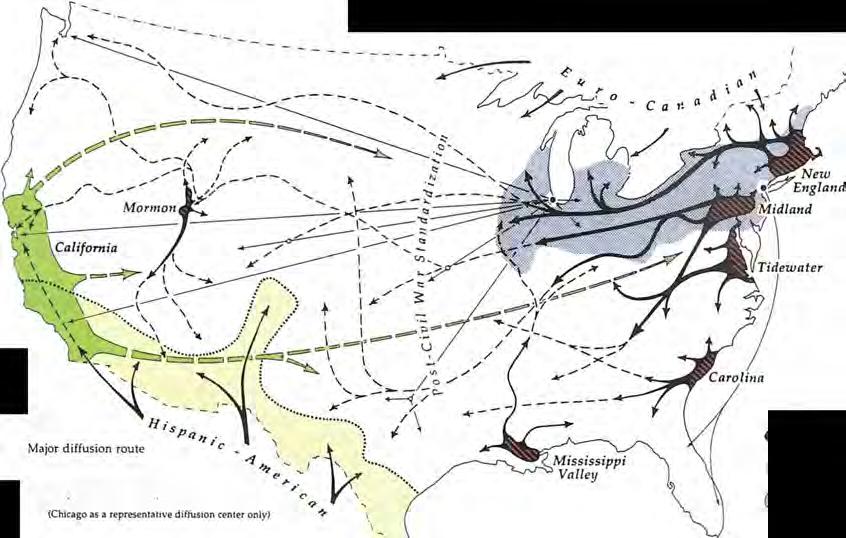
CULTURAL IMPULSES
,- More diffuse influences
Major architectural divide
Industrial-era standardized elements
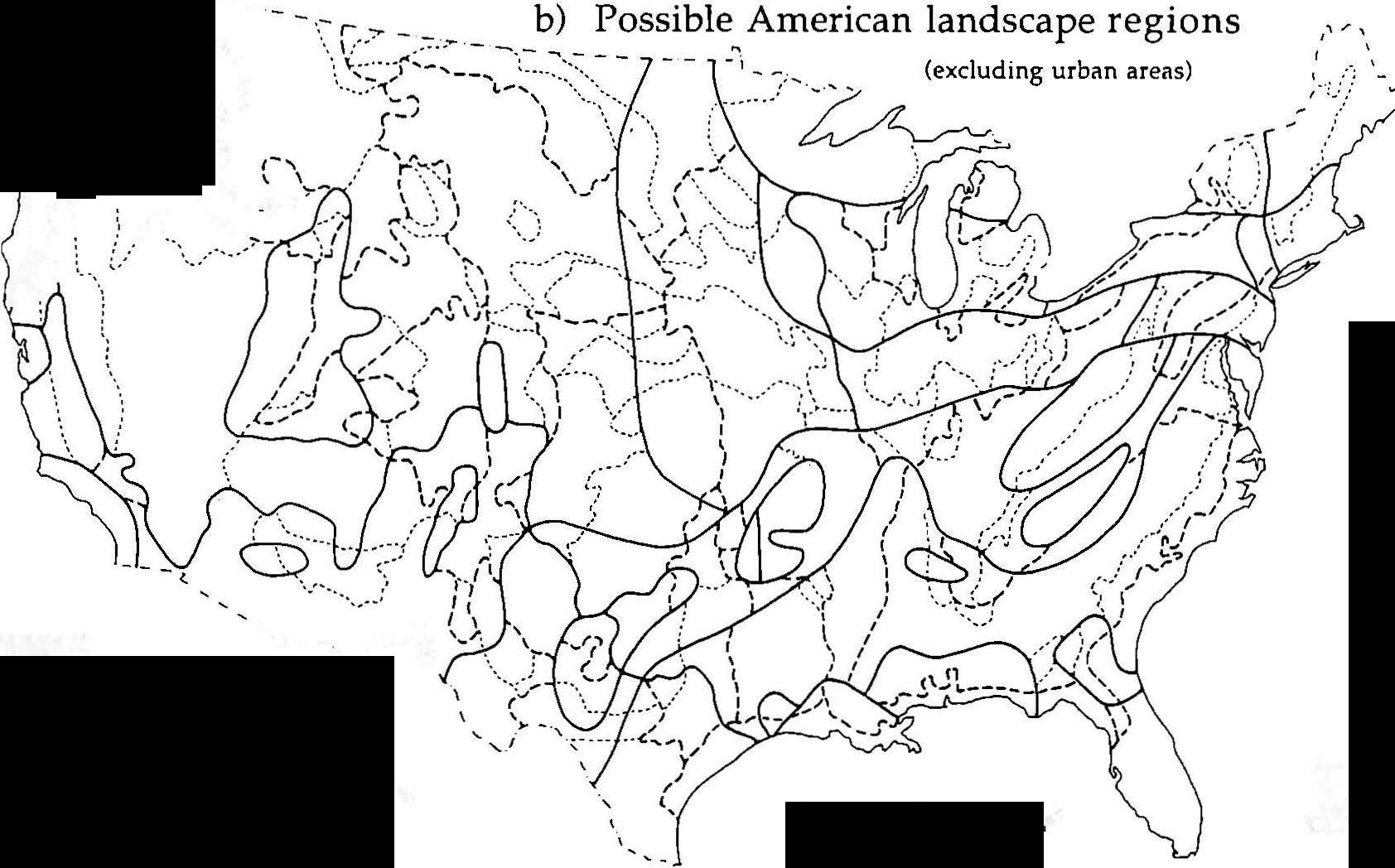
Cuhural (Alter Zelinsky, Meinig. Jordan.Mitchell.and others) Land resource (Aher the Natio11JJI Atlas oftl,t Uniltd StaltS) Physiographic (After Hilmmondl a) Cultural impulses that diffused landscape
Figure 1.1 A geographical view of American Landscape processess and their regional outcomes.
Conccplion, design,,1nd drilhingby M. r. Conzcn
Introduction
at a number oflandscapeartifacts and practicesand poses this central question.And will the ease with which vast development projects can now refashion great swaths of urban and rural terrain in ultimately monotonous and generic designs lead to the loss of identity for places that historically have long excelled in reflecting regional diversity and uniquehumaninterest?Fromthegeographer'spointofview,thisisthe ultimatequestion:willthegeographicalvarietyofAmerica'slandscapes bleed away into a continental-scale generic sameness psychologically nolesslikelobotomythanmountaintop-removalincoalcountry,orwill it survive through the creative emergence of new forms of regionally distinct cultural expression? The two maps offered here (Fig. 1.1) are intended as a challenge to further thought and investigation on this particular human-environmentaltheme.