Acknowledgments
One happy consequence of a years-long steep in tragedy has been a clearer sense of my own good fortune. The writing of this book has been accompanied by countless affirmations of this, from friendships personal and professional, to serendipitous moments where an argument came together, to the various structural supports that made writing about everyday misfortune bearable (even rewarding). Here’s a very brief attempt, then, to account for some of these graces.
This book would not have been possible without the guidance and encouragement of Felicity Nussbaum, whose insightful criticism saw the project through its early years as a dissertation. I only hope it reflects her wise influence adequately. Helen Deutsch pushed me to think about the theoretical stakes of the project early on in its development, and on more than one occasion offered a suggestion that was so perfectly timed that it seemed fateful. Lowell Gallagher’s perceptive reading of my work repeatedly challenged me to do better, while Jonathan Sheehan kept me honest about the history and, in the process, helped turn a five-page document into what it is today. At a pivotal moment during this book’s life, Sarah Kareem gave feedback on its opening gambit and helped me more than I think she realizes. Other friends and co-conspirators from my time at UCLA were instrumental in testing arguments. Ian Newman, Michael Nicholson, Taylor Walle, Katherine Charles, and James Reeves have all gone on to carry out their own research, but as it turns out, played a key part in supporting my own.
At the University of Toronto, I’ve found a vibrant intellectual community whose support remains indispensable. Tom Keymer, Simon Dickie, Terry Robinson, Brian Corman, Paul Stevens, Carol Percy, and Jeremy Lopez, among others, have read or listened to parts of this book. Their engagement with my thinking has made it immeasurably better. Audiences at a number of venues have sharpened my claims, and I owe debts in particular to Julia Fawcett, Misty Anderson, Josh Gang, Lynn Festa, Colin Jager, Vincent Pecora, Paula McDowell, Jane O. Newman, and Morgan Vanek for conversations that yielded a number of well-timed suggestions. Denise Cruz was a crucial support during the writing of this book and continues to be a
valued friend. She and Sam Pinto helped push me to the finish line, one thirty-minute writing session at a time.
Several institutions have aided in this book’s completion as well. I am grateful to the Social Science Research Council and the Andrew W. Mellon Foundation for their support of a timely interdisciplinary working group on “Religion and Modernity” that got the project off and running. Research assistance provided by Yale University’s Lewis Walpole Library and its staff was similarly formative. A great debt is owed to the staff of The William Andrews Clark Memorial Library and UCLA’s Center for 17th- and 18thCentury Studies, who supported me through a fellowship and copious research help. And a Connaught New Researcher Award at the University of Toronto greatly aided in bringing the project to completion. Parts of Chapter 3 first appeared in an earlier form as “Tragedy and the Economics of Providence in Richardson’s Clarissa,” in Eighteenth-Century Fiction 22 (Summer 2010): 599–630; and a portion of Chapter 4 appeared earlier as “Prosaic Suffering: Bourgeois Tragedy and the Aesthetics of the Ordinary,” in Representations 138, no. 1 (Spring 2017): 118–41. I appreciate their permission to reuse some of that material here.
I have been fortunate to work with Jacqueline Norton at Oxford University Press, who saw its potential and shepherded the manuscript through the process of publication. Anonymous readers made critical suggestions that improved the manuscript, and for that I thank them. A special note of thanks goes to my research assistant, Veronica Litt, who, in addition to being a fine scholar herself, proved essential to the book’s completion. Ian Johnston provided the translation of Medea used in the Introduction’s epigraph, for which I am also grateful.
My greatest debts are owed to my family, however, whose household labor is present, silently, on every page of this book. I thank my parents especially for their indefatigable encouragement and inspiration, adding that they are a constant reminder of what it means to strive against the pressures of economic precariousness by risking it all. Without them, none of this would have been possible. Most of all, I thank my partner, Kelsie, and our little ones Ellie and Charlie, to whom this book is dedicated. In a project so concerned with the fragility of our domestic ties, you have been a source of deep comfort, security, and affection, daily reminders of just how tough these bonds can be.
1. The Bourgeois Revaluation of Tragedy: Dignity and the Ordinary in George Lillo’s London
2. Close to Home: The Uncanny of Georgian Domestic Tragedy
3. A Fine Subject for Tragedy: Providence, Poetic Justice, and Clarissa’s Real Affliction
4. Prosaic Suffering: Edward Moore, Diderot, and the Natural Picture of
5.
List of Illustrations
1.1. William Hogarth, Gin Lane. 1750–1. Engraving, 37.4 × 31.8 cm 45
1.2. William Hogarth, detail from upper-right corner of Gin Lane. 1750–1. Engraving, 37.4 × 31.8 cm 49
1.3. William Hogarth, Plate 1 (“Moll Hackabout arrives in London at the Bell Inn, Cheapside”) of A Harlot’s Progress. 1732. Engraving, 30.8 × 38.1 cm 50
1.4. William Hogarth, Plate 5 (“Moll dying of syphilis”) of A Harlot’s Progress. 1732. Engravings, 31.8 × 38.2 cm 51
1.5. Anonymous, Frontispiece to The London Merchant. 1763 61
2.1. Anonymous, detail from The complaint and lamentation of Mistresse Arden of Feversham in Kent [1633?]. Woodcut print 78
2.2. Image depicting the home of Arden of Faversham, Abbey Street, Faversham 79
2.3. Anonymous, details from Newes from Perin in Cornwall Of a Most Bloody and Unexampled Murther. 1618. Woodcut print 79
2.4. [François Boitard?], Illustration depicting Act V, scene 2 of Othello in Jacob Tonson’s The Works of Wiliam Shakespeare [sic]. 1709 84
2.5. [Engleman?], after a painting by Thomas Stothard, Plate depicting Act III, scene 2 of Fatal Curiosity in Inchbald’s The British Theatre. 1807 87
4.1. Jean-Baptiste Greuze, La malédiction paternelle. Le fils ingrat [The Paternal Curse: The Ungrateful Son]. 1777. Oil on canvas, 130 × 162 cm 149
4.2. Jean-Baptiste Greuze, La malédiction paternelle. Le fils puni [The Paternal Curse: The Son Punished]. 1778. Oil on canvas, 130 × 163 cm 150
4.3. Mather Brown, The Last Scene in the Tragedy of the Gamester. 1787. Oil on canvas, 200 × 256 cm 162
5.1. W. W. Ryland, after Angelica Kauffman, Maria—Moulines. 1779. Stipple and etching in red-brown ink on paper 202
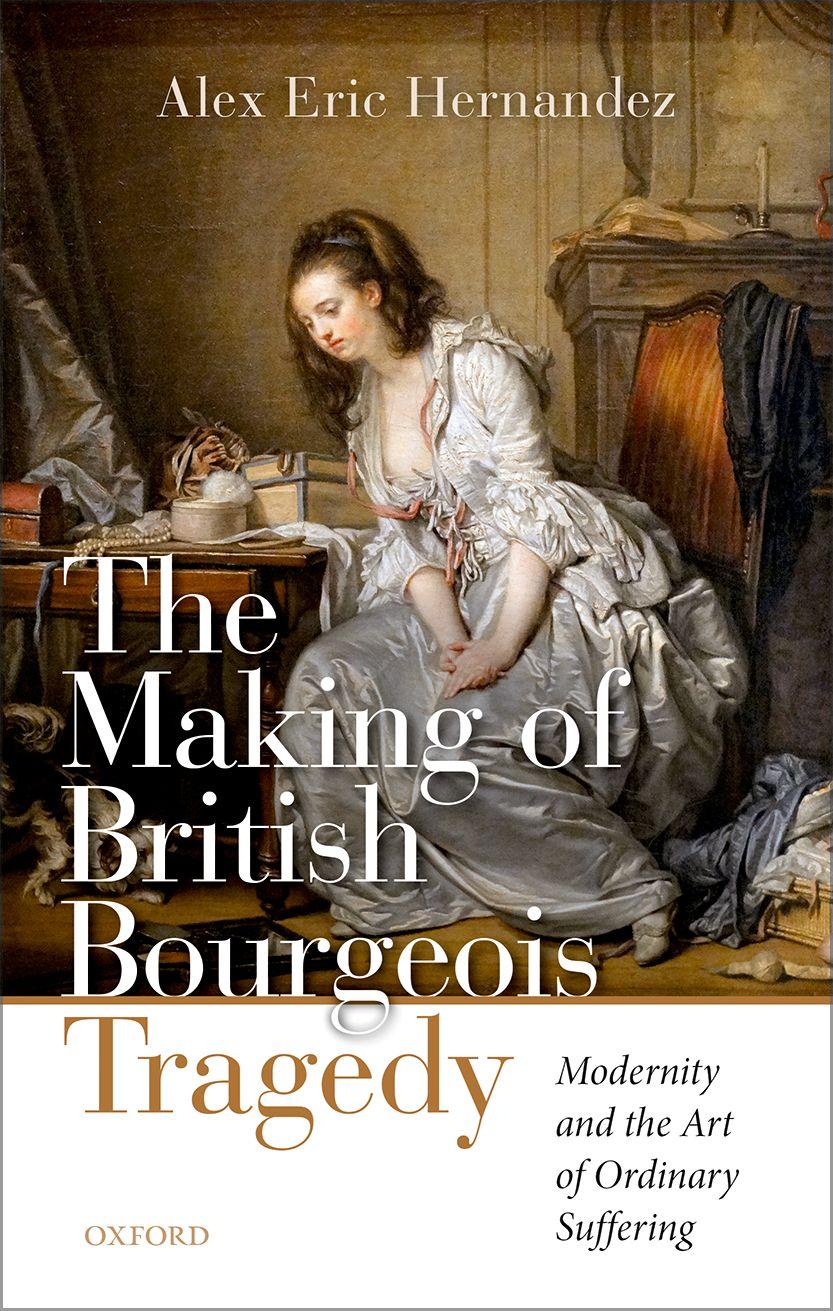
5.2. Jean-Baptiste Greuze, Le Malheur Imprévu ou Le Miroir brisé [Unforeseen Misfortune, or, The Broken Mirror]. 1763. Oil on canvas, 56 × 46 cm 204
C.1. Thomas Rowlandson, The Sorrows of Werter; The Last Interview. 1786. Etching with stipple engraving, 25 × 35 cm 224
An Introduction to Bourgeois Tragedy
Or, “Silently and Smoothly Thro’ the World”
I don’t want a grand life for myself— just to grow old with some security. They say a moderate life’s the best of all, a far better choice for mortal men. Going for too much brings no benefits. And when gods get angry with some home, the more wealth it has, the more it is destroyed.
Medea, 149–55
The middle class has long seemed impervious to tragedy. Consider the opening to Daniel Defoe’s Robinson Crusoe (1719), which famously begins with a vision of modest productivity and social stability for what his contemporaries called “the middling sort of people.” Recalling those days before he set out to try his fortune, Crusoe narrates the chiding of his father, an immigrant, who warns him to adhere to the via media of a simple, commercial life:
He bid me observe [this middle state] and I should always find, that the Calamities of life were shared among the upper and the lower Part of Mankind; but that the middle Station had the fewest Disasters, and was not expos’d to so many Vicissitudes as the higher or lower Part of Mankind; nay, they were not subjected to so many Distempers and Uneasiness either or Body or Mind, as those who, by vicious Living, Luxury and Extravagancies on one Hand, or by Hard Labour, Want of Necessities, and mean or insufficient Diet on the other Hand, bring Distempers upon themselves by the natural Consequence of their Way of Living Peace and Plenty were the Hand-maids of a middle Fortune.1
1 Defoe, Robinson Crusoe, 4–5. Subsequent citations refer to this edition and appear parenthetically in the text.
The Making of British Bourgeois Tragedy: Modernity and the Art of Ordinary Suffering. Alex Eric Hernandez, Oxford University Press (2019). © Alex Eric Hernandez. DOI: 10.1093/oso/9780198846574.001.0001
It’s a touching scene, Crusoe tells us: “I was sincerely affected with this Discourse, as indeed who could be otherwise?” (6). Desperate to preserve the only son that remains to him, the elder Kreutznaer voices the alreadyclichéd promise of middling prosperity: “observe, and you will always find . . . ” Neither precarious like the indigent, nor liable to the reversals of aristocratic fortune, bourgeois life was industrious and low-risk, “calculated for all kind of Vertues and all kinds of Enjoyments.” In this way, as Defoe elegantly phrases it, the middle station went “silently and smoothly thro’ the World” (5).
Father Crusoe had reason to be optimistic. For decades now, economic and social historians have traced the extensive growth of the British middling sort, that amorphous social category that encompassed, in fine gradations of perceived rank and standing, merchants of all stripes, tradespeople, shopkeepers, and artisans, professionals, even (according to some contemporaries) members of the lower gentry, country farmers, freeholders, and well-off laborers and their families. In his classic history of eighteenthcentury England, for example, Paul Langford paints a picture of steady economic growth in which a “powerful and extensive middle class [resting] on a broad, diverse base of property . . . increasingly decided the framework of debate.”2 “An English tradesman is a new species of gentleman,” Samuel Johnson claimed, not without concern over the changing cultural landscape.3 Standards of living were on the rise too, with a prolonged if not also modest estimated per capita income growth of 0.30% per year between 1700 and 1760, according to recent accounts. If we talk of the “long eighteenth century,” those figures are far more impressive, curving upwards into what many call the “hockey-stick graph” of GDP during industrialization.4 By about 1780, output grows decisively to between 1.32% and 2.06% annually, helping most of Britain (though not yet Ireland) escape the Malthusian trap, eventually doubling the population during the century that followed the Hanoverian accession.5 Inventories, legal and marital records, as well as
2 Langford, Polite and Commercial People, 68.
3 Quoted in Porter, English Society, 50.
4 See Broadberry et al., “British Economic Growth, 1270–1870,” esp. table 22. The authors of this study note that their work largely confirms what has come to be known as the CraftsHarley view of British economic development. See Crafts and Harley, “Output Growth.” An important corrective to this is offered by Eric Hobsbawm, who influentially traced the slowing in growth in the per-capita figures to increasing numbers of laboring poor. See his “British Standard of Living.”
5 Rule, Vital Century, 5–15; 28–31. On population growth in the period, see Wrigley and Schofield, Population History of England.
countless anecdotes confirm a sense of the expanding material comforts available to households with standards of living above mere subsistence, the numbers of which swelled, and more and more defined Britain’s culture.6
A few years before Robinson Crusoe’s foreboding advice, Defoe characterized the nation’s social fabric in terms of the comforts a bit of surplus could buy. Nestled between twin extremes—“The great, who live profusely” and “The miserable, that really pinch and suffer want”—were those most insulated from the “Disasters” and “Vicissitudes” we colloquially refer to as tragic: “The middle sort, who live well.”7
Perhaps it’s unsurprising then that the era witnessing the “rise of the middle class” is also often seen to mark the so-called “death of tragedy.” For George Steiner, whose endlessly controversial argument I invoke here, the late seventeenth century is the “great divide” for the genre, the era after which a variety of historical forces (capitalism, Enlightenment, the loss of shared “mythological, symbolic, and ritual reference,” to name a few) coalesce to make tragedy an impossibility.8 His view seems to confirm the sense of Defoe’s opening vignette in Crusoe that tragic misfortune would be largely avoidable in this new era, the middling sort having squeezed out the “Hellenic forms” of high tragedy, leaving nothing behind but a plodding, epic-comic prosperity. How then can a life defined by its stability, by the rhythms of an everyday getting-and-spending, foster the sort of convulsive passions necessary for tragedy? Isn’t the very idea of “the bourgeois,” as Franco Moretti observes, predicated on values like efficiency, lawfulness, and comfort?9 Hardly fodder for the tragic, it would seem. Echoing Walter Scott’s complaint about the bourgeois tastes of modern audiences, Steiner goes on to claim that the values of middling life ensured that the market for tragedy turned middlebrow and sentimental.10 Thrust into a world much
6 A number of studies confirm Langford’s account of the growing cultural influence exerted by consumers and thinkers tied to the middle rank, and together present a narrative of rank’s transmutation into a self-conscious discourse of middle-class ideology. See, for example, Hunt, The Middling Sort and Earle, English Middle Class. For a survey of the rich historical literature debating the extent to which a middle rank or “class” cohered in the period, see Wahrman, “National Society, Communal Culture.”
7 Defoe, Review, 6.
8 Steiner, Death of Tragedy, 292. For a sense of the persistence of this argument, as well as a series of powerful critiques, see Felski, Rethinking Tragedy
9 See Moretti, The Bourgeois, chap. 1.
10 See Scott, “Essay on the Drama,” 1:219–395. This is not to say that tragedies were no longer written—Susan Staves points out that the latter half of the century alone saw more than a hundred new tragedies brought to stage—but that they failed to embody the essence of the genre. See her “Tragedy,” 87.
more ordinary, tragedy loses the possibility of transcendence so that finally it “disappeared altogether or took tawdry refuge among the gaslights of melodrama.”11
In place of tragedy, many have argued, the middling sort looked to another incipient literary form often linked to our narratives of eighteenthcentury optimism: the novel.12 Sandra Macpherson notes, for example, that the history of the novel has largely been read as an explicitly anti-tragic tradition; the famed “rise of the novel” passes as more or less the flip side of the old “death of tragedy” coin.13 “The suspicion that there is something inherently untragic about the novel-form is hard to shake off,” adds Terry Eagleton, concluding that this assumption is largely a function of class: “The temper of eighteenth- and nineteenth-century English fiction, the heyday of the making of the English middle class, is anti-tragic.”14 Tragedy hibernates in his view, suspended by the dynamism of what Georg Lukács called the novel’s “extensive totality,” its ability to draw in complex causal chains and diverse agencies, glossing over the isolation of one’s personal misfortunes. Thus: “[The novel] gives form to a totality of life that is rounded from within; [it] seeks . . . to uncover and construct the concealed totality of life.”15 Construction, revelation, meaning—like Crusoe’s Providences, novels disclose the secret fullness of the everyday, rescuing the quotidian details of the modern world from its veneer of banality and senselessness. A narrative exercise in the consolations of bourgeois life, in which “the triumph of meaning over time” gradually emerges through the epic perspective made possible for its reader, the novel legitimates its evils. It exposes what seems to be the “intensive totality” of the drama—with its pitched suffering and claustrophobic plots—as merely one of a thousand counterfactual trade-offs necessary in order for the ascendant middle rank to “live well.”16
11 Steiner, Death of Tragedy, 194.
12 Eagleton, Sweet Violence, chap. 7. See also Peyre, “Tragedy of Passion,” 77; and cf. Steiner’s related point in The Death of Tragedy: “The history of the decline of serious drama is, in part, that of the rise of the novel” (118).
13 In Harm’s Way, Macpherson looks to the novel to overturn this assumption. See her introduction for a slightly different framing of this problem in eighteenth-century literary studies.
14 Eagleton, Sweet Violence, 180; 179. In his provocative account of modernity and the tragic, Mourning Happiness, Vivasvan Soni offers a slightly different take, arguing that modernity converts tragedy into “trial narratives,” most of which devolve into mechanical illustrations for a bourgeoisie coming to grips with secular happiness. Interestingly, he doesn’t mention bourgeois tragedy.
15 Lukács, Theory of the Novel, 60.
16 Thus, Franco Moretti argues that the modern novel finds its truest expression in Bildungsroman, which formalizes the process of becoming reconciled to the world (Way of the World, 55).
Silently and smoothly thro’ the world indeed. And yet despite this, for eighteenth-century Britons, depictions of middling misfortune seemed to be vital in a way that they had rarely been before. Onstage, tragedies featured new and complex characters pulled from the social middle; a thriving print market fueled a healthy demand for tales of domestic discord; novels examined intensely personal, existential pain and suffering in the lives of their everyday figures; few scenes could evoke more feeling than that of the bourgeois déclassé. The Making of British Bourgeois Tragedy seeks to account for this vitality and the lasting cultural importance of what has come to be known as “bourgeois tragedy.” In what follows, I assemble a body of text and performance that contradicts both Defoe’s optimism and the narrative of tragedy’s demise in the period, redefining the genre in order to better account for its movement between media, examining the changing conventions through which its practice mobilized a shared present more felt than articulable. Where many have seen aesthetic stagnation, overwrought or misfiring emotions, and the absence of an idealized tragicness, I see instead a sustained engagement in the affective processes and representational techniques through which the middle rank feels its way into modernity. I’m interested, that is, in the way the Crusoevian “rise of the middle class” was always far from certain, burdened from the start by an anxiety over the potential of loss or failure. Giving the lie to so much of what we think we know about the effervescent middling sort in the period, the making of British bourgeois tragedy records a haunting ambivalence toward the modernizing processes that went hand in hand with the creation of Defoe’s confident middle class.
At the core of this account is the simple, often overlooked fact that the afflictions of common people came to be treated in the genre with a measure of dignity and seriousness previously denied them in tragedy. Indeed, the central insight of this book is that the very historical emergence of something like “bourgeois tragedy” represents a gradual, shifting cultural debate over the extent and shape of suffering: who precisely gets to suffer meaningfully, and what is the character of the affliction they undergo? Whose life, and whose way of life, is grievable? After all, tragedy posits the destruction or forfeiture of something valued, the mournful loss of one’s attachments, whether those attachments happen to be people, or fantasies of the good life, or even a newly materializing sense of the dignity of the ordinary. To see something as tragically lost is to register its considerable worth. In rehearsing these losses in relation to everyday life, bourgeois tragedy argues for a realignment of many of the genre’s core values.
Yet tragedy also shows us what it is to suffer, playing out and exploring these emotions, meditating upon what it means to be afflicted—or, in fact, what it fails to mean. Bourgeois tragedy is no exception to this, telling of how the era’s valorization of this-worldly happiness erodes those cherished frameworks that made sense of not only the good, but also one’s affliction. The genre imagined a particularly modern sort of affliction, I argue, an “ordinary suffering” proper to ordinary life, divested of the sorts of meanings, rhetorics, and affective resonances once deployed to understand it. Whereas neoclassical aesthetics aligned tragedy with the heroic and the admirable, ordinary suffering was domestic, familiar, a private phenomenon turned public, entangled in the nascent values of capitalism and the particularities of the era’s rationalizing bureaucratic systems, yet no less haunted by God. Responding to the changing atmosphere of the age, the works assembled here offered practical affective responses to a range of concerns that were virtually unprecedented in tragic literature, and thereby enlivened a kinesthetic imagination through which those emotions were embodied. In this way, bourgeois tragedy heralded a European modernity in which pain and suffering were increasingly taken as difficult facts to be overcome, tenuously bound to notions of its sanctifying or positively dolorous effects, though not for that reason secular 17
That last point is worth emphasizing here, for in taking up the notoriously difficult term, “modernity,” I certainly don’t mean to imply that that cultural condition is inherently secularized, or that the refiguration of tragic suffering necessarily involves a loss of sacrality. As Misty Anderson has recently noted, “the modern” “name[s] an ideology that unfolded in time,” one that thrives by positing a “religious antimodernity as a foil in the narrative of modernity’s rise.”18 Similarly, Jonathan Sheehan cautions that our notions of secularization have too often devolved into a “shorthand for the inevitable (intentional or not, serious or ironic) slide of the pre-modern religious past into the modern secular future,” a zero-sum story of modernization as the eclipse of belief.19 To be sure, few genres pressure the assurances of faith like tragedy. Yet time and again, the strategies employed in order to meditate upon affliction in bourgeois tragedy testify not only to the persistence but the positive flourishing of religion, even when such beliefs,
17 See Taylor, Secular Age, 647–66, for example, though the discussion across part V, Dilemmas I in the text is germane; Cf. Odo Marquard’s argument in “Theodicy Motives in Modern Philosophy.”
18 Anderson, Imagining Methodism, 13.
19 Sheehan, “Enlightenment, Religion, and the Enigma of Secularization,” 1076.
mythologies, and ritual practices seem to make increasingly less sense and offer little comfort to those depicted. A case in point is the fact that the encroaching assumption that (for more and more people) happiness is at hand in this life rather than the next not only fails to extinguish faith in one’s futurity but, in many cases, also invests everyday suffering with a metaphysical import largely alien to earlier periods. Like all ideologies, then, modernity tends to minimize its fissures, but these complexities are present in spades in bourgeois tragedy—indeed, modernity’s ambivalences tend to lie at the heart of the genre and contribute to a sense that, as several scholars have claimed, modernity simply is a tragic condition.20 Insofar as the genre explores many of these characteristic aspects of the modern social imaginary, therefore, it seems to mark a largely unacknowledged site in which the contradictory processes of modernization play out in print and performance.
In other words, bourgeois tragedy names both an innovation in tragic aesthetics and an episode in the history of suffering. This is a complex claim, of course, whose nested elements unfold slowly in the ensuing chapters and may only be fully appreciable in the hindsight enabled by history and recounted at the close of this book. What follows here, consequently, merely sketches a brief, preliminary history of the genre that situates it within some of the larger trends of the period. In doing so, I’ll begin clarifying the terms I draw upon and gesturing toward the layers of argumentation that make up this book’s intervention, turning later to questions of method. Here then is an introduction to bourgeois tragedy.
Ever since Denis Diderot’s founding definition in the Entretiens sur le Fils naturel (1757), historians of eighteenth-century theatre have referred to a series of dramas focused on the misfortunes of the middle rank as “bourgeois tragedy.”21 This name has always been somewhat misleading when applied to the British context, however, a jarring anachronism in light of what we know about the period’s social rhetoric. For one, Britons did not often speak of their middle sort using the term “bourgeois” until somewhat later (and then only rarely), when it assumed a more pejorative connotation or was enlisted in Marxist analysis to denote the class of manufacturers that
20 A recent collection of essays explicitly links the two and continues a longstanding critical tradition. See Billings and Leonard, Tragedy and the Idea of Modernity. 21 Diderot, “Entretiens,” 1131–92.
drove capitalism in the nineteenth century.22 (Even the decidedly British “middling,” H. R. French observes of the eighteenth century, was used relatively infrequently as a means of self-identification.23) Moreover, Diderot’s French bourgeoisie was a complicated social entity with its own endemic complexities and definitional problems, a category not always easily exported across the Channel because it implied a status closer to the English landed gentry or a narrow circle of the moneyed elite, largely confined and defined by their association with the cities.24 To be sure, there are several figures we would identify now as part of an haute bourgeoisie in the British tragic canon (and we shall return to them, for they are important to the story I tell), but notable examples of the genre drew from the ranks of apprentices, migrant laborers, and skilled tradespeople, bearing little resemblance to the incipient ruling class of classical French historiography or Marxist dialectics. In such cases, “bourgeois tragedy” depicts a seedy, unsentimental urban world we might think of as decidedly un- or even anti-bourgeois in the typical sense, closer in spirit to that navigated by E. P. Thompson’s beleaguered laboring class.25 Evidence of the diverse economic base that made up the British social middle, these tragic figures aspire to the stability of our stereotypical middle, suggesting that the enduring usefulness of Diderot’s terminology lies in the way it maintains a fantasy of the good life even when enacting its failure. Mindful of these caveats, I nevertheless adopt much of this traditional critical vocabulary precisely because such acts of naming see the genre as elaborating a way of life that the bourgeois came to connote. Which is to say that much like Defoe’s rhetorical middling, bourgeois tragedy imagined a way of being in the world whose values, assumptions, and practices were seen as fundamentally those of ordinary people and everyday life.
Apropos of such terminological acts of creation, one might point out that until relatively late in the century, the term Britons most often associated with this literature was “domestic tragedy.” This designation traced the
22 Moretti’s dataset is revealing here, and unsurprisingly, sees a late rise in the frequency of that term’s usage relative to both the French context and the more preferred British “middle rank” and “class.” See Moretti, Bourgeois, 9–10.
23 This contention lies at the heart of his account of social representation in the period. See French, Middle Sort of People
24 See Sarah Maza’s subtle exploration of these issues in Myth of the French Bourgeoisie; Darnton tackles some of these issues as well in Great Cat Massacre, 125–7. The French understanding of the bourgeois, for example, typically implied an urban rentier class not necessarily synonymous with the working merchants and tradesmen one sees fallen from grace in many of the earliest British bourgeois dramas.
25 Thompson, Making of the English Working Class.
genre’s pedigree back to the theatre of the English Renaissance and framed it according to a particular set of nascent values that would later seem inextricably linked to the middle sort. Plays like the anonymous Arden of Faversham (1592) and Thomas Heywood’s A Woman Killed with Kindness (1603) and The English Traveller (1633) focused their plots on the homebound tensions that threatened the early modern family, utilizing a mixture of prose and verse by which to represent “the horror of the everyday ordinariness of it all.”26 Among the earliest forms of stage realism, the genre familiarized tragedy, locating its action among Englishmen and women in the present, the mundane spaces they inhabited, and the commonplace circumstances that brought about their suffering. In many cases, too, they brought to life true or folkloric incidents, enacting a violent crime literature that remained popular well into the early decades of the eighteenth century, by which time the plays themselves were seldom (if ever) actually performed.
According to Raymond Williams, these experimental tragedies were part of a process “long and deep” in the making, in which a “new structure of feeling” began permeating the soil of European art and culture.27 Playwrights in the Restoration and early eighteenth century, for instance, linked the Renaissance domestic tradition to their more recent work in shetragedy, mapping the “pathetic” female leads of the latter onto the homely concerns of the former and thereby privileging what several of them claimed was “private woe.” Like the homes simulated onstage, private woe imagined a pain interiorized and personal, constituted by the tender intimacies and attachments that the domestic increasingly seemed to promise.28 Domestic dramas like Nicholas Rowe’s The Fair Penitent (1702) and Lewis Theobald’s The Perfidious Brother (1715) thereby helped transition to what many critics to this day have taken to be a more self-consciously sentimental tragedy aligned with bourgeois feeling. Nevertheless, Thomas Otway’s The Orphan (1680) and Venice Preserv’d (1682), Thomas Southerne’s The Fatal Marriage (1694), and Rowe’s The Tragedy of Jane Shore (1714) remained lavishly draped in the trappings of earlier theatrical traditions. These plays retained
26 Helgerson, Adulterous Alliances, 15. 27 Williams, Modern Tragedy, 28; 45.
28 Thus, Samuel Johnson claims that Thomas Otway’s The Orphan is “a domestic tragedy drawn from middle life,” adding that “Its whole power is upon the affections” (Lives of the Poets, 1:339–40). That is, rather than move the intellect, Johnson claims that its force lies in the drama’s power to “interest” the heart. On the relation of she-tragedy to later domestic or bourgeois tragedies, see Laura Brown’s classic essay, “The Defenseless Woman and the Development of English Tragedy.”
elements of the grandly heroic, sometimes exotic worlds they ostensively depicted, even if that world increasingly appeared in the literal and metaphorical backdrop of the action. Republic, kingdom, and empire are finally at stake in their plots, but many later tragedians will move their political themes further and further behind the proscenium, until finally the only matter left onstage is the home itself. Looking forward to these developments, Allardyce Nicoll thus takes this to be nothing short of a “progressive and revolutionary . . . endeavor to find a new field of tragic emotion.”29 Writers in the period sensed a realignment in tragedy’s operative passions too: the preface to Charles Johnson’s 1717 revision to Racine’s Bajazet (1672), to take just one example, positioned she-tragedy alongside its ancient models, offering Britons a “A sad, true Tale, a Modern Scene of Woe.”30
The Making of British Bourgeois Tragedy contends, however, that the watershed moment in the creation of this “new field of tragic emotion” came in the decades that followed she-tragedy’s vogue, when a group of tragedians, many of whom were themselves commoners, began depicting a specifically middling misfortune as worthy of the tragic. What defined this new field was its earnest exploration of ordinary affliction; its familiar emotional tenor, recognizable situations, and representational tactics. In contrast to the baroque chromaticism of early modern passions, these plays enacted feelings at once more direct and decidedly smaller, paradoxically sensational and somehow tenderly intimate. Like the heroic tragedies celebrated in the period, bourgeois tragedy sought to evoke terror and pity; unlike them, no admiration was to be engendered by watching the great suffer. Instead, the average spectator, for the first time perhaps, could have mourned a version of him- or herself battered and broken onstage, imagining their experience as part of a genre bound at once by social, cultural, and affective ties. Of course, this isn’t to say that the full impact of that genre upon collective practice was registered immediately, as if its mere appearance signaled the arrival of the bourgeoisie as a class with coherent and singular aims. Nor did this newfound seriousness render the middling and lower orders immune to the indignities that could be part of life in those stations, even decades later. As we’ll see, in many ways the pleasures of tragedy could be constituted by the spectator’s condescending pity, by the assertion of difference and the asymmetries of situation and power. As Robert Hume has repeatedly insisted too, sentimental tragedies would never form the dominant
29 Nicoll, History of Early Eighteenth-Century Drama, 114–15.
30 Johnson, Prologue to The Sultaness.
tradition in the period (though it’s worth countering that many of these plays were much too grim to dismiss as sentimental).31
And yet the importance of this moment is unmistakable in retrospect, as the Georgian stage saw common folk and their concerns become an increasingly prevalent source of serious dramatic material over the 1720s and 30s. Thus, by 1721, Aaron Hill (perhaps the most important English tragedian in the first quarter of the century) published his domestic drama, The Fatal Extravagance, very loosely based on The Yorkshire Tragedy (1608). In Hill’s tragedy, a failed gambler struggles against the urge to commit murdersuicide in a series of set pieces that only thinly veil his family’s bankruptcy as a figure for the sudden collapse of South Sea Co. stock. The jewelerturned-playwright, George Lillo, would achieve lasting fame in a pair of God-haunted dramas produced in the 1730s, The London Merchant (1731) and Fatal Curiosity (1736), that dwelled largely on the economic pressures faced by those on the edges of respectable society. Other experiments in bourgeois and domestic tragedy, many of which utilized a stripped-down prose so as to both capture the status of their principal characters and foster modes of theatrical realism, cropped up often if not always successfully. Charles Johnson’s Cælia, or the Perjur’d Lover (1732), John Hewitt’s blank verse Fatal Falsehood (1734), and Thomas Cooke’s The Mournful Nuptials, or Love the Cure of all Woes (1739) dilated upon violence and betrayal by those nearest to oneself, and together began to imagine what would become the melodrama of the industrialized nineteenth century. More influentially, Edward Moore’s prose tragedy, The Gamester (1753), staged a tension between aristocratic Epicureanism and middling providentialism as a sort of classinflected Pascal’s wager, a wager in which suffering ultimately gives rise to both Christian faithfulness and profound doubt. Unfairly relegated to the footnotes of sentimentalism, this body of serious drama paved the way for Diderot’s “tragédie domestique et bourgeois” and G. E. Lessing’s “bürgerliche Trauerspiel,” innovations which Peter Gay numbers as among the signal artistic achievements of the Enlightenment.32 By midcentury, then, the British stage offered an honest exploration of ordinary people and their feelings, with profound consequences for modern art.
Exactly what brought about this cultural turn is a difficult question to answer, and doesn’t boil down to one single factor in my view. For instance, though capitalism is the single most commonly cited reason for the genre’s
31 Hume, Rakish Stage, 297–300; 343; and Stone, “Making of the Repertory,” 195–6.
32 Gay, The Enlightenment: An Interpretation, vol. 2, chap. 6.
emergence—and in many ways rightly so—to claim it as the sufficient condition for a particularly bourgeois tragedy is undoubtedly too tidy an explanation. If this were so, we might expect to see the same thing in Holland, Venice, or Genoa, three other commercial centers where merchants had a relatively high social standing. We simply don’t. On the contrary, France and Germany take up the genre with just as much gusto as their British counterparts, despite less enthusiastic (and for historians, more hotly debated) adoptions of capitalism in the period. One faces the same sorts of explanatory issues if they posit the Protestant religious tradition instead as the determining factor, though it is true that several early bourgeois tragedians were raised in a strain of dissenting Christian theology that we associate with the sanctity of the ordinary. Much more likely, however, these large-scale social changes coalesced around existing British institutions and forms (like she-tragedy and true crime ballads) that could give voice to everyday concerns at a moment when the early public sphere provided a venue for their amplification. Bourgeois tragedy would appear then to be a response to processes that ran parallel in the period. On the one hand, there was slow, steady economic growth leading up to the boom times of industrialization at the turn of the nineteenth century; on the other hand, a culture of public performance and print that everywhere seemed to trumpet the gains of the middle sort thereby creating a widespread sense (so Defoe argued) that the social sphere was relatively fluid and the bourgeois way of life in particular was on the upswing. Bourgeois tragedy spoke to the gap between these two realities, which is to say the dynamic, imagined space where collective and individual fantasies meet and produce (if the conditions are right) new arts.
In fact, this story might seem oddly familiar. In The Rise of the Novel, Ian Watt describes a similar process of cultural investment in the commonplace, though in his reckoning, a newfound “serious concern with the daily lives of ordinary people” helped to explain not the drama’s shifting affective priorities, but rather prose fiction’s developing feel for formal realism and its relationship to capitalism.33 In Watt’s view, interest in the lives of nonaristocratic figures reflected the rising fortunes of the middling sort and their curiosity for stories of others in comparable socio-economic conditions. Hence, the novel is the great scene of everyday struggle, and in this way, the cradle of realism. Or consider instead the “conceptual leitmotif” of Erich
33 Watt, Rise of the Novel, 60.
Auerbach’s still-indispensable Mimesis: “the serious treatment of everyday reality, the rise of more extensive and socially inferior human groups to the position of subject matter for problematic-existential representation.”34 His argument envelops the history of realism into an account of how the quotidian and bourgeois came to be taken seriously, an account that doesn’t so much abolish tragedy as it liquidates and sublates its form. Thus, Auerbach’s thesis culminates in what he calls the grand “formless tragedy” of Gustav Flaubert, and later, Virginia Woolf and Émile Zola—but interestingly, not before tracing a bead through Friedrich Schiller’s bourgeois drama, Kabale und Liebe (1783), and thereby finding high realism’s true sources in both “the sentimental middle-class novel and the middle class tragedy.”35 Drawing these literary threads together, Moretti notes that in taking up Diderot’s auxiliary terms for bourgeois tragedy, “le genre sérieux,” “le genre moyen,” “the class in the middle adds a style which is itself in the middle.”36 Moretti means to signal the novel’s prosaism here—readings of Wilhelm Meisters Lehrjahre (1796), Illusions perdues (1837–43), and Madame Bovary (1856) illustrate the turn—but the implication is a telling one, for even in its erasure from the account of realism that ensues, bourgeois tragedy hides, like the artifice of its prose, in plain sight. Hence, the genre figures something of a prolepsis for this shift in cultural moods, one of the first sustained, self-conscious attempts to fuse the severity of tragedy with an interest in “everyday reality.”
Now to be sure, the differences between drama and novel matter—quite a bit, in fact, as later chapters will show—but my account seeks to re-stitch these histories together, taking as a matter of fact that these forms intersected in fateful ways around questions of how to approach that “everyday reality.” Accordingly, and though the work of theatre and performance studies forms an important part of its conceptual framework, this study refuses to limit itself to the theatre. For while the genre no doubt initially arose out of theatrical traditions, the questions it pursued, the stories it told, its spectatorial methods, and, in many cases, its critical language were catalyzed in the experimental milieu of eighteenth-century print and performance, an instance of what Joseph Roach has called the “interdependence of orature and literature” through which cultural memory is kept alive in practice.37 In
34 Auerbach, Mimesis, 491; Moretti, from whom I take the phrase “conceptual leitmotif,” argues that Auerbach’s most lasting contribution lies in the way Mimesis materializes the elusive quality of “everydayness” (Bourgeois, 71).
35 Auerbach, Mimesis, 488; 437. 36 Moretti, Bourgeois, 73.
37 Roach, Cities of the Dead, 12.