ForNora
Contents
Preface
Acknowledgments
1. Is Liberalism Inescapable?
2. Disciplined by Liberalism: Contestations, Pedagogies, and the Ex emplary Mr. Mill
3. Mill Reconsidered: From a Crisis of Certainty to a Politics of Unce rtainty
4. The School of Virtues: Emancipating Women, Wives, and Mother s
5. Earning Democracy: Class Politics and the Public Trust
6. Governing Dependencies: Between Authority and Self-Determina tion
7. Politics, Possibility, and Risk: Beyond the Liberalism Trap
Notes
Bibliography
Index
Preface
The problem this book explores can be illustrated by an affair featuring the Russian president. In the summer of 2019, Vladimir Putin announced that liberalism was dead. Interviewed by the FinancialTimesahead of the G20 summit in Japan, Putin punted on Russia’s interference with US elections and turned instead to the failures of liberalism, an idea that had become, in his words, “obsolete.” Using fundamental disagreements over LGBTQ rights, multicultural politics, and migrant protections as examples of liberalism’s decline, Putin argued that its defenders were tone deaf to the demands of the “overwhelming majority.” The liberal idea, he concluded, had “outlived its purpose.”1
Putin’s pronouncement quickly captured the news cycle. Asked about the interview, then-President Donald Trump seemed ready to agree with the Russian autocrat, though he also mistook the latter’s use of the term “liberal” to refer to California Democrats.2 Most others correctly understood Putin to be attacking a tradition of western political thought originating in the nineteenth century.3 A few noted that Putin’s critical assessment had become fashionable “among reactionaries” in several countries, bolstering the rise of farright figures like Jair Bolsonaro, Matteo Salvini, and Marie Le Pen. In that reactionary fashion, for instance, Hungary’s Viktor Orbán claimed that alternative visions of the world are taking hold, visions that “are not Western, not liberal, not liberal democracies, maybe not even democracies, and yet are making nations successful.”4 Those who were loath to side with Putin but reluctant to praise liberalism argued that while the liberal idea is not yet obsolete, it is “on the ropes” and its systems clearly “under pressure.”5
European Council President Donald Tusk was more forthright in his criticism of Putin’s assertions. At the G20, Tusk told his audience: “We are here as Europeans also to firmly and univocally defend and promote liberal democracy. What I find really obsolete are— authoritarianism, personality cults, the rule of oligarchs.”6 The FinancialTimesitself published not one but two separate rebukes of Putin’s comments, suggesting he was posturing on the world stage to downplay liberalism’s successes, particularly in terms of economic development.7
By no means were reactions limited to politicians and reporters. Putin’s claims about the fate of the liberal idea became part of a series of scholarly responses to Raymond Geuss’s critique of the liberal tradition in his curious commemorative of Jurgen Habermas’s ninetieth birthday. For Seyla Benhabib, Putin’s and Geuss’s overlapping pronouncements against liberalism warned of “strange bedfellows,” while for Martin Jay it suggested a “guilt by association” which “may not be a fair tactic although in this case, it is hard to resist.”8 The exchange made clear the extent to which public and scholarly debates can merge around the question of liberalism and its value. As a “vexed object of attachment,” the idea has as firm a footing in academic circles as it has in public debate.9
Putin’s interview clearly sparked a broad conversation about the vitality and utility of the liberal idea. But one must wonder why it worked so well as to capture the attention of news media, pundits, scholars, and political officials alike. After all, Putin’s comments were in many ways quite mundane. This is not the first time that liberalism has been declared dead by its critics or revived by its defenders. A little over a century after its birth, Herbert Hoover announced that “liberalism was under attack “even in the great countries of its origins.”10 And though Francis Fukuyama declared its universal triumph in 1989, thirty years later he made headlines again for observing that the “liberal world order” had begun to falter and, perhaps, to reverse.11 Because challenges to liberalism have emerged sharply in places like the United States and Europe— exemplars of the liberal tradition—they are especially damaging to
“the reputation of that system as a whole.”12 In the intervening years, Fukuyama argues, the uneven distribution of globalization’s gains and particularly the rise of identity politics have ruptured any liberal consensus, deepened social resentments, and made feasible the popularity of politicians like Putin, who have capitalized on these challenges in their appeals to the people liberalism forgot.13 For detractors, Fukuyama’s concerns about liberalism’s future reinforce their criticisms of the celebratory bell he rang in 1989. After all, we are reminded, “what counts as victory in the field of ideas, theory or ideology will always be contested.”14
Still, many have tried to “keep the ship afloat,” with book after book released “trying to breathe new life into liberalism” in the face of these challenges.15 The Economist even chose to mark its 175th anniversary by devoting a series of issues to liberalism’s rise, decline, and prospects for resurrection in the twenty-first century. Presidents, legacy media, news blogs, pundits, and scholars all carry on debates over whether the “comfy Western consensus” over liberalism is under threat.16 At the very least, all this talk of its relative health indicates that the liberal idea is well and widely attended to.
For precisely that reason, liberalism remains a reliable and convenient flashpoint for political conversation. In fact, Putin’s FinancialTimesinterview later makes clear that the real object of his ire was a specific set of rights-based claims and democratic practices, which have been undercut by his regime and for which Russia has received sustained criticism. However, by couching policy questions on LGBTQ rights or minority protections in the language of liberalism, Putin effectively reframed the ensuing debate away from issues of democratic legitimacy and his regime’s own conduct and toward an assessment of the liberal idea itself. His critics fell in line. Taking various defensive positions, they outlined either what liberalism has achieved or more cautiously, what liberalism can achieve but has not yet. Others accepted its demise.
Thus, following his interview, coverage of the G20 summit as well as related conversations between scholars narrowed in on the fate of the liberal idea as much, if not more, than on Russian policies.17 By
directing his interview toward a discussion of liberalism, Putin worked a sleight of hand—centering our focus on the life of an idea while quietly shifting his regime’s policies into the background.
And therein lies the liberalism trap.
My primary claim in this book is as follows: we are, in both public discourse and in studies of political thought, too preoccupied with the idea of liberalism. Focus on liberalism has become habitual and in so becoming, burdens interpretive practices among scholars as well as political debates in society at large. As the Putin affair illustrates, liberalism can become a discursive ploy, redirecting political conversations about specific practices and policies toward debates about the life and times of the liberal idea. Attentiveness to the idea is narrowing our range of inquiry. My claim, importantly, is not a statement about bad readings or biases. The problem of the liberalism trap runs much deeper. Liberalism is used to outline a set of theoretical and evaluative practices that organize how we think. We tend to approach political questions, histories, and texts in terms of their presumed relation to liberalism, and we understand the significance or utility of these things in terms of what they might tell us (or not) about liberalism.
This is an issue of interpretive method. Liberalism has become a discursive anchor that weighs down how we approach politics. Our attachment to this idea does not simply bias critical inquiry and deliberation. That attachment restricts the conditions under which such work is possible. The book offers an argument about how a familiar idea can transform into a methodological trap for political thinking.
The book makes three critical interventions. The first concerns interpretive habits: how can reliance on liberalism, as a methodological frame for inquiry, bind contemporary politics, from the media coverage surrounding a G20 summit to the erudite discussions that have marked political scholarship for nearly a century? I concentrate my study in the following chapters on the field of political theory. In its attentiveness to ideas and their implications, the field is poised to query how, and with what effects, conceptual attachments can shape our political perspectives. Yet, as
I argue, approaches and debates within the field have become subject to the conceptual dominance of liberalism as an interpretive frame. This tension, between critical practice and interpretive habits, affords striking insight into the challenges posed by the liberalism trap.
Second, it outlines how the interpretive habits involving liberalism impact scholarly work through a study of the liberal tradition’s now preeminent figurehead: John Stuart Mill. Popularly seen as liberalism’s “founding father,” Mill offers critical resources for identifying the effects of the liberalism trap and, as the book advises, for escaping it. Reading Mill through his status as a liberal icon has displaced the fundamental appreciation for uncertainty that informs his politics. Instead of a liberal ideologue, I identify Mill as a cautionary radical, a progressive thinker caught up in the challenges and the opportunities of doing politics without the conceit of certainties. The uncertain attitude Mill embraces is at once a condition of possibility and of risk. Recovering that condition not only reinvigorates our understanding of Mill but also informs how we approach our own political contexts and challenges.
The book’s third critical intervention involves the politics of canon construction and “canonization” itself. Over the past few years, increased attention has rightly been paid to the exclusionary effects of canon construction—particularly as concerns representations of gender, race, and non-western contributions to political thought. I add to this work by drawing attention to the politics of inclusion into the canon. We ought to concern ourselves with the ways in which canonical recruitment can contain a thinker or a text’s receptions and in turn limit how they are read into contemporary political thought. In Mill’s case, for instance, I suggest that contemporary discussions around gender equity and postcoloniality might engage a Millian interest in uncertainty. That interest disrupts reliance on ideological anchors like liberalism, enabling a wider, even if more complex, range of possibilities for political analysis and collaboration. These interventions attend to the varied effects of reading through liberalism in studies of politics—from the way we approach questions of political import, to the way we take up texts and
authors to address those questions. In all, the book initiates a discussion about the dangers of the liberalism trap, and in so doing, invites consideration of what we might discover beyond it.
Acknowledgments
This book is a product of the teachers I’ve been blessed to know, and who have come through my life in many forms. By the light of their minds, as J.S. Mill would say, I have learned so much and am learning still.
I wouldn’t have had the opportunities I’ve had without the sacrifices my parents have made. They left everything they knew and loved in Sri Lanka when the war broke out and pursued a much different life than they had likely imagined. My mother, Amali, is a cultural anthropologist. She brought me along on her early field work in India, embarking on an academic career with a stubborn six-yearold and later managing a multigenerational household mostly on her own—I now look back with amazement at her strength and stamina. She remains my foremost mentor in feminist theory and practice. My father, Rajan, masks his real vocation as a political commentator with a daytime career in urban planning. Peppering story time with his own distillations of Marx and Engels, and biographies of US civil rights leaders, he set the tone of my interests and became my first editor and critic. I still write with my parents in mind. Needless to say, my early plans to become a virologist by day and a singer by night stood no chance against the examples they offered, of a life spent with ideas. I am obliged to them for that.
It seems unfair that I could have exceptional role models at home only to encounter more out in the world, but I did. In Canada, John Shaw, Brent Pavey, and John Barnes made lessons on religion, politics, and English a delight and encouraged my first experiments with writing. I am fortunate too to have had Barbara Arneil, Bruce Baum, and Mark Warren as professors during my time at the University of British Columbia. At Northwestern, Daniel Galvin, James Druckman, and Sara Monoson led wonderful seminars that invited
fun and creative applications of political theory. Lars Tønder, and Elizabeth Beaumont (then at the University of Minnesota) were especially generous with their time; early discussions with Lars and Liz were essential to developing what would (eventually) become this book. But it was Laura Janara’s contagious love of political theory that first sparked my own. Her invitation to discuss a future in the field changed everything. It was also Laura who suggested I work with the exceptional Mary Dietz and that remains the best advice I have ever followed.
Mary brings political theory to life. Her phenomenal lectures, precise and insightful readings, and ability to guide without leading are the gold standard of academic research and teaching. From Mary, we learned to follow the text—and the questions, challenges, and confusions it generates—into the analysis. My fascination with J.S. Mill, and the idea for this book, first germinated in her classes. Serendipitously, my introduction to Mill in Mary’s class coincided with James Farr’s fantastic seminar in American Political Thought. Jim stumped me with an incisive comment on a paper concerning the US political tradition. “I get the contestation part of the argument,” he responded, but suggested that I interrogate my own assumptions about “the ‘liberalism’ within which it all allegedly unleashes itself.” Clearly, that comment had legs. It is a great privilege to have worked with Mary and Jim and to now call them friends.
These formative teachers are joined by the amazing colleagues I learned from in graduate school. In Laura Montanaro, Andrew Clarke, and Clark Banack, I found brilliant, lifelong friends—and delightful people to travel with. Bai Linh Hoang, Giovanni Mantilla, and Michael Julius kept classes lively and life fun in Minneapolis, and I am thankful to know Libby Sharrow an inspiring scholar, and fellow X-Filer. The truth is still out there.
At Northwestern, Nick Dorzweiler, Alison Rane, Samara Klar, Kharunnisa Mohamedali, Emily Alvarez, Joshua Robison, Rachel Moskowitz, Christoph Nguyen, Ari Shaw, and Thomas Leeper became family. They made five years in Chicago wonderfully rich and all too short. I also benefitted from Ross Carroll’s and Doug Thompson’s excellent leadership of the Political Theory Workshop,
where I first put some of the ideas in this book up for consideration. There was no better place to do so, as Ross and Doug created a space in which intellectual exchange, collegiality, and lasting friendships rounded out our training in political theory. Nick and Alison, Désirée Weber, Chris Sardo, Lexi Neame, Anna Terweil, Boris Litvin, Lucy Cane, and Arda Gucler helped nurture that space, and I am thankful for having been part of their community.
And then of course there’s Jennifer Forestal. My compatriot, my co-author, my WhatsApp sister—who has read and commented on too many drafts of this project. One never knows what life after graduate school will entail, especially after being immersed in a program where political theory was well and widely respected. What started as a lifeline in those early days of being freshly minted theorists in unfamiliar departments across the country has transformed into one of the most supportive and productive friendships of my life. Working with Jeni is a collaborative dream— from simultaneously co-editing paragraphs online (it works!) to dividing and conquering the appetizer and drink lines at conferences. Reader, if you can find your own Jeni, you’ll be better for it.
The arguments about Mill and about liberalism I make in this book were given at various conferences over the years. I am appreciative of the perceptive comments and questions that came from audiences, panelists, and discussants at APSA, WPSA, CPSA, and especially APT and BIAPT—which include those from Daniel O’Neill, David Williams, Jeanne Morefield, Eric MacGilvray, Michael Goodhart, Alasia Nuti, and Terrell Carver, as well as Inder Marwah, whose wonderful work has enriched how I read and understand Mill. Thanks also to Anne Manuel for facilitating visits to the John Stuart Mill Library housed at Somerville College, Oxford, and for invitations to participate in the events she has organized for the archive.
I could not have asked for a better editor than Angela Chnapko who, along with Alexcee Bechthold steered the project smoothly through the various stages of academic publishing. Sincere thanks also to Brid Nowlan for copyediting and to Derek Gottlieb for indexing. And it was a special delight to work with my talented
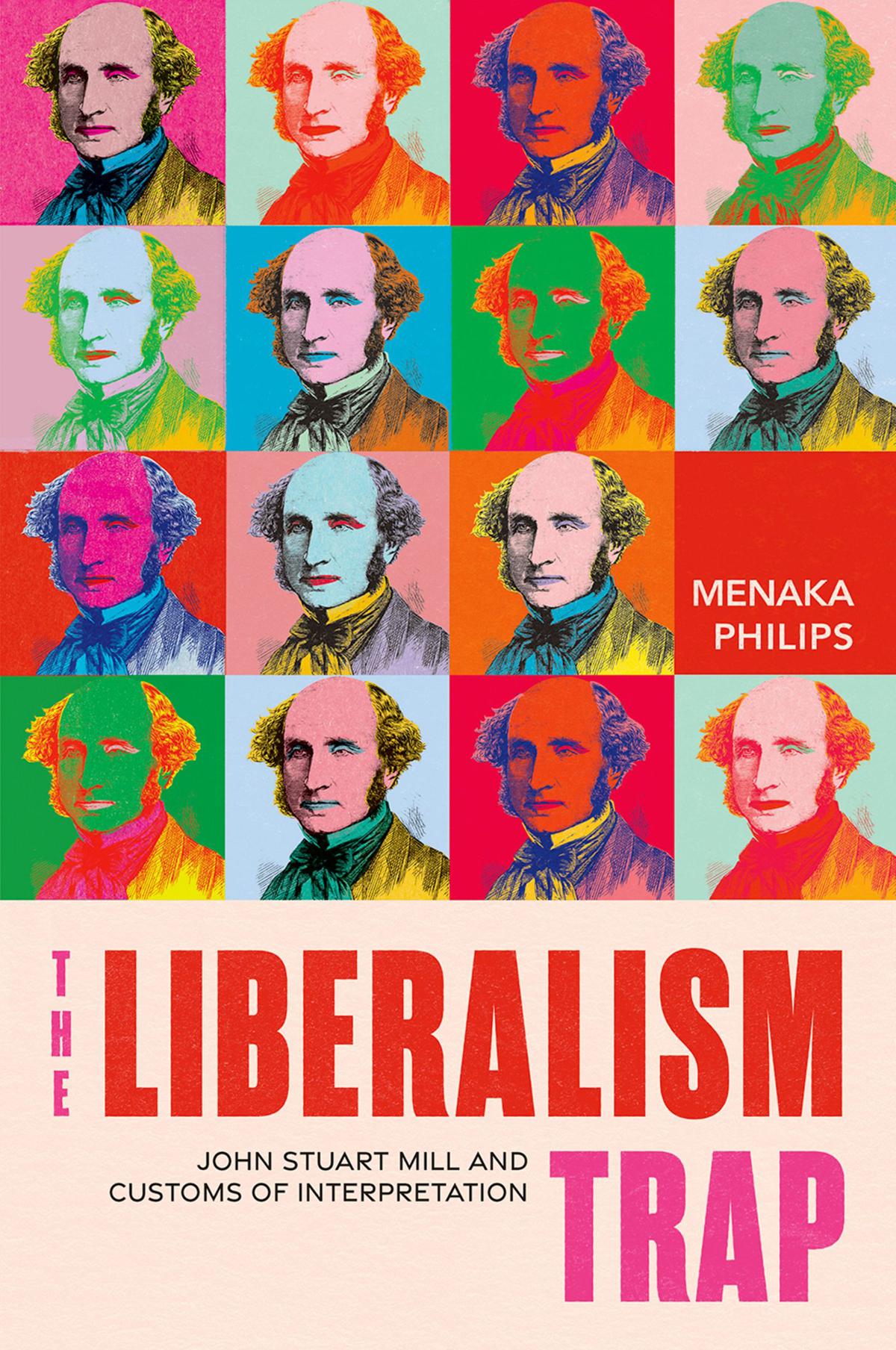
friend Kara McGuire (Also Known As), and her colleague Katie Frederick, who conceptualized and designed the book’s cover.
I found my first professional home at Tulane University thanks in large part to Tom Langston and Nancy Maveety who brought me on board. I learned much from colleagues at Tulane, who read draft chapters and advised me through my first years in the profession. This is especially true of the PoliChix (Chris Fettweis’s moniker, which we hate to love, but do)—Mirya Holman, Christina Kiel, Celeste Lay, Casey Love, Anna Mahoney, Virginia Oliveros, and Izabela Steflja. What a wonderful group of scholars to learn from—and a better happy hour crowd cannot be found.
I also found a true a family of friends in Mary Grace, Patrick, Meredith, Kelly, Brandon, William, Madeleine, Kara, Seamus, Trey, Nikki, Paul, and Krysia. Even in the thick of writing, pandemics, parenting, and hurricanes, they make life a joy with Friendsgivings, pizza challenges, beach getaways, and so many costumed escapades. It doesn’t matter where we are, Core Group is forever. And because (as Jeni would say) space matters, I must acknowledge the place where I discovered this family: New Orleans. A city of haunting contrasts, great revelry, and deep magic. In the immortal words of Anne Rice, “as soon as I smelled the air, I knew I was home.”
My move to the United States for graduate school began with a brief year in Minneapolis. As a fresh-faced student in a new country, I had plenty of reason to be anxious, and I would have been had it not been for Nance and Brian Longley. They made me welcome, offered great conversation, delicious meals, and time with their family. But I owe them a special debt of gratitude for their daughter Nora—an incomparably beautiful soul. Nora and I were chance roommates in Vancouver, and years later, fortune would bring me to her home city for graduate school. I am grateful for that extra time with her. Before she left, Nora told me she was proud of me, and that is an honor I hope one day to earn. This book is dedicated to her.
My own (very) large family of accomplished aunts, uncles, and cousins spread around the world has been a steady anchor in the
sometimes-nomadic life academia can involve. There are few things I look forward to more than our chaotic reunions, the 1,000 daily group messages, and Zoom chats between 10 generations, across 5 time zones. And by far the most loved Auntie there is, my sister Mira is one of the best and brightest people I know. Along with my mother, she was there for me at a particularly difficult time; the project would not have crossed the finish line without her. To my dragons Jai and Rami—whom I carried in one form or another while writing this book—my thanks for the daily reminders to laugh, dance, and play.
Now to Geoff Dancy. He managed breakfasts and bedtimes whenever Mill demanded my attention and lent his considerable editing skills to this manuscript (more than once). I met Geoff on an elevator in Minneapolis, where he hatched a five-year plan. As with most things he sets out to achieve, he executed that plan with aplomb. Far past the five-year mark, through four cities, with two great kids, dearest Bellatrix, silly Elvira, and so much more to come —the Philips Dancy Krewe can parade with the best of them. In Geoff, I have found a sharp mind that can spar and inspire, a friend always ready to support and to encourage, and a partner with whom I have built a life that feels like an adventure. There is no greater gift than that.
1
Is Liberalism Inescapable?
As soon asyou labela concept, you change howpeopleperceive it.
Adam Alter, The New Yorker
To be trapped by an idea is to be beholden to it, to become so deeply entangled that our perceptions are bound to it. Understanding that entanglement and its effects in the context of liberalism constitutes the central aim of this book. What I call the liberalism trap is not a problem of the idea itself, but of our collective infatuation with it.
Preoccupations with liberalism—a fixation on working out its meaning(s), origin(s), and future(s)—are becoming methodologically customary, and with troublesome consequences for the study and practice of politics. In the scholarly context, liberal preoccupations generate interpretive habits which detail not only why, but how scholars of politics must center analyses and debates around questions and presumptions about liberalism.1 And in the broader public sphere, concerns about the death and/or resurrection of liberalism have been the lifeblood of political discourse for over a century.2 From academia to political punditry, no idea in modern history has enjoyed as much study and use, and from all angles, as has the liberal idea.
Notably, when the term “liberal” appeared around the fourteenth century, it referred to noble and generous spirits, characteristics befitting free men and gentlemen. Research using Google Ngram data suggests that the word gained a more political meaning in the late 1700s, as use of terms like “liberal policy” or “liberal principles”
began to gain traction.3 The Liberalesgroup of Spain was among the first to adopt the term as a political identifier in 1812, during its fight for universal male suffrage, a constitutional monarchy, and land reform.4 By 1815 “liberalism” had made its first appearances in the context of Western European party politics, associated with themes of free inquiry, self-government, and a market economy, though “it remained an obscure and marginal category.”5
Over the past two centuries, those simple beginnings have given way to a conceptual powerhouse, imbued with an almost human-like agency through pronouncements about liberalism’s birth, its health, its responsibilities, and its failures. And that agency is widely felt. Thomas Nagel observes that virtually every political argument in the western world is a variation on the theme of liberalism.6 But ongoing interrogations of liberalism’s imperial past and its transnational grip today indicate that this is by no means a strictly “western” phenomenon.7
The breadth of arguments about it also reveals liberalism’s conceptual elasticity. The term’s evolution, Harold Laski noted, has incorporated “winds of doctrine so diverse in their origin as to make clarity difficult, and precision perhaps unattainable.”8 For John Dewey “liberalism has meant in practice things so different as to be opposed to one another,” something Judith Shklar warned might result in the term becoming too “amorphous” to be of much use.9
Evidence of this elasticity can be found in everyday political conversations. On matters of public policy, for instance, liberalism has been used to both justify and challenge regulations concerning what women wear, while proposals for universal healthcare in the United States have been viewed as a battle for and against liberalism’s survival.10 For some pundits on the right it is a political ideology devoted to big government and interventionist social agendas. Meanwhile, critics on the left see it is a platform for free market and elite interests that impedes the efficacy of democracy and the achievement of social justice. And despite disputes over who, or what, is or is not a “liberal,”11 the subject of liberalism’s life and prospects throws together “socialists, conservatives, social
democrats, republicans, greens, feminists, and anarchists” in sometimes unexpected ways.12 Debates about liberalism have made for uneasy bedfellows over the years—a point some have toyed with for narrative effect.13
Liberalism’s conceptual elasticity offers a clue to understanding its popularity as an object of constant praise and censure; there is always room for renegotiating its meaning and value. The life of this idea has been nourished by continuous discussion of its past effects, its present significance, or its future possibilities. Though both its critics and defenders tend to evaluate the success of liberalism as a measure of the political consensus it achieves, in reality, victory in the realm of ideas should also be judged by sheer persistence. The endurance of this idea relies less on collective agreement over its value and more on a collective need to attend to it in political analysis. Even for some of its most ardent critics, liberalism maintains a hold they cannot seem to shake. As Wendy Brown says of left politics, an attachment to the liberal idea reflects “an organization of desire we wish were otherwise.”14
But the wishing otherwise Brown desires maintains an active connection to the idea, and keeps it, in a word, alive. Brown’s lament thus captures something of the nature of liberalism’s victory in political discourse—it is not one of consensus but of inescapability. Whether we love it, hate it, or remain endlessly ambivalent about it, the liberal idea is defended, critiqued, and assessed across the political spectrum. The question of liberalism’s power, then, is not about universal appeal (or emerging decline) but about its discursive resilience. On that score, liberalism’s dominance in the realm of ideas is unparalleled. And this is precisely why declarations of its death, along with attendant efforts to keep it alive, might be almost comical if not for the very real effects our deep attachments to liberalism are producing: from conflicts over policy to conversations between academics, those attachments are directing the way we think about and do politics.
A Tumultuous Affair: Political Theory and Liberalism
The effects of preoccupations with liberalism are best on view in the so called “ivory tower” of academic political theory. If even a field oriented around the interrogation of ideas and practices can become caught in the liberalism trap, it would offer substantive evidence of the trap’s hold. But the problem in this sphere is that liberalism’s conceptual triumph can prop up a particular mode of inquiry, which imposes limits on how scholars address perennial questions and contemporary problems. Pressing political concerns—from structural inequality to democratic malaise—are presented as subjects of liberalism’s rise, decline, evolution, and so on. Escaping the liberalism trap is thus a disciplinary problem with political ramifications.
Imagine that the very efficacy of political science is seen as tethered to “the consequences of liberalism’s fate in the polity at large.”15 Disciplinary historians have argued that professional political science is and always has been a “species of liberalism” that responded to demands for revising or reconsidering the “liberal visions” at its foundation.16 Disagreements over liberalism are understood to have reoriented the intellectual identity and relationships among the subfields of political science as a whole. Scholars document, for instance, how the “varieties of liberalism” that organized the US discipline became targets of censure for European émigrés like Leo Strauss, Hannah Arendt, Theodor Adorno, and Max Horkheimer.17 Having experienced political upheavals across the Atlantic, these thinkers took a largely critical view of liberalism’s intellectual purchase in US political science.18
Yet even these challenges to liberal visions of the discipline have helped to perpetuate scholarly preoccupations with the idea. The process of perpetuation-through-critique marks one of the most influential confrontations with liberalism’s role in US intellectual and political life, from scholar Louis Hartz. Published in 1955, Hartz’s The Liberal Tradition in America contributed to the disquiet of the
postwar era. In his view, liberalism had so fully captured the US mind that neither its citizens nor its intellectual leaders were equipped to rethink US political identity, nor its response to a rapidly changing global context. These liberal foundations made for a future in which past would be prologue.
The Liberal Tradition has haunted studies of US political thought and development since it appeared. Generations of scholars after Hartz have worked either to prove or debunk his central thesis about the United States’ liberal origins, arguing for the elasticity of liberal ideas and their openness to contestation, or for competing ideologies which have prevented the kind of liberal indoctrination Hartz described.19 His intervention effectively organized a scholarly tradition of investigating liberalism in studies of US political thought. In ways they may not have expected, then, the legacy of the postwar émigrés and critics like Hartz has been to sustain the conceptual power of the very idea they aimed to disrupt.20
As in the public sphere, liberalism’s dominance in political scholarship is an achievement of twentieth-century contestations. Consequently, John Gunnell observes,
the literature of political theory is, and since the late 1930s has been, saturated with discussions about liberalism and its tradition—rise and decline faith dangers, limits, collapse, challenges, agony, paradox, irony, spirit, development, end, poverty and crisis and its relation to innumerable things, individuals and other political concepts.21
For Duncan Bell, liberalism has simply become the metacategory of contemporary political discourse.22 Without question, attention to this metacategory has been incredibly generative. Evaluations of liberalism have underwritten arguments over the role of the state in the provision of social goods, the relation between the individual, family, and community, policies concerning colonial and postcolonial contexts, and minority claims to representation and justice.23 These debates have fruitfully proposed ways of thinking differently about liberalism in relation to social and redistributive justice, the nature of
personhood, the challenges facing modern multicultural societies, and international relations.
But the broader interpretive effects of disciplinary preoccupations with the idea ought to give scholars pause. In attending to liberalism across various sites of analysis, we can transform the idea from a subject of study into a condition for study. The metacategorical effect of our investments in this idea is thus a methodological practice which puts liberalism first, so to speak. Now, preoccupations with liberalism can mark the boundaries of our interpretive work. And we can become trapped by them. Working within these interpretive boundaries can limit how we approach particular debates and problems, setting up divisive labeling practices in place of real conversations and ideological disagreements in place of political negotiations.
A Caveat on Scope
An objection to this argument worth addressing at the outset involves the scope of the problem concerning liberalism. Readers might take my intervention against the liberalism trap to constitute an intervention against liberalism writ large. The distinction between these points is critical and goes to the heart of my departure from existing studies of liberal thought: I am not making a case for abandoning ideological frames per se (if such a thing is even possible). My intervention does not, therefore, dismiss the conceptual utility of liberalism in toto or its historical significance to the development of political thought. For these reasons too, I do not engage in already well-tilled debates over what liberalism is, does, or fails to be. This is not a book that tries to “pin down” liberalism and its notoriously elastic definitional history, nor is it interested in disparaging liberalism or saving it from attack. What this argument does attempt is to unsettle the custom of examining politics through these questions. The problem I identify has little to do with the liberal idea and everything to do with how and why we deploy this idea in political discourse. By and large, liberalism’s conceptual triumph has begun to infiltrate the practice of
political theorizing rather than remaining subject to that practice. Put another way: scholars are not just thinking about liberalism; liberalism, or more particularly preoccupations with it, are shaping the way we think about politics. An examination of our reliance on this idea is therefore imperative. And nowhere is that reliance on better display than in the reception of liberalism’s quintessential representative: John Stuart Mill.
J.S. Mill, The Iconic Liberal
No doubt J.S. Mill will appear to be a counterintuitive choice for this project. Most students are introduced to his thought through its association with liberalism. They first encounter OnLibertyas one of liberalism’s essential texts. Beyond the classroom, too, Mill’s name is referenced almost daily across dozens of articles concerning liberalism from issues of education to debates about pornography.24
So why pursue an assessment of our investments in liberalism through one of the idea’s most iconic representatives? The argument that our relationship to liberalism has come to constitute an interpretive trap might be more apparent with figures like Hobbes or Locke, thinkers who predate liberalism’s political emergence. Here, at least, the charge of anachronism could be applied and would clearly outline the interpretive latitude we take in making liberalism central to analyses of thinkers or texts. As Chapter 2 notes, there is certainly room for investigating the role liberalism plays in receptions of these canonical figures and others like them. Laying the groundwork for such inquires, however, is most effectively done in relation to Mill. My concern is not simply that we are applying the “wrong labels” to the “wrong thinkers.” It is not about correct labeling practices, but about the politics oflabeling. The application of ideological labels to a text or thinker has interpretive and political consequences for how we perceive them going forward. It is, therefore, Mill’s paradigmatic status that can best illustrate the methodological effects of political theory’s affair with liberalism. The
thinker we are most comfortable with reading under the liberal label can illustrate the consequences of centering liberalism in general. Chapters 2 and 3 focus on Mill’s ideological status, and what it has cost us in terms of our engagement with his thought, while Cha pters 4, 5, and 6 illustrate how his tenure as “the liberal” negatively impacts the way we treat his work on questions of gender, class, and empire. As an iconic liberal, Mill exemplifies the interpretive problems that arise out of our relationship with liberalism. After all, reliance on settled opinion, OnLibertytells us, can undermine critical thought. And because Mill’s association with liberalism is so often relied upon, little consideration is given to how that association has directed the way scholars understand and appropriate his political writings.
Mill is hence a critical test of the book’s central premise. That our attachments to liberalism might limit engagement even with one of its paradigmatic figures would indicate that something has gone awry. It is my contention that Mill’s exemplary status within the liberal canon can lead us to read his theories as if they speak to ideological certainties and to style particular elements of his texts to fit whatever version of liberalism is under review. Trapped within the confines of this idea, readers substitute Mill’s now canonical status as a liberal figurehead for his political arguments. The thinker is being drowned out by the very tradition he is supposed to captain.
Considered by many to be the father of modern liberalism, Mill is ideally placed to illustrate how our preoccupations with the idea shape the practice of political theorizing.25 Drawing inspiration from Mill’s concerns with habituated learning, we ought to ask whether our focus on liberalism has itself become habitual, and to what extent it closes us off to alternative resources for, or approaches to, political theorizing.
As I argue, emphasizing Mill’s exemplarity as a liberal has obscured a key element of his political thought: the uncertainty he employed as a political thinker and actor. Untethered from his now customary identification with liberalism, Mill’s political writings on human nature, individuality, and social progress give evidence of a
cautionary radical, a thinker driven not by ideological certainties but by the challenges and the possibilities of doing politics without any guarantees of success. I develop this reading by re-centering Mill’s oft-overlooked Autobiography. A text avidly read and commentated on by Mill scholars working in the tradition of intellectual biography, Mill’s self-reflective study is rarely drawn into contemporary appropriations of his more famed political discussions concerning individuality, harm, or the conditions for individual and social development.26
The separation of Mill’s self-assessments from his political writings is a mistake. The Autobiography is an essential primer to Mill’s thought, an argument I make in Chapter 3. Written and revised over seventeen years, the text details Mill’s evolution as a public intellectual with a mind “always pressing forward, equally ready to learn and unlearn either from its own thoughts or from those of others.”27 It is a text which shows Mill turning many of his observations about political life—the dangers of customary knowledge, the connections between individuality and community, and the challenges of social progress—upon himself as he examines the effects of his education, his relationship with his father, James Mill, and his pivotal mental crisis. Mill’s experiences lead him to appreciate the role of uncertainty in political life, and his own politics are very much instructed by that appreciation.
A Caveat on Mill
My profile of Mill might rankle some readers who will protest the focus on his relation to liberalism. Why not consider his identification with utilitarianism, democracy, or socialism? After all, Mill explicitly wrote on these ideas, and scholars have attended to those writings.2 8 In response, I would argue that the liberal identifier has claimed a greater hold on Mill’s legacy, and I would not be alone in noting this. Though Mill scholars have examined his engagements with other traditions of thought, his almost parental relationship to liberalism is rarely questioned. Even as he warns us away from labeling Mill too