LC record available at https://lccn.loc.gov/2023009534
For my parents, William Luis and Linda Lee Tracey
A N ote on T erminology
The terms asiático / a and Asia (for Asian and Asia) do not consistently appear in Spanish colonial sources. In colonial Mexico, one phrase commonly used to refer to the lands across the Pacific was la china. Since people of Asian provenance became known as chinos upon arrival, Asian and Asia are the most accurate translations for “chino / a” and “la china” in Mexico. Thus, this book uses Asian and Asia in their contempor ary meanings as shorthand for the g reat diversity of peoples in this history and the locales from the Indian Ocean World to East Asia, respectively.
Filipino is a similarly complicated term, since nothing resembling the contempor ary Filipino national identity existed in the early modern period. In fact, during the late colonial period, Filipino often referred to Spaniards born in the Philippines and not to the land’s Indigenous inhabitants.1 Most often, Spanish sources characterized Philippine peoples as indios (Indigenous vassals) or moros (enslavable Muslim enemies). In some cases, colonial-era authors differentiated among specific ethnic groups like Tagalogs, Kapampangans, Visayans, Ilocanos, and so forth. When it is possible to identify the ethnicity of an individual or community, I use labels that privilege specificity. When this is not possible or when I refer to a group consisting of multiple ethnicities autochthonous to the Philippines, I use “Philippine” with a corresponding noun.
The goal is to avoid, as much as possible, reproducing the colonial rhetoric of “indio / a” (indiyo in Tagalog) unless the reference is to its specific employment in primary sources and / or Spanish colonial systems of categorization. This word is derogatory not only in contempor ary Tagalog but also in many areas throughout Latin America.2 I have also placed the names of other castas (castes) of New Spain—including “chino / a”—in
quotes to cite the language of colonial sources. In a similar vein, I refer to enslaved or formerly enslaved peoples by either first name or first and last names and not solely by their last names (e.g., “Catarina” in lieu of “San Juan”), which were often markers of possession.3 These are imperfect approaches to irresolvable issues of colonial nomenclature and power that, for the sake of intelligibility, are nonetheless essential to the narration of this history.
Timeline
Mid– late Tupac Inca meets Pacific Islanders at Tumbez and launches an 1400s expedition into the Pacific.
1492 Christopher Columbus believes he has reached Asia after crossing the Atlantic and landing in the Caribbean.
1522 The Victoria returns with eighteen sur vivors to Sanlúcar de Barrameda, completing the first known circumnavigation.
1548 In his will, the first bishop of Mexico, Juan de Zumárraga, frees an enslaved Indian man of Calicut named Juan Núñez, the first Asian man known to have lived in the Americas
1565 The Afro-Portuguese Lope Martín pilots the first ship to complete the tornaviaje (return voyage) from the Philippines to the Americas, inaugurating the era of the Manila galleons. Miguel López de Legazpi burns Cebu and establishes the first Spanish colony in Asia on top of its ruins.
1565–1815 Spanish ships known as the Manila galleons regularly sail across the Pacific in both directions, connecting the Philippines and Mexico.
1571 The Rahjanate of Maynila is destroyed, and the Spanish Intramuros rises over the ashes.
1580–1640 The Union of the Two Crowns of Spain and Portugal leads to an era of intercolonial mobility and slave trading.
1585 Juan González de Mendoza publishes in Rome a best-selling account of China titled Historia de las cosas mas notables, ritos y costumbres del gran reyno dela China. In the following years, hundreds of Catholic missionaries flock to Asia.
1587 Pedro de Unamuno’s expedition lands at Morro Bay, California, with eight Philippine Natives of Luzon.
1588–1589 The Tondo Conspiracy, led by don Agustín de Legazpi and don Martín Panga, is brutally repressed, isolating elites on Luzon from direct connection and kinship with Muslim Southeast Asia.
1590 Treasury officials in charge of the Caja de Acapulco (cashbox of Acapulco) attempt the first consistent recordings of Manila galleon traffic and labor in Mexico.
1593 En route to the Spice Islands, “Sangley” (Chinese) rowers mutiny and kill the Spanish governor of the Philippines, Gómez Pérez Dasmariñas.
1596 Nine Chinese captains and eighteen merchants in Manila present a formal complaint of unfair treatment to the bishop of Nueva Segovia, Miguel de Benavides.
1597 The former governor of the Philippines, Luis Pérez Dasmariñas, pens an elaborate proposal to deport all unconverted “Sangleyes” from Manila.
1602 Sebastián Vizcaíno recruits Asian crew members from Acapulco for an expedition up the coast of California that reaches present-day Oregon.
1603
1604
Several thousand “Sangley” rebels attack Manila, and an army including Spanish, Japanese, and Philippine troops burns the Parian (Chinese quarter) and massacres many thousand “Sangleyes”—militants and innocent bystanders alike.
Ber nardo de Balbuena’s epic, Grandeza mexicana, celebrates the flow of Asian goods from across the Pacific to Mexico City.
1606–1663 With the assistance of thousands of Philippine Natives from Luzon, the Spaniards occupy Ternate, one of the famed Spice Islands.
c. 1610–1688 Catarina de San Juan (born Mirra) of South Asian origin is traded across the Pacific as a slave, earns her freedom, and becomes an exemplar of ascetic Catholic devotion in Puebla, Mexico.
1614 A Japanese embassy under the command of Hasekura Rokuemon Tsunenaga lands in Acapulco en route to Rome.
1615 Multiethnic labor gangs break ground on the Fort of San Diego in Acapulco. All Asians become “chinos” in the port’s treasury records as of this date, ending the fluidity of terms that had proliferated since 1590.
1639 A second major uprising cripples Manila and ends in yet another wholesale massacre of “Sangleyes” on Luzon.
1644 The Ming dynasty falls to northern invaders, and Qing rule commences.
1645 All “mestizos,” “mulatos,” “negros,” “chinos,” and “zambaigos” (mixed Afro-Indigenous people) are banned from carrying ar ms after an outbreak of violence in Veracruz.
1671
1672
Fernando de Haro y Monterroso submits an influential petition to the colonial court in Guadalajara to free enslaved “chinos” within its jurisdiction.
Queen Regent Mariana of Austria confirms Fernando de Haro y Monterroso’s petition and expands it to include all “chinos” in Mexico. However, corruption in Mexico City slows the prog ress of emancipation.
1700 The last Hapsburg emperor, Carlos II, dies without an heir in Madrid, and the Bourbons inherit the Spanish Crown.
1751 The largest Manila galleon ever, La Santísima Trinidad y Nuestra Señora del Buen Fin, makes its maiden voyage with 407 crew members.
1762–1764 The British seize Manila during the Seven Years’ War. Spanish economic reforms in the aftermath of the conflict severely undermine the Manila galleon route.
1806
The first shipment of Chinese conscripted laborers arrives in Trinidad, inaugurating a new wave of Asian labor mig ration to the Americas— primarily the Caribbean.
1810 Miguel Hidalgo’s speech, the Grito de Dolores (Cry of Dolores), announces the call to arms against the New Spanish colonial government and begins the Wars of Mexican Independence.
1813 The rebel army under José María Morelos besieges and burns Acapulco.
1815 The Spanish Crown declares a formal end to the Manila galleons, and the last of these ships, the Magallanes, sails back to Cavite with little profit.
1821 Agustín de Iturbide proclaims the independence of Mexico. In the next year he becomes emperor of this new nation.
1822 The Mexican rejection of reparations to the Spanish Philippines for commercial losses signals a long-ter m break between the eastern and western nodes of the old Manila galleon route.
1838–1917 Half a million conscripted and indentured South Asians arrive at the plantations of the British Caribbean.
1847–1874 125,000 Chinese land in Cuba to labor under the stipulations of their contracts, yet most are reduced to a life of de facto bondage.
1848 Through the Treaty of Guadalupe Hidalgo, Mexico cedes an enormous territory to the United States. Soon after, the first Chinese laborers and gold prospectors arrive in the newly occupied California territories, particularly San Francisco.
1849–1874 100,000 Chinese are contracted to work in Peru under conditions similar to the brutal ones of their compatriots in Cuba.
1855 Forty-five Chinese workers arrive in Puntarenas, Costa Rica.
1864 The first Chinese railroad workers land in Mexico.
1898 The United States intervenes in the Cuban and Philippine Wars of Independence against Spanish rule and occupies Cuba, Puerto Rico, the Philippines, and the Mariana Islands in the aftermath.
1911 303 Chinese and 5 Japanese residents of Torreón are massacred during the Mexican Revolution.
1915 William Schurz inaugurates the historiography on the Manila galleons after drafting and defending his dissertation under the tutelage of Herbert Eugene Bolton at the University of California at Berkeley.
The First Asians in the Amer i cas
I ntroduction
At 4:04 a.m. on January 5, 1688, Catarina de San Juan breathed her last in Puebla de los Ángeles, Mexico.1 Her ascetic life of perpetual suffering had reached its holy and inevitable end. A few devotees carried the corporeal relic that was her body from her dilapidated home (containing only one small room) to the house of Hipolyto del Castillo y Altra “to have in death a more decent place” for the customary postmortem washing and shrouding.2 In the blue light before sunrise, the Jesuit fathers rang the bells of the College of the Holy Spirit to announce her passing. They prepared a palm leaf and a crown of flowers to honor Catarina as a virgin.3
Word spread quickly, and by 5:00 a.m., the city had swelled with “innumerable people” from miles around hoping to catch a glimpse of the sacred corpse.4 Nobles and the poor alike hurried to the home of Castillo y Altra, so that it looked like “a church on Maundy Thursday, where the public of the entire city enters and exits and performs the stations [of the cross].”5 However, this orderly procession did not last for long. As eager spectators converged on the home, their patience waned, and they rushed the door. The doorframe groaned and split, and the pious mob crowded around the body, eager to k iss Catarina’s hands and feet, touch her rosaries, take flowers from her shroud, and even cut off her fingers and pieces of flesh to keep as holy relics.6
In this state, Catarina’s body remained on display until the next afternoon, when a religious procession ar rived to inter her in the main chapel of the Jesuit college. According to one of her confessors and hagiographers, Alonso Ramos, “The large crowd that gathered and attended the burial is
inexplicable . . . even on the rooftops, balconies, and windows of the houses that correspond to the doors of the temple of our College of the Holy Spirit, there appeared a multitude of men and women.”7 As the pallbearers approached the college, they needed to extract Catarina’s body from the coffin, which had to be rotated to fit inside the narrow doorway. When the crowd spotted her holy figure, they stormed in “to rob her of the few decorations that had remained on the deceased.”8 They grasped the last shreds of her tunic, hair, and flesh and the final flowers from her shroud, and they even made off with her shoes.
Within the chapel, the undeterred Jesuits buried Catarina by a presbytery in a vault that also held stillborn infants—similarly valued for their purity. Two keys sealed the vault. In a speech given shortly after her interment, the Jesuit Francisco de Aguilera proclaimed that “all that the world adores as most precious, it makes holy, without claiming it, nor searching for it, [it found] a poor little china, slave, foreigner, who made us fill our tongues with her praises, our hearts with jubilation, and even our eyes with tears.”9
But for all the acceptance she eventually found among Puebla’s denizens, Catarina continued to be a “a poor little china” (the colonial Mexican term used to refer to any Asian person) and a “slave, foreigner.” This was so although she had lived almost seventy years in Puebla, most of them as a free woman. Those who knew Catarina speculated that she might have been born on the Arabian Peninsula or lived in her youth as a princess of the Mughal royal family in India. The Jesuit Joseph del Castillo Graxeda’s conjecture was the least ambitious and, therefore, perhaps the most persuasive: “Catharina was native to the Mughal Kingdom. The place where she was born is unknown, and even she did not know it for being such a young age when she was taken from it.”10 As a child, Catarina had been a victim of a Portuguese slave raid in South Asia. She was eventually sold in Spanish Manila. Then, at the nearby port of Cavite, she was made to board a Spanish galleon destined for Mexico. The journey across the world’s largest ocean on an early modern ship, even one advanced for its time, lasted many months under hor rid conditions. In 1621, Catarina disembarked at the port of Acapulco in chains and was sent overland to Puebla. There, she eventually gained her freedom and, through her piety, became a renowned symbol of holy virtue and global Catholic hegemony.11
Despite her celebrity, Catarina—the per son behind the reputation— remained an unknown and unknowable entity, a “Thesaurus absconditus” (hidden treasure) in the words of the Jesuit Antonio Plancarte.12 For the funerary procession, Plancarte painted a dark, sealed box of Asian design and penned a poem to accompany it:
Here from china, you see my color; inside the gold I save as greater treasure, that hidden here you will find. Although the more turns you give the key, it will not open, none will understand it; since the cipher only God knows, for you [only] in his time will he reveal it.13
According to Plancarte, the inner quality of Catarina’s soul lay beyond the human g rasp. What those attending her f uneral perceived, instead, was her exotic difference—her body “here from china” (meaning Asia) now laid out before them. Catarina remained inextricably tied to the thousands of hands seeking to defile and consume her, desiring to turn the key that would expose her interior, yearning for the total submission she withheld in life and reserved for the Holy Trinity alone. As silent as stone, Catarina had become her foreignness.
Today, Catarina de San Juan is erroneously known by another name, the China Poblana (the “china” of Puebla). In his 1897 book Historia de la Puebla de los Angeles, the Mexican historian Antonio Carrión conflated the China Poblana, a popular nineteenth-centur y form of dress that was a symbol of Mexican femininity, with the distant memory of an Asian woman who had once lived in Puebla.14 He wrote that the women of Puebla had known Catarina de San Juan as “la China, which they called her affectionately,” and thus, Catarina had become the China Poblana.15 The allure of the castor (patterned skirt), white slip, white blouse, and shawl of the China Poblana melded with Carrión’s resurrection of an Asian-inf used Baroque past. From this orientalist conflation of the two “chinas,” Catarina de San Juan shapeshifted into folklore.16
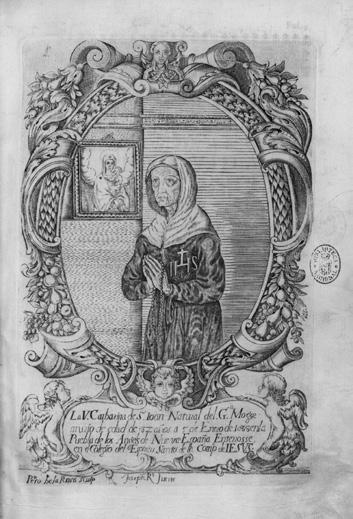
The coordinated efforts to suppress Catarina de San Juan’s story shortly after her death enabled Carrión’s invention and other s like it.17 From 1689 to 1692, Alonso Ramos published an ambitious hagiography of Catarina in three enormous volumes that commemorated his confessant as a religious icon and made a daring case for her beatification (figure I.1). Because it celebrated Catarina’s celestial visions and ethereal visitations with the Holy Trinity, however, Ramos’s hagiography aroused inquisitorial suspicion. Throughout the post-Tridentine (1563–) Catholic world, the worship of persons who had not been formally beatified or sanctified was strictly prohibited.18 In the end, Ramos’s dream of crafting a holy figure to elevate Puebla as a sacred site of the Catholic world was not to be realized. He had overplayed his case by prematurely declaring that Catarina had performed miracles and other acts of God: only the Sacred Congregation of Rites and the pope could make this determination. Even one of the theologians who supported Ramos’s first volume warned that Catarina’s “visions, revelations, and prophecies” could make a reader “seasick.”19 In 1692 the Spanish Inquisition banned Ramos’s magnum opus for “containing revelations, visions, and apparitions [that are] unfit, implausible, full of contradictions and comparisons [that are] inappropriate, indecent, reckless, and that sapient blasphemiam (that reveal or that nearly are blasphemies).”20
Ramos’s hefty three-volume work was the longest text ever published in colonial Mexico, and hardly anyone would read it.21 The New Spanish Inquisition confirmed the Spanish ban on printing and distribution in 1696 and dismantled the public altar in the little room where Catarina had lived.22 Inquisitors then confiscated most of the remaining publications about her and burned them.23 From the outstretched hands that had despoiled her body to the suppression of her devotion, Catarina had become a myth within a decade of her passing. In the words of Kate Risse, she was “too spectacular, too unorthodox, too popular.”24 She was also, I would add, too foreign.
Yet although Catarina de San Juan was distorted by her erstwhile hagiographers and modern eulogizers, she remains one of the very few Asians in the early modern Americas whose name has endured. In this sense, she is exceptional. Although thousands of Asian people tr aveled to and through the colonial world during this period, Catarina’s life was recorded with a level of detail afforded to few others of her time. Her commemoration is
I.1 Portrait of Catarina de San Juan
This portrait appeared in the first volume of Alonso Ramos’s hagiography of Catarina de San Juan (1689) and is the only historical image that survives of an Asian individual who lived in New Spain. By 1691, an inquisitorial edict outlawed the circulation of this and other portraits of Catarina, which had already become images of popular devotion thought to have healing power. The caption reads, “The virgin Catarina de San Juan of the Great Mughals died at the age of eighty-two on January 5 of 1688 in Puebla de los Angeles of New Spain. She was buried in the College of the Holy Spirit of the Company of Jesus (La v[irgen] Catharina de S[an] Ioan del g[ra]n Mogor murio de edad de 82 años a 5 de enero de 1688 en la Puebla de los Angels de Nueva España. Enterrose en el Colegio del Espíritu Santo de la comp[añí]a de Iesvs).”
Alonso Ramos, Primera parte de los prodigios de la omnipotencia y milagros de la gracia, en la vida de la venerable sierva de Dios Catharina de San Joan (Puebla, Mexico: Imprenta Plantiniana de Diego Fernandez de Leon, 1689), Sig. 3 / 18733, 1:1. Reproduction courtesy of Biblioteca Nacional de España.
even more remarkable given that her identity as a formerly enslaved Asian woman made her an unlikely candidate for remembrance.
While she had achieved a rare degree of fame by the end of her life, in many ways Catarina’s story is also more broadly emblematic of other Asian peoples in the early Americas, about whom only fragments survive. Catarina was one of many people who boarded a Spanish galleon in the Philippines—either voluntarily or in captivity— and crossed the tempestuous Pacific to reach a strange land beyond the horizon. Once they arrived in New Spain, the haggard survivors of this journey faced a new challenge: the violent colonial realities of the Spanish Americas. Collectively, these free and enslaved Asians represented a new kind of mig rant in global history, and their experiences shifted endlessly along a continuum between the two poles of coming and going, bondage and freedom, assimilation and foreignness, and recognition and repudiation.
How many of their histories have been lost to human memor y or to infinite entombment as a decaying shred of discarded paper in the archives of a dead, Baroque empire? The experiences of Asian peoples in colonial Mexico and the Spanish Americas are neither folklore nor myth: they are history. The traces of their lives that can be recovered from the oblivion of time and the fickleness of human memor y populate this book and constitute a history of unlikely survivals, perseverance against prejudice, and spectacular convergences of distant peoples
The First Asians in the Americas is the first book to examine the mobility of both free and enslaved Asians to and through the Americas during the 250 years that Spanish ships sailed the Pacific Ocean between the Philippine port of Cavite and Acapulco, Mexico. The book’s scope is necessarily global, and its approach attends to the grain of lived experience. At the heart of this story are the desires both to understand what Asians made of their new lives in new lands and to uncover how regimes of difference making impacted the search for just treatment in a deeply race-conscious colonial world. Regardless of their origin, the vast majority of Asians who disembarked in Acapulco became known as “chinos,” like Catarina. This invented term slotted Asian peoples into New Spain’s casta (caste) system, alongside more familiar casta designations that variously defined AfroMexican and Indigenous peoples as “indios,” “mulatos,” and “negros.” Formally, becoming “chino / a” conditioned Asian peoples’ status within the New Spanish social order. It restricted their ability to work in certain
trades and made them legally vulnerable to enslavement and the Inquisition.25 Informally, in the ears of Spaniards, the word “chino / a” alone often conjured up the expectation of servitude, criminality, and un-Catholic behavior. Even Catarina’s popularity could not overcome her nature as a “china, slave, foreigner” in the eyes of her admirers.
Facing these perils, “chinos” recalibrated their social relationships and blended into existing Indigenous and Afro-Mexican communities as they sought to secure their freedom, acquire sustenance, and live with dignity. From the bustle of Manila to the rural rhythms of the Costa Grande, and from the height of Spanish imperial power to the early strug g les for independence in Mexico, this book tracks the little-known forms of Asian mobility that defined the deep entanglement of the Pacific world with the colonial lifeblood of the Spanish Americas. From archival shadows, it produces names, networks, and communities. And from the locked sepulcher of Catarina de San Juan, it offers not a new cipher as in Plancarte’s vision, but a multitude of epigraphs, attesting to the lives of other people—just as extraordinary and just as worthy of our attention, analysis, and empathy as Catarina—hundreds of years after they passed from earthly memory.
Through this history, it is my aim to offer three interventions: the first geographic, the second temporal, and the third methodological. First, I join a growing cohort of scholars invested in restoring the importance of the Pacific to the history of colonial Latin America, a field traditionally focused on the Atlantic.26 Rooted in the passage of Spanish galleons sailing between the Philippines and Mexico, the history of transpacific Asian mobility presents a strong case for adopting a Pacific orientation in the study of Latin America. Second, I make a chronological intervention in the long history of Asian migration to the Western Hemisphere. While the story of Asian migration conventionally begins in the nineteenth centur y, this book builds on a recent turn in the scholarship to the importance of the early modern period. The story that I tell unfolds between the late sixteenth and early nineteenth centuries. To the history of Asians in the Americas, it offers a new inception, one in which mobility was free and forced.
Third, this book focuses methodologically on the racialization of mobile, non-Spanish communities in Hispanic colonies. Through the use of the word “chino / a”—and the numerous sociolegal repercussions of that designation—the colonial bureaucracy effectively collapsed the diverse ethnolinguistic groups that made the Pacific passage into a single, racialized
collective. We have not yet completed the picture of how this legal form of difference making developed, or of how it impacted the day-to-day lives of Asians in the Hispanic World. Similarly, we have yet to uncover the full range of Asian responses to racialization. Many Asian peoples sought to differentiate themselves from “chino / a” stereotypes to achieve social mobility, while others engaged in multiethnic collaborations with Indigenous and Afro-Mexican communities to mitigate the conditions of bondage. This book tracks the evolution of both colonial praxes of difference making and Asian peoples’ adaptations in the face of this adversity to reconstruct the human experience of long-distance mobility across the world’s largest ocean during the early modern period.
The Spanish Pacific
By the late sixteenth centur y, the Spanish Crown had created the world’s first transpacific empire. The vessels that connected the Asian and American ports of this domain between 1565 and 1815 are widely known today as Manila galleons, though the name is somewhat misleading for several reasons. First, the port of Cavite, near Manila—not Manila itself—was the ships’ most frequent point of embarkation and disembarkation in Asia. Second, Spanish records from the period refer to the ships not as galeones de Manila (Manila galleons) but as naos de china (Asia ships). Third, the ships often varied greatly in size from small galliots to full-sized galleons, and during the last half centur y of the trade route, they consisted solely of mid-sized frigates. In total, this transpacific line comprised roughly 332 departures from Mexico to the Philippines and 379 from the Philippines to Mexico.27 The most consistent periods of transpacific navigation occurred from the late sixteenth to the mid-seventeenth centuries, while significant disruptions transpired during the 1650s, 1670s, 1680s, 1740s, and 1760s. Of course, even during decades of relative stability, many ships never reached their destinations. Captaining a galleon on the formidable Pacific crossing certainly required a degree of hubris.
During the years of their operation, the Manila galleons constituted a critical lifeline from Spanish-held regions in the Americas to those in Asia. This enormous zone fell under the governance of Mexico City, the seat of the Viceroyalty of New Spain. In the eyes of one governor of the Philippines, Manila “is a fort or outpost of New Spain,” more a colonial Mexican
territory than a Spanish one.28 At the orders of New Spanish viceroys, Spaniards in the Philippines conducted diplomatic missions with nearby kingdoms, assigned missionaries to convert wary Indigenous populations, and launched violent incursions into neighboring regions with limited success. By the same token, New Spain “was as much an American entity as an Asian one.”29
Over the past fifteen years, scholars in the new field of Spanish Pacific studies have argued that colonialism in the Americas cannot be f ully understood without attending to the global nature of the sprawling Spanish empire.30 While this scholarship has begun to demonstrate the importance of the Pacific to the Hispanic World, the entanglements of Spanish imperial ambition, the fragility of colonial societies in Pacific littorals, and the experiences of free and enslaved Asian subjects remain imperfectly understood. The task at hand, then, is to delineate the human experience of the Spanish Pacific from the perspective of its most marginalized subjects.
It is now widely recognized that reaching Asia was the principal aim of early Iberian overseas voyages, beginning with Portuguese navigators who sought a route to India in the fifteenth centur y. The Genoese Christopher Columbus was no exception, though he sought to emulate Marco Polo by sailing across the Atlantic instead of traveling east from Europe. In 1493, he returned to Barcelona, claiming to have found a new route to Asia. Thereafter, generations of millenarian missionaries, imaginative officials, and covetous merchants continued the dream of reaching distant Asian kingdoms by sailing westward into the setting sun. As the American continents slowly gained recognition as distinct landmasses, they became an inconvenient obstr uction separating the Iberian Peninsula from the silks and cloves of China and the Spice Islands.
The Pacific would similarly prove to be a significant barrier in the quest to reach Asia. Spaniards reluctantly acknowledged the ocean’s colossal size during the sixteenth and seventeenth centuries, and consequently, most aspiring colonialists eventually reoriented their ambitions toward the Americas, their Indigenous populations, their natur al resources, and the profitability of the transatlantic slave trade. Understandably, the Atlantic World has dominated oceanic historiographies of the Americas for these reasons. The Atlantic framework has produced a rich scholarly discourse on the multidirectional movement of people and ideas, the blending of borderlands between empires, and—more recently—the lives of African,