Introduction
Seeing God’s Body
Since the Middle Ages, it has become axiomatic among both Jews and Christians to reject the notion of an embodied God. With a few exceptions, the idea that God possesses neither a body nor a form in the material sense has become a part of the collective consciousness of the West in the modern period.1 Even today, popular and scholarly discourse alike describes the God of Judaism and Christianity, as well as Islam, as an invisible, incorporeal being who cannot be perceived via the bodily senses. And while Christians specify that the imperceptible God can be seen in Jesus, God “the Father” remains, at least in theory, disembodied and largely veiled from human eyes.
In recent years, however, a growing number of Hebrew Bible scholars have questioned the assumption that God lacks a body. Scholars such as Esther Hamori, Benjamin Sommer, and Mark Smith all highlight God’s embodied manifestations in scriptural texts and problematize the commonly held assumption that God is both invisible and incorporeal, noting that these metaphysical musings concerning God’s nature derive more from the Greek philosophical world of Platonism than the ancient Near Eastern world of the Hebrew Bible.2
In the Bible itself, we do not find an abstract, immaterial being who is ultimately unknowable and beyond human perception. Instead, we find a visible—and even at times embodied—being who chooses to be made known to humans and does so in ways that engage their bodily senses.
When it comes to the New Testament, though, scholars have been mainly remiss in querying God’s so-called incorporeality.3 Such an oversight is in
1 As Christoph Markschies notes, groups as disparate as pantheists and Mormons (The Church of Jesus Christ of Latter-day Saints) are the “exceptions” who subscribe to the notion of an embodied God (God’s Body, 1; cf. 323–24). See also Webb, Jesus Christ, Eternal God, esp. 243–70.
2 Sommer, The Bodies of God; Hamori, “When Gods Were Men”; Hamori, “Divine Embodiment in the Hebrew Bible”; Smith, Where the Gods Are.
3 Notable exceptions include Mauser, Gottesbild und Menschwerdung; Moore, God’s Gym; Bockmuehl, “ ‘The Form of God’ (Phil. 2:6)”; Litwa, We Are Being Transformed, esp. 120–26; Thiessen, “ ‘The Rock Was Christ.’ ” See also Bultmann, “Untersuchungen zum Johannesevangelium”; Malone,
The Embodied God. Brittany E. Wilson, Oxford University Press. © Oxford University Press 2021. DOI: 10.1093/oso/9780190080822.003.0001
part understandable, for the New Testament never reveals God’s body in the same way that we find in parts of the Hebrew Bible, as when Jacob wrestles with God (Gen 32:22–32) or when Moses glimpses God’s back (Exod 33:17–23). By the time of the New Testament, we also find Jews and Christians interacting in a more sustained manner with Platonism (the philosophical “school” that argued most adamantly for an incorporeal God) and even referring to God as invisible (e.g., Col 1:15; 1 Tim 1:17; Heb 11:27).4 Such differences, however, do not mean that all Jews and Christians during this time period conceived of God in disembodied terms. Instead, opinions were divided among Jews and Christians over the question of God’s body throughout late antiquity, and it was not until the Middle Ages, with theologians such as Maimonides and Thomas Aquinas, that the tide began to turn against those who favored God’s corporeality.5 Before the Middle Ages, though, Jews and Christians expressed God’s corporeality in a variety of ways, and this variety, I argue, can be found within the pages of the New Testament itself, especially in relation to how early Christians conceived of Jesus’s own body.
This book, then, addresses a current lacuna in New Testament scholarship by turning its attention to recent discussions of divine embodiment that are occurring in related disciplines. In addressing this lacuna, I primarily focus on the two-volume work known as Luke-Acts as a test case. Thus, while each chapter discusses pertinent New Testament texts, I narrow my discussion to Luke-Acts in order to provide a thick description of the ways in which the narrator (or “Luke”) represents divine embodiment in his narrative. These representations reflect an awareness of debates concerning the divine in the ancient world and point ahead to future christological controversies, both of which make Luke-Acts an especially fruitful test case for understanding divine embodiment in the early church (especially given that Luke-Acts makes up approximately one-third of the entire New Testament).
Thus, while there is a diversity of views in the New Testament regarding God’s body, this book argues that Luke-Acts stands out as an important example of a New Testament text that portrays God as visible and corporeal. According to Luke, God is a visible, concrete being who can take on a
“The Invisibility of God.” See also the discussion of Christ’s cosmic body (and the literature cited therein) in Chapter 2.
4 See also John 1:18; 5:37–38; 6:46; Rom 1:20; 1 Tim 6:16; 1 John 4:12, 20; 3 John 11. Cf. 2 Cor 4:17–18; 5:7; Col 1:16; Heb 11:1–3.
5 See Markschies, God’s Body
variety of different forms, as well as a being who is intimately intertwined with human fleshliness in the form of Jesus. In this way, the God of Israel does not adhere to the incorporeal deity of Platonic philosophy, especially as read through post-Enlightenment eyes. Luke’s portrayal of God instead finds more affinity with Greco-Roman traditions that conceive of the divine in corporeal terms and, above all, with the God that we find in the pages of Jewish Scripture.
To explore the New Testament’s—and specifically Luke’s—account of God’s embodiment, this book unfolds in two main sections. Part I (Chapters 1–3) challenges long-held assumptions concerning God’s invisibility and incorporeality by arguing that Luke-Acts depicts God as both visible and embodied. Part II (Chapters 4–6) then extends these insights to Luke’s depiction of Jesus as a visibly embodied being who is both human and divine. In Luke-Acts, the depiction of Jesus in these terms has both similarities and dissimilarities with Luke’s depiction of God and suggests that one of the ways in which God can become manifest is in human flesh. Indeed, in Luke-Acts and beyond, questions concerning God’s body are intimately linked with Christology.
Seeing and Not Seeing God’s Body
Many modern Westerners assume that God lacks a body. How, though, did this assumption come to be? A number of different factors have led to this pervasive idea among Jews and Christians in the West and among biblical scholars more specifically, but the role of Greek philosophical thought has been instrumental.6 Greek philosophy’s antagonism toward the notion of God having a body, and divine anthropomorphism more broadly, stretches back to the pre-Socratic philosopher Xenophanes (c. 570–478 BCE). Xenophanes, whose words are preserved in the writings of the Christian theologian Clement of Alexandria (c. 150–215 CE), satirized the anthropomorphic gods of Homer and Hesiod and offered in place of the Homeric pantheon a supreme God who is “in no way similar to mortals either in body or in thought.”7 However, it is Plato (427–347 BCE) who most famously
6 For a more in-depth discussion that traces the opposition toward God’s body in Western philosophical and theological circles, see Hamori, “When Gods Were Men,” 35–50; Markschies, God’s Body, esp. 1–73. See also Webb, Jesus Christ, Eternal God
7 Xenophanes, fr. 170 (= Clement of Alexandria, Strom. 5.109.1), in Kirk, Raven, and Schofield, The Presocratic Philosophers, 169. Xenophanes, however, does not deny that God has a body, saying only that God’s body is different from those of humans. See Vernant, “Mortals and Immortals,”
favored a disembodied God with his concept of God as “Being.”8 According to Plato, the cosmos consisted of two different realms: one that was immaterial, invisible, eternal, and unchanging and another that was material, visible, transient, and constantly “becoming.”9 God, along with souls and Plato’s famous “Forms,” belonged to the former, whereas embodied human beings belonged to the latter. Humans could attain knowledge of God through reason, or the rational soul, but they could not do so fully through the bodily senses.10 Because sense organs were a part of the material world, they could not always be trusted to reflect ultimate reality. Instead, the highest mode of existence (i.e., immaterial Being) could be best apprehended through the immaterial mind.
Plato’s influence regarding God’s invisible immateriality could be felt on various fronts. Most immediately, we find Plato’s student Aristotle (384–322 BCE) maintaining that God, as the “Unmoved Mover,” was nonphysical, even though he rejected Plato’s notion of the Forms and the idea that the soul could exist apart from the body. Plato’s influence on biblical interpretation, however, would find its most lasting legacy in the writings of the Jewish philosopher Philo of Alexandria (c. 20 BCE–50 CE). Prior to Philo, we find some Jewish texts increasingly evincing a discomfort with depictions of God’s body, a discomfort that may be attributed in part to an increased interaction with wider Hellenistic culture.11 But it is Philo’s readings of Jewish Scripture through the lens of Greek philosophy—particularly Middle Platonism— that marked a clear application of a metaphysical and cosmological Platonic framework to biblical texts.12 Philo introduced the principle that Scripture speaks figuratively and that its “inner meaning” must be discerned by means of allegorical interpretation, an interpretative method that is also grounded in the Platonic belief that language renders the invisible things of the world visible to the mind.13
28–29; cf. Hamori, “When Gods Were Men,” 35–36. For an overview of perspectives on God’s body in ancient philosophy from Xenophanes to Aristotle, see Markschies, God’s Body, 31–53.
8 See Renehan, who argues that the very notions of incorporeality and immateriality originate with Plato (“On the Greek Origins of the Concepts of Incorporeality and Immateriality”).
9 For a comprehensive guide to Plato’s philosophy and Platonism more broadly, see Fine, The Oxford Handbook of Plato; Dillon, The Great Tradition
10 On Plato’s conception of the senses and their relationship to the soul, see Clements, “The Senses,” 132–35.
11 See the discussion in Chapter 2 for examples of how some Second Temple Jewish texts start to describe God as invisible and evince anti-anthropomorphic tendencies.
12 For a discussion of the influence of Alexandrian Platonism in Philo’s writings, see Dillon, The Middle Platonists, 139–83.
13 See Boyarin, “The Eye in the Torah,” 548–49.
Philo’s allegorical method, ironically, was initially taken up by Christian interpreters rather than Jewish interpreters. Christian theologians such as Origen (c. 185–251 CE) found Philo’s method amenable to his Platonic proclivities, with Origen in turn producing his own allegorical interpretations of Scripture. Starting in the second century CE, an increasing number of Christian interpreters exemplify Middle Platonic concerns, including not only Origen but also Justin Martyr (c. 100–165 CE) and Clement of Alexandria (c. 150–215 CE), and allegorical interpretation itself eventually became the dominant interpretative method among Christian elites.14 For Augustine (354–430 CE), allegorical interpretation enabled him to reconcile the Bible with his views about God’s incorporeality, which he gleaned from his study of Platonist and Neoplatonist philosophy (especially the philosophy of Plotinus [205–270 CE]). Even though Augustine had rejected Christianity in his youth because he was troubled by biblical accounts of God’s physicality, he writes that Ambrose, the Bishop of Milan (339–397 CE) (who was also influenced by Neoplatonism), helped him to overcome this difficulty by teaching him to read the Bible allegorically.15
Among Jewish interpreters, however, it was not until Maimonides (Moses ben Maimon) in the Middle Ages (1135/38–1204 CE) that we find a firm rejection of God’s body in a manner that aligned with Platonic ideals. Maimonides was deeply influenced by Neoplatonism, as well as Islamic speculative theology (kalām) and its revision of Aristotelianism, and this influence is nowhere more apparent than in his virulent anti-anthropomorphic stance.16 Like Muslim theologians such as Averroes (Ibn Rushd) (1126–1198 CE), Maimonides repudiated divine corporeality (e.g., Guide, 1.1, 46), but he also argued that all references to seeing God refer to “intellectual apprehension and in no way to the eye’s seeing” (Guide, 1.4).17 Christian theologian Thomas Aquinas (c. 1225–1274 CE) would in turn follow Maimonides in attributing references to seeing God to the sight of the “inner eye.”18 Indeed, the combined influence of thinkers such as Maimonides, Averroes, Augustine, Aristotle, and Plato was integral in the development of Aquinas’s theology and his tenets that God is immaterial, immutable, and
14 See Berchman, From Philo to Origen. See also Markschies, God’s Body, 54–73.
15 Hamori, “When Gods Were Men,” 37–38. See also, though, Markschies, God’s Body, 222–31.
16 Hamori, “When Gods Were Men,” 39–41; Markschies, God’s Body, 3–6.
17 Trans. Maimonides, Guide of the Perplexed, 28.
18 Hamori, “When Gods Were Men,” 41–45; Markschies, God’s Body, 7–9.
atemporal—tenets that would have a lasting impact on understandings of God within Western thought.19
It is because of such thinkers that many today, including biblical scholars, often conceive of God in disembodied terms. In her explanation of how this phenomenon developed, Hebrew Bible scholar Esther Hamori clarifies with the following:
[T]he core of classical theism includes the doctrine that God is immaterial and the doctrine that God is immutable (thus is not embodied, and cannot become embodied), and includes the idea that the prevailing model of all language about God is necessarily analogical. In some circles it is thus understood as a given that biblical passages describing God in such terms must be interpreted metaphorically. The influence of this standard framework (the philosophically “orthodox” view) in modern biblical interpretation is radical and pervasive, even among those who would not think themselves influenced by Xenophanes, Averroes, Maimonides and Aquinas.20
In a similar vein, I would extend Hamori’s comments to argue that a specifically Platonic-Christian framework is also pervasive in modern biblical scholarship. We should not be surprised by this framework, for as New Testament scholar Michael Peppard observes, “[t]he twin powers of Platonism and Christianity have governed the intellectual traditions of the Western world” to the point where “[i]t has been almost impossible for a resident of that world to think independently from their metaphysical and theological systems.”21 Within this worldview, we find a range of related dichotomies that have their roots in Platonic thought and that often bubble to the surface in discussions of biblical embodiment (divine or otherwise). Such dichotomies include (but are not limited to): reality/representation, being/becoming, divine/human, immaterial/material, invisible/visible, form/matter, Creator/creation, soul/body.
19 This impact continues today, to the point where the philosopher Richard Swinburne (1934–) offers this representative definition in the opening line of his classic work on theism: “By a theist I understand a man who believes that there is a God. By a ‘God’ he understands something like a ‘person’ without a body (i.e. a spirit)” (The Coherence of Theism, 1). He expands later: “By a ‘spirit’ is understood a person without a body, a non-embodied person. . . . That God is a person, yet one without a body, seems the most elementary claim of theism” (The Coherence of Theism, 99). Cited in Hamori, “When Gods Were Men,” 45.
20 Hamori, “When Gods Were Men,” 46
21 Peppard, The Son of God, 31.
During the Enlightenment, the wedge between the soul, or “the mind,” and the body became particularly sharp, for the respective components of this binary were assigned to separate and distinct ontological realms. Scholars often attribute this ontological separation to the seventeenth-century French philosopher René Descartes, who famously distinguished between mental substance (res cogitans, “the thinking thing”) and corporeal substance (res extensa, “the extended thing”).22 Such a “Cartesian dualism,” however, is especially problematic for our purposes, because it does not accurately capture depictions of the body in the ancient world, or even depictions of the body in ancient Platonic accounts, which tend to describe the body’s relationship to the immaterial realm more in terms of a spectrum rather than an unbridgeable chasm.23 Plato himself, while positing a radical distinction between the body and the soul, still thought that the soul was composed of elements from the world. Unlike Descartes, Plato does not equate corporeality and incorporeality with materiality and immateriality, and around the time of the New Testament, many self-styled Platonists look remarkably like Stoics on matters related to the body and the soul.24 When I speak of Platonism, or a PlatonicChristian framework, therefore, it is important to remember that those of us living in the wake of the Enlightenment often view these systems of thought through a lens that potentially distorts their ancient manifestations.
Yet while this brief overview explains why many biblical scholars take God’s invisible immateriality for granted, an increasing number of people are starting to challenge this assumption. As noted earlier, Hebrew Bible scholars have been in the vanguard on this front, and I will highlight three in particular who have emerged as significant voices in the recovery of the Bible’s portrayals of God as an embodied being and who are especially important for this project: Esther Hamori, Benjamin Sommer, and Mark Smith.25
Esther Hamori was by no means the first to write on God’s body in the Hebrew Bible, for before Hamori we find others addressing this topic, such as James Barr in his landmark article on theophany and anthropomorphism and Howard Eilberg-Schwartz in his equally important work on the gendered
22 Note, though, that even Descartes’s dualism is not absolute (see, e.g., his famous Sixth Meditation).
23 See Martin, The Corinthian Body, 6–15.
24 Martin, The Corinthian Body, 12. For a discussion of the debates over the corporeality of the soul in late antiquity, see Markschies, God’s Body, 100–26.
25 In addition to the three I highlight here, see also, e.g., Kamionkowski and Kim, Bodies, Embodiment, and Theology; Knafl, Forming God; Putthoff, Gods and Humans, Wagner, Göttliche Körper; Wagner, God’s Body
nature of God’s body.26 Hamori, however, significantly advanced the conversation in her 2008 book, “When Gods Were Men”: The Embodied God in Biblical and Near Eastern Literature. Here Hamori discusses theophanies and divine anthropomorphism in the Bible, focusing in particular on instances where God appears in realistically human terms as a “man” (שיא or ish), otherwise known as “ish theophanies” (Gen 18:1– 15; 32:22– 32). Hamori also provides a taxonomy of the various types of anthropomorphism in the Bible and argues that instances of what she terms “concrete anthropomorphism” (such as the ish theophanies) do not reflect “primitive” or theologically unsophisticated beliefs.27 Instead, Hamori highlights the importance of metaphor in understanding theophany, for “[b]oth metaphor and theophany efface the distinction between what is materially real and what is immaterially imagined.”28 Metaphorical language is no less real than so- called literal language, and “[t]he metaphorical nature of theophanic language functions to organize our view of God in a way that highlights certain characteristics and pushes others to the background.”29
Soon after Hamori, Benjamin Sommer published his own book in 2009 on the topic of divine embodiment, entitled The Bodies of God and the World of Ancient Israel. As the title suggests, Sommer argues that God has multiple bodies in the Bible. The Bible contains what he terms both “fluidity” traditions and “antifluidity” traditions, with the former pointing to the belief that Israel’s God could have many overlapping selves or what he terms “fluidity of divine selfhood.”30 Classifying Israelite and broader ancient Near Eastern concepts of the divine in terms of fluidity, Sommer maintains, is a better way forward than the traditional categories of monotheism and polytheism or immanence and transcendence. Fluidity terminology helps us to see that the ancient Israelites were not originally “polytheistic” but that they, like their Near Eastern neighbors, thought that a deity had the ability to fragment the divine self and appear in different locations simultaneously.
26 Barr, “Theophany and Anthropomorphism”; Eilberg-Schwartz, God’s Phallus, 59–133. For further discussion on God’s body in relation to gender concerns, see Moore, God’s Gym, esp. 82–102; Wagner, God’s Body, 118, 138, 162.
27 In addition to concrete anthropomorphism, Hamori’s categories include the following: envisioned, immanent, transcendent, figurative, and mixed anthropomorphism (“When Gods Were Men,” 26–34). However, for a more thorough taxonomy that complicates some of these categories (especially envisioned anthropomorphism), see Knafl, Forming God, esp. 256–66.
28 This quote comes from Mark Smith’s summary of Hamori’s approach to anthropomorphism (Smith, Where the Gods Are, 7).
29 Hamori, “When Gods Were Men,” 55.
30 Sommer, The Bodies of God, e.g., 13.
Mark Smith extends the insights of Hamori and Sommer (and Smith’s own prior work) by discussing divine anthropomorphism in relation to space and place in his 2016 book, Where the Gods Are: Spatial Dimensions of Anthropomorphism in the Biblical World. Here Smith argues that God has three different types of bodies in the Hebrew Bible: one that is human in scale and manifest on earth in a material sense (as in Genesis), a second that is a superhuman-sized body manifest on earth but often luminous and not physical or fleshy (as in Exodus and Isaiah), and a third that partakes of a bodily form, though the nature of its physicality remains unclear, and is manifest in the cosmic realm (as in the later prophets).31 This third divine body becomes particularly important in the postbiblical period and demonstrates that there is not a linear development in Jewish tradition from earlier “primitive” accounts of an embodied God to later “sophisticated” accounts of a disembodied God.32 What we find instead is that some sources move away from the idea of a divine body (such as the Priestly and Deuteronomic traditions), whereas others move toward a divine cosmic body (such as Ezek 1, Second Isaiah, Dan 7, and 1 Enoch).
All of these above works, in their own way, problematize the classical theistic claim that God lacks a body. Such work on God’s body is particularly important for this project, since the authors of the New Testament, Luke included, drew extensively on Jewish scriptural texts and the depictions of God received therein. But it is important to note that the intellectual history behind classical theism also does not represent the diversity of opinions regarding God’s body within the wider Greco-Roman world of the New Testament. The Greek philosophical tradition directly critiques the anthropomorphic gods of the epic tradition, as found, for example, in the mythologies of Homer and Hesiod, but the opinions preserved in philosophical texts likely represent a very small percentage of the population.33 The majority of people living in the ancient world would not have been privy to such elite ruminations, and the popularity of cult statues and other images of the divine suggests that
31 Smith, Where the Gods Are, esp. 13–30. Note that his opening chapter draws from his previous JBL article, “The Three Bodies of God.”
32 Andreas Wagner makes a similar point against the idea of a strictly linear, evolutionary approach to divine anthropomorphism. In his discussion of divine anthropomorphism within the context of ancient Near Eastern iconography, he argues that there is no discernible shift away from anthropomorphic depictions of God in Israel over time (God’s Body, esp. 29–37).
33 For a discussion of divine bodies in the epic tradition, see Vernant, “Mortals and Immortals.” Note, though, that the division between poets and philosophers on this issue is too tidy, for some poets were also vehemently opposed to the depiction of the gods in anthropomorphic terms, Euripides being a prime example.
many probably embraced divine “bodies” without any qualms (something that philosophers also acknowledge when they condemn the “superstitions” of popular piety).34 Even within philosophical discourse, however, we find a variety of views on the issue of God’s body.35 Stoicism and Epicureanism, for example, were unequivocally materialist systems of thought. Stoics in particular treated all substances, including God and souls, as “bodies” (σώματα), and they closely identified God with the cosmos, which was itself a living, material being endowed with sensation.36 Although Stoicism started to wane in popularity after the second century CE, it was a dominant philosophical framework during the period of the New Testament, and its influence can be felt within the New Testament’s pages.37
Despite the ascendancy of Platonic trajectories after the New Testament, traditions about God’s body extended well beyond the first and second centuries within both Jewish and Christian circles.38 Christoph Markschies’s magisterial book God’s Body: Jewish, Christian, and Pagan Images of God (translated in 2019 from the 2016 German edition) documents this diversity of opinion during the late antique period, noting that a more uniform opinion concerning God’s body (among elites, at least) did not start to emerge until the Middle Ages.39 Among Christians, this diversity reached its climax in what became known as the anthropomorphite controversy.40 According to the Christian historian Socrates of Constantinople (380–439 CE), the question of God’s body caused an outbreak of heated clashes among groups of Egyptian monks, for one group of monks favored the opinion that God was corporeal and had a human form (the so-called anthropomorphites), while another insisted that God was incorporeal and free from all form (Hist. 6.7).
Although the position of the anthropomorphites was eventually condemned, Markschies argues that this controversy demonstrates that the belief in God’s corporeality extended until this time and that it was more widespread—even
34 For a discussion of cult statues and other forms of divine representation, see Markschies, God’s Body, 74–99, and my discussion in Chapter 1.
35 For an ancient account of these views, see Cicero’s famous discussion of the different philosophical positions regarding God’s “body” in his On the Nature of the Gods (De natura deorum).
36 See Markschies, God’s Body, 41–48. On Stoicism in particular, see Sellars, Stoicism, esp. 81–106; Salles, “Introduction.”
37 On the role of Stoicism in early Christianity and how Platonism superseded Stoicism as the more popular philosophical framework for Christians by the end of the second century, see EngbergPedersen, “Setting the Scene.”
38 On how traditions about God’s body also extended into early Islam, see Williams, “A Body Unlike Bodies.”
39 For the German edition, see Markschies, Gottes Körper
40 Markschies, God’s Body, 231–82. See also Patterson, Visions of Christ
among educated Christians—than Socrates would have us believe.41 Among Jews, the continuing belief in God’s body can particularly be seen in mystical traditions, such as Merkabah mysticism and, above all, Shi‘ur Qomah material, which records the secret names and measurements of God’s limbs and body parts.42 According to some scholars, the depictions of God’s body in these mystical texts find continuity with depictions of God in Jewish apocalyptic traditions, leading them to surmise that the idea of an embodied God has long been a part of Judaism.43
Despite this interest in God’s body both before and after the New Testament, when it comes to studies on God’s body in the New Testament itself, scholars have been strangely silent. Part of this silence, as I mentioned earlier, might be attributed to the New Testament’s references to God’s invisibility or to the fact that God’s body does not come clearly into view, as in the “ish theophanies” of Genesis—two points that we shall explore more in depth in Chapter 2. One might also attribute the silence to the New Testament’s familiarity with Greek philosophical traditions. Scholars debate the degree to which Platonism surfaces in the New Testament, but many agree that Platonic assumptions can be discerned in at least some books, such as the Gospel of John and Hebrews.44 Even if such assumptions can be discerned, however, the New Testament hardly provides us with a series of philosophical treatises, Platonic or otherwise. (And we would do well to remember that New Testament texts likewise reflect assumptions found in Stoicism, a “school” of thought that propagates the notion of an embodied God.)45 I will argue, therefore, that while these above factors have certainly contributed to the scholarly silence, it is, in fact, our modern-day philosophical dispositions that largely lead us to assume that the God of the New Testament is an invisible, immaterial being.
Contra this assumption, I argue that the New Testament’s portrayal of God—and God’s relationship to Jesus—in fact stands in tension with our
41 Markschies, God’s Body, 231–82.
42 Markschies, God’s Body, 127–81.
43 See, for example, Orlov, From Apocalypticism to Merkabah Mysticism; Orlov, Divine Manifestations, esp. 19–151. Orlov and others who argue for a linear development between apocalyptic texts and later mystical texts stand in the tradition of Gershom G. Scholem and his foundational work on this topic (e.g., Major Trends). On the problems in tracing Jewish mysticism’s “prehistory” in earlier Jewish and Christian texts and in generalizing about its development, see Reed, “Rethinking (Jewish-)Christian Evidence.” See also Schäfer, The Origins of Jewish Mysticism
44 For a helpful overview of the role of Hellenistic philosophy, including Platonism, in the New Testament, see Sterling, “Hellenistic Philosophy.” For an argument that Paul appropriates Platonic traditions, see Wasserman, The Death of the Soul; Wasserman, Apocalypse as Holy War, 174–202.
45 See, e.g., Rasimus, Engberg-Pedersen, and Dunderberg, Stoicism in Early Christianity
modern Platonic-Christian conceptions of what it means to see the divine. This is particularly the case in Luke-Acts, which some might find surprising, given that Luke’s two-volume work is often identified as being one of the most “Greco-Roman” (or “Gentile”) and philosophically astute books of the New Testament. We shall see, though, that Luke is intimately indebted to Jewish ways of writing about God and that Luke appropriates many of these representations in his own depiction of God. This project, then, is largely a task of unveiling: we shall see how the God of the New Testament—Luke’s version, in particular—looks different when we remove the philosophical blinders that have inhibited us from viewing God in more material terms.
To be clear, by narrating my project in these terms, I do not mean to suggest that the intellectual history after the New Testament represents a period of “decline,” where the “pure” traditions of the New Testament became corrupted by the later “paganizing” influences of Greek philosophy, or, more specifically, Platonism, that infiltrated the church.46 For many Christians from the second century onward, Platonism (and later Neoplatonism) was a useful frame of reference for understanding and articulating their faith, and a number of New Testament texts naturally lend themselves to Platonic interpretations and are themselves informed by Platonic conceptions. Christians such as Clement of Alexandria, Origen, and Augustine were grappling with biblical interpretation in a way that made sense in their own time, and early Christian interpretation also differed from Platonic principles in important ways.47 As Markschies demonstrates, early Christian interpretation itself differed on the question of God’s corporeality: philosophically trained Christian authors were not univocal on the point, nor did they all adhere to Platonism, either explicitly or implicitly.48 Moreover, I do not mean to suggest that recovering the Jewish milieu of the New Testament’s depiction of God somehow “insulates” early Christianity from external pagan “encroachments.” Jewish ideas about divinity were already “hellenized” by the time the New Testament was written, so it is problematic to speak of Greco-Roman (or “pagan”) ideas influencing Christianity only after the New Testament.49
46 Jonathan Z. Smith’s devastating critique of this “decline” narrative in Protestant Christian scholarship looms large here (Drudgery Divine, esp. 54–84). See also J. Warren Smith, “Plato among the Christians.”
47 For an overview of the relationship between Hellenistic philosophy—including Platonism—and early Christianity, see Drobner, “Christian Philosophy.” On how Origen, for example, differed from Platonism, see Edwards, Origen against Plato
48 See, for instance, Markschies’s discussion of Tertullian and Melito of Sardis (God’s Body, 69–71, 183–93).
49 See, in particular, M. David Litwa’s discussion of this topic in Iesus Deus, 6–21.
First-century Judaism was not immune to Platonism (Philo being the primary case in point) or to wider Greco-Roman culture. Indeed, most writers of the New Testament, to varying degrees, had a foot in both “worlds,” so to speak: the world of Judaism and the world of the ancient Mediterranean. Luke himself is no different, and even though I primarily focus on the Jewish distinctiveness of Luke’s work, I also highlight places where he engages “Greco-Roman” ideas, a trend we shall see in particular with his portrayal of Jesus.
All the same, this project proceeds on the assumption that Judaism is the primary matrix of the New Testament, and specifically Luke-Acts.50 Jewish representations of God have their own flavor and distinctives, and I shall flesh out these distinctives throughout much of the project. Luke himself relies heavily on the Greek translations of Israel’s Scriptures, and he stands within the literary traditions of the Second Temple period, especially texts of the apocalyptic variety. He does not, however, find much affinity with texts— Jewish or otherwise—that promulgate a picture of the divine in metaphysical or philosophically fraught terms. A Philo Luke is not. When I speak, therefore, of Luke’s indebtedness to Jewish traditions, I primarily mean those traditions that represent the God of Israel as an anthropomorphic deity and/or concrete presence who visibly encounters humans on earth (and sometimes in heaven) in the “bodily” sense and who desires to be in relationship with humans.
By focusing on the specifically Jewish origins of Luke’s portrayal of God and Jesus, my main goal is to further discussions that emphasize the Jewishness of Christianity’s earliest theological and christological convictions. My hope for this book is that it will advance conversations that focus on the Jewish roots of Christianity’s conceptions not only of God but of Jesus’s own embodiment. As Sommer provocatively puts it, the Christian claim that God has an earthly body, a Holy Spirit, and a heavenly manifestation is in effect a Jewish one.51 In this way, I hope to demonstrate how the embodied God of Jewish
50 For an excellent discussion of Luke’s Jewish context and a critique of the long-held view that Luke’s narrative represents “Gentile Christianity,” see Oliver, Torah Praxis
51 Sommer, The Bodies of God, 135; emphasis added. Alan Segal (“The Incarnation,” 116) and Daniel Boyarin (The Jewish Gospels, esp. 34, 102, 158) make a similar point by noting that the Christian doctrines of the Trinity and incarnation have Jewish roots. See also the discussions of Christian scholars who argue that the Old Testament’s depiction of divine anthropomorphism and human theomorphism anticipates the incarnation (Mauser, Gottesbild und Menschwerdung; Dearman, “Theophany, Anthropomorphism, and the Imago Dei”), as well as Jewish scholars who argue that Judaism is inherently incarnational (Wyschogrod, “A Jewish Perspective on Incarnation”; Neusner, The Incarnation of God; Wolfson, “Judaism and Incarnation”). (On this latter point, though,
Scripture both contributes to and differs from the embodied Jesus of the New Testament. Thus, while many of the early church fathers found it necessary to “translate” the relationship between God and Jesus into the philosophical language of their day, I want to suggest that with the benefit of hindsight, it is necessary—and indeed imperative—for us to recognize the inherently Jewish shape of the God-Jesus relationship for our own historical moment.
Seeing God in This Book
Before proceeding any further, it is important to say a brief word about what I mean when I say God’s “body.” Since the “corporeal turn” in the 1980s, the body has been a site of debate among theorists and has even generated an interdisciplinary field known as “body studies.” Chris Shilling, a leading figure in body studies, defines the body as emergent material phenomena that shapes, and is shaped by, its social environment.52 Shilling’s definition helpfully captures both naturalistic and social constructionist positions on the body by holding in tension the biological materiality of bodies and the social forces that shape and define bodies. It highlights how bodies are both active agents and passive receptors, as well as the fact that bodies are never static entities or fully complete (hence the “emergent”). His definition also helpfully destabilizes a mind/body dualism, and he elsewhere critiques the Western tendency to equate a person with their “mind,” while also cautioning against an inverted Cartesianism that equates a person with a limited conception of physicality. Yet while this definition offers a helpful starting point, Shilling is ultimately a sociologist who is writing primarily from the position of present-day social theory. For our purposes, therefore, I offer some emendations and clarifications to this definition that are more specifically tailored to understanding the body—and specifically, God’s body—in biblical texts. First, it is important to underscore that I am dealing with textual representations of God’s body. Of course, embodied human beings constructed these representations, and these representations in turn have the ability to construct human conceptions of the body. Biblical representations of God’s
see also Segal, “The Incarnation,” 116–39.) For a helpful summary of the implications of God’s body for Jewish and Christian theology, see Hamori, “Divine Embodiment,” 161–83.
52 Shilling, The Body and Social Theory, xii. See also his helpful overview in The Body: A Very Short Introduction
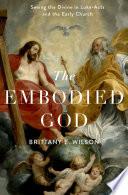
body have historically incited (and continue to incite) material images of that body (as the image on the cover of this book exemplifies), even though the Bible elsewhere prohibits visual representations of the divine.53 Biblical representations of God’s body also enable humans to experience God phenomenally in embodied terms. Based on biblical (and material) descriptions of God’s body, humans are able to form “mental images” of this body, a phenomenon that blurs the distinction between “representation” and “reality” by concretely positioning an embodied God in the human imagination.54 By speaking of textual representations, therefore, I do not mean to say that God’s body is somehow not “real” or not related to “real” bodies. My point is simply one that concerns the book’s source material. In this book, my primary sources consist of ancient literary phenomena and, when pertinent, research that engages ancient material phenomena (such as cult statues and so forth).
Second, I primarily define the body in this book in relation to human bodies. This is not to say that God cannot be represented, for example, as an animal body; this happens on various occasions in the Hebrew Bible, and I discuss at least one example of God’s theriomorphic form in the New Testament in Chapter 2.55 But as Mark Smith notes, “a definition [of a body] without reference to the human body would not seem to account for the central role that it plays in biblical anthropomorphism in general and in biblical representations of God’s body in particular.”56 Smith’s comment also finds support in wider discussions that maintain that all theism is inherently anthropomorphic and that even religion itself is a type of anthropomorphism.57 Humans cannot help but anthropomorphize, and the very notion that humans can address a God who desires to be in relationship with humans is itself anthropomorphic. Denying the phenomenon of anthropomorphism, as Esther Hamori notes, is a misstep from the beginning.58
53 Note also that material representations of God’s anthropomorphic form often depict that form as a male body, drawing from “verbal images” such as “the Ancient of Days” (e.g., Dan 7:9–10; cf. Rev 1:13–16). The image on the cover of this book, for instance, depicts God as a male “Ancient of Days” figure and also draws from Isa 66:1 and New Testament descriptions of Jesus being exalted to God’s right. Note too that the artist, Peter Paul Rubens (1577–1640), portrays God as a white, European male.
54 See Wolfson, “Judaism and Incarnation,” 239–54, and my discussion in Chapter 1.
55 See Smith’s discussion of theriomorphism in the Hebrew Bible in Where the Gods Are, 47–57. See also Strawn, “ ‘Mischmetaphor.’ ”
56 Smith, Where the Gods Are, 14. See also Wagner, God’s Body, esp. 1–8.
57 On how theism is inherently anthropomorphic, see Cherbonnier, “The Logic of Biblical Anthropomorphism”; Hamori, “When Gods Were Men,” 46–50. On how religion is a type of anthropomorphism (or should be redefined as “systematic anthropomorphism”), see Guthrie, Faces in the Clouds
58 Hamori, “When Gods Were Men,” 46.
Because of the centrality of human bodies in biblical accounts of God, I agree with Smith that Benjamin Sommer’s (much critiqued) definition of a body is too broad. Sommer defines the body as “something located in a particular place at a particular time, whatever its shape or substance.”59 As Smith observes, Sommer’s definition might include all sorts of nonliving objects not usually regarded as bodies.60 At the same time, Sommer’s definition, I believe, raises important points. It reminds us that ancient views of the body (including biblical views) do not always map onto our modern views. A number of “nonliving objects” that we might not regard as “bodies” were, in fact, viewed this way in the ancient world, as when the Stoics portray the created universe as a living being with a spherical body (e.g., Diogenes Laertius, Vit. 7.139–140), aligning with Plato’s own conception of the physical cosmos as a living creature with body and soul (e.g., Tim. 28B; 30B–D; 32C–34B).61 Many ancients, moreover, conceived of God or the gods as having the ability to embody physical objects.62 Sommer’s vague definition (purposefully so, in my view) also grapples with the fact that there are various elusive—yet still concrete—ways in which God becomes manifest in biblical texts. We might not term all of these manifestations as “bodies” per se, but they are certainly manifestations that problematize a conception of God’s invisible immateriality.
With these qualifications in view, my primary reliance on human bodies in understanding divine bodies leads to my third clarification of Shilling’s definition: I do not always refer to God’s “body” in this book because it is not always clear in the text whether God’s concrete and/or visible presence is human (or humanlike) in form. In these instances, I may say that God becomes “embodied” or “tangible” as a way to jar us from our postEnlightenment ways of envisioning God, but this does not necessarily mean
59 Sommer, The Bodies of God, 2.
60 Smith, Where the Gods Are, 14. Smith himself, along with Anne Knafl, relies mainly on the definition of “body” provided by the Oxford English Dictionary, which reads as follows: “the physical or material frame or structure of man or of any animal” (Smith, Where the Gods Are, 14; Knafl, Forming God, 72). I deem this definition to be insufficient, given its lack of interaction with theoretical discussions of the body, which is why I begin with Shilling’s definition.
61 Sellars, Stoicism, 91–99; Salles, “Introduction,” 3.
62 On the divine embodying physical objects in the ancient Near East, see, e.g., Herring, Divine Substitution; Hundley, Gods in Dwellings; Putthoff, Gods and Humans; Sommer, The Bodies of God On the divine embodying physical objects in the Greco-Roman world, see, e.g., Platt, Facing the Gods, 77–123; Steiner, Images in Mind; Markschies, God’s Body, 74–99. See also Thiessen’s discussion of Christ’s “rock body,” drawing here on Sommer’s argument concerning God’s rock bodies (“ ‘The Rock Was Christ’ ”; cf. Sommer, The Bodies of God, 49–54).
that God has a “body” that is recognizably anthropomorphic (with the qualification, again, that not every body is anthropomorphic).
My fourth emendation to Shilling’s definition is that it is not always clear whether God’s body in the Bible qualifies as “material phenomena.” In Smith’s definition of God’s three bodies in the Hebrew Bible, for example, he describes the first body as material, the second as luminous but not physical, and the third as partaking of a bodily form but with an unclear physicality.63 In other words, biblical texts are not always precise concerning the substance of God’s body; in fact, we shall find that the majority of biblical texts are silent on this point. We should be careful, of course, in assuming that depictions of God’s body that refrain from describing it in physical terms do not bear any relation to materiality. Just because a text does not specify the nature of God’s body, that does not mean that ancient hearers assumed that God lacked a physical form. All the same, I try to be careful in how I describe biblical accounts of God’s body if the accounts are vague (and they typically are). In such instances, I frequently use the term “anthropomorphic”—literally, “human” (ἄν θρωπος) + “form” (μορφή)—to describe how a given passage describes God. I do so because the term captures God’s human or humanlike shape and/or actions but preserves the ambiguity regarding God’s physicality. I use “anthropomorphic,” then, as a more general umbrella term. I also use the term “form” itself quite frequently (although not in the sense of a Platonic “Form”). Not only is “form” a word that often appears in accounts of theophany (see Chapter 4), but it is appropriately ambiguous. “Form” captures the elusive nature of numinous manifestations, which are themselves phenomena that frequently surpass human understanding and conceal as much as they reveal. Since God’s body is both like and unlike human bodies, we find that God’s body holds a mysterious quality that makes it different from the “material phenomena” of typical human bodies.
My final emendation to Shilling’s definition is that I define God’s body closely in relation to sight. In other words, my discussion of God’s body is inextricably connected to how humans “see” that body. I would go so far as to say that this is a book ultimately about both sight and embodiment; the two are intertwined to such a degree that it is impossible to speak about one without speaking of the other. This connection between sight and embodiment surfaces throughout this project in various ways. I address this connection when I problematize the notion that God is invisible “by nature”
63 Smith, Where the Gods Are, esp. 13.
and when I discuss times when textual representations elicit visual images of God’s body in the imaginal realm. I address it again when I discuss the experience of theophany, which literally means an appearance of God (θεός + ϕανεῖν), as well as visions and epiphanies more broadly. Finally, I address it when I discuss how Luke subjects Jesus’s own corporeality to visual verification, with sight in this instance functioning to provide “proof” of his fleshly form.
Of course, sight is not the only “bodily” sense that God’s body engages in the Bible. Sensory studies from across various fields reveal how the senses never operate in isolation but are always interacting with one another and with other bodily processes, such as cognition and the emotions.64 Biblical scholars are increasingly incorporating such studies into their own textual analyses, and there remains much work to be done on how visions and epiphanies in particular are multisensory, embodied experiences.65 I have limited my discussion, however, primarily to how the sense of sight intersects with divine embodiment. I do so largely because of space constraints but also because of the prominence of sight language in Luke’s own narrative and because sight language features so prominently in divine-human encounters more broadly.66 Moreover, focusing on the role of sight—and its intersection with embodiment—stands in contrast to previous approaches that mainly focus on the role of speech and hearing in theophanic accounts. As New Testament scholar Jane Heath observes, modern biblical scholarship is indebted to the Reformation’s championing of the word over the image and of hearing over seeing, with this preference for hearing “the Word” often emerging in scholarly works.67 Focusing on sight, and specifically on seeing God, then, forces us to grapple with our own inherited traditions of privileging the verbal over the visual and to reframe how we “see” biblical texts.
In order to explore the parameters of beholding the divine, this book is divided into two main sections: “Seeing God” (part I) and “Seeing Jesus” (part II), with each part containing three chapters. Chapter 1 explores the biblical prohibition against crafting visual images of God and problematizes
64 See, e.g., Butler and Purves, Synaesthesia and the Ancient Senses; Betts, Senses of the Empire
65 For embodied, multisensory approaches to visionary experience among biblical scholars, see Harkins, Reading; Henning, “Apocalyptic Literature”; Prince, “Seeing Visions”; Wilson, “Seeing Divine Speech.” For a discussion of ancient Greco-Roman epiphanies as embodied experiences, see Tagliabue, “An Embodied Reading of Epiphanies.”
66 Platt, “Sight and the Gods.” Although see also Tagliabue’s correction that sight is not always the preeminent sense in epiphanies (“An Embodied Reading of Epiphanies,” 213–30). See also the discussion of sight in biblical theophanies in Chapter 2.
67 Heath, Paul’s Visual Piety, esp. 20–27.
the commonly held notion that images are prohibited because they cannot represent an invisible God. It further holds that in Luke-Acts, as elsewhere in biblical texts, God’s body emerges at the level of verbal representation. Luke, like many Jews during his time, prohibits “idols,” but he relies on anthropomorphic images of God in his descriptions of God. Chapter 2 continues to problematize the idea that God is invisible by focusing on instances when God becomes visibly manifest to humans—namely, in the form of visions and theophanies. In Luke’s narrative, God’s body is largely veiled from view, but we get glimpses of God and God’s concrete presence in scenes where God chooses to reveal the divine self to humans. With these theophanic revelations, we also find that God overlaps with other figures, such as angels, the Spirit, and Jesus, to the point where it is difficult to identify the referent of the theophany. Chapter 3 turns its attention specifically to this issue of God’s intersection with other heavenly (and human) characters in the text and argues that Luke stands in a long tradition of depicting God’s “fluidity” (or “fragmentation,” to use Sommer’s terminology) and multiple forms. It maintains that modern-day understandings of monotheism inhibit us from seeing the myriad ways in which God becomes manifest, some of which include actual human bodies, and, for Luke, Jesus himself.
In part II, I specifically angle my field of vision to Jesus. Chapter 4 carries forward the discussions from the previous two chapters by discussing how human characters in Luke’s narrative see Jesus in the context of epiphanies during his earthly ministry. Even though Jesus is clearly a human with a physical body, seeing him can at times be an elusive enterprise that situates him within the divine realm and connects him to God. Chapter 5 discusses Jesus’s humanity in more detail and highlights how sight in particular functions to confirm Jesus’s corporeality. Chapter 6 brings together Chapters 4 and 5 by discussing Luke’s depiction of Jesus in his ascended state in the book of Acts. Here we find a Jesus who becomes visually manifest to his followers in the form of epiphanies (or “Christophanies”) but who is at the same time, according to Luke, an embodied human in heaven. Luke’s overall depiction of the earthly and heavenly Jesus finds precedent in how Luke’s narrative and other Jewish texts represent God, but his depiction also makes Jesus’s humanity more central to his characterization.
In many ways, each of these chapters is able to stand on its own. Readers are thus welcome to read selectively and according to whichever topic interests them most. Part I is organized around key focal points that relate to God: idolatry and divine anthropomorphism (Chapter 1), visions and
theophanies (Chapter 2), and God’s intersection with intermediary figures (what I am calling “divine fluidity”) (Chapter 3). Even though Jesus inevitably comes up in part I (especially in Chapter 3), part II is christologically focused. It discusses Jesus’s divinity and humanity when he is on earth (Chapters 4 and 5, respectively) and then his divinity and humanity when he is in heaven (Chapter 6). Every chapter begins with a broader discussion of the topics before turning to a careful reading of the Lukan text; again, readers may want to skip straight to the detailed exegetical work or skip that work altogether, depending on their interests. In part I, the broader discussions primarily look backward, so to speak, by situating Luke’s depiction of God among its scriptural and Second Temple antecedents, whereas in part II, the discussions primarily look forward by highlighting how Luke’s depiction of Jesus points ahead to future christological controversies. Note also that in part II, the exegetical portions follow the basic narrative contours of Jesus’s life, as opposed to the more atomistic approach of part I since, as characters, Jesus holds more “screen time” than God, who has less frequent “cameo” appearances. Yet while the book’s individual chapters and sections can be read in isolation, readers should also be aware that this book has a natural progression, with each chapter building on what comes before. To understand fully the scope of what it means to see Jesus in Luke-Acts requires that one also understands what it means to see God. Moreover, I would argue that for Luke, one cannot see God without also seeing Jesus. But first, let us begin with God.