Global History with Chinese Characteristics: Autocratic States along the Silk Road in the Decline of the Spanish and Qing Empires 1680-1796 Manuel Perez-Garcia
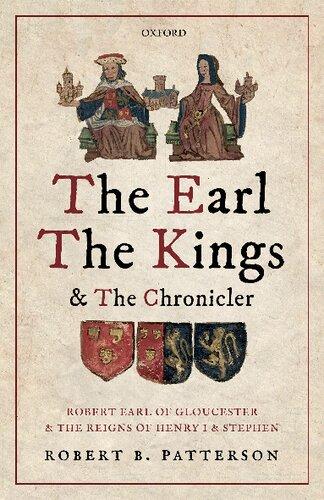
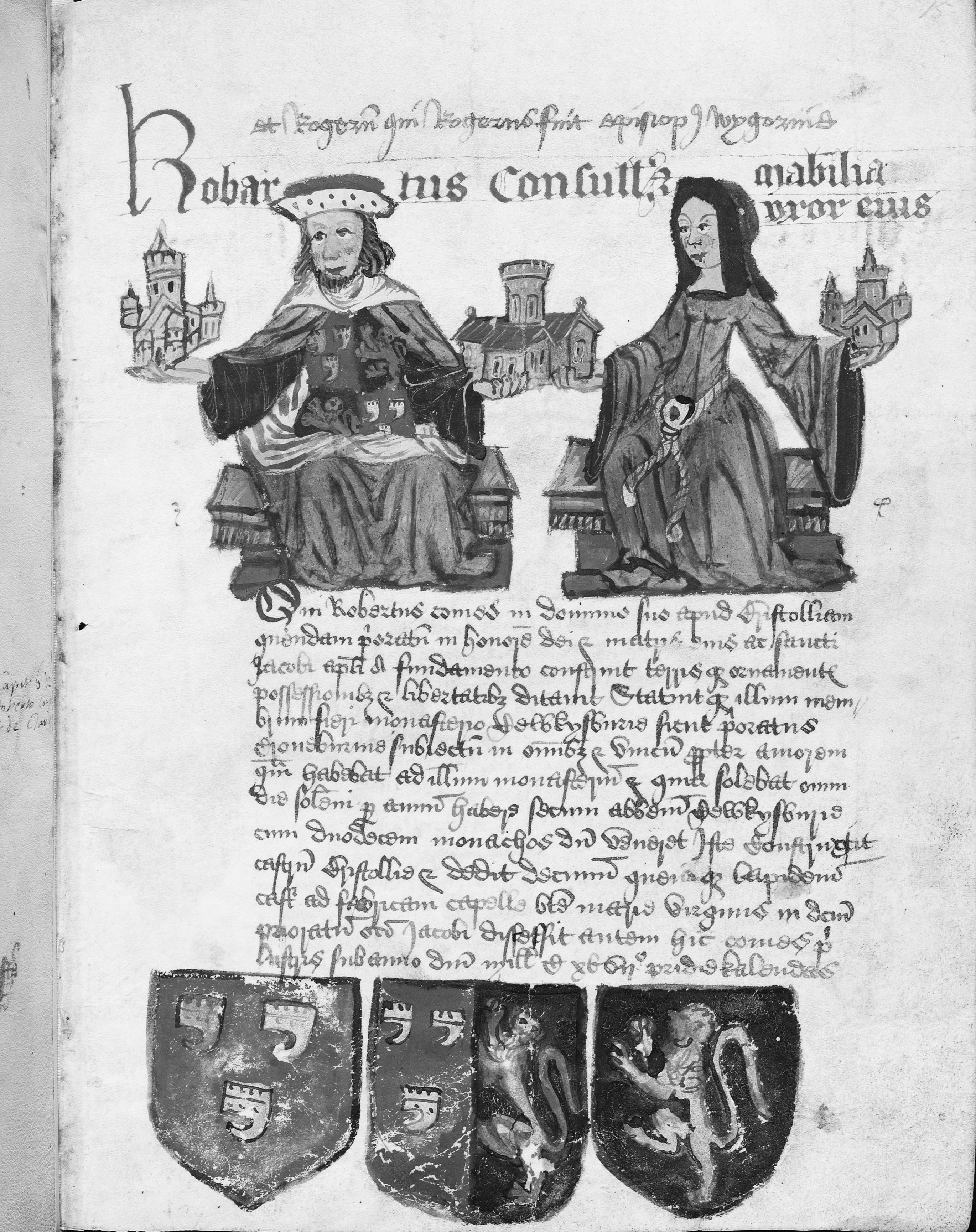
Frontispiece Earl Robert and Countess Mabel of Gloucester as Monastic Patrons s.xviin
The Bodleian Libraries, The University of Oxford, MS Top. Glouc. d. 2, fol. 15r.
The Earl, the Kings, and the Chronicler
Robert Earl of Gloucester and the Reigns of Henry I and Stephen
ROBERT B.
PATTERSON
Great Clarendon Street, Oxford, OX2 6DP, United Kingdom
Oxford University Press is a department of the University of Oxford. It furthers the University’s objective of excellence in research, scholarship, and education by publishing worldwide. Oxford is a registered trade mark of Oxford University Press in the UK and in certain other countries
All rights reserved. No part of this publication may be reproduced, stored in a retrieval system, or transmitted, in any form or by any means, without the prior permission in writing of Oxford University Press, or as expressly permitted by law, by licence or under terms agreed with the appropriate reprographics rights organization. Enquiries concerning reproduction outside the scope of the above should be sent to the Rights Department, Oxford University Press, at the address above
You must not circulate this work in any other form and you must impose this same condition on any acquirer
Published in the United States of America by Oxford University Press 198 Madison Avenue, New York, NY 10016, United States of America
British Library Cataloguing in Publication Data Data available
Library of Congress Control Number: 2018946763
ISBN 978–0–19–879781–4
Printed and bound by CPI Group (UK) Ltd, Croydon, CR0 4YY
To Robert and Denise, Duncan, Josiah, and Ruth Patterson
Preface
This book has emerged from a doctoral dissertation initially directed by Professor Sidney Painter at The Johns Hopkins University and completed in 1962 after his death under the supervision of his successor, Professor John W. Baldwin, with the assistance of Professor Joseph R. Strayer of Princeton University. I put the idea of a book aside to pursue interests in scribal administrations and their generated business documents, but continued to hunt for Robert and earldom of Gloucester material. I was encouraged in these efforts over the years by Professor R. H. C. Davis of Merton College, whom I first met in Oxford when he was preparing his edition of King Stephen’s, the Empress Matilda’s, and Henry fitz Empress’s charters. I also never came away from discussions of my work with my friend James Campbell of Worcester College without some new idea and question to ask of my material. I profited from the advice of Richard Sharpe about Tewkesbury Abbey’s charters and am particularly indebted to David Bates, Nicholas Vincent, and Daniel Power for documentary transcriptions. The virtual explosion of literary and documentary editions along with scholarly studies of King Henry I’s and Stephen reigns and of allied subjects from the 1970s along with my accumulated data has made a full study of Robert an obvious opportunity. Furthermore, some of David Crouch’s studies have raised some challenging issues about Robert and the testimony of the Historia Novella about certain Robert-related subjects. Edmund King’s new edition of the Historia highlighted the Gloucester family’s role, including possibly Robert’s, in creating its version of the text.
My efforts have been aided by the staffs of the Thomas Cooper Library, University of South Carolina; The British Library; Department of Coins and Medals, The British Museum; The National Archives (formerly The Public Record Office); The Bodleian Library; The Bibliothèque Nationale; the Archives Départmentales du Calvados; The Wiltshire Record Office; The Bristol Record Office, and The Gloucestershire Record Office. In particular I am indebted to Michael A. Williams and Amanda Saville, Queen’s College Library, Oxford; D. J. McKitterick and Joanna Ball, the Wren Library, Trinity College, Cambridge; Paul Zutshi and Frank Bowles, Cambridge University Library; Irvine Gray, Brian Smith, and David J. H. Smith of the Gloucestershire Record Office; Gwyn Jenkins, Daniel Huws, Rhydian Davies, and Rhianydd Davies of the National Library of Wales; Zoe Stansell of the Department of Manuscripts, the British Library, Tamsin Mallett of the Cornwall Record Office; Gaye Morgan of the Codrington Library, All Souls College, Oxford; and Michael Riordan, Archivist, St. John’s College, Oxford. Funding for my research trips has been provided by the Research and Productive Scholarship Committee, University of South Carolina; the National Endowment for the Humanities; and from the Southern Region Education Board. Periodic hospitality was provided by H. G. Pitt, David Bates, John and Frances Walsh, James and Baerbel Brodt Campbell, Robert and Amanda Simpson, Brian and Alison Smith, Christopher
Preface and Jean Elrington; Sir James Holt, Joseph P. Funke, and the Fellows of Merton and of Worcester Colleges. Robert Faber, Terka Acton, Stephanie Ireland, Cathryn Steele, Manikandan Chandrasekaran, Donald Watt, and Edwin Pritchard all have helped me get this project to press. Lastly, no acknowledgment can do justice to the many contributions my wife, Ruth Weider Patterson, has made to this book through her keen interest, encouragement, productive questions, and suggestions. Columbia, South Carolina June 2018
List of Figures and Acknowledgments
Frontispiece. Earl Robert and Countess Mabel of Gloucester as Monastic
Patrons s.xviin ii
The Bodleian Libraries, The University of Oxford, MS Top. Glouc. d. 2, fol. 15r.
1.1. Evidence of Robert earl of Gloucester’s hand from the first-person subscription in his name at the foot of Richard de Grainville’s foundation charter for Neath Abbey in 1130: The charter’s text and subscription are in different hands. 10
6.1. The rubricated Prologue of Margam Abbey’s copy in an unidentified hand of William of Malmesbury’s Historia Novella sent to Robert earl of Gloucester. BL, MS Royal 13 D.ii, fol. 110r, col. a, ll. 30–2; partial text of dedication to the earl, ll. 30–41. 179
ANS Anglo-Norman Studies: Proceedings of the Battle Conferences
BGAS/BGAST Bristol and Gloucestershire Archaeological Society Transactions
BIHR/HR Bulletin of the Institute of Historical Research/Historical Research
BL British Library
BM British Museum
BN Bibliothèque Nationale
BNJ British Numismatic Journal
Bodl. Bodleian Library
BRS Bristol Record Society Publications
BSAN Bulletin de la Société des Antiquaires de Normandie.
EHR English Historical Review
HSJ The Haskins Society Journal. Studies in Medieval History.
MSAN Mémoires de la Société des Antiquaires de Normandie
NA National Archives (formerly Public Record Office)
NLW National Library of Wales
PRO Public Record Office (now National Archives)
PRS Pipe Roll Society
SRS Somerset Record Society
TCD Library, Trinity College, Dublin
TRHS Transactions of the Royal Historical Society
WGAS West Glamorgan Archive Service
Abbreviated titles for sources and secondary works can be found in the Bibliography. Lowercase Roman numerals following ‘s.’ indicate paleographical dating.
Introduction
Robert (c.1088 × 90; d. 1147), grandson of William the Conqueror and eldest son of the future King Henry I of England (1100–35), could not succeed his father because he was a bastard. Instead, as the earl of Gloucester, he helped change the course of English history by keeping alive the prospects for an Angevin succession through his leadership of its sympathizers against his father’s successor, King Stephen (1135–54), in the civil war known as the Anarchy. Although, with England as a prime example of the dynastic instability plaguing western European monarchies in the twelfth century, the period more than fulfilled what the term implies, it also witnessed great cultural developments, in which Robert participated.1 He is one of the great figures of Anglo-Norman history (1066–1154) and for his many-faceted links to it occupies important niches in the era’s historiography, from comprehensive political studies of Henry I’s and Stephen’s reigns to the “Brother Cadfael” novels of Ellis Peters.2 The breadth of his activities has earned him places in the literature of modern history’s allied fields such as studies of Norman or Anglo-Norman England;3 government and law;4 art and architecture;5 the Church,6 literacy, literature, and education,7 urban geography,8 social and
1 Bisson, The Crisis of the Twelfth Century, 60, 182–91, 269–88.
2 Hollister, Henry I; Green, Henry I; Round, Geoffrey de Mandeville; Davis, King Stephen; Chibnall, The Empress Matilda; Bradbury, Stephen and Matilda; Crouch, The Reign of King Stephen; Stringer, The Reign of Stephen; King, King Stephen; The Anarchy of King Stephen’s Reign; e.g., Pargeter (alias Peters), Brother Cadfael’s Penance
3 Chibnall, Anglo-Norman England; Chibnall, The World of Orderic Vitalis; Le Patourel, The Norman Empire; Bates, The Normans and Empire; Bartlett, England under the Norman and Angevin Kings 1075–1225; Garnett, Conquered England
4 Warren, The Governance of Norman and Angevin England 1086–1272; GOE; Painter, Studies in the History of the English Feudal Barony; Haskins, Norman Institutions; Richardson and Sayles, The Governance of Medieval England; Kealey, Roger of Salisbury: Viceroy of England; MMI; Law and Government in Medieval England and Normandy
5 Boase, English Romanesque Art 1100–1216; Tewkesbury Abbey: History, Art & Architecture; Renn, Norman Castles in Britain, 118; Grant, Cardiff Castle; Brown, English Castles, 70. Fernie, The Architecture of Norman England
6 Cheney, Roger, Bishop of Worcester,1164–1179; Cownie, Religious Patronage in Anglo-Norman England 1066–1135; Cowley, The Monastic Order in South Wales 1066–1349; Cowley, “The Church in Medieval Glamorgan”; Williams, The Welsh Cistercians, 2 vols.; Saltman, Theobald, Archbishop of Canterbury
7 Clanchy, From Memory to Written Record; Dutton, “Ad Erudiendum Tradidit: The Upbringing of Angevin Comital Children”; Short, “Patrons and Polyglots: French Literature in Twelfth-Century England”; Thomson, William of Malmesbury, 2nd edn.; Damian-Grint, The New Historians of the Twelfth-Century Renaissance; Anglo-Norman Political Culture and the Twelfth-Century Renaissance, 13, 33–4. Haskins, “Adelard of Bath and Henry Plantagenet.”
8 Beresford, New Towns of the Middle Ages; Bristol; Tait, The English Medieval Borough; Hemmeon, Burgage Tenure in Medieval England; Brooke and Keir, London 800–1216: The Shaping of a City; Winchester in the Early Middle Ages: An Edition and Discussion of the Winton Domesday
xvi The Earl, the Kings, and the Chronicler economic history,9 numismatics,10 and military history and the chivalric code.11 Indeed, Robert of Gloucester was a twelfth-century Renaissance man.
As part of his plan to make war on King Stephen on behalf of his half-sister’s claim to the Anglo-Norman throne, Earl Robert added a weapon to appeal to the litterati by commissioning the great Benedictine scholar William of Malmesbury to write a history of their times. The result was the Historia Novella, which is an apologia for the Empress Matilda’s right to the throne and for the earl of Gloucester’s sponsorship. Anyone attempting a biography of Robert is confronted by the political persona Malmesbury created of the high-minded baron who, although at heart loyal to Matilda, had to perform a conditional homage to Stephen out of necessity until the king gave him grounds to rebel and champion the empress. On top of that, there is the challenge of dealing with the inherent contradiction of the Historia’s case for the earl and then of sorting out fact from varieties of distortion in a mostly reliable work to create a more accurate political Robert.
Malmesbury’s version of current events never became a major part of the corpus of medieval historical knowledge because for centuries his chief literary successors mostly ignored the Historia. The major exception, thirteenth-century Matthew Paris of St. Albans, gave Robert’s so-called conditional oath of fealty to Stephen a classical flourish: “As long as you shall maintain me as senator I will support you as emperor.”12
The chronicler’s account of Robert’s career during the Anarchy became a force in English historiography during the nineteenth century when history was becoming established as an academic subject. The first critical edition of the Historia appeared in 1840, the work of Thomas Duffus Hardy, but it was its successor, edited with commentary for the Rolls Series and published in 1887–9 by the extremely influential Oxford scholar William Stubbs, ultimately bishop of Oxford, which exerted the most influence. Stubbs gave the work his complete endorsement, although he recognized its limitations.13 Key elements of the work appear in
9 Stenton, The First Century of English Feudalism 1066–1166; Green, The Aristocracy of Norman England; Newman, The Anglo-Norman Nobility in the Reign of Henry I: The Second Generation; Crouch, The Image of Aristocracy in Britain 1000–1300; Crouch, The English Aristocracy 1070–1272: A Social Transformation; Le Patourel, The Norman Empire; Bates, The Normans and Empire
10 Blackburn, “Coinage and Currency under Henry I: A Review”; Boone, Coins of the Anarchy; Archibald, “The Lion Coinage of Robert Earl of Gloucester and William Earl of Gloucester.”
11 Beeler, Warfare in England 1066–1189; Hollister, The Military Organization of Norman England; Morillo, Warfare under the Anglo-Norman Kings 1066–1135; Gillingham, “Conquering the Barbarians: War and Chivalry in Twelfth-Century Britain”; Strickland, War and Chivalry: The Conduct and Perception of War in England and Normandy 1066–1217; War and Society in Medieval and Early Modern Britain.
12 Among annals, Winchester’s, which did use the Historia Novella, contradicted its representation of Earl Robert’s oath to King Stephen: “Ann. Winchester,” 50; Matthew Paris, Chronica Majora ii. 164 (transl., mine); King, HN (1998), lxviii–lxix, xcv–cvii; see also Chapt. 6, 203. Scribe 24, the author of the “Margam Annals,” barely used the Historia Novella or mentioned little concerning Robert even though the abbey possessed a copy and was the earl’s foundation: Patterson, “The Author of the ‘Margam Annals’: Early Thirteenth-Century Margam Abbey’s Compleat Scribe,” 198–9; Patterson, The Scriptorium of Margam Abbey and the Scribes of Early Angevin Glamorgan, 92–3; see also Chapt. 6, 203 and Figure 6.1.
13 See, e.g., Maitland, “William Stubbs, Bishop of Oxford,” 420; Patterson, “William of Malmesbury’s Robert of Gloucester,” 983–4.
Kate Norgate’s mainly chronicle-based England under the Angevin Kings, and in the entry for Robert she contributed to The Dictionary of National Biography 14 And the Historia achieved an enhanced standing through document-verified accounts used by John Horace Round, the apostle of the new methodology, in his Geoffrey de Mandeville, even though he found some of Malmesbury’s passages questionable and partisan.15
For over half of the twentieth century scholars recognized some of Malmesbury’s faults as a historian, but saw little to criticize in the Historia Novella except bias.16 However, I was moved to probe the text further by H. W. C. Davis’s remark that “no doubt we receive from William of Malmesbury the version of events Robert of Gloucester desired to be set before posterity.” That led in part to a severely critical assessment of the Historia and its author in a 1965 article, “William of Malmesbury’s Robert of Gloucester: A Reevaluation of the Historia Novella,” and a follow-up piece in 1968 and ultimately to this book.17
Before the year was out, the first publication of Stephen’s, Matilda’s, her husband’s and son’s acta in Regesta Regum Anglo - Normannorum , volume three, edited by R. H. C. Davis challenged me to rethink some of my former positions.18 David Crouch’s full-length study of the Anarchy, The Reign of King Stephen (1970), a fullscale revisionist piece by Joe Leedom, “William of Malmesbury and Robert of Gloucester Reconsidered” (1974), and Crouch’s partly supportive, partly critical essay of 1985, “Robert of Gloucester and the Daughter of Zelophehad,” gave added impetus. Warren Hollister’s 1975 article, “The Anglo-Norman Succession Debate of 1126: Prelude to Stephen’s Anarchy,” enhanced the image of Earl Robert as a Matilda loyalist during the late 1120s. And then you could not read Rodney Thomson’s William of Malmesbury (1970) and not wonder how my vintage 1965 image of the historian could exist side by side with the scholarly polymath of 1970. Marjorie Chibnall’s The Empress Matilda (1991) showed model subtlety in handling both criticism and implicit endorsement of the Historia Novella’s testimony on a caseby-case basis. Several interpretations of passages particularly benefiting Robert’s image by David Crouch in The Reign of King Stephen and Edmund King in his new edition, William of Malmesbury Historia Novella: The Contemporary History (1998), were encouragements to expand the topic of Robert’s literary patronage to include his likely direct or indirect role as one of Malmesbury’s sources. King’s Introduction also was both resource and foil for my thinking about the alteration of the text of
14 Stubbs, William of Malmesbury, GR i and ii. cxli–cxlii; Gordon-Keltner & Millican, “Norgate, Kate,” 9; Norgate, England under the Angevin Kings i. 270–1 & n., 274, 294 & n. Norgate, “Robert, Earl of Gloucester,” 1242–4.
15 Round, Geoffrey de Mandeville, e.g., 11, 61, versus 22, 69, 115.
16 Galbraith, “Historical Research in Medieval England,” 17, 23; Darlington, Anglo-Norman Historians, 9; Southern, “Aspects of the European Tradition of Historical Writing: The Sense of the Past,” 253–6; Gransden, Historical Writing i. 183.
17 Davis, “Henry of Blois and Brian Fitz Count,” 297; Patterson, “William of Malmesbury’s Robert of Gloucester: A Reevaluation of the Historia Novella,” 983–97; Patterson, “Stephen’s Shaftesbury Charter: Another Case against William of Malmesbury,”487–92.
18 Regesta iii, esp. no. 898.
xviii
The Earl, the Kings, and the Chronicler the Historia Earl Robert received and production of the codex containing a copy of the work later sent to Margam Abbey.19
Contrary to my former views, Robert was loyal to Matilda during the last decade of his father’s reign, but certainly not immediately following the king’s death. The earl also may have had grounds before late May 1138 for believing that Stephen was attempting to seize at least some of his estates.20 Furthermore, evidence of Robert’s involvement with the Angevins before he led Matilda to England in 1139 is even stronger than I formerly claimed.21 Malmesbury, however, is still open to criticism for omitting Robert’s abandonment of his oath to Matilda and recognition of Stephen as king in the winter of 1135.22 Nor did William mention the loss of the earl’s place at court to Waleran of Meulan and the king’s favoritism toward his family, which were motives for Robert’s retraction of fealty to Stephen.23 William is accountable to some degree for publishing a disingenuous explanation of Robert’s homage to Stephen. The chronicler falsely claimed that his patron’s service to Matilda was completely unselfish.24 Some dubious stories like Henry I’s deathbed concession of Normandy and England to Matilda in Robert’s presence and Stephen’s attempted abduction of him are more valuable as evidence of the earl’s literary collusion with Malmesbury than grist for indictments other than for his gullibility. Malmesbury’s failure to publish the papal injunction Robert conjured up to justify his denial of fealty may not be William’s fault but Robert’s or a member of his household.25 His willingness to accept possibly promised material and failure to correct his manuscript might be excusable because of his failing health.26
William of Malmesbury’s Historia Novella reveals an unabashed propagandist, but also, as readers of this book will find, a valuable resource for the study of the Anarchy, reflecting a range of virtues found in his other works. Malmesbury also deserves credit for what may be considered the only contemporary biography of his patron and special respect for striving to complete his commission under adverse conditions.27
My findings in these topical categories are reorganized in the six following chapters containing aspects of three major phases of Robert of Gloucester’s life, which I refer to as careers, and of his baronial modus operandi: his youthful grooming (Chapt. 1); promotion to favored royal counselor, servant, and a specially designed
20 Patterson, “William of Malmesbury’s Robert of Gloucester,” 986; Regesta iii. no. 898; see also Robert’s foundation of St. James’s Bristol and possibly his grant to the abbey of Tiron as complimentary gestures toward Matilda: see Chapt. 4, 118–19; also Chapt. 2, 44.
21 Patterson, “William of Malmesbury’s Robert of Gloucester,” 991–2; see Chapt. 5, 143–4.
22 Patterson, “William of Malmesbury’s Robert of Gloucester,” 985–6, 987–8; see also Chapt. 5, 131.
23 Patterson, “William of Malmesbury’s Robert of Gloucester,” 990–1; Crouch, Reign of King Stephen, 68, generously acknowledged my introduction of this reason for Robert’s rebellion; see Chapt. 5, 137–8.
24 Patterson, “William of Malmesbury’s Robert of Gloucester,” 993–5, 998–9; Gransden, “Prologues in the Historiography of Twelfth-Century England,” 74–5; see Chapt. 5, 169–70; Chapt. 6, 197.
25 HN (1998), 24–5; Patterson, “William of Gloucester’s Robert of Gloucester,” 989, 992–3.
26 Farmer, “William of Malmesbury’s Life and Works,” 53; See Chapt. 6, 197–8.
27 Chapt. 6, 197–8. For an assessment of Malmesbury and his Historia embodying the preceding points, see Bradbury, Stephen and Matilda, 125.
earldom (Chapt. 2); aspects of his baronial life (Chapts. 3–4); and his military, political, and literary sponsorship of Matilda’s succession (Chapts. 5–6).
From all of this material emerges an exemplary post-Conquest baron. In pursuit of traditional aristocratic goals, Robert and Mabel fitz Hamon more than rectified her parents’ dynastic failure, which had brought her to the king’s son as her family’s heiress. Socially and politically enhancing marriages were obtained for several of their children. But a failure in this regard and in providing an appanage led in part to Robert’s facing military rebellion from at least one son.28
Robert reveals a range of jurisdictional powers enjoyed by only a tiny minority of the Anglo-Norman aristocracy. As a Marcher lord in his Welsh honor of Glamorgan his courts exercised almost complete viceregal powers. Elsewhere, he enjoyed most major prerogatives of ordinary lordship over tenants. His earldom of Gloucester, with overlordship of the constable of Gloucester castle, who also was the county’s sheriff, made him politically dominant in the demesne heartland of his most valuable English honor of Gloucester.29 To rule and exploit his Norman, English, and Welsh honors Robert developed an administrative system resembling the king’s, including a writing-office and staff which Robert’s nephew later as Henry II found advantageous to raid for his own administration.30 Evidence about his best-illustrated English honor of Gloucester confounds some long-held notions about feudal lords and honorial society. The honor was socially and tenurially diverse. Tenants by knight-service like Richard Foliot and Osbert Eightpence might be considered burgesses; some of the honor’s barons, holders of multiple knights’ fees, were themselves barons of their own lordships and vassals of lords other than Robert, including the king.31 Armies Robert mustered also were not limited to tenants by knight-service.32 The apex of his power was reached not just by being lord of military tenants, but as leader of an affinity made up of independent lords who were in some way under his orders. At least during the 1140s independent lords were minting pennies in Robert’s name on their lands with dies supplied by his administration.33
As a demesne landlord, Earl Robert was exceptional for the extent of his urban holdings in England, for his burghal development, and for his patronage of the merchant class. Urban unrest fueled by the increasing wealth and the de facto power it gave conflicted with the old social order in Western Europe. Robert appreciated the economic potential of boroughs and gave personal and economic privileges in return for rents and other revenues and with political savvy made members of his boroughs’ patriciates trusted councilors like Robert fitz Harding of Bristol.34
Robert of Gloucester, who was at least bilingual in Anglo-Norman French and Latin, was very much a part of a realm and culture that was in many ways more
28 See Chapt. 4, 87–8.
29 White, “Earls and Earldoms during King Stephen’s Reign,” 78–9; see Chapt. 2, 33. Appendix 2.1.
34 Chapt. 4, 100–5. On the symbiotic relationship between urban landlords and burgess-tenants, see Dyer, Lords and Peasants in a Changing Society: The Estates of the Bishopric of Worcester 680–1540, 32, 61, 86; Postan, The Medieval Economy and Society, 212.
The Earl, the Kings, and the Chronicler
extensive than the label Anglo-Norman implies.35 Wales provides perhaps the best examples of his cultural involvement beyond the kingdom and duchy. His transChannel barony included honors there as well as in England and Normandy. Some of his military tenants held land in the honor of Glamorgan as well as in England. The earl’s mercenaries included Welshmen and Flemings.36 A vernacular history Robert personally commissioned to be adapted from Welsh histories about the ancient kings of Britain became one of the sources of Geoffrey Gaimar’s Estoire des Engleis and illustrates how the power the earl achieved in South Wales by marriage, conquest, and treaty could lead to literary assimilation and then reincarnation in another form.37
This example of Robert’s taste for romanticized history and his role in its transmission are just some of the reasons for his deserved prominence in what Charles Homer Haskins dubbed “The Renaissance of the Twelfth Century.” The king’s son was raised to be a fully literate knight (a miles litteratus), educated in the Liberal Arts, and thus prepared for a notable participation in the increasingly literate culture of his father’s court. Robert became a dedicated reader with a taste, I believe, for Latin classics and for history, including the just-mentioned new romance type, and even maintained a library to support his tastes. His membership in the royal family and reputation for learning attracted patronage-seeking authors representing each of his historical tastes, William of Malmesbury with traditional Suetonian and Carolingian roots and Geoffrey of Monmouth still composing in Latin but recording a romanticized version of the past. Robert’s just-mentioned sponsored vernacular adaptation of Welsh histories and patronage of Geoffrey earn the earl of Gloucester some credit as a promoter of the Arthurian legend. The Cluniac Gilbert Foliot, abbot of St. Peter’s Abbey Gloucester, the poet Serlo of Wilton, and the distinguished scholar of Arabic science and philosophy, Adelard of Bath, moved in the earl’s circle. He also belonged to a literary network which may have begun in either his court or his father’s and led to Lincolnshire and possibly Yorkshire. But rivaling even the Gaimar details is the fact that this Renaissance man who fought for Matilda and against Stephen had the supreme self-confidence to commission a self-serving apologia of his politics and influence the verdict of future generations.38
35 Short, “Patrons and Polyglots: French Literature in Twelfth-Century England,” 242; Bates, The Normans and Empire, e.g., 62, 74, 86, 120–6, 186–7.
38 Haskins, The Renaissance of the Twelfth Century; Gransden, Historical Writing, 186–7; Short, “Gaimar’s Epilogue and Geoffrey of Monmouth’s Liber vetustissimus,” 338 & n.; Damien-Grint, The New Historians of the Twelfth-Century Renaissance, 43–4; see also Hanning, The Vision of History in Early Britain, 135–37, 71–2; see Chapt. 1, 10–11; Chapt. 2, 49–50; Chapt. 6, 178–80, 183.
Genealogical Chart
Robert of Gloucester and the Norman Ducal-Royal Family
Rollo
William Longsword
Richard l
Richard ll = Judith of Brittany
Baldwin V of Flanders = Adela d. of Robert ll k. of France Richard lll
Robert~Herleva of Falaise
Baldwin VI Robert l the Frisian Matilda = William ll & k. of England
Malcolm lll = Margaret d. of k. of Scots Edward Aetheling
Sibyl = Robert Curthose William Rufus Cecilia abbess of Caen Adela = Stephen ct of Blois x~Henry = MatildaDavid k. of Scots = Adeliza of Louvain
William Clito Haimo Dentatus of Torigni & Creully
William Theobald Stephen = Matilda of Boulogne Henry b. of Winchester
Haimo l dapifer and sheriff of Kent Roger de Montgomery = Mabel de Bellême Eustace William Matilda
Haimo ll dapifer and sheriff of Kent Robert Fitz Hamon = Sibyl de MontgomeryRobert ll de Bellême
Isabelle de Douvres~Robert = Mabel Fitz Hamon
Robert ll e. of Leicester = Amicia
Richard lll bishop of Bayeux
William = Hawise
Robert
Richard Matilda = Rotrou c. of PercheJuliana = Eustace de Pacy
Reginald = d. of William Fitz Richard
Robert
Robert = Matilda of Avranches Matilda = Emp. William Aetheling
Henry V
= Geoffrey ct. of Anjou
Haimo
Richard Philip? Roger
bishop of Worcester
Mabel = Ranulf ll e. of Chester
Mabel Amicia Isabel = John Lackland Ranulf lll e. of Chester
HenryGeoffreyWilliam
A King’s Illegitimate Son
On September 30, 1139, in the fourth year of King Stephen of Blois’s reign (1135–54), King Henry I’s only living legitimate child and designated heiress, the Empress Matilda, landed in England to claim her father’s throne from Stephen, her paternal first cousin. Her sponsor and military escort was her half-brother, Robert earl of Gloucester, one of the mightiest barons of the Anglo-Norman realm, backed up by a force of some 140 knights.1 Thus began the leadership role in England Robert would play in Matilda’s and the Angevins’ dynastic war over the royal succession until his death in 1147, a major political example of the challenges traditional western European cultural institutions and patterns of power faced during what has been called the Crisis of the Twelfth Century.2
To begin with, in an earlier age, Robert, eldest and firstborn son of King Henry I (1100–35), might well have become king of England on his father’s death in 1135.3 Instead, Henry first groomed him for a baronial career, then later elevated him to the rank of earl and made him one of his most intimate counselors and trusted agents. Robert’s political ambitions remained baronial throughout his public life; when given the opportunity later to lay claim to his father’s throne, he declined because he considered his nephew Henry the rightful heir. William of Malmesbury’s Historia Novella, which Robert commissioned, portrayed him in large part as a betrayed baron. The reason for Robert’s apparently paradoxical career was stated simply by the anonymous author of the Gesta Stephani: “Robert . . . [was] King Henry’s son, but a bastard.”4
Robert was one of several of his father’s pre-accession and premarital progeny.5 They were the early products of Henry’s prodigious sexual drive, which the AngloNorman historian Orderic Vitalis colorfully described as “lasciviousness like any horse or mule which is without reason” and which the king’s marriage to EdithMatilda, daughter of King Malcolm III of Scotland, was supposed to curb, but failed to accomplish.6 William of Malmesbury excused Henry’s womanizing as his
1 HN (1998), 60–1. Stephen was the son of Henry I’s sister Countess Adela of Blois and her Crusader husband, Count Stephen-Henry, who perished at the battle of Ramla in May 1102: LoPrete, Adela of Blois Countess and Lord (c.1067–1137), 4; Runciman, A History of the Crusades i. 76–8.
2 Bisson, The Crisis of the Twelfth Century, 17–18, Chapts. 3–4.
3 GND ii. 248–9. For Robert’s familial relationships, see Genealogical Chart, xxi.
4 GS (2004), 12–15; see also Chapt. 6, 185, 189.
5 GND ii. 248–9. On Henry’s illegitimate children, see CP v. 683; xi, Appendix D, 105–21; GivenWilson and Curteis, Royal Bastards, 60–73; the most recent study is Thompson, “Affairs of State,” 129–51, esp. 134.
6 OV v. 298–9; GR i. 714–17. See also Henry of Huntingdon (1996), 700–1.
The Earl, the Kings, and the Chronicler desire to obtain a plentiful supply of royal offspring;7 if that was his motive, one can only observe that for Henry this must have been a labor of love. Following Robert and before 1100, Henry’s various sexual liaisons produced first Richard and then, in uncertain order of birth, possibly William de Tracy, but at least a Sibyl, and probably Juliana and Matilda; after Henry became king, the list continued to grow until the grand total reached about twenty-five. So far as can be determined, Robert shared no mother with any of this illegitimate brood, although some others like Richard and Juliana did.8
Henry’s illegitimate first offspring was born between c.1082, when his father would have reached puberty, and Henry’s acknowledgment of him as his son, sometime before his accession to the Anglo-Norman throne on August 5, 1100.9 The mother’s name is unknown. Robert’s first place in the order of his father’s five or six bastards’ births before 1100 suggests a natal date for the future filius regis well back from then. Also, Henry’s premarital sexual liaisons may only have begun after he became a knight in 1086 and joined the permissive culture of bachelor knighthood in which beguiling or intimidating women into sexual relationships was part of common behavior.10 Furthermore, if Robert’s own illegitimate son Richard was regarded as ageworthy (30) to be a bishop c.1135, as seems very likely, his necessarily pubescent father must have been born no later than about forty-four years earlier, or c.1091. About 1088–90 seems to be the most likely.11
Considering these chronological calculations about Robert and his father, Henry’s known itinerary during the 1080s makes England, c.1081–c.1087 and part of 1088, to have been the likely place for his sexual encounter with Robert’s mother.12 Henry only crossed the Channel to the duchy in late 1086. He was with his father when the Conqueror died at Rouen (Seine-Inf.) on September 9, 1087 and was the only son in attendance at the funeral in Caen.13 After this the young prince remained in Normandy and only returned to England before 1091 in an attempt during July 1088 and several months following to receive from his royal brother William Rufus extensive estates left him by their mother.14 At his death
7 GR i. 744–5.
8 Ansfrida probably was not the mother of Richard, born c.1094 × 1100, and Robert; the Chronicon Monasterii de Abingdon, ii. 122, which mentions her maternal relationship to Richard, does not mention Robert; GR i. 760–1. Thompson, “Affairs of State,” 133–4; Appendix A., 141–51.
9 HN (1998), 8–9; Brooke, Medieval Idea of Marriage, 138n., reports the age for girls was 12 and for boys 14. Henry was born in 1068/9.
10 The five most likely pre-1100 children are Robert, Richard, Matilda of Perche, Juliana, and Sibyl; William de Tracy may be another: Thompson, “Affairs of State,” 134, 138; Duby, “Youth in Aristocratic Society,” 112–22.
11 3rd Lateran Council, c. iii: Mansi, Concilia xxii, cols. 218–19; Cheney, Roger, Bishop of Worcester, 7n.; for Bishop Richard, see also Chapt. 4, 86. Against John of Worcester and the “Gloucester Chronicle,” JW iii. 178–9, see HN (1998), esp. 8–9, even 112–13; King, King Stephen, 5.
12 OV iv. 148 & n., 149; Regesta i (1998), nos. 39, 60 & n., 146, 193, 253, 266 III, 301; OV iv. 148–9; Regesta ii. pp. 393, 397; Hollister, Henry I, 36, 48, 61, 68; Bates, William the Conqueror, 129.
13 OV iv. 80–1, 94–7; ASC a.1086, 1087; Thompson, “Affairs of State,” 138.
14 OV iv. 148 & n., 149; GR i. 510–13, 710–13; Aird, Robert Curthose, 115; Green, Henry I, 29, believes Henry made another visit to England c.1089 based on the GR’s reference to one (i. 712–13); Hollister, Henry I, 68, I believe, more correctly interprets the passage as a recapitulation of Henry’s previous visit.
A King’s Illegitimate Son 3 in 1087 William the Conqueror left his Anglo-Norman realm divided, with his Continental domain to be under the rule of his eldest but alienated son Robert Curthose and England positioned to become Rufus’s. The Conqueror provided no land for Henry, only a legacy of £5,000.15 Queen Matilda (d. 1083) had intended for him to receive a major portion of the appanage created for her from estates confiscated from an Anglo-Saxon thane, but after her death Henry’s father retained them as royal demesne and William Rufus (1087–1100) quickly had other plans for them.16
Professor David Crouch has argued that a nameless, hypothetical sister of an Oxfordshire landlord, Stephen Gay, was Henry’s partner in fathering Robert during one or more of his visits to the area in 1084 or soon after.17 An original charter in the muniments of St. John’s College, Oxford, in favor of St. Mary’s Kirtlington (Oxon.), a dependency of Norman Aunay Priory, establishes that the donor, Philip Gay, was the son of Stephen Gay.18 And the Gloucester Chronicle contained in the Chronicle of John of Worcester refers to a Philip Gay as the cognatus of Earl Robert of Gloucester.19 Since in Crouch’s experience with charters cognatus has mostly stood for first cousins, he deduces that with Philip Gay as Robert’s first cousin, Philip’s father Stephen would be the earl’s maternal uncle and a sister of Stephen, Robert’s mother. Furthermore, Henry can be placed at least once in the 1080s in the Oxfordshire area, where the Gay family held land, during a visit to Abingdon Abbey (Berks.) in 1084, and at least one of Henry’s known mistresses, Ansfrida, belonged to a local family.20
There are, however, several problems with this theory of Robert–Gay lineage and its later influence in Anarchy politics. Aside from the fact that there is no evidence that the Stephen Gay of the St. John’s College charter had a sister, the term for Philip Gay’s affinity to Robert, cognatus, does not necessarily mean first cousin, as Crouch himself admits; it is commonly used to designate a kinsman of some sort, as in Orderic Vitalis’s Historia Ecclesiastica. William the Conqueror referred to his second cousin Edward the Confessor as his cognatus. 21 Charter evidence of Robert’s son and successor, Earl William of Gloucester (1147–83),
15 Holt, “Politics and Property in Early Medieval England,” 17–19, 45–8, revising Le Patourel, “The Anglo-Norman Succession 996–1135,” 225–34; Le Patourel, “Normandy and England 1066–1144,” 4–5. William’s division has generated considerable scholarly debate; for an illustrative bibliography, see Aird, Robert Curthose, 99n.
16 GR i. 510–13; OV iv. 220–1.
17 Crouch, “Robert of Gloucester’s Mother,” 323–33; see Genealogical Chart, xxi.
18 Transcr. in Crouch, “Robert of Gloucester’s Mother,” 331–2 from St. John’s College Oxford, Mun. XXI (1); Crouch, Reign of King Stephen, 215 & n., is more cautious. For the connection between Kirtlington and Aunay, see VCH Oxfordshire vi. 41 & n., 228–9.
19 JW iii. 249–50; Crouch, “Robert of Gloucester’s Mother,” 324, 333; Crouch and Trafford, “The Forgotten Family in Twelfth-Century England,” 48 & n. Philip was first cousin of Reginald Gay, an Oxfordshire tenant of the honor of Gloucester: Cart Thame i. no. 5, grant by Reginald of land with consent of the earl of Gloucester (Robert) c.1138; VCH Oxfordshire vi. 153, 155, 279.
20 VCH Oxfordshire vi. 327 & n.
21 Regesta i (1998), e.g., nos. 139, 181; a cognatio can mean a society of some kind: DuCange, Glossarium ii. 392. For another possibility for Bishop Jocelin’s and Earl William’s association, see Barlow, Thomas Becket, 111–12; was Philip Gay a cognatus of Earl Robert because his uncle was one of the earl’s Oxfordshire tenants?: Cart. Thame i. no. 5; see also Crouch, Reign of King Stephen, 215n.