Adams vs. Jefferson: The Tumultuous Election of 1800
Joel H. Silbey
Storm over Texas: The Annexation Controversy and the Road to Civil War
Raymond Arsenault
Freedom Riders: 1961 and the Struggle for Racial Justice
Colin G. Calloway
The Scratch of a Pen: 1763 and the Transformation of North America
Richard Labunski
James Madison and the Struggle for the Bill of Rights
Sally G. McMillen
Seneca Falls and the Origins of the Women’s Rights Movement
Howard Jones
The Bay of Pigs
Lynn Parsons
The Birth of Modern Politics: Andrew Jackson, John Quincy Adams, and the Election of 1828
Elliott West
The Last Indian War: The Nez Perce Story
Glenn C. Altschuler and Stuart M. Blumin
The GI Bill: A New Deal for Veterans
Richard Archer
As If an Enemy’s Country: The British Occupation of Boston and the Origins of Revolution
Thomas Kessner
The Flight of the Century: Charles Lindbergh and the Rise of American Aviation
Craig L. Symonds
The Battle of Midway
Richard Moe
Roosevelt’s Second Act: The Election of 1940 and the Politics of War
Emerson W. Baker
A Storm of Witchcraft: The Salem Trials and the American Experience
Louis P. Masur
Lincoln’s Last Speech: Wartime Reconstruction and the Crisis of Reunion
David L. Preston
Braddock’s Defeat: The Battle of the Monongahela and the Road to Revolution
Michael A. Cohen
American Maelstrom: The 1968 Election and the Politics of Division
Marc Gallicchio
Unconditional: The Japanese Surrender in World War II
Oxford University Press is a department of the University of Oxford. It furthers the University’s objective of excellence in research, scholarship, and education by publishing worldwide. Oxford is a registered trade mark of Oxford University Press in the UK and certain other countries.
Published in the United States of America by Oxford University Press 198 Madison Avenue, New York, NY 10016, United States of America.
All rights reserved. No part of this publication may be reproduced, stored in a retrieval system, or transmitted, in any form or by any means, without the prior permission in writing of Oxford University Press, or as expressly permitted by law, by license, or under terms agreed with the appropriate reproduction rights organization. Inquiries concerning reproduction outside the scope of the above should be sent to the Rights Department, Oxford University Press, at the address above.
You must not circulate this work in any other form and you must impose this same condition on any acquirer.
Library of Congress Cataloging-in-Publication Data
Names: Weddle, Kevin John, author.
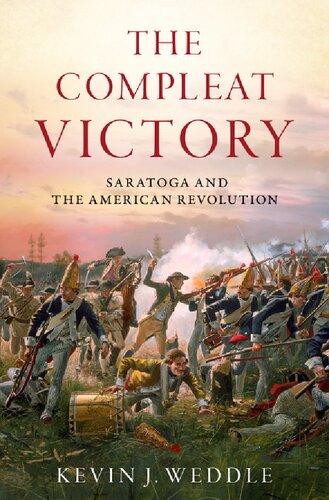
Title: The compleat victory : Saratoga and the American Revolution / by Kevin J. Weddle.
Other titles: Battle of Saratoga and the American Revolution
Description: New York, NY : Oxford University Press, [2021] | Series: Pivotal moments in American history | Includes bibliographical references and index. Identifiers: LCCN 2020041604 (print) | LCCN 2020041605 (ebook) | ISBN 9780195331400 (hardback) | ISBN 9780199912537 (epub) | ISBN 9780199715992 (epdf) | ISBN 9780197549445 (ebook other)
LC record available at https://lccn.loc.gov/2020041604
LC ebook record available at https://lccn.loc.gov/2020041605
1 3 5 7 9 8 6 4 2
Printed by Sheridan Books, Inc., United States of America
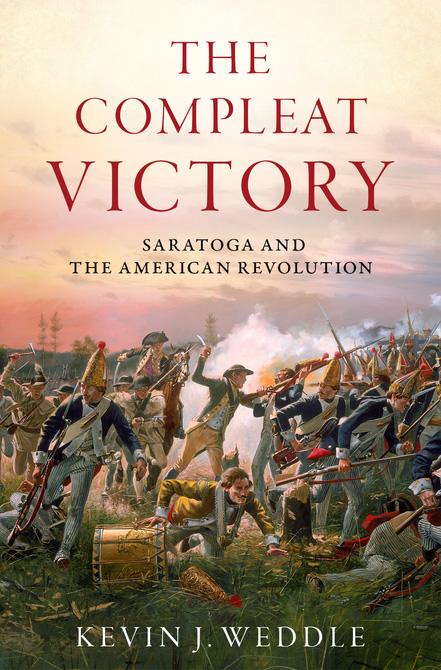
The Compleat Victory
SARATOGA AND THE AMERICAN REVOLUTION
Kevin J. Weddle
For Jeanie
CONTENTS
List of Maps ix
Editors’ Note xi
Acknowledgments xv
Introduction: Fatal Ambition 1
Chapter 1: Opening Moves 7
Chapter 2: The First Invasion 25
Chapter 3: A New British Strategy 51
Chapter 4: A Question of American Command 73
Chapter 5: Laying the Groundwork 86
Chapter 6: The Fall of Fort Ticonderoga 102
Chapter 7: Defeat, Retreat, Disgrace 123
Chapter 8: Aftershocks 144
Chapter 9: Burgoyne Moves South 151
Chapter 10: The Ordeal of Philip Schuyler 164
Chapter 11: The Murder of Jane McCrea 172
Chapter 12: Not to Make a Ticonderoga of It 178
Chapter 13: Oriskany and Relief 195
Chapter 14: Cat and Mouse 219
Chapter 15: Burgoyne’s Dilemma 230
Chapter 16: The Battle of Bennington 236
Chapter 17: Gates Takes Command 258
Chapter 18: The Battle of Freeman’s Farm 272
Chapter 19: Sir Henry Clinton to the Rescue 294
Chapter 20: The Battle of Bemis Heights 307
Chapter 21: Retreat, Pursuit, and Surrender 329
Chapter 22: British Strategic Reassessment 351
Chapter 23: The Fruits of Victory 361
Conclusion: Men and Measures 379
Appendix A: What Became of Them? 391
Appendix B: Chronology of the Saratoga Campaign, 1776–1778 395
Appendix C: Key British Letters/Orders/Meetings, 1776–1777 401
Appendix D: Orders of Battle 407
Notes 417
Bibliography 485
Index 497
LIST OF MAPS
1. Northern Theater of Operations, September 1775 through December 1776 49
2. Burgoyne’s Plan for 1777 60
3. Howe’s Plan for 1777 68
4. Saratoga Campaign, June through October 1777 97
5. Burgoyne’s Capture of Fort Ticonderoga, July 2‒6, 1777 115
6. Battle of Hubbardton, July 7, 1777 131
7. Siege of Fort Stanwix, August 2‒22, 1777 191
8. Battle of Oriskany, August 6, 1777 202
9. Battle of Bennington, August 16, 1777 247
10. Battle of Freeman’s Farm, September 19, 1777 275
11. Clinton’s Relief Expedition, October 3‒16, 1777 301
12. Battle of Bemis Heights, October 7, 1777 319
13. Burgoyne’s Final Camp at Saratoga, October 11‒17, 1777 332
EDITORS’ NOTE
Most historians of the American War for Independence agree that Saratoga was a pivotal moment in that long struggle. The victory of American citizen-soldiers and the surrender of an entire British army caused Europe’s leading military power to intervene in support of the American cause. When France entered the war, other European states followed. The fighting spread from America to Europe, Africa, and Asia. A colonial rebellion became a world war. Great Britain suffered the worst defeat in its modern history, and the new United States won their independence.
That understanding of Saratoga’s importance is widely shared by scholars. But precisely how and why it happened is a more difficult and complex question. Saratoga was not a single battle. It came as the climax of a long campaign, after many other events that drew in a diversity of American Continentals, State militia, British regulars, Canadian troops, German mercenaries, and Indian warriors. Their commanders had different traditions of leadership, and the many men who served with them had profoundly different ideas of why they were there.
These events have drawn the attention of Kevin Weddle, an historian who has distinguished himself in two professional careers. He is a graduate of West Point who, like other leading graduates of that great institution, joined the Army Corps of Engineers. His long military career has spanned a broad range of assignments, including as battalion commander, as well as service in Operations Desert Storm and Enduring Freedom. At the same time, Weddle actively pursued another career as a professional historian. He earned a doctorate in American history at Princeton, published a major dissertation on the American Civil War, and produced other important works of scholarship. And he brought his two professional careers together as a professor at the Army War College, where he rapidly rose to become its Deputy Dean.
We invited Weddle to contribute a volume to the Pivotal Moments in American History series at Oxford, on a subject of his own choosing.
He selected the Saratoga campaign, which had first drawn his attention when he began to study it as a cadet. His continuing interest in the campaign centered on problems of leadership. For many years, the study of leaders had been at the heart of much historical scholarship. More recent generations of scholars have shifted their primary inquiries to other questions of high importance in social, economic, demographic, cultural, and intellectual history. Much was gained by this enlargement of historical research, but something important has been lost.
In recent years, we in the United States have suffered a decline in the quality of leadership in high elective offices of our American Republic. The primary cause is not only a pattern of failure in our leaders themselves, but in those of us who choose them. Our culture on many levels has tended to move away from the vital task of preparing Americans for their primary civic responsibilities in the choice of those who should lead in a free and open society.
In consequence, historians are returning to the study of leadership. Weddle’s book on Saratoga centers not merely on a few at the top. It is broadly conceived to include a diversity of people who functioned in many prominent roles in a world-historical event and who made a difference, both positive and negative, in its outcome. It studies a broad array of leaders, senior and junior, civilian and military, who functioned in the thirteen American states, in Britain’s constitutional monarchy, in French and British Canada, in German professional forces, and within American Indian nations. Some have given rise to an historical literature that is large and often deeply divided. Weddle, who commands a large range of primary and secondary materials and whose inquiries draw on his own personal experience and background, comes to his own balanced conclusions. His inquiries combine the precise thinking of a professional soldier with a scholar’s concern for the evidence. At the same time, he has written a fluent, graceful, and engaging book that brings out the drama of pivotal moments.
The Saratoga campaign occurred in a flow of events that began in 1775 and continued to 1777 and beyond. Each of its battles featured different sets of commanding officers and supporting leaders. Weddle’s book takes the form of a braided narrative, centering on several sequences of leaders who made choices, choices that made a difference in the world. Military history can be confusing to the nonprofessional reader, especially when it involves so many characters operating over such a wide geographic area. Weddle’s skill keeps
the story of Saratoga moving forward with a clarity that conquers confusion.
More than any other book on its subject, Weddle’s narrative studies the central role of an American leader who was not present on the field at Saratoga—George Washington, who was learning by trial and error to master his role as commander-in-chief of the Continental army and as a leader in the American cause. Washington began with a near-fatal failure to perceive the vital importance of events on the distant northern frontier. Then, through a process of learning and growth, he worked constructively with individual military commanders and civilian leaders in the Saratoga campaign, sending some of his most able officers and best fighting units from his own forces. Weddle reconstructs a pattern of change and growth in the man and the event. Altogether it enlarges and refines our understanding of the man, the event, and problems of leadership in a long sequence of critical moments.
Weddle does something similar for major leaders on every side and is always very careful, creative, and independent in his judgments. In that way he makes fresh and original contributions to our understanding of a number of individual leaders on the American side, including St. Clair at Ticonderoga; Gansevoort at Stanwix; Herkimer at Oriskany; Stark at Bennington; Morgan and Dearborn at Freemans Farm; Gates and Learned and Arnold at Bemis Heights; and British, Hessian, Canadian, and American Indian leaders in equal measure. In this book, Weddle reflects on general models of leadership, such as Bernard Montgomery’s idea of “grip.” And through it all, he also gives particular attention to forms of effective leadership in open systems. All of us can put his knowledge and judgment to work, when we choose our own leaders or when we find ourselves chosen to lead in a free society.
David Hackett Fischer James M. McPherson
ACKNOWLEDGMENTS
No one can complete a book that takes more than ten years to research and write without being indebted to many people. First and foremost, David Hackett Fischer not only brought me into the project, but he went above and beyond the call of duty by reading at least two full drafts of the book and many other versions of important sections. His feedback and suggestions were instrumental in fleshing out key themes, and he enthusiastically endorsed my focus on strategy and leadership. David is an exceptional historian and a national treasure, and I am fortunate to call him a mentor and a friend. Jim McPherson, another mentor and friend, provided helpful feedback and support.
Eric Schnitzer, chief historian at the Saratoga National Historical Park, cheerfully offered his time and considerable expertise. He not only shared his own research, he also reviewed and provided timely expert feedback on major portions of the book. He patiently answered all my queries, which was especially critical to my understanding of how the two major battles unfolded and the details of the often-confusing orders of battle. His deep knowledge of the campaign, the sources, and the period came to my rescue time and time again.
My colleagues at the United States Army War College have been encouraging and helpful at every stage. My boss, Dr. Clay Chun, was an enthusiastic supporter. Several of my good friends and fellow faculty members read and provided invaluable feedback on early drafts, including Pete Haas, Chris Bolan, Joel Hillison, Bill Johnsen, and John Paterson. The book is much better because of their generous efforts.
I spent many days exploring the various sites associated with the Saratoga campaign. I profited from numerous discussions and correspondence with park rangers and other staff members at the Fort Ticonderoga Museum, the Mount Independence State (Vermont) Historic Site, the Hubbardton Battlefield State (Vermont) Historic Site, the Fort Stanwix National Monument, the Oriskany Battlefield
State (New York) Historic Site, and the Saratoga National Historical Park. They all enthusiastically responded to my many questions.
While serving as the William L. Garwood Visiting Professor at Princeton University in 2019, I taught a course on World War II strategy and leadership, which helped crystalize my thinking about the two topics that figure so prominently in this book. I owe many thanks to Robbie George and Brad Wilson of the James Madison Program for offering me the appointment, the Army War College’s leadership for approving it, my hardworking and supportive preceptor, Mark O’Brien, and last but never least, my wonderful students.
I am indebted to the extremely helpful staffs at all the archives and libraries I physically and virtually visited during my research. Librarians and archivists at the British Library, the Library of Congress, Ellen McCallister Clark and Rebecca Cooper at the Society of the Cincinnati Library, Miranda Peters and Christopher D. Fox at the Fort Ticonderoga Museum, and April Miller at the Firestone Library at Princeton University, promptly responded to my many requests. Also, the Interlibrary Loan staff at the Army War College Library was extremely efficient and always cheerful. Three institutions, at which I spent many weeks researching the book, and their staffs deserve special mention: the William L. Clements Library at the University of Michigan, the Army Heritage and Education Center (AHEC), and the David Library of the American Revolution (DLAR). Terese Austin and Valarie Proehl helped me negotiate the marvelous collection of the papers of British senior leaders at the Clements Library. AHEC, a part of the Army War College, was invaluable for its extensive collection of secondary sources and published primary material as well as the microfilm collection of Horatio Gates’s papers. Finally, I spent the most time at the DLAR (now the David Center for the American Revolution at the American Philosophical Society in Philadelphia), which was one of the most user-friendly places to conduct research I have ever visited. Its librarian, Kathy Ludwig, has an encyclopedic knowledge of the DLAR’s unsurpassed collection of material—British and American—related to the American Revolution, and I benefitted many times from her wise counsel and suggestions.
I was very fortunate to receive a Society of the Cincinnati Scholar’s Grant and a United States Military Academy Omar N. Bradley Research Fellowship, which helped defray the cost of travel and research. Many thanks to Ellen McCallister Clark, Clifford Rogers, and Lee Johnston.
My editor, Tim Bent, and the entire staff at the Oxford University Press were always professional, encouraging, and responsive. Tim did a superb job of editing, counseling me to let the story unfold, to keep things moving, to cut extraneous detail, and, whenever possible, to show not tell. Not only that, but Tim displayed almost infinite patience with me when the project was delayed for an extended period due to a serious family health crisis. I will be forever grateful for his support. Joellyn Ausanka carefully and skillfully shepherded the project through to competition. Joellyn and her team were a joy to work with.
Finally, my wonderful wife, Jeanie, has cheerfully allowed Saratoga to live with us for more than a decade. She also patiently and with great forbearance listened to me for hours as I read major portions of the book out loud to her, and she offered many useful critiques and suggestions. Jeanie’s support was essential, and her courage while successfully fighting a terrible disease was inspirational. This project would have never reached a conclusion without her.
The Compleat Victory
Introduction: Fatal Ambition
THE QUEEN’S HOUSE WAS modest as royal palaces went in eighteenth-century England. In 1761, King George III purchased the former country home of the Duke of Buckingham for his young wife, Princess Charlotte of MecklenburgStrelitz. This unpretentious retreat for the royal family—later expanded substantially—would one day be known as Buckingham Palace. A family home, only a few steps from St. James Palace, the official royal residence, the Queen’s House provided the king and queen with some respite from their official duties.
It was there, in late August 1777, that the king received a message. It so thrilled him that he burst into his wife’s chambers, waving the paper in the air, exclaiming, “I have beat them! I have beat the Americans!”1 The message informed His Majesty that British Lieutenant General John Burgoyne had captured Fort Ticonderoga, the strategically important American fortress located on the southern narrows of Lake Champlain. Achieved with minimal casualties, the victory convinced the king and his ministers that the military strategy they had put in place that spring was unfolding according to plan.2
In October 1777, two months after the king’s impromptu celebration and three months after taking Ticonderoga, Burgoyne surrendered his entire army of almost six thousand officers and men to an American force of Continental soldiers and militia under the command of Major General Horatio Gates at a place called Saratoga. Only one year earlier, the American Revolution looked to be on its last legs. The Americans had been forced out of New York, and the rebel army was slowly evaporating. However, the Americans were able to stave off their seemingly inevitable defeat by winning at Trenton and Princeton in late 1776 and early 1777. After these surprising
setbacks, the British were determined to end the war once and for all. They devised a complicated plan. Three different British armies would converge on Albany, New York, take control of the Hudson River, and split the newly self-proclaimed independent nation in two. Burgoyne would command the army from Canada; the main army, under the British commander-in-chief, General Sir William Howe, was to first seize Philadelphia, then support Burgoyne by moving up the Hudson. The strategy miscarried badly.
When word of Burgoyne’s surrender reached London on the evening of December 2, 1777, the country was stunned. Everyone had been led to believe that victory over the upstart American colonists was just around the corner. Politicians, newspapers, and the public clamored for blame to be assigned. Opposition members in Parliament demanded the resignation of key ministers. Senior military officers were embarrassed.3 The American victory at Saratoga was a major military setback for the British. It profoundly affected the course of events over the next five years, not least because it led directly to France’s decision to enter the war on the Patriot side, which changed the entire character of the American Revolution, from a colonial rebellion to a world war.
Given that the focus of this series about pivotal moments in American history is on historical contingency, it would be unthinkable to omit the Saratoga campaign. The planning and execution of the campaign are replete with critical decisions by leaders on both sides, and chance played a major role, as it always does in war. This book covers the entire campaign in all its complexity, including its origins, execution, and aftermath, and a more dramatic and consequential American story is hard to find.
I first became interested in the American Revolution and the Saratoga campaign while a cadet at the United States Military Academy at West Point, located 130 miles south of the main battlefield. Throughout a long military career, I have been fortunate to lead hundreds of staff rides and battlefield tours to sites in the United States and Europe, ranging from the Battle of Agincourt to Saratoga to Waterloo to Gettysburg to Gallipoli to the D-Day landings in Normandy. These trips, combined with two combat deployments, command of a battalion, and teaching posts at West Point and the US Army War College, sharpened my interest in leadership and military strategy, which are the two major themes that run through this book.
Essential to understanding the Saratoga campaign’s outcome is an appreciation of the origins of the strategy that drove the military
operations and of the leaders whose decisons drove the British and American forces to their final clashes along the Hudson River.
Who was to blame for Britain’s ignominious defeat? Most have assigned the lion’s share of the responsibility to Lord George Germain, Secretary of State for the Colonies, and the minister responsible for British military operations in North America. Howe is also blamed for wasting time and resources on other campaigns when he should have been assisting the army from Canada. Yet I argue that it was the strategy itself that was ultimately responsible. The foundations for the British defeat at Saratoga were laid in London, New York, and Quebec, where the strategy was devised in the winter and spring of 1777.
Indeed, responsibility for the loss at Saratoga spreads wide. Germain tried to micromanage the war from a continent away and failed to ensure that all the British commanders in North America, especially Burgoyne and Howe, coordinated their efforts. By the summer of 1777, Howe understood that the only way to win the war was to destroy the American Army under the command of General George Washington. However, he did not move quickly or synchronize his actions with those of Burgoyne’s army to make this happen. Finally, Burgoyne, the man who surrendered to Gates, proved to be simply out of his depth. Despite being an experienced and popular commander, Burgoyne never understood until it was too late just how challenging the American environment would be for moving and supplying and fighting with a large European army.
Despite their ultimate victory, the Americans were not immune to failures of leadership during the Saratoga campaign. Major General Arthur St. Clair, commanding Fort Ticonderoga, committed a series of blunders that led directly to the fortress’ evacuation and ensured that Burgoyne’s invasion got off to a fast start with a major success. For the most part, Major General Philip Schuyler, commander of the so-called Northern Department, made decisions that helped lay the groundwork for ultimate American success. Still, his wildly pessimistic reports to Congress and General Washington caused his superiors to lose confidence in his ability to stem Burgoyne’s seemingly inexorable advance south toward Albany.4
Schuyler’s replacement was Horatio Gates, who built on the foundation that Schuyler had already laid. Later in the war, events would demonstrate just how fortunate Gates had been in August 1777 to inherit a situation in which his talents meshed with the circumstances. Major General Benjamin Lincoln, Gates’s second-in-command late in the campaign, proved invaluable to his superiors in handling
the sometimes unreliable militia units from the New England states and in the substantive reinforcement of the Northern Army when it mattered the most. The Americans also had a depth of strong leadership in many outstanding field officers and junior general officers who performed admirably during the campaign. Brigadier General John Stark led his troops to victory at the Battle of Bennington, an engagement that proved the beginning of the end for Burgoyne and his army. Though heavily outnumbered, Colonel Peter Gansevoort successfully defended Fort Stanwix. Colonel Daniel Morgan led his riflemen at the Battle of Freeman’s Farm and the Battle of Bemis Heights. All of these American senior leaders—and many more besides—contributed to the victory at Saratoga.
Perhaps the most dynamic combat leader on either side was Major General Benedict Arnold. From the moment he joined the Northern Army, he made a difference—helping to restore morale, managing militia, conducting reconnaissance missions and raids, and personally leading the final assault at the Battle of Bemis Heights. There is no doubt that Arnold’s role was central to the American success at Saratoga, even though he was volatile and easily took offense. But the advantages Gates derived from having Arnold as one of his combat commanders far outweighed the disadvantages.
The Americans in the Northern Department were also fortunate that their commander-in-chief was George Washington, even though he was more than 200 miles away to the south and distracted by the challenge of facing Howe’s main British Army. Washington underestimated the threat to and the readiness of the Northern Department in the winter and spring of 1777. Nonetheless, he more than made up for his earlier inattention to the theater after the loss of Ticonderoga in July. Washington patiently counseled and mentored the anxious Schuyler and provided sound advice. He also appealed to New England governors and assemblies to muster and dispatch militia forces to join the Northern Army, hurried significant reinforcements northward, and, perhaps most importantly, assigned Benedict Arnold and Benjamin Lincoln to report to Schuyler. Washington’s contributions to the Saratoga campaign are generally glossed over, but they were essential for American victory. Washington could have neglected or even ignored the Northern Army while he faced General Howe, but he did not. He continued setting priorities and allocating his resources accordingly.
While preparing one of my Army War College courses, I encountered British Field Marshal Sir Bernard Montgomery’s notion of “grip,” a term he used to describe a commander who was
able to manage a battle or campaign by personally scrutinizing and supervising all elements of a military operation.5 These attributes are essential elements of leadership. However, I wanted to take the concept a step farther. For this book, I have expanded on Montgomery’s definition of grip to include the ability to anticipate how operations might unfold and how to react to change, something closer to what Carl von Clausewitz called “genius.”6 “Grip” results when superior leadership combines with experience and expertise. According to my formulation, Alexander the Great, Napoleon, Lord Nelson, Ulysses S. Grant, Robert E. Lee, and (closer to Montgomery’s own time) General George Patton all had “grip,” in their ability to sense how a battle or maneuver was unfolding, how the overall engagement was playing out, and when to take the right action, even in uncertain environments and in the absence of critical information. Montgomery’s definition mainly concerned tactical actions on the battlefield. My concept of grip can equally be applied at the operational and strategic levels of war.7 Simply put, the Saratoga campaign turned out the way it did because American leaders displayed more grip—at all levels of war—than their British counterparts.
In war, geography is everything. The Saratoga campaign was epic in both its scope and its impact. Few operations in American history—with exceptions in the Civil War and World War II—took place over such vast distances in such forbidding terrain. It ranged across thousands of square miles and involved dozens of separate battles, engagements, sieges, and maneuvers, some relatively minor, but others pivotal.
To understand this reality and make sense of a very complex campaign, I spent many days walking the sites. The beauty of the Lake Champlain region and the Mohawk River valley in central and western New York made this a very pleasurable experience. It also drove home just how challenging it would have been for eighteenthcentury armies to manage operations over such rugged terrain. The experience increased the respect I already had for those on both sides who marched through these woods, across these rivers and creeks, and over these hills and mountains from June through October 1777.
Native Americans played a major role in the Saratoga campaign, and they participated on both sides of the conflict. I use the terms Native and Native American frequently in the book, but for the most part employ Indian or Indians, as most people, Indian and nonIndian, did at the time.