Introduction
Why Kālidāsa, Why Now?
There are two post-Kālidāsa narratives that I know of about a person going into a deep state of ex-stasis at the sight of a cloud. I use the Greek “ex-tasis,” as opposed to the English “ecstasy” in order to tune both the word and the situation to a somewhat different pitch; it is not clear exactly what emotions and contexts are at play. The first belongs to Mādhavendra Purī, an associate of the 1500s saint Caitanya, who was considered by his followers to be an incarnation of Krishna, in the mood of his premiere devotee and manifestation of his “bliss-energy” (hlādinī śakti), Rādhā.
Mādhavendra Purī saw the rain cloud as blue-black, as śyāma, having the same color as Krishna, and thus fell into a swoon of remembrance. A few hundred years later, a young Gadadhar Chatterjee (later known as Ramakrishna) fainted at the site of a dark storm cloud, whether it was from its beauty or from pure remembrance is not clear, but the Welsh poet Robert Graves’s commentary on the incident may be telling.1 Graves, in his opus, The White Goddess, sees Ramakrishna as a pure ecstatic who was colonized by the Brahminical hierarchy to further cement its authority and influence, noting, like William Blake did before him, how the purity of poetic genius can become entrapped in theologies and their power-based structures.
A number of winters ago, I gave my first public presentation at an annual meeting of the American Academy of Religion held in San Francisco (speaking of poetic cities). I gave a paper on Hanumān’s (“Voyage by the Mind through a Sea of Stars”) journey to Śrī Laṅkā in the Rāmāyaṇa of Vālmīki. The designated respondent commented, not in an outright derogatory tone, that I was seemingly “transported” while reciting what he considered to be another version of Eliade’s “Magical Flight” archetype (the voyaging, shamanic Hanumān being compared to a shape-shifting cloud). I responded, “If one is not transported by this material, what is the point in working with it?”
Perhaps this anecdote exemplifies how the overwhelming scholarship on India tends toward the prosaic, for this arena has been the Western area of
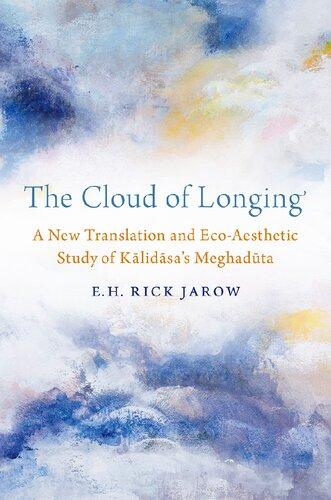
The Cloud of Longing. E.H. Rick Jarow, Oxford University Press. © Oxford University Press 2021. DOI: 10.1093/oso/9780197566633.003.0001
strength and understanding (as well as colonization). The poetic and aesthetic darshans, or viewpoints, of India have been catalogued and classified, but there almost seems to be an embarrassment around their ex-tasis, their “hyperbolic” emotion (as the prominent Sanskrit scholar, A. A. Macdonell put it when he spoke of the “lovelorn damsels in Sanskrit literature”).2 My charge here is to open and intrinsically explore this aesthetic dimension, this experience of rasa, the liquid mellow of aesthetic ex-tasis, which from the beginning of the classical Indian tradition was said to be the goal of any valuable work of art. This work is neither a history nor a critical study of the vast arena of Indian aesthetics; rather, it is a journey into the experience of rasa through one classical Sanskrit poem. It is written for lovers of literature in general (as opposed to Indologists or Sanskritists) and seeks to claim a place for Sanskrit aesthetics and its variant sensibilities in the arena of world literatures. In addition to this, and perhaps most importantly, it seeks to articulate a vision of nature that can add depth, richness, subtlety, and even transformation to our culture’s habitual way of viewing and experiencing the natural world.
At the center of this project is the remarkable experience of rasa, a flow of expanded feeling—envisioned not merely as a spontaneous outburst of expression but also as a sensitive-hearted response that could be cultivated through caring discipline. Kālidāsa’s Meghadūta, an entire poem whose protagonist is a cloud, has long been considered a major work capable of engendering such an aesthetic experience in someone who has taken the time and energy to work with it. Let us therefore open to a text and a tradition that is not only formally intricate and grand but that can be savored in the here and now as well, for such is the intention of this volume. With all respect to the tremendous work that has been done in cataloging and exploring the immense field of Sanskrit literature, I specifically focus here on a sustained close reading of the Meghadūta in order to share how it may speak to contemporary readers as well as to concerns about the experience of the natural world.
We hold traces of Kāvya (classical Indian court poetry) through manuscripts, printed books, and in digital archives. The way and context in which these genres were produced are not fully clear to contemporary scholars or to residents of South Asia. There are varieties of conjectures about Kāvya based on manuscript evidence (not minimal, but not overwhelming) that do make some sense, but it is sobering to realize how little actually remains from the classical tradition.3 From this, contemporary scholars and critics have identified a skeletal canon of authors and their poetic and dramatic works, depicting classical India through a combination of received epic
narratives, mythic compendiums (Purāṇa), and court poems of linguistic virtuosity (Kāvya). Periodic attempts to revive traditions of Sanskrit drama in India come and go; the great film versions of epic and dramatic literatures on television and in cinema, however, have had significant mass impact and may now be primary vehicles for the transmission of classical Sanskrit texts.
The fact remains, however, that we do not fully know what Sanskrit poetry and drama might have been in their day. That is, the historical and social context of their creation and performance is obscure. The majority of historians and scholars do generally agree, however, that Kālidāsa was active during the reign of Chandragupta II, who ruled most of northern India from circa 375 ce to 415 ce . Kālidāsa is believed to have been a court poet, receiving royal patronage and articulating the “high-cultural” Sanskritic norms of his epoch. The earliest actual references to the poet are found in a Sanskrit inscription dated 473 ce, at Mandsaur’s sun temple in Madhya Pradesh, with verses that imitate both the Meghadūta and Ṛtusaṃhāra.4 An inscription on the shrine of Aihole (634 ce), praising him as a “great poet,” establishes his latest possible date.5
The evolution of Kāvya through later languages can certainly be (and has been) documented, and we can make relatively educated suppositions about their contexts and functions. As the tradition developed, the texts of Kālidāsa were considered “classics.”6 Such a label already indicates a significant contextual shift from previous interpretive communities as the texts morphed through time and space.
Kālidāsa traveled West through the translations and writings of Sir William Jones, H. H. Wilson, and Goethe, becoming known as the “Shakespeare of India”—an emblem of an imagined high culture, an icon.7 Such “great works” now appear in a new context: required reading for Indian literature courses, and occasionally, perhaps, in a “world classics” compendium.
Kālidāsa serves as a standard of literary virtuosity and depth, but the world he wrote about has faded into the shadows of collective memory (or rather, forgetfulness). This world may have been portrayed as an ideal one, and perhaps it never existed at any time. Kāvya, like the bear-hunting ritual described by Jonathan Z. Smith, may in fact depict more of a paradigmatic vision of how things could or should be than one with any phenomenological accuracy.8
My mentor, from Banaras Hindu University, Bishvanath Bhattacharya, once remarked that one cannot find the “fine stuccoed roofs of Ujjain” described in the Meghadūta no matter how hard one looks for them.
Nevertheless, Kālidāsa’s world lives on and morphs through one context after another. Hence, when I use the word “Kālidāsa,” I am not referring to an individual but rather to an emblem on a series of texts that may reflect a collective integration of Indian classical culture. Indeed, there are some scholars of Indian literature who have put forth theories of “multiple Kālidāsas.”9
The later commentaries, and much later theories of literature that make extensive use of verses from Kālidāsa, may also fall—if not under—certainly alongside this label. The way in which such ideals live and morph is crucial to this project, for it is not so much that I may be taking Kālidāsa out of context—his works are already out of context—as that I am taking them out of their currently accustomed frames of discourse in order to establish what I believe to be one of significant relevance. All of this, then, leads to the question, “Why Kālidāsa, why now?”
I would be most disingenuous if I professed the academic project to be free of its times and concerns; be it history, politics, or economies. The early Orientalists who dug into the mine of Sanskrit literature had their agendas, as have the following generations of Indologists, scholars of Sanskrit, and contemporary scholars of religion and literature. In most of these cases, Indian poetics and drama have been left in the background, with philosophy, religion, linguistics, and social ethnography occupying the foreground. So, why pay attention to this Kāvya, and why now? After all, the Meghadūta of Kālidāsa is not unknown or new. It is most likely a fourth-century work and has been translated numerous times into English and other languages. There is H. H. Wilson’s poetic flight in the 1800s; M. R. Kale’s chock-full of notes edition for students first published in 1916; Franklin Edgerton’s literal translation in the 1940s; S. K. De’s scholarly critical edition of the text in the 1950s; and, in the 1970s, Leonard Nathan’s credible and poetically breathtaking version, which is the most figuratively if not literally accurate translation I know of.10 Lately, one can find some really good, and some not so good, versions of the text on line. These translations have been preceded by scores of Sanskrit commentaries from Dakṣiṇāvartanātha, to Mallinātha, to a most unusual Bengali commentary, the Tātparyadīpikā, attributed to the Vaishnava theologian Sanātana Gosvāmin.11 Most recently, the industry of translating classical Indian texts has been inspired by competing publishing companies, who want their version of the current “Great Books of the East” or now “Asia” to spread. Perhaps the recent work of Sheldon Pollock and others to translate and present a much larger corpus of Indian literatures may be a major departure from this. My focus, here, will be solely on the Meghadūta as an
icon of the classical aesthetic sensibility. Still, Kālidāsa’s work rarely makes it onto anyone’s short list. Rather it sits like most Kāvyas on bookshelves as some sort of quaint curio, a beautiful but irrelevant artifact of an aristocratic culture that is generally out of favor with both the left-leaning hallways of the academy and the right-leaning government institutes of Sanskrit studies. While it is used as a text to study in some Sanskrit classes (because of its sheer beauty and manageability of volume) its figurative detail and extended metaphorical complexity reward sustained retroactive reading. Moreover, working with the text requires a more than basic knowledge of Sanskrit, as well as a familiarity with the Indian epics and the cultural mythos that produced them.12
I doubt that anyone can claim to be cognizant of their complete agenda in engaging such materials, but I think it is incumbent upon one to give an open and serious account of the why and wherefore. I believe one can make a contemporary case, if not for Kāvya in general, then for Kālidāsa and the Meghadūta in particular. Hence let me outline the rationale of this study. I go back to the fourth century because the poetry of Kālidāsa remains unparalleled; because there has been little critical work published on Kāvya outside of the commentarial traditions (much more work has been done on drama or Nāṭya than poetry and poetics); and because it offers a vision of the relationships between language, emotive feeling, and the natural world that can speak to and even educate contemporary sensibilities. Kāvya, which may be thought of as literature as art, predates and postdates Kālidāsa, of course, and appears in a number of languages as well as regions. Likewise, critical discussions on poetics both predate and continue as a part of the process of engaging Kāvya.13 Kālidāsa, however, resides in the middle of all this, almost like a fulcrum that balances a very particular sensibility.
The study of and attention given to the Meghadūta need not be then a part of a quaint Orientalism that wants to laud an India of old or exalt the beauty and wisdom of the past. Such projects have their own rationales and arenas of function. If one pays attention to classical Indian categories, however, it is understood that what was, comes around again.14 This is arguably the case with the Meghadūta, and perhaps with the Ṛtusaṁhāra and Kumārasambhava (other poetic works of Kālidāsa) as well, for the darshans (darśanas, or visions) of nature offered in these texts are extraordinary in their breadth and sensibility. The Meghadūta in particular, envisions the natural world as something much more than a backdrop for human subjects to live out their lives. Its sense of nature, moreover, is more integrated than
in romantic notions of paradisiac beauty or of abject terror projected onto landscapes. Rather, nature, as experienced through Meghadūta, is a tapestry of myth, memory, substance, feeling, form, and space. The landscape is simultaneously the mindscape, meteorology is metaphor, and neither psyche nor soma is absolutely apart from one another. In, around, and throughout this, as Barbara Stoler Miller astutely remarked, is the “unmanifest cosmic unity” of Śiva.15 While this “unity” is rarely depicted literally (a doctrinal impossibility in any case), its presence pervades the landscapes, mindscapes, and mythscapes of the text. Let me say, at the outset, that this mytho-cosmic sensibility that pervades the poetic realms of Kālidāsa is not an exception but the rule. To call it “religious” or even “spiritual” would reduce the wondrous complexity and interweaving of imagination, epic history, and immanent divinity that make up this narrative.
For those not familiar with the text, the Meghadūta, or Cloud Messenger, is a short lyric poem (Kaṇḍa-Kāvya) about a lovelorn Yaksha (a somewhat minor spirit being) living in a mountainous exile separated from his mate. In a fever of emotional anguish, he spies a floating cloud and asks it to deliver a message to his beloved. Addressing the Cloud as a person, the Yaksha then describes, in amazing detail, the route the Cloud will have to take to get to his home, the city of Alakā; the abode of Kubera, keeper of the wealth of the gods and lord of the Yakshas. The first and longer part of the poem describes the various landscapes that the Cloud will travel through, while the second part of the poem describes the city of Alakā itself and the imagined delivery of the message to his beloved.
The poetic envisioning of the landscapes, as well as its amazing integration of feeling and form, is my prime reason for reintroducing this work of Kālidāsa (whom it has been my pleasure and privilege to read for decades) into the conversations of the literary humanities. In a world that has moved toward cultural connectedness, a contemporary person educated in the Western humanities, who has read Homer, Shakespeare, and Milton, should ideally also have read Kālidāsa.
The Meghadūta, however, has significance beyond being a major work of classical India’s most iconic literary figure. It offers more than a lyrical look at the life and times of a poet or of a culture; it also offers a way of looking through nature that can inform and inspire our efforts to reorient ourselves in the natural world. This is a primary value and focus that will be explored in detail in this volume.16
As a contemporary Western reader, I have no choice but to filter my reading of Kālidāsa through a postmodern lens, but I have done my best to not use the work of the poet to prove any particular contemporary contention. The translations are done scrupulously and thoroughly. The major Indian commentators have been consulted in every instance, and more obscure commentaries have been consulted as well. I do reserve the right, however, to translate in a less than literal way when necessary. To my mind, this preserves and transmits the sensibility of the text much more than choppy literal translations that do not read well in English. On the other hand, any place where I have taken license can be clearly justified by and found in the actual text (and discussed in the notes). This is translation, not transcreation, although a good argument can be made that any serious translation is a transcreation.
Still, my intention here is not to present Kālidāsa as he was heard in the royal courts of the Guptas, for I do not think that is possible, and it holds no more than academic interest for me. Rather I present Kālidāsa because he speaks to me in a way that very few Western poets have. Through the Meghadūta, I have learned to look at and experience the natural world in a radically different way, and this is what I seek to convey in this translation and reflection. For its sheer beauty; for its remarkable discourse on ecological poetics; for its instruction in integrating sound, cadence, sense, and sensibility; and for its “tantric” perspective, the Meghadūta may be unparalleled. I will discuss the “tantric” perspective in detail later on. Let me briefly explicate what I mean by this much used (and often maligned) Indian word that has entered the contemporary lexicon.
The “tantric” sensibility (versus a particular lineage of practice) is one of transcendence within immanence. It does not privilege a disembodied consciousness existing beyond the phenomenal world. Rather it weaves (to weave,√tan, being at the root of the word tantra) a vision of the world and awareness as non-different. And yet difference remains. When I first began to read and study the Meghadūta with Bishvanath Bhattacharya, he remarked about the text one day, “How can you deny multiplicity?”
Indeed, the weaving of unity and multiplicity, presence and absence, may be the great triumph of the Meghadūta. There have been numerous Indian philosophical positions that declare the non-duality of duality, from the Mādhyamika’s rūpaṁ śūnyataiva śūnyataiva rūpam (form is emptiness, emptiness is form) to Gauḍīya theologian Jīva Gosvāmin’s acintya-bhedābhedatattva (inconceivably one and different), but Kālidāsa puts meat on these
bones. He illustrates and demonstrates the interpenetration of awareness and phenomena and, in doing so, exposes many of the pitfalls of falling to one side of this notion. One may argue that Kālidāsa’s world is fundamentally dualistic, but figuration of any kind already begins to bend categories of separateness. Moreover, the fact that Kālidāsa explicitly challenges the reality of literal representation places him in the rasa-dhvani aesthetics camp, one which offers aesthetic rapture, to borrow Masson and Patwardhan’s term, as a way through realms of temporality and incompleteness. To be clear, I am not claiming any particular spiritual agenda or formal affiliation for Kālidāsa (even though Śiva is clearly the dominant divinity in his work). He is writing as a poet, not as a philosopher or spiritual teacher. It is just this, however, “the aesthetic,” that has been chronically and characteristically shortchanged, and the point of rasa theory is to exalt the aesthetic and acknowledge its spiritual dimensions. Citra-kāvya, or “ornamentation for its own sake,” or for the sake of virtuosity, is constantly disparaged by the Sanskrit poeticians as inferior. Rasa, on the other hand, is seen as the central transformation of emotion to sublime heights, and, in this sense, it carries on the Vedic trope of rasa as immortal nectar.17
In any case, one can say from the invocation at the beginning of Śākuntala that Kālidāsa was a worshipper of Śiva, in his manifest forms; and one can say from the denouements of his plays that the redeeming presence of Śakti, of the feminine, is ubiquitous in his work, but Kālidāsa’s tantric sensibility exceeds arguments of linear history or textual content because they are largely stylistic: the collapsing of contraries through sustained metaphor; the thrill of the sights, sounds, tastes, and touches of the sensory world; the depiction of mountains and rivers in erotic congress; and the awareness of nature in divinity, as well as divinity in nature, all point toward tantric leanings.18 Here is where literary studies and intrinsic literary studies in particular can make a contribution to discussions of oneness and difference. They can combat the dominance of unqualified historicism and the concomitant assumption that its chronological logic stands above, or informs, other forms of discourse. While the question of when the plays were written, under what dynasty, and the like are not unimportant, they are ultimately extrinsic to the work, which operates through an associative trans-textual logic. This sense also allows one to understand the way such a text may morph through different interpretive communities in different times and places. Just as Harold Bloom can declare that, ultimately, there is only an oral Torah, prevailing notions of just what is intrinsic or extrinsic may depend on how a particular community
receives a text. Rawson’s popular work on tantra speaks to this when he discusses the tantric view of time as one that openly faces the maw of dissolution rather than seeks some separated vantage point of observation.19 Hence, the method I argue for here is to read Kālidāsa closely as a “you” versus an “it” to borrow Martin Buber’s terminology.20
Most importantly perhaps, Kālidāsa’s poetic sensibility offers a specific vision of the natural world that we may do well to revisit. It is one that does not separate the word from the tongue, la parole from la langue. It does not seek to de-shroud the word of its mystery to reveal “meaning.” Rather, mystery, erotic mystery in particular, is at the very core of language, which is at the very core of the natural world. To separate language from love is to move from the poetic to the prosaic; and while works of this kind are necessarily prosaic, I try to frame this one in a way that least violates the precincts of the poetic.
After all, this is the crux of the Meghadūta’s argument. Those afflicted by love no longer distinguish the animate from the inanimate, no longer consent to the atrophy of the imagination. Their world flows through the heart, as well as through the mind, and their words consequently are to be “tasted,” not interpreted. The idea of language as purely conventional could only occur to someone like Descartes; that is, to someone living locked away in a room. From a tantric point of view, the movement to withdraw from the senses is not any different than being captivated by them, for ultimately, the world we see is the world we are.
The Meghadūta sees a world at play, but it is not necessarily free play. The text is well aware of the tug of the opposites. There is fear and danger as well as openness and freedom; there is display as well as shame, flights of fancy, and flights away from predators. Because all of this is moving in time, nothing stands still; no vision of the natural world is ultimate, just as no season can last forever. Moreover, the entire landscape of the Meghadūta is imagined; it is seen through the mind of the protagonist, an exiled Yaksha.
On the one hand, the imprint of nature is extraordinary. How could someone have such a finely tuned memory where every detail of sight and sound—the dew drops in the wind, the rumbling of different types of thunder, throngs of birds floating by on their way—are perfectly remembered? Maybe there is a faculty of seeing here that we are generally not accustomed to. The twentieth-century magician Aleister Crowley is said to have trained his visualizing capacities by playing two games of chess with two different people at once, thus learning to envision every piece on the two
boards without his physical presence. This is again, however, assuming the primacy of matter. What if, as from the Platonic perspective, the ideas are primary? What if the imagined tree is just as substantial as the physical tree? Texts like the Yoga Vāsiṣṭha, in India, constantly challenge the notion that physical reality is fundamentally different than imagined reality. From the point of view of death, both a dream and a life are said to be qualitatively similar. All this is to iterate the aesthetic perspective that imagination is not necessarily a detour or a modality to help enforce moral truths. And the language of the Meghadūta is not as much about something (representation) as it is, itself, something—working with meter, sonoric and semantic figuration to incarnate a powerful and prevailing mood that can transport the sensitive heart (suhṛdaya). Let us begin this pilgrimage of imagination by traveling through the poem itself and then looking into the rich theoretical discourse of Sanskrit poetics to have some frame of reference for Kālidāsā’s project.
What follows is a translation of 111 verses of the Meghadūta. There may indeed be more (or less) verses, as S. K. De enumerates in his critical edition of the text. I am following the lineage of Western translators here (Edgerton, Nathan) for the sake of consistency. Some versions of the text separate the pūrva and uttara Megha, “early” and “later” sections. I have (again following recent translators) kept one unified work. Each verse of Kāvya is sometimes referred to as a flawless pearl, and I have done my best to convey this sense in the translation. Here, I offer the Meghadūta, the voyage by a cloud over landscapes of India, as imagined by a lovelorn Yaksha in the anguish of separation from his beloved.