1
Great Clarendon Street, Oxford, OX2 6DP, United Kingdom
Oxford University Press is a department of the University of Oxford. It furthers the University’s objective of excellence in research, scholarship, and education by publishing worldwide. Oxford is a registered trade mark of Oxford University Press in the UK and in certain other countries
© June Howard 2018
The moral rights of the author have been asserted
First Edition published in 2018
Impression: 1
All rights reserved. No part of this publication may be reproduced, stored in a retrieval system, or transmitted, in any form or by any means, without the prior permission in writing of Oxford University Press, or as expressly permitted by law, by licence or under terms agreed with the appropriate reprographics rights organization. Enquiries concerning reproduction outside the scope of the above should be sent to the Rights Department, Oxford University Press, at the address above
You must not circulate this work in any other form and you must impose this same condition on any acquirer
Published in the United States of America by Oxford University Press 198 Madison Avenue, New York, NY 10016, United States of America
British Library Cataloguing in Publication Data Data available
Library of Congress Control Number: 2018939594
ISBN 978–0–19–882139–7
Printed and bound by CPI Group (UK) Ltd, Croydon, CR0 4YY
Links to third party websites are provided by Oxford in good faith and for information only. Oxford disclaims any responsibility for the materials contained in any third party website referenced in this work.
For my colleagues
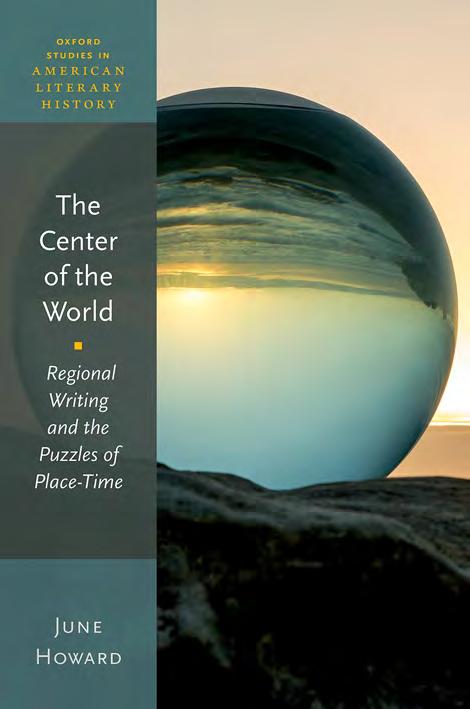
This is a book about writing about particular places. It is also a book about how such writing shapes the ways we inhabit and imagine, not only neighborhoods and provinces, but also the world.
Simultaneously, equally, localities and regional writing are fully themselves, and are shaped by their borders and forces beyond their borders. Simultaneously, unpredictably, particular places shape the “beyond.” My argument is that the local and the national and the global, the place and the planet, are never disconnected. I multiply terms deliberately here; let me mark all their meanings and relationships as provisional, to be investigated in the pages that follow. I hope to interrupt the familiar process of arraying such categories on a scale from small to large, and to reveal how habitually we correlate places with particular times.
I set out to study the local color fiction in the latter nineteenth and early twentieth centuries, mostly—not only—in the United States. The Center of the World is still very much about that topic. But, step by step, I have adventured far beyond the confines of my (perhaps any) scholarly specialization. Reading the regionalism of the past, I found myself continually drawn to recent publications—place-oriented fiction is often considered old-fashioned, but it is a vital part of contemporary literature. Pursuing questions that interested me entailed crossing national borders, and seeing them as features of the landscape rather than limits. The more I read, the more I found authors of every era—writing to and from and about many particular places—challenging me to think flexibly about the scale of their work. And my investigations converged, to a degree that sometimes seemed almost uncanny, with big issues in cultural and social theory.
I have come to see the way my inquiry unfolded, not as odd, but as entailed by the continuing vitality of regionalism—multiplied by the stretch between my endemically post-structural skepticism and my determinedly historicist orientation. During the time I worked on this book (quite a lot longer than I intended), I have been just one of many scholars analyzing how categories of identity and difference, conflict and solidarity, intersect with place—one of many mapping the movements of literary works and ideas—one of many struggling to find nonteleological ways of writing about modernity. I found that I could not answer my questions about “local color” without taking on those problems.
Let me propose a broad description of the puzzles I found myself engaging: how can we recognize both the inevitably situated nature of story-telling and knowledgemaking, and the way they enable connection between people, between distant places, and across time? My best answer is expressed in the particular pages that
follow. To put what I have learned abstractly, as writing a preface requires: as far as I can see, we are both the creatures and the creators of our horizons.
In the course of shaping this inquiry into a book, I have come to understand that I am writing as much about time as about space and place. A horizon is defined by where the sun rises and sets. On my reading, its circularity (as we rotate to look at it or it moves with us) already evokes the spinning globe. Also commonsensically, but more metaphorically, “horizon” indicates mental limits. To say that someone wants to broaden their horizons is everyday discourse. Organizations have “planning horizons” of a year, or two, or five years—the process often, not always, provokes comments on the need to see farther. In the specialized realm of philosophy, the term invokes pretty much the same puzzle; for phenomenologists, delimiting horizons both makes meaning possible on the ground, and implies the possibility of expansion. From the perspective of a literary scholar: metaphors (intrinsically and metaphorically) broaden horizons, making connections that violate literal and logical boundaries, to say nothing of national borders.
The phrase “the center of the world” evokes the puzzles that interest me so effectively and thoroughly that it came to seem inevitable as a title. I do not specify “American literature” as a topic, because doing so always somehow seemed to imply that the United States is the center of the world. It is not, of course. It is the ground I stand on, where I write from, enabling and obstructing me at the same time. The national haunts the regional and the global, just as race does—and they haunt my title. Let me take the risk of being reductive, to reduce the risk of being misunderstood: what I am saying is that claims of centrality are always right, and always wrong. Studying regionalism has taught me that the center of the world is everywhere.
That does not emancipate me from dealing with the determinate relations of place. Like so many regionalist authors, I am committed to decentering yet must engage terrains of power that are never flat and rarely tilt in only one direction. I hope that both the received definitions of local color and regionalism, and the phrase “the center of the world,” will have changed their meanings for the reader by the time we reach the last page of the book.
The first chapter, titled “From the Ground Up: Thinking about Location and Literature,” discusses conceptual questions explicitly and considers past and present studies of my topic. It begins by moving between the way we talk about place in ordinary language, and specialized usages, in order to generate a fresh concept of “region.” Its claim that we should think both relationally and substantively may seem simple, but it is hard-won. Those categories are mobilized in a survey of American literary regionalism and its reception—an approach that enables me to identify through-lines in scholarly reading, and work past the current stalemate between critics seeking deep authenticity and those who are sure they have found shallow tourism. I test received opinion against the available empirical evidence about the circulation of regional writing. And I move temporality to the center
of the discussion; borrowing a term from Bahktin, I develop an account of the chronotope of this distinctively modern form and track back to the insights of Raymond Williams. I end the chapter with a brief explanation of why I have framed this study as an exploration of genre.
The second chapter, “Local Knowledge and Book-Learning,” shifts into the mode of literary history. The figure of the schoolteacher, who personates the contested connection between the particular place and the world beyond, plays an important role in local color fiction in the nineteenth century—and powerfully persists. The one-room schoolhouse, in particular, is a site where provincial and metropolitan or cosmopolitan knowledges meet. The presence of teachers in this body of work has been noticed before, of course. But their profound significance for the form emerges only on the conceptual landscape established in the first chapter. This—I believe—is the value of genre criticism, which is best understood not as classification but as a pressure on interpretation that enables us to see patterns. I offer a series of readings to demonstrate that the one-room school and its teacher appear in texts by many different authors, over a long period, and to show how our understanding of those works is altered by recognizing this pattern. I attend to enormous differences across racial lines in what schooling means, and the force of counter-examples. I conclude by expanding my horizons, and considering the implications of this work for college and university teachers. I point out that we have more in common with schoolteachers than we usually acknowledge. As other scholars have suggested, the cultural work of regional writing continues; here I offer a concrete and immediate, even urgent, example of how acknowledging the importance of the places we live might shift our perspective.
The third and fourth chapters analyze works by two writers who have been important in my inquiry: Sarah Orne Jewett and Edith Eaton. These chapters are interpretive, but not only interpretive; my understanding of regionalism was developed in dialogue with these authors. I am not “applying” a theory or “demonstrating” my argument, but unfolding the implications of my approach and continuing—with their help—to interrogate the premises of literary analysis and social theory.
Jewett has played an important role in discussions of local color fiction from their beginnings. Since this research originated in my period specialization, in some sense it was always as much about time as about place. In Chapter 3, “The Unexpected Jewett,” I argue that despite Jewett’s participation in her own construction as a canonical local colorist, there is much to be gained by reading her in our contemporary frameworks and even against the grain. I take the opportunity to reconsider my own past work, and to assess where Jewett criticism stands today. What do we know about how she thought about race—and how should our conclusions on that point shape what we think about her? I turn to Jewett’s own accounts of her project, and read a particular story closely. I argue that we can best understand Jewett’s work by taking her religious belief seriously, and joining
her in imagining the collapse of racialized nationality, the everyday, and the infinite into a transfiguring moment. The center of Jewett’s world is the New England village, reimagined as a woman-centered, radically Christian democracy.
Edith Eaton has entered the canon of literary regionalism more recently. She achieved a public voice in the early twentieth century, mostly but not only under the explicitly-of-color name Sui Sin Far; was subsequently neglected; and has now been rediscovered. In Chapter 4, “World-Making Words, by Edith Eaton and Sui Sin Far,” I offer a sketch of her life and works, attending closely to how recent research has changed our thinking and to how she is raced and placed in literary history. Eaton was able to get stories about profoundly subordinated immigrants from China to North America into print, both as news and as fiction. Her success as “Sui Sin Far” depended on her connection to “Chinatown”; I argue that understanding the history of that strange, global locality helps us to understand this doubly-named author. Also, no readers including scholars have adequately recognized the ways she locates herself in literary tradition. I try to do so in close readings of three stories by Sui Sin Far, and go on to show that Edith Eaton challenges and claims multiple national literatures, imagining writing beyond their horizons.
The fifth and final chapter, like the second, ranges across time and offers many examples. In fact it is broader, because I consider stories on screens as well as in print. Probably it has always been best to understand works in any medium by thinking about media, in the plural; in “Regionalisms Now” I take on this challenge. I think beyond the moment of a work’s production (the central focus of my past research) and consider circulation and reinvention. It would not be tenable, given my approach to literary kinds, to suggest that there “is” a current genre that lineally descends from local color. Genres are not entities; the notion of tradition is utterly implicated in the problems this book examines; contemporary culture is fractionated. Yet writers continue to be fascinated by place, and to use and transform the formal resources offered by the authors they have read. The project of narrating place still, today, projects temporality; the texts I choose to write about offer (interesting, immanent) theories of place-time. The categories that I have generated through my study of the past prove useful for understanding the present. I attend most closely to the work of Wendell Berry and Ernest Hebert. I leverage the insights of many writers, from V. S. Naipaul and John Berger to D’Arcy McNickle and Ursula Le Guin.
I hope it is already apparent that I use “local color” to refer to a specific kind of late nineteenth-century literature, and “regionalism” to refer more broadly to placeoriented writing (including local color). I precipitate those terms out of the provisional, although I leave the difference between writing and literature suspended. I do know that literary scholars sometimes position “local color” and “regionalism” as opposites. I first encountered those categories as a student who wanted to understand literary genres in the United States at the turn from the nineteenth to the twentieth century. When I looked them up in handbooks, local color was
described as limited and quaint—regionalism, instantiated by Faulkner, as more ambitious, even (puzzlingly) “universal.” When the comparison was with realism, regionalism shifted into the stigmatized position. The looking-up has moved online, but versions of these appraisals are circulating today. Every element of their received wisdom implicates the issues I examine. Through a category like “quaint,” places are located in time, and value is assigned through location—both generally, and in literature’s generic system. In “From the Ground Up,” I begin with everyday usages, with the goal of bootstrapping us into an analytic relation to the play of our attention and the place of authority. I also discuss the sources of “place-time,” which appears in my title. I took the liberty of inventing it, late in my writing, as a shorthand term that nods to physics and acknowledges both materiality and social construction.
Writing this book, working from many and varied sources, I have tried to write accessibly. By that I mean both making an effort to be clear, at the level of the sentence, and explaining the sources and stakes of my claims. I remain a passionate proponent of interdisciplinarity, but the very success of that project has made it more difficult to know who one’s audience is, when to stop reading, where to stop writing. I hope for readers who range across many fields, and these puzzles matter beyond the academy. Teaching, interdisciplinarity, and public engagement are (I believe) more closely connected than usually acknowledged; we are beckoned to many horizons. Let me say, dear reader: boundaries between kinds of writing seem increasingly unclear. This is mostly—but I hope not only—an academic book. My point of entry to attention is a university press with a very long history, and a broad reach. Like the regional writers I center in this study, I have reflected on how publishing places me on the landscape of power. My academic coordinates allow me long thoughts that sometimes produce long sentences; important matters sometimes turn on a fine point. And I know that background explanations themselves may become dull. In the end, “accessibility” requires location to be meaningful. Someone has to be able to get somewhere. My awareness that different kinds of knowledge, from everyday to expert, are constantly clashing and combining has shaped both the content, and the style, of the book.
{ ACKNOWLEDGMENTS }
I have been fortunate beyond measure in my conversation partners during the time I have worked on this book. I have dedicated it to my colleagues, to say thank you and to put front and center an acknowledgement of how utterly I am indebted to my community of inquiry. I do particularly mean my co-workers on the Ann Arbor campus of the University of Michigan. I also mean “collegiality” in its broadest and strongest sense, including both people who have moved on to other places and scholarly friends who actually work elsewhere and have never had an office next door except in my imagination. I delight in Wikipedia’s explanation of the term: “Colleagues are those explicitly united in a common purpose and respecting each other’s abilities to work toward that purpose.” Remarkably, my daily experience has lived up to that somewhat utopian description more often than not.
I want to acknowledge the collaboration of Kiara Vigil in my work on Gertude Bonnin. The contributions of Sarah Ruffing Robbins, Dottie Webb, and Laura Aull are mentioned in the text. These particular colleagues were once, I am proud to say, my students. Their influence, and that of other students, is not confined to the points where it comes up. I am grateful for the opportunity to think things through in the classroom with so many wonderful undergraduate and graduate students. Outside the classroom, I owe warm thanks as well for the research assistance of Katherine Lennard, Jesse Carr, and Rachel Miller.
My ongoing conversations with Sandra Zagarell have informed my perspective on regionalism for a very long time; I am especially grateful for what she has taught me about Jewett. Ernie Hebert kindly agreed to an interview that helped me a great deal at a key moment in my thinking about regionalisms in the present day. I want to thank Mary Chapman for sharing her research and for not asking, but motivating, me to rewrite much of Chapter 4 at a moment when the book was accepted and, I thought, almost done. Even during the busiest times, Joshua Miller generously honored our pact to serve as “first readers” for the books we were working on—giving me both excellent advice and confidence. Gordon Hutner has been a key interlocutor ever since I decided this work needed to become a book, and its three readers for Oxford University Press were wonderfully generous and insightful. Jim Dean has constantly inspired me to write from the ground up, asking me very hard questions and helping me—every single day—to find my way to workable, hopeful answers.
The University of Michigan has provided material support for my research in many ways—from a salary to live on and the research account associated with my Thurnau Professorship (awarded in recognition of my teaching), to a crucial
sabbatical term and complementary funding that enabled my appointment as a Fulbright Scholar in 2013. I owe thanks as well to the Danish Fulbright Commission; I was not able to work much on this book while teaching at the University of Southern Denmark in Odense, but I learned a lot from my colleagues and my students. I am grateful to those who have engaged with me at the many talks about regionalism I have given during my work on this book, and remember responses at the University of Copenhagen, and the University of Coimbra in Portugal, as especially thought-provoking. Longer ago, the hook that has kept me writing about this topic was set at a conference panel on “The Schoolteacher as BorderCrosser,” organized by Sarah Ruffing Robbins for the 1999 American Studies Association Convention in Toronto. Frances Smith Foster was the presiding spirit (her encouraging note about my paper stayed on my bulletin board for years) and the discussion helped me see what the horizons of this work might be. Most recently, it heartened me to participate in great conversations about regionalism at the American Literature Association’s conference on the topic in New Orleans in September 2017.
It is completely conventional, I know, to say that I have been thinking about regionalism for too long to be able to offer individual thanks to everyone who has helped me; it is also completely true. I will just say again: thank you, colleagues and students.
The third section of Chapter 3 is a revised version of a portion of “Unraveling Regions, Unsettling Periods: Sarah Orne Jewett and American Literary History,” which appeared in American Literature 68 (365–84). Material from “Sui Sin Far’s American Words,” published in Comparative American Studies 6:2 (144–60) in 2008, appears in the third and fourth sections in Chapter 4; it is reprinted by permission and I supply here the reference to the journal’s website required by Taylor and Francis: www.tandfonline.com.
I am grateful to these individuals and institutions for permission to reproduce images: the Association of European Border Regions; Air Science Consultants, Inc. DBA Skywatch Weather; the Earth Science and Remote Sensing Unit, NASA Johnson Space Center; Wallace J. Nichols; the Regents of the University of Minnesota; Jon de Mello, C.E.O., The Mountain Apple Company; the St. Louis Art Museum; the University of Michigan Press; Historic New England; Joe Mabel; the Clements Library, University of Michigan; the Special Collections Research Center, University of Chicago Library; the Library of Congress; Counterpoint Press; Ernest Hebert; Working Dog Productions; and Yale University Press.
1. From the Ground Up: Thinking about Location and Literature 1
2. Local Knowledge and Book-Learning: Placing the Teacher in Regional Story-Telling
3. The Unexpected Jewett
4. World-Making Words, by Edith Eaton and Sui Sin Far
5. Regionalisms
{ List of FIGURES }
1.1 Map from the website of the Association of European Border Regions (2017). Members are indicated in red, non-members in green, with mixed red and green for partial and planned members. The online version of the map can be varied to show, for example, large-scale cross-border collaborations as well. Reproduced by permission. 5
1.2 Example of a weather map of the United States by Air Science Consultants, Inc. DBA Skywatch Weather. Used by permission. 6
1.3 Photograph of the Earth taken from Apollo 17 on December 7, 1972. Image courtesy of the Earth Science and Remote Sensing Unit, NASA Johnson Space Center. Photography AS17-148p22727, available from the website http://eol.jsc.nasa.gov.
9
1.4 and 1.5 Publicity materials for the Blue Marbles Project. Used by courtesy of Wallace J. Nichols. Information about the Blue Marbles Project is available on the website http://www.wallacejnichols.org/130/blue-marbles/html. 10–11
1.6 World Map: Hobo-Dyer Equal Area Projection. Copyright 2015 www.ODTmaps.com. Used by permission. For maps and other related teaching materials contact: ODT, Inc., PO Box 134, Amherst MA 01004 USA; 800-736-1293; Fax: 413-549-3503; Skype: ODTInc; Email: odtstore@odt.org; Web: http://manywaystoseethe world.org.
1.7 Upright Human Body, Space and Time. From Yi Fu Tuan, Space and Place: The Perspective of Experience (copyright University of Minnesota Press, 1977), p. 35. Reprinted by permission.
12
36
1.8 The cover of Israel Kamakawiwo’ole’s album Facing Future, released in 1993 by Mountain Apple Records. Reproduced courtesy of Jon de Mello. 37
1.9 Hecataeus’ world map, 500 bce, as rendered by Jona Lendering (modified slightly for this publication), courtesy of Livius.org. 43
2.1 Winslow Homer, Snap the Whip, published as a centerfold in Harper’s Weekly, September 20, 1873. 49
2.2 Winslow Homer, The Country School, 1871; oil on canvas; 21 ¼ × 38 1¼ inches; Saint Louis Art Museum, Museum Purchase 123:1946. 49
2.3 Mary Keithan’s Michigan One-Room Schoolhouses, published in 2008, offers a selection from her several hundred photographs of one-room schoolhouses across the state and includes information about the Michigan One-Room Schoolhouse Association, founded in 1993 and still active as of 2017. Cover reproduced by permission of the University of Michigan Press. 50
2.4 Frank Beard, “First Acquaintance with Flat Creek,” from Edward Eggleston, The Hoosier School-Master: A Novel (New York: Orange Judd and Company, 1871), p. 10. 52
2.5 Frank Beard, “Old Jack Means, the School Trustee,” from Edward Eggleston, The Hoosier School-Master: A Novel (New York: Orange Judd and Company, 1871), p. 13. 54
2.6 Frank Beard, “Hank Banta’s Improved Plunge-Bath,” from Edward Eggleston, The Hoosier School-Master: A Novel (New York: Orange Judd and Company, 1871), p. 36. 54
2.7 Frank Beard, “Bull,” from Edward Eggleston, The Hoosier School-Master: A Novel (New York: Orange Judd and Company, 1871), p. 75. 56
2.8 Frank Beard, “Jeems Phillips,” from Edward Eggleston, The Hoosier School-Master: A Novel (New York: Orange Judd and Company, 1871), p. 48. 60
3.1 Portrait of Sarah Orne Jewett with book (undated). Reproduced with permission from Historic New England. 99
3.2 Sarah Orne Jewett at the age of eight. From Francis Otto Matthiessen, “Sarah Orne Jewett,” published by Houghton Mifflin in 1929.
4.1 Edith Eaton’s grave, Mount Royal Cemetery, Montréal. Photograph by the author.
4.2 “ The Chinese Sacred Lily, or Oriental Narcissus,” from The Geo. H. Mellen Co. Illustrated Catalogue of Bulbs, Roses and Plants, Innisfallen Green Houses, Springfield, Ohio, 1899, p. 11.
4.3 The cover of the original edition of Mrs. Spring Fragrance, published by A. C. McClurg and Company of Chicago in 1912.
4.4 Acknowledgements page, and facing blank page, from the original edition of Mrs. Spring Fragrance, showing its “Chinese” decorations.
4.5 The title page of Eaton’s “The Son of Chung Wo,” published in Leslie’s Illustrated Weekly in 1910, demonstrating the use of a “chop suey” typeface.
4.6 Portrait of Edith Eaton, published in the Independent in 1909.
4.7 Historic Chinatown Gate, Seattle, Washington, about two weeks before its formal unveiling, February 8, 2008. Photograph by Joe Mabel.
4.8 Cover and back page of the “Guide Book to the Joss House” distributed by the Wah Mee Exposition Company at the Chicago World’s Fair, 1893. Reproduced with permission from a pamphlet in the collection of the William L. Clements Library at the University of Michigan.
4.9 Frontispiece and first page of the “Guide Book to the Joss House” distributed by the Wah Mee Exposition Company at the Chicago World’s Fair, 1893. Reproduced with permission from a pamphlet in the collection of the William L. Clements Library at the University of Michigan.
119
122
127
128
128
129
132
134
135
135
4.10 The Ferris Wheel and Chinese Theatre (on the left) on the Midway Plaisance at the World’s Columbian Exposition in Chicago. Photograph taken by E.R. Walker in 1893. Reproduced by courtesy of the University of Chicago Photographic Archive [apf3-00088], Special Collections Center, University of Chicago Library. 136
4.11 The Robert Louis Stevenson monument in Portsmouth Square, San Francisco. Reproduced from the 1907 book Stevensoniana: An Anecdotal Life and Appreciation of Robert Louis Stevenson, ed. Sir John Hammerton (facing p. 308).
4.12 Cuba Libre, c.1898. Attributed to F. W. Guerin, St. Louis. From the Library of Congress, https://www.loc.gov/item/2005688946.
5.1 Map of Port William, from Wendell Berry’s That Distant Land. Drawn by Molly O’Halloran and reprinted by permission of Counterpoint Press.
5.2 Genealogy of Port William families, from Wendell Berry’s That Distant Land. Drawn by Molly O’Halloran and reprinted by permission of Counterpoint Press.
5.3 Saints Peter and Paul Church in the North Beach neighborhood of San Francisco. Photograph by the author.
154
158
179
180
188
5.4 Map of the Darby region, reproduced courtesy of Ernest Hebert. 191
5.5 “Cooty’s Cabin,” reproduced courtesy of Ernest Hebert 191
5.6 The Indigeneous northeast: a network of waterways. From Lisa Brooks, The Common Pot: The Recovery of Native Space in the Northeast, p. xvii (copyright University of Minnesota Press, 2008), p. xvii. Reprinted by permission.
5.7 Publicity poster for The Dish, 2000. Reproduced by permission of Working Dog Productions PTY LTD.
5.8 “Wheat Strips on Plateau,” from Taking Measures across the American Landscape by James Corner (author) and Alex S. MacLean (photographer) (Yale University Press, 1996), p. 128. Reprinted by permission.
199
211
214
From the Ground Up
thinking about location and literature
That one lives at the center of the world is the world’s profoundest thought.
—wendell berry, Whitefoot
[T]he particular mix of social relations which . . . [define] the uniqueness of any place is by no means all included within that place itself.
—doreen massey, Space, Place and Gender
What Is a Region?
Everyone knows what a region is.
It’s an area, a section, a domain, a district. A province, a neighborhood, a territory, a vicinity, a locality . . . a place.
A word that means all those things is not a very precise tool for thinking with.
Expert knowledge is more informed by—indeed sometimes captive to— everyday understandings than we usually realize. In previous work, I argued this was so for “sentimentality,” and I have come to think it is pervasively true of scholarly terms. We can’t get the “real” out of “realism,” or the “modern” out of modernism and modernity. Regionalism is a form of realism and decisively engaged with the nature of the modern. My clarifying effort will have to work through confounding complexities, from crowding semi-synonyms to the discontinuities of genre—to a way of thinking about this term that is useful for my specialist enterprise, and also explains the continued relevance of particular places in so many efforts to understand life in the twenty-first century.
In other words: what I seek to do, in this chapter, is to articulate region as a concept.
In Travelling Concepts in the Humanities Mieke Bal offers a lucid, eloquent explanation of what that means. Concepts look like words or labels, but they are, instead, “miniature theories,” implying a “systemic set of distinctions” (22) and rooted
in specific scholarly conversations. She analyses the concept of the concept, its history, its specific role in the humanities, in careful detail. And she argues that to be productive they should be understood not only as requiring ongoing critical reflection, but also as interacting with rather than being applied to the cultural objects being studied. In the humanities, although we do not always explicitly or effectively defend our doing so, we construct knowledge in dialogue with the works we study. I suspect the somewhat peculiar status of literary studies in the university is linked with this truth. For at least the last half-century, theories and insights from our field have exercised enormous influence across the academy. Yet colleagues in other disciplines find our methods disconcertingly flexible, and rarely accord our work the status of science (indeed they sometimes seem to privately believe that we are simply speculating). Beginning by analyzing region enables me to be rigorous. As Bal shows, the clarification of concepts now does much of the work once done by disciplines, and it can make the difference between a “muddled multidisciplinarity” and a “productive interdisciplinarity” (25). The conviction that claim is correct underpins the reflections I offer below.
We need the grip that refining “region” as a concept will give us, because it is not only a vague and powerful word in everyday speech, but also a technical term in an astonishing variety of disciplines. Literary scholars have borrowed from many of them and offered summaries of the powerful body of work theorizing place (amply represented in my bibliography). For me, the most useful thing about looking across these cacophonous conversations is that a common theme— or more precisely, a fundamental tension—does emerge. We are constantly shifting between what I call substantive and relational understandings of region. I will take that distinction—arrived at after considerable study and thought, despite its seeming simplicity—as a guide in sorting through multiple disciplinary takes on region. In the next section, I will show that it can also move us beyond unhelpfully polarized debates in literary scholarship.
To begin by stating it simply: when we talk about regions, we talk about particular places. Say (for example) “the Midwest,” and certain landscapes, cities, and states come to mind, weighty and substantive. Yet a relational element is always implicit, because every region is defined by its location in a larger system; “the Midwest” depends on opposing terms like “New England” and “West,” and on overlapping ones like “Great Lakes.” That is true even if one is gazing out a window in Michigan—as I am while writing these words.
The substantive view of region invokes the real. Does anyone really doubt that there is a there there? But already we are involved in the massively recursive processes that constitute that real. Putting it less simply: the iterated insistence on the simple fact of location marks an aporia. As we have known since Saussure, in language there is only difference, without positive terms. The way the relational shadows the substantive is in some sense a version of how, in general, common sense is unsettled by theory. But it is not only that, and that is not the only thing to say;
nor is the relational at work only in representation. As the geographer Doreen Massey puts it in the passage I have used as an epigraph, “the particular mix of social relations which . . . [define] the uniqueness of any place is by no means all included within that place itself” (5). It does not matter where you are. If you gaze around looking for traces of other places you will find them, frozen in commodities produced elsewhere or written on the ground as pavement leading away. Or, in the case of the trees outside my window, standing substantial and quiet but embodying by their very presence an intricate history of land-use decisions made at multiple sites.
I am saying, then, that although the substantive and the relational approaches to region constantly pull apart, may seem opposed in a given account, they can never be separated.
The balance does shift as any given discussion progresses. For quite a long time scholarly usages have been shifting toward the relational. The increased emphasis on the social construction of categories—gender, race, nation, and so on—is visible not only in the “soft” fields of literary and cultural studies but also in adjacent ones like history and anthropology, and across the social sciences. Remarkable work like that of the humanistic geographer Yi-Fu Tuan, which fully acknowledges both the substantive and the relational aspects of place, brings disciplines together. And certainly many scholars of literary studies, in any decade, have acknowledged the material and institutional, remembering that narratives are neither arbitrary nor easily malleable, and that they take hold and have effects. But I think it is uncontroversial to note that, whether we call it constructivism, post-structuralism, anti-foundationalism, or something else, the trend—punctuated by course corrections—has been broadly away from treating anything as solidly existing and toward an interest in how it is made.
The relational is also fundamental to approaches to region in the social sciences and policy studies—something especially worth noting in a book of literary scholarship, given the humanist tendency to think of everyone else as excessively substantive. In international relations, a discussion that focuses on region is about the interdependence of neighboring states, often focusing on how economic, political, and cultural connections mesh. In urban planning, a region is understood quite specifically as a metropolitan area and its hinterland. We can turn to a classic of anthropology for a particularly vivid statement of this received view: big cities are defined “by their capacity to import and export people, products, images and messages. Spatially, their importance can be measured by the quality and scale of the highway and rail networks linking them with their airports.” This is Marc Augé, who returns to the substantive in the next sentence— and then wonderfully reinscribes the relational in it: cities’ “relation with the exterior is being written into the landscape at the very moment that so-called ‘historic’ centres are becoming increasingly attractive to tourists from all over the world” (vii). I would add only that that tourism has been around for a very long time, so that “moment” may be understood as spanning centuries.
Regionalism always means pretty much what it does in literature—a big idea that is shared by enough people to be considered a movement. But outside literature it is less often advocacy for a particular place than a call for attention to relationships. A regionalism more or less by that name emerged in the period after the Second World War, its most consequential result the formation of the European Coal and Steel Community in 1951—which was designed, as stated explicitly in the Schuman Declaration, to unify production and make war between France and Germany “not merely unthinkable, but materially impossible.” That organization became the European Economic Community in 1958. Another wave of advocacy, “the new regionalism,” began in the 1980s, and in 1993 the EEC became the European Union. The very fact that the EU’s roots in coal and steel are mostly forgotten marks the success of a regionalist project in shaping the globe. The North American Free Trade Agreement (NAFTA) took effect in 1994; the African Union was formed in 2001 and began to function the next year. In today’s economic and political landscape, we take the importance of these regional organizations for granted. Yet their power is constantly renegotiated. The EU in particular has been intensely challenged since the global financial crisis of 2008. There was a break between the period when every news outlet seemed full of anxious (even panicky) discussions of the difficulties of the common currency the euro, and the coverage of European tensions over the Syrian refugee crisis and immigration generally. But now “Brexit,” the 2016 British vote to leave the European Union, may even test the federation’s viability. The entailed prospect of Scottish voters revisiting and reversing their 2014 decision to remain within the United Kingdom demonstrates at once the persistent and pervasive tension between nationalism and regionalism— and the impossibility of fully separating them.
European federalism has led to an increased emphasis on regionalism in a more local sense as well. The Maastricht Treaty that created the EU provided for the establishment of a Committee of the Regions, which held its first plenary session in Brussels in 1994. This “assembly of regional and local representatives” must be consulted on many matters, and is committed (according to its mission statement) to both integration and diversity. It works to involve local and regional authorities in European governance, aspiring both to respond to “the challenges of globalisation” and to ensure that “decisions are taken and applied as close to the citizens as possible and at the most appropriate level.” The ambition of the project is striking—and so is the ambiguity of its place-keeping term: how close to the ground is “appropriate”? The privilege now accorded the local is clear—although it’s equally clear throughout public discourse that this valuation has not dispelled the countervailing habit of representing many places as parochial, backward, in fact not to be trusted with decisions.
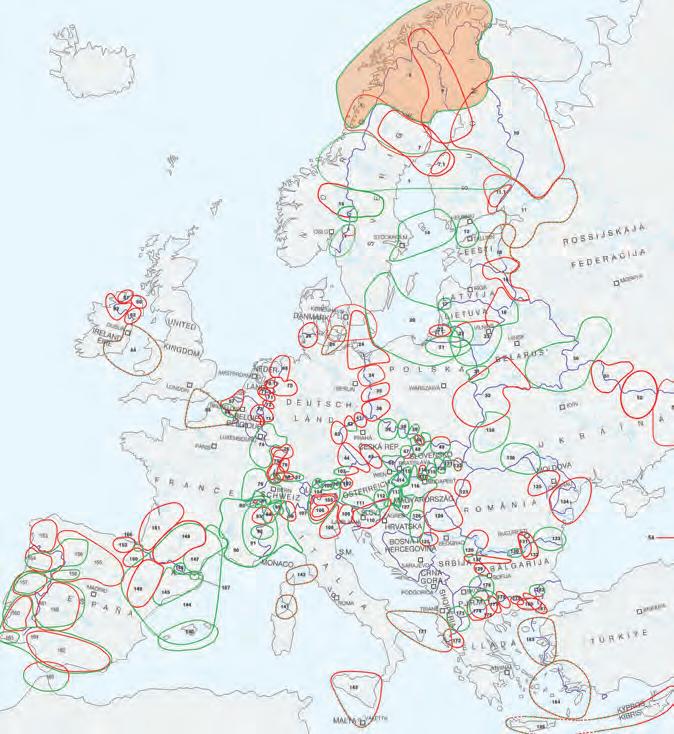
There is also an Association of European Border Regions, formally instituted in 1971 with the goal of lowering barriers and enhancing cooperation in regions striving to stay connected across national boundaries. (See Figure 1.1.) It is pleasing that its formation was first discussed at a conference in Basel, Switzerland—a
figure 1.1 Map from the website of the Association of European Border Regions (2017). Members are indicated in red, non-members in green, with mixed red and green for partial and planned members. The online version of the map can be varied to show, for example, large-scale cross-border collaborations as well. Reproduced by permission.
city whose airport offers exits to three different nations. Their website vaunts: “95 out of the approximately 163 working border and cross-border regions have become members of AEBR.” The numbers, the scale of the issue, are surprising. The emergence of a federal system in Europe—unevenly and perhaps now insecurely, but persistently, expanding—has profoundly enabled such initiatives, allowing advocates to affirm connections despite deeply vexed histories. Such cross-border connections are important in the Western hemisphere, as well. Of course, the supranational region is available in everyday usage—we easily say “Latin America.” We indicate border regions that cross national boundaries, as in “Great Lakes”—although within the U.S., it seems easy to forget that four of the five have Canadian shorelines. Studies of the U.S.–Mexico borderland—let us say