Oxford University Press is a department of the University of Oxford. It furthers the University’s objective of excellence in research, scholarship, and education by publishing worldwide. Oxford is a registered trade mark of Oxford University Press in the UK and certain other countries.
Published in the United States of America by Oxford University Press 198 Madison Avenue, New York, NY 10016, United States of America.
All rights reserved. No part of this publication may be reproduced, stored in a retrieval system, or transmitted, in any form or by any means, without the prior permission in writing of Oxford University Press, or as expressly permitted by law, by license, or under terms agreed with the appropriate reproduction rights organization. Inquiries concerning reproduction outside the scope of the above should be sent to the Rights Department, Oxford University Press, at the address above.
You must not circulate this work in any other form and you must impose this same condition on any acquirer.
CIP data is on file at Library of Congress
ISBN 978–0–19–755734–1
DOI: 10.1093/oso/9780197557341.001.0001
Printed by LSC communications, United States of America
In memory of Thandeka Mdeliswa, aka Superstar.
You will always be loved and never forgotten!
Preface
I write these words in the fall of 2020. The world is still in the grip of a global pandemic that began in early March of this year in the United States. In response to COVID-19, classes at the university where I teach immediately went online. I prepared myself as best I could for this new normal of academic life. The course I taught that spring was a social philosophy course, “Struggle and Protest.” My students and I attempted to make sense of the nature of resistance and arguments for its justification, as well as the role of anger and hope in the face of what seems like perpetual struggle. I had never taught online before. Most of my students had never taken an online class. It was a new experience for us all. I was ever so conscious of the unique challenges my students, who are predominately people of color and first-generation college students, would have during this tough time. How could they focus on philosophical questions when they and people who looked like them were losing their jobs, falling ill, even dying—difficulties that data reveal were highly correlated with race.
The course, unfortunately, could not have been timelier. As our semester went on, anti-racist protests were occurring around the world in response to the police killings of Breonna Taylor in March and George Floyd in May. Video footage revealing the details of the killing of Ahmaud Arbery appeared in March. Two months earlier, white men chased him down and murdered him in a case of “jogging while Black.” Witnesses reported that the shooter used a racial slur after the shooting, and the white men were authors of several racist posts on social media. Arbery’s killers would have gotten away with murder if journalists didn’t publicize the story. My students, of course, were angry.
During this time, more people began to take up the mantra of Black Lives Matter (BLM). This uptake was quite different from when Alicia Garza, cofounder of Black Lives Matter, originally
expressed it online in response to the shooting of Trayvon Martin in 2012. This time it appeared that America was finally getting it. People publicly incited All Lives Matter retorts less and less. Businesses released online statements in support of Black folk. Institutions took up the challenge to become more diverse and inclusive. And allies in other countries marched in solidarity, as well as protested racism occurring on their own soil.
However, police shootings of Blacks continued. A white teenager was arrested for killing two Kenosha, Wisconsin, protestors. He was eventually released on $2 million bail, paid for by a pillow entrepreneur and a 1980s sitcom actor. Hate groups like the Proud Boys went public later in the year. A Republican legislator in New Hampshire told people on Facebook to burn and loot homes with BLM signs. A twenty-four-year-old white man was charged with ethnic intimidation in Michigan for shooting into a family’s home because they had BLM signs in their window. Racism can be quite resilient. British Nigerian actor John Boyega, known for his role in various Star Wars movies, used his platform to speak out against racial injustice. Speaking with pain and anger at a London rally organized to protest the shooting of George Floyd he said, “Look, I don’t know if I’m going to have a career after this, but f— that. . . . Black lives have always mattered. . . . We have always been important. We have always meant something. We have always succeeded regardless. And now is the time. I ain’t waiting. I ain’t waiting.”1 In the summer, WNBA and NBA players, coaches, and owners also used their platforms to promote anti-racist messaging, freely expressing their emotions. When an officer shot Jacob Blake seven times in the back in August, the Los Angeles Clippers’ owner wrote on Twitter, “I am again angry over the shooting of a Black man.” When the Kentucky attorney general failed to indict officers on murder charges for the killing of Breonna Taylor, NBA star LeBron James noted how “devastated, hurt, sad, and mad” he was over it.2
The anger many were feeling was not just in response to the police. This was a rage that was boiling over from other racial incidents and injustices. It was directed at the forty-fifth president. During the president’s election campaign and his presidency, he often expressed
racist ideas (e.g., “When Mexico sends its people, they’re not sending their best. . . . They’re bringing rapists”) and instituted policies that disproportionally impacted nonwhites (e.g., the Muslim ban). Their anger was also directed at fellow citizens. I had grown up watching historical footage of hate groups like the Ku Klux Klan. They may have expressed pride in being white, but their hoods signified shame. Not in this era! White nationalists and white supremacists got bold. They marched hoodless in Charlottesville, Virginia, to protest the removal of a statue of Robert E. Lee and chanted, “Jews will not replace us,” in the streets. And the alt-right attempted to rehabilitate the public image of white nationalism. They had some success when the magazine Mother Jones described their leader, Richard Spencer, as a “dapper white nationalist.”3
It’s easy to blame a president, white nationalists, and white supremacists for America’s racial problems. If only it stopped there. Thanks to technology, many began to share their own racial encounters. Through online videos and social media testimonies, we increasingly saw that people were constantly harassing Latinx folk for speaking Spanish and accusing them of being illegal, white women were calling the police on Blacks for no reason other than being Black, and only a few people seem to care about or were bringing mass attention to missing Indigenous women in the United States. W. E. B. Du Bois wrote in the second chapter of his seminal text The Souls of Black Folk that “the problem of the twentieth century is the problem of the color line.”4 We are twenty years into the twenty-first century and four years from when the first Black US president left office. Still this problem exists. This problem and America’s unwillingness to address it have made many people angry—angry like never before.
Booker T. Washington, a figure whose work my students and I engaged with in the course, expressed to whites in his “Atlanta Compromise” speech that the formerly enslaved were “the most . . . unresentful people that the world has seen.”5 To say that Blacks are not a resentful people is to make an essentialist claim about how all Black people feel and who they are by the very fact of their Blackness. This kind of essentialism is false. However, while
Blacks as a group are not by their very natures a resentful people, this doesn’t mean that today many Blacks and nonwhites (along with their white allies) do not have justifiable reasons to be angry at racism, and many are in fact angry. So what should Black people do with this anger? What should anyone do with anger at racism—the profound, justified rage that, not only after the events of 2020, but in the public and private sphere pre-2020, so many of us have felt and are still feeling?
In an essay for The Atlantic titled “Anger Can Build a Better World,”6 as well as in interviews with BBC and Monocle Radio about the anger of Portland protestors, I said that anger has important communicative functions in an unjust world. It can remind us that the lives of the marginalized matter and make us aware of the fact that racial justice is lacking. It also motivates productive action toward creating a more just world. I received interesting responses from readers and listeners. Some agreed with me but suggested we should be cautious with anger. Others conceded the fact that anger at racism can be motivating, but they believed that “it is so often expressed as violence towards the innocent,” and that “anger is not the great communicator. . . . We don’t need that now.”7 This convinced me even more that there needs to be an elaborate case made for rage at racism. That’s what you’ll find in this book.
How can we make sense of this strong emotion we feel in response to racism’s many forms and manifestations? Why are so many afraid of it? How can we better respond to others who are angry? Does anger have a role in anti-racist struggle and protest? The more we reflect on these questions, the better equipped we are to fight the good fight, or at least get out of the way of those who dare to step on the battlefield for racial justice.
Acknowledgments
Thinking and writing are never done alone. They take place in community. I am grateful for a community that has inspired and challenged my thinking on anger, provided space for me to write, and nourished my heart and mind when thinking became tiring and doubts began to creep in that this project would ever see the light of day.
Thanks to Lawrence Blum and Christopher Lewis for believing in me and the ideas in this book when they first appeared as a sixthousand-word writing sample for graduate school admissions. I will never forget your kindness and attention.
Lucy Randall, your belief in this book is one of the main reasons it exists. Your editorial support has helped me write a better book. Thank you. Special thanks to Hannah Doyle for making this process as smooth as ever.
This project would have taken longer to enter the world if it wasn’t for the help of my research assistant, Chris McVey. We both experienced some struggles while preparing this book for publication. But his commitment to make it happen, despite it all, was and still is inspiring.
Academics have so much on their plates. So when they take time out to read your work and provide helpful feedback, it not only reveals how smart they are, more importantly, it tells you how selfless, thoughtful, and loving they are. Thanks to Chris Lebron, Kathryn Norlock, Alice MacLachlan, Owen Flanagan, Kim Frost, Brandon Terry, Nicolas Bommarito, and anonymous reviewers for your suggestions, pushback, and questions.
The ideas in this book benefited from audience engagement at conferences, colloquiums, and institutes. Thanks to the following institutions and departments for inviting me to share my
work: University of Wisconsin–Madison, Claremont McKenna College, PIKSI Program at MIT and Penn State University, Wits University, Elon University, Cal State Bakersfield, CUNY Graduate Center, Cal State Los Angeles, UC Riverside, Buffalo State University, Stellenbosch University, UC San Diego, Brown University, Society of Philosophy and Psychology, Marquette University, Princeton University, Wesleyan University, University of Michigan at Ann Arbor, Harvard University, University of North Carolina at Charlotte, TEDx audience at University of Illinois, Chicago, and the House of Beautiful Business.
During my first semester at the University of California–Riverside I taught a graduate seminar on the moral psychology of anger. In the last week, students workshopped draft chapters of this manuscript with excitement, generosity, and rigor. It benefited tremendously as a result. Much thanks to Abel Ang, Jonathan Baker, Taylor Doran, Alba Cercas Curry, Kristen Ekstrom, Victor Guerra, Tommy Hanauer- Rehavia, Marie Evanston, Rotem Herrmann, Osup Kwon, Maxwell McCoy, Deborah Nelson, Micaela Quintana, David Shope, Jared Smith, Marek Twarzynski, and Katherine Vidueira.
Shout out to the various writing groups that provided space, community, and accountability. The Virtual Stanford writing group led by Wendy Salkin and the UCR women’s writing group led by Kim Yi Dionne benefited me richly. To my writing partner, Luvell Anderson, I look forward to writing with you every week. Thanks for your energy, advice, and particularly your patience when I talk way beyond our allotted break time.
Special thanks to Axelle Karera and Kris Sealey for being my personal Black woman philosophers’ support system. Your wisdom, empathy, strength, and humor helped me get through revisions after revisions. Because of you, I am inspired every day to #MEM.
To my department colleague and workout partner, Adam Harmer. You are a hell of a friend! Thank you for listening to me when I vent, reading my work although it has nothing to do with your early
modern research area, and inspiring me to constantly stay strong and fit. When the going gets tough, you bring me smoothies, send me workout texts, willingly participate in my outdoor adventures, and so much more. (Let’s continue to fall off bikes together on our road to tenure.)
Introduction
I’m sure that every African American can recall the first time they were called the N-Word. My first experience occurred when I was seven years old. I was playing with a white friend of mine outside of an apartment complex in Wilmington, Delaware. I don’t remember his name. All I know is that we used to play together a lot and got along quite well. That was until, one autumn day after not seeing him for a while, I went up to him to say hello. He replied emphatically, “My daddy told me I can’t play with N*ggers!”
I was hurt! And I was angry!
If seven-year-old me was ignorant of the word’s meaning, I could have escaped the pain and the fury. If he would’ve hurled the words “ignoramus” or “deplorable” at me instead, I would have been too clueless to be insulted. But at seven, I knew what that word meant. It was not something you only ran across in big dictionaries, buried between words that began with the letters M and O. No! That word had a long history and it was a weapon that anyone could use against humans with Black skin, including children.
I do not remember my first kiss. I do not remember the first book I ever read.
I do remember the first time I was angry. And it was at racism.
I wish I could say that was the last time I was outraged and the last time I experienced racial mistreatment. As years went by, I realized that racism was a reality—often daily or every now and again if you were lucky. But my response to it would remain the same. Racism and the people who practiced it deserved my rage.
When my primary school teachers showed us calm responses to racism via Eyes on the Prize documentaries, which told the story of
Blacks’ fight for civil rights in the United States, I was that student always boiling with rage at my desk as I watched whites brutalize African Americans in the Jim Crow South. I saw my own rage reflected back to me when I learned about people fighting slavery and racism in history. I read about angry responses to racism in the poetry of Black Arts Movement writers who were able to express it with rhythmic eloquence. I witnessed this rage as I watched live footage of the Los Angeles riots in 1992. While wrapping up my senior year in college, I wanted to escape to New York City to express my rage with other outraged folks when I heard that the New York Police Department had shot Amadou Diallo forty-one times—and had gotten away with it!
More recently, I’ve experienced anger at racism more and more. Racists have become much bolder and more shameless since the election of the forty-fifth president. I am not alone in noticing this. People come to me privately to help them make sense of their feelings. I know of outraged folks who have marched daily in response to the shootings of Black men and women at the hands of the police. From Baltimore to Portland, Ferguson, and Kenosha, people are angry at racism. And it’s not just Blacks either. Folks with different hues of skin and regional accents, who are from different economic backgrounds and different countries, are mad as hell at racism and its normalization in the United States.
In response, some critics seem to think that what is most strange and alarming about this time is the angry reactions of anti-racists, and not the racism itself. Perhaps they think anger is the true threat to our democracy. In white supremacist societies, anti-racism has always been considered dangerous. In places that pride themselves on being rational, emotions have always been in the hot seat.1 Combine these two contexts together and you have a culture that—instead of being rightfully challenged by such anger—is likely to view the emotions of anti-racists with suspicion and fear. And in such a culture, there are likely to be just as many anti-racists who are ashamed of their rage as there are those who embrace it. * * *
Emotions help us grapple with the world. Some alert us to danger, aid in decision-making, and motivate our actions. Others help us understand ourselves and other people. And they assist us in tempering our actions.
For these reasons, Charles Darwin claimed that emotions are adaptations that help us survive and reproduce. Robert Solomon, a scholar who wrote extensively about emotions from a philosophical perspective, adds an existential outlook by noting that emotions are what allow us to have a meaningful life. He states, “It is because we are moved, because we feel, that life has a meaning.”2 However, Solomon does admit that the type of emotion matters; while all emotions make life meaningful, some meanings are demeaning. Love, for example, may enhance our life, while emotions like sadness may define our lives as pitiful.
Emotions are also social and political. They are directed at and engage the social and political world. Humanists remind us that all kinds of political societies are filled with people who have emotions that are directed at the nation-state, political principles or policies, and political citizens. These political emotions also play a role in our lives. They can reinforce oppression or motivate us to fight it; they can derail the pursuit of justice or expedite it; they can enliven us or make us politically apathetic. Some emotions are presumed to do a better job in the political sphere than others—or at least do the job with fewer moral risks.
Compassion motivates us to engage in altruistic action and create egalitarian institutions.3 And many think that citizens must feel patriotic love in order for a political culture to survive and flourish. Only then are we able to focus on general welfare rather than our own selfish pursuits. Many think that only emotions like compassion and love can help us to engage in positive action in order to achieve these goals, whereas other emotions—less positive ones— are considered a threat.
We often tend to see “negative” emotions like fear and anxiety as barriers to liberal political goals. Fear can be a problem for democratic self-government since it can give rise to othering and scapegoating. Political scientists have described how public fears create
public desires that often legitimize unfair policies. And these policies disproportionately affect certain racialized peoples. For example, fear of Blacks as “hyperviolent” impacted prison expansion. Anxiety over Latinos becoming the majority led to the legitimization of the US Immigration and Customs Enforcement (ICE). And fear of Arab men as violent and hyperpatriarchal was used after September 11, 2001, to create public fear of terrorists, support for war, and profiling and surveillance initiatives. Such racial politics of emotions reinforce oppression.4
But there is one political emotion that we tend to be overly concerned about. It’s the emotion I felt at seven years old. It’s the emotion many experienced when George Floyd’s and Eric Garner’s cries for help were ignored, when white supremacists were described as fine people by an acting president, when Sandra Bland never made it home, when members of a white militia killed anti-racist protestors in 2020, and when COVID-19 was downplayed by officials as the outbreak continued to have a disproportionate effect on communities of color. So many are worried about anger and doubtful about the positive role it can play, but it is plainly true: there is a lot to be angry about.
Anger is thought to cause disruption.5 In her 2016 book Anger and Forgiveness, philosopher Martha Nussbaum claims that anger involves down-ranking the wrongdoer to a moral position that is beneath us and a desire for payback and revenge. Though it may have an evolutionary history—helping with our fight-or-flight response by serving as a signal, motivation, and deterrent—she doubts that it is necessary today. Although she admits that anger can be useful, this use is limited. It is useful until things go astray, and given what anger involves, it often does go astray.6 Anger, in her view, is also an impediment to other emotions and attitudes that are needed to construct a better future, such as generosity, empathy, and love. Therefore, when she considers the role of anger in the context of political injustice she writes, “It is a bad strategy and a fatally flawed response.”7
Owen Flanagan also doubts that anger is necessary even in cases in which it can work. In Geography of Morals, he considers a story
retold by Nussbaum of a child who was rescued from a concentration camp by a soldier in the Allied forces. The soldier revealed to the child how angry he was about what the Nazis were doing in the camp. By doing so, the soldier helped the child recognize that the humanity that the Nazi oppressors had denied the prisoners in the camp still existed in the world—and would prevail. Rage was the sign that morality had returned. Flanagan questions if only anger could have served this purpose, however: “Suppose that instead of fury at the evidence of depraved racist inhumanity, he experienced compassion and solidarity and profound tearful sadness. . . . Could a contagion of tears rather than a contagion of rage be healing, could it restore hope in humanity? The answer seems clearly yes.”8
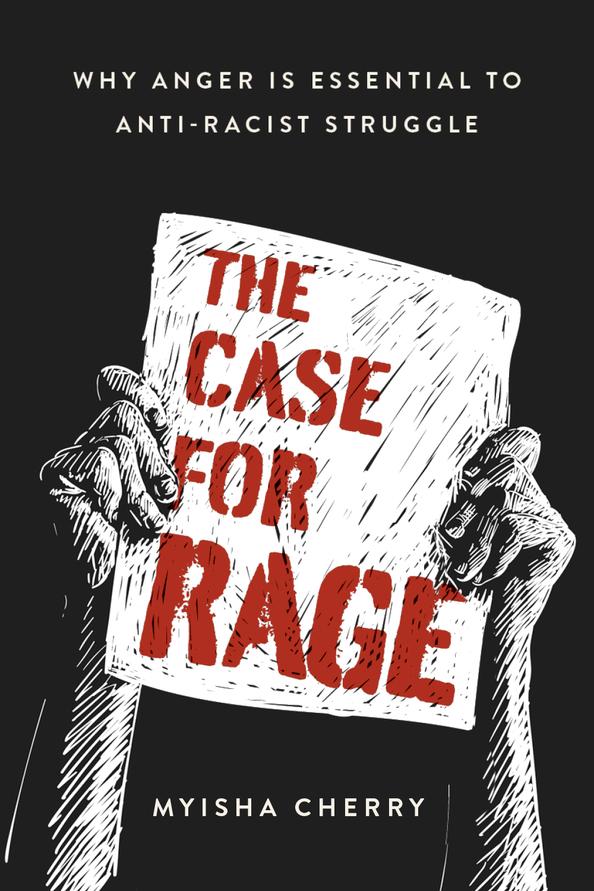
But we must be careful to give rage the credit it deserves. It has a special power that is mighty enough to combat some of the strongest forces and systems at work in the world. In this book I argue that a particular type of anger, what I call Lordean rage, has an important role to play in anti-racist struggle. Taking its name from Audre Lorde, the Black feminist poet and scholar who first articulated the version of rage I’ll be exploring, Lordean rage is targeted at racism. It tends toward metabolization and aims for change. It is informed by an inclusive and liberating perspective. An organizer who is angry at racial inequality and motivated to end it so that all of us, regardless of skin color, can flourish has Lordean rage. It is not an ideal type of anger. Rather, it is often experienced by the racially oppressed and their allies. Although Lordean rage may not be necessary, it can be uniquely used for anti-racist purposes.
When compared to the more generic notion of rage, it is less vulnerable to criticisms that it interferes with liberal goals and therefore should be replaced with more positive emotions. Instead, as I explain, Lordean rage does not preclude other emotional and cognitive responses like compassion and empathy. So, when a protestor marches in the street, their anger is expressing compassion for the downtrodden and love for justice. For this reason, I claim throughout this book that Lordean rage should not be discarded, suppressed, or replaced but rather managed—although my view on what this management entails parts with traditional notions.
My argument falls within the tradition of feminist philosophers who have argued for the intrinsic and instrumental value of anger in response to oppression. These philosophers have noted the appropriateness of anger in response to sexist oppression. They claim that it is a form of protest that may help women retain their self-respect, gain insight into their oppression, and bear witness to that oppression. It is also a way to claim one’s love for good, and one’s hatred for evil. Recent books written by activists and journalists on the rage of women in the context of the #MeToo movement also defend anger in the fight against sexism and misogyny. They point to how anger has been a motivating force in inspiring myriad responses to sexist oppression. I have learned a lot from these insights.
I am specifically concerned in this book, however, with anger in the context of racial oppression. Although a person could read the feminist literature and then decide to apply those insights into their own racial projects, I think that speaking explicitly to the specificity of people’s lives and struggles is important. Just as oppressions have similarities, there are also dissimilarities. It’s important that we recognize that our oppressions, social positions, and fights are multifarious. Thinking about what anger distinctly does in the context of racial injustice is a way of being attuned to these differences, and at the same time seeing them as illuminating rather than divisive. I am interested in what role anger distinctively plays in anti-racist struggle.
Anger plays the role of expressing the value of people of color and racial justice; it provides the eagerness, optimism, and self-belief needed to fight against persistent and powerful racist people and systems; and it allows the outraged to break certain racial rules as a form of intrinsic and extrinsic resistance. This helps explain how the oppressed can feel affirmed when others get angry on their behalf, how people are able to fight against powerful systems despite the risk of abuse and arrests, and why WNBA and NBA players—who used their platform to combat racism—were viewed as radical for simply expressing their feelings.
It is easy to assume that this is a book about “Black rage” but that is not the case. I recognize that Blacks are not the only victims of
racial oppression, nor are they the only people outraged about racial injustice. I am concerned with the anger of all people of color and their allies—an anger directed at racism. I engage the African American intellectual tradition more than any other, however; African Americans (with the exception of Native peoples) have had one of the longest relationships with US racism, and thus Black thinkers provide us with a rich archive of reflections, analyses, and exemplar actions that can help us think about anger and race. The Black intellectual tradition that I rely on may at times seem both typical and atypical. It may be surprising to some readers that my account of anger is not based on radical male figures like Malcolm X or Nat Turner, but Black feminist Audre Lorde. My examples of freedom fighters who embraced anger are not limited to figures like David Walker but also include Martin Luther King Jr. as well as Ida B. Wells and Sojourner Truth. There are some people you may expect to hear from, but do not. The thinkers whom I engage in no way exhaust the list of exemplars and scholars of anger at racial injustice. Nevertheless, they are “a critical initial starting place”9 in thinking about anger and anti-racist struggle.
I write this book as a moral psychologist and philosopher of race. This means that I am concerned with the nature of anger, its functionality, and its cultivation in the context of racial oppression. While I engage the work of historical figures and use social movements as examples, this book is in no way an intellectual historical project. For example, while Audre Lorde inspires my own account of appropriate rage, I do not attempt to reconstruct her views or arguments on anger by determining her commitments and reasons or the motivations and influences driving them. Also, it is not my aim to describe how anger has operated historically within certain social movements. I do hope that this sampling of thinkers and movements might provide a deeper understanding about the role of anger in anti-racist struggle and perhaps inspire deeper interests in their work.
I should also note that this book is meant to be a short, crossover book that appeals to the academic and activist, the philosopher and citizen. As a result, my aim is to be philosophically grounded and accessible. Reflecting on the role of anger in the
anti-racist struggle is not simply an armchair exercise or an interesting philosophical problem. I am concerned with what my argument means beyond the ivory tower, so I have readers outside of academia—for example, the thousands who flooded the streets to protest police violence in spring 2020, recent in my memory as I write this—in mind. I also do not think that philosophers are the only folks who have insightful things to say about anger and race, and they should not be the only people who get to hear my own insights on anger and race either. In my work as a whole, I not only write to the public but engage their contributions and think with them. I do not apologize for these choices and believe they need no further explanation.
Two particularly important attitudes undergird this project that are worth mentioning here. The first is embracing the inevitability of racism and the need to be excellent practitioners of anti-racist struggle given this knowledge. This requires diligence in the face of perpetual struggle, knowing what’s in one’s control, and rejecting utopian prescriptions.10 In that spirit, I am interested in looking at the role a nonideal emotion like anger plays in responding to a nonideal society. My approach rejects the idea that only positive emotions are the most effective and appropriate ones. One’s resistant practices can still be justified and effective even when they are uncivil. As such, I accept that we need to expand our modes of principled resistance.11 In that spirit, I accept that Lordean rage may not be pure, innocent, or civil, but this does not diminish its usefulness and appropriateness in anti-racist struggle, nor does it preclude other moral possibilities.
Overall, the aim of this book is to use the resources of moral psychology, ethics, philosophy of race, and social and political philosophy to make a case for Lordean rage’s important role in anti-racist struggle. If I do this properly, it will influence some to, at least, not be so quick to recommend that we eliminate rage when racial wrongdoing grabs our public attention. The book shows that rage is not the problem—it is a response to the real problem. More importantly, the book shows the range of possible ways that many people have to respond powerfully and positively to racism with rage.
Remember, emotions are not what make us human, but theorizing about emotions is a distinct human activity. So let’s get to theorizing about one of the most controversial emotions around—anger—and its place in the most controversial of contexts—racial injustice.