How Does Fumed SilicaWork?.......................................270
Applying Sensitizer to the Fumed SilicaCoatedPaper 270
Streaking Issues with Fumed Silica
CHAtrtlt1z
and Fix Alternative for
t.NAtrtlt1:3
for EDTA Clearing Bath: Kitchen Blend 320 Old School 1% HydrochloricAcid Platinum Clearing Bath ..................................................................320
Few Final B-V-D Ideas 618 Galina Manikova's Van Dyke on Porcelain Workflow.... 619 Preparing the Porcelain Form.........................................
C#AtrtltZ..Z..
Paper
Contrast Control for Van Dyke........................................606
The Liam Lawless Contrast Control Sensitizer for Van Dyke 606
Liam's Contrast Control PartA 606
StandardVan Dyke Part B...............................................607
Standard Van Dyke Part C ..............................................607
Small Volume Conversion Table .............. . .................. 839
Appendix -B Selected Bibliography: Alternative Processes
Appendix - F Resources, Workshops & Internet Sites: Chemistry, Paper, Lab Gear, References, and the Book Artist's Web
l«Pt.X
To access the above Online Appendices, please follow the steps below:
1. Open your browser and go to http://www.cengage.brain.com
2. Typethe author, title, or ISBN ofthis book in the Search window. (The ISBN is listed on the back cover.)
3. Click on the book title inthe list ofsearch results.
4. When the book's main page is displayed, click the Access button under the Free Materials tab.
5. Once the Book Companion Site opens, you may download each ofthe Appendices, by clicking on the Appendix name.
This section ofthe book is always in progress. Long after the manuscript and image fileshavebeen sent to thepublisherfor production, people are still commenting and contributing and for the last three editions thesebookshavebeen an evolutionenjoyed by artists and scholars ofthe medium.
I can't imagine successfully completing a project of this magnitude without the generous collaboration, knowledge, and wisdom of my family, friends, fellow artists, and students especially my students. With that in mind I'll happily use this space to express my thanks for the pleasure ofyour company on this journey through the three editions ... each one a very different book and meriting an ever increasing gratitude forthe patience and advice ofmy friends.
To begin, I'll make a deep bow of gratitude to my wonderful core group of proofreaders and fact checkers. They are, by unanimous consensus, the very best in the world with language, science, chemistry, history, and alternative process photography and I am honored to call them friends and to be in
their company. I am ever grateful for their time and for setting me straight when my writing and research needed adjusting and a proverbial kick in the seat of the pants. Thank you, in loose order ... Mike Ware, Keith Carter, Luis Gonzalez Palma, Susan Bright, Lyle Rexer, Alex Timmermans, Dan Estabrook, Richard Cynan Jones, Alan Greene, Roy Flukinger, Sandy King, Monika Ozog, Danielle Ezzo, Lindsay Rogers, Tommy Matthews, Lisa Elmaleh, Sam Hiser, Bob Crowley, Mark Osterman, France Scully Osterman, Denise Ross, Bob Szabo, Niles Lund, Ben Sloat, Michelle Pritzl, Jon Coffer, S. Gayle Stevens, Jody Ake, Gordon Mark, Bob Kiss, Howard Effner, Dick Sullivan, MadelynWillis, DanaSullivan, Mary Dorsey Wanless, Malin Sjoberg, Will Dunniway, Jon Cone, Mike Webb, Wolfgang Moersch, Kelly Wrage, Katie O'Brien, Will Dunniway, Zoe Zimmerman, Galina Manikova, WlodekWitek, and xtine Burrough. I want to give special thanks to my former MFA candidate and current colleague, Amanda King, for line editing every single page of the first draft. My very special thanks to my friend Fionnbharr 6 Suilleabhain for his generosity of time and incredible line-editing skills. Finn managed to edit all 1200 pages of the original manuscript while packing and moving to Mozambique!
Special thanks to two of my favorite MFA graduates, Jessica Somers for her work on the Dick Sullivan's Athenatype, and Cotton Miller for his research and advice on the Inkjet Photopolymer Gravure and Gumoil. My gratitude to Tony Gonzalez for his significant contribution to the details involved in his personal gum bichromate and digital negative production techniques. Also to Richard Cynan Jones for his time vetting the maddening calotype maze. Thanks to Joe Boylefor his great illustrations. Thank you to my friend of over 30 years, Dick Sullivan, for your contributions with the carbon, fumed silica, and Athenatype techniques andforletting me play in your carbon facility in Santa Fe. Thanks to Reid Callanan at the Santa Fe Photography Workshops for providing a great crew and workshop opportunity for so
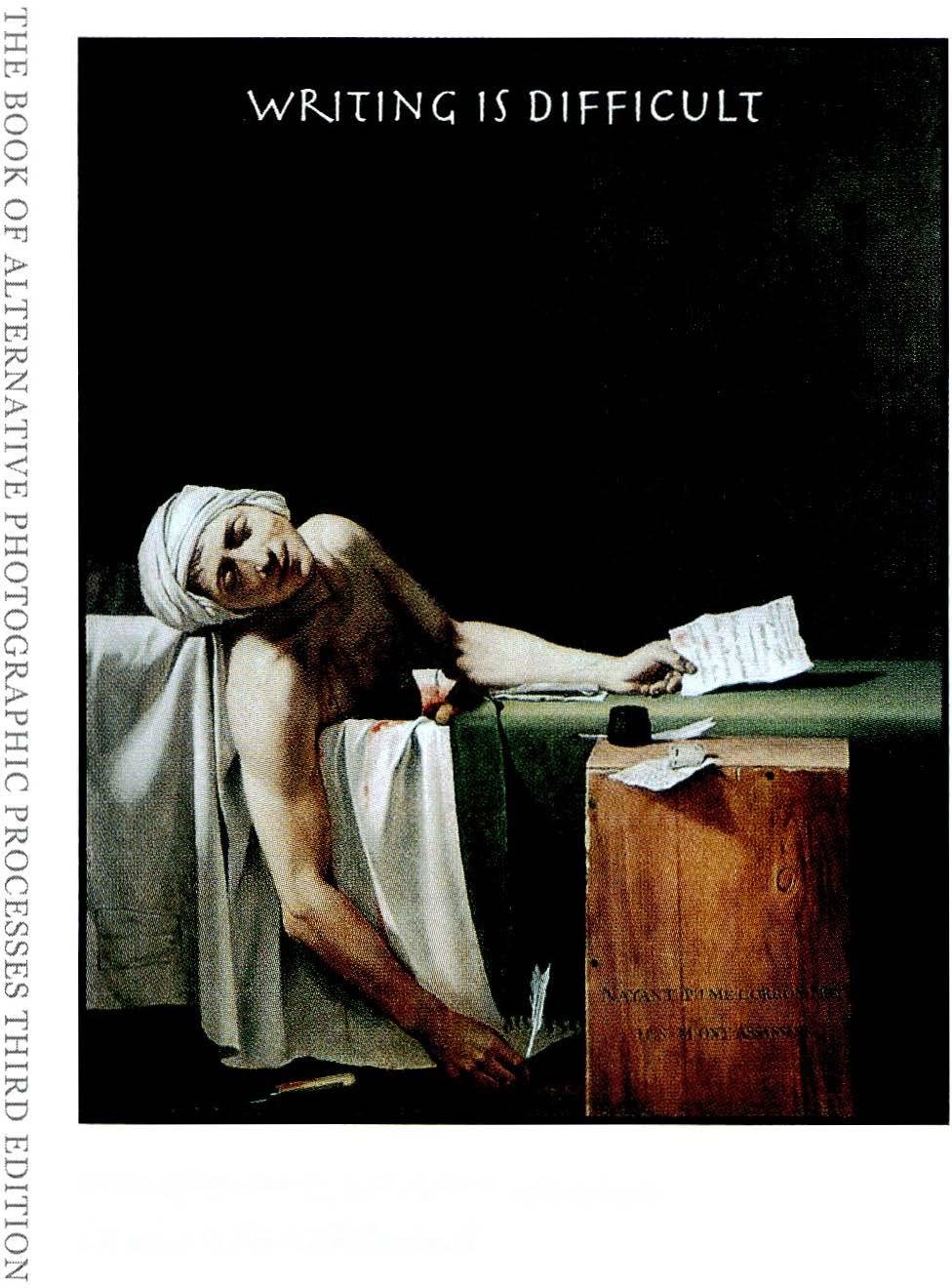
Christopher James, Writing is Difficult, 2007 (Courtesy of the Artist/Author)
much ofmy student testing. A special thanks to Mark Osterman for the great solo contribution of his dry plate emulsion research in the alternative negative chapter.
Anyonewho has ever created a book, even halfthis size, knows how important it is to have your editor, production team, and publisherbelieving inwhatyou are creating. I was luckywith thefirst and second editions, and am lucky again. Thank you Jim Gish, my editor for all of the books, for your gift of autonomy that was appreciatedeverysingle day it has been a wonderful 12 years and I look forward to working with you again. Thank you to Larry Main, Andrew Crouth, Nicole Calisi, Sandy Clark, Sarah Timm, Meaghan Tomaso, MarisaTaylor, Jennifer Feltri-George, Becky DiCaprio, AnneMajusiak (a superb picture researcher ifyou need one), and Tom Schin whothoughtthis subject was a good idea to invest in a book 12 years ago and for asking all ofthe right questions.
THE BOOK ARTIST'S WEB SITES
AMargaret Adams
Paul Adams
JodyAke
Bina Altera
Christina Z Anderson
DickArentz
B
Jo Babcock
Elena Baca
Christine Baczek
Jonathan Bailey
Craig Barber
Emily Barton
Peter Baryshnikov
Cynthia Batmanis
Matt Belanger
Laura Bennett
Jayne Hinds Bidaut
Diana Bloomfield
Joe Boyle
Thanks aswellgo to RoyFlukinger and Linda Briscoe Meyer at The Ransom Center / U. ofTexas-Austin for their friendship and outstanding help in tracking down images intheircollection. As well, SteveVallario when he was at Pictorico / Mitsubishi Imaging, Kat Kiernan at the Kiernan Gallery, Tess at Houk Gallery, Gagoshian Gallery, Pace-MacGill Gallery, and to all of the museum research assistants who I asked questions ofover the years.
Adeeplyfeltthankyoutoalloftheartists,myfriends, who allowed me to reproduce their excellent work in this book ... your generosity, support, and enthusiasm wereoutstandingandperfect on everylevelimaginable. Have I forgotten anyone? Oh yeah! Most importantly, I thank mywife, Rebecca, forputting upwithme, for her perpetually zany sense ofhumor, love, support, andpositivestateofbeing. Itwas awonderful experience creatingthisbook inthe Dublin, NH studiowithyouand Cypress thankyoualways foreverything.
Web Site email: christopher@christopherjames-studio.com
Studio email: dublinstudio@earthlink.net
If you are seeking a personal and customized workshop experience, where you decide on the number of days you would like, the type ofprocess, or processes, that you wish to work with, and the specific scope ofwhat you would personallylike to learn while working with me, (without the crowding that comes with a larger workshop experience), consider exploring this opportunity by taking a customized and private 1 to 3 person workshop with me in my Dublin, NH studio. Dublinis in the southwest corner ofthe state, near NewYork, Massachusetts, and Vermont, and has been an artist's colony and summer destination for travelers for well over a century. Located near The MacDowell Colony, Dublin features a perfect New England environment, great hiking on Mt. Monadnock, a deep-water swimming lake, and outstanding diversity in dining and local B & B and motel lodging. Manchester International Airport is 45 minutes away and Boston is an hour and 40 minutes by car.
ThinkingWhileWriting:March2014
Six months ago, mywife, Rebecca, sent me an email (which was odd considering she was laying next to me in bed) after reading a new reader's Amazon review for the 2nd edition of my book The generous reviewer had written, "... James' book revives the discussion about "Imperfection" andits artistic merit. Every alternative print is unique and oftenimperfect. FortheancientGreeks, perfectionwas aprimerequisiteforhigh art andbeauty,andthis concept wasrevivedduringthe Renaissance in art andin architecture. The question iswhether artists today"want"toachieve perfection.Theverybeautyofalternative processes isitsimperfectionandunpredictability, andthereinliesthebeauty ofsuch images.Andeachimage isuniqueand irreproducible. Thereis alsothegreatappealofahaptic (referringtothe sense oftouch) approachthatis missing indigitalphotographyandinso manyotherhightechnologyfields."
Rebecca, who is inclinedtosee all things withintheir relationshipstothe naturalworld, wrote, "The beautyof alternative process IS the imperfection ofthese images and our desire for ittodaystems fromtheculturalerosion ofour connections to nature."
This example of a dialogue, in which a discussion of syntax instigates a philosophical conversation about important things that are lost, or missing, is ofhuge interest to me and especially true when considering the hand-made alternativephotographic image and our emotional connections to the unique and imperfectbeautyof those processes andtheirartifacts.
Sixmonths afterRebecca'sbedtime email, Iwas doing some researchoncriticalthinkerswhohadbeen engaged with the brand new medium ofphotography during the mid 1800s. I spent a few hours considering their unique experienceswiththis amazing invention as theywere not only seeing the first images from the new medium, they were having dinner withthe people who were makingthem. I began to make some notes onwhat I had been reading and thinking ... and as I wrote, working on the laptop in my Dublin, NH studio at the end ofsummer, this exposition began to take shape and turned into this piece that I am offeringtoyou now.
The more perfectlyyou render an imperfect thing, the more inevitable the imperfections ofthat thing must be acknowledged. Inthecaseofphotography, wheretheprimaryintentionwas to reflecttheperfection ofnature, itis a feeble endeavor. One ofthe big questions on the table inthe mid-18oos, being discussed by athletic and agile intellectssuchas LadyElizabeth Eastlake, SirWilliamNewton, andPeter HenryEmerson, waswhetherthe imperfections ofphotographywere actuallycloserto our aestheticfeelings for artbecausethe imperfections represented ourpersonalexperienceswith nature,ratherthannature itself in a manner similartorepresentational painting.
In 1857, Lady Elizabeth Eastlake surmised that beyond mere light and appearance, which are the perfect scientific abilities of the medium, are found the beautiful conditions of photography that reflect the viewer's imagination and personal life references. From this vantage, when greater precision and detail are addedto the image (she used the word superadded) the eyewill miss the personal truths that function as thevisual connective and emotional tissue between theviewer and the work
SirWilliam Newton created a great scandal within the Royal Photographic Society by uttering aloud his personal opinionthatpicturestaken slightlyout offocus,withuncertainand ill-defined forms, were more artistically beautiful than perfect still life reflections in the manner ofa 17th century Dutch painting; those lovely and warm renderings of dead game, hanging root vegetables, and bowls of fruit of what was on the tables owned by the painter or painter's patron atthe time.
Newton essentially offered the conflicting proposition that the worse photography performed its assigned job, the more successful it was at representing the ideals of art. Newton's hypothesis, along the lines of
Emerson's great torment over whether photography could be enjoyed as an art or a science, created one ofthe first photo-critical firestorms. Sir Newton's argument was met with alazy response that the possibility ofcapital "A" Art inthe midstofallthis perfect science was heresy. Asimple example ofhowto see this conflictis to compare a reproductionofasaint named St. Matthewon a museum greetingcardrackto oneonaplasterpanel paintedinfull-blown mysterybyCaravaggio. Emersoninsistedthatphotographyrankedasthelowestofalltheartsbecausetheindividualityofthe artist had no room within the science to showitself. Hewas wrongofcourse. When the contextual mystery is missing, so toois the human experience and its connectiontolife ... which is always a mystery.
IfI may, thereisanequivalentreferenceinthemammothcolorphotographicprintsthataresocurrentlyinvogue ingraduate schools, museums, and "cutting-edge" galleries. These humungous images strip the human experience away and amplifythe premise that photographic science and reproduction technologyis capable ofenhancing and shockingyouraestheticexperiencebyshowingyou a pimple as large as a manholecover ... big deal.
Let'sbegin ...
From its inception, photography has never been a single, identifiable, technology or process. Throughout its evolution, the medium has been a slowly moving glacier ofchange, adaptation, and obsolescence followed closely by another metaphorical glacier influenced by the heat of science, industry, technology, aesthetics, and cultural. I think of these separate entities as I do the boulders I find in the woods near my studio evidence of the glacier's melting. Each of these transformations, the great majority of them overlapping, has ushered in an ever-greater democratization of photographic image making and resulting public adoption and adaptation. Each of these cycles have had the same family name regardless ofhow odd the offspring appeared and they have always shared the genus, in a philosophical sense, a class ofthings that share common characteristics, and DNAof photography... thatofmaking marks withlight.
In 1829, inaletterto NicephoreNiepce,LouisDaguerrewrotethewellknownsentimentthathewas burning with desire to seeNiepce'sexperimentsfromnature. Notagreatdealhas changedsincethatsentimentwasexpressedexcept forthe wayin whichthe desire to make and look at photographs is satiated. In the midst ofour current photographic and digital revolution there is the unlimited potential ofintegrating it all under the proverbial big-tent of alternative photographicpractice andpossiblymaking this the mostexcitingtime in the photographicarts in over acentury.
Photography was set free from the yoke of representation several decades ago. It is unnecessary, and ultimately counter-productive, for an artist using the language of photography to be required to choose one style of image making over another. The most constructive strategy is to take the parts that work for you, from every discipline that interests you, and to incorporate them into your photographic vision and workflow. I love that I can make pictures on my iPhone and send them to you. I feel very differently about my wet collodion ferrotypes and ambrotypes. Mypersonal investment in learning to make them gracefullywas quite different. As a result, the investment oftime bestows a greater value andmeaning upon them for me.
When I make awetcollodion plate, I makeit forever. When I make a picture with myiPhone, I makeitforthe moment. Philosophically, it is the difference between making your Eggplant Parmesan with a hand-made sauce that has been simmering for 24 hours and buying you a frozen version ofthe same meal that I'll heat in a microwave oven. They are both Eggplant Parmesan, but they are both not Eggplant Parmesan. One youwilltalk about each time you visit, the other youwill easily forget.
The invention ofphotography, and its ultimate mass democraticization, as represented in the inexpensive and easily procured tintype and ambrotype, changed the role ofthe painter in society. For the first time, it was not a requirement to bewealthyor powerful, as an individual or institution, to commission a painter to depict a likeness ofoneself ... or of one's theologyor position. Facedwith this reality, painters were excused from the obligation of representingthewaya subjectactuallylooked andwere compelledto explore theway it felt, whatthesubjectmight represent metaphorically,howtheartist'sperspectives couldbediscussedconceptuallyandfigurativelyratherthan objectively, in harmonywiththe unique impressions thatthe artist expressed with her paint.
Where a photograph's task once was to relentlessly recreate perfection, often more perfect thanthe human eye could ever hope to experience, with the exception ofthe accidental artifact, it lacked the elementofgesture that a painter, facedwiththe task ofpleasing the vanityofothers, could inject in a representational painting. My grandfather, Alexander James, a gifted painter and studio partner of John Singer Sargent, used to solve the problem when painting pot-boiler (because theykept the soup-pot full) portraits of admirals, andwealthypatrons, with a bold stroke ofred or green as a highlight on an ear, edge ofa nose, or on the arch ofan eyebrow his personal tip ofthe hatto the artistwithin.
This simplicity ofgesture, so prevalent inthe earliest days ofthe medium, became an identifiable strength that was associated with the adventure that reflected the beginning of photography. This would continue into the early 1900s inthehands ofphotographic artists using commerciallyproducedflexiblefilm andsilvergelatin paper. Often, theemotionalreflectionofthatspontaneitywastheresultofamovementunfrozen, orchemical aberration,fortuitous accident, or post-print manipulation ... enchantingqualities found in most hand-made alternativeprocesswork.
From this perspective, as digital imaging absorbs the roles ofphotography and adopts the attributes and qualities of photographic representation, is it possible to tell the difference between the original analog and the new digital? Wasn't thatthe point? Is photography nowfreeto become, as painting did, something entirelynew?
I believe it is.
In 1859, Charles Baudelairewrote, "Ifphotographyis allowedtosupplement art insomeofitsfunctions,itwill soon have supplanted or corrupted it altogether." I wonder ifhe ever consideredthe implications ofbeingwrong? And whatwould he think about the state ofthe mediumtoday?
I am inclined to believe, especially in an academic sense, that photography may no longer need to insist that it be curated and studied as an exclusive medium. It's entirelypossible that its greatest opportunity lies in being integratedwith, andlayering itsinfluences upon, all ofthearts... and notbeingsubjecttothevisual theologiesthat fracture the discipline into "schools" ofdisciples who think and see what is often simply nothing more than a new set ofparty clothesforthe Emperor.
Regardless, many are still in a defensive crouch about "their" medium and concerned with many of the same issuesthatpermeatedthrough the salons ofthemid-late 1800s andthe Photo Secessionists ... where criticaljudgmentwasevaluatedbytheexpectedperfectionofprocessandnotbyitsartisticexpressionorthebeautifulconditions ofimperfection thatrevealthe artist's, andtheviewer's, personallife references andimagination.
To me, photography is unquestionably evolving into a medium that will soon require a new definition. From an alternativeprocess perspective, one that I believe is the spear tip inthis newadventure,theflexibility of these processes present a perfect marriage partner to almost all ofthe arts that are willing to see what will happen iftheytakethe proverbial plunge. To the upcoming generations ofphotographic artists, schooledwith the pixilated imagery and battery-dependent tools of digital imaging, using one's hands to make an image is a persuasive argument simply because it is almost always imperfect ... and as a result, a profound and precise reflection ofus all.
AbouttheThirdEdition
Ifyou take a momentto considerthethings thatyoudobest, youwill come to the reasonable conclusion thatyour unique talents are ones that you taughtyourself. This is thetruth ofhowthe animal kingdom learns ... it is called play. It is play that has guided my teaching. It is play that delights the mind and propels the process ofteaching yourselfjustfor thejoy ofit. Andthatjoy is the philosophy ofthis book.
This thirdedition ofThe Book ofAlternative Photographic Processes represents a significant part ofmy evolution as anartistandauthor ... andas a teacherand mentor ofartists. Forthe lastfourdecades I've been modifying, editing, andaddingto, thisbodyofaltprocessknowledgeandlongbeforethepublicationofthefirstedition,in2001,
most ofthe ideas in this book were photocopied and handed out to my students as working notes. One day, as I was waiting for my next seminar to begin, Tom Schin, from Delmar Thompson, unexpectedly dropped in to my office at The Art Institute of Boston, introduced himself, and asked me if I thought I had a book in those notes. I said, "yes, I did" which validated one ofthe prime tenets of my teaching ... that you had better be ready when you get lucky.
The writing has a greatly expanded historical and personal narrative now and aside from the hundreds of reproductions and illustrations, the three editions represent what "we" have learned together; pertinent and peculiar observations, techniques, anecdotes, and a solid dose of interesting, and often irreverent, history to give perspective on where it all came from.
There are also a lot historical rumors, to enhance the connections between the processes and the people that were "burning with desire" about them. The writing represents the philosophy of how I teach alternative processes, always encouraging my students to be confident in their craft but never at the expense of their inspiration or ideas. I encourage perfect imperfection and playing with ideas about how photography can be integrated with all forms of visual expression and communication. To paraphrase Mark Twain ... it hardly matters when your technique is great if your imagination is out of focus.
As always, I've organized this book to equally meet the needs of several different audiences. For teachers, the book is designed to be flexible and compatible with individual teaching styles. I have done my best to make the contents interesting, clear, and accessible to high school and college-age students, as well as professional artists. As well, a significant percentage of the illustrations in this book were created by students and their teachers, and the images are easily integrated with historical archetypes This comparative collection "sets the bar" and demystifies the critical and historical judgments of what is good, and what is not so good.
For the student, this edition is designed to be fun and to work as a comprehensive, inspirational and technical resource, addressing historical and interdisciplinary connections from the beginnings of photography to its present. The word "student" applies to all ofus and encourages the embrace ofserendipity and accident as a way to avoid the cliche. Far too often, alternative process work is all about someone's ability to get a decent print instead of showing that the process has been used to illuminate a great and creative concept. It is my intention, through the illustrations, to celebrate the art instead ofthe surface.
This third edition is a resource for photographers and artists of all abilities, in any medium, where marking with light is in play. It is increasingly clear that nearly all graphic disciplines, and media, can be accommodated by the integration of alternative processes. In essence, much ofthe book documents the marriage of 19th and 20th century handcraft, science, and romanticism, with 21st-century technologies and critical theory.
New to this edition a major re-write ofthe last two editions, with significantly extended chapters packed with new imagery and information, condensed chapters that mirror changes in the genre, and many more interesting historical characters and stories to make the learning real. I've made every effort to avoid a "this is the onlyway it can be done" pedagogical model and I've written thetext asthoughyou were working right nextto me andwe are in the midst ofa conversation. Ifyou are old enough, we are having our second beer and laughing about how much fun this is.
Thefirst thing I tell my students when I meetthem for a class, seminar, or workshop is, "Ilove this shit." The next time we meet, it is what they tell me! Success in alternative processes blossoms from a willingness to enjoy image making for the pleasure of the process rather than the product. We play. We learn to hunger for the accidental and consider quirky outcomes as opportunities for greater self-expression! Much ofwhat the reader discovers will emerge as a result ofplay and ifyou don't embrace the concept ofplay you probablywon't learn a lot about anything in life Enjoy!
Christopher James 2014 www.christopherjames-studio.com