Oxford University Press is a department of the University of Oxford. It furthers the University’s objective of excellence in research, scholarship, and education by publishing worldwide. Oxford is a registered trade mark of Oxford University Press in the UK and certain other countries.
Published in the United States of America by Oxford University Press 198 Madison Avenue, New York, NY 10016, United States of America.
All rights reserved. No part of this publication may be reproduced, stored in a retrieval system, or transmitted, in any form or by any means, without the prior permission in writing of Oxford University Press, or as expressly permitted by law, by license, or under terms agreed with the appropriate reproduction rights organization. Inquiries concerning reproduction outside the scope of the above should be sent to the Rights Department, Oxford University Press, at the address above.
You must not circulate this work in any other form and you must impose this same condition on any acquirer.
Library of Congress Cataloging-in-Publication Data
Names: C. Howard, Gary, author.
Title: The biology of death : how dying shapes cells, organisms, & populations / Gary C. Howard.
Description: New York, NY : Oxford University Press Academic Newgen, [2021] | Includes bibliographical references and index.
Identifiers: LCCN 2021011285 (print) | LCCN 2021011286 (ebook) | ISBN 9780190687724 (hardback) | ISBN 9780190687748 (epub)
The words death and dying are uncomfortable. They conjure up fear of the unknown, loss, and sadness. We know on an intellectual level that everyone dies, but we avoid thinking about it. We make jokes about it. We really want nothing to do with it. For the last several decades, death has been almost invisible in the lives of people in developed countries. Those who die are whisked away. “Viewing” of the body is held at the funeral home. It is said that the person has “passed” rather than died. Humans are conflicted by their instinct to avoid death at the same time that they are aware that death is inevitable—an awareness that psychologists refer to as mortality salience.
All living things eventually die. Yet death is much more complicated than simply the last event of life. Death is actually interwoven into life at many levels. It has influenced what we are as a species. In many ways, we depend on death for our very existence. In fact, death has shaped most of the aspects of our life, and it is intimately linked with our growth, development, protection against disease, and more.
In a broader sense, a careful examination of death involves a multitude of fascinating issues: How do we define life and death? Are viruses alive or not? How do we know when a person is dead? Why do we age and can we do anything about it? It also raises a host of ethical questions about research into aging and if it is even ethical to consider extending life spans. Given the pace of medical advances, what is the future of death? In the same way, death has influenced the direction of entire species. By foreclosing some evolutionary pathways, it has shaped all life through a cycle of life and death, both throughout time and in normal development. The loss of populations and even species channeled evolution and eventually focused human evolution to modern humans.
Most amazingly of all, living organisms evolved systems to use the death of cells to their own advantage. All cells seem to carry “death” gene programs that can be activated as needed. Many organisms, including humans, now rely on those programs to kill certain cells during development and to battle disease. The most dramatic occurs during metamorphosis of insects and frogs, but humans use the death of specific cells to hone our immune system and give us fingers and toes. Even single-celled organisms use quorum sensing to eliminate some cells to ensure the overall survival of the colony in harsh environments. Plants use it to cause leaves and fruit to drop in the fall.
Thus, there is more to death than just dying. It is not simply the end of an individual. Death is intimately intertwined with life. Since the beginning, life has had to contend with death, but the most amazing aspect is that life evolved ways to use death. It has made us what we are today by acting at multiple levels, including cellular, tissue, individual, and even population. Most amazingly, living organisms, even many single-celled organisms, have learned how to take advantage of death to promote growth, development, protection from diseases, and even life itself. Death is more than just dying.
This book took several years to think about and prepare, and I didn’t do it alone. I am very grateful to a number of people. I thank Debra Bakerjian (University of California, Davis), Henry Gilbert (California State University, East Bay and University of California, Berkeley), Birgit Schilling (Buck Institute for Research on Aging), and Andrey Tsvetkov (University of Texas, Houston) for their insightful and helpful comments on the manuscript. I also thank Jeremy Lewis for his guidance and patience and the extraordinary Oxford University Press team, including Bronwyn Geyer, for their skill and generosity and the outstanding work of Archanaa Rajapandian and her team at NewGen. Finally, I thank my wife and daughters for giving me the time and support to complete this project.
1
Death in Life
Dying is a very dull, dreary affair. And my advice to you is to have nothing whatever to do with it.
W.
Somerset Maugham
Death is serious business. So why do we laugh about it so much? We make up funny expressions about it: Box city. Boot Hill. Worm farm. Pushing up daisies. Kick the bucket. Bite the dust. Other cultures do the same. In German, it might be “den Loeffel abgeben” (hand over the spoon) or “ins Grass beissen” (bite into the grass). We whistle past the graveyard. It’s easy to make jokes about death. We laugh to save ourselves from thinking about it. Humor is one of our best defenses against the thought of death.
We need that defense because death is no laughing matter. It conjures up fear, uncertainty, and grief. Its finality intimidates us. Our fear of it might be innate. Death is the most-feared topic among children and adolescents. Death anxiety— or thanatophobia, as it is formally known—affects children as young as four years of age, and it is one of the greatest fears of adolescents (Lane and Gullone 1999). Interestingly, the fear of death decreases for those closest to it. The aged, especially those over sixty-five, have less fear of death than other age groups. We also fear the death of others. Psychologists use the Holmes and Rahe scale (Holmes and Rahe 1967) to measure stress. On that scale, the death of a spouse or, perhaps even worse, the death of a child is rated as by far the most stressful event in life.
Some psychologists refer to this fear as mortality salience (Burke, Martens, and Faucher 2010). We are conflicted by our instinct to avoid death at the same time as we know intellectually that death is inevitable. The fear of death fits into the larger theory of terror management, which assumes that almost all of our activities are driven by a fear of dying. We defend ourselves by avoiding death or distracting themselves from it, perhaps by ignoring it or laughing about it.
Death isn’t just scary. It raises questions about the meaning of life and our ultimate place in the universe. It also causes us to realize that we are still biological beings. It’s easy to forget our connections to the natural world. Most of us, at least in much of the developed world, live in a protective bubble. We are mostly protected from the elements. We are warmed in the winter
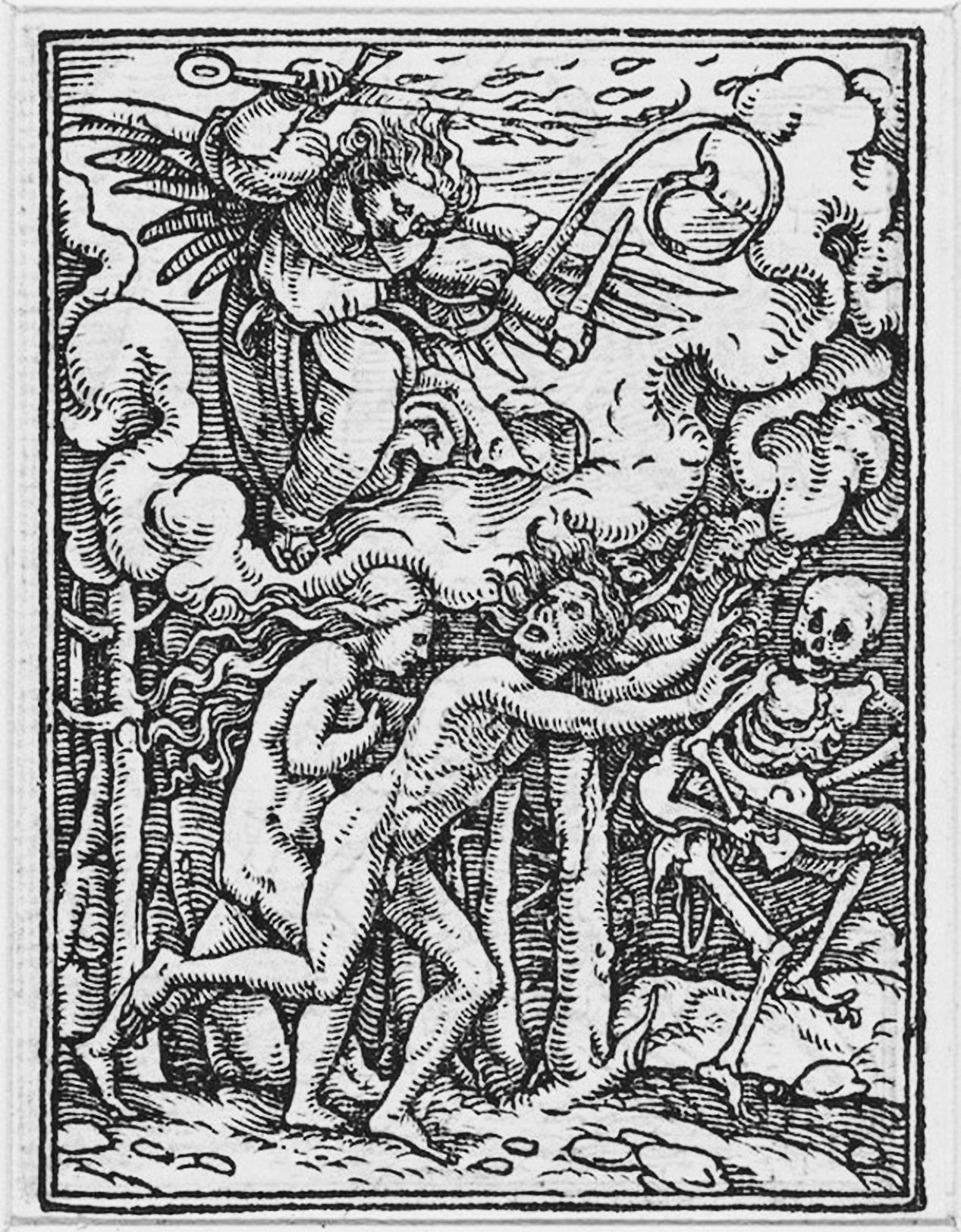
Figure 1.1 Expulsion from paradise. Hans Holbein (1497–1543) created a series of woodblock prints that depicted various scenes in which Death intrudes in everyday life. In this scene, Adam and Eve are cast out of Eden to work “till thou return unto the ground; for out of it wast thou taken: for dust thou art, and unto dust shalt thou return” (Genesis 3:19).
and cooled in the summer. We no longer need to fear predators. We don’t have to forage for food; it’s readily available at a local supermarket. We go to work, watch television, text with each other, and often forget the natural world that still exists all around us. Death, like birth and sickness, is one of those fundamental events that force us to remember that we are still biological animals.
It’s a cliché to say that death is a part of life. The Austrian British philosopher Ludwig Wittgenstein said, “Death is not an event of life. Death is not lived through” (1922, 88). We mostly think of death as the event that ends life. Everyone dies, and so we naturally associate death with the end of the life of a person, or a beloved pet, or the flowers at the end of summer. It could be our own life or that of a loved one. In all of these cases, death is seen as an end. We mourn the lost person or pet. We miss the beauty of the flowers as they wilt, the color fades, and the blooms fall.
Yet death is much more complicated than simply the last event of life. Death is actually interwoven into life at many levels. Some of its manifestations represent an end. Others are critical for development and health.
Rather than having nothing to do with it, as suggested by Maugham’s quote at the beginning of this chapter, we depend on death for our very existence. In fact, death has shaped most of the aspects of our life, and it is intimately linked with our growth, development, protection against disease, and more.
In this book, we will examine the biology of death from several perspectives. We will begin by looking at what life and death are. How do we define life and death? Which organisms are living and which are not? For example, viruses seem to exist at the boundary of life and death (see Chapter 2). In particular, the definition of death has profound practical implications. The traditional definition is the loss of activity in the heart. However, modern medicine can work miracles to artificially maintain a heartbeat and breathing. Many physicians and ethicists prefer brain death as a standard, but that brings many complications, especially legal and ethical ones.
We will then examine the death of whole organisms and the events that occur before and after death (Chapters 3 and 4). So why do we age and die? Deaths from trauma or disease are clear. But what is “old age”—and why do we age at all?
We might speculate that old people die off to spare scarce resources for the benefit of a younger generation. That explanation might make us feel better about aging and death; it might seem to provide some purpose to these events. But as comforting as that explanation might be, it is simply wrong. Aging and death generally occur well after the reproductive years, and thus there is no way for evolutionary pressure to select for this outcome.
We all die, but what happens in that process (Chapter 5). The result is invariably “ashes to ashes and dust to dust.” Death in plants and animals sets in motion a well-defined series of biochemical and microbiological events, and those events are so predictable that they are frequently used in forensic investigations (Chapter 6). When the temperature and other factors are taken into consideration, the lengths of time after death when rigor mortis sets in and then relaxes are well known. Even the succession of insects that invade the dead body is known, and those insects too die and decompose in a predictable manner.
For many thousands of years, humans have recognized the importance of death. They treated the dead in special ways. They buried dead people in locations as simple as a cave or as complex as a pyramid; valuable or useful objects were often included in the burials. Humans are the only species known to show such caring for the dead. Humans have been doing that for a long time, and many anthropologists believe that caring for the dead is a defining characteristic of being human.
The events leading up to death are also well studied. In some cases, the cause of death is trauma or illness. The courses of diseases are, in many cases, understood and reasonably predictable. Aging is another story. Some of its features are trivial (e.g., gray hair, loss of hair, wrinkles). Others are more problematic and involve loss of vigor and strength, muscle and bone mass, hearing and vision, and mental capacity. Americans and many others spend amazing amounts of money trying to slow these inevitable effects.
But why do we age at all? Are we some kind of biological machine that wears out over time? The short answer is that no one really knows. Genetics is clearly involved (Chapter 7). Longevity and certain disease conditions that limit longevity run in families. Progeria is a rare condition that tragically accelerates aging, so that even young children exhibit accelerated manifestations of aging. Might there be a real “fountain of youth” that would allow us to live longer and healthier, even forever? Are red wine and chocolate good for us as well as just good? Molecular genetics has made remarkable progress in the last decades. What was once science fiction is now becoming science fact.
Moreover, the events immediately before and after the death of an individual are not the whole story. Death affects many other aspects of our life and development. Death—the death of cells, tissues, individuals, and even whole populations—is actually interwoven into the lives of all living things. It has made us what we are. The deaths of cells, individuals, and populations have formed us. In fact, death has shaped all life through cycles of life and death, through evolution, and through normal and pathological development. Recycled organic material from one generation provides the nutrients for the next. The atoms and molecules of which we are made have been used before by other living organisms. We “borrow” them for a brief period and, eventually, must give them back so they can be used again and again.
Amazingly, organisms have evolved systems that use death to their advantage. Every cell carries the genetic program that would ensure its death (Chapters 811). In fact, normal development and life could not exist without the carefully regulated death of certain cells. At the cellular and tissue levels, normal development relies on the death of some cells to ensure the proper organization of others. For example, caterpillars transform into butterflies during metamorphosis; during this process, cells die and tissues are lost even as new tissues are built
from new cells. Some aspects of human development bear some resemblance to metamorphosis; for example, a fetus in the early stages of development has tissue between the fingers, but as the fetus grows, that tissue dies so that the digits can move independently. Another example of the role of this process of programmed cell death, or apoptosis, can be seen when the human body is afflicted by disease; damaged cells die off, which allows other healthy cells and the whole organism to survive. A third example of how cell death is part of human life is the fact that certain types of cells wear out and die and must be replaced regularly. In plants, a similar process is a protection that limits infections. Also, leaves fall from trees in the autumn because a line of cells die where a leaf stem is attached.
Even evolution has been influenced by death (Chapter 12). Darwin discovered the principle of natural selection or “survival of the fittest”; in essence, those who are more fit reproduce more effectively. The less fit reproduce less effectively and die sooner. In Farley Mowat’s book Never Cry Wolf (2010), the main character learns that the wolves in the Canadian Artic act as a tool for nature to cull the caribou herd. The wolves observe the herd and test its members to determine which ones are weak, sick, old, or otherwise less able to defend themselves. Those are the caribou that they attack, and in doing that, they eliminate those weaker members, leaving the stronger ones to survive and reproduce. Without the pressure of the wolves, the caribou herd would become weaker overall and suffer. By eliminating injured, old, and diseased animals, the wolves ensure the survival of the caribou. Darwin’s mechanism of survival of the fittest or natural selection has been translated into action. The weaker animals are killed and the more fit survive to procreate. Death ensures life.
In the same way, death has influenced the direction of entire species by foreclosing some evolutionary pathways. Many species have died out over the course of time. And at several points in the history of life on earth nearly every living thing was killed off by cataclysmic events: even highly successful species were suddenly killed off, leaving only a small number to carry on. Whole dominant groups were wiped out. For example, the dinosaurs had ruled earth for millions of years. In a sudden (at least in terms of geologic time) event, they were killed off, and mammals began their rise. So too many hominoid species were lost over time by death or interbreeding, leaving only modern humans (Chapter 13).
The study of death raises significant issues of bioethics (Chapter 14). Research might be directly related to extending human life, or it may focus simply on treating or preventing diseases, particularly of the aged. In either case, thorny ethical problems involve fairness, cost, the risk of unintended consequences, and the alleviation of suffering. Although this book does not examine the many important religious or philosophical aspects of death, these ethical issues are critical for scientists and the general public to consider.
Finally, we will consider the future of death (Chapter 15). In a world in which many of us in the West are insulated from many of the consequences of our biological nature, several events remind us that we are still living organisms: birth, hunger, injury, sickness, and aging. Death is final, at least for now. However, exciting new advances in molecular genetics, stem cell biology, and regenerative medicine may let us stave off death for a while.
Thus, there is more to death than just dying (Chapter 16). It is not simply the end of an individual. Death is intimately intertwined with life. It has made us what we are today by acting at multiple levels: cells, tissues, individuals, even entire populations. Most amazingly, living organisms, even many single-cell organisms, have learned how to take advantage of death to promote growth, development, protection from disease, and even life itself.
2 Defining Life and Death
The boundaries which divide Life from Death are at best shadowy and vague. Who shall say where the one ends, and where the other begins?
Edgar Allan Poe, “The Premature Burial”
In his famous short story “The Premature Burial,” Edgar Allan Poe vividly describes the horror of being buried alive. The premise was that some people are declared dead even though they are still alive, and after burial they awaken in the grave. To give his story credence, Poe cited several accounts (including those of a congressman’s wife, a Parisian journalist, and an artillery officer) of such mistakes, in which graves were opened to reveal that the persons buried had struggled to get out of the grave. He wrote, “To be buried while alive is, beyond question, the most terrific of these extremes which has ever fallen to the lot of mere mortality. That it has frequently, very frequently, so fallen will scarcely be denied by those who think.”
The story and the accounts cited were fiction, but the fear of premature burial was widespread in the eighteenth and nineteenth centuries, and those fears were supported by numerous anecdotal accounts that were likely no more accurate than the ones Poe used. “I might refer at once, if necessary, to a hundred well authenticated instances,” the narrator of Poe’s story says. Of course, the “authenticated” instances were completely fictional.
While the stories were not true and might sound silly to us now, they were common enough in the day: somebody knew somebody who told them that they’d seen it. Some people even made provisions to help them escape the grave or to signal that they were still alive to those above. For example, J. G. Krichbaum of Ohio received a US patent for a device that would alert others to help those who had been buried alive: “My invention has relation to that class of devices for indicating life in persons buried under doubt of being in a trance in which connection is obtained between the person in the grave and an indicator on the ground over the grave through a casing or tube leading from the surface of the ground down to the coffin” (Krichbaum 1882). His and other devices were thought to be needed because of mistakes by those responsible for determining
if a person was truly dead or not. The fear was that the “deceased” might be in some sort of coma and just appear to be dead. The idea even gained traction with the scientific establishment. The London Association for the Prevention of Premature Burial was established in 1896 by Walter Hadwen and William Tebb (JAMA 1899), and Tebb and Colonel Edward Perry Vollum published Premature Burial and How It May Be Prevented (Tebb and Vollum 1896).
To Poe and others of that era, “the boundaries which divide Life and Death are at best shadowy and vague.” Of course, medical science in Poe’s time was much less sophisticated than it is today. The processes of death were then poorly understood, and instrumentation for proper testing was nonexistent. Death was determined by the standard of that day—the loss of breathing and a heartbeat. Interestingly, even with all of our modern medical knowledge and instrumentation, that is still the most-used method of determining death today.
Medicine has come a long way since Poe’s time, but our increased knowledge of life and death and the sophisticated instrumentation that we have developed have not completely ended the uncertainty of determining whether someone has really died, at least in some cases. Questions about life and death continue to haunt us. Premature burial is not the problem; now we wonder how we can be sure that a person is really dead before we harvest organs for transplantation or whether it is too soon to give up and terminate life support for a patient in a persistent vegetative state. Families hoping against hope for a miracle sometimes resist a medical determination. Who can blame them? Furthermore, our powerful modern methods for artificially maintaining respiration and circulation have clouded the determination of death. New tests, such as those for brain activity, are widely used and just as widely disputed. More about this later. But the issue in Poe’s time and, in fact, still in our own is how to determine who is actually dead. To resolve that, we need to understand what it means to be dead or alive.
It seems like it should be easy to differentiate between things that are alive and things that are not, and in many cases it is. We are unlikely to make a mistake when we say that a playful kitten is alive or that a pebble is not. Yet we use the terms life and death so casually that we tend to take them for granted. They are so familiar that we can easily lose track of what they really mean. Most of the time it doesn’t matter. But sometimes it does.
The terms living and dead refer to very different things, of course. Let’s start with the second one. Nonliving things can be divided into two categories: things that were never alive and things that were once alive but no longer are. It’s the latter group of things that we call dead. Things that were never alive and things that are dead share several characteristics, including a lack of movement and a lack of the abilities to reproduce and use energy. Some things that were once alive, such as fossils, retain a degree of internal organization, but so do crystals, which were never alive.
But when it comes to things that are living and things that are dead, sometimes the differentiation is less clear. Are leaves that have fallen from trees in autumn dead or still alive?
Life: Hard to Define
In ancient Greece, Aristotle wrote that “nature proceeds little by little from things lifeless to animal life in such a way that it is impossible to determine the exact line of demarcation” (Aristotle 1910: bk. VIII, pt. 1). We could paraphrase his statement in referring to death. Nature proceeds little by little from things alive to death in such a way that it is impossible to determine the exact line of demarcation.
Since death is the absence of life in something that was once alive, the question becomes: What is life? What is it that makes something alive? What is so special about life that we can differentiate it from death? Scientists have long struggled with these questions. Until the nineteenth century, vitalism was the dominant explanation for life. Vitalism posited that living organisms were governed by nonphysical principles. They were fundamentally different from nonliving material. For example, they argued that organic material could not be made with nonliving materials. Vitalism suffered a serious blow in 1828 when Friedrich Wöhler synthesized urea from inorganic materials. In more recent years, many scientists have weighed in with varying degrees of success, but in the end, all definitions of life seem to come up short.
The physicist Erwin Schrödinger published his classic book What Is Life? in 1944. Schrödinger saw life as bringing “order from disorder.” Heredity is a key characteristic of life and one aspect of bringing order from disorder. How are traits passed on from one generation to the next? Schrödinger believed that whatever was responsible for heredity had to be extremely small, permanent, and nonrepetitive. At that time, little was known about the biochemical basis of heredity. Classical genetics was established well after earlier work by Mendel and others was rediscovered in the early 1900s. The early geneticists who worked with fruit flies in the genus Drosophila, such as Thomas Hunt Morgan, Alfred Sturtevant, H. J. Muller, and Calvin Bridges, made remarkable—even astounding—progress on understanding genetics by sophisticated crossing of flies and examination of offspring (Rubin, 1988). However, without knowing what molecules were actually involved in the process, it was not possible to connect classic genetics to the contents of the cell. Interestingly, also in 1944, Oswald Avery solved one of the biggest problems in biology by showing that DNA was, in fact, the hereditary material. So Schrodinger’s book did not really answer its own question. Yet that does not mean that the book lacked value. The real value
of Schrodinger’s ideas about life was that they inspired other scientists, including physicists such as Maurice Wilkins and Francis Crick, to focus on biological problems. The intersection of physics and biology spurred a great revolution that yielded molecular biology and molecular genetics. The next great step was the determination of the double helix structure of DNA by Crick and biologist James Watson. That discovery provided the molecular basis for the great advances of the next decades.
More recently, Lynn Margulis and Dorion Sagan (2000) contributed an interesting book with the same title, What Is Life? However, they more or less avoided a direct answer to the question. They wrote, “The question ‘What is life?’ is . . . a linguistic trap. To answer according to the rules of grammar, we must supply a noun, a thing. But life on Earth is more like a verb. It repairs, maintains, re-creates, and outdoes itself.” They then elaborated on the notion of life as a verb by describing the activities that characterize life. Others have used a similar strategy, and it may be the best possible answer that we can get. The fact is that life is very hard to define. It’s far easier to explain what it does rather than what it is (Table 2.1). From that we can form an opinion of what life is and, in that way, understand how death lacks those qualities.
Others have also tried their hand at defining life. Stuart Kaufman (2004, 654–665) attempted to ground the definition of life in a more biophysical or thermodynamic manner. He suggested that a living organism is “an autonomous agent in a self-replicating system that is able to perform at least one thermodynamic work cycle.” It was a valiant try, but Kaufman’s explanation founders when he considers how cells organize themselves: “I can only stumble with ordinary English: the cell achieves a propagating organization of building, work, and constraining organization that completes itself by formation of a second cell. Is this matter alone, energy alone, entropy alone, or information alone? No. Do we have
Table 2.1
Characteristics of Living Organisms
They regulate their internal environment (homeostasis).
They are made up of one or more cells (organization).
They use energy (metabolism).
They grow (growth).
They change in response to the environment (adaptation).
They respond to external stimuli (response).
They reproduce themselves (reproduction).
a formulated concept for what I just described? No.” In many ways, his answer is similar to that of Margulis and Sagan: life is a collection of activities. The difficulty in defining life was noted by Daniel Koshland (2002):
What is the definition of life? I remember a conference of the scientific elite that sought to answer that question. Is an enzyme alive? Is a virus alive? Is a cell alive? After many hours of launching promising balloons that defined life in a sentence, followed by equally conclusive punctures of these balloons, a solution seemed at hand: “The ability to reproduce—that is the essential characteristic of life,” said one statesman of science. Everyone nodded in agreement that the essentials of a life were the ability to reproduce, until one small voice was heard. “Then one rabbit is dead. Two rabbits—a male and female—are alive but either one alone is dead.” At that point, we all became convinced that although everyone knows what life is, there is no simple definition of life.
Loike and Pollack (2019) summarized life as “the property of an organism that possesses any genetic code that allows for reproduction, natural selection, and individual mortality.” This definition leaves out robots using artificial intelligence, but it is open to life-forms other than those known on Earth. That is a key aspect to remember. Carl Sagan warned against the tendency to define life according to what we have learned about life on Earth—it could be quite different elsewhere in the universe.
In summary, many outstanding biologists, such as those noted here, have found it to be surprisingly hard to define life. In effect, many of their explanations could be covered by adapting Supreme Court justice Potter Stewart’s famous comment about pornography: we may not be able to define life, but we know it when we see it. Most biologists would likely agree that life has several consistent characteristics that are needed for an organism to be considered to be alive. The term autopoiesis refers to the characteristic of living systems that allows them to maintain and to reproduce itself. It was first suggested by Chilean biologists Humberto Maturana and Francisco Varela (1980). Perhaps this is the most reasonable description of what it means to be alive.
Recognizing Life and Death
As Sagan warned, the characteristics associated with living organisms so far really only apply to those that live on Earth. This biased view ignores the obvious confounding factor: that life elsewhere in the universe might not look much like it does here on Earth. What would life look like on another planet? Just as intriguingly, what did life look like when it first emerged here on Earth? If we created
a new form of life, what would it look like? Those questions are critical issues for three groups of scientists: astrobiologists, who search for extraterrestrial life; those who study the origins of life on Earth; and those who study synthetic biology.
Life in Other Places
Is there life elsewhere in the universe? If so, what form might it take? Would it be similar to life on Earth? Would it be based on carbon? What would characterize that life? Most of us here on Earth can speculate about those questions, but they are a practical matter for exobiologists.
In 2003, the first of five successful NASA rovers landed on Mars to conduct various scientific measurements. Some were aimed at looking for evidence of life (e.g., organic molecules) rather than life itself. Still, knowing what to look for requires an understanding of what is alive. In fact, NASA defines life as a “self-sustaining chemical system capable of Darwinian evolution” (NASA 2020). Steven Benner (2010) carefully reviewed the various definitions and characteristics of life and noted, “Astrobiologists are committed to studying life in the Cosmos, the terran life we know as well as the extraterran life we do not know but hope to encounter. But what exactly do we seek?” That is a great and haunting question. Certainly, writers and filmmakers have imagined many possibilities. The Mos Eisley cantina scene in Star Wars: Episode IV—A New Hope was widely praised for its many imaginative creatures. However, a more careful look shows that it is still heavily influenced by what we know about our own vertebrate biology.
NASA clearly has a deep interest in defining life. Its scientists and other exobiologists are searching the universe for signs of life, even if that life is not quite like life on Earth. Its website notes that the definition of life has “a distinctly gray and fuzzy quality,” rather than being a bright line. That’s not much help, but given how much trouble we have in defining life on Earth that is right in front of us, it’s probably a pretty accurate assessment. Cleland and Chyba (2002) argue that any attempt to define life is premature until a more careful and general description of living creatures is available, perhaps including those from other worlds. That is also not a very satisfying answer, but it may be the best we have.
Origin of Life (and Death)
Research into possible life on other planets is fascinating, but the study of life right here on Earth is equally amazing. How did life begin? Interestingly, questions of
life and death occur only where there is life. Without life, there is no death, but how did it all get started? Abiogenesis refers to the transformation of matter from nonliving to living, and how this happened is one of the great remaining questions in biology. Life might have originated somewhere else in the universe and been transported to Earth. That theory, called panspermia, has been around for some time and was revived most recently by Hoyle and Wickramasinghe (1977). Some support for panspermia has come from recent findings of biological material in meteorites. However, the only life that we are aware of in the universe right now is on Earth. If astrobiologists are successful, the concept of life originating somewhere else might need to be revisited. Even then, the original question about life on Earth would remain.
The Earth is a bit over 4.5 billion years old, and for almost a billion years after it formed, there was no life. Obviously, there was also no death. Then about 3.7 billion years ago, life appeared. The exact mechanism is not yet understood, but one of the first suggestions came from Charles Darwin in a letter to Joseph Hooker in 1871. Darwin wrote about “some warm little pond” that had a mixture of chemicals and a source of energy. He speculated that in this pond a protein substance might have been created that could change over time.
Many researchers have tested more sophisticated versions of Darwin’s “warm little pond” and the recipe he suggested in broad terms. The first, in 1953, were the classic experiments by Stanley Miller and Harold Urey. They showed that basic organic chemicals resulted from the exposure of an early Earth atmosphere to electrical discharges that simulated lightning (Miller and Urey 1959). Many variations on these experiments have clearly demonstrated that various useful biological molecules result from these mixtures.
The next challenge is to find a molecule to preserve this information. Although most forms of life today store their genetic information in DNA, many scientists believe that the earliest life used RNA for this purpose. In addition to preserving information so that life can continue, RNA can act as an enzyme itself without any protein. This was a revolutionary finding. Until then, enzymes, biological molecules that catalyze chemical reaction, were all thought to be proteins. These two characteristics strongly implicate RNA in the beginnings of life. This is often referred to as the “RNA world hypothesis.” But where did the RNA come from? An excellent study in 2009 partially answered this question. It showed that the basic building blocks of RNA can be assembled from simple organic molecules, such as hydrogen sulfide and hydrogen cyanide, other chemical compounds that are widely assumed to have been part of the early Earth, and ultraviolet light (Powner, Gerland, and Sutherland 2009).
Thus, at some point, this nascent chemical biology began to take on some of those characteristics of life that we noted earlier. Through the use of RNA, they could preserve the information for their own existence. This view gained