1
Oxford University Press is a department of the University of Oxford. It furthers the University’s objective of excellence in research, scholarship, and education by publishing worldwide. Oxford is a registered trade mark of Oxford University Press in the UK and certain other countries.
Published in the United States of America by Oxford University Press 198 Madison Avenue, New York, NY 10016, United States of America.
© Oxford University Press 2019
All rights reserved. No part of this publication may be reproduced, stored in a retrieval system, or transmitted, in any form or by any means, without the prior permission in writing of Oxford University Press, or as expressly permitted by law, by license, or under terms agreed with the appropriate reproduction rights organization. Inquiries concerning reproduction outside the scope of the above should be sent to the Rights Department, Oxford University Press, at the address above.
You must not circulate this work in any other form and you must impose this same condition on any acquirer.
CIP data is on file at the Library of Congress
ISBN 978–0–19–092792–9
9 8 7 6 5 4 3 2 1
Printed by Sheridan Books, Inc., United States of America
CONTENTS
Preface xiii
Introduction: The Aesthetic Impulse 1
1. An Animal in Search of Stimulation for Pleasure and Need: Two Stories on the Forces that Drive Us Toward Art and Aesthetics 15
2. The First Humans and the First Art 23
3. What a Sexy Tale! Key Stimuli and Attraction: Aesthetics in the Animal Kingdom 43
4. The Woman in Red and the Man with the Chrome-Plated Wheels: Aesthetics and Key Stimuli in the Human World 53
5. The Human Peacock: Body Ornamentation and Artistic Behavior from Tribal Society to Modern Primitives 77
6. Who Lives Here? Decoration, Design, and Ornamentation on Objects and Surroundings 95
7. Art and the Brain’s Reward System: Brain Processes and Neuroaesthetics 107
8. Fiction and Narrative: The Function of Symbolic Aesthetics 117
9. Summing Up the Aesthetic Impulse: Adaptation, Cheesecake, or . . . ? 129
10. Opening the Doors of Aesthetics: Concluding Remarks 139 Notes 147 References 151 Index 159
PREFACE
I have chills running down my spine. My arms and legs tingle as if charged by static electricity. The hairs on my arms and neck stand up and my skin breaks out in gooseflesh as though hit by a bout of fever. Then I start to feel a lump in my throat. My voice becomes thick and my eyes start to water. My entire system is reacting as though I am having a powerful allergic reaction.
But I am not ill. I am in a state of peaceful bliss. I am looking at something beautiful and it moves me. It is that simple and wonderful.
What has moved me is the Villa Majorelle in Marrakech, Morocco, the former residence of the fashion designer Yves Saint Laurent—an art deco building in intense cobalt blue, turquoise, and lemon yellow colors surrounded by tall lime-green cacti, palm trees, and violet bougainvillea flowers in bloom. I drove through the snow-clad landscape of Denmark. I waited all night in a deserted airport. And now—around 36 hours since I last lay in a bed—I am standing in the dry heat of 26°C under the glaring desert sun in the Jardin Majorelle, feeling my sensory receptors firing at the sight of this color explosion. It is (almost) as pleasurable as great sex, and a number of questions arise: What kind of peculiar animal decorates its surroundings with such aesthetic care? Plants, colors, architecture—everything organized according to an inner aesthetic idea. Moreover, why are we moved to tears when these efforts are successful?
We are all familiar with the puzzling phenomenon of being moved by certain shapes, colors, sounds, and tunes. This aesthetic sensibility is simply one of the main ingredients in the many highlights of life. But why is that, and why on Earth do we even have these delightful sensory experiences? These questions preoccupy me. If they preoccupy you, too, then this book has fallen into the right hands.
A preface is usually written at the end of the writing process and this case is no exception. What is just about to begin for the reader has just ended for the author, and now the two parties meet in the doorway, so to speak. Although not a place fit for a long conversation, before we go our separate ways, I would like to mention the people who have helped me along the way.
Jacob Wamberg, professor of Art History at the University of Aarhus, has read the first drafts of the manuscript and contributed his inspiring comments. So have Dr. Mathias Clasen and Dr. Alexandra Kratchmer of the School of Communication and Culture at the University of Aarhus. It has been valuable to me to have professionals with a background in the humanities read and
comment on my evolutionary and behavioral psychology analyses of the aesthetic impulse before introducing them to a bigger audience, and I owe them a debt of gratitude.
Charlotte Bentsen, MA in English literature, has assisted in translating my idiosyncratic sentences into grammatically correct English. Then there are my friends.
My friend and colleague Dr. Thomas Dalsgaard has contributed immeasurable input. He has read the manuscript several times. He has returned it with red lines and suggestions such as “explain,” “elaborate,” or “leave out,” and I have generally taken his advice.
I want to thank my friend, director, and gallerist, Torsten Hansen, for a great many discussions on aesthetics, art, and what “turns people on.” Torsten has a practical relationship with aesthetics. He makes a living out of selling art and beautiful artifacts that people simply need to own. And I have learned a lot from this practical knowledge.
I also want to thank my partner, Anne-Charlotte Bo, for endless conversations about art, aesthetics, and design and for always providing constructive criticism and inspiration for my projects. Finally, I want to thank my children, William and Hedvig. They have inherited my interest in art and music and they are thus never afraid to make a quick contribution when I am musing on these subjects. This, too, is educational for me.
It has been a pleasure to complete this study. I hope the result is an equally pleasurable experience to read.
Marrakech January 2018
Introduction
THE AESTHETIC IMPULSE
It is cold, dark, and damp.
The space is tight and small so you need to constantly bend over to avoid hitting your head against the overhang. We are now more than two kilometers inside the mountain, and something has been stirring above our heads.
Bats!
Black flapping shadows that, miraculously, never hit us, but startled by our footsteps and the flickering light from our headlights, do what all scared animals do: empty their bowels and escape. It is very effective in films, but right now I would rather be rid of it. I have spent the past few months writing to the French culture authorities and now I am finally here. In Dordogne in the southwest of France, where our ancestors settled more than 40,000 years ago.
The walls are covered in bear claw marks, and there are big round hollows in the bedrock that have been dug out over millennia by bears tossing and turning in their hibernation. And then I suddenly notice them! Completely different markings. Made by our own species. And the reason I am here in the first place.
More than 2.5 kilometers into the cave, the ceiling is decorated with paintings and engravings of horses, bison, mammoths, rhinoceros, and ibex. I feel hot and cold at the same time. This ornamentation defies reason. Why on Earth have humans taken the trouble to do this in such an unreachable place? What pointless effort. What remarkable exertion. No other animal would ever do the same. I am a psychologist and an expert on human behavior, but this is so overwhelmingly peculiar that I am finding it hard to describe it in words.
Any new insight starts with curiosity, and mine is so great that I want to share it with the reader. I have become aware of something that we humans do. We adorn ourselves. We decorate our things. We embellish our homes. This is a curious aesthetic behavioral pattern on which we spend vast amounts of time, energy, and resources and which manifests itself in virtually everything we do
from mindless and meaningless ways of passing time to silliness, festivity, and vanity and to what is central to being human.
It is something specifically human and biologically mysterious that no other animals do, to this degree, and that does not even occur among our closest great ape relatives. The aesthetic impulse to adorn ourselves and our surroundings comes so naturally to us that it is easily overlooked, and it leaves anyone trying to describe it with the privileged problem of not knowing where to start and where to end. In principle, we could start anywhere, so why not simply start with what is right there in front of us.
Right now, I am sitting at my desk at work writing these lines. And what does my workspace look like? Try to imagine it.
I need room to work and provide supervision to students, so there must be a table, a computer, and a couple of chairs. I must also be able to see, so a lightbulb above the table is also necessary. If these things are in place, I can do my job. The walls do not need to be painted and the lightbulb does not need a shade. I do not need carpets, textiles, patterns, and colors on the table and chairs either, and plants, pictures, and all kinds of knick-knack are, of course, completely unnecessary in a workspace. So, a barren room with a table, a couple of chairs, and a lightbulb hanging from the ceiling. Was this how you pictured my office?
Probably not. I would not be able to thrive in such a room, none of my colleagues’ rooms are like that, and if my students were to come to an office at the university that looked as described, they would find it conspicuous and think that the professor occupying the office was probably rather weird.
My office has pictures. It has plants and carpets, and the furniture fabric is color-coordinated in tones of red, ochre, and dusty orange. Even the note board, which is supposed to be a practical thing that keeps track of my appointments, has gradually been taken over by aesthetics. It now holds so many children’s drawings and postcards that there is hardly any room for notes and messages.
Our homes and cities are likewise filled with items that go beyond practical necessity. Our houses are full of colors, designs, patterns, and ornaments on walls, ceilings, floors, furniture, linen, and kitchenware. The cup we drink from has color and painted images on it, and the ceramics are structured in a way that is pleasing to the eye and pleasing to the touch. Our walls are decorated with pictures, patterned wallpaper, and shelves with vases, knick-knacks, and things we like, which gives the room its atmosphere and which makes it feel like home to us.
With the different shapes and colors of plants in our gardens and parks, we shape a pleasing visual sensation for our eyes to rest upon. Even when we cook, eat, and set the table, the look, and not just the flavor, is carefully considered.
Our body aesthetics alone could fill a whole book. We paint our bodies and we dye and cut our hair and beards in elaborate styles. We pierce, brand, tattoo, and ornament our skin. We decorate ourselves with jewelery, feathers, fur, and
leather; we put colors and patterns on the clothes we wear, and we rub oils and heavy, sweet perfumes on our skin.
We make an extra effort out of ourselves and our surroundings when we party and celebrate so that we are literally gorging on different sensory perceptions. We fill the world with music, song, and dance, and we decorate the night sky with fireworks. We work for months on perfecting this aesthetic extravagance. How much time, money, and effort does the Olympics opening ceremony or a carnival or a festival or a wedding cost? And yet we continuously find the time, money, and resources for these beautiful, superfluous, and over-the-top events, and we do so universally.
Man is an animal among other animals on Earth but also a very special animal: an aesthetic animal. It is a being that embellishes itself and its surroundings; that creates art, music, and dance; and that spends vast amounts of time and resources doing so, as if it had nothing better to do. Thus, the aesthetic impulse is a characteristic of the human species that can be found throughout all cultures regardless of time, place, and material status. However, the impulse is obviously not unaffected by these matters.
At a time when our ancestors were barely clothed and had little food they went deep into dark caves to decorate them from floor to ceiling—and these were not even the caves in which they lived. Spears and bowls were barely been finished before they are adorned with ornaments, symbols, and figures. It is as if the aesthetic impulse is a primary impulse in its own right on a par with the need to find shelter and food!
Why do we do this?
Shouldn’t a species that only just has the bare necessities spend its time and effort on something other than artistic decorations that play no part in the function of the object and that do not bring us any closer to the goal of survival? You would think so, but these priorities still exist today among tribes and poor people all over the world.
The San people in the Kalahari Desert, Australian Aborigines, and the Inuit people of the north all tempt fate with a harsh existence in some of the world’s least hospitable environments, and yet they still find the time and energy to decorate their tools, weapons, and kitchenware and to carve beautiful images of the mythological creatures of their beliefs in bone, bark, rock, and sand— for instance the Eland, the Lizard, the Rainbow Serpent, the Mother of the Sea.
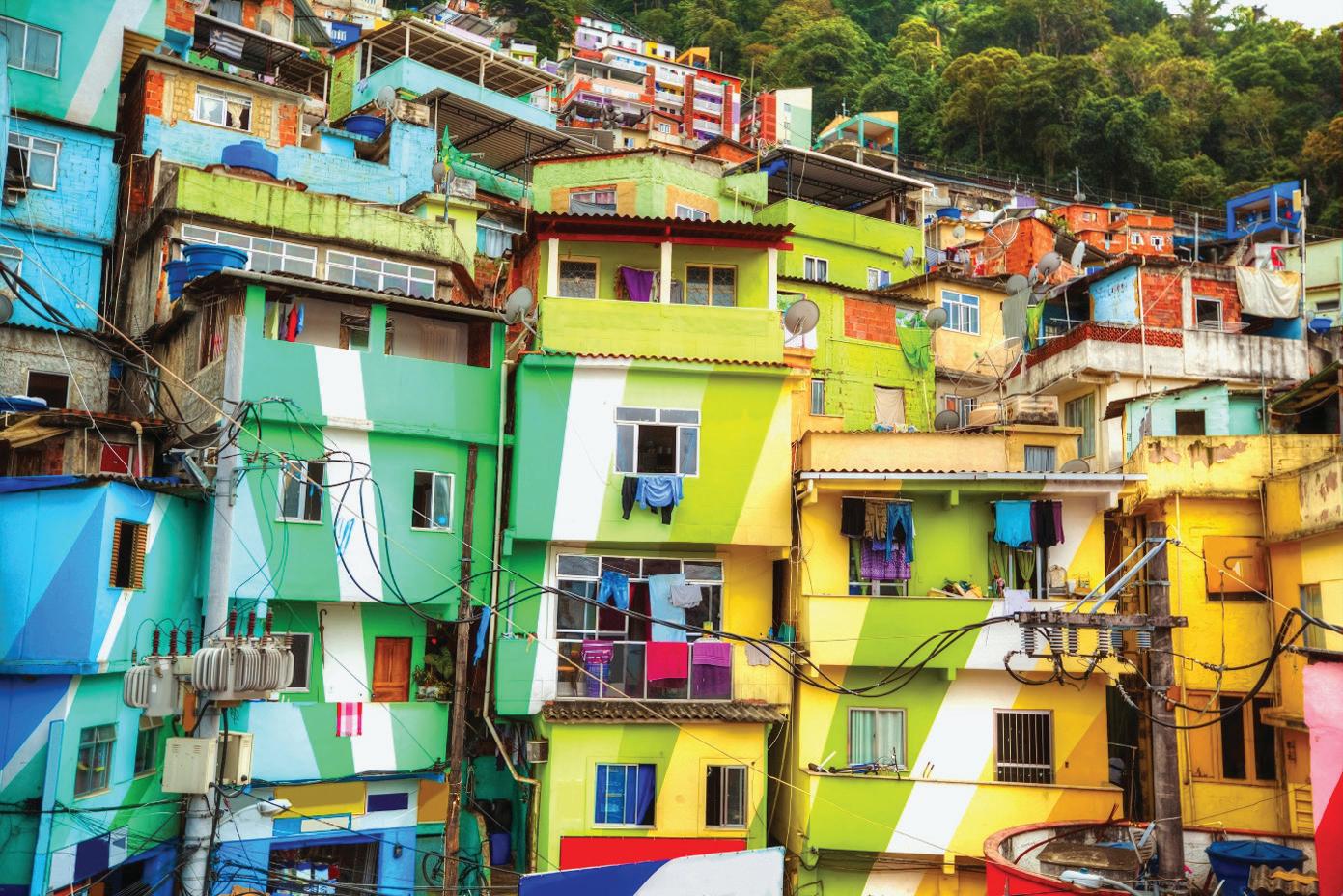
Taking a walk through the favelas of Rio or Sao Paolo, you will find destitution but also aesthetic energy. Houses, walls, and interiors are painted in a multitude of colors (Figure I.1). Glossy magazine pictures of film stars are intermingled with religious icons and blinking fairy lights. The decorations from last year’s carnival are still up. From the moment you can afford a washing-up brush you start to think of what color to choose—should it be red or green? Why?
Source: Skreidzeleu/Shutterstock.com
When asked directly, very few can actually give a satisfactory answer. It is not like it is easy.
If you see me with a hammer, you can ask what I need it for and I can answer that I need to hammer a nail. If you ask me why I want to hammer the nail, I can answer that I want to hang a picture on the wall. And if you then ask me why I want to hang a picture on the wall, I can answer: Because I think it looks nice. But if you then proceed to ask me why I think it looks nice, then I will be at a loss for words. We have now reached a point of reason that cannot be explained further than because I do and because that is what we humans—of the species Homo sapiens have always done. In fact, we are dumbfounded and lapse into silence when confronted with the ultimate whys behind our natural inclinations and urges.
Nevertheless, it is this silence that I want to challenge because we must be able to come closer to the answer than that. Nature simply would not allow a species to waste so much time and effort on an activity completely unrelated to the survival and well-being of that species. Consequently, the aesthetic impulse cannot be meaningless and superficial.
This is likely also why the aesthetic impulse is present from the dawn of both the history of the species and the history of each individual. This impulse appears to be—like language and tool making—an innate disposition of human nature; something we just do that does not require learning and develops spontaneously, but which is, of course, shaped by culture.1 Infants spontaneously
FIGURE I.1. Favela Rio de Janeiro.
follow and respond to song, music, and rhythmic activities. They spontaneously produce doodles on paper, in sand, mud, and spilled liquids, and they attentively follow the patterns that come out of this activity. This rhythmic, motoric creation activity is simultaneously pleasurable for them, and this pleasure sensation will stay with us through adulthood.2 Already at a very young age children spontaneously begin to dress up and paint and adorn themselves.
Theses on the nature of art very rarely mention the quite significant fact that artistic experiences, processes, and presentations give us sensual experiences that are physically pleasurable, which makes us engaged, focused, stimulated, moved, and aroused.3 The fact that the aesthetic impulse is connected to lust indicates that this behavior may very well be of biological value, because one of the ways in which nature makes us do the things that are essential to our survival is by making these activities pleasurable and therefore attractive. This is why we do not need to be rewarded for eating and for having sex. These activities are rewarding in and of themselves.
The Functions of Artistic Behavior
I am not the only one who has been wondering about the functions of artistic behavior in human life, and over time there have been different perspectives on this matter.
In most of the world’s prehistoric and present societies, art is expressed in the context of religious and cultic ceremonies. According to the theological perspective, art in its original form cannot be separated from cult and thus cannot be separated from the basic human search for meaning of life and existence. Humans are predisposed to seek meaning, and art is one of the ways in which this search for meaning is expressed.
But humans also live in groups based on a social hierarchy system and therefore seek status, build a pecking order, and compete with conspecifics for power. According to the sociocultural perspective, the search for meaning through art is therefore also a tool for power, which is used by those who set the agenda: What is good, beautiful, and wonderful; what can and should be appreciated?
Thus, what persistent and revolutionary art products have in common is that they are perceived—through the sociocultural perspective—as tools of power that can be used for positioning, individually as well as in groups, in the fight for status that is continuously fought in societies based on social hierarchy. Art can have this function, and therefore the sociological perspective is not incorrect either.
Through the view of anthropology, the social identity functions of art are considered as characteristics of a group or tribe’s culture, values, and history. Groups need to have an in-group connection and to mark their boundaries to outsiders. For this purpose, we make use of our signs and markings.4
Within my own field—psychology the hows and whats of aesthetics are brought into focus.
Particular emphasis has been placed on aesthetic effects (stimuli, color, design, and pattern), as well as what degree of order, complexity, and ambiguity we are attracted to and that the brain considers pleasurable and engaging in a work of art.5 Furthermore, people within the field of personality psychology have dealt with whether this sensitivity and these aesthetic preferences correlate with certain personality features. Among other things, they have found that people who score high on traits like Stimulation Seeking and Openness in personality tests show greater interest in art than others and tend to like modern, abstract art, whereas people who score high on traits like Conscientiousness and Sociability are more inclined toward traditional, realistic art styles in which it is clear what the image depicts.6
The more ultimate questions of why we even exhibit such behavior and what functions the aesthetic impulse might serve have largely been left to psychoanalysts like Freud and Jung and their successors and thus to theoretical and speculative rather than practical, empirical, and experimental approaches.
Freud, on the one hand, perceives art as he does dreams, slips of the tongue, fairy tales, and neurotic symptoms: as disguised and dissatisfactory instinctual urges of the sexual kind, which the conscious mind and society do not want to acknowledge and which therefore cannot be satisfied openly and directly, but must find an outlet through more indirect and symbolic means. Put briefly, we make art because we cannot satisfy our primary sexual and aggressive urges directly, within the given conditions of society. Art replaces the urge, and in this way art becomes displaced or sublimated satisfaction.
Thus, art becomes a vent through which to let out steam when frustrations become too severe. This is good for the artist as well as society, as the wellexecuted artwork can, according to Freud, simultaneously function as surrogate wish fulfilment for others as well and thus be a kind of cultural pressure relief valve.7
For Jung, on the other hand, art cannot be reduced to a kind of displaced surrogate satisfaction or a symptom of the artist’s underlying frustrations. Rather, the artistic impulse is, according to him, an innate (archetypal), inner urge and a means to self-expression, self-realization, and self-knowledge (Jung 1966).
Art may certainly serve all of these functions, from pressure relief valve to self-realization, as Freud and Jung claim and, as we shall see in Chapters 4 and 5, there is also a probable connection between sex and art, albeit a link different from the one proposed by Freud. But is the primary function of art really to serve as a pressure relief valve for our sexual and aggressive urges, or are there other reasons for the development of this behavioral pattern? I think there are other reasons, and that is what I will attempt to demonstrate in the following chapters.
None of the aforementioned perspectives is wrong per se or mutually exclusive. However, none of them is a sufficient explanation, alone or combined, and there are several reasons for this.
First, they engage the question from the wrong starting point. Most often, they start with Art and art with a capital “A” is accessible for exploration for only a few. However, a far more basic behavioral impulse lies behind artistic activity: The aesthetic impulse or the human need to embellish itself and its surroundings, and its desire to fill time and space with song, music, dance, and stories. This impulse is universal and, once we understand what feeds and motivates this behavior, we can understand why some people create art and what functions this behavior serves in human life.
Second, the aforementioned perspectives fully or partially neglect the fact that man is a biological creature with an evolved history. Moreover, even though aesthetics and art normally fall under the category of culture, it is possible that creating culture is something natural for us humans and that we must therefore explore the human species’ evolved history to find the reason(s) that cannot otherwise be explained.
An impulse is a natural, internal behavioral incentive that does not need external reward to exist. As we will see, a number of observations indicate that the aesthetic impulse is exactly such an inherent part of human nature and therefore a primary impulse in its own right:
• The aesthetic impulse is present in all known present and past human cultures regardless of time, place, and material level.
• It occurs in our infants as an innate, pleasurable activity, which (like playing) does not need to be learned or rewarded in order to exist.
• The brain’s reward circuit is activated when we are presented with aesthetic experiences and objects.
• We voluntarily spend, as individuals and as a society, enormous amounts of time, effort, and resources on satisfying this impulse.
• Useless behavior without value that takes costly resources away from other useful activities is ruthlessly weeded out by selection during the evolutionary history of a species.
In addition, the aesthetic sense has several important functions, as we will see:
• It may guide us toward what is biologically good for us, and help us choose the right fitness-enhancing items in our surroundings.
• Aesthetic behavior is a valid individual fitness indicator as well as a unifying social group marker.
• Aesthetically skilled individuals get more mating• possibilities, higher status, and more collaborative offers.
Thus, as I see it, there is no way around it. If we want to understand the distinctively human need to adorn ourselves and our surroundings—both the need
to personally and actively create, decorate, and embellish and the ability to passively appreciate and enjoy these aesthetic works—we need to look into the evolutionary biology of the human species. We need to enter the psychological engine room and understand our basic programs, motives, and drives. As seen from this level of analysis, there are three distinctive species characteristics that stand out.
First, as a species, humans are highly stimulation-seeking animals. We are, by nature, curious and exploring creatures who investigate our surroundings. Once our basic needs are fulfilled, we do not just passively exist but convert our calorie intake into new stimulation-seeking explorations in our environment and surroundings.
Furthermore, humans live in groups based on a social hierarchy system , as already mentioned. We are social- hierarchic creatures who compete with conspecifics for resources and are allowed access to the basic necessities of life, which we all crave, according to our social status in the group. Sometimes this species characteristic is very pronounced, as with the Yanomami people in the jungle of South America, and other times less so, as with the more egalitarian San Bushmen of South Africa, but it is never absent. The need for status is a deep- rooted human motive that is fundamental for humans all over the world.8 Also in this respect, then, we resemble our primate relatives as well as a vast number of other social species with a pecking order such as dogs, horses, chickens, and all the other domesticated animals we surround ourselves with.
Last but not least, humans are symbolic and “narrative” beings—animals in search of meaning. It is as natural for humans to create stories about who we are, why we are here, and how the world works as it is for a spider to create webs. In this respect, we are unique.
Nothing about the aesthetic impulse makes any sense if these ultimate species characteristics are disregarded and left out. It is therefore in this basic programming that we begin our investigation.
The Structure of the Book
In Chapter 1 we start out with the most basic driving forces behind the aesthetic impulse: the human animal’s ecological living conditions and our ultimate species characteristics as neophile and stimulation-seeking carnivores and food opportunists. Humans turn calorie intake into aesthetic activity, exploration, and play, for instance, instead of sleeping up to 16 hours a day as the big cats do after a successful hunt. Our stimulation-seeking nature and the concept of the optimal stimulation level (OSN) are mandatory for understanding the aesthetic impulse; that is, how and why the aesthetic forms change and develop, and why we are motivated to art and aesthetics both as a species and as individuals.
So far, two main points of view have divided the research. One views relief, energy, and celebration as the main feelings that arouse our need to decorate ourselves and our surroundings, while the other views anxiety, insecurity, and our need to control these feelings as the cause for this artistic activity. So is it pleasure or need that drives us to this behavior?
On the whole, the aesthetic field is full of absolute and seemingly incompatible oppositions through which people have, over time, passionately divided into positions that may only seem to be mutually exclusive. In Chapter 1, I argue that the human need for stimulation is a decisive factor behind the aesthetic impulse and simultaneously show how we, by considering the need for stimulation, can actually end the aforementioned opposition between pleasure and need, celebration and anxiety.
In Chapter 2 we follow the aesthetic impulse back to human prehistory and take a look at prehistoric art. In order to establish our aesthetic inclinations as a primary impulse—and not just as a surplus phenomenon appearing in high cultures in times of plenty, when people have no better things to do—it is important to track this impulse back to its first expression and to the material living conditions at the time. Here, it is interesting who these people are in terms of psychology. Who were the creators of the prehistoric art and what motivated this activity? Here, too, there are different theories and oppositions.
In Chapter 3 we go back even further in evolutionary history and examine whether there are traces of the aesthetic impulse in other species. Do other species have a sense of aesthetics? Do they make aesthetic choices, and do they exhibit examples of aesthetic behavior? Among other things, we will look at bird song and crane dance. We follow the fascinating bowerbirds as they create their remarkable and colorful constructions. And we join in as experiments are conducted with chimpanzees in the lab.
In Chapter 4 we look at how key stimuli and brain programming affect our own species aesthetics and determine which shapes, colors, and landscapes we are attracted to and consider beautiful. Like other animals, we are predisposed to respond to certain key stimuli that have been associated with an expectation of functionality, fitness, and increased well-being. In other words, the perception of beauty represents a strong internal indicator by which it pays to be guided in order to gain various benefits.
In this investigation, we enter the micro-processes of artistic creation. We look at the aesthetic effects that make up a work of art and why something captivates and fascinates us.
Everything beautiful is aesthetic, but not everything aesthetic is beautiful in the traditional sense of the word. We also decorate ourselves and our surroundings for the purpose of intimidation and threat and to signal strength, danger, and power. Similarly, we have a pleasurable fascination with topics that signal dominance and horror. Human and animal skulls can be beautiful and fascinating in their own unique way (any tattoo artist can attest to that), and we will