1 International Legal Argumentation Practice in Need of a Theory
Ian Johnstone and Steven Ratner
I. Introduction
In a decentralized global system that lacks the formal trappings of domestic governance systems, most disputes between and among states and non-state actors never reach either a domestic or an international courtroom for authoritative resolution. This state of affairs continues, even with the creation of new international tribunals in recent decades. Despite, indeed because of, the relative scarcity of judicial settlement of disputes, international legal argumentation remains pervasive, but notably in a range of nonjudicial settings. States, corporations, nongovernmental organizations (NGOs), and even guerrilla groups make claims in international legal terms in political bodies like the United Nations’ organs or domestic parliaments, private diplomatic discussions, and public statements in formal and informal settings.
What purpose does such argumentation serve? What are its effects, intended and unintended? Who is engaging in the argumentation? Who is the audience? What, for that matter, counts as a legal argument and how is it different from other kinds of argument? These questions are not all new, but they have never been addressed systematically in one volume. Answering them is critical to a central goal for scholars and practitioners of international law and relations—to understand how international law actually operates in international affairs.
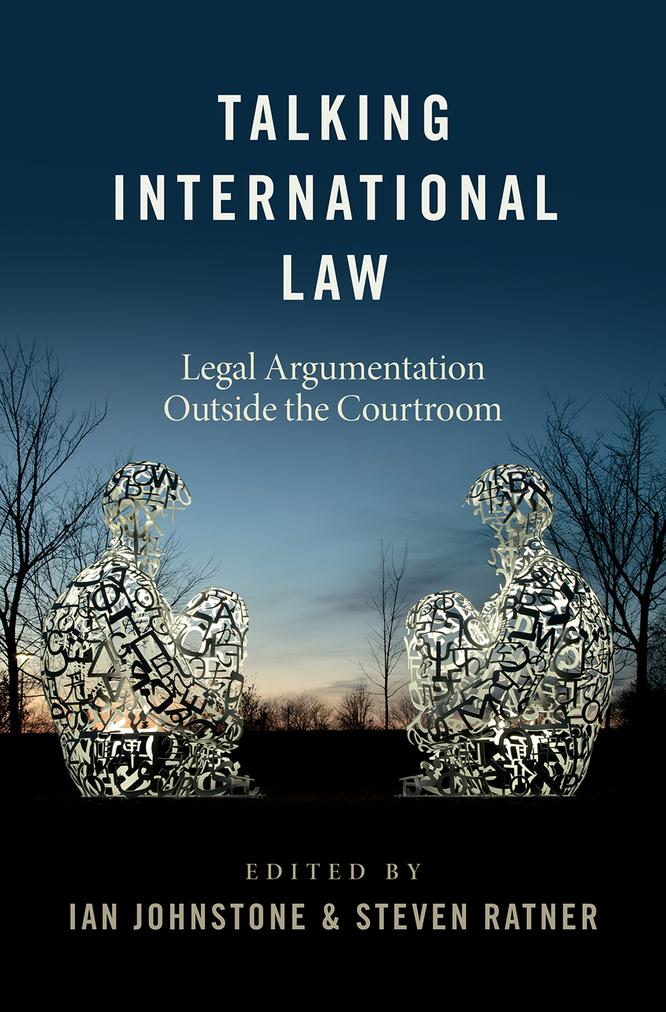
This book probes these and other questions related to the place of international legal arguments from a multi-perspectival lens. It brings together a group of scholars and practitioners from around the world who have either written about or engaged in international legal argumentation outside of courtrooms. We draw on various theoretical traditions that address the phenomenon of argumentation in international affairs, either as an element of legal theory or of international relations theory. Yet our approach is largely inductive, looking at the actual practice of legal argumentation in a variety of settings and issue areas. From the cases, we seek to identify patterns and common themes in why, where, how, and to what effect the language of law is used outside of courts. This fills a significant gap in scholarship on international law and international relations by exploring the microprocess of communication using international law. Ian Johnstone and Steven Ratner, International Legal Argumentation
In this introduction, we will first describe existing theories that address argumentation in international affairs. These are not theories of argumentation per se, but rather areas of legal and international relations theory in which the phenomena of communications and argumentation are central. We then set out the questions our contributors were asked to consider in their essays. The introduction concludes with an overview of each chapter.
II. Argumentation: Theoretical Orientations and Gaps
Law is the language of international society. This proposition, though perhaps an overstatement (states communicate in ways other than through legal argumentation), captures an important feature of how states interact with each other, and increasingly with non-state actors. At least six bodies of scholarly literature address, directly or indirectly, argumentation in international affairs. Three are rooted in international law: compliance theory, interpretation theory, and critical legal theory. Three have found their way into international relations theory, although the first two have roots in other disciplines: communicative action, practice theory, and norm contestation. As the academic fields of international law and international relations have become intertwined, these schools have begun to borrow from each other. Yet they do not add up to a coherent theory. What is missing is a systematic focus on the invocation of legal norms during the conversation about compliance and other matters. This volume is designed to bring us a step closer to a full-blown theory of international legal argumentation.
A. Theories from International Law
1. Compliance Theory
Much of international legal theory focuses on compliance, precisely because coercive enforcement is rare in a decentralized international system. If not out of fear of sanctions, why do states comply with international law? Ever since H.L.A. Hart posited his internal acceptance theory of law, argumentation has been a prominent feature in theories of compliance. For a legal system to exist, sanctions are not necessary; the principal explanation for compliance is an internalized sense of obligation. Several prominent schools of legal thought have built on that insight. The New Haven School or policy-oriented approach associated with Myres McDougal and Harold Lasswell defines law as a “process of authoritative decision-making” characterized by communication between states,1 often in response to international
1 The methodology employed by McDougal and Lasswell is well captured in the following passage: “[t]he communications which constitute an international agreement, like all other communications, are functions of a larger context, and the realistic identification of the content of these communications must require a systematic, comprehensive examination of all the relevant features of that context, with conscious and deliberate appraisal of their significance.” Myres McDougal, Harold Lasswell, and James Miller, The Interpretation of Agreements and World Public Order: Principles of Content and Procedure (New Haven and London: Yale University Press, 1967), 11.
incidents.2 Incidents in particular provoke reactions of decision makers and legal authorities in the form of statements as well as deeds, resulting in back-and-forth argumentation about the legality of actions taken. Transnational Legal Process posits that international law acquires a certain “stickiness” through a process of interaction, interpretation, and internalization.3 Legal argumentation permeates all three elements as governments engage with each other and with domestic actors in articulating what the law means and what compliance requires. And the management model of compliance sees international law as operating through a process of justificatory discourse: “the interpretation, elaboration, application and ultimately enforcement of international rules is accomplished through a process of (mostly verbal) interchange among interested parties.”4 States feel compelled to give reasons and justifications for their conduct; these justifications are reviewed and critiqued in various settings, particularly international institutions. The felt need to have those justifications accepted pushes states in the direction of compliance because, being bound up in an interdependent international system, they want to remain members in good standing in that system.
All three of these schools (New Haven, Transnational Legal Process, and the management model) have elements of both instrumentalism and constructivism in their theories of compliance. The instrumental account is that states obtain tangible benefits from participating in the system. Rules exert an impact on state behavior because states have an interest in reciprocal compliance by other states and in preserving a reputation for playing by the rules so other states will cooperate with them in the future or on other issues. The constructivist account is that membership in the international legal system generates a sense of obligation to comply with its rules and the felt need to be seen as complying. Engaging in legal argumentation to justify one’s actions is a way of remaining a member in good standing.
None of these theories, it should be noted, depends on the interlocutors being truly persuaded of the merits of a rule. As Ryan Goodman and Derek Jinks have argued, state behavior can change through acculturation, the pressure to conform to the beliefs and norms of the surrounding culture.5 The audience need not agree with or even assess the merits of the norm; what matters is the degree of identification it feels (or wants to feel) with some reference group.6 In the geopolitical sphere, the referent group could be other great powers, regional neighbors, democratic countries, or the Global South.7 Acculturation of this sort may lead to internal acceptance of the norm, but the behavior can change before or without that ever happening.
2 W. Michael Reisman and Andrew R. Willard, eds., International Incidents: The Law that Counts in World Politics (Princeton: Princeton University Press, 1988).
3 Harold Hongju Koh, “Why Do Nations Obey International Law?,” Yale Law Journal 106 (1997): 2599 (book review).
4 Abram Chayes and Antonia Chayes, The New Sovereignty: Compliance with International Regulatory Agreements (Cambridge: Harvard University Press, 1995), 118.
5 Ryan Goodman and Derek Jinks, “How to Influence States: Socialization and International Human Rights Law,” Duke Law Journal 54 (2004): 621, 638–645.
6 Alastair Iain Johnston, “Treating International Institutions as Social Environments,” International Studies Quarterly 45 (2001): 487.
7 Courtney Fung, China and Intervention in the UN Security Council (Oxford: Oxford University Press, 2019)
For other legal scholars, true persuasion is central. Tom Franck’s “fairness discourse” involves reasoning and communication on the basis of principles that combine procedural legitimacy and distributive justice.8 Through this discourse, a sense of obligation is fully internalized by the targets of the communication: not only behavior but minds are actually changed. Steven Ratner goes furthest in developing a theory of persuasion by identifying four dimensions of a communications strategy: publicity (how public to be in the argumentation); density (how much law to invoke); directness (whether to appeal for compliance simply because it is the law, or because the law serves some higher purpose); and tone (how confrontational and accusatory to be).9 Ratner does not claim that all persuasion aims to get a target to internalize a norm, but his model suggests what factors will make that more likely.10
2. Interpretation Theory
A growing body of literature considers argumentation through the lens of legal interpretation. All law, according to Ronald Dworkin, is fundamentally an exercise in interpretation.11 In a domestic legal system, judges are the primary (though not sole) interpreters of the law. In the decentralized international legal order, interpretation occurs in a more diffuse process that includes adjudication, but also through the argumentation that occurs in quasi-judicial settings, the political organs of intergovernmental organizations, diplomatic conversation between states, government policy documents and statements, and the writings of practitioners, scholars, and engaged citizens in academic journals, blogs, and media outlets.
Many of those who proffer interpretations of the law in these settings are selfinterested actors, such as the legal advisers to governments. This presents a conundrum. If “auto-interpretation” by self-interested actors is the norm, who decides what is the best interpretation of the law? Iain Scobbie draws on rhetorical theory to postulate that a set of ground rules for persuasive argumentation exists in the process of interpreting international law.12 But he does not explain how those ground rules are administered in a horizontal legal system where there is no court to render authoritative decisions. Ian Johnstone does seek to explain that through the concept of an “interpretive community,” an idea borrowed from literary theory that he applies to the
8 Thomas M. Franck, Fairness in International Law and Institutions (Oxford: Clarendon Press, 1998), at 7, 14.
9 Steven R. Ratner, “Persuading to Comply: On the Deployment and Avoidance of Legal Argumentation,” in Interdisciplinary Perspectives on International Law and International Relations: the State of the Art, edited by Jeffrey L. Dunoff and Mark A. Pollack (New York: Cambridge University Press, 2013), 577. See also Steven Ratner, chapter 6, in this volume.
10 For an earlier analysis of what makes arguments persuasive, see Stephen Toulmin, The Uses of Argument (Cambridge: Cambridge University Press, 1958).
11 Ronald Dworkin, “Law as Interpretation,” Texas Law Review 60 (1982): 27; Owen Fiss, “Objectivity and Interpretation,” Stanford Law Review 34 (1984): 1325; Cass Sunstein, Legal Reasoning and Political Conflict (1996), 167; Richard H. Fallon, Jr., “The Meaning of Legal ‘Meaning’ and Its Implications for Theories of Legal Interpretation,” University of Chicago Law Review 82 (2015): 1235, 1238–1239.
12 Iain Scobbie, “Rhetoric, Persuasion and Interpretation in International Law,” in Interpretation in International Law, edited by Andrea Bianchi, Daniel Peat, and Matthew Windsor (Oxford: Oxford University Press, 2015), 61. His summary of the ground rules is “start from a topic which is an object of agreement, pay attention to the audience’s pre-conceptions, including its understanding of legitimate or proper argumentative methods, adapt the argument to the audience,” at 62.
practice of international law.13 The interpretive community is an amorphous constellation of actors that provides the assumptions, categories of understanding, and conventions of argumentation that make reasoned exchange about the meaning of a text possible. There are widely shared understandings and expectations about the relevant sources, processes, and argumentative techniques that characterize the international legal enterprise. One may question whether Article 38(1) of the International Court of Justice (ICJ) Statute fully exhausts all the so-called sources of international law, or whether Articles 31 and 32 of the Vienna Convention on the Law of Treaties (VCLT) provide adequate guidance on how to interpret treaties. But it is hard to claim that they are not central components of international legal practice. A competent lawyer would ignore these instruments at his or her peril.
Yet the interpretive community does more than simply set the parameters of discourse. It passes judgment on what constitutes the correct (or at least) best interpretation of the law. “Correctness” is not based on objective criteria, but rather is the outcome of an intersubjective, discursive process driven by the assumptions and categories of understanding that are embedded in the international legal discipline. What is a right or wrong interpretation can only be answered by other participants in the interpretive community.14 More concretely, the impact of international law is felt through the weight of international legal opinion; that opinion is both shaped and measured through argumentation.
The participants in the legal discourse include officials and judges who are directly involved in the making, interpretation, and implementation of a particular legal norm. But it extends beyond them to all officials, legislators, judges, lawyers, scholars, and other nongovernmental actors who participate in some way in the field of international law or practice in which the interpretive dispute arises; as well as an amorphous constellation of stakeholders—what can be called transnational civil society—who listen to and critique the discourse that goes on within the inner circles.15 As René Provost points out, non-state actors of various stripes—starting with the most “highly qualified publicists” (enshrined in Article 38(1)(d) of the ICJ Statute) and including NGOs such as the International Committee of the Red Cross (ICRC), and even nonstate armed groups—engage in the process of interpretation.16
13 Ian Johnstone, “Treaty Interpretation: The Authority of Interpretive Communities,” Michigan Journal of International Law 12 (1991): 371. The term “interpretive community” was coined by literary theorist Stanley Fish. See Stanley Fish, Is There a Text in This Class? The Authority of Interpretive Communities (Cambridge: Harvard University Press, 1980) For a review of literature on legal interpretive communities, see Ian Johnstone, The Power of Deliberation: International Law, Political and Organizations (New York: Oxford University Press, 2011), 33–41. For later writing on the concept, see various chapters in Interpretation in International Law, supra note 12.
14 Ingo Venzke, How Interpretation Makes International Law (Oxford: Oxford University Press, 2012), 366; Jean d’Aspremont, “The Multidimensional Process of Interpretation: Content-Determination and Law-Ascertainment Distinguished,” in Interpretation in International Law, supra note 12, at 111, 114.
15 Johnstone, The Power of Deliberation, supra note 13. See also Andraz Zidar, “Interpretation and the Legal Profession: Between Duty and Aspiration,” in Interpretation in International Law, supra note 12, at 135; Jean d’Aspremont, “Wording in International Law,” Leiden Journal of International Law 25 (2012): 575. See contra Gleider Hernandez, “Interpretative Authority and the International Judiciary,” in Interpretation in International Law, supra note 12, at 166.
16 René Provost, “Interpretation in International Law as a Transcultural Project,” in Interpretation in International Law, supra note 12, at 300.
Much of the argumentation about interpretation is aimed at compliance, but the line between compliance with existing law and creating new law is blurry. Interpretation often involves refining, elaborating, or stretching the meaning of a legal term. At a minimum, it gives content to and thereby “hardens” inchoate norms. At a maximum, it is “constitutive of international law.”17 Moreover, even when the argumentation fails to produce clarity on the weight of international legal opinion, interpretative debates can provide structure and a modicum of stability to the international system. Legal argumentation is inherently confrontational, but not necessarily coercive. From one perspective, legal discourse is a battleground; from another, it is a bridge.18 From the first, disputes over interpretation are an “argumentative battle for semantic authority.”19 The battle cannot be mitigated let alone resolved through legal language, because it is about whose language is the true language of international law.20 From the second perspective, argumentation about interpretation is a vehicle for managing the conflicts that are inherent in any pluralistic society. Because it requires the offering up of arguments that fit within a wider context of intersubjective understandings about the rules of international life, it is a bridge if not to consensus and cooperation at least to peaceful coexistence.
3. Critical Legal Theory
Yet, as critical legal theorists remind us, not all participants in legal argumentation are equal: powerful actors dominate. Antonio Gramsci defined hegemony as domination not through brute force but through ideas—by developing an ideology that serves the interests of the powerful at the expense of the less powerful, but which the less powerful come to accept. Dominant actors do not impose order; they construct an order founded on values and ideas that work to their advantage, and then seek to legitimize that order through legal discourse that purports to be apolitical and universal.21 Critical theorists stress that the structure of the international system is not fixed or immutable; it is a product of historical circumstances. It may be so enduring that it comes to be seen as natural, but it is not.
From this perspective, the distribution of power in the international system has a determining impact on the formulation, interpretation, and application of international law. The more powerful actors are better able to dictate the terms of legal debates, to win those debates, and to bear the reputational and other costs if they lose. More insidiously, legal argumentation does not constrain self-serving interpretations
17 d’Aspremont, supra note 14, at 113. Duncan Hollis makes a related point when he speaks of “existential interpretation,” which validates the existence of a rule by deciding whether it even counts as law. Duncan Hollis, “The Existential Function of Interpretation in International Law,” in Interpretation in International Law, supra note 12, at 79.
18 Venzke, supra note 14, at 356–360.
19 d’Aspremont, supra note 14, at 113.
20 Venzke, relying on Davidson, supra note 14, at 369.
21 As Robert Cox put it, “Hegemony derives from the ways of doing and thinking of the dominant social strata of the dominant state or states insofar as these ways of doing and thinking have inspired emulation or acquired the acquiescence of the dominant social strata of other states. These social practices and the ideologies that explain and legitimize them constitute the foundation of the hegemonic order.” Robert W. Cox with Timothy J. Sinclair, Approaches to World Order (Cambridge: Cambridge University Press, 1996), 517.
of the law by powerful actors, but rather legitimizes those interpretations by making them seem like a reflection of universally applicable community standards. Invoking the language of the law hides from view the fact that contestable political choices are being made.22 To give an example, the UN Charter and many General Assembly resolutions enshrine two fundamental principles—“self-determination” and “territorial integrity”—which are often in conflict. Yet international law says little about how to resolve the conflict—about which people are entitled to assert the right to self-determination against states that claim territorial integrity. The principles are in fundamental contradiction, and there is nothing within the law to resolve the contradiction. International law is an elaborate argumentative structure that pretends to resolve these sorts of conflicts, but in the end it comes down to a matter of political choice. Moreover, critical legal theorists claim the argumentative structure is fundamentally incoherent as it vacillates perpetually between asserting that the law operates separate from the realities of power politics and asserting that it functions precisely because it is rooted in the political realities of state practice.23 The project of critical legal studies in a nutshell is to examine the structure of legal argument to reveal that pattern, to reveal the inherent contradictions and hidden ideologies that run through all international law.24
A related critique concerns the power of experts. The critical literature spans both subject matter experts and legal experts. So, for example, economists in the World Bank and International Monetary Fund (IMF) are criticized for constructing structural adjustment policies that adhere to conventional economic wisdom with little regard for the distributional impacts. “Liberal peacebuilders” are accused of crafting programs and institutions that reflect Western conceptions of good governance and the rule of law without considering local perceptions of political legitimacy. In the field of international law, the claim is that legal discourse occurs among a closed circle of lawyers—the “self-appointed visionaries and arbiters of humanity’s needs”25 who shut out perspectives that are beyond the mainstream through technical, formalistic, and ultimately obfuscating legal language. The invocation of legal expertise gets in the way of inclusive decision-making even when important value and political choices are being made.
4. The Missing Elements
Although all three of these theoretical orientations inform our understanding of why states make legal arguments and the effects thereof, none of them zeroes in on the actual microprocess of communication. The choices that international actors make between legal and nonlegal arguments (and the diversity of views about where to draw the line between them); the variety of motivations for and consequences of those
22 Martti Koskenniemi, “The Politics of International Law,” European Journal of International Law 1 (2000): 1.
23 Martti Koskenniemi, From Apology to Utopia: The Structure of International Legal Argument (Cambridge: Cambridge University Press, 2009).
24 David Kennedy, International Legal Structures (Baden Baden: Nomos Verlagsgesellschaft, 1987).
25 Paul B. Stephan, “Comparative International Law, Foreign Relations Law and Fragmentation: Can the Center Hold?,” in Comparative International Law, edited by Anthea Roberts, Paul B. Stephan, PierreHugues Verdier, and Mila Versteeg (New York: Oxford University Press, 2018), 66.
choices; the relevance of the particular speaker, audience, and venue; the role of the thinness or thickness of the existing legal landscape in argumentation; and the implications for the direct targets of an argument as well as others who might hear it are among the critical issues that these theories leave out. Nor, generally, do they consider how and why non-state actors make legal arguments. To address these issues requires unpacking particular argumentative strategies in discrete settings, a task we set out to do in this book through our case studies offered from both scholarly and firsthand perspectives.
B. Theories from International Relations
1. Communicative Action
In indirect response to the critical theorists, Jürgen Habermas posits an ideal of legal argumentation that is not insular: “Legal discourse cannot operate self-sufficiently inside a hermetically sealed universe of existing norms but must rather remain open to arguments from other sources.”26 Though a philosopher and not an international relations theorist, Habermas has applied his theory of communicative action to the European Union.27 His theory holds that there are at least three kinds of communicative behavior: bargaining based on fixed preferences; strategic argumentation, in which arguments are used to justify positions and induce others to change their minds; and “true reasoning,” in which actors seek a reasoned consensus on the basis of shared understandings, where each actor not only tries to persuade but is also open to persuasion.28 The last is Habermas’s ideal of communicative action. It is not meant to describe an actual state of affairs, but its basic principles are presupposed in any linguistic communication.29 It may be impossible to distinguish “true reasoning” from strategic argumentation, but even the latter can have beneficial effects. Jon Elster posits the “civilizing force of hypocrisy”: even hypocritical arguments (seemingly impartial arguments that are really designed to hide one’s self-serving motivations) often lead to principled and more equitable outcomes.30 If the rhetoric changes with every shift in short-term interests, then it will be dismissed as “cheap talk,” and the
26 Jürgen Habermas, Between Facts and Norms (Cambridge: Polity Press, 1996), 230.
27 Jürgen Habermas, The Crisis of the European Union: A Response (Cambridge: Polity Press, 2013).
28 Thomas Risse, “‘Let’s Argue’: Communicative Action in World Politics,” International Organization 54 (2000): 1, 7–9. This is Risse’s summary of Jürgen Habermas’s Theory of Communicative Action, Vol. 2 (New York: Beacon Publishing Group, 1985).
29 Habermas argues that the ideal speech situation is embedded in the very nature of the discourse. “Insofar as participants understand themselves to be engaged in a cooperative search for common ground solely on the basis of good reasons, then they must—as a condition of the intelligibility of their activity— assume that the conditions of the ideal speech situation are satisfied.” See Lars Lose, “Communicative Action and the World of Diplomacy,” in Constructing International Relations: The Next Generation, edited by Karen Fierke and Knud Erik Jorgensen (London: Routledge, 2001), 179. See also Frank Cunningham, Theories of Democracy: A Critical Introduction (London: Routledge, 2002), 176.
30 Jon Elster, “The Strategic Uses of Argument,” in Barriers to Conflict Resolution, edited by Kenneth Arrow, Robert Mnookin, Lee Ross, Amos Tversky, and Robert Wilson (New York: Norton and Norton, 1995), 249. See also Diego Gambetta, “Claro!: An Essay on Discursive Machismo,” in Deliberative Democracy, edited by Jon Elster (Cambridge: Cambridge University Press, 1998), 19, 23.
entire purpose of making impartial arguments is lost.31 Presumably those who engage in the argumentation believe it serves a purpose (or else why bother) and therefore will feel some pressure to match deeds with words in order not to appear blatantly hypocritical.32
In a similar vein, deliberative democrats hold that in a well-functioning democracy, public policy should be decided not only through voting but also through the exchange of reasons that all those who are subject to them can accept.33 This exchange of reasons will not always lead to agreement (that is why legislatures vote) but makes it easier to live with disagreement. If the matter is put to a vote, those who lose can at least feel all the relevant issues were aired and the interests of all stakeholders were considered.34 Friederich Kratochwil, Thomas Risse, Michael Zurn, and others have sought to extend this line of thinking to international affairs.35 They posit a logic of arguing, separate from but related to the logics of consequences and appropriateness.36 According to the third logic, which is tied to the second, arguing helps to construct norms that reflect “appropriate” behavior and to determine whether the norms apply in a particular situation. Some deliberative democrats speak of multiple public spheres in which a range of opinions is developed and exchanged on matters of common concern: “a highly complex network that branches out into a multitude of overlapping international, national, regional, local and sub-cultural arenas.”37 International organizations are settings where a good deal of transnational deliberation occurs. Because international law is a concrete manifestation of shared (intersubjective) understandings about what constitutes acceptable behavior among states, the reasoned exchange that occurs there often has a legal character, although deliberative democrats tend not to acknowledge that point.
2. Practice Theory
Stretching from Ludwig Wittgenstein’s philosophy of language, to Pierre Bourdieu’s sociology, to Étienne Wenger’s organization theory, to Emanuel Adler’s communitarian
31 Cf. Jack Goldsmith and Eric Posner, “Moral and Legal Rhetoric in International Relations: A Rational Choice Perspective,” Journal of Legal Studies 31 (2002): 115; Jack L. Goldsmith and Eric A. Posner, The Limits of International Law (New York: Oxford University Press, 2005), 167.
32 Thomas Risse’s notion of argumentative self-entrapment makes the same point. Risse, supra note 28. See also Frank Schimmelfennig, The EU, NATO, and the Integration of Europe: Rules and Rhetoric (Cambridge: Cambridge University Press, 2003).
33 Amy Gutmann and Dennis Thompson, Democracy and Disagreement (Cambridge, MA: Belknap Press, 1996).
34 Id
35 Risse, supra note 28; Michael Zürn, “Democratic Governance Beyond the Nation-State: The EU and Other International Institutions,” European Journal of International Relations 6 (2000): 183; Friedrich Kratochwil, Rules, Norms and Decisions (Cambridge: Cambridge University Press, 1989).
36 On the logics of consequences and appropriateness, see James March and Johan Olsen, Rediscovering Institutions (New York: Free Press, 1989).
37 Habermas quoted in Philip Schlesinger and Deirdre Kevin, “Can the European Union become a Sphere of Publics?,” in Democracy in the European Union: Integration through Deliberation?, edited by Erik Oddvar Eriksen and Erik Fossum (London: Routledge, 2000), 211. See also Seyla Benhabib, ed., “Towards a Deliberative Model of Democratic Legitimacy,” in Democracy and Difference: Contesting the Boundaries of the Political (Princeton: Princeton University Press, 1996), 74; John Dryzek, Deliberative Global Politics (Cambridge: Polity Press, 2006); James Bohman, “International Regimes and Democratic Governance: Political Equality and Influence in Global Institutions,” International Affairs 73 (1999): 499, 506.
international relations, the concept of a community of practice has deep roots. It has found its way into the international law literature via Yves Dezalay and Bryant Garth, Jutta Brunnée and Stephen Toope, Jens Meierhenrich, and Anthea Roberts.38
To understand the relationship between legal argumentation and communities of practice, four elements of the concept are especially important. The first is “background knowledge,” a term originally coined by John Searle.39 This is similar to Wittgenstein’s idea of “tacit knowledge” and to Habermas’s notion of a “common lifeworld”—the background of shared assumptions, understandings, and practices that make meaningful communication possible. Searle put this in terms of interpretation. No rule is self-interpreting: a person must have contextual understanding to arrive at the correct meaning, and that contextual understanding draws on a cultural awareness, habits of mind, and presuppositions that those engaged in communication must share.
The second is the meaning of “practices.” Adler and Pouliot define them as “socially meaningful patterns of action, which, in being performed more or less competently, simultaneously embody, act out, and possibly reify background knowledge and discourse in and on the material world.”40 A practice is not the same as either action or behavior:
The concept of behavior evokes the material dimension of doing, as a deed performed in or on the world; then the notion of action adds an ideational layer, emphasizing the meaningfulness of the deed at both the subjective and intersubjective levels; and, finally, the term “practice” tacks another layer on the edifice or, better put, makes it hang together as one coherent structure, by pointing out the patterned nature of deeds in socially organized contexts.41
In the international law realm, Meierhenrich explains that practices are habitual, routinized behavior that facilitates a particular understanding of the world: “work activities . . . that are performed in a regularized fashion and which have bearing, whether large or small, on a social phenomenon, in our case, on the operation of international law.”42
The third is the notion of shared discourse. Those who engage in a social practice share a common discourse, a way of speaking about the activities in which they are engaged that reflects a certain perspective on the world.43 Law is a disciplined and specialized form of discourse. There are widely shared understandings and expectations
38 For an excellent review of the philosophical and sociological roots of practice theory, see Jens Meierhenrich, “The Practice of International Law: A Theoretical Analysis,” Law and Contemporary Problems 76 (2013): 1.
39 John Searle, Expression and Meaning: Studies in the Theory of Speech Acts (Cambridge: Cambridge University Press, 1979).
40 Emanuel Adler and Vincent Pouliot, eds., International Practices (New York: Cambridge University Press, 2011), 1, 4.
41 Id. 5.
42 Meierhenrich, supra note 38, at 19.
43 Étienne Wenger, Communities of Practice: Learning Meaning and Identity (Cambridge: Cambridge University Press, 1998), 125–126.
about the relevant sources, processes, and argumentative techniques that characterize the international legal enterprise.
Fourth, being competent in the field is to possess “know-how”—a kind of knowledge that can only be acquired through practice.44 Drawing on Wittgenstein’s language theory and pragmatist philosophy, the idea is that knowledge and competence come from usage. We know the meaning of a word from how it is used. We understand the functioning of a professional discipline from how it is practiced.
Combining these four ideas and applying them to law, international law is an argumentative practice, competence in which depends on possessing a reservoir of background knowledge. One learns the law in part by studying it, but also by engaging in the practice. In so doing, one does not simply (or even primarily) learn black letter rules, but rather acquires tacit legal knowledge—the techniques of argumentation and interpretation that are embedded in the discipline. One internalizes a “certain perspective on the world,” as well as a certain set of methods for reading texts and making claims based on those texts and the contexts in which they are encountered.
3. Norm Contestation
Finally, argument is a central feature of the burgeoning literature on “norm contestation.” This literature stems from the work on norm diffusion pioneered by Martha Finnemore, Katherine Sikkink, and other constructivist international relations scholars.45 While that work addresses how norms spread and become internalized, it does not focus on argumentation per se. Later research on norm contestation does. Antje Wiener defines contestation as “the range of social practices [that] discursively expresses disapproval of norms.”46 She starts from the assumption that, in democratic societies, the norms, rules, and principles of governance ought to be contestable at any given time by those governed by them (drawing on Habermas, among others). Contestation, while inherently confrontational, can generate legitimacy if it is regular and inclusive of all stakeholders.47 Others take a similarly positive view of norm contestation as a way of generating shared understandings, echoing the deliberative democrats.48 Even when the norms originate from a particular culture, such as liberal democracies, contestation can result in the extension of those norms
44 Vincent Pouliot, “The Logic of Practicality: A Theory of Practice of Security Communities,” International Organization 62 (2008): 255, 269.
45 Martha Finnemore and Kathryn Sikkink, “International Norm Dynamics and Political Change,” International Organization 52 (1998): 887; Thomas Risse and Kathryn Sikkink, “The Socialization of International Human Rights Norms into Domestic Practices: An Introduction,” in The Power of Human Rights: International Norms and Domestic Change, edited by Thomas Risse, Stephen C. Ropp, and Kathryn Sikkink (Cambridge: Cambridge University Press, 1999), 1; Margaret Keck and Kathryn Sikkink, Activists Beyond Borders: Advocacy Networks in International Politics (Ithaca, NY: Cornell University Press, 1999).
46 Antje Wiener, Theory of Contestation (New York: Springer, 2014), 1.
47 Id. 10. See also Antje Wiener, “Contested Compliance: Interventions on the Normative Structure of World Politics,” European Journal of International Relations 10 (2004): 189.
48 Wayne Sandholtz, “Dynamics of International Norm Change: Rules Against Wartime Plunder,” European Journal of International Relations 14 (2008): 101. Adam Bower, “Arguing with Law: Strategic Legal Argumentation, US Diplomacy, and Debates over the International Criminal Court,” Review of International Studies 41 (2015): 337.