Significantly updated, the sixth edition features two new chapters:
- ‘Geography and Strategy’, by Daniel Moran, which explores how the physical environment shapes war on land, at sea, in space, and in the air.
- ‘Strategic Studies: The West and the Rest’, by Amitav Acharya and Jiajie He, which explores non-Western contributions to strategic thinking and the need to take these ideas seriously.
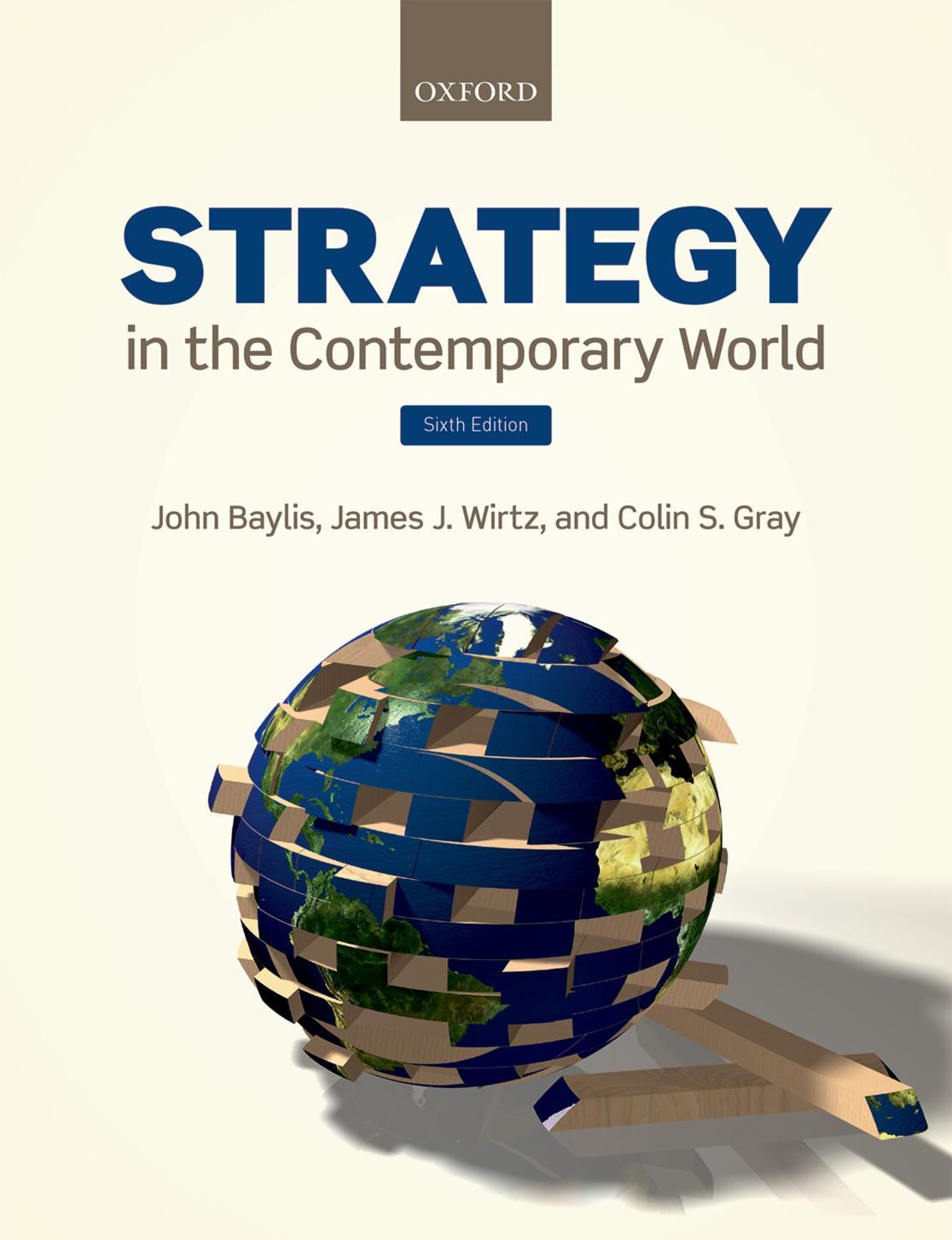
Strategy in the Contemporary World
An Introduction to Strategic Studies
SIXTH EDITION
Edited by
John Baylis, James J. Wirtz, Colin S. Gray
1
Great Clarendon Street, Oxford, OX2 6DP, United Kingdom
The moral rights of the authors have been asserted Third edition 2010 Fourth edition 2013 Fifth edition 2016
Impression: 1
All rights reserved. No part of this publication may be reproduced, stored in a retrieval system, or transmitted, in any form or by any means, without the prior permission in writing of Oxford University Press, or as expressly permitted by law, by licence or under terms agreed with the appropriate reprographics rights organization. Enquiries concerning reproduction outside the scope of the above should be sent to the Rights Department, Oxford University Press, at the address above
You must not circulate this work in any other form and you must impose this same condition on any acquirer
Published in the United States of America by Oxford University Press 198 Madison Avenue, New York, NY 10016, United States of America
British Library Cataloguing in Publication Data Data available
Library of Congress Control Number: 2018949229
ISBN 978–0–19–253689–1
Printed in Great Britain by Bell & Bain Ltd., Glasgow
Links to third party websites are provided by Oxford in good faith and for information only. Oxford disclaims any responsibility for the materials contained in any third party website referenced in this work.
This book is dedicated to the grandchildren of John Baylis— Leo, Connie-Jo, and Olly—in the hope that they will live in a more peaceful world
Acknowledgements
We would like to thank Sarah Iles and Emily Spicer of Oxford University Press for their advice and support with the sixth edition of our text. We benefited greatly from their very efficient analysis of a wide range of reviewers’ comments on the previous edition of the book. These comments, as with previous editions, have proved invaluable to us in improving the text and adding new chapters. We also owe a great debt to Danielle Cohen of Lake Forest College. Her great efficiency, eye for detail, and hard work during the production of the book have been of considerable assistance to the editors.
John Baylis, James J. Wirtz, and Colin S. Gray
List of Contributors
Amitav Acharya is the UNESCO Chair in Transnational Challenges and Governance and Distinguished Professor of International Relations at American University. He is the author of Whose Ideas Matter? (Cornell, 2009); The Making of Southeast Asia (Cornell, 2013); Rethinking Power, Institutions and Ideas in World Politics (Routledge, 2013), and The End of American World Order (Polity, 2014; Oxford, 2015).
John Baylis is Emeritus Professor of Politics and International Relations and a former Pro-Vice Chancellor at Swansea University. Prior to that he was Professor of International Politics and Dean of Social Sciences at Aberystwyth University. He has published more than 20 books and over a hundred chapters and articles. His books include Anglo-American Defence Relations 1939–1984 (Macmillan, 1984); Anglo-American Relations since 1939: The Enduring Alliance (Manchester University Press, 1997); Alternative Nuclear Futures: The Role of Nuclear Weapons in the Post-Cold War World, with Robert O’Neill (Oxford University Press, 2000); The Makers of Nuclear Strategy, with John Garnett (Pinter, 1991); The Globalization of World Politics, with Steve Smith and Patricia Owens (7th edn, Oxford University Press, 2016); An Introduction to Global Politics, with Steven Lamy, Steve Smith, and Patricia Owens (4th edn, Oxford University Press, 2016); and The British Nuclear Experience: The Role of Beliefs, Culture and Identity, with Kristan Stoddart (Oxford University Press, 2015). He has a BA, MSc (Econ), PhD, and DLitt from Swansea and Aberystwyth Universities.
Eliot A. Cohen is Robert E. Osgood Professor of Strategic Studies at Johns Hopkins University’s School of Advanced International Studies. His books include Supreme Command: Soldiers, Statesmen, and Leadership in Wartime (Simon & Schuster, 2002); Conquered into Liberty: Two Centuries of Battles Along the Great Warpath that Made the American Way of War (Free Press, 2011); and, most recently, The Big Stick: The Limits of Soft Power and the Necessity of Military Force (Basic Books, 2017). From 2007 to 2009 he served as Counselor of the Department of State.
John Ferris is a Fellow of the Royal Society of Canada, and a Professor of History at the University of Calgary. He is an Honorary Professor at The Department of International Politics, The University of Aberyswyth, and The Department of Law and Politics at Brunel University, and an Associate Member of Nuffield College, Oxford. He publishes widely in military, international, strategic, and intelligence history, and strategic studies. He is the authorized historian of The Government Communications Headquarters, and his history of GCHQ will be published in 2019, the centenary of that institution.
Sir Lawrence Freedman is Emeritus Professor of War Studies at King’s College London, where he has taught since 1982, and served as Vice-Principal. Elected a Fellow of the British Academy in 1995 and awarded the CBE in 1996, he was appointed Official Historian of the Falklands Campaign in 1997. He was awarded the KCMG in 2003. In June 2009 he was appointed to serve as a member of the official inquiry into Britain and the 2003 Iraq War. Professor Freedman has written extensively on nuclear strategy and the cold war, as well as commentating regularly on contemporary security issues. His most recent books are Strategy: A History (2013) and The Future of War: A History (2017).
The late John Garnett was Woodrow Wilson Professor of International Politics at the University of Wales, Aberystwyth, and, until his retirement, Chairman of the Centre for Defence Studies at King’s College London. He was educated at the London School of Economics where he received a first-class honours degree and master’s in international relations. He was the author of numerous books on international relations and strategic studies, including Contemporary Strategy
(Croom Helm, 1975) with John Baylis, Ken Booth, and Phil Williams; and Makers of Nuclear Strategy (Pinter, 1991) with John Baylis.
Roger Z. George has been Professor of National Security Practice at Occidental College and formerly taught strategy at the National War College. He was a career CIA intelligence analyst who served at the State and Defense departments and has been the National Intelligence Officer for Europe. He is co-editor (with James B. Bruce) of Analyzing Intelligence: Origins, Obstacles, and Innovations (2nd edn, 2014) and co-editor (with Harvey Rishikof) of The National Security Enterprise: Navigating The Labyrinth (2017).
Colin S. Gray is Emeritus Professor of Strategic Studies at the University of Reading. He has advised the American and British governments for many years. Among his books are a trilogy on strategy with Oxford University Press: The Strategy Bridge: Theory for Practice (2010); Perspectives on Strategy (2013); and Strategy and Defence Planning: Meeting the Challenge of Uncertainty (2014). His latest book, also with Oxford University Press, is Theory of Strategy (2018).
Sheena Chestnut Greitens is an Assistant Professor in the Department of Political Science at the University of Missouri. Her research focuses on international and domestic security issues, particularly in East Asia and under non-democratic regimes. Her first book, Dictators and Their Secret Police, was published by Cambridge University Press in 2016, and won the International Studies Association’s best book award.
Jiajie He is a lecturer in the Department of International Politics at Fudan University, China. Her research interests include norm diffusion and localization theory, nation building in China and India, and ASEAN normative influence.
Beatrice Heuser has a Professorship of International Relations at the University of Glasgow. She holds degrees from the Universities of London (BA, MA) and Oxford (DPhil), and a Habilitation from the University of Marburg. She has taught at the Department of War Studies, King’s College London, at five French universities/higher education institutions, and at two German universities, and has briefly worked at NATO headquarters. Her publications include The Evolution of Strategy (2010); Reading Clausewitz (2002); Strategy before Clausewitz (2018), and many works on nuclear strategy, NATO, and transatlantic relations.
Darryl Howlett obtained his master’s degree from Lancaster University and his PhD from Southampton University. His publications include ‘The Emergence of Stability: Deterrence-in-Motion and Deterrence Reconstructed’, in Ian R. Kenyon and John Simpson (eds), Deterrence and the Changing Security Environment (Routledge, 2006).
Jeannie L. Johnson is an Assistant Professor in Political Science at Utah State University. She is the author of The Marines, Counterinsurgency, and Strategic Culture: Lessons Learned and Lost in America’s Wars (Georgetown University Press, 2018) and the co-editor of Crossing Nuclear Thresholds: Leveraging Socio-Cultural Insights into Nuclear Decisionmaking (Palgrave Macmillan, 2018). Dr Johnson previously worked for the CIA’s Directorate of Intelligence and the US State Department. She received her doctorate from the University of Reading in 2013.
James D. Kiras is Professor at the School of Advanced Air and Space Studies, Air University, Maxwell Air Force Base, Alabama, where he directs the courses on irregular warfare, military theory, and graduate-level research methods. He received his PhD from the University of Reading (UK), is a Senior Fellow of the Joint Special Operations University, United States Special Operations Command, Tampa, Florida, and consults and lectures frequently on the subjects of special operations and terrorism. Dr Kiras co-authored Understanding Modern Warfare (Cambridge University Press, rev. edn, 2016) and his first book was Special Operations and Strategy: From World War II to the War on Terrorism (Routledge, 2006).
Jeffrey S. Lantis is Chair of Global and International Studies and Professor of Political Science at the College of Wooster. He earned a PhD in political science from Ohio State University. A former Fulbright Senior Scholar in Australia, he is an expert on strategic culture, international security, and nuclear non-proliferation. Among his many books and academic journal articles, Lantis is author of Arms and Influence: US Technology Innovations and the Evolution of International Security Norms (Stanford University Press, 2016) and editor of Strategic Cultures and Security Policies in the Asia-Pacific (Routledge, 2015).
Thomas G. Mahnken is President and Chief Executive Officer of the Center for Strategic and Budgetary Assessments and Senior Research Professor at the Philip Merrill Center for Strategic Studies at The Johns Hopkins University’s Paul H. Nitze School of Advanced International Studies (SAIS). His books include Strategy in Asia (Stanford University Press, 2014), Competitive Strategies for the 21st Century (Stanford University Press, 2012); Technology and the American Way of War Since 1945 (Columbia University Press, 2008); and Uncovering Ways of War: US Intelligence and Foreign Military Innovation, 1918–1941 (Cornell University Press, 2002). He is editor of The Journal of Strategic Studies
Daniel Moran is Professor of International and Military History in the Department of National Security Affairs at the Naval Postgraduate School in Monterey, California. He was educated at Yale and Stanford Universities, and has been a member of the Institute for Advanced Study at Princeton, and professor of strategy at the Naval War College in Newport, Rhode Island. Professor Moran teaches and writes about strategic theory, American foreign relations, and the history of war and international relations since the nineteenth century.
Justin Morris is Senior Lecturer in the School of Law and Politics at the University of Hull, UK. He was Head of (the then) Department of Politics and International Studies from 2007 to 2013. His primary research interests include: the great powers and the notion of great power responsibility, the United Nations Security Council, and the Responsibility to Protect (specifically in relation to forcible intervention), topics on which he has authored a number of articles. He is co-author (with the late Professor Hilaire McCoubrey) of Regional Peacekeeping in the Post-Cold War Era and co-editor (with Dr Richard Burchill and Professor Nigel White) of International Conflict and Security Law: Essays in Memory of Hilaire McCoubrey
Stefanie Ortmann is a Lecturer in International Relations at the University of Sussex. Her research interests include Russia as a great power in the post-cold war world and the return of a narrative of ‘rising powers’ in world politics as well as critical geopolitics. She has written about the geopolitical concept of spheres of influence, Russia as a great power and its influence in Central Asia, and conspiracy theories.
Columba Peoples is Senior Lecturer in International Relations in the School of Sociology, Politics and International Studies at the University of Bristol, UK. He received his PhD from the University of Wales, Aberystwyth in 2007, and is the author of Justifying Ballistic Missile Defence: Technology, Security and Culture (Cambridge University Press, 2010) and co-author (with Nick Vaughan-Williams) of Critical Security Studies: An Introduction (Routledge, 2015).
Michael Sheehan is Professor of International Relations at Swansea University. He is a graduate of Aberystwyth University (BSc in International Politics 1976, PhD 1985). He is the author of 11 books on security, the most recent being International Security: An Analytical Survey (Lynne Rienner, 2005); The International Politics of Space (Routledge, 2007); and Securing Outer Space (Routledge, 2009, co-edited with Natalie Bormann). He is currently researching Arctic security issues.
John B. Sheldon is Chairman of ThorGroup GmbH, a space and cyberspace consulting company. He was previously a Senior Fellow in Global Security Studies at the Munk School of Global
Affairs at the University of Toronto in Canada. A former British diplomat, John holds bachelor and master’s degrees from the University of Hull, UK, and a PhD in politics and international relations from the University of Reading, UK.
C. Dale Walton is Program Chair and Associate Professor of International Relations at Lindenwood University in St Charles, Missouri, as well as a Senior Research Fellow with the John W. Hammond Institute for Free Enterprise. Prior to coming to Lindenwood, he taught at the University of Reading (UK) and Missouri State University. Dr Walton has published three monographs: Grand Strategy and the Presidency: Foreign Policy, War, and the American Role in the World (2012); Geopolitics and the Great Powers in the Twenty-First Century: Multipolarity and the Revolution in Strategic Perspective (2007); and The Myth of Inevitable US Defeat in Vietnam (2002). He also is one of the co-authors of Understanding Modern Strategy (2nd edn, Cambridge University Press, 2016).
Nick Whittaker teaches international relations and sociology at the International Study Centre, University of Sussex. His research interests include critical geopolitics and British identity and foreign policy. He has recently been published in Geopolitics with the article ‘The Island Race: Ontological Security and Critical Geopolitics in British Parliamentary Discourse’.
James J. Wirtz is the Dean of the School of International Graduate Studies, Naval Postgraduate School, Monterey, California. He is the author of Understanding Intelligence Failure (Routledge, 2017).
Guided Tour of Textbook Features
This book is enriched with a range of learning tools to help you navigate the text and reinforce your knowledge of Strategic Studies. This guided tour shows you how to get the most out of your textbook package and engage effectively with these learning features.
Reader ’s Guide
One of the most import ant qu estions f been how to control weapons re garded structive. During the cold war, this had and de structive capacity of such weap
For
Critical Thinking History ca
● History is the data! History can provide the o never arrives (by definition), while the presen
BOX 10.1 Definitions
Strategy Bridge
The metaphorical concept of a strategy bridge is e strategy performs. Strategy can be considered in f distinctiverealmsofpoliticsandtheirpolicymaki
Key Points
● The emergence of geopolitics reflected a new at the end of the nineteenth century, which em European great powers.
● It also reflected a shifting constellation of pow
Reader’s Guides
Reader’s Guides at the beginning of every chapter provide a clear overview of the scope of coverage within each topic and introduce the contextual background of each chapter.
Critical Thinking
By debating a key topic from each chapter, these boxes encourage you to critically evaluate core questions, presenting opposing arguments so that a reasoned and well-informed conclusion can be formed. Questions encourage you to critically reflect on alternative perspectives and help you to build the important skills of analysis and argumentation.
Boxes
Throughout the book, boxes on Key Perspectives, Key Concepts and Definitions provide you with extra information and contextual background on key topics that complement your understanding of the main chapter text.
Key Points
Each chapter ends with a set of key points that summarize the most important arguments to provide an at a glance overview of the issues raised within each chapter.
End of Chapter Questions
Questions
1. Why did strategists seek to apply ga the main criticisms of this applicatio
2. How convincing are moral critiques
3. Is it possible to achieve scientific obj
Further Reading
P. F. Diehl and N. P. Gleditsch, Environm presents an overview of research on t
N. P. Gleditsch, ‘Whither the Weather? C (2012) 49(1): 3–9 is a selection from a
A set of carefully devised questions has been provided to help you assess your comprehension of core concepts and prompt critical evaluation of key arguments.
Further Reading
To take your learning further, reading lists have been provided to help you familiarise yourself with the key academic literature.
Web Links
Web Links
US Department of Defense http://www.d providing some insight into their disti environment.
The Clausewitz home page http://www.c
At the end of every chapter you will find an annotated summary of useful websites that are central to Strategic Studies to help you explore areas of further research interest.
Guided Tour of the Online Resources
The online resources that accompany this book provide students and instructors with ready-to-use teaching and learning materials. These resources are free of charge and provide opportunities to contextualise and consolidate understanding and further develop skills of critical analysis.
www.oup.com/uk/baylis_strategy6e/
For students:
Case Studies
Six additional case studies with web links and questions help to contextualise your understanding of key debates, focusing on the following conflicts:
1. Afghanistan
2. The South Ossetian war
3. The US–Coalition invasion and occupation of Iraq
4. The conflict in the Congo
5. The Russian war in Chechnya
6. The Iran–Iraq War
7. Additional Case Studies: The Israeli— Palestinian Conflict
Web Links
Web links have been provided to help deepen your understanding of key issues and explore further areas of research interest.
For adopting lecturers:
PowerPoint Slides
These complement each chapter of the book and provide a useful resource in preparing lectures and handouts; they can be fully customized to meet the needs of the course.
Test Bank
This ready-made electronic testing resource can be customized to meet your teaching needs, offering a range of questions to use in lectures and seminars to assess and reinforce students’ understanding.
Introduction: Strategy in the Contemporary World
JOHN BAYLIS AND JAMES J. WIRTZ
Introduction
Books often reflect a specific historical context, shaped by the hopes, fears, and problems that preoccupy authors and policymakers alike. This is especially true of books on strategy, security studies, and public policy because contemporary issues are of paramount importance to authors in these fields. Our efforts also reflect contemporary threats and opportunities. When we gathered in September 2000 to present chapters for the first edition of this volume, we wanted to create a textbook that demonstrated the continued relevance of strategy and strategic studies to interpreting contemporary issues, using insights gained from the classic works on strategy. At that time, some observers suggested that strategy was an obsolete vestige of a dark past, something that would be forgotten in a brighter future. Little did we know that, one year later, the ‘New World Order’ would be shattered by the al-Qaeda attacks on the Pentagon and the World Trade Center. The wars in Afghanistan and Iraq, the terrorist bombings in Madrid in 2004 and London in 2005, and the proliferation of nuclear weapons to North Korea erased any lingering doubts about the relevance of strategy when it came time to produce the second and third editions of this volume. By the time we gathered again in September 2011 to discuss the fourth edition of our project, the ‘al-Qaeda’ decade appeared to have come to an end. But as we scanned the strategic horizon, we began to consider the possibility of a renewal of balance of power politics along the Pacific Rim, a showdown between the West and Iran over its nuclear weapons programme, and the potential threat posed by cyberwar. The list of challenges and issues confronting us continued to grow as we worked to assemble our sixth edition. ISIS has emerged out of the remnants of al-Qaeda, new weapons (unmanned vehicles) and forms of warfare (‘gray zone’ conflict) are commonplace, and a return of great power rivalry not only in Asia, but also in Europe, which was raised as a possibility in the fifth edition, is now a grim reality.
It is clear that interest in strategic studies is cyclical and reflects the times. Strategic studies emerged during the early years of the cold war when political leaders, government officials, and academics interested in security issues wrestled with the problems of how to survive and prosper in the nuclear age, when Armageddon might be just minutes away. Given the experiences of the 1930s, when appeasement and ‘utopian’ ideas of collective security had largely failed to ensure peace, the prevailing mindset during the cold war was one of ‘realism’. It was believed that in a world characterized by anarchy and unending competition, states inevitably exercised power to secure their national interests. For nuclear age realists, however, power had to be exercised in a way that promoted the interests of the state, while at the same time avoiding conflict which would lead to the destruction not only of the states involved but of civilization as a whole. This predicament gave rise to theories of deterrence, limited war, and arms control that dominated the literature of strategic studies (and indeed international relations) during the period from the 1950s to the 1980s. Writings by Herman Kahn, Bernard Brodie, Henry Kissinger, Albert Wohlstetter, and Thomas Schelling became classics in the field. Did the key assumptions inherent in the strategic studies literature lead to the adoption of particular security policies, or did policy itself drive the writing on the subject? The answer to these questions remains a matter of debate. Some believed that the literature reflected existing realities; others believed that the writings themselves helped to generate a particular way of looking at the world and legitimized the use of military power. An iterative process was probably at work, however, as theory and practice modified and reinforced each other.
The great strength of the literature on strategic studies was that it reflected the harsh realities of a world in which military power was (regardless of utopian ideals) an instrument of state policy. One of its weaknesses, however, was the inherent conservatism in realist thinking that implied that the contemporary world was the best of all possible worlds. For good theoretical and practical reasons, realists hoped that the cold war, with its magisterial confrontation between the United States and the Soviet Union, would continue into the indefinite future. Significant change, because it raised the spectre of nuclear Armageddon, was a prospect that was nearly too horrific to contemplate and too risky to act upon.
With the relatively peaceful collapse of the Soviet Union, realism came under suspicion and the ideas and policies of disarmament advocates and utopian thinkers began to hold greater sway in policy circles. The 1990s was the decade of the ‘peace dividend’ and ‘dot.com’ mania as the information revolution entered consumer and business culture. The preoccupation of strategists with the state, and its use of military power, was viewed by a new generation of ‘utopian’ scholars as part of the problem of international security itself. Strategists were often seen as ‘dinosaurs’. Preoccupied with ‘old thinking’, they appeared unwilling to come to terms with the fact that force was apparently fading as a factor in world politics. The traditional emphasis on the military aspects of security was challenged by scholars who believed that the concept should be broadened and deepened. According to this view, there were political, economic, societal, and environmental aspects of security that had been ignored. Some scholars asserted that ‘security’ as a concept had been used by elites to push issues to the top of the political agenda or to secure additional resources for particular policies and government organizations and military programmes. In the view of some critics, official policy was pushed along by armies of military contractors and manufacturers, government workers, and members of the military who had a vested interest in keeping war alive to preserve their careers and livelihoods.
By the mid-1990s, these criticisms of traditional realist thinking were transformed into mainstream scholarship. Security studies emerged as an area of intellectual enquiry that increasingly eclipsed strategic studies. Researchers came to focus on the nature of security itself and how greater security might be achieved at the individual, societal, and even global levels, compared with the cold war preoccupation with state security, defined only in military terms. Although security studies reflected a wider range of theoretical positions than had characterized strategic studies in the past, there was a strong normative (realists would say utopian) dimension to much of the writing, especially from those of a post-positivist persuasion. The end of the cold war fundamentally challenged the conservative tendency in realism (and the strategic studies literature). Peaceful change was now a reality, and military power was no longer seen by many as the predominant prerequisite for security. The balance of terror between East and West had not simply been mitigated (in line with the theories proposed in the strategic studies literature) but had now been transcended, opening up the prospects for a new, more peaceful world. Although the post-cold war euphoria and the literature that followed in its wake were very much a product of their time, there were warning signs in the years leading up to the millennium that the emergence of peace, or as Francis Fukuyama put it ‘an end of history’ (meaning an end of major conflicts), might have been premature. The first Gulf War, the conflicts associated with the disintegration of Yugoslavia, and civil wars in Africa demonstrated all too clearly that military force remained a ubiquitous feature of the contemporary world. It was at this point, just as the al-Qaeda attacks took place in September 2001, that the first edition of this book was published. The book reflected a growing feeling that perhaps too much emphasis in security studies literature had been given to non-military security. The volume suggested that, useful as this new literature was, there was still room for scholarship that focused on the reality that military power remained a significant feature of world politics. Ironically, by the time the initial edition hit the bookshelves, few felt inclined to argue with that position. Although the first edition had much to say about those present circumstances, the ensuing editions contain a more mature set of reflections on the role of military power in the contemporary world and the changes that have occurred over the last two decades. While our sixth edition includes analyses of the conflicts in Afghanistan, Iraq, Libya, Georgia, Lebanon, and Gaza, our contributors have also broadened the coverage of key facets of strategy. We also explore the debates about whether there has been a revolution in military affairs and the future of warfare, given the phenomenal pace of information age innovation that has produced drone and cyberwarfare and nascent applications of artificial intelligence on the battlefield. Attention is also given to the strategic implications of the changing structure of global politics and the role of American military power in a world in transition. At a broader conceptual level, this edition also explores the continuing relevance of various theories of peace and security in a world that is vastly different from the cold war era when these concepts were central to most thinking about strategic studies. Looking back from the perspective of this sixth edition, it is illustrative to note that issues that barely received mention at the turn of the last century—cyberwarfare, transnational terrorism, and ‘hybrid warfare’—now seem to be enduring issues for consideration by strategists. Great power competition, which then seemed to be a vestige of the past, now appears to be again a phenomenon of our times.
To set the scene for the chapters that follow, this introduction answers three questions: (1) What is strategic studies? (2) What criticisms are made of strategic studies? and (3) What is the relationship of strategic studies to security studies?