Series editors: Raymond Rocco, University of California, Los Angeles, and Alfonso Gonzales, University of California, Riverside
The Fight for Time: Migrant Day Laborers and the Politics of Precarity
Paul Apostolidis
Specters of Belonging: The Political Life Cycle of Mexican Migrants
Adrián Félix
Specters of Belonging
The Political Life Cycle of Mexican Migrants
ADRI Á N F É LIX
Oxford University Press is a department of the University of Oxford. It furthers the University’s objective of excellence in research, scholarship, and education by publishing worldwide. Oxford is a registered trade mark of Oxford University Press in the UK and certain other countries.
Published in the United States of America by Oxford University Press 198 Madison Avenue, New York, NY 10016, United States of America.
All rights reserved. No part of this publication may be reproduced, stored in a retrieval system, or transmitted, in any form or by any means, without the prior permission in writing of Oxford University Press, or as expressly permitted by law, by license, or under terms agreed with the appropriate reproduction rights organization. Inquiries concerning reproduction outside the scope of the above should be sent to the Rights Department, Oxford University Press, at the address above.
You must not circulate this work in any other form and you must impose this same condition on any acquirer.
Library of Congress Cataloging-in-Publication Data
Names: Félix, Adrián, 1983– author.
Title: Specters of belonging : the political life cycle of Mexican migrants / Adrián Félix. Description: New York, NY, United States of America : Oxford University Press, [2019] | Series: Studies in subaltern Latina/o politics | Includes bibliographical references and index.
Identifiers: LCCN 2018023202 (print) | LCCN 2018039044 (ebook) | ISBN 9780190879389 (Updf) | ISBN 9780190879396 (Epub) | ISBN 9780190879372 (pbk. : acid-free paper) | ISBN 9780190879365 (hardcover : acid-free paper)
Subjects: LCSH: Mexicans—United States—Politics and government. | Mexican Americans—Politics and government. | Mexican Americans—Attitudes. | Naturalization—United States. | Citizenship—United States. | Return migration—México | United States—Emigration and immigration—Social aspects. | México—Emigration and immigration—Social aspects.
LC record available at https://lccn.loc.gov/2018023202
9 8 7 6 5 4 3 2 1
Paperback printed by Sheridan Books, Inc., United States of America
Hardback printed by Bridgeport National Bindery, Inc., United States of America
Con todo mi amor para mi mamá Lilia Domínguez y mi abuelita Isabel Martínez de Domínguez. Mis matriarcas migrantes.
“Me han puesto cercas, corrales y fronteras. Y no hay alguna que yo no haya brincado...”
-El Solitario
1. Introduction: The Political Life Cycle of Mexican Migrants
2. Enunciations of Transnational Citizenship: Mexican Migrants’ Encounters with Naturalization
3. Enactments of Transnational Citizenship: Migrants’ Entanglements with Mexican Party Politics
4. Embodiments of Transnational Citizenship: Postmortem Repatriation
5.
Foreword: Ghosts across Borders
Adrián Félix is what a young, emerging scholar should be. He knows that the best stories aren’t found in esoteric academic papers or weekend conferences but in the streets, at community free-for-alls, within rallies, and dusty roads. His dives into the hoi polloi (or, as we Mexicans like to call them, el pueblo) unearth the anecdotes and data that journalists dream of, but which he uses as the fuel for theoretical frameworks out of Herbert Gans and Mario T. García. And Félix writes not in the ivory tower gobbledygook, which dooms too many fine tomes to dusty, ignored stacks, but in a language that can cross over to the mainstream—the opening pages of this book are alone worth the price of admission.
But, more importantly, el compa Adrián knows the power of food. Félix and I come from the city he focuses on for this book: Jerez, Zacatecas. It turned out he and my sister were classmates as undergrads at UCLA, but I had no clue who he was until he introduced himself to me when I once lectured at USC, where he was finishing his doctorate. We hit it off quickly, not just because of our shared background, but also because he was as obsessed with the food of our homeland as I was.
Cheese so ripe that its smell could penetrate through concrete. Toasted pumpkin seeds. Vats of quince paste. Fervi, the best Mexican chocolate on the planet thanks to its judicious use of almonds. Birria de res beef prepared goat stew-style. And tiny black seeds called acualaistas that come from a fistsized black squash considered a weed across the Southwest United States and most of México—but snacked on by jerezanos as if we were riding the bench at a baseball game.
I always gave him money on his many visits to Jerez for this book so he could return with these treats. It allowed us a chance to catch up and talk about his research while we munched on lunch. But, more importantly, we
were doing in our own little way what the subjects in Specters of Belonging tried to do on a macro-scale: rage, rage, against the dying of our jerezano light.
I KNOW THE stories, themes, conclusions, and theories examined in Specters of Belonging well, because I lived it all.
Around the 1990s, when I was a teen, I remember my uncles and their friends organizing clubes sociales hometown associations. They held dances in labor halls across Southern California to raise funds and transform their villages from places with no potable water and maybe one telephone line into humble suburbs. The pachangas went on for about fifteen years, until the men and women who collected millions of dollars for their countrymen realized it was all a ruse. Money would improve a road, but it wouldn’t save their villages from the eternal stasis of the Mexican elites.
So some brave ones decided to enter politics. The pioneer was Andrés Bermúdez, whose roots are in my mother’s village of El Cargadero and who once courted one of my aunts. The architect was Lupe Gómez, whose tax service is right next to one of my favorite Mexican beer bars. Félix talks about both men in this book, and I covered many of their stories in my days as a reporter. But I always ultimately wondered: Why were these migrants helping a country that forced them to a foreign land? Why spend so much time and money on efforts whose fruits they would never truly enjoy because their life was now in the United States? And why couldn’t the Mexican government treat these hombres as returning heroes instead of sketchy enemies?
In other words, why fight for a ghost?
I refuse to romanticize what too many academics and activists do. And that’s why Specters of Belonging is so important. Félix remains remarkably clear-eyed about a subject and people in which he has an admitted vested interest. He details the Pyrrhic victories won by the likes of Bermúdez and Gómez. He literally sees the idea of Mexican transnationalism to the graves of jerezanos buried back in the motherland even as they died in a country where most ended up spending the majority of their lives.
And although he unfortunately doesn’t indulge readers in the comida the two of us have shared over the years, Félix introduces a new meal to the diet of transnational studies: the political campaign trail. Instead of obsessing over culture like too many scholars do, he instead focuses on the bureaucratic, the realpolitik, the glad-handlers, and godfathers. This is a mestizo version of The Making of the President 1968, with an ending as unfortunate as that classic but with a glimmer of hope brought on by the pluck of immigrants who gambled
it all yet kept their honor—and ultimately kept the light of the past alive for others to seek it.
Félix joins a long list of Zacatecanos/as in American letters: historian Matt Garcia (whose pioneering research into Southern California Mexican citrus workers gave them a face and story long neglected by academic and mainstream writers), novelist Helena Maria Viramontes, anthropologist Martha Menchaca, and legendary Chicano cartoonist Lalo Alcaraz, with myself as a pretender to their greatness. We all, in our own way, deal with the visage of a past we can never return to, but which we can’t help but to keep alive. Félix takes it to the next step by capturing the efforts of our courageous, damned paisanos. It’s an honor to write this foreword, and watch out for Félix as his ideas permeate immigrant literature in academia.
And Adrián? I think I need another wheel of cheese . . . but I’ll settle for asado de boda.
Gustavo Arellano
Acknowledgments
Where does a migrant ghost belong? In many ways, this book is about restless phantoms and how these migrant specters haunt the projects of nationalism, democracy, citizenship, political membership, and belonging of the U.S. and Mexican states. By these restless ghosts I am referring, of course, to Mexican migrants and their specters of belonging across the transnational space spanning the México‒U.S. borderlands. As such, there are many spirits that inhabit these pages. But before I pay my respect and profess my gratitude to the souls who have nurtured this project, I am going to call out some enemy names. To someone writing and teaching on the political root causes of Mexican migration over the last decade, Donald Trump embodies the principal nemesis, and his nefarious rise to power is an affirmation of everything I’ve said about the United States in relation to ethnic Mexicans and people of color and aggrieved communities more broadly (Asian, Arab, Muslim, Black, Indigenous, Queer, Gender Nonconforming . . .)—it is a settler colonial, white supremacist, antimigrant, xenophobic, hetero-patriarchal, racist, nativist nation-state predicated on imperial citizenship. On the other end of the double-edged blade of transnationalism, I would be remiss if I didn’t call out México’s elite political class, but I will save my full scorn for and disdain of their corrupt regime for later. For now, suffice it to say that for a first-generation son of formerly undocumented, working-class migrants with limited formal schooling to be writing the acknowledgments to this book from the “internal exile” of his ancestral rural hometown deep in the heart of north-central México (the quintessential “spectral village” that so inspired López Velarde over a century ago) is the most fitting and poetic repudiation of Trump and everything he represents. This book is devoted to Mexican migrants’ political struggles, and their specters of belonging will transcend and outlive the imperial citizenship regime of the U.S. state and the clientelistic citizenship regime of the Mexican state that seek to co-opt, domesticate, and/or exclude them altogether on both sides of the border.
Now, allow me to show my love for the many Mexican migrants, comrades, and colleagues who have inspired and supported this project in one way or another. For a book that’s all about roving specters of belonging, there is one enduring phantom that continues to haunt my thinking on Mexican migration: the looming ghost of Don Andrés Bermúdez Viramontes. From the moment of Don Andrés’ wake, the Bermúdez extended household has lovingly made me part of the family. I’ve attended baptisms, birthdays, and burials with the Bermúdez family, honoring the different stages of the migrant political life cycle that frame the chapters of this book. Gracias to Andrés Jr. for opening his home to me and for making a tradition out of his annual trek to Santa Cruz to speak with my students about his father’s transnational legacy. I hope to one day be able to write a definitive political biography of Don Andrés and the many contradictions of this larger-than-life figure who continues to bedevil my musings on Mexican migration.
In my time in Northern California, I have been fortunate to work with the transnational political activists of Proyecto Migrante Zacatecano (PMZ)—a cross-border organization that builds on the legacy of Bermúdez and others but has broken away from the clientelistic grip of the Mexican state and its subnational political institutions and party apparatuses. In Northern California and North Texas, I would like to thank the following Zacatecano/ a political activists (not all PMZ members): Juan Castro, Don Herminio Rodríguez, Andrés Quintero, Silvia Ramírez, and Sergio Ortega.
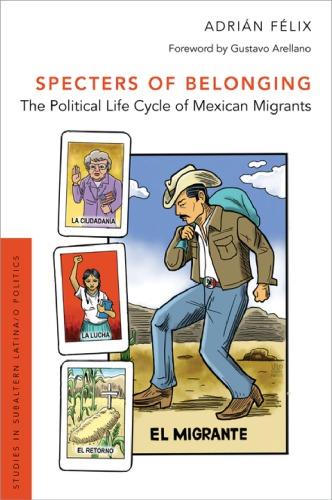
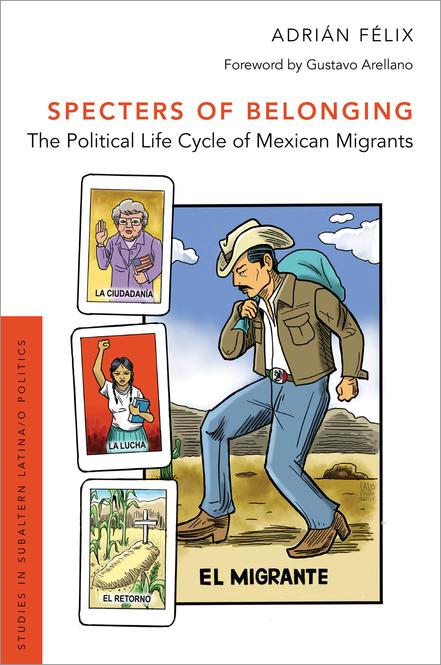
The Zacatecano imprint on this book is evident from beginning to end, including the foreword and the cover, for which I have to thank an everpolemical pair of paisanos the irrepressible journalist Gustavo Arellano and legendary political cartoonist Lalo Alcaraz. While I am much more of an agrarian communist than a “rancho libertarian,” there is no question that those two have been, and will, continue to be important voices in the raging debates around race and migration in the United States.
In my time in Santa Cruz, I had the honor of working with the following community organizations, whose indigenous organic intellectuals and epistemologies helped influence a book on mestizo Mexican migrants: Senderos, the Santa Cruz County Day Worker Center, and MILPA of East Salinas. Also, much love to the participants and volunteers at my citizenship and political education class, which is now entirely run by students.
Now, on to my amazing mentors, colleagues, and students. As an undergraduate student at UCLA, I am fortunate to have met Zachariah Mampilly, who saw potential in a first-generation kid from the northeast San Fernando Valley and introduced me to key mentors who would put me on the activist
research path. As the first person in my family to go to college, it’s very likely I would have fallen through the cracks if it weren’t for mentors like Zach, whose work on armed nonstate actors and third world social movements continues to inspire me. Much love, also, to my UCLA partners in crime— Romeo Guzmán, Miguel Sauceda, Alberto Pereda, and my compadre Andrés Haro—and a shout out to the profe Ray Rocco, who has trained generations of scholar activists.
Once in graduate school at USC, I had the best advisor a PhD student could ask for—Ricardo Ramírez. Ricardo not only allowed me to spread my intellectual wings beyond the methodological confines of Latino politics, he also went above and beyond by making sure I was well nourished— intellectually, spiritually, physically. Ricardo has become a role model and a lifelong personal friend. The rest of my mentors and committee members at USC were just as wonderful. They include Janelle Wong, Nora Hamilton, Pierrette Hondagneu- Sotelo, Carol Wise, Laurie Brand, and Apichai Shipper. Other scholars of borders, migration, memory, and displacement who were deeply influential include George Sánchez, Michael Dear, Josh Kun, Manuel Pastor, and Macarena Gómez-Barris. A very special shout out to Robin D. G. Kelley for the most transformative graduate seminar experience ever and for being such a remarkable scholar and human being.
I wouldn’t have survived graduate school without the moral and intellectual support of fellow graduate students, many of whom have launched their own successful careers as academics and continue to inspire me. From my years at USC I want to thank Abigail Rosas, Ana Elizabeth Rosas, Gerardo Licón, Gustavo Licón, Lisa Ybarra, Denise González, Jillian Medeiros, Glenda Flores, Hernán Ramírez, Jerry González, Ed Flores, and Emir Estrada. A special saludo to the compa Alex Aviña, whose beautiful and powerful book inspired the title for this manuscript. As an early career, interdisciplinary scholar in political science, I wouldn’t have survived the often-hostile field without the support and camaraderie of friends like Arely Zimmerman, Raul Moreno, Chris Zepeda, Osman Balkan, and George Ciccariello-Maher. From the political and migration sociology crowd, thanks to Matt Bakker, Rocio Rosales, Melissa Abad, Lorena Castro, and Danny Olmos. From anthropology, many thanks to the homie Héctor Beltrán.
I am also indebted to colleagues at the Universidad Autónoma de Zacatecas, especially Rodolfo García Zamora, for insightful conversations and useful materials on my multiple field research trips. Thanks also to local archivists Leonardo de la Torre y Berúmen and Nico Rodríguez for granting
me access to vital primary sources and sharing their vast local knowledge of Jerez with me.
Straight out of grad school, I had two amazing post- doc mentors who continue to play supportive roles at different junctures in my career: Phil Williams at the University of Florida (UF) and Jonathan Fox at UC Santa Cruz (now at American University). UF was a great place for me to teach Latino politics/studies and turned out to be an unlikely site for my first apprenticeship in Marxism (¡ahí estamos compa Beto!). Jonathan Fox’s vast knowledge of Mexican politics and migration never ceases to amaze me, and he always keeps me sharp with his impossible devil’s advocate questions.
UC Santa Cruz’s department of Latin American and Latino Studies (LALS) was the most amazing intellectual community a young scholar activist could call home and it feels bittersweet to offer this as my despedida. In the LALS family and beyond I want to thank Sylvanna Falcón, Shannon Gleeson, Pat Zavella, Cat Ramírez, Gabi Arredondo, Rosa-Linda Fregoso, Cecilia Rivas, Jessica Taft, Fernando Leiva, Patricia Pinho, and Peggy Estrada. A special thanks to Alessandra Alvares, LALS’s undergrad advisor. I am going to miss you all! Beyond LALS I want to thank Norma Klahn, Felicity Amaya-Schaeffer, Marcia Ochoa, Olga Nájera-Ramírez, Juan Poblete, Mark Massoud, Kent Eaton, Verónica Terríquez, Steve McKay, Eric Porter, Grace Peña Delgado, Kristina Lyons, and Nick Mitchell. I also want to thank the following folks who I met as grad students/post-docs at UCSC, several of whom have now launched successful careers in academia and beyond: Tania Cruz Salazar, Xóchitl Chávez, Claudia López, Ruben Espinoza, Chava Contreras, and, especially, Alicia Romero, for offering me a home away from home in our memorable years in exile in San José.
Last but not least, I want to thank my undergraduate students at UCSC and beyond—too many to name here but special mention is in order for Adi Reséndez (for her ongoing work with Latin American artisan communities); Andrés Arias, Lili Romero, and Adriana Garcia (for accompanying me on different occasions to immigration court as I served as an expert witness); Miriam Campos (for carrying the torch of the citizenship class in Santa Cruz); Angel Álvarez (for being a trusted liaison with community organizations); Juan Quiñones (for being my entrée into local San José politics, even when I didn’t want him to be!); Christy Sandoval (for her phenomenal work as choreographer/director at Teatro Campesino); Citlally Figueroa (for being such a gracious empress of all things East San José); and Jocelyn Aguirre (for sharing with me the intimate ruptures of Mexican migration in her personal and family life). It is for you and the future generations of students to come
that I write. I look forward to the next phase of my career in the Department of Ethnic Studies at UC Riverside, where I get the honor of working with my colega, Alfonso Gonzales.
Throughout my career, I’ve had the financial support of several institutions and programs including the McNair Scholars Program, the American Political Science Association Minority Fellows Program, the Ford Foundation Predoctoral Fellowship Program, the UC President’s Postdoctoral Fellowship Program, the Institute for Latino Studies Young Scholars Symposium at Notre Dame, and the Woodrow Wilson Early Career Enhancement Fellowship for Junior Faculty, among others. This last award allowed me to take a (muchneeded) sabbatical in the Department of Ethnic Studies at Santa Clara University. I want to thank my colleagues Anna Sampaio, James Lai, Clarisa Pérez-Armendáriz, and Patrick Lopez-Aguado for my short but productive stay at SCU. During this award period, I had the honor of working with Alicia Schmidt Camacho. Alicia and Lisa García Bedolla are two of my greatest academic role models for their deep sense of community, solidarity, social justice, and family.
Speaking of familia, I want to end by thanking my closest friends, family, and loved ones. In my time in Santa Cruz/San José, a couple of jalisciense/ Zacatecano families lovingly opened their homes to me: the González and Santillán- Castro clans. Of course, my greatest source of love, support, and inspiration is my immediate family. I thank my father Rosendo Félix—in many ways the quintessential Zacatecano migrant (for better and for worse!) who has worked incessantly since arriving to the United States in the late 1970s—for those nights when he was especially generous with his memories of life back in the rancho. I listened intently. I also want to thank my four brothers and their partners—Iván, Esteban, Jonathan, and Ernesto and my lovely primas, Diana, Jackie, Stephanie, and Mónica. I hope this book makes you proud, the way each one of you makes me proud in your own unique way. I can’t wait to share this book with my sobrinos/as! Special thanks to my tío Carlos, for being a constant research companion in Zacatecas and for sharing his uniquely mad view of the world with me.
I have always been bendito entre las mujeres and, as such, the greatest source of moral and spiritual support has been the women in my family—my migrant matriarchs—the loving legion of tías (my tía Lupe, Chela, and Toña especially), abuelita (my sweet abue Chabela), and above all, my dear mother, Lilia. Upon migrating to the United States, my loving mother selflessly endured countless sacrifices with the interest of her children always in mind. La amo con todo mi corazón mamá y le dedico esta obra con todo mi cariño.
xx Acknowledgments
Last, I thank Claudia Judith González and her family—my eternal mestiza muse.
Adrián Félix
Jerez, Zacatecas
January 1, 2018
Specters of Belonging
1
Introduction
The Political Life Cycle of Mexican Migrants
The Thickening of Transnational Citizenship
It was the closing day of Guadalupe Gómez’s campaign for a seat in México’s federal congress in the midterm elections of summer 2009. A longtime resident of Orange County, California, Gómez was the only contender to run as a “migrant candidate,” doing so with the right-wing Partido Acción Nacional (National Action Party, or PAN) in his home state of Zacatecas. Like Gómez, I traveled from Southern California to Zacatecas to shadow the migrantturned-politician as he took to the campaign trail. It had been an intense summer of campaigning in the migrant-sending municipios of Zacatecas and its remote ranchos (villages)—the state that, like the candidate, my parents had left for the United States in search of work decades earlier.1 On the final day of the campaign, I traveled to the charming municipality of Genaro Codina to attend Gómez’s last speech before driving back two hours to the district seat for the official closing rally that evening.2 As Gómez delivered his speech and subsequently shook hands and listened to the grievances of the gathered crowd—mostly local campesinos who supplement their livelihood with remittances from relatives in the United States—I reached over to the candidate with the familiarity of a campaign operative and uttered that I would get a head start back to the district seat to await his final rally later that night. By that point, I had become such a fixture at Gómez’s campaign
All personal names in this study were changed for purposes of anonymity except in the case of political officials and activists who consented to being interviewed for this project.
events that he began publicly acknowledging the presence of a “U.S. academic” in his speeches.3
I took to the road with the sense of satisfaction that came on the closing day of what turned out to be a competitive campaign for the migrant candidate. Little did I know that further up the highway, I would find myself, quite literally, in the wrong place, at the wrong time. Unbeknownst to me, as we wrapped up Gómez’s closing campaign event, a gun battle had unfolded between members of the Mexican military and cartel henchmen in a community not far from Genaro Codina. As luck would have it, I approached that community precisely as one of the cartel gunmen was trying to make an escape. I slowed my vehicle as I neared the speed bumps, the only barrier that allows local villagers to cross the narrow two-lane highway. A man stood by the side of the road and slowly began to cross. I made nothing of it at first, until the man stopped in the middle of the lane, reached for his waistband, pulled out a handgun, assumed the shooting position and aimed directly at me, unflinchingly. As my truck was coming to a halt (with nowhere to turn), I realized that the gunman was in urgent need of a getaway vehicle, his face covered in blood. Well aware of the modus operandi of these roving armed bands, my immediate reaction was to not surrender my vehicle and instead swerve out of his line of fire and speed away, hoping for the best. I put my truck in gear, turned the wheel and ducked, expecting to hear the blast from the gun and glass shattering as I sped past him, flying over the speed bumps. Yet, there was nothing. As I looked up and into the rearview mirror, adrenaline rushing through my body, I realized that the subject was out of ammunition, effectively having emptied his rounds in the gun battle with the soldiers. My immediate thought was of the candidate who was coming up the highway. For a split second, I considered turning around and confronting the injured suspect. Seeing a Federal Police patrol car racing down the highway, instead I continued driving, phoning Gómez directly to alert him of the scene up the road.
What exactly were Gómez and I—two residents of Southern California— doing in rural México in the midst of a raging “Drug War”?4 To the cynics, Gómez was there for the spoils of office and I, the “academic,” was there to document and “study” Mexican migrants’ incursion into the increasingly troubled politics of their homeland. Yet, despite some political and ideological differences between the two of us (I am no PANista), I believe that Gómez and I were there for the same reason. As Gómez put it on a separate occasion, we were both there because “tenemos nuestro corazón allá” (we left our heart over there). Indeed, Gómez’s— and to some degree my own—return
was akin to our (post)revolutionary poet Ramón López Velarde’s fateful arrival to a “subverted Eden,” a “spectral village” ensnared in violence where the “prodigal son” found his “hope shattered” but not defeated.5 It was our deliberate diasporic return to the homeland’s “maize- covered surface” and its “mutilated territory,” to cite López Velarde’s more celebrated post-revolutionary poetics.6
Over the course of the last thirty years, Lupe Gómez has lived, established and operated a successful business, and raised a family in Orange County, California.7 He is a naturalized U.S. citizen and a registered Democrat. As a successful business owner, Gómez says he has the “mind of a Republican” when it comes to cutting taxes but is a “Democrat at heart,” because of his commitment to social justice and the welfare state. This degree of migrant social, economic, and political “integration” in the United States notwithstanding, Gómez has clearly maintained strong ties with his community and country of origin. Notably, Lupe Gómez has been an active leader in California-based Mexican hometown associations (HTAs) from the state of Zacatecas. He’s a past president of the famed Federación de Clubes Zacatecanos del Sur de California.8 Despite the risks, and his fulltime obligations in Orange County, Gómez was the only person to run for a single-member- district seat in México’s 2009 congressional elections as a U.S.-based “migrant candidate,” an option that has been made available to paisanos since the early 2000s (see chapter 3 for a full discussion). Nearly ten years after his initial bid for office, Gómez was recruited as a proportional representation candidate for México’s federal congress in the 2018 election cycle, this time by Movimiento Ciudadano. In short, Lupe Gómez is a paradigmatic example of the thickening of transnational citizenship the political process by which Mexican migrants simultaneously cultivate crossborder citizenship claims in México and the United States over the course of their “civic lives” (see Wals 2010).9 To borrow from Levitt’s classic ethnography, “The more diverse and thick a transnational social field is, the more numerous the ways it offers migrants to remain active in their homelands” and in the United States (2001: 9).
As the U.S. state has “thickened” its border with México over the last decades (see Andreas 2009), escalating the racialized policing of migrant bodies, so too have Mexican migrants “thickened” their cross-border claims of transnational political membership and belonging (Smith and Bakker 2008).10 Since September 11, 2001, the “homeland security state” has deepened its migration- control apparatus in Latino communities throughout the United States (Gonzales 2013) in a process akin to what