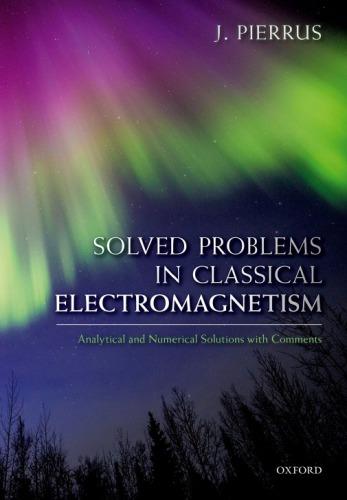
SolvedProblemsin ClassicalElectromagnetism
Analyticalandnumericalsolutionswithcomments
J.Pierrus
SchoolofChemistryandPhysics,UniversityofKwaZulu-Natal, Pietermaritzburg,SouthAfrica
GreatClarendonStreet,Oxford,OX26DP, UnitedKingdom
OxfordUniversityPressisadepartmentoftheUniversityofOxford. ItfurtherstheUniversity’sobjectiveofexcellenceinresearch,scholarship, andeducationbypublishingworldwide.Oxfordisaregisteredtrademarkof OxfordUniversityPressintheUKandincertainothercountries
c J.Pierrus2018
Themoralrightsoftheauthorhavebeenasserted FirstEditionpublishedin2018 Impression:1
Allrightsreserved.Nopartofthispublicationmaybereproduced,storedin aretrievalsystem,ortransmitted,inanyformorbyanymeans,withoutthe priorpermissioninwritingofOxfordUniversityPress,orasexpresslypermitted bylaw,bylicenceorundertermsagreedwiththeappropriatereprographics rightsorganization.Enquiriesconcerningreproductionoutsidethescopeofthe aboveshouldbesenttotheRightsDepartment,OxfordUniversityPress,atthe addressabove
Youmustnotcirculatethisworkinanyotherform andyoumustimposethissameconditiononanyacquirer
PublishedintheUnitedStatesofAmericabyOxfordUniversityPress 198MadisonAvenue,NewYork,NY10016,UnitedStatesofAmerica BritishLibraryCataloguinginPublicationData Dataavailable
LibraryofCongressControlNumber:2018932794
ISBN978–0–19–882191–5(hbk.) ISBN978–0–19–882192–2(pbk.) DOI:10.1093/oso/9780198821915.001.0001
Printedandboundby CPIGroup(UK)Ltd,Croydon,CR04YY
LinkstothirdpartywebsitesareprovidedbyOxfordingoodfaithand forinformationonly.Oxforddisclaimsanyresponsibilityforthematerials containedinanythirdpartywebsitereferencedinthiswork.
Preface
Thesedaystherearemanyexcellenttextbooksrangingfromtheintroductorytothe advanced,andwhichcoverallthecorepartsofatraditionalphysicscurriculum.The Solvedproblemsin... books(thisbeingthesecond)werewrittentofillagapfor thosestudentswhopreferself-study.Hopefully,theformatissufficientlyappealingto justifyenteringanalreadycrowdedspacewherethereisn’tmuchroomfororiginal insightandnewpointsofview.
Thisbookfollowsitspredecessor[1] bothinstyleandapproach.Itcontainsnearly 300questionsandsolutionsonarangeoftopicsinclassicalelectromagnetismthat areusuallyencounteredduringthefirstfouryearsofauniversityphysicsdegree. Mostquestionsendwithaseriesofcommentsthatemphasizeimportantconclusions arisingfromtheproblem.Sometimes,possibleextensionsoftheproblemandadditional aspectsofinterestarealsomentioned.Thebookisaimedprimarilyatphysicsstudents, althoughitwillbeusefultoengineeringandotherphysicalsciencemajorsaswell.In addition,lecturersmayfindthatsomeofthematerialcanbereadilyadaptedfor examinationpurposes.
Whereverpossible,anattempthasbeenmadetodevelopthethemeofeachchapter fromafewfundamentalprinciples.Theseareoutlinedeitherintheintroductionorin thefirstfewquestionsofthechapter.Variousapplicationsthenfollow.Inevitably,the author’spersonalpreferencesarereflectedinthechoiceofsubjectmatter,although hopefullynotattheexpenseofprovidingabalancedoverviewofthecorematerial. Questionsarearrangedinawaywhichleadstoanaturalflowofthekeyconceptsand ideas,ratherthanaccordingtotheir‘degreeofdifficulty’.Thosemarkedwitha ** superscriptindicatespecializedmaterialandaremostlikelysuitableforpostgraduate students.Questionswithoutasuperscriptwillinvariablybeencounteredinmiddle toseniorundergraduate-levelcourses.A * superscriptdenotesmaterialwhichison theborderlinebetweenthetwocategoriesmentionedabove.Inallcases,studentsare encouragedtoattemptthequestionsontheirownbeforelookingatthesolutions provided.
Itiswidelyrecognizedthatlearning(andteaching!)electromagnetismisoneof themostchallengingpartsofanyphysicscurriculum.Intheprefacetohisbook Modernelectrodynamics,Zangwillexplainsthat‘anotherstumblingblockisthenonalgorithmicnatureofelectromagneticproblem-solving.Therearemanyentrypoints toatypicalelectromagnetismproblem,butitisrarelyobviouswhichleadtoaquick solutionandwhichleadtofrustratingcomplications’.Theseremarksratherclearly
[1]O.L.deLangeandJ.Pierrus, Solvedproblemsinclassicalmechanics:Analyticalandnumerical solutionswithcomments.Oxford:OxfordUniversityPress,2010.
outlinethechallenge.Certainly,itismyfirmbeliefthatstudentsbenefitfromahigh exposuretoproblemsolving.Topicswhichrequiretheuseofacomputerareespecially valuablebecauseoneisforcedtoaskateachstageinthecalculation:‘Ismyanswer reasonable?’Forthemostpart,thecomputercannotassistinthisregard.Otherconsiderationsplayarole.Experiencedefinitelyhelps.Sodoesthatsomewhatelusiveyet much-prizedattributewhichwecall‘physicalintuition’.
Allthecomputationalworkiscarriedoutusing Mathematica R ,version10.0.The relevantcode(referredtoasanotebook)isprovidedinashadeboxinthetext.For easyreference,thosequestionsinvolvingcomputationalworkarelistedinAppendixJ. Readerswhousedifferentsoftwarefortheircomputeralgebraareneverthelessencouragedtoreadthesenotebooksandadaptthecode—wherevernecessary—tosuittheir ownenvironment.Thatistosay,studentsusingalternativeprogrammingpackages shouldnotbe‘putoff’byourexclusiveuseof Mathematica ;thisbookwillcertainly beusefultothemaswell.Also,readerswithoutpriorknowledgeof Mathematica can rapidlylearnthebasicsfromtheonlineHelpatwww.Wolfram.com(orvariousother places;tryasimpleinternetsearch).Frommyexperience,studentslearnenoughof thebasicconceptstomakeareasonablestartafteronlyafewhoursoftraining.All graphsofnumericalresultshavebeendrawntoscaleusingGnuplot.
Forabooklikethisthereare,ofcourse,certainprerequisites.First,itisassumed thatreadershavepreviouslyencounteredthebasicphenomenaandlawsofelectricity andmagnetism.Second,aworkingknowledgeofstandardvectoranalysisandcalculus isrequired.Thisincludestheabilitytosolveelementaryordinarydifferentialequations. Anacquaintancewithsomeofthespecialfunctionsofmathematicalphysicswillalso beuseful.Becausereaderswillhavediversemathematicalbackgroundsandskills, Chapter1isdevotedtosettingouttheimportantanalyticaltechniquesonwhichthe restofthebookdepends.Asafurtheraid,nineappendicescontainingsomespecialized materialhavebeenincluded.Inkeepingwiththemoderntrend,SIunitsareadopted throughout.Thishasthedistinctadvantageofproducingquantitieswhicharefamiliar fromourdailylives:volts,amps,ohmsandwatts.
Usuallyoneofthefirstdecisionstheauthorofaphysicsbookmustfaceisthe importantmatterofnotation:whichsymboltouseforwhichquantity.Acursory lookatseveralstandardtextbooksimmediatelyrevealsnotabledifferences(Φ or V forelectricpotential, dv or dτ foravolumeelement, S or N forthePoyntingvector, andsoon).Becausethechoiceofnotationissomewhatsubjective,colleaguesinthe samedepartmentoftenpossessdivergentopinionsonthistopic.Somyownpreferences andprejudicesarereflectedinthenotationusedinthisbook.Foreasyreference,a comprehensiveglossaryofsymbolsisappended.
Chapters2–4focusprimarilyonstaticelectricityandmagnetism.TheninChapters 5and6webeginthetransitionfromquasi-staticphenomenatothecompletetimedependentMaxwellequationswhichappearfromChapter7onwards.Forthemostpart thisisabookthatdealswiththemicroscopictheory,exceptinChapters9and10, whichtouchonmacroscopicelectromagnetism.WeendinChapter12withacollection ofquestionswhichconnectMaxwell’selectrodynamicstoEinstein’stheoryofspecial relativity.
Althoughthequestionsandsolutionsarereasonablyself-contained,itmaybe necessarytoconsultastandardtextbookfromtimetotime.Universitylibrarieswill usuallyhaveawideselectionofthese.Someofmyfavourites,listedbytheirdateof publication,are:
☞ Classicalelectrodynamics,J.D.Jackson,3rdedition,JohnWiley(1998).
☞ Introductiontoelectrodynamics,D.J.Griffiths,3rdedition,PrenticeHall(1999).
☞ Electricityandmagnetism,E.M.PurcellandD.J.Morin,CambridgeUniversity Press(2013).
☞ Modernelectrodynamics,A.Zangwill,CambridgeUniversityPress(2013).
Withoutthehelp,guidanceandassistanceofmanypeoplethisbookwouldnever havereachedpublication.Inparticular,Iextendmysincerethankstothefollowing:
☞ AllardWelterfordrawingthecircuitdiagramsofChapter6,forhisadviceon various Mathematica queriesandforresolving(usuallyinagood-naturedway!) somepedanticissueswithLATEX.
☞ KarlPenzhornforattendingtomyothercomputer-relatedproblemsandalsofor helpingwiththeCorelDRAWsoftwarewhichwasusedtoproducemanyofthe diagramsinthisbook.
☞ ProfessorOwendeLangewhoconceivedtheformatofthese Solvedproblemsin... books,andwithwhomIco-authoredRef.[1].Hopefully,atleastsomeofOwen’s professionalismandattentiontodetailhasrubbedoffontomesincewebegan collaboratingintheearly1990s.
☞ ProfessorRogerRaabforhisencouragementandadvice.Roger’sresearchinterests havestronglyinfluencedmycareer,andIstillrecallourfirstdiscussionontheuse ofCartesiantensorsandtheimportanceofsymmetryinproblemsolving.Indeed, mostofAppendixAandseveralquestionsatthebeginningofChapter1arebased onsomeofhisoriginallecturematerial.
☞ Formerlecturersandcolleagueswho,inonewayoranother,helpedfostermy continuingenjoymentofclassicalelectromagnetictheory.Inapproximatechronologicalordertheyinclude:PeterKrumm,DaveWalker,ManfredHellberg,Max Michaelis,RogerRaab,CliveGraham,PaulJackson,TonyEagle,OwendeLange, FrankNabarroandAssenIlchev.
☞ Severalgenerationsofbrightundergraduateandpostgraduatestudentswhohave providedvaluablefeedbackonlecturenotes,tutorialproblemsandothermaterial fromwhichthisbookhasgraduallyevolved.
Pietermaritzburg,SouthAfrica J.Pierrus December2017
Someessentialmathematics
Nearlyallofthequestionsinthisintroductorychapteraredesignedtointroducethe essentialmathematicsrequiredforformulatingthetheoryofelectromagnetism.All ofthetechniquesdiscussedherewillbeusedrepeatedlythroughoutthisbook,and readerswillhopefullyfinditconvenienttohavetheimportantmathematicalmaterial summarizedinasingleplace.TopicscoveredincludeCartesiantensors,standardvector algebraandcalculus,themethodofseparationofvariables,theDiracdeltafunction, timeaveragingandtheconceptofsolidangle.Ourprimaryemphasisinthischapter isnotonphysicalcontent,althoughcertaincommentspertainingtoelectricityand magnetismaremadewheneverappropriate.
Althoughthescalarpotential Φ,theelectricfield E andthemagneticfield B are familiarquantitiesinelectromagnetism,itisnotalwaysknownthattheyareexamples ofamathematicalentitycalledatensor.Furthermore,itissometimesnecessaryto introducemorecomplicatedtensorsthanthese.Thischapterbeginswithaseriesof questionsinvolvingtheuseofCartesiantensors.Wewillfindthatthecompactnature oftensornotationgreatlyfacilitatesthesolutionofmanyquestionsthroughoutthis book.Readerswhoareunfamiliarwithtensorsandtheassociatedterminology,orwho needtorevisethebackgroundmaterial,areadvisedtoconsultAppendixAbefore proceeding.Attheendofthisappendix,weincludea‘checklistfordetectingerrors whenusingtensornotation’.Thisguidewillbehelpfulforboththeuninitiatedand theexperiencedtensoruser.
Question1.1
Let r = x ˆ x + y ˆ y + z ˆ z bethepositionvectorofapointinspace.UseCartesiantensors tocalculate:
( a ) ∇i rj ,
( b ) ∇ · r ,
( c ) ∇r,
( d ) ∇r k where k isrational,
( e ) ∇i (rj /r 3 ) ,
( f ) ∇i {(3rj rk r 2 δjk )/r 5 } and ,
( g ) ∇e ik r where k isaconstantvector .
SolvedProblemsinClassicalElectromagnetism. J.Pierrus,OxfordUniversityPress(2018). c J.Pierrus.DOI:10.1093/oso/9780198821915.001.0001
Solution
(a)Theoperation ∇i rj (= ∂rj ∂ri ) producesatensorofranktwowithninecomponents.Sixofthesecomponentshave i = j ,andforthem ∂rj ∂ri =0.The remainingthreecomponentsforwhich i = j allhavethevalueone.Thus
i
j = δij , (1) where δij istheKroneckerdeltadefinedby(III)ofAppendixA.
(b)Expressing ∇ r intensornotationandputting i = j in(1)gives ∇ r = ∇i ri = δii . UsingtheEinsteinsummationconvention see(I)ofAppendixA yields
(c)Writing r = √
j anddifferentiatinggive
becauseof(1).UsingthecontractionpropertyoftheKroneckerdeltagives
But(3)istruefor i =
and z ,andso
(d)Considerthe ithcomponent.Then [∇
becauseof(3).Theresultis
Putting k = 1 givesanimportantcase
(seealsoQuestion1.6).
( e ) ∇i (rj /r 3 )= ∇i rj r 3 + rj ∇i r 3 = ∇i rj r 3 + rj
whereinthelaststepweuse(1)and(3).
( f )Similarly,
Comments
(i)Since ∇i rj = ∇j ri wecanwrite δij = δji (i.e.theKroneckerdeltaissymmetric initssubscripts).Itpossessesthefollowingimportantproperty:
Inthefinalstepleadingto(10), j iseither x, y or z .OfthethreeKroneckerdeltas (δxj , δyj and δzj )twowillalwaysbezero,whilstthethirdwillhavethevalueone. Becauseofthis, δij issometimesalsoknownasthesubstitutiontensor.
(ii)Subscriptsthatarerepeatedaresaidtobecontracted.Soin(10), i iscontracted in Ai δij .Equivalently,onecansaythat Ai δij iscontractedwithrespectto i (iii)Atensorissaidtobeisotropicifitscomponentsretainthesamevaluesunder apropertransformation.‡ δij isanexampleofanisotropictensor:anysecond-rank isotropic tensor Tij canbeexpressedasascalarmultipleof δij (i.e. Tij = αδij ).[1]
Question1.2
(a)Considerthecross-product c = a × b.Showthat ci = εijk aj bk , (1) where εijk istheLevi-Civitatensordefinedby
ijk =
(b)Provethat
1 if ijk istakenasanyevenpermutationof x, y , z 1 if ijk istakenasanyoddpermutationof x, y , z 0 ifanytwosubscriptsareequal. (2)
∇ × r =0 , (3) where r =(x,y,z ). ‡ ProperandimpropertransformationsaredescribedinAppendixA.
[1]H.Jeffreys, Cartesiantensors,Chap.VII,pp.66–8.Cambridge:CambridgeUniversityPress, 1952.
Solution
(a)TheCartesianform c = ˆ x(ay bz az by )+ ˆ y (az bx ax bz )+ ˆ z(ax by ay bx ) has x-component cx = ay bz az by = ε
+ εxzy az by asaresultoftheproperties (2)1 and(2)2 .BecauserepeatedsubscriptsimplyasummationoverCartesian components,wecanwrite cx = εxjk aj bk using(2)3 .Similarly, cy = εyjk aj bk and cz = εzjk aj bk .Nowthe ithcomponentof c is (a × b)i whichis(1).
(b)Followingthesolutionof(a)wewrite (∇× r)i = εijk ∇j rk =
ijk δjk = εijj =0. Hereweusethecontraction εijk δjk = εijj andtheproperty εijj =0 thesame conclusionalsofollowsfrom(4)ofQuestion1.5 .Thisresultistruefor i = x,y and z .Hence(3).
Comments
(i)TheLevi-Civitatensorisathird-ranktensor.Itisclearfrom(2)thatitisantisymmetricinanypairofsubscripts.
(ii) εijk isalsoknownasthealternatingtensororisotropictensorofrankthree:any third-rank isotropic tensor Tijk canbeexpressedasascalarmultipleof εijk (i.e. Tijk = αεijk ).[1]
Question1.3
(a)ConsidertheproductoftwoLevi-Civitatensorswhichhaveasubscriptin common.Showthat εijk ε mk = δ
Hint: Theproduct εijk ε mk isanisotropictensorofrankfour.Prove(1)bymaking alinearcombinationofproductsoftheKroneckerdelta.
(b)Use(1)toprovetheidentity
(A × B)
, (2) where A and B arearbitraryvectors.
Solution
(a)Becauseofthehint, εijk ε mk = aδij δ m + bδi δjm + cδim δj wheretheconstants a, b and c aredeterminedasfollows:
i = x,j = x, = x,m = x : εxxk εxxk =0= a + b + c. i = x,j = y, = x,m = y : εxyk εxyk = εxyz εxyz =1= b.
i = x,j = y, = y,m = x : εxyk εyxk = εxyz εyxz = 1= c.
Thus a =0 andweobtain(1).
(b)Equations(1)and(2)ofQuestion1.2give (A × B)k = εk m A Bm = ε mk A Bm . Multiplyingbothsidesofthisequationby εijk andusing(1)yield εijk (A × B)k = εijk ε mk A Bm =(δi δjm δim δj )A Bm .Contractingsubscriptsgives(2).
Comments
(i)Noticethefollowingcontractionsthatfollowfrom(1):
(ii)Makingthereplacements A → ∇; B → F in(2)gives
andif ∇ × F =0 then
Question1.4
Suppose A(t) and B(t) aredifferentiablevectorfieldswhicharefunctionsofthe parameter t.Provethefollowing:
( a ) d dt (A B)= B dA dt + A dB dt , (1)
( b ) d dt (A × B)= dA dt × B + A × dB dt , (2)
( c ) d dt α(t)A = A dα dt + α dA dt (3)
Here α(t) isadifferentiablescalarfunctionof t.
Solution
Theseresultsareallprovedbyapplyingtheproductruleofdifferentiation.
(a) d dt (A B)= d dt (Ai Bi )= Bi dAi dt + Ai dBi dt whichis(1).
(b)From(1)ofQuestion1.2itfollowsthat d dt (A × B) i = d dt εijk Aj Bk .So d dt (A × B) i = εijk dAj dt Bk + εijk Aj dBk dt = dA dt × B i + A × dB dt i .
Sincethisistruefor i = x, y and z ,equation(2)follows.
(c)Theresultisobviousbyinspection.
Comment
Theparameter t oftenrepresentstimeinphysics.Thus A(t) and B(t) aretimedependentfields,andaccordinglythederivatives(1)–(3)representtheirratesofchange.
Question1.5
Suppose sij and aij representsecond-ranksymmetricandantisymmetrictensors respectively.Usingthedefinitions
Solution
Thesubscriptnotationisarbitrary,andso
Substituting(1)in(3)gives
Comment
,whichproves(2).
Equation(2)isaspecialcaseofageneralproperty:theproductofatensor sijk ... symmetricinanytwoofitssubscriptswithanothertensor amkni... thatisantisymmetric inthe same twosubscriptsiszero.Thatis,
Question1.6
Suppose r =(x,y,z ) and r =(x ,y ,z ) representpositionvectors‡ ofpointsPand P respectively.Provethefollowingresults:
denotedifferentiation withrespecttotheunprimedandprimedcoordinatesrespectively. ‡ Thecommonorigin O ofthesevectorsiscompletelyarbitrary.
Solution
Itisconvenienttolet R = r r .Then
But
using(1)and(3)
ofQuestion1.1.Substitutingthislastresultin(2)gives(1)1 .Similarly,(1)2 follows, since ∂R/∂ri = ∂R/∂ri .
Comment
Inelectromagnetism,itisimportanttodistinguishbetweentheunprimedcoordinates ofafieldpointPandtheprimedcoordinateslocatingthesources ofthefield.Aswe haveseeninthesolutionabove,mathematicaloperationssuchasdifferentiationand integrationcanbewithrespecttocoordinatesofeithertype.
Question1.7
ExpresstheTaylor-seriesexpansionofafunction f (x,y,z ) aboutanorigin O inthe form
Solution
TheTaylor-seriesexpansionof f (x,y,z ) about O is f (x,y,z )=[f (x,y,z )]0 + ∂f (x,y,z ) ∂x 0 x
2 f (x,y,z )
2 f (x,y,z )
0 zx +
2 f (x,y,z )
2 0 z 2 + ··· , (2) which,intermsoftheEinsteinsummationconvention,is(1).
Thesebeingelectricchargesandcurrents.
Comments
(i)Notethecompactformofthetensorequation(1),andcomparethiswith(2).
(ii)Sometimesthefunction f isitselfacomponentofavector(say,theelectricfield y -component Ey ).Then,usingtensornotationtoexpressthecomponentofa vector,wehave
Question1.8
Let A, B, C, f and g representcontinuousanddifferentiable‡ vectororscalarfields asappropriate.Usetensornotationtoprovethefollowingidentities:
andallothercyclicpermutations
( i ) ∇ (∇ × A)=0 , (9)
( j ) ∇ × ∇f =0 , (10) ( k ) ∇ × (∇ × A)= −∇2 A + ∇(∇ · A), (11) ( l ) ∇ (∇f × ∇g )=0 , (12) (m) ∇(A B)=(A ∇) B + A × (∇ × B)+(B ∇) A +
Solution
( a )Thevariouspermutationsin(1)mayallbeprovedbyinvokingthecyclicnatureof thesubscriptsoftheLevi-Civitatensor.Consider,forexample,(1)1 .Usingtensor notationforascalarproductand(1)ofQuestion1.2gives
Now εijk = εkij ,andso A · (B × C)= εkij Ai Bj Ck =(A × B)k Ck ,whichproves theresult.Theremainingcyclicpermutationscanbefoundinasimilarway.
‡ Supposethesefieldshavecontinuoussecond-orderderivatives,so ∇i ∇j Ak = ∇j ∇i Ak ,etc.
( b )Clearly, (A × B) · (A × B)=(A × B)i (A × B)i = εijk Aj Bk εilm Al Bm =(δjl δkm δjm δkl )Aj Al Bk Bm = Ai Ai Bj Bj Ai Bi Aj Bj (subscriptsarearbitrary) =(A · A)(B · B) (A · B)2 . Hence(2).
( c )Itissufficienttoshowthat [A × (B × C)]i = Bi (A · C) Ci (A · B).From(1)of Question1.2 [A × (B × C)]i = εijk Aj (B × C)k = εijk Aj
jl )Aj Bl Cm , usingthecyclicpropertyof εklm and(1)ofQuestion1.3.Contractingtherighthandsidegives Am Bi Cm Al Bl Ci = Bi (A · C) Ci (A · B) asrequired.
( d )Considerthe ithcomponent.Then ∇i (fg )= g ∇i f + f ∇i g bytheproductruleof differentiationandtheresultfollows.
( e ) ∇ (f A)= ∇i (f A)i = ∇i (fAi )= Ai ∇i f + f ∇i Ai = A ∇f + f (∇ A)
( f )Considerthe ithcomponent.Then [∇ × (f A)]i = εijk ∇j (fAk )= εijk (Ak ∇j f + f ∇j Ak )=(∇f × A)i + f (∇ × A)i
( g ) ∇ (A × B)= ∇i (A × B)i = ∇i εijk Aj Bk = εijk (Bk ∇i Aj + Aj ∇i Bk ) =(εkij ∇i Aj )Bk (εjik ∇i Bk )Aj (propertiesof εijk ) =(∇ × A)k Bk (∇ × B)j Aj =(∇ × A) B (∇ × B) A
( h ) [∇ × (A × B)]i = εijk ∇j εklm Al Bm =(δil δjm δim δjl )∇j (Al Bm ) = ∇m (Ai Bm ) −∇l (Al Bi ) (contractsubscripts) = Bm ∇m Ai + Ai ∇m Bm Bi ∇l Al Al ∇l Bi (productrule) =(B · ∇)Ai (A · ∇)Bi + Ai (∇ · B) Bi (∇ · A) , whichprovestheresult. ( i ) ∇ · (∇ × A)= ∇i (∇ × A)i = ∇i εijk ∇j Ak = εijk ∇i ∇j Ak =0 , since ∇i ∇j Ak issymmetricin i and j ,whereas εijk isantisymmetricinthese subscripts(seeQuestion1.5).Hence(9). ( j ) [∇ × ∇f ]i = εijk ∇j ∇k f =0 asin(i).Hence(10).
( k ) [∇ × (∇ × A)]i
(cyclicpropertyof εijk )
(contractingsubscripts)
asrequired.
( l )Thisresultfollowsimmediatelyfrom(7)and(10)above.
(m) ∇i (A · B)= ∇i (Aj Bj )
, whereinthelaststepweuse(4)ofQuestion1.3.Thisprovestheresult.
Comments
(i)Equations(1)and(3)arethewell-knownscalarandvectortripleproducts respectively.Wenotethefollowing:
☞ In(1)thepositionsofthedotandcrossmaybeinterchanged,providedthat thecyclicorderofthevectorsismaintained.
☞ Theidentity(3)isusedoftenandisworthremembering.Foreasyrecall,some textbookscallitthe‘BAC–CAB rule’.See,forexample,Ref.[2].
(ii)Suppose A, B and C arepolarvectors.‡ Thetransformation A · (B × C) p → A · (B × C) resultsinthescalartripleproductchangingsignunderinversion, andsoitisapseudoscalar. If A, B and C arethespanningvectorsofacrystal lattice,then A (B × C) isthepseudovolumeoftheunitcell.†
(iii)Inelectromagnetism(1)–(13)areveryusefulidentities.Althoughprovedherefor Cartesiancoordinates,theresultsarevalidinallcoordinatesystems.
Question1.9
Considerthescalarfunctions f (r) and g r(t),t .Suppose r = r(t) isatime-dependent positionvector.Showthat
‡ ThedistinctionbetweenpolarandaxialvectorsisdescribedinAppendixA. SeealsoAppendixA.Intheabove,pistheparityoperatordescribedonp.598.
† Inthisexample,the volume oftheunitcellis |A (B × C)| Thisalsoappliestootherresultsinthischapter,suchasGauss’stheoremandStokes’stheorem.
[2]D.J.Griffiths, Introductiontoelectrodynamics,Chap.1,p.8.NewYork:PrenticeHall,3edn, 1999.
Solution
Sincebothproofsaresimilar,weconsiderthatfor(1)2 only.Thetotaldifferentialof g (x,y,z,t) is
=
Then
whichis(1)2 since dr/dt =(dx/dt,dy/dt,dz/dt) and ∇ =(∂/∂x,∂/∂y,∂/∂z )
Comments
(i)Equation(1)1 isthechainruleofdifferentiation.Equation(1)2 isoftencalledthe convectivederivative.Itiscomposedoftwoparts:thelocalorEulerianderivative ∂g ∂t andtheconvectiveterm v ∇ g ,where v = dr/dt isthevelocityofan elementofchargeormassasittravelsalongitstrajectory r(t)
(ii)Suppose T (r,t) representsatemperaturefield.Thelocalderivative ∂T ∂t providesthechangeintemperaturewithtimeatafixedpointinspace,whereasthe convectiveterm v ∇ T accountsfortherateatwhichthetemperaturechanges inafixedmassofairasitmoves,forexample,inaconvectioncurrent.
(iii)Forthevectorfields f r(t) and g r(t),t ,thesederivativesare
Question1.10
Theflux φ ofanarbitraryvectorfield F(r,t) is
= s F da , where s isanysurfacespanninganarbitrarycontour c.Supposetheposition,sizeand shapeof c (andtherefore s)changewithtime.Showthat
Hint: Let r u(t),v (t) beaparametricrepresentationof s where u1 ≤ u ≤ u2 and v1 ≤ v ≤ v2 seeAppendixH .Then
Solution
Differentiating(2)gives
Considerthesecondterminsquarebracketsin(3).Using(1)1 ofQuestion1.9yields
Usingtensornotation,(4)canbewrittenas
(subscriptsarearbitrary)
(rearrangingterms).(6)
Comparing(5)and(6)showsthat
,whichistrueforall componentsofthisvector.Then(3)becomes
whichis(1).
Comment
Equation(1)isausefulresultforcalculatingemfsinnon-stationarycircuitsormedia. SeeQuestion5.4.
Question1.11
Usetherelevantdefinitionandtheresultthat r isapolarvectortodeterminewhether thefollowingvectorsarepolaroraxial:(a)velocity u,(b)linearmomentum p, (c)force F,(d)electricfield E,(e)magneticfield B and(f) E × B. (Assumethattime,massandchargeareinvariantquantities).
Solution
(a) u = dr dt ispolarsince t isinvariantand r ispolar.
(b) p = m u ispolarsince m isinvariantand u ispolar.
(c) F = dp dt ispolarsince t isinvariantand p ispolar.
(d) E = F q ispolarsince q isinvariantand F ispolar.
(e)Applytheparitytransformationtotheforce
Clearly, F = q u × B requires B = B whichshowsthat B isaxial.
(f) E × B p → ( E) × B = E × B whichispolar.Thisvectorrepresentstheenergy fluxperunittime‡ inthevacuumelectromagneticfield see(7)ofQuestion7.6
Comments
(i)Thepolar(axial)natureoftheelectric(magnetic)fieldestablishedintheabove solutionabovecanbeconfirmedbythefollowingintuitiveapproach.Wesuppose uniform E-and B-fieldsarecreatedbyanidealparallel-platecapacitorandan idealsolenoidrespectively,andconsiderhowthesefieldsbehavewhentheirsources areinverted.Thisisillustratedinthefiguresbelow;noticethat E reversessign, whereas B doesnot.
E-field:cross-sectionthroughcapacitorperpendiculartotheplates
{source q at r} p → {source q at r}
‡ Apartfromafactor μ0 ,whichisapolarconstantofproportionality.SeeComment(ii)onp.14.
B-field:cross-sectionthroughsolenoidperpendiculartothesymmetryaxis
{source Idl at r} p → {source Idl at r} p
(ii)Suppose c = a × b.Clearly, c is:
☞ polarifeither a or b ispolarandtheotherisaxial(seethe E × B example above).
☞ axialif a and b areeitherbothpolarorbothaxial.
(iii)Let a and b representarbitraryvectorsthatsatisfylawsofphysicswhichwe expressalgebraicallyas:
b = α a and bi = βij aj . (1)
Here a istakentobethe‘cause’and b the‘effect’.Theconstantsofproportionality
α and βij aretensorsofrankzeroandtworespectively. Underrotationofaxes, theybehaveasfollows:
☞ α and βij arepolarif a and b areeitherbothpolarorbothaxial,
☞ α and βij areaxialifeither a or b ispolarandtheotherisaxial.
So,forexample,intheBiot–Savartlaw see(7)2 ofQuestion4.4
andweconcludethat μ0 isapolarscalarsinceboth dB and Idl × r areaxialvectors.
(iv)Theseresultscanbegeneralizedtophysicaltensorsandphysicalpropertytensors ofanyrank.[3]
(v)Considerationsofsymmetryandthespatialnatureoftensorscansometimesbe exploitedtogainusefulinsightintoaphysicalsystem.Consider,forexample,a sphereofchargewhichissymmetricaboutitscentre O .Supposethesphereis spinningaboutanaxisthrough O .Inversionthrough O obviouslyleavesthesphere unchangedaswellasallitsphysicaltensorsandphysicalpropertytensors.
Thefollowingterminologyisusedintheliterature(see,forexample,Ref.[3]): a, b arecalled physicaltensors(heretheyarephysicalvectors)and α, βij arephysicalpropertytensors see alsoComment(viii)ofQuestion2.26
[3]R.E.RaabandO.L.deLange, Multipoletheoryinelectromagnetism,Chap.3,pp.59–72. Oxford:ClarendonPress,2005.
Becausepolarvectorschangesignunderinversionitfollowsthattheelectricfield at O isnecessarilyzero,whereasthemagneticfield,beinganaxialvector,may haveafinitevalueatthecentre.Symmetryargumentsalonecannotrevealthe valueof B at O ;thiscanbedeterminedeitherbysolvingtherelevantMaxwell equationorbymeasurement.
(vi)Inadditiontocharacterizingphysicaltensorsandphysicalpropertytensorsby theirspatialproperties,itisalsopossibletoconsiderhowsuchquantitiesbehave undera time-reversaltransformation T.Inclassicalphysics,timereversalchanges thesignofthetimecoordinate t T → t = t.Formotioninaconservativefield thetime-reversedtrajectoryisindistinguishablefromtheactualtrajectory;[3] r T → r = r.Withthisinmind,weconsidertheeffectofatime-reversaltransformationonthefollowingfirst-ranktensors:
☞ u = dr dt T → dr dt = u
☞ p = m u T →−p
☞ F
Tensorswhichremainunchangedbytime-reversaltransformationsarecalledtimeeven(F and E above),whilstthosewhichchangesignaretime-odd(u, p and B above).Thespace-timesymmetrypropertiesofthesefivevectorsarethus:
☞ u and p aretime-oddpolarvectors,
☞ E and F aretime-evenpolarvectors,and
☞ B isatime-oddaxialvector.‡
(Inthebulletedlistsabove,ithasbeenassumedimplicitlythat m and q are time-even,polarscalars.[3] )Ref.[3]alsoprovidesinterestingapplicationsofthese symmetrytransformationstophysicalsystems.Forexample,itisshownthatthe Faradayeffect inafluid(whetheropticallyactiveorinactive)isnotvetoedbya space-timetransformation,whereastheelectricanalogueofthiseffect,whichhas neverbeenobserved,isvetoed.[3]
(vii)Thesymmetriesreferredtoin(vi)abovearepartofamuchmoregeneralidea basedonNeumann’sprinciplewhichstatesthateveryphysicalpropertytensorof asystemmustpossessthefullspace-timesymmetryofthesystem.(Thisisquite apartfromanyintrinsicsymmetryofthetensorsubscriptsthemselves.)
‡ Anexampleofatime-evenaxialvectoristorque, Γ = m d dt (r × p).
Inthiseffect,amagnetostaticfield B appliedparalleltothepathoflinearlypolarizedlightina fluidinducesarotationoftheplaneofpolarizationthroughanangleproportionalto B