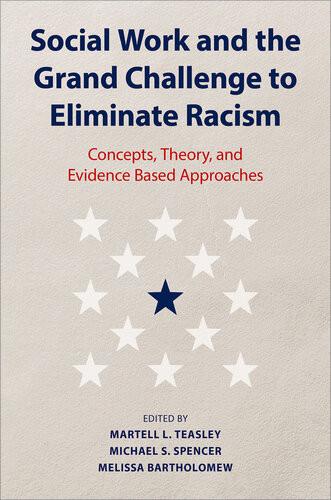
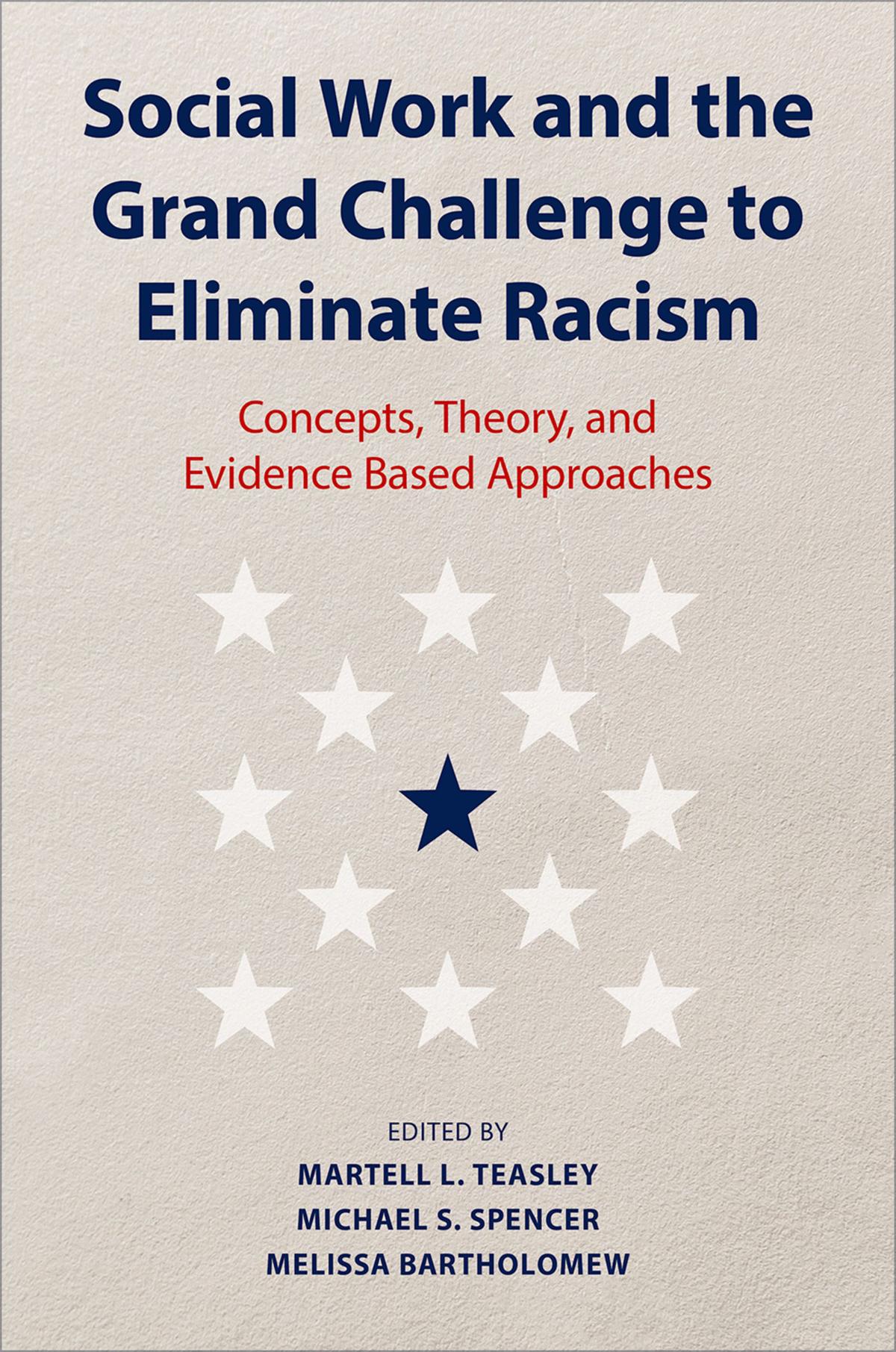
Social Work and the Grand Challenge to Eliminate Racism
Concepts, Theory, andEvidence BasedApproaches
Editedby MARTELL L. TEASLEY, MICHAEL S. SPENCER, AND MELISSA
BARTHOLOMEW
Oxford University Press is a department of the University of Oxford. It furthers the University’s objective of excellence in research, scholarship, and education by publishing worldwide. Oxford is a registered trade mark of Oxford University
Press in the UK and certain other countries.
Published in the United States of America by Oxford University Press 198 Madison Avenue, New York, NY 10016, United States of America.
© Oxford University Press 2023
All rights reserved. No part of this publication may be reproduced, stored in a retrieval system, or transmitted, in any form or by any means, without the prior permission in writing of Oxford University Press, or as expressly permitted by law, by license, or under terms agreed with the appropriate reproduction rights organization. Inquiries concerning reproduction outside the scope of the above should be sent to the Rights Department, Oxford University Press, at the address above.
You must not circulate this work in any other form and you must impose this same condition on any acquirer.
Library of Congress Cataloging-in-Publication Data
Names: Teasley, Martell L., editor. | Spencer, Michael S., editor. | Bartholomew, Melissa, editor.
Title: Social Work and the Grand Challenge to Eliminate Racism : concepts, theory, and evidence based approaches / Edited by Martell L. Teasley, Michael S. Spencer, Melissa Bartholomew.
Description: New York : Oxford University Press, [2023] | Includes bibliographical references and index.
Identifiers: LCCN 2022053631 (print) | LCCN 2022053632 (ebook) | ISBN 9780197674949 (hardback) | ISBN 9780197674963 (epub) | ISBN 9780197674970
Subjects: LCSH: Racism. | Social service and race relations. | Minorities—Civil rights.
Classification: LCC HT1521 .S543 2023 (print) | LCC HT1521 (ebook) | DDC 305.8—dc23/eng/20221208
LC record available at https://lccn.loc.gov/2022053631
LC ebook record available at https://lccn.loc.gov/2022053632
DOI: 10.1093/oso/9780197674949.001.0001
Racismisagrandchallengeforthesocialworkprofessionbecause theprofessionhasnevertackledthecentralityofracismasacausal factor,precipitatingproblemformationinthelivesofpeople.
—MartellL.Teasley
Contents
Contributors
Introduction
RacismandSociety
RaceandSocialOutcomes
TheGoalofThisBook
TheChallengeofEliminatingRacism
PART I. HISTORY, RACISM, AND SOCIAL WORK EDUCATION
1. The Meaning and Function of Race and Racism: A Conceptual Understanding
MartellL.Teasley
The Meaning and Function of Race and Racism
Racism
Institutional Racism
Systemic Racism
Racial Projects
Racializing People
Racialized Identity
Racial Commonsense Thinking
Conclusion
2. Anti-Racism Social Work: History and Future Challenges
MartellL.Teasley
Social Work and Racism
Racism in Early Social Work
Racism and Civil Rights
Racism, Diversity, and Social Work Education
Racism and Social Work
Anti-Racist Social Work
ASWB and Racially Biased Licensure Testing
Conclusion
3. Using Personal-Professional Narratives as a Technique for Teaching: Social Work Students about the Complexities of Racism
TracyR.Whitaker,RubyM.Gourdine,andRobertL.Cosby,Jr .
Racism in the Helping Relationship
Challenges in Discussing Racism with Social Work Students
Use of Personal-Professional Narratives
Personal-Professional Narrative Case Study
Juvenile Court Experience
Child Welfare Agency
Evaluating Outcomes
Implications for Practice
Summary and Conclusion
4. Eradicating Racism: Social Work’s Most Pressing Grand Challenge
AbrilN.Harris,SmithaRao,ManuelCano,BongkiWoo,Ty Tucker,DaleDagarMaglalang,andMelissaWoodBartholomew
Conceptualization of Racism
Racism and the History of Social Work
Social Work’s Efforts to Eradicate Racism
Intrapersonal Efforts to Eradicate Racism
Interpersonal Efforts to Eradicate Racism
Institutional Efforts to Eradicate Racism
Conclusion
5. Ending Racism: A Critical Perspective
HaroldE.BriggsandMartellL.Teasley
The Sustainability of Racism in America
Racism by Legislative Fiat and De Jure
Building a Race Consciousness-Raising and Anti-Racism Practice and Theory Narrative
Structural and Policy Approaches to Anti-Racism Practice
Practice Approaches for Addressing Structural and Interpersonal Racism
Behavioral Approach to Understanding Racism and Racial Prejudice
Mindfulness and Anti-Racism Practice
Combined Practice Approaches for Reducing Racism
Addressing Racial Discrimination through Task-Centered Practice
Confronting the Denial of Racism
Anti-Racism and Anti-Oppression Practice
Critique of Anti-Racism and Anti-Oppressive Practice
Perspectives
Conclusion
PART II. RACISM AND INDIVIDUAL AND FAMILY WELL-BEING
6. Ensure Healthy Development for Youth: Expansions and Elaborations for Equity
ValerieB.Shapiro,AmeliaSeraphiaDerr,NehalEldeeb,Henrika McCoy,MiguelA.Trujillo,andCucT.Vu
In Matters of Equity, Creating Change Does Not Necessarily Create Progress
Re-examining UnleashingthePowerofPreventionfor Equity Elaborations
In Matters of Equity, Aspirations and Intentions Are Insufficient Re-examining the Goal to Establish Equity-Enhancing Interventions
Understanding the Effects of Tested Programs on Marginalized Groups
Case Example: An Equity-Enhancing Approach to Program Adaptation and Implementation
Equity-Enhancing Interventions Prioritize Participatory Processes
Equity-Enhancing Interventions Are Tailored to Particular Cultures, Contexts, and Conditions
Equity-Enhancing Interventions Innovate Delivery Methods to Improve Service
Can Unleashing Prevention Be Anti-Racist?
7. Ensuring Healthy Development for All Youth: Prevention of Psychosis
MelissaE.Smith,PamelaRakhshanRouhakhtar,andJason Schiffman
The Promise of Prevention for All?
Overview of Early Psychosis Prevention
The Grand Challenge of Preventing Serious Mental Illness
The Promise of Prevention: An Update
Setting the Stage: Race and Mental Illness
Brief History of the Social Construction of Mental Illness and Race
Current Racial and Ethnic Disparities in the Identification and Treatment of Serious Mental Illness
Role of Structural and Individual Racism in Mental Healthcare
A Mirror Image? Racial and Ethnic Disparities in Psychosis Prevention
Structural Racism, Racial Bias, and Cultural Responsiveness in Assessing Youth for Psychosis Risk
Are Promising Evidence-Based Practices for Psychosis Prevention Racially and Culturally Responsive? Strategies for Reducing Structural Racism and Racial Bias and Increasing Cultural Responsiveness: Implications for Social Work Research, Education, and Practice
Development of Racially and Culturally Responsive EvidenceBased Practices
Service Provision: Helping Family and Youth Unleash Their Power
Summary
8. Closing the Health Gap: Addressing Racism, Settler Colonialism, and White Supremacy
MichaelS.Spencer,SantinoG.Camacho,BongkiWoo,RobertoE. R.Orellana,andJessicaI.Ramirez
A Holistic View of Health
The Association between Racism and Settler Colonialism, and Physical and Mental Health
Eliminating Racism in Health Systems
Health Service Delivery
Workforce Development
Health Information Systems
Equitable Access
Financing Systems
Leadership and Governance
Culturally Relevant Health-Promotion Interventions to Reduce Exposure to Racism
Racial Healing
Cultural Coping and Cultural Resilience
Culturally Tailored and Culturally Grounded Interventions
Toward Solutions and Reconciliation
Conclusion
9. Integrating AASWSW’s Grand Challenges of Productive Aging with Anti-Racism and Health Equity Lenses to Improve
Population Health
ErnestGonzales,NancyMorrow-Howell,JacquelineL.Angel,Lisa Fredman,LisaA.Marchiondo,RobertHarootyan,JasminChoi, NandiniChoudhury,KelsiCarolan,KathyLee,ErwinTan,Patricia Yu,EmilyShea,CliffWhetung,andChristinaMatz
An Integrated Framework of Productive Aging, Anti-Racism, and Health Equity
Definitions
Public Policy, Culture, and Discrimination
Individual Capacity
Neighborhood Capacity
Institutional Capacity
Productive Activities
Outcomes among Older Adults
Outcomes for Families, Organizations, and Society
Contributions of an Integrated Framework
Progress to Date and Future Research
Implications for Education
Conclusion
10. Racism and the Grand Challenge of Ending Family Violence among Black Families
AlanJ.Dettlaff,ReikoBoyd,andTriciaBent-Goodley
Black Families and Child Maltreatment
Black Families and Intimate Partner Violence
Historical Overview of Racism and Violence against Black Families
Forced Family Separation
Laws and Policies to Maintain White Supremacy
The Role of Racism in Creating and Perpetuating Risk for Family Violence
Racism and Poverty
Racism, Health, and Stress
Racism, Geographic Contexts, and Structural Inequities
Evidence-Based and Evidence-Informed Strategies for Ending Family Violence
Applying an Anti-Racist Framework to Violence Prevention
11. Beyond Colorism: The Impact of Racialization in U.S. Latinxs
RocíoCalvo,JandelCrutchfield,andJorgeDelva
Healthcare
Housing
Education
Criminal Justice
Promising Practices to Counteract the Impact of Racism on Latinxs
Conclusion
12. Confronting the History of Racism against Asian Americans in the United States
MeirongLiu
Introduction
Asian Americans and Historical Experiences of Othering
Impact of Racism on the Health and Mental Health of Asian Americans
Anti-Asian Racism and the Grand Challenges for Social Work
Moving Forward: Strategies to Eliminate Anti-Asian Racism
Disentangling the Model Minority Myth
Fostering Racial Solidarity
Reflecting Racism within the Social Work Profession and Developing an Anti-Asian Racism Workforce
Support Reporting and Bystander Intervention Training
Policy Initiatives on Anti-Asian Racism
The Importance of Community-Based Solutions
Addressing Access to Mental Healthcare
Culturally Sensitive Evidence-Based Intervention
Directions for Future Anti-Asian Racism Research
Conclusion
PART III. ELIMINATING RACISM THROUGH STRENGTHENING THE SOCIAL FABRIC
13. Strengthening the Social Responses to the Human Impacts of Environmental Change
RachelForbes,DorlisaJ.Minnick,AmyKrings,FeliciaM.Mitchell, SamanthaTeixeira,andShanondoraBilliot
Chapter Overview
Intersection of Health Equity and Environmental Justice
Pesticide Exposure
Food Systems and Food Security
Water
Extractive Energy and Natural Resource Development
Extreme Weather Events
Urban Heat Islands (UHI)
Tornadoes
Hurricanes and Flooding
Climate Migration
COVID-19
Air Quality
Food Systems
Water
Activism and Advocacy
Conclusion and Moving Forward
14. Race and Racism in the Homelessness Crisis in the United States: Historic Antecedents, Current Best Practices, and Recommendations to End Racial Disparities in Housing and Homelessness
DeborahK.Padgett,BenjaminF.Henwood,andJamesPetrovich
Foreword: A Brief Comment on the Authors’ Positionality
Racism in Plain Sight: From Slavery to Jim Crow to Post–World War II Housing Exclusion
Research on Homelessness: The Missing Significance of Race
Current Best Practices in Ending Homelessness: Housing First
The HUD-VASH Program for Homeless Veterans: A Rare Success
Story and Lessons Learned
African Americans among Homeless Veterans
The Success of HUD-VASH
Structural and Institutional Changes Needed to Address Racial Inequities in Housing Access and Housing Security
Conclusion and Recommendations
15. Eradicating Social Isolation: Focus on Social Exclusion and Racism
SandraEdmondsCrewe,ClaudiaThorne,andNatalieMuñoz
Introduction
Social Isolation and Social Exclusion
Social Isolation
Social Exclusion
Theories: Racism and Social Exclusion
Critical Race Theory
Intersectionality
Racialized Organizations Theory
Social Exclusion, Stigma, and Racism
Relationship of Racism to Social Exclusion and Stigma
Income and Wealth
Education
Physical and Mental Health Outcomes
Case Vignettes (Racism and Social Exclusion)
Case Vignette # 1: Ms. Jones
Case Vignette #2: Julissa
Case Vignette #3: Michael
Conclusion: The Way Forward
PART IV. PROGRESSIVE APPROACHES TO ELIMINATING
INSTITUTIONAL, SOCIAL POLICY, AND ECONOMIC RACISM
16. Juvenile Justice for Achieving Equal Opportunity and Justice
SusanA.McCarter,Bo-KyungElizabethKim,PatriciaLoganGreene,andVanessaDrew
Juvenile Justice and Delinquency Prevention Act
Disparate Impacts of Juvenile Justice System Involvement
Micro-Level Impacts
Meso-Level Impacts
Macro-Level Impacts
Assessing Racial and Ethnic Disparities in Juvenile Justice
Reducing Racial and Ethnic Disparities in Juvenile Justice
Conclusion and Implications
17. From Mass Incarceration to Smart Decarceration
SusanA.McCarter,CamilleR.Quinn,CharlesH.Lea,III,and LauraS.Abrams
Mass Incarceration
Racial and Ethnic Disparities in the Criminal Justice System
Promote Smart Decarceration Grand Challenge
Micro, Meso, and Macro Contributors to RED
Micro Factors
Meso Factors
Macro Factors
Strategies to Redress Racial and Ethnic Disparities in the Criminal Justice System
Increase the Availability of and Access to Culturally Congruent
Reentry Programs
Address Collateral Consequences through Racial and Ethnic Equity-Informed Policies and Practices
Decriminalize Low-Level Offenses and Invest in Alternatives to Incarceration
Repeal Racialized Criminal Justice Legislation and Policies
Adopt Racial Impact Statements as a Policy Priority
Address Explicit and Implicit Bias along the Carceral Continuum
Conclusion/Implications
18. Reducing Racialized Barriers to School Success for All Children and Youth
TerenceDwightFitzgerald,MartellL.Teasley,TashaSeneca Keyes,andSchnaviaHatcher
Race, Gender, and Disproportionality in School Suspension and Expulsion
Potential Outcomes of School Suspension and Expulsion
Existing Approaches for Tackling Disproportionality
Current Approaches
Launching the School Success Project (SSP)
Collaboration and Capacity-Building
Utilizing Evidence-Based and Innovative Methods
Completing the Interactive Map
Developing a Dissemination Strategy
Conclusion
19. Reversing Extreme Inequality: The Legacy and Persistence of Racism Economic Inequality
TrinaR.Shanks,JenniferRomich,StephanieC.Boddie,Laura Lein,andDominiqueS.Crump
The Legacy and Persistence of Racism: Implications and Possibilities for Extreme Economic Inequality
The Significance of the Racial Income and Wealth Gaps
The History of Exclusionary Policies in the United States
Native Americans
Black Americans
Latinx/Hispanic
Asian Americans
White Americans
Labor and Income
Assets and Wealth
Land Loss
Wealth Stripping through Fees and Fines
Policy to Mitigate Economic Inequality by Race
Reparations
What Can Social Workers Do?
Conclusion
20. White Supremacy and American Social Policy: Implications for Racism-Centered Policy Practice
JeromeH.Schiele,DeniseMcLane-Davison,andChristopher Maith,Sr .
The Reluctance to Address White Supremacy
White Supremacy’s Foundation
Social Policy as Racial Regulation
The Denial of Racism
Policy Practice to Address White Supremacy
Policy Practitioner Roles
Racism-Centeredness in a Social Welfare Policy Course
Womanist Pedagogy and Racism-Centeredness Course Assignments
Congressional Black Caucus Foundation (CBCF) Annual Conference
Conclusion
21. Policy, Practice, and Institutional Barriers to Financial Capability and Asset Building Related to Race (Racism) in the United States
JennyL.Jones,JulieBirkenmaier,LissaJohnson,GenaG. McClendon,YunjuNam,JinHuang,andEyitayoOnifade
The Economics of Racism
The Challenges of Economics and Race/Racism
Race and Financial Education
Financial Socialization
Financial Education
For example, some schools
Financial Guidance
Impacts of Financial Education on Financial Behaviors and Well-Being
Race and Household Financial Access
Basic Financial Access: Banked Status
Alternative Financial Service (AFS) Use
Policy and Practice Suggestions to Increase Rate of Banked
Products and Services Use
Credit Reports, Credit Scores, and Credit Use
Policy and Practice Suggestions Regarding Consumer Credit
Retirement Savings
Policy and Practice Suggestions Regarding Retirement Accounts
Racism as a Barrier to Achieving Financial Capability and Asset
Building for All
Racial Wealth and Disparity
Race and FCAB and Social Work Education
Conclusion
Index
Contributors
Laura S. Abrams, PhD, MSW, University of California, Los Angeles
Jacqueline L. Angel, PhD, MA, University of Texas, Austin
Melissa Wood Bartholomew, PhD, JD, MDiv, MSW, Center for Diversity, Inclusion, & Belonging, Harvard Divinity School
Tricia Bent-Goodley, PhD, MSW, Professor Emeritus, Howard University
Shanondora Billiot, PhD, MSW, University of Illinois
Julie Birkenmaier, PhD, MSW, LCSW, St. Louis University
Stephanie C. Boddie, PhD, MSW, Baylor University
Reiko Boyd, PhD, MSW, University of Houston
Harold E. Briggs, PhD, AM, University of Georgia
Rocio Calvo, PhD, MA, Boston College
Santino G. Camacho, MPH, University of Washington
Manuel Cano, PhD, MSW, Arizona State University
Kelsi Carolan, PhD, MSW, University of Connecticut
Jasmin N. Choi, BSW, Boston University
Nandini Choudhury, MSW, LCSW, MPH, Center for Innovation in Social Work and Health, Boston University
Robert L. Cosby, PhD, MSW, Jr, Howard University
Sandra Edmonds Crewe, PhD, MSW, Howard University
Dominique S. Crump, LLMSW, University of Michigan
Jandel Crutchfield, PhD, MSW, University ot Texas at Arlington
Jorge Delva, PhD, MSW, Boston University
Amelia Seraphia Derr, PhD, MSW, Seattle University
Alan J. Dettlaff, PhD, MSW, University of Houston
Vanessa Drew, EdD, LSW, Elon University
Nehal Eldeeb, University of California, Berkeley
Terence Dwight Fitzgerald, PhD, EdM, MSW, Council for Mental Wellbeing
Rachel Forbes, MSW, University of Denver
Lisa Fredman, PhD, MSPH, Boston University
Ernest Gonzales, PhD, MSSW, New York University
Ruby M. Gourdine, DSW, MSW, Howard University
Robert (Bob) Harootyan, MA, MS, University of North Carolina, Wilmington
Abril N. Harris, PhD, MSW, University of Washington
Schnavia Hatcher, PhD, MSW, University of Alabama
Anna Hayward, PhD, MSW, State University of New York, Stonybrook
Benjamin F. Henwood, PhD, MSW, LCSW, University of Southern California
Jin Huang, PhD, MSW, St. Louis University
Lissa Johnson, MBA, MSW, LCSW, Washington University, St. Louis
Jenny L. Jones, PhD, MSW, Clark Atlanta University
Tasha Seneca Keyes, PhD, MSW, California State University San Marcos
Bo-Kyung Elizabeth Kim, University of Southern California
Amy Krings, PhD, MSW, Loyola University Chicago
Charles H. Lea, III, PhD, MSW, University of Houston
Kathy Lee, PhD, MSW, University of Texas at Arlington
Laura Lein, PhD, MA, University of Michigan
Meirong Liu, PhD, MS, LLM, Howard University
Patricia Logan-Greene, University of Buffalo
Dale Dagar Maglalang, PhD, MA, MSW, Brown University
Christopher Maith, Sr, PhD, MBA, Morgan State University
Lisa A. Marchiondo, PhD, University of New Mexico
Christina Matz, PhD, MSW, Boston College
Susan A. McCarter, PhD, MSW, MS, University of North Carolina, Charlotte
Gena G. McClendon, PhD, ML, Washington University, St. Louis
Denise McLane-Davison, PhD, MA, Toronto Metropolitan University
Dorlisa J. Minnick, PhD, MSW, Shippensburg University
Felicia M. Mitchell, PhD, MSW, Arizona State University
Nancy Morrow-Howell, PhD, Washington University, St. Louis
Natalie Muñoz, PhD, MSW, Howard University
Yunju Nam, Ph.D., MSW, University of Buffalo
Eyitayo Onifade, PhD, MSW, Clark Atlanta University
Roberto E. R. Orellana, PhD, MPH, MSW, University of Washington
Deborah K. Padgett, PhD, MPH, MA, New York University
James Petrovich, PhD, LCSW, Texas Christian University
Meredith Powers, PhD, MSW, University of North Carolina, Greensboro
Camille R. Quinn, PhD, LCSW, LISW-S, University of Michigan
Jessica I. Ramirez, PhD, MSW, MPH, University of Washington
Smitha Rao, PhD, MA, The Ohio State University
Jennifer Romich, PhD, MA, University of Washington
Pamela Rakhshan Rouhakhtar, PhD, University of Maryland, Baltimore County
Jerome H. Schiele, DSW, MSW, Morgan State University
Jason Schiffman, PhD, MA, University of California Irvine
Trina R. Shanks, PhD, MSW, University of Michigan
Valerie Shapiro, PhD, University of California Berkeley
Emily Shea, MSW, MPH, City of Boston
Melissa E. Smith, PhD, MSSW, University of Maryland
Michael S. Spencer, PhD, MSSW, University of Washington
Erwin Tan, MD, Research & International Affairs Director, AARP Thought Leadership
Martell L. Teasley, PhD, MSW, University of Utah
Samantha Teixeira, PhD, MSW, Boston College
Claudia Thorne, PhD, LISW, LCSW, Coppin State University
Miguel A. Trujillo, PhD, LCSW, University of Denver
Ty Tucker, PhD Candidate, MSW, Boston College
Cuc T. Vu, City of Seattle
Cliff Whetung, PhD Candidate, MSW, NYU Silver School of Social Work
Tracy R. Whitaker, PhD, MSW, Howard University
Bongki Woo, PhD, MSW, University of South Carolina
Patricia Yu, Ph.D, LCSW, Executive Office of Health and Human Services at the Commonwealth of Massachusetts