Professor Emeritus of Condensed Matter Physics at Grenoble University (Grenoble institute of Technology), now retired, 38410 St Martin d’Uriage, France; https://sites.google.com/site/flouchet/, francoislouchet38@gmail.com
1
Great Clarendon Street, Oxford, OX2 6DP, United Kingdom
All rights reserved. No part of this publication may be reproduced, stored in a retrieval system, or transmitted, in any form or by any means, without the prior permission in writing of Oxford University Press, or as expressly permitted by law, by licence or under terms agreed with the appropriate reprographics rights organization. Enquiries concerning reproduction outside the scope of the above should be sent to the Rights Department, Oxford University Press, at the address above
You must not circulate this work in any other form and you must impose this same condition on any acquirer
Published in the United States of America by Oxford University Press 198 Madison Avenue, New York, NY 10016, United States of America
British Library Cataloguing in Publication Data Data available
Library of Congress Control Number: 2020939783
ISBN 978–0–19–886693–0
DOI: 10.1093/oso/9780198866930.001.0001
Printed and bound by CPI Group (UK) Ltd, Croydon, CR0 4YY
Links to third party websites are provided by Oxford in good faith and for information only. Oxford disclaims any responsibility for the materials contained in any third party website referenced in this work.
Use At Your Own Risk
Mountaineering, and more particularly off-piste skiing, are dangerous and can involve exposure to avalanches and other hazards.
The present book aims at disclosing and disseminating the essence of avalanche triggering processes. The resulting guidelines cannot eliminate these hazards, but they can help understand and manage them.
The content provided in this book is given “as is” and in no event shall the author be liable for any damages, including without limitation damages resulting from discomfort, injury or death, claims by third parties or for other similar costs, or any special incidental or consequential damages arising out of the use of this publication.
This book is obviously no substitute to training, experience, skill and wisdom.
Foreword and Acknowledgements
Do not go where the path may lead, go instead where there is no path and leave a trail
Ralph Waldo Emerson
This was a magnificent, resplendent, brilliant, gorgeous winter Sunday morning. After a week-long period of snowstorms, an incredible sun was shining on tremendous amounts of freshly fallen snow. I was reluctantly wearing a pair of terrible snowshoes instead of my preferred cross-country skis, and we were walking with my wife Marie and a couple of friends, Jacqueline and Serge Macel, between the Valloire ski resort and “lac des Cerces”. A short distance beyond the small shepherd cabin of Plan Lachat, at the foot of the Galibier pass, we suddenly heard a loud bang coming from the Pointe du Vallon, and immediately noticed a huge avalanche tumbling down from the very top of the steep slope, readily turning into an airborne powder flow. “Watch out, watch out!” Serge shouted, pointing at two skiers a significant distance below, trying to escape the avalanche front. They obviously could not succeed, and were readily swept out by the impressive flow like miserable tiny beetles. The avalanche went on, crossed the small Valloirette creek, climbed up the opposite riverside in our direction, and stopped at about 100 m from where we were standing. The whole thing got rooted to the ground. Not the slightest noise. Not the slightest sign of life. I hurtled down the path towards Valloire trying to get help, yelling to other trekkers down-slope, who in turn tried passing on the message to other hikers, while my companions were desperately scanning the closest part of the avalanche flow. After a while, I was flown over by a helicopter. I clearly heard it land higher up, out of my sight, and take off again only after a few seconds. I received the explanation 15 minutes later while rushing back to join my group: I met two guys skiing down towards Valloire and asked them what was going on up there. They furiously replied that they were themselves the skiers caught by the avalanche, and that I shouldn’t have given the alarm or called the helicopter! I was told later on by my group that the head of one of the skiers was jutting out above the snow level. He succeeded in getting out, found his companion, and extracted him from the avalanche. The latter was terribly angry to have lost his glasses! And his main comment was that he was a professional mountain guide, and that they were not responsible for the avalanche release, for the “obvious” reasons that the avalanche started at a significant distance above them, and that they have already crossed this slope several times in the past without any problem.
As far as I remember, that was in February 1997. At this time, I didn’t know much about avalanches, but I was deeply convinced that such statements were stupid. All I had to do was figure out why. This is how I started my research work on avalanches.
This work could not have been achieved and the present book would not have been written without sometimes fortuitous, but always invaluable and priceless encounters, often turning into warm, long lasting and unforgettable friendships. I will especially mention and gratefully acknowledge:
Malcolm Heggie and Jany Thibault. Both of them sadly passed away recently. Both of them had been working on dislocation core structures in covalent crystals, Malcolm essentially on theoretical models in diamond and ice, Jany and myself on electron microscopy and modeling dislocation
x Foreword and Acknowledgements
cores in semiconductors. Dislocations in such crystals and in ice are quite similar. In addition to my immoderate taste for mountaineering, this was probably one of the reasons for my interest in ice and snow. I first met Malcolm in the seventies. We visited each other several times in the universities of Toulouse, Exeter, and Grenoble. He introduced me to the concept of soliton, in the sense of a solitary broken bond in a covalent dislocation core, on which I built theoretical models of dislocation mobility in pure and compound semiconductors. Malcolm and I shared numerous conferences, particularly with Jany during several two-week workshops in Aussois. Jany was also a brilliant physicist, and a top-range mountaineer. She used to organize a few ski and trek programs during such conferences. As for Malcolm, after having tried to teach him cross-country skiing in thick and steep forest environments, I remember him complaining his skis were longer than the average tree separation.
Kolumban Hutter, met during my very first conference on avalanches at Innsbruck EGS symposium in 2000. I started my talk saying something like: “I am a physicist. I’ve been working on plasticity and rupture of crystalline materials for more than 20 years, but I do not belong to your scientific community. This is my first contribution to avalanche research”. I had no idea what would be the reactions of the audience to my presentation. Kolumban was the very respected session chairman and, as such, was sitting in the front row, just facing me. I was presenting a fairly simple but original slab avalanche model, showing that a transition from a tensile crown crack instability to a shear basal one occurred for a universal angle cos2/3=35.3o A . The chairman’s comment was: “Let’s define that as Louchet’s angle!” Thank you, Kolumban, for having immediately trusted me during my avalanche initiatory rite!
Jérôme Weiss and Paul Duval, with whom I have been working on ice plasticity and fracture at the Grenoble Glaciology Department for more than 10 years. Thank you Paul for your invaluable glaciologist experience during our work on ice slip geometry, dislocation cross-slip, and dynamic recrystallization. Thank you also Jérôme for your pioneering work on dislocation avalanches by acoustic emission analysis, which was the starting point of a long and fruitful collaboration on selforganized critical dislocation dynamics. With our common PhD student Thiebaud Richeton, we showed in particular that such a behavior was shared by a number of other materials, and we evidenced a quite general “mild” (Gaussian) to “wild” (scale-invariant) transition controlled respectively by short-range or by long-range elastic interactions. Based on our numerous discussions, this period also gave me the opportunity of revisiting Hall–Petch law and Andrade creep in terms of approaches of a critical point.
Jérôme Faillettaz, a young mechanical engineer fond of skiing and mountaineering. I was his PhD thesis supervisor. During innumerable coffee-fueled discussions, we discovered together unknown and unexpected fantasies of avalanches. We scoured a number of international meetings, carefully avoiding awfully clean and expensive conference hotels, sharing a can of beans in a cheap room in Davos, or spending a couple of nights in a small tent in the hills during an EGS conference in Nice. Jérôme is now a Senior Researcher at Zürich University. Thank you so much Jérôme for your disrespect to scientific or any other type of “authority”, your enthusiasm, and your confidence. Thank you also for your careful reading of the proofs of this book, and your quite sensible comments.
Jean-Robert Grasso, who helped us enter the universe of Self Organized Criticality. Together with Jérôme, we designed a specific cellular automaton, disclosing the mechanisms responsible for such a scale-invariant (and probably self-organized) critical behavior, and merging all gravitational flows into a single formalism. Thank you Jean-Robert for your brilliant idea to spend a year in UCLA, while Jérôme and myself were in Grenoble. Owing to the time lag between Grenoble and Los Angeles, and the back and forth daily mailing, the succession of our respective sleeping and active periods resulted in a quasi-continuous working time. Our paper on the cellular automaton
Foreword and Acknowledgements xi in Physical Review Letters was written within an incredible short time, and qualified for illustrating the front cover of the journal.
Alain Duclos, met somewhere in the Canadian Rockies. We were attending a snow and avalanche workshop in Penticton (British Columbia), a small town with a nice old wooden shop serving mugs of coffee and beer, and selling tons of second-hand books. I bought a number of them (books, not mugs), much to my backpack’s and my own backbone’s misfortune. Alain was quite interested in the work presented at the meeting by Jérôme and myself. We decided to continue our passionate discussions when coming back home. We did. I became the secretary of his newly created Data-Avalanche Association, now widely recognized in the avalanche field. Alain and many other members of the Data-Avalanche association taught me much of their long-standing field experience. We shared numerous discussions, working sessions, field experiments, and also friendly working dinners. A lot of thanks to all of them. Particular thanks again to you Alain for sharing your invaluable field knowledge and analysis during proof reading of this book, and also to Céline Lorentz for designing a schematic in chapter 5 of this book.
Joachim Heierli, who proposed the innovative “anticrack” concept. Thank you Joachim for your participation in field experiments in Aussois, and for sharing spirited scientific discussions in Edinburgh, Davos, Grenoble, and Freiburg.
My brother Jean for his careful and detailed reading of the manuscript, and his meaningful remarks.
My four anonymous referees, for their interesting and valuable comments, that helped me improve and complement several parts of the book, and also my Editors for the particularly efficient and trustworthy relationship I had with them.
Finally, and above all, I would like to pay a special tribute to my wife Marie, to whom I dedicate this book. She has been enduring and still endures the formidable and terrific role of a researcher’s wife, living every day with a guy able to suddenly stop in front of any weird object by the roadside, immediately falling into a contemplative ecstasy, keeping his brain in a state of intense excitement until the deepest and ultimate secrets of the “thing” have eventually been revealed. She deserves my profound admiration for her patience, and my infinite gratitude for her constant and unfailing support.
1
Introduction
A journey of a thousand miles begins with a single step
Lao-Tzu
The names of many places and villages in European mountains refer to memories of old, more recent, or recurrent avalanching events, as “lavancher” or “lavachet” in local French-speaking alpine dialects, coming from “labina” in Latin. This is also the root of the term “Lawine” in German, “avalanche” in English and French, “avalancha” in Spanish, and “valangha” in Italian.
An avalanche may be defined as the destabilization and flow of part of the snow cover. We shall essentially deal here with the former, focusing on avalanche triggering mechanisms. Studies of avalanche flow processes indeed mainly involve fluid mechanics, and are usually described by classical Navier–Stokes equations, despite the difficulty due to heterogeneity (e.g. vertical snow density gradient) and specific non-linear aspects of dynamical snow behavior. This is another and quite interesting story to look at, but partly out of the main scope of the present work. Meantime, avalanche triggering mechanisms have been debated for decades, and need some re-foundation on clear scientific bases. This is the main goal of the present book.
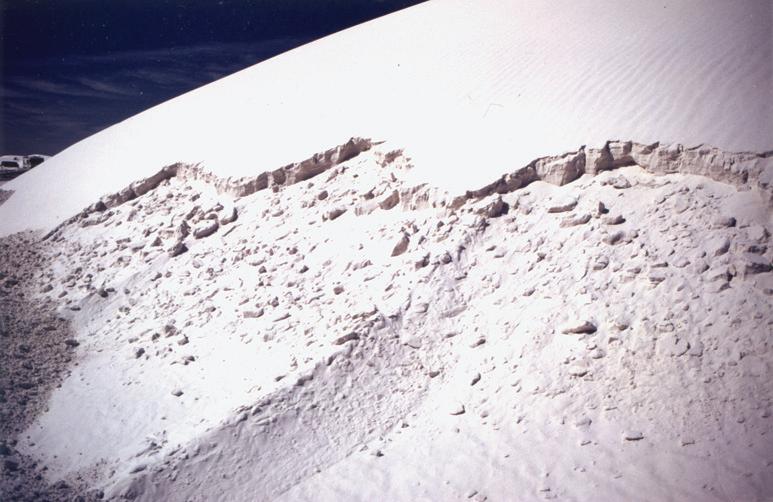
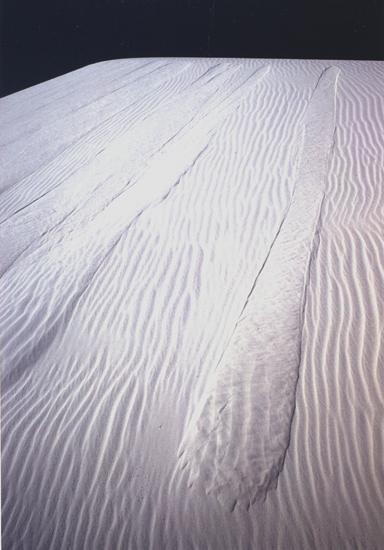
Snow avalanches share a number of characteristics with some other types of gravitational flows. Avalanches shown in Figs 1.1 and 1.2 perfectly illustrate slab avalanches and loose “snow” avalanches, as defined hereafter, except that they actually are gypsum sand and not snow avalanches! Another feature shared by gravitational flows is given in chapter 5, showing common statistical characteristics between snow avalanches, landslides, and rock-falls, all of them belonging to the same class of critical phenomena.
Avalanche studies are at the intersection of several traditional fields of science or practice. Each community (physics, mechanics, mathematics, practitioners, etc.) has its own language, which may yield some misunderstandings. The present book is written in a language used in physics, but equivalents will be given for clarity if necessary. In this respect, it should be useful to make clear a few definitions and several idioms that are used to characterize avalanches.
The snow cover is a layered structure built up during successive snowfalls. Upper layers may be destabilized and glide down as a whole, resulting in “slab avalanches”. The glide plane, the interface between the gliding slab and the older snow substrate, is known as the “basal plane”. It initially consists of a “weak layer” (WL) made of brittle snow, whose collapse may trigger the avalanching process. But the snow cover may also glide as a whole on the underlying bare ground, giving rise to so-called “full-depth” avalanches.
More precisely, three main types of snow avalanches are usually distinguished:
i) Slab avalanches. Their release results from the initial failure of an underlying weak layer (WL) that separates two adjacent snow layers. Such a failure, that may or may not result in avalanche release, usually propagates beneath the slab over distances ranging from meters
to kilometers, and is associated with a downward displacement (or “settlement”) of the slab, and sometimes with an audible “whumpf”, an onomatopoeic term for the muffled noise produced by the settlement. They are responsible for most human fatalities, and therefore deserve specific interest.
ii) Loose snow avalanches. In cold fluffy snow, i.e. with low cohesion, they occur preferentially on steep slopes. They are often thought to be triggered by the destabilization of a few snow grains that knock out a couple of other ones, and so on, usually resulting in a narrow snow slide flowing down as a superficial combination of tiny sluffs from a quasi-punctual starting point (Fig. 1.2), and gradually growing in size. Their bed surface is ill defined. They may be quite harmful when pouring down into narrow gullies. By contrast, in wet snow conditions, low cohesion results from lubrication by melt water, and may help release of loose snow avalanches on gentler slopes, with significantly larger sizes. A detailed description of such mechanisms will be found in (Daffern 1992, Tremper 2008).
iii) Full-depth avalanches, actually encompassing all other types together, which is the reason why a variety of full-depth avalanche definitions are found in the literature.
A few other terminologies are often used:
i) The distinction between “dense” and “airborne powder” avalanches essentially refers to avalanche flow processes. As we shall focus on triggering mechanisms, this question has in principle no call to be discussed in detail here. However, some avalanche flow characteristics
Fig. 1.1 Gypsum sand slab avalanche, illustrating slab snow avalanches,White Sands National Park, New Mexico (USA). (Photograph by François Louchet)
Fig. 1.2 Loose dry gypsum sand avalanches, illustrating loose snow avalanches, White Sands National Park, New Mexico (USA). (Photograph by François Louchet)
may be determined by initial conditions, and powder flows may originate from particular triggering processes.
ii) Slab avalanches can be artificial (or accidental) or spontaneous (or “natural”), depending on whether they result from some external action (skier, animal, explosives, etc.) or not. Spontaneous avalanches necessarily involve some time-dependent ingredients, as an overload due to a cornice rupture, a new snowfall, or accelerating creep (i.e. viscous flow) that may bring the system from ductile deformation to brittle failure (Gubler and Bader 1988). However, the possible role of the WL is still under debate in this last case.
Owing to the complexity and variability of the snow cover and of unexpected variations of weather conditions, forecasting avalanche release is a formidable task. Our belief is that an increased knowledge and understanding of underlying mechanical and thermodynamical processes can significantly help both hazard control and mitigation measures.
The main goal of the present book is thus to disclose and analyze the main processes involved in avalanche release. It seems useful to start in chapter 2 with a short review of the basics of snow structure and topology. Snow being a complex arrangement of ice crystals, themselves found in oodles of geometrical shapes, sizes, and formation mechanisms, we shall essentially focus on those that are more directly involved in avalanche release. Readers interested in further developments are referred to specialized textbooks.
We shall essentially focus on two snow peculiarities. Since the snow cover results from an accumulation of snowflakes, it may be considered as a granular material, with quite original properties due to the unusually large grain surface vs volume ratio, and to their changeable healing propensity. Snow also being a mixture of ice, air, and water, the topological concept of percolation is of interest to deal with stress distribution in the snow cover, and will be briefly discussed.
Chapter 3 will be dedicated to some mechanical and physical concepts ruling deformation, fracture, and friction processes, with particular attention paid to the simplicity of the analysis, but without betraying the scientific validity of the arguments.
Chapters 4 and 5 will get into the very heart of the matter, with a thorough exploration of slab avalanche release mechanisms. First, observations and field experiments will be analyzed. The modeling section will empanel digital simulations and analytical approaches, whose results will be extensively discussed.
Chapter 6 will deal with superficial and full-depth avalanche triggering, discussing the various possible types and corresponding mechanisms, essentially in terms of self-organized criticality for the former, and of percolation for the latter.
Finally, chapter 7 will tentatively discuss the expected influence of the present and unprecedented climate warming on avalanching activity and associated hazards.
The reader is also encouraged to visit the Data-Avalanche site http://www.data-avalanche.org/ for further and more practical information, more particularly on risk management and mitigation strategies.
2
Snow, an Intriguing, Complex, and Changeable Solid
We must always tell what we see, but above all, and this is more difficult, we must always see what we see
CharlesPéguy
The purpose of the present chapter is to give the minimum basic concepts that will be useful for understanding avalanche problems. For more information, the reader is referred to the considerable bunch of snow treatises available in libraries and bookshops, and more particularly to chapter 3 of the excellent book by Tony Daffern (1992) on avalanche safety. It is however worth noting that the very particular structure of snow, made of complex and changing mixtures of ice, air and water, endows this material with a considerable variety of physical properties. The topological concept of percolation, that can be conveniently used for exploring these properties, will be discussed at the end of the chapter.
2.1 From ice to snow
Figure 2.1 shows the water phase diagram. Line AD separates solid (left) from liquid (right), and AE separates liquid (top) from vapor (bottom). As shown by the horizontal line BC, under usual pressure conditions found on the Earth’s surface (so-called “normal conditions”), water solidifies at 0°C (into 1H type ice crystals, with a hexagonal crystallographic structure), and boils at 100°C. Beyond the “critical point” E, liquid and vapor phases cannot be distinguished any more. There is no sharp transition in this case between these phases. In other words, phase boundaries vanish. We deal in this case with a “supercritical” fluid. Actually, the concept of criticality is by far more general than its application to the water phase diagram. We shall return to this concept in Appendix A for other applications.
A particularly interesting and well known feature of ice crystals is illustrated by the negative slope of line AD: starting from a state in the solid phase, a pressure increase at constant temperature brings the system through the AD line up to the liquid state. The physical reason for this counter-intuitive peculiarity is that, due to the specific molecular bonding of 1H crystals, ice density is lower than that of water, i.e. ice takes up a larger volume than the same weight of water. This property results in floating ice cubes, or at a different scale, drifting icebergs. Taking the problem the other way round, another and obvious consequence of this specificity is that trying to shrink the volume of a piece of ice by external pressure favors melting, since liquid water satisfies with a smaller volume than solid ice.
Snow being made of ice, it inherits the same property, which has interesting consequences in ski practice: in “warm” snow, ski pressure favors the formation by local melting of a thin water
Fig. 2.1 Phase diagram of water. Pressure is in atmospheres, and temperature in °C. A is the triple point where the three phases (solid, liquid, vapor) coexist. E is the critical point, beyond which there is no sharp transition between liquid and vapor. The negative slope of the DA line is responsible for quite specific characteristics of the water solid/liquid transition (see text).
layer that helps sliding, despite the fact that warming by ski friction on snow also contributes to the same melting effect. This is by far less efficient in colder snows, a phenomenon well known by cross-country skiers, who have the strange feeling of skiing on dry sand instead of snow, more especially if they are using the skating technique.
2.2 Snow crystals
Snow crystals nucleate from a supersaturated atmosphere, helped by dust particles through a reduction of interfacial energy. They nucleate as single crystals, i.e. in which water molecules are precisely arranged along parallel directions and stacked planes. The well-defined V-shaped geometry of water molecules (Fig. 2.2) results in precise molecular arrangements when condensed in the solid state. In the 1H solid phase (our well known common ice, stable under our Earth’s pressure and temperature conditions), the 104.45° angle between O–H bonds in the free molecule slightly deforms up to 109o, in order to comply with a stable hexagonal crystallographic symmetry (Schulson and Duval 2009). By contrast with Oxygen atoms, Hydrogen ones exhibit a limited long-range ordering, obeying Bernal–Fowler rules (Pauling 1933):
i) two Hydrogens are located close to each Oxygen.
ii) each O–O bond must not contain more than one Hydrogen.
However, such features are of little importance in snow mechanical properties.
Snow, an Intriguing, Complex, and Changeable Solid 7
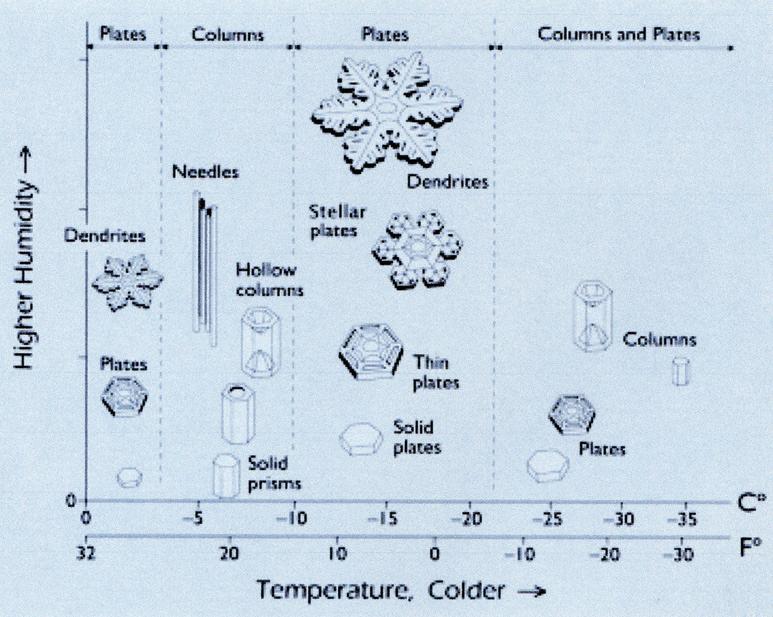
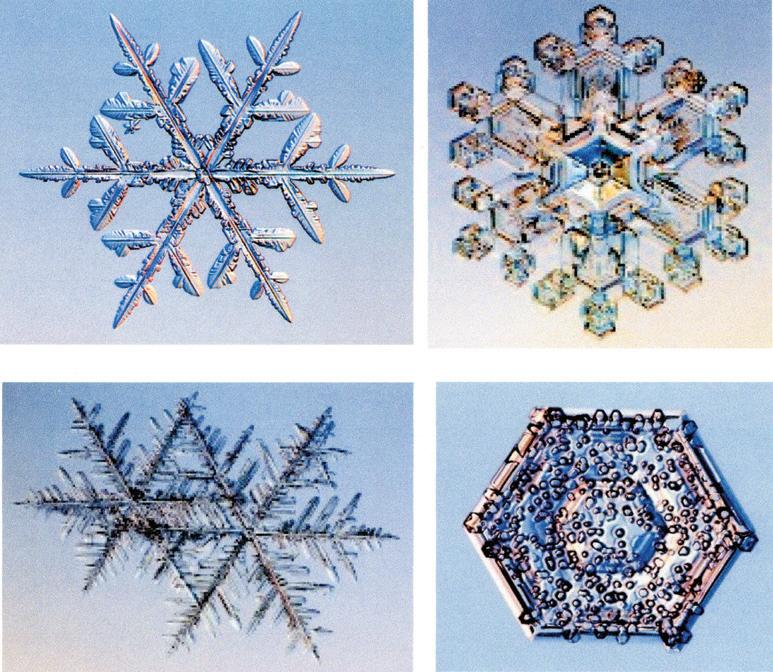
Due to the 109° angle of the H2O molecule, snow crystals exhibit a simple 6-fold symmetry, resulting however in impressive oodles of complicated shapes, depending on temperature, temperature gradients, and humidity during nucleation and growth. A few examples are shown in Figs 2.3 and 2.4. As a detailed description of such crystals is beyond the scope of the present work, the reader is referred to (Daffern 1992, Libbreght 1999).
Fig. 2.2 Schematic model of a water molecule H2O. The angle between O–H directions in the free molecule is 104.45°.
Fig. 2.3 Snow crystal morphology vs temperature and humidity. (After Ken Libbrecht, kgl@caltech.edu, http://www.snowcrystals.com/science/science.html).
Fig. 2.4 Examples of snow crystals: top left and right, stellar dendrites (i.e. star-shaped tree-like crystals); bottom left, fernlike stellar dendrites (containing many side branches); bottom right, rimed crystals, resulting from collisions between snow crystals and freezing water droplets. (After Ken Libbrecht, http://www. its.caltech.edu/~atomic/snowcrystals/class/class-old.htm)
After nucleation, such crystals aggregate during their motion in the atmosphere into snowflakes, each of them being made of a combination of single crystals of various orientations. Due to the intricate shapes of snow crystals, their random aggregation into snowflakes incorporates a significant amount of air, which results in a low density. This is why snowflakes fly around during snowfalls, in strong contrast with hail showers. This is also why they can be easily transported by wind, which may result in so-called wind slab formation.
The white color of snow differs from the transparent and slightly bluish aspect of bulk ice, due to the huge surface vs volume ratio, that favors light scattering.
2.3 From snowfalls to snow layers
Snow falls on the ground forming successive layers, whose structure and properties may evolve with time, helped again by humidity, temperature, and temperature gradient conditions, and
Snow, an Intriguing, Complex, and Changeable Solid 9
various types of loading (further snowfalls, skiers, snowmobiles, grooming machines, etc.). In some cases, the top layer may be formed by wind transportation, forming improperly named “wind slabs”.
The cohesion between such layers also evolves with time. Failure of one of these interfaces, as mentioned in the introduction, may destabilize as a whole the layer stacking sequence located above the destabilized interface, resulting in an incipient slab avalanche. As a consequence, the term “slab” refers to the group of such destabilized stacked layers, which cannot be properly defined until triggering occurs. Such slabs are responsible for the majority of avalanche fatalities. This is why two chapters (4 and 5) will be most entirely dedicated to slab avalanche release.
Other types of ice crystals may form in the stacking sequence of the snow cover, at the surface or at interfaces of already deposited layers. This is the case for instance of surface hoar, facets, and depth hoar. Surface hoar is made of those superb ice crystals that grow at snow surface in “warm” and humid atmospheres, due to the significant temperature gradient at the surface of a colder snow cover during cold and clear nights. These well-known shiny flakes provide incredibly smooth ski sliding. If they are buried during a snowfall before transformation into stronger structures, they become a layer (still named “surface hoar”!) on which the slab may potentially slide down very easily.
Facets and depth hoar also grow under thermal gradients, often (but not always) at interfaces between different snow layers: indeed, during clear nights, the external temperature goes down, whereas deeper snow layers keep warmer, due to the thermal flux from the ground (geothermal flux). It is usually thought that this phenomenon takes place on north slopes, as the external temperature is colder than on south ones, at least in the northern hemisphere (readers from the southern hemisphere should translate this sentence the other way round!). It is worth noting however that this mechanism may also occur on other slope orientations, particularly in early winter during which the atmosphere cools down due to a weak and low sun, whereas the ground keeps warmer. Under such a temperature gradient, the system is out of equilibrium, water molecules evaporate from the warmer bottom layer (“sublimation”), and condense on the colder bottom part of the upper layer, resulting in a lace of delicate brittle crystals.
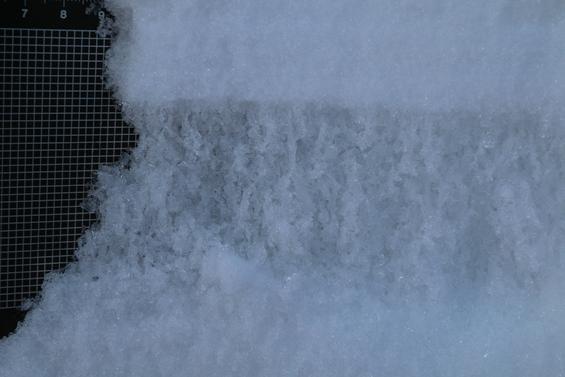
In all cases, resulting intermediate interfaces consist of (or transform into) granular aggregates of polyhedral ice grains bonded by brittle ice bridges, usually known as “weak layers” (WL) (Fig. 2.5).
As the metamorphic transformation occurs at constant volume, the average density of the WL is comparable to those of top and bottom layers. Yet, it may exhibit a larger brittleness for at least two reasons:
i) It is made of bigger crystals separated by larger flaws. Griffith’s criterion developed in chapter 3 states that larger flaws correspond to a reduced toughness.
ii) Despite the fact that the WL average density is similar to that of top and bottom layers, it may vary across the WL thickness, the lighter zones being significantly more brittle than the denser ones.
In addition, the lower thermal conductivity of the lighter layer increases the local temperature gradient, enhancing the metamorphic transformation rate. For a similar reason, WLs may also form on both sides of freezing crusts (this is called a “super gradient”).
For all these reasons, WLs are recognized to play a key role in snow slab avalanche triggering processes. It is therefore of interest to understand in more details the weak layer behavior, in order to be able to predict which conditions may favor slab avalanching, as detailed in chapters 4 and 5.
2.4 Snow as a granular medium
Granular matter is made of assemblies of solid grains, whose sizes may range from nanoscopic up to macroscopic scales. Properties of such ensembles strongly depend on grain sizes, through the volume vs surface ratio R=V/S. As volumes and surfaces scale respectively as the 3rd and 2nd powers of grain size, R is homogeneous to a length. As a consequence, the behavior of granular ensembles is essentially ruled by volume properties in the case of bigger grains (large R values), and by surface in the case of smaller ones.
In this respect, granular media may be defined as a wide intermediate stage in which both volume and surface effects have to be simultaneously taken into account to understand physical properties.
In the case of mechanical (and more specifically dynamical) properties for instance, granular media behavior is ruled by the balance between grain weight and inertia, which are volume parameters on the one hand, and contact interactions, obviously of surface nature on the other hand.
In the limiting case of powders, small R values enhance surface effects during contacts, as for instance friction, cohesion, or chemical reactivity (including water capillary effects for sand or snow for instance). In the opposite case of large R values, inertial effects dominate, resulting in strong changes in bulk structure during collisions. This is the case for shocks between icebergs, which may yield bulk damage and fracture. In comparison, collisions between small flying beetles (with small R values) are much less damaging than those between heavy birds or cars, whose external skin or shell cannot resist inertial effects.
The lower bound of this domain is usually considered to be at around 1 μm. Above this size, indeed, grains are large enough to be unaffected by Brownian motion (i.e. thermal fluctuations), which means that surface effects will not overwhelm volume effects any more. The upper bound of the granular media domain is more arbitrary and difficult to define precisely, and depends on investigated physical properties, but the centimeter or decimeter range looks reasonable.
Fig. 2.5 Typical weak layer section. Bonneval sur Arc (Savoie) 22 February 2017. Scale is given by 2 cm × 2 cm squares. (Photograph by Alain Duclos).
Snow, an Intriguing, Complex, and Changeable Solid 11
Granular media may be found under two main states, as deformable and possibly flowing condensed matter when relative velocities between grains are low enough, as for full depth avalanches for instance (chapter 6), or as suspensions in a fluid (liquid or gas) in the opposite case (e.g. airborne powder avalanches, or wind transportation of snow). In the condensed state, stresses are not homogeneously distributed as in a “traditional compact” solid, but are concentrated along particular patterns called “force chains”. Such chains may act as screening shields for other grains embedded in between, which experience lower stresses. Formation of arches, that may support the weight of grains located above, and protect those lying underneath, is a particular case of force chains.
Snow is a very particular case of granular materials, due to the complicated “hairy” surface of snow grains, often made of elongated arms (dendrites) as shown above (Figs 2.3 and 2.4), and characterized by huge specific areas. For comparable grain sizes, this geometrical specificity shifts R values towards much smaller scales as compared to more classical granular media made of spherical, polyhedral, or more generally convex shaped grains. Such a peculiarity has various consequences:
i) Due to smaller R values at comparable grain sizes, phenomena related to grain contacts are enhanced. This is the case for friction that hinders sliding and associated shearing, for increased cohesion, and also for grain welding that has fundamental consequences on avalanche release and on flow arrest processes as well (chapters 5 and 6, appendix B).
ii) Snow grain arms are particularly brittle; snow grains may easily collapse under stress; this is the case for weak layers (Fig. 2.5, and chapters 4 and 5), resulting in a significant increase of R values, becoming more comparable to classical granular matter, and making slide and shear phenomena much easier.
iii) Under most physical conditions found on Earth, snow is fairly close to its melting point. Due to water molecules’ diffusion on surfaces, driven by surface tension reduction, the intricate shapes of snow crystals may also evolve into more rounded ones, with larger R values, leading to the same consequences as in ii).
Snow is thus a very particular granular medium. When made of cold, loose, and dry crystals, it may be indeed dealt with as a granular solid, or as a granular fluid in the case of wind transportation for instance, but cohesive snow is more conveniently described as a porous medium, as discussed hereafter.
2.5 Snow as a porous medium: the concept of percolation
The porous character of snow is indeed quite important, as it may affect mechanical properties. By contrast with bulk ice, snow may be considered as an ice foam that may contain a significant amount of air and water. It may for instance collapse under stress into a denser material, or sinter under favorable temperature conditions. As a consequence, it may exhibit changing physical or mechanical properties, and usual laws ruling bulk solids may not directly apply. This is the case for instance for Coulomb’s friction law, as shown and analyzed in chapter 3.
Other properties are controlled by snow topology, particularly in the case of full depth avalanches discussed in chapter 6. The topological concept of percolation, reminiscent of coffee making, is quite important in various physical problems, and particularly in yielding and fracture mechanisms. It can be illustrated in a very simple way, as follows.
Let us consider a coffee filter filled with coffee powder, and let us pour water on it. Three different situations may be considered:
i) If the powder is firmly crammed down into the filter, hot water poured on it would stay at the surface, unable to go through the powder. In this case, it is possible to find connected paths made of coffee powder grains in mutual contact, resulting in “force chains” that go through the entire system. Coffee grains are said to “percolate” through the system, but water does not, and coffee making becomes a complicated task.
ii) If the coffee powder is less tightly packed, water would be able to find a way through the powder, down to the coffee pot. It percolates through the system, but the coffee powder still percolates, which prevents its mechanical collapse. This is called “bi-percolation”.
iii) if too much water is poured at the same time on the coffee powder, the mixture turns into a fluid in which coffee powder grains float freely. Water percolates, but coffee grains do not any more. This is the situation found in “turkish coffee” making.
Physical, and more specifically mechanical, properties of random media drastically change at socalled percolation thresholds, where isolated clusters become connected into a theoretically infinite network, or conversely.
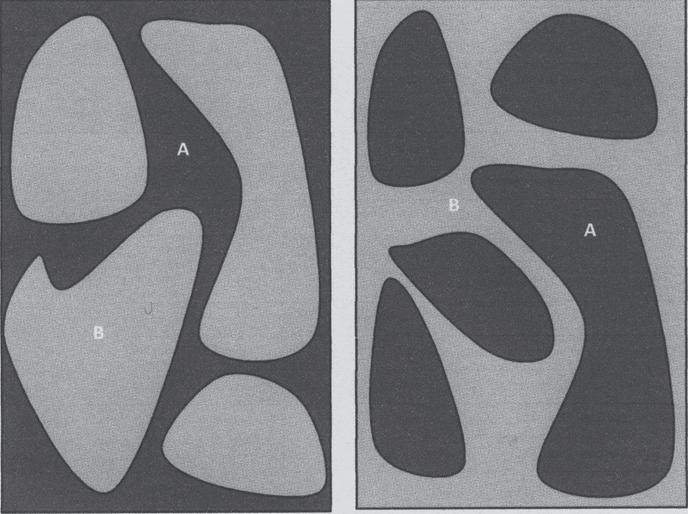
Fig. 2.6 Percolation: (a) A percolates in B; (b) B percolates in (A). A and B can mutually percolate only in 3 dimensions (bi-percolation).
We shall see in chapter 6 that, in a similar way as for coffee, rain water may percolate through snow layers, and how bi-percolation or “mono-percolation” may result in quite different wet snow avalanche types.
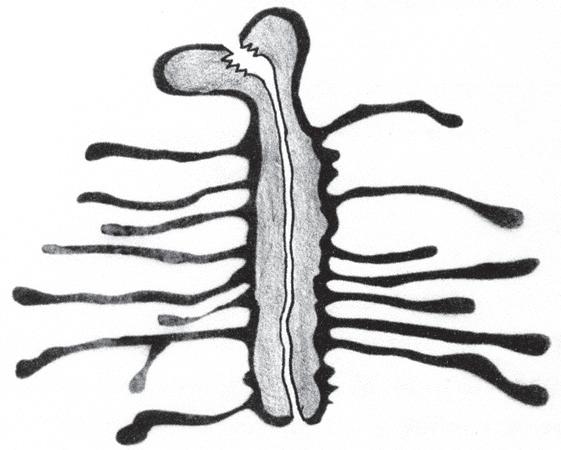
It is worth noting that bi-percolation would be impossible in a two-dimensional space. For instance, in a 3-d coffee maker, water is able to use the 3rd dimension to bypass a continuous chain of powder coffee grains, which is impossible in 2-d. This is a privilege of three-dimensional spaces. We should be delighted to realize that if we were two-dimensional beings, we would not be allowed to enjoy coffee drinking, to say nothing of the fact that, for the same reason, the whole ingestiondigestion process would split the drinker into two separate parts (Fig. 2.7)! Such a situation may be encountered in avalanche glide surfaces (that are 2-d objects), A and B being for instance snow and water for full-depth avalanches sliding on bare ground, or collapsed and non-collapsed zones in slab avalanche weak layers.
Fig. 2.7 A two-dimensional beetle necessarily split into two separate parts due to its digestive system. (Adaptation by François Louchet of an artwork by Martine Rey).
3
Deformation, Fracture, and Friction
Processes
What gets us into trouble is not what we don’t know. It’s what we know for sure that just ain’t so MarkTwain
In order to avoid misunderstandings in the discussion of avalanche release mechanisms, precise definitions of involved physical (and more particularly mechanical) quantities are required. Usual mechanical properties of solids are defined hereafter on this basis.
3.1 Deformation of solids
Stress is defined as the force per unit surface, expressed in Pa, kPa (103 Pa), or MPa (106 Pa), in the same way as pressure, which is a particular case. Stresses may indeed describe different loading geometries. Uniaxial tensile stresses are responsible for lengthening rubber bands, uniaxial compressive ones for shortening car suspension coils, shear components are involved in resistance to ski glide, etc. For this reason, stresses are usually expressed in the form of “tensors”, mathematical objects written as 3 × 3 tables, containing nine “scalar” stress components. In avalanche problems, the most useful components are tension, compression, and shear. For the sake of simplicity, they will be referred to as scalars, expressed in Pa, kPa, or MPa.
Strain is defined as relative deformation, i.e. for instance the lengthening of a sample divided by its length. It is dimensionless (i.e. has no units), but is often expressed in %. Strictly speaking, in the same way as stresses, strains are tensors. Their different components may be distinguished, but we shall use them separately as tension, compression, or shear strains. Stress-strain curves, which characterize deformation properties of solids, exhibit several stages, as discussed now.
3.1.1 Elasticity
A typical stress-strain curve of a solid is shown in Fig. 3.1. It usually starts with a so-called elastic domain in which strain is proportional to stress. In this domain, strain is reversible, which means that the original shape is restored upon stress release.
Elastic properties are characterized by various quantities, depending on the involved stress tensor components. They are usually referred to under the generic name of “stiffness”:
Young’s modulus (E) describes the elastic response of a solid experiencing a load along a uniaxial compression or tensile axis. It is defined as the stress to strain ratio, and represented by
Fig. 3.1 Schematic stress-strain curve, showing the elastic and plastic domains, and definitions of various mechanical quantities. The curve represents the stress vs strain variations under constant strain rate. The yield stress is usually defined as the point A where the stress-strain curve departs from the elastic domain straight line by an amount of 0.2%. Beyond this point the material deforms plastically, i.e. it does not recover its initial shape upon stress release. The so-called tensile strength corresponds to the maximum stress (B), and is the end of the homogeneous plastic deformation stage. Beyond B, the flow stress decreases due to strain localization, ending up with ductile rupture at C.
the slope of the stress-strain curve in the elastic domain (Fig. 3.1). Strain being dimensionless, E is measured in Pa, kPa, or MPa. It is also referred to as the elastic modulus
The shear modulus (G) describes the solid response to a shear stress (instead of a tensile stress), and is defined as the ratio of shear stress to shear strain. It is also measured in Pa. In compact solids, both uniaxial and shear elastic deformations take place at constant volume.
The bulk modulus (K) describes volumetric elasticity, i.e. the elastic volume variation of a solid under an isotropic (i.e. hydrostatic) stress. It is defined as the ratio of hydrostatic stress to volumetric strain, and is the inverse of compressibility
3.1.2 Plasticity
The elastic domain ends at a so-called yield stress, beyond which deformation gets easier, but becomes irreversible, i.e. the original shape is not restored upon stress release. This is the plastic domain. Yield stress is usually defined as the stress for which the stress-strain curve departs from the linear elastic response by a conventional but arbitrary offset strain value, usually chosen to be 0.2%. This is called the 0.2% yield stress. Solids with a large yield stress obviously have an extended elastic domain, such as springs for instance. The yield stress of steel is significantly larger than that of “butter from the window”, and its plastic deformation requires temperatures by far higher, but the physics of deformation are fairly similar.
Ductility characterizes the solid ability to undergo significant plastic deformation between yield point and rupture. It can be opposed to brittleness.
Hardness measurements are an alternative characterization of yield stress, used instead of uniaxial tests for practical reasons, but they also incorporate work hardening properties (increase of flow stress with strain) that make result interpretations more difficult. Hardness measurements are often carried out by indenting of the solid under constant load with a very sharp and hard indentor, and subsequently measuring the indentation size.
The stress required to keep the solid deforming at constant strain rate beyond the yield stress is called the flow stress. It usually starts increasing with strain (this is called work hardening). In tensile deformation, it goes through a maximum called tensile strength. Beyond this maximum starts an unstable softening leading to plastic failure.
It is worth mentioning that snow is not a compact solid. As a consequence, the above quantities may be applied (with caution) in the elastic domain, but may sometimes be irrelevant in the plastic one.
3.1.3 Static vs dynamic loadings
If a drum parchment is pressed firmly but slowly, it does not emit any sound, whereas it sounds beautifully if sharply knocked. This is the difference between static and dynamic loadings. The elastic and plastic properties discussed above mainly stand for “quasistatic” loadings, i.e. when the time required to apply the load is longer than the travel time of an acoustic wave throughout the material. In the opposite case of dynamic loadings, the effects on the solid of the propagating wave front, of inertia, and of the associated high stress and strain rates have to be taken into account. This situation is likely to be found in the case of avalanches triggered by pedestrians, skiers, snowmobiles, or artificial triggering by explosives for instance, in which acoustic wave transmission through the snow layer, or at air/snow or snow/snow interfaces, play a key role in the WL failure process, whereas quasistatic loadings are usually relevant in natural avalanche release (except in specific cases such as cornice failure for instance). The abruptness of the skier’s dynamic impulse is of considerable importance. It is indeed transferred to the weak layer through the propagation of an elastic wave through the slab.
If part of the WL has a lower density than that of the layer above (as mentioned in section 2.1), the wave velocity would be smaller in that part of the WL. It can be inferred from the conservation of the transferred energy flux that the wave amplitude varies in the opposite way, i.e. is larger in this WL zone. This effect may significantly favor its failure, all the more so because this lighter zone is more brittle (section 2.1).
3.2 Fracture initiation and extension
Fracture is obviously influenced by loading geometry. Characteristics of the stress tensor (compression, tension, and shear components) play a key role. But fracture phenomena are (too) often studied in the case of continuous, homogeneous, and defect-free media. Yet, fracture of solid mater ials involves the nucleation and propagation of a two-dimensional object (a crack) in a threedimensional one (a solid). This is why geometrical and topological concepts are of interest in this field. A crack has indeed “to know” where to start from! It is indeed difficult to imagine where a crack would first appear in a perfectly homogeneous medium loaded homogeneously.
Inhomogeneous stresses, arising from particular slope shapes or snow layers packing, may act as stress concentrators. This is the case, for instance, at the junction between a lower steep slope and