Dietary Fiber for the Prevention of Cardiovascular Disease: Fiber’s Interaction between Gut Micoflora, Sugar Metabolism, Weight Control and Cardiovascular Health 1st Edition Rodney A. Samaan Md Mph Bs https://ebookmass.com/product/dietary-fiber-for-the-prevention-ofcardiovascular-disease-fibers-interaction-between-gut-micoflora-sugarmetabolism-weight-control-and-cardiovascular-health-1st-editionrodney-a-samaan-m/ ebookmass.com
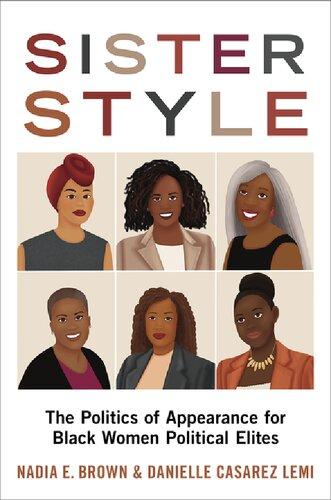
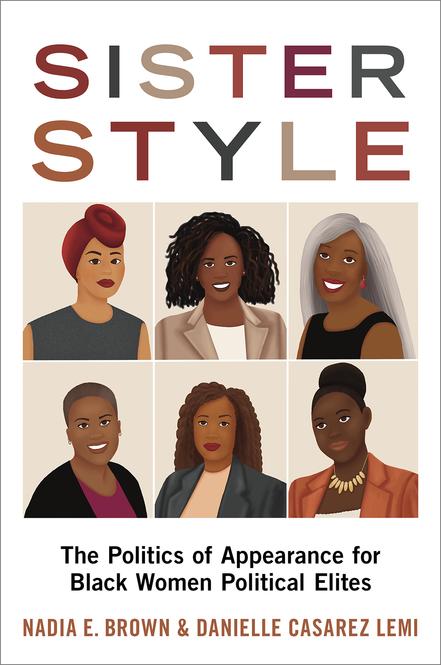
Sister Style
Sister Style
The Politics of Appearance for Black Women Political Elites
NADIA E. BROWN AND DANIELLE CASAREZ LEMI
3
Oxford University Press is a department of the University of Oxford. It furthers the University’s objective of excellence in research, scholarship, and education by publishing worldwide. Oxford is a registered trade mark of Oxford University Press in the UK and certain other countries.
Published in the United States of America by Oxford University Press 198 Madison Avenue, New York, NY 10016, United States of America.
All rights reserved. No part of this publication may be reproduced, stored in a retrieval system, or transmitted, in any form or by any means, without the prior permission in writing of Oxford University Press, or as expressly permitted by law, by license, or under terms agreed with the appropriate reproduction rights organization. Inquiries concerning reproduction outside the scope of the above should be sent to the Rights Department, Oxford University Press, at the address above.
You must not circulate this work in any other form and you must impose this same condition on any acquirer.
Library of Congress Cataloging-in-Publication Data
Names: Brown, Nadia E., author. | Lemi, Danielle Casarez, author. Title: Sister style : the politics of appearance for black women political elites / Nadia E. Brown, Danielle Casarez Lemi.
Other titles: Politics of appearance for black women political elites
Description: New York : Oxford University Press, 2021. | Includes bibliographical references and index.
Identifiers: LCCN 2020044164 (print) | LCCN 2020044165 (ebook) | ISBN 9780197540572 (hardback) | ISBN 9780197540589 (paperback) | ISBN 9780197540602 (epub)
Subjects: LCSH: African American women—Political activity. | African American women politicians. | Beauty, Personal—Political aspects—United States. | Hairstyles—Social aspects—United States. | Colorism—United States. | African Americans—Politics and government—21st century. Classification: LCC E185.86 .B697448 2021 (print) | LCC E185.86 (ebook) | DDC 305.48/896073—dc23
LC record available at https://lccn.loc.gov/2020044164
LC ebook record available at https://lccn.loc.gov/2020044165
DOI: 10.1093/oso/9780197540572.001.0001
1 3 5 7 9 8 6 4 2
Paperback printed by LSC Communications, United States of America
Hardback printed by Bridgeport National Bindery, Inc., United States of America
Dedicated to Nile, Nuri, and Neva
And for the Black womxn who we remember when we #SayHerName
Acknowledgments
Nadia E. Brown
This book has been a journey in self-love. The idea of this project started in 2009 when I first started to seriously think about going natural (after three failed attempts in college). However, I was advised not to go natural when I was on the academic job market because I did not want potential employers to view me as the “scary Black feminist.” I followed that bad advice, and my decision to do so has haunted me ever since. During data collection for my first book, Sisters in the Statehouse, Black women legislators candidly shared their natural hair journeys with me and openly detailed the ways that their appearance influenced their political experiences. In fact, a majority of my interviews for that book would open up with legislators talking about some aspect of their appearance. Casual Black women’s conversations in which we complimented one another on our hair, clothing, or make up would organically lead to a conversation about how their appearance has political implications. From there, the idea for this book project was born.
This book is several years in the making. I got married, had three kids in less than four years, switched institutions, and was involved in a car accident. Understandably, these incidents took me away from this project. Thankfully, Danielle Lemi agreed to join me in this vision and to co-author this book. She is a brilliant scholar, patient co-author, and steadfast ally. I am thankful for her friendship. Moreover, her expertise in sophisticated survey design and experiments has made this book richer. Danielle is a full and equal author and I am grateful for her work on this manuscript.
Likewise, I remain deeply grateful to Angela Chnapko for believing in this project and her steadfast commitment to seeing this in print. She was patient with me as I worked on this book in stages given my life circumstances. I am grateful and humbled by her commitment to this scholarship.
This manuscript benefited from the editorial assistance of Mili Jha and Abigail Bowen. The cover was designed by Acamy Schleikorn, a Black woman artist, who captured the essence of the women in our study. And this book was made stronger by the research assistance of Guillermo Caballero, Aiden Colburn, LaRae Crenshaw, Maricruz Osorio, India Lenear, Hanya Malik, Grace Reon, and Sono Shah.
I appreciate my many colleagues who have made this book possible. I am thankful for the support of the Butler Center at Purdue University for funding early parts of this project. Many thanks to my colleagues in African American studies for allowing me to teach courses on Black women’s aesthetics as I honed this project. The leadership of Venetria Patton and Marlo David in this endeavor is unmatched. I am grateful to my colleagues in political science who read various drafts of this book, invited me give talks on my research, and made space for me to think through the ideas in these pages. I could not have completed this work with the academic support and friendship of Laurel Weldon, Valeria Sinclair-Chapman, Rosie, Clawson Pat Boling, and Molly Scudder and Jean Beaman (now at the University of California, Santa Barbara). Unmatched in her mentorship (and patience) is my former department head, Rosie Clawson. There are no words to express the amount of appreciation I have for Rosie. Indeed, it is difficult to adequately write about Rosie without tearing up. She is a force of nature who is always guided by principles, a sense of justice, and equity. She is a friend who is willing to tell it like it is even when it hurts, and is an advocate for her faculty. I have learned so much from Rosie. She has listened to me complain, wiped away tears, offered sage advice, connected me with influencers who would mold my career, co-hosted my first baby shower, and drunk margaritas with me. This book has been improved by my conversations with, and critiques from, Valeria Sinclair-Chapman, who is deeply rooted in the tradition of our great Black politics forebearers and who has reminded me that there is nothing new under the academic sun. Valeria is one of smartest people I know. I’m grateful to have a professional and personal relationship with this woman. We’ve opened up new doors together—as Black women political scientists— and as colleagues. I am thankful for what we built at Purdue, and believe that our legacy will tell the story of the power of what two Black women tenured professors can do to change a department with the support of leadership. My girls affectionately call her Auntie Val because of the relationship that I have with her. She’s a colleague and a friend, an Academic Mama who has always been available to share parenting advice and scholarly tips. Rounding out the big three from Purdue’s political science department was Laurel Weldon. I’m thankful for her vision, support, and belief in me since day one. Laurel—and Aaron Hoffman—are not only academic mentors but good friends who have offered excellent advice, provided opportunities for career advancement, and championed my growing family in numerous ways. Next, many thanks
to Keith Shimko (and Chris Olofson), Molly Scudder, Kyle Haynes, Logan Strother, Tara Grillos, and Mark Tilton.
My time at Purdue University has been enriched by my chosen academic family. Words cannot express my appreciation and love for my graduate students: Guillermo Caballero, Jasmine Jackson, Michael Simrak, India Lenear, and Michael (MJ) Strawbridge. They are truly the best part of my academic life at Purdue. As I prepare to join the faculty at Georgetown University, I am most saddened to leave these students—as well as the other students that I recruited to the PhD program in political science at Purdue University. I remain excited for their futures and know that our bond is deeper than an institutional affiliation. Many thanks to the students in my spring 2020 Black Lady Classroom, who inspire me to be a better Black woman scholar. Our experience together has made me a better professor, mentor, and colleague. Thank you. Big ups to my students in African American studies and American studies at Purdue University. I am grateful for the interdisciplinary relationships that we were able to build and the resulting co-authored essays that were produced.
This book would have been impossible to produce without the guidance and foundation received from my colleagues and peers. Thank you for my sistah-scholars: Melina Abdullah, Lakeyta Bonnette, Khalilah BrownDean, Camille Burge, Niambi Carter, Pearl Dowe, Ashley Daniels, Natasha Duncan, Andra Gillespie, Christina Greer, Keneshia Grant, Megan Ming Francis, Zinga Fraser, Lorrie Frasure, Jenn M. Jackson, Kim Mealy, Taneisha Means, Jamila Michener, Shayla Nunally, Dianne Pinderhughes. Melanye Price, Jamil Scott, Christine Slaughter, Wendy Smooth, Tiffany WilloughbyHerard. I am grateful to Natasha Behl, Christina Bejarano, Cristina Beltran, Tabitha Bonilla, Ivy Cargile, Christian Dyogi Phillips, Magda Hinojosa, Mala Htun, Sophia Jordan Wallace, Nazita Lajevardi, Natalie Masuoka, Yalidy Matos, Jennifer Merolla, Zein Murib, Celeste Montoya, Maricruz Osorio, Stella Rouse and Kim Yi Dionne. I deeply appreciate Treva Lindsey, and Aria Halliday Danielle Phillips-Cunningham, for their friendship and interdisciplinary critiques of my work. I am indebted to the collegiality and support of my Women Also Know Stuff board members, the #PSSistahScholars crew, and the #MeTooPoliSci Collective. A special and heartfelt thank you to my National Conference of Black Political Scientists family. I am also appreciative of my fellow Bunchees and the Ralph Bunche Summer Institute program of the American Political Science Association. Thank you to Ray Block,
Jr., Christopher J. Clark, Bernard Fraga, Eric Gonzalez Juenke, Hakeem Jefferson, Dwaine Jengelley, Ravi Perry, Christopher Stout, Fernando Tormos-Aponte and for your steadfast support. A big thank you to the editorial team of Politics, Groups and Identities. I am thankful for my sorority sisters of Delta Sigma Theta Sorority, Inc., who supported this project in multiple meaningful ways. A special thank you goes to Tracy Y. Scott and the Black Women’s PAC for graciously allowing Danielle and me to be a part of the organization as scholars.
None of this would be possible if were not for Jane Junn, my self-professed Academic Mama, and Alvin Tillery, my academic big brother. They have been my rock, a consistent source of support and the main guiding forces in my academic career. They molded me into a scholar, from my days as a graduate student at Rutgers University to my years on the tenure track and beyond. There will never be enough “thank yous” to adequately express my appreciation for them. Likewise, I am indebted to Sarah Allen Gershon, who is my “forever co-author.” I am thankful for our academic partnership and our friendship.
Lastly, I am most grateful for my family. Thank you to the Browns: Joseph A. Brown, Nicholas and Cimberly Brown (along with Joseph C. Brown and Zoey E. Brown), Lindsey M. Brown and Thomas Martin, and Myra E. Brown. Thank you to the original Brown Girl, Janie Elizabeth Brown Barham, my paternal grandmother who passed in April 2020 before the completion of this book. Many thanks to the Hudson family. We are so excited to be moving closer to you as we return to the DMV. I am grateful for my cousin Carolyn James and her enduring belief in me. Thank you to my Auntie Barbara, Uncle Gilbert and Vernee Wilkinson for always being in my corner and praying for my family. I reserve my deepest gratitude for those who have loved me day in and day out, who helped to build me up, who cried and laughed with me, and who make me a better woman through their love and consistent support. Thank you to my mother, Nadine E. Medley, who selflessly moved to Indiana to help Brian and me take care our family in 2015 and has been with us ever since. She is the rock of our family. To Brian M. Lawrence, my partner: I am blessed each day to be your wife. Thank you for challenging me to be the best in all that I undertake. My efforts are strengthened by your love. I am grateful for B’s unwavering belief in me—even when I do not believe in myself. I look forward to our future together and to growing into the fullness of our partnership. Throughout it all, I remain deeply grateful for the #BrownGirls: Nile, Nuri, and Neva. Being an Academic Mama has fundamentally transformed
my identity as a scholar. My daughters have guided me to be a more intentional, thoughtful, and patient person. This book is for you. I hope that you see the beauty in your ebony skin and coiled hair. These are markers of your heritage, reminders that you are the hopes and dreams of our ancestors.
Danielle Casarez Lemi
This book has been a constant part of my daily life for about four years now. As a grad student writing about representation and getting ready to do elite interviews, I read Nadia’s first book, Sisters in the Statehouse. I learned how to structure interviews and send interview invitations. I would later cold email Nadia asking for feedback, and Nadia graciously agreed to read my work and get on a call and give me feedback. I was a first-gen grad student from the California State University system in a doctoral program where women of color were neglected. I was just beginning to grasp my status as a woman of color in political science, and just beginning to realize that my experiences and frustration with the neglect are by design in our discipline. That Nadia was willing to give a random grad student such personal feedback meant so much to me. Nadia has influenced my work substantively and has been a model for staying true to myself as a scholar.
Over the years, we would meet in person, stay in touch, and learn that our research interests in intragroup diversity and representation were converging. This book has consisted of collecting a ton of original data, raising funds, learning Adobe Photoshop, dancing in Deep Ellum, and inviting ourselves to a corporate holiday party. As we dove into this book, I was finishing my doctorate and moving to Dallas, Texas, for a postdoctoral fellowship at the John G. Tower Center for Political Studies at Southern Methodist University. This book was a constant through my cross-country moves, job market trials, and ultimate career change. Over the course of this book, I have grown as a person and as a scholar. One of the biggest lessons from this project is my learning about interpretivism and work I wish I had read in graduate school. I was trained as a positivist, and during this project, I was trying to find my voice, learn how to publish, get exposure, and earn respect, all while trying to figure out what I wanted to do with my life since political science kept slamming the door in my face. Nadia was a patient co-author and friend when our dialogues showed how little I understood about interpretivism and what it meant to fully center Black women—without making cross-group comparisons—in this project. For that, I am grateful. Working on this project has been a true privilege.
So many people, many already mentioned, helped us push this forward. Chapter 4 would not have been possible without Tracy Scott and the Black Women’s Political Action Committee of Texas (BW PAC). We are enormously grateful for Tracy’s and the PAC’s support of this project. Chapter 8 was made possible with the APSA Rita Mae Kelly fund and support from Pearl Dowe and Christina Bejarano. Gina Coorley and Sambhav Tripathi at Lucid also graciously helped us as I became frazzled fielding the second experiment. We thank Grace Reon for helping us proofread and check our second experiment before launching. Many thanks to Emily Beauliu, Niambi Carter, Christina Greer, and Christina Wolbrecht for their trust and permission for us to use their photos as we figured out how to design the second experiment. Earlier drafts of the first experiment of Chapter 7 benefited from feedback from the reviewers at Journal of Race, Ethnicity, and Politics, Amy Lerman and participants at the APSA 2018 meeting, participants at the APSA 2017 meeting, and participants at the 2018 Gender and Political Psychology conference. Chapter 6 was a massive data collection project, and we are thankful to Sono Shah, Maricruz Osorio, India Lenear, Guillermo Caballero, Hanya Malik, Aiden Colburn, LaRae Crenshaw, and Grace Reon for the scraping, the coding, and the searching they did to help us finish that chapter. The financial aspect of all of these moving parts was made easier with the help of Ray Rafidi at Southern Methodist University and Paige Pfeifer at Purdue University.
Another constant through my life over the last few years has been the support of Jim Hollifield and Luisa del Rosal at the Tower Center. I am grateful for the financial and moral support, and for the constant cheering both have given me as I worked to find my way in the discipline. At the Tower Center, I had the money I needed to support my work, the encouragement to keep going, and the time and autonomy to do whatever I wanted—exactly what early-career scholars need.
The final constant through all of this has been my parents. Throughout the ups and downs, my parents have stood by with love and patience. Everything I have been able to do is owed to them.
Sister Style
1 Introduction
If I didn’t define myself for myself, I would be crunched into other people’s fantasies for me and eaten alive.
Audre Lorde
In a January 2020 interview with The Root, Representative Ayanna Pressley (D-MA) revealed that she suffered from alopecia areata and had lost her hair to the disease (Moulite 2020). Rep. Pressley, the first Black woman to represent Massachusetts in Congress, had garnered a significant amount of attention as a member of “the Squad” (McNulty 2019), a group of newly elected progressive politicians, and as one of the women elected during the 2018 Blue Wave (Fisher 2019). Rep. Pressley’s political brand and signature style—her Senegalese twists—ignited conversations about representations of Black women political elites with Afro-textured hair (Branigin 2018). The Massachusetts Congresswoman told The Root,
As a Black woman, the personal is political. My hair story is no exception. Sharing a very personal story today to create space for others. My twists have become such a synonymous and a conflated part of not only my personal identity and how I show up in the world, but my political brand. And that’s why I think it’s important that I’m transparent about this new normal and living with alopecia. (Moulite 2020)
In the interview, Rep. Pressley noted that Black girls and women had written affirming messages to her about her decision to wear her Afrotextured hair. Consequently, the decision to go public about her health condition was based on the fact that girls looked up her. Having been intentional in her decision to wear Senegalese twists as a transitional hairstyle, Rep. Pressley was prepared for people to believe her hair was a political statement. A transitional hairstyle is a protective style worn while moving from
chemically relaxed hair to natural hair (Ndichu and Upadhyaya 2019). She explained, “the reality is I’m Black. And I’m a Black woman. And I’m a Black woman in politics. Everything I do is political” (Moulite 2020). For Rep. Pressley, hair and her decision to forgo wigs to hide the alopecia is “about self-agency. It’s about power. It’s about acceptance” (Moulite 2020).
This book is about the everyday politicization of Black women’s bodies and its ramifications for politics. Our focus is on Black women politicians and Black voters. Since President Donald Trump’s election in 2016, there has been a renewed interest in intersectional approaches to voter behavior, particularly as scholars seek to explain why White women voted for Trump (Junn 2017). By contrast, Black women are the most reliable Democratic voters (Gillespie and Brown 2019). Preliminary exit poll data from the 2020 election suggests that 9 in 10 Black women reported support for the Biden/ Harris ticket. Indeed, it was Black women’s organizing and voter turnout that delivered the presidency for Biden (Schmidt 2020). This pattern holds true for the previous presidential election as well. According to exit poll data, more than 90% of Black women voted for Hillary Clinton in 2016 and 96% voted for Barack Obama in 2012.1 However, much attention—particularly in the Democratic Party—has been placed on turning Black women’s high rates of political participation into electoral successes for those women as candidates (Robinson 2018).
Black women have won prominent elections and they comprise a sizable number of all women legislators. Despite these successes, however, they remain an underappreciated group in American politics. The Democratic Party and its allies are reluctant supporters of Black women, an idea that former DNC chair Donna Brazile, Yolanda Caraway, Leah Daughtry, and Minyon Moore (2018) reinforced in their latest memoir. Black women activists, politicians, and political strategists alike have urged the Democratic Party to support policies that benefit Black women as well as to support Black women candidates (Packnett 2017). Avis Jones DeWeever of the Black Women’s Roundtable advised the Democrats to “water your own backyard” (Williams 2019) meaning that the party should do more to cultivate Black women candidates rather than attempting to woo back White male voters who are inconsistent Democratic supporters. Likewise, political activist Angela Davis touts the rationale for supporting Black women candidates:
Black women have had to develop a larger vision of our society than perhaps any other group. They have had to understand white men, white
women, and black men. And they have had to understand themselves. When Black women win victories, it is a boost for virtually every segment of society. (Scott 2017)
Research supports Davis’s claims. For example, Black women legislators are most likely to champion legislation that advances civil rights and women’s rights (Brown and Banks 2014). Black women legislators are also especially attuned to how legislation that is seemingly beneficial to society as a whole may unintentionally harm Black women and all people of color (Orey et al. 2006).
After the 2016 election, Black women proved that they were “born for a time such as this,” a quote from the Biblical Book of Esther that Stacey Abrams used in her Georgia gubernatorial primary victory speech in 2018 (Carr and Peeler-Allen 2018). As candidates, Black women were up to the task. In 2018, writer Luvvie Ajayi led a volunteer-run effort to create a database of Black women who would seek elected office. The website, Black Women in Politics, would go on to house information on over 600 Black women candidates for federal, state and local elections. Taking to heart Shirley Chisholm’s oft-quoted saying, “If they don’t give you a seat at the table, bring a folding chair,” Black women mounted their own campaigns for public office in record-breaking numbers (Mohdin 2018), and many of them won their races. According to the Center for American Women in Politics, today Black women comprise about 17% to 18% of all women members of Congress and state legislators.2 The significance of these victories indicates that Black women are a powerful voting bloc as well as viable candidates for political office.
In 2020, Black women candidates for Congress ran at record numbers. The Center for American Women and Politics notes that there were at least 130 Black women congressional candidates.3 Black women, including multi-ethnic Black women who report having Black ancestry in combination with another race, comprise 20% of all women candidates for the House of Representatives and 21.7% of all women candidates for the Senate. Black women are seeking federal legislative office as both Democrats and Republicans. Furthermore, Black women candidates made national headlines. For instance, Cori Bush defeated 20-year incumbent Lacy Clay (D-MO) in a July 2020 primary to represent Missouri’s 1st Congressional district. She handily won the general election and is headed to Congress to join the more progressive branch of the Democratic party. And in the November 2020 election,
Candace Valenzuela narrowly lost her bid to become the first Afro-Latina in Texas’s 24th Congressional district. And two Black women, Angela StantonKing (R) and Georgia State Senator Nikema Williams (D) were candidates for Georgia’s 5th Congressional district. Williams easily defeated Stanton-King for this open seat that was once held by Civil Rights icon Representative John Lewis (D), who died of cancer in July 2020. Other noticeable down ballot races where Black woman made historical inroads are Kim Jackson who became the first queer Georgia state senator and Michele Rayner-Goolsby who made history as the first openly Black queer woman elected to any position in Florida. She will serve in the state’s House of Representatives. These women’s successful elections demonstrate the diversity among Black women candidates as well as their ability to win races (Brown and Gershon 2020).
The biggest electoral prize of all in 2020 goes to Kamala Harris for her successful candidacy as Vice President as part of the Biden/Harris ticket. This is a historic win. Harris, the second Black woman and first South Indian American senator in the nation’s history, was tapped as the Democratic Party’s vice presidential nominee after months of anticipation and speculation following Biden’s announcement that his VP pick would be a woman. Black women activists, politicos, and citizens mobilized to demand a Black woman vice presidential nominee.4 Indeed, the political moment was right for a Black woman—and a multi-ethnic Black woman—to be selected for the bottom of the ticket. As millions of protestors decried systemic racism and police brutality over the deaths of George Floyd, Breonna Taylor, Tony McDade, Ahmaud Arbery, and Rayshard Brooks in 2020, Black Lives Matter activism seized the national stage. Similarly, the coronavirus pandemic and the lack of a cohesive response from federal government shone a national spotlight on the persistent racial inequities in the country. The anti–Asian Americans and xenophobic attacks stoked by fears and accusations that the virus originated from China also exacerbated hate crimes and led to an increase of hate crimes committed against this group. It is within this context that Kamala Harris emerged as the Democratic choice for vice president. Indeed, Kamala Harris rose to this occasion and galvanized Americans, who cast more than 75 million votes for her and Biden. This was the most votes earned by any presidential ticket (North 2020). Americans convincingly showed their support for Kamala Harris’s historic bid for office. In recognition of this support, Harris directly thanked Americans for their support but also specifically called out Black women voters and acknowledged that Black women made this victory a reality. During her victory speech,
Kamala Harris stated “While I may be the first woman in this office, I will not the last, because every little girl watching tonight sees that this a country of possibilities” (Betancourt 2020).
Yet in still, Kamala Harris may have some possibilities available to her that other Black women candidates may not have because of her appearance. This multi-ethnic Black woman was once called the “best-looking attorney general in the country” by President Barack Obama (Lemi and Brown 2020). While Obama apologized for these gender-biased comments shortly after he said them in 2013, his comments underscores how people view Harris. Her competence as an attorney general, senator, and later the first woman of color vice presidential candidate for a major political party will be assessed in part on the basis of her record but also in the context of racialized-gendered beauty aesthetics. Like Black women political elites who have come before her, Harris will have to contend with ethno-racial and gendered stereotypes that will largely draw on her appearance and not her political accomplishments. At the time of writing, one focal point of public discourse is about Harris’s identity and her connections to Black and Asian American voters given her multiracial background (e.g. Lemi 2020). In this study, we include Kamala Harris as a Black woman because she has written about herself as a Black woman (Harris 2019), and while some may perceive her dual backgrounds to be mutually exclusive, we do not believe her being Asian means she is not Black, nor do we believe that her being Black means she is not Asian.
Although their work “boost[s] virtually every segment of society” (Williams 2019), Black women politicians’ bodies are deeply politicized in the United States, as Black women political figures consistently encounter inappropriate commentary on their bodies (Ford 2015). Often, this commentary is negative. For example, in 2011, Representative Jim Sensenbrenner (R-WI) criticized Michelle Obama’s childhood obesity campaign, reportedly saying, “. . . Michelle Obama, her project is obesity. And look at her big butt.”5 In another instance, actress-comedian Roseanne Barr was fired from Roseanne in 2018 for likening Valerie Jarrett, former advisor to President Obama, to an ape.6 Further, Congresswoman Cynthia McKinney made national headlines in 2006 when she was profiled by Capital Police as a visitor to Congress rather than a member of the national legislature. The Congresswoman had changed her hairstyle and suddenly became unrecognizable to Capital Police (Brown 2018). These examples demonstrate that the bodies of Black women political elites face a tremendous amount of scrutiny. Black women’s bodies are
perceived to be transgressive (Copeland 2010), out of place (Puwar 2004), defying norms (Shaw 2006), or grotesque (Kerchy 2005) in political spaces.
Furthermore, these actions and comments against Black women’s bodies are reflective of the broader misogynoir in the United States that denies Black women bodily respect and autonomy in everyday life (Bailey 2018). The continuing manifestations and intrusions on their bodies today are legacies of Black women’s historical lack of ownership of their bodies. To deny the racist, sexist, and patriarchal underpinnings that have created a culture in which Black women are both demeaned and fetishized on the basis of their physical appearances would be shortsighted. Black women are often simultaneously hypervisible and invisible, meaning that they are perceived as overly present and are yet ignored altogether, which either renders them as something with which they do not fully identify or erases other signifiers that they wish to adopt. Racialized difference and gendered performance simultaneously amplify racist and heteronormative politics at work (Story 2017). A historical examination shows that centuries of enslavement and colonialism have led to a defining/redefining the Black female body, and that colonialism is tied to racialized conceptualizations of gender and gendered notions of race (Story 2010).
Take for instance Hudgins v. Wright (1806) in which the Wrights, who were enslaved Americans, claimed that they were entitled freedom because they were descendants of a free American Indian woman. However, Hudgins, their White enslaver contended that the Wrights were the descendents of an enslaved Black woman and an American Indiana man and thus, were not entitled to freedom. The Virginia High Court of Chanery concluded that because the Wrights were various shades that they were entitled to their freedom. The Virginia Supreme Court of Appeals granted the Wrights’ their freedom, however, did not agree with the Chancellor’s line of reasoning. Judge St. George Tucker drew on the physical characteristics of American Indians and people of African descendent to conclude that the phenotype present in generations of interracial descendants makes it difficult to conclude that the Wrights’ appearances proved them not to be American Indian and thus, deserving of freedom. Indeed, Judge Tucker decreed that “Nature has stampt upon the African and his descendants two characteristic marks, besides difference of complexion, which often remain visible long after the characteristic distinction of colour either disappears or becomes doubtful, a flat nose and woolly head of hair. The latter of these disappears the last of all” (Hudgins v. Wright, 11 VA 134). However, because the Wrights were determined not to be Black
and could not be enslaved, they were presumed free because of their phenotype. Judge Tucker noted that “the witnesses concur in assigning to the hair of Hannah. . . the long, straight, black hair of the native aborigines of this country” (Hudgins v. Wright, 11 VA 139). Because Hannah Wright had long and straight hair, she was free. Phenotype, most notably hair and skin tone, were used to denote who was free and who could be enslaved. The physical markers of women carried racial significance that marries ancestry and freedom. The centrality of race can be tied to one’s appearance, even within a complicated and contested system of racial hierarchy that imparts meaning on this social phenomenon (Haney Lopez 1994). Indeed, generations of Wrights were able to forgo enslavement and racial subordination because they do not have distinct African features. Unlike Hannah and her family, Black women with African features have faced a uniquely racialized and gendered history in the United States because of the connections to their physical features and how social groups were formed and reified in America.
While rooted in histories of colonialism, imperialism, and slavery, discussions of Black women’s bodies still contain agency and representation. For instance, soul and R&B singer Solange Knowles’s fourth album contained a song entitled, “Don’t Touch My Hair,” in which she detailed the importance of Black women owning their own bodies. The song became an immediate anthem for Black women because, as one Black woman reviewer opined, it was a “beautiful reflection of how our locks are intertwined with our rich history and subsequently bear a special significance that goes beyond our outward appearances.”7
To be sure, candidates for political office make strategic choices about how to present themselves to voters (e.g., McIlwain and Caliendo 2011). However, not all candidates have to weigh decisions about their self-presentation alongside stereotypical tropes, cultural norms that denigrate Blackness, and European beauty standards, in addition to the historical legacies of racism, colorism, sexism, and heteropatriarchy. As such, Black women candidates face unique pulls and pushes in presenting an acceptable image in the eyes of voters.
This is where our book begins. We tackle questions central to the politics of appearance for Black women politicians and the Black voters who evaluate them. We join positivist and interpretivist approaches and innovate with a multi-method investigation of the following questions: What are the origins of the contemporary focus on Black women’s bodies in public life? How do Black women politicians make sense of the politics of appearance? Is there
a phenotypic profile into which most Black women politicians fit? How do voters process the appearances of Black women candidates?
The Study of Black Women in Politics to Date
To answer these questions, we situate this book within two literatures: candidate evaluation and the politics of body, hair, and skin tone. These literatures traverse the subfields of political representation, gender and politics, and racial and ethnic politics.
Race, Gender, and Candidate Evaluation
There are distinct differences in how (mostly white) women and (mostly men) Black candidates have been evaluated by voters (Githens and Prestage 1977). Researchers have used experiments and surveys to demonstrate that voters believe that women politicians are more compassionate, more likely to prioritize family and women’s issues, warmer, more equipped to deal with education issues, more liberal and Democratic, and more feminist than men (e.g., Alexander and Andersen 1993; Burrell 1994; Huddy and Terkildsen 1993; Kahn 1996; Koch 2000). On the other hand, men politicians are thought to be more intelligent, more conservative, stronger, and better suited to deal with issues of crime, defense, and foreign policy (Lawless 2004b). The public expresses more confidence in a male commander in chief, especially around issues of foreign policy (Deloitte and Touche 2000). Issue competency stereotypes may have more to do with the political socialization that implicitly teaches citizens that men are better at managing issues like crime and foreign affairs, or that they are more emotionally suited to politics (Huddy 1994; Sanbonmatsu 2003). These stereotypes about a candidate’s personal traits shape voters’ tendencies to vote for either a male or female candidate (Sanbonmatsu 2002; Lawless 2004a; Kahn 1996). Generally, women are more likely to support women candidates (Rosenthal 1995; Sanbonmatsu 2002). Support for women candidates is more prevalent among those who are more educated (Dolan 1996) and younger (McDermott 1998), and those who are sporadic church goers (Welch and Sigelman 1982). Additionally, ethnoracial minorities favor women in government at higher rates than their white counterparts (Dolan 1996). However, some research has demonstrated that
gender has less of an effect on voter choice in real-world elections. Instead, a candidate’s party identification and incumbency have the greatest influence on voter choice (Dolan 2004, 2014a; Sanbonmatsu 2003). Additionally, gender stereotypes may only be salient to the politically uninformed (Bauer 2015). Still, gendered stereotypes about political leadership are persistent (Due Billing and Alvesson 2000). Though enlightening, many of these genderbased studies have not assessed whether these issues apply to Black women.
Similar to the research on gender, scholars of Black politics have established that voters apply biases to Black candidates. Some have shown that Whites will purportedly vote for a qualified Black candidate (e.g., Schuman et al. 1997), and others have found that racial prejudice may not motivate Whites’ vote choice (e.g., Citrin, Green, and Sears 1990). Certainly, Black politicians may be an exceptional “subtype” of Black people in the minds of White voters (Schneider and Bos 2011). Nevertheless, racial prejudice may affect evaluations of a Black candidate’s personality and issue positions (Moskowitz and Stroh 1994). Black candidates’ skin tone may be the deciding factor in Whites’ willingness to vote for a Black candidate (Fiske and Taylor 1991; Ashmore and Del Boca 1981; Weaver 2012; Terkildsen 1993). The implicit bias toward lighter-skinned Blacks over darker-hued Blacks may have been present in Whites’ preferences for Black candidates with differing skin tones (Citrin, Green, and Sears 1990). Like the women and politics literature, this body of work is instructive but limited in that it tends to neglect the study of Black women candidates.
Scholarship using an intersectional lens clarifies the politics of Black women candidates in particular (Smooth 2006). The literature suggests that Black women are not automatically doubly disadvantaged in American electoral politics because of their race and gender. Black women have developed a distinct Black female consciousness, which affects their political behavior and ideologies (Simien 2006). As such, Black women do not separate or rank their racial and gendered identities, and they instead form a new identity that represents the interlocking of their parts (Brown and Banks 2014; Hancock 2007; Simien 2006; Orey et al. 2006).
Studies have shown that Black women voters differ from Black men and White women voters in their evaluation of Black leaders and political phenomena (Burns, Schlozman, and Verba 2001; Gay and Tate 1998). Black women are the fiercest supporters of Black women candidates (Philpot and Walton, Jr. 2007), and Black women candidates can effectively mobilize Black voters, irrespective of gender (Philpot and Walton, Jr. 2007). Black