Exploring the Variety of Random Documents with Different Content
“His morbid tendencies, his—” She stopped abruptly. “He must have been suffering from mental aberration.”
“All suicides are temporarily insane,” agreed Mitchell. “Otherwise they would not kill themselves; but, Mrs. Porter, in Brainard’s case the medical evidence went to prove that the wound in his throat could not have been self-inflicted.”
“Fiddle-de-dee! I don’t place any reliance on that deputy coroner’s testimony.” Mrs. Porter indulged in a most undignified sniff. “Was Dr. Beverly Thorne present at the autopsy?”
“No.” Mitchell moved nearer the center table. Mrs. Porter’s altered manner at the mention of Beverly Thorne’s name had not escaped the detective’s attention. Apparently Mrs. Porter was far from loving her neighbor like herself. The family feud, whatever it was about originally, would not be permitted to die out in her day and generation. Mitchell dropped his voice to a confidential pitch: “Come, Mrs. Porter, if you will tell me what you have in mind—” Mrs. Porter’s frigid smile stopped him.
“I can hardly do that and remain impersonal—and polite,” she remarked, and Dorothy, watching them both, smothered a keen desire to laugh. “It is my unalterable opinion that Bruce Brainard, in a fit of temporary insanity, killed himself,” added Mrs. Porter.
“Ah, indeed! And where did he procure the razor?”
“That is for you to find out.” Mrs. Porter rose. “Do that and you will —”
“Identify the murderer,” substituted Mitchell, with a provoking smile; in the heat of argument she might let slip whatever she hoped to conceal.
“No, prove my theory correct,” Mrs. Porter retorted, rising and walking toward the door. She desired the interview closed. “Have you the key to Mr. Brainard’s bedroom?”
“Yes, Mrs. Porter.”
“Then kindly return it to me.” And she extended her hand. “The room must be cleaned and put in order.”
“Not yet,” retorted Mitchell. “It was to prevent anything being touched in the room that I locked the door. After the mystery is solved, Mrs. Porter, I shall be most happy to return the key.”
Mrs. Porter elevated her eyebrows as she looked at Dorothy and murmured in an audible aside, “Clothed in a little brief authority;” then, addressing Mitchell, who was following them to the door, “Mr. Mitchell, in the absence of my nephew, Mr. Wyndham, I must remind you that I cannot permit you or your assistants to intrude upon the privacy of my family.”
“Except in the line of duty, madam.” Mitchell’s tone matched hers. “This case must be thoroughly investigated, no matter who is involved. Miss Deane, kindly inform your sister that I must see her at the earliest possible moment.”
“She will see you when she is disengaged, and not before,” retorted Mrs. Porter, wrath getting the better of her judgment, and laying an imperious hand on Dorothy’s arm she conducted her from the room.
Mitchell turned back and paced up and down the library for over five minutes, then paused in front of the telephone stand. “So the old lady is hostile,” he muttered, turning the leaves of the telephone directory. “And Pope isn’t back yet—” He ran his finger down the list of names and at last found the one he sought. Hitching the telephone nearer he repeated a number into the mouthpiece, and a second later was talking with Beverly Thorne.
“What, doctor, you don’t wish to come here again!” ejaculated the detective, as Thorne refused his first request. “Now, don’t let that fool feud interfere with your helping me, doctor. I assure you you can be of the greatest assistance, and as justice of the peace I think there is no other course open to you. Yes, I want you right away— you’ll come? I shan’t forget it, doctor. I’ll meet you at the door.” And with a satisfied smile the detective hung up the receiver and went in search of Murray.
Mitchell, twenty minutes later, stood twirling his thumbs in the front hall; his growing impatience was finally rewarded by the ringing of the front bell, and before the butler could get down the hall he had opened the door and was welcoming Thorne.
“We’ll go upstairs, doctor,” said Mitchell, after Thorne had surrendered his hat and overcoat to Selby, and stood waiting the detective’s pleasure. “Selby, ask Miss Vera Deane to join us at once —”
“I am here,” cut in a voice from the stair landing, and Vera stepped into view. Her eyes traveled past the detective and rested on Beverly Thorne with an intentness which held his own gaze. Totally oblivious of Mitchell and the butler they continued to stare at each other. Suddenly the carmine crept up Vera’s white cheeks, and she turned to Mitchell, almost with an air of relief. “What is it you wish?”
“A few minutes’ chat with you,” answered the detective, mounting the stairs. “Suppose we go into Mr. Brainard’s bedroom. Will you lead the way?” waiting courteously on the landing, but there was an appreciable pause before Vera complied with his request, and it was a silent procession of three which the butler saw disappear upstairs.
Mitchell was the first to speak as they gathered about the bedroom door. “Nice dainty little watch charm to carry about with me,” he said, holding up a massive brass key which measured at least six inches in length, with a ward in proportion. “Did you lock Mr. Brainard’s door, Miss Deane, on Monday night when you returned to your other patient?”
“No, I left the door unlocked, but closed.” Vera spoke with an effort. “As you see, Mr. Mitchell, the old lock turns with difficulty, and I feared the noise it makes”—a protesting squeak from the interior of the lock as Mitchell turned the key illustrated her meaning—“would disturb Mr. Brainard.”
“It needs oiling, that’s a fact.” Mitchell flung open the unlocked door. “Come right in,” he said, and stalked ahead of them.
Vera paused on the threshold and half turned as if to go back, but Thorne’s figure blocked the doorway. Slowly, with marked reluctance, she advanced into the bedroom, and at a sign from Mitchell, who was watching her every movement, Thorne closed the door, his expression inscrutable.
“Look about, Miss Deane,” directed Mitchell, sitting down and drawing out his notebook. “I want you to study each article in the room and tell us if it is just where it stood at the time you discovered Brainard had been murdered. Sit down, if you wish,” indicating a chair near him.
“Thanks, I prefer to stand.” Vera eyed the two men, then did as she was bidden, but as she looked about the bedroom she was considering the motive underlying the detective’s request. What did he hope to learn from her? How dared he make her a stalking horse, and in the presence of Beverly Thorne! The thought bred hot resentment, but the red blood flaming her cheeks receded as quickly as it had come at sight of a figure stretched out in the bed under the blood-stained sheets and blankets. A slight scream escaped her and she recoiled.
“It is only a dummy,” explained Mitchell hastily, laying a soothing hand on her arm. She shrank from his touch.
“I realize it now,” said Vera, moistening her dry lips with the tip of her tongue. “I had not expected to find it there.”
“Do you see any changes in the room, Miss Deane?” asked Mitchell, as she lapsed into silence.
Vera, who had been gazing at the figure in the bed as if hypnotized, turned mechanically about and inspected the bedroom. The window curtains had been drawn back and the shades raised, and the room was flooded with light. Catching a glimpse of herself in the huge antique mirror above the mantelpiece as she turned her back to the bed, Vera was startled to see how white and drawn her reflection appeared in its clear depths, and surreptitiously rubbed her cheeks to restore their color.
“I see nothing changed on the mantel,” she said, and the sound of her calm voice reassured her; she had not lost her grip, no matter what the mirror told her. “But”—she wrinkled her brow in thought as her eyes fell on a chair on which were flung a suit of clothes and some underclothing—“Mr. Brainard’s dress suit was laid neatly on the sofa over there, and his underclothes there also.”
“Did you place them there?” asked Mitchell, jotting down her remarks.
“No, they were there when I came into the bedroom Monday night.”
“Did they appear mussed or rumpled the next morning, Miss Deane, as if Brainard had risen in the night and searched the pockets?” inquired Thorne, breaking his long silence. He had followed the detective’s questions and Vera’s replies with the closest attention, while his eyes never left her. It seemed almost as if he could not look elsewhere, and but for Vera’s absorption she could not have failed to note his intent regard.
Vera hesitated before answering his question. “I think the clothes had not been touched,” she said. “My impression is that they lay exactly where Mr. Brainard placed them before retiring.”
“Do you think Mr. Brainard, a sick man, placed the clothes on the sofa, and not Wyndham or Noyes?”
“You must get that information from either of those men,” replied Vera wearily. “I was not present when Mr. Brainard was put to bed.”
“But you can inform us, Miss Deane, if Dr. Noyes ordered an opiate administered to Brainard,” broke in Mitchell, and Thorne looked sharply at him. What was he driving at?
“No, Dr. Noyes did not order an opiate.” Vera moved restlessly. “I gave Mr. Brainard a dose of aromatic spirits of ammonia as directed, and that was all.”
Mitchell rose and stepped into the center of the bedroom and pointed to the transom. It was an oblong opening in the thick wall, forming the top, apparently, of what had formerly been a door jamb;
the communicating doorway, judging from appearances, having been bricked up years before. The glass partition of the transom, secured at the bottom to the woodwork by hinges, hung down into the bedroom occupied by Craig Porter from chains fastened to the upper woodwork of the transom, and was barely visible from where Vera and Thorne stood in Brainard’s bedroom. The glass partition, when closed, was held in place by a catch lock at the top.
“Look at that, Miss Deane,” exclaimed Mitchell harshly. “The transom is almost entirely open. Do you still maintain that you heard no sound during the night in this bedroom?”
“I heard no sound which indicated murder was being committed in this room,” Vera protested vehemently. “I tell you I heard nothing,” observing Mitchell’s air of skepticism. “To prove to you that all sound does not carry into the next bedroom, one of you go in there, and I will steal from the hall into this room and over to the bed, and the one who remains can tell what takes place in this room.”
“A good idea.” Mitchell walked briskly toward the door. “You watch, doctor,” and he stood aside for Vera to step past him into the hall, then followed her outside and closed the door securely behind him.
Barely waiting for their departure, Thorne moved over to the chair on which lay Brainard’s clothes, and hurriedly searched the few pockets of the dress suit, only to find them empty. Evidently the police had taken charge of whatever had been in them. He was just turning away when the door opened without a sound and Vera, her white linen skirt slightly drawn up, slipped into the room and with stealthy tread crept toward the bed.
Thorne watched her, fascinated by her unconscious grace and her air of grim determination. He instinctively realized that the test she had suggested was repugnant to her high-strung, sensitive nature, and only his strong will conquered his intense desire to end the scene. As close as he was to her he heard no sound; but for the evidence of his eyes he could have sworn that he was alone in the room. He saw her turn to approach the head of the bed, falter, and draw back, and
was by her side instantly. She looked at him half dazed, and but for his steadying hand would have measured her length on the ground. He read the agony in her eyes and responded to the unconscious appeal.
“Come back, Mitchell,” he called, and while he pitched his voice as low as possible its carrying qualities reached the detective in Craig Porter’s bedroom, and he hurried into the next room in time to see Thorne offer Vera his silver flask.
“No, I don’t need it,” she insisted, pushing his hand away. “It was but a momentary weakness. I have had very little sleep for the past forty-eight hours, and am unstrung. If you have no further questions to ask me, Mr. Mitchell, I will return to my room.”
Before replying Mitchell looked at Thorne. “Did she do as she said she would?” he asked. “I heard nothing in the next room until you called me.”
“Yes. Frankly, had I not seen Miss Deane open the door and enter this room I would have thought myself alone,” responded Thorne.
“The carpet is thick.” Mitchell leaned down and passed his hand over it. “It would deaden any sound of footsteps. You are sure that you heard no talking in here Monday night, Miss Deane?”
“I have already said that I did not,” retorted Vera, and she made no attempt to keep the bitterness she was feeling out of her voice. “It seems very hard to convince you, Mr. Mitchell, that I am not a liar.”
Thorne, who had been staring at the bed-table, looked up quickly.
“Did you see a razor lying on this table when you arranged the night light for Brainard, Miss Deane?” he asked.
“No.” Vera sighed; would they never cease questioning her? “That brass bell, the glass night light, empty medicine glass, and water caraffe were the only articles on the table.” Mitchell went over to the foot of the bed. “Just whereabouts on the bed did you see the razor yesterday morning?” he asked.
Vera, who stood with her back almost touching the bed, turned reluctantly around. It was a high four-post bedstead and required a short flight of steps to mount into it, but some vandal had shortened the four beautifully carved posts to half their height and the canopy had also been removed.
The figure lay huddled face down, for which Vera was deeply grateful. Even in its dark hair she visualized the tortured features of Bruce Brainard, and she turned with a shudder to point to a spot on the bed just below the sleeve of the pyjamas which clothed the figure.
“The razor lay there,” she announced positively.
“Thanks.” Mitchell closed and pocketed his notebook. “Now, one more question, Miss Deane, and then we will let you off. At what time yesterday morning did you go to summon Dr. Noyes?”
“To be exact, at twenty minutes of six.”
“And what hour was it when you first discovered the murder?”
Vera stared at him dazedly, then her trembling hand clutched the bedclothes for support, but as her fingers closed over the sleeve of the pyjamas they encountered bone and muscle. With senses reeling she half collapsed in Thorne’s arms as the figure rolled over and disclosed Murray’s agitated countenance.
“H-he m-made m-me do it, miss,” the footman stuttered, pointing an accusing finger at Mitchell. “Said he wanted to play a trick on Dr. Thorne; but if I’d dreamed he wanted to scare you, miss, I’d never have agreed, never. And I’ve been lying here in agony, miss, afraid to speak because I might scare you to death, and hoping you’d leave the room without knowing about me. If Mrs. Porter ever hears!”
Murray gazed despairingly at them. “She wouldn’t have minded me making a fool of Dr. Thorne. Oh, Miss Deane, don’t look at me like that!” and his voice shook with feeling.
“It’s all right,” gasped Vera, standing shakily erect; Murray’s jumbled explanation had given her time to recover her poise. She turned to
Detective Mitchell, her eyes blazing with indignation. “The farce is ended, sir, and my answer to your last question is the same—I found Mr. Brainard lying here with his throat cut at twenty minutes of six. Good afternoon.” And she left the three men contemplating each other.
CHAPTER IX IN THE ATTIC
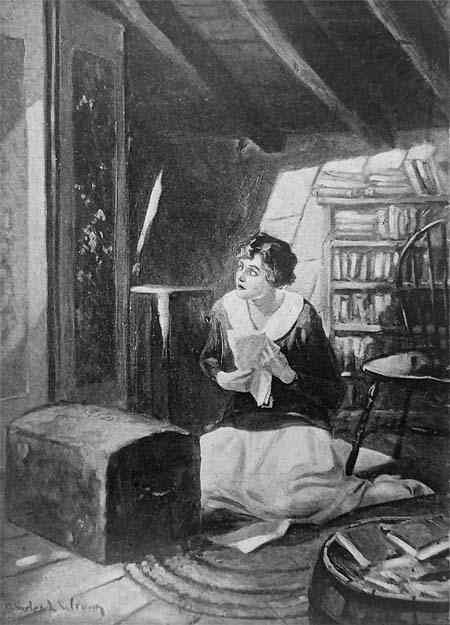
THE high wind sweeping around the Porter mansion in ever increasing volume found an echo under the eaves, and the attic in consequence resounded with dismal noises. Much of the space under the sloping roof had been given up to the storage of trunks and old furniture, but on the side facing the Potomac River wooden partitions divided that part of the attic into rooms for servants.
The south wall of the attic was lined with pine book shelves which ran up to the wooden rafters. There old Judge Erastus Porter had stored his extensive law library, and there his great-niece, little Millicent Porter, had made her playhouse when she visited him. The nook used in childhood had retained its affection in Millicent’s maturer years and, the trunks forming an effectual barricade, she had converted it into a cozy corner, placed pretty curtains in the dormer window, a rug on the bare boards, wheeled an easy-chair, a highboy, and a flat-top desk into their respective places, and, last but not least, a large barrel stood near at hand filled with out-ofprint books and a paper edition of Scott’s novels. Mrs. Porter on her first tour of inspection of the attic had remonstrated against the barrel, stating that it spoiled the really handsome pieces of furniture which Millicent had converted to her own use, but her daughter insisted that the barrel added a touch of picturesqueness, and that she still enjoyed munching an apple and reading “Ivanhoe,” a statement that drew the strictured comment from Mrs. Porter that Millicent had inherited all her father’s peculiarities, after which she was left in peace and possession.
Bundled up in a sweater, Millicent sat cross-legged before a small brass-bound, hair-covered trunk, another companion of her childhood, for she had first learned to print by copying the initials of
her great-great-grandfather outlined in brass tacks on the trunk lid. The trunk still held a number of childish treasures, as well as cotillion favors, invitations, photographs, and a bundle of manuscripts. But contrary to custom, Millicent made no attempt to look at the neatly typewritten sheets; instead she sat contemplating the open trunk, her head cocked on one side as if listening.
Finally convinced that all she heard was the moaning of the wind under the eaves, she lifted out the tray, and, pushing aside some silks and laces, removed the false bottom of the trunk and took from it a ledger. Propping the book against the side of the trunk she turned its pages until she came to an entry which made her pause:
Dined with Mrs. Seymour. Bruce Brainard took me out to dinner. He was very agreeable.
And apparently from the frequency with which his name appeared in her “memory book,” Bruce Brainard continued to be “agreeable.”
Millicent turned page after page, and for the first time read between the lines of her stylish penmanship what her mother, with the farsighted eyes of experience, had interpreted plainly. Flattered by the attentions of a polished man of the world, years older than herself, Millicent had mistaken admiration for interest and liking for love. Brainard’s courtship of the debutante had been ardent, and what she termed an engagement and her mother “an understanding” had followed. Brainard had pleaded for an early wedding, but business had called him away to Brazil, and on Millicent’s advice, who knew her mother’s whims and fancies, he had postponed asking Mrs. Porter’s consent to their engagement until his return.
Millicent read on and on in her ledger; accounts of parties gave place to comments about her brother, Craig, then he absorbed the entire space allotted to each day, and the progress of his trip home was duly recorded, and the items:
October 5th—Thank God, Craig is home again, but, oh, what a wreck! It’s agony to see him lying in bed unable to move hand or foot, unable to speak, unable to recognize
us. But he’s home, not lying in an unknown grave somewhere in Europe. I’ve just met Dr. Alan Noyes, who accompanied Craig to this country, and to whose skill Craig owes his slender hold on life. The doctor is painfully shy.
October 7th—Saw more of Dr. Noyes today; he improves on acquaintance. Mother says he is not shy, only reticent.
Millicent did not linger over the next few entries, but paused and scanned the words:
October 15th—Vera Deane has replaced the night nurse for Craig. She reminds me so of Dorothy, yet they are not a bit alike. Persuaded Dr. Noyes to talk about his experiences in the field hospitals abroad. Must write Bruce tonight without fail.
Millicent skipped several pages, then came the entry:
December 15th—I had no idea Alan Noyes had such a temper; we quarreled most awfully. He announced his creed is never to forget a friend and never to forgive an enemy. Well, I can be stubborn, too.
Millicent sighed drearily and jumped to the date:
December 24th—Alan Noyes has been exceptionally nice today. Our quarrel has blown over. I wish I had told him about Bruce when we first met.
A tear rolled down Millicent’s white cheek and splashed upon the paper, then suddenly she bowed her head and gave way to the grief consuming her. The minutes lengthened, and at last she sat up and dried her eyes. The outburst had brought physical relief, for during the past twenty-four hours she had fought off every inclination to allow her feelings sway, had suppressed all sign of emotion, and had refused to discuss Bruce Brainard’s mysterious death, even with her mother.
“Who’s there?” she called, as heavy steps approached.
Mrs. Porter had hoped that Millicent’s unnatural calm would give way when unburdening herself to her old chum, Dorothy Deane, and she had made opportunities to leave the girls together. But she was not aware that Dorothy had shown an equal desire to avoid the topic of the tragedy, and Millicent found to her secret relief that she was not urged to confidences which she might later bitterly regret. But that afternoon she had felt the need of being by herself, and had fled upstairs, hoping her mother would not think of looking for her in the attic.
Millicent pulled a chair close to her side and was on the point of rising from her cramped position before the trunk when she heard someone coming up the uncarpeted stairs. She slammed the ledger shut and thrust it among the silks and laces in the trunk, and, pulling out a vanity box, commenced powdering her nose and removing all traces of recent tears.
“Who’s there?” she called, as heavy steps approached.
“Me, Miss Millicent.”
“Oh, Murray!” Her tone spoke her relief. “Have you brought the coffee and sandwiches I told Selby to order for me?”
“Yes, miss.” And the footman emerged from behind the highboy which, with a Japanese screen, partly blocked the view of the cozy corner from the rest of the attic.
“Just put the tray on my desk,” directed Millicent. “Has mother gone out?”
“Yes, miss; she took Miss Dorothy in to Washington.” Murray moved several of the desk ornaments to make room for the tray. “These ladies called just now, Miss Millicent, but I said you were out.” And he handed her a number of visiting-cards.
She barely glanced at the names before tossing the cards aside. “I am thankful you did, Murray; make my excuses to callers for the next week. I can see no one.”
“Very good, miss.” But Murray lingered, a troubled look in his eyes. “The ’tec, Mitchell, left word that he’d be back this evening, miss, and that he’s got to see you.”
“Oh, he has?” Millicent’s eyes sparkled with anger. “Inform Mr. Mitchell that I decline to see him.”
“Yes, miss,” and Murray smiled broadly. “Shall I throw him out, miss?”
“Heavens, no!” exclaimed Millicent. “You might get in serious trouble with the law. He has, I suppose,” bitterly, “the right to hang about the scene of a crime—detectives are sanctioned human vultures.”
“He is, miss; a regular troublesome, meddlesome busybody, getting innocent people into trouble,” responded Murray feelingly. “He thinks he’s so bright with his ideas—I’ll idea him.” And the footman, forgetting his customary respectful attitude in his indignation, doubled up his fists suggestively. “How is Miss Deane feeling, miss?”
“Who, Miss Vera? She is at last getting some rest; be sure, Murray, and tell mother and Miss Dorothy not to disturb her when they return.”
“Certainly, miss.” The footman turned to leave. “Anything else I can get you, miss?”
“Not a thing, thank you.” But as Murray stepped around the highboy she asked: “Any telegrams or telephones?”
“No telegrams, miss; but the telephone is going every instant, ’most all of them are reporters.”
“Don’t give out any information, Murray,” she cautioned.
“Certainly not, miss.” And he hurried away.
Millicent waited until she heard the door at the foot of the attic stairs close, then bent over the trunk and again took out the ledger and carefully tore out a handful of pages. Before replacing the ledger in its hiding-place she felt about under the false bottom until convinced that the article she sought was still there, after which she put back
the ledger and the false bottom, rearranged the silks and laces, put in the tray, and locked the trunk.
“If you are not going to drink your coffee, I will,” announced a voice to her left, and a man stepped out from behind the Japanese screen. A low cry escaped Millicent, and her hands closed spasmodically over the pages torn from her ledger.
“Hugh!” she gasped. “Where—where have you been?”
“In town.” Wyndham stopped by the tray and, picking up the plate of sandwiches, handed it to Millicent. She shook her head. “No?” he queried; “then I’ll eat your share.” He poured out a cup of coffee and drank it clear, almost at a gulp. “That’s delicious,” he declared. “I had no idea I was so cold and hungry. Can’t I help you get up?”
But Millicent declined his proffered assistance, and rose somewhat clumsily, both hands engaged in pressing the torn sheets into the smallest possible compass.
“Where have you been, Hugh?” she asked again.
“Sitting on a trunk behind that screen waiting for Murray to go downstairs,” he responded, refilling his cup.
“Then you came up to the attic just after he did?”
“In his wake, so to speak.” He shot a questioning look at her. “Everyone appears to be out this afternoon.”
“Yes.” Millicent carefully turned her back to the dormer window and sat down on the arm of her easy-chair. “You haven’t answered my question, Hugh—where have you been ever since the inquest?”
“At the club.” Wyndham helped himself to another sandwich.
“Awfully sorry I couldn’t get in touch with Dorothy Deane and deliver your message. I was sorry to disappoint you.”
“But I wasn’t disappointed. She received the message in time and came last night.” Wyndham seemed to have some difficulty swallowing his coffee.
“Is she still here?” he inquired as soon as he could speak.
“Yes. Mother insisted that she could run her social column from here as well as from her boarding-house. Most of the social news is gathered over the telephone,” explained Millicent vaguely. “And mother promised to motor in to the office every afternoon and bring her out again in the evening.”
Wyndham set his coffee-cup back on its saucer with small regard for its perishable qualities.
“I might have known that she would come,” he said, half to himself; then louder: “Intimate friends don’t have to be told when they are needed.”
“Dorothy has so much tact—”
“Discussing me?” And Dorothy Deane appeared at Wyndham’s elbow. There was a distinct pause as she recognized Millicent’s companion, and her cheeks, rosy from her long motor ride in the wind, paled. “Oh!” she ejaculated, with an attempt at lightness which deceived but one of her hearers. “The wanderer has returned.”
“Yes—returned to you,” was Wyndham’s quiet rejoinder, and his eyes never left her. “It was very careless of you, Dorothy, not to leave word at the office that you were coming out here last night.”
“If I had mentioned it the managing editor would have insisted that I cover”—she stopped and colored painfully—“new developments for the paper.”
Wyndham transferred his attention to his cousin. “New developments,” he repeated. “Have there been any since I left last night?”
His question did not receive an immediate reply, for Millicent had not paid strict attention to their conversation, being absorbed in secreting the sheets torn from her diary inside her gown.
“Nothing new,” she responded dully. “The detectives are still looking for clues, and under that pretense poking their noses into everyone’s concerns.”
“Let them. Who cares?” But Wyndham did not look so care-free as his words implied. “Brainard’s death is a seven days’ wonder in Washington, Millicent; so be prepared for all sorts of sensational stories. Our friends will talk themselves to a standstill after a time.”
“I suppose sensational stories are to be expected,” admitted Millicent, and she moved restlessly away from her chair. “But what are Bruce’s friends doing?”
Wyndham looked at her quickly. “I don’t understand you—”
“I mean what steps are Bruce’s friends taking to trace the—the murderer?”
Wyndham took a newspaper from his pocket and unfolded it.
“Brainard’s brother has offered a reward of five thousand dollars for the arrest of the criminal,” he stated, pointing to an article in the paper.
Dorothy broke the silence with an impatient stamp of her foot. “The fool!” she exclaimed. “He’d better have waited until it’s proven beyond doubt that it was a murder and not a suicide.”
The newspaper crinkled in Millicent’s hand as she took it, and Wyndham, his eyes roving about the cozy corner, stated quietly:
“The police have found that Brainard never shaved himself, but went every morning to a barber shop just below his apartment house. Apparently he never owned a razor, and the police seem to think that evidence precludes all possibility of suicide.”
“I don’t see why,” protested Millicent, looking up from the paper. “If Bruce contemplated suicide he could have purchased a razor.”
“True, but investigation proves that he did not buy a razor at any of the dealers handling them in Washington, or at a pawnshop. I must admit the police have been very thorough in their search,”
acknowledged Wyndham. “It’s all in the evening papers.” He stopped for a moment, then added steadily, “I think, no matter how terrible we find the idea, that we must accept the theory that Brainard was murdered.”
Millicent caught her breath. “I don’t agree with you,” she retorted obstinately. “Are we meekly to consider ourselves murderers just because Bruce never, apparently, owned a razor?”
“You are right,” declared Dorothy, but her manner, to Wyndham’s watchful eyes, indicated that she was clutching at a straw rather than announcing her convictions. “Some friend might have loaned him a razor— Heavens! what’s that?”
A loud hail sounded up the staircase. “Millicent! Millicent!” and they recognized Mrs. Porter’s angry accents. “Why in the world are you staying in that cold attic? Come down at once.”
“Yes, mother.” Millicent started for the staircase, casting an appealing look at Dorothy as she passed her, and in mute response the latter turned to follow, but at the top of the stairs Wyndham laid a detaining hand on her shoulder.
“Wait,” he entreated, and as he met her wistful, frightened glance he repressed with difficulty the emotion that threatened to master him.
“Dorothy, never forget I have your interests at heart to the exclusion of all else.”
“Hush!” She raised a trembling hand to his lips, and seizing it he pressed it against his cheeks.
“Dear, how cold you are!” he murmured fondly, caressing her hand.
“Hush!” she reiterated. “Hugh, you must not—this is not the time—”
“It is,” with obstinate fervor. “You cannot have forgotten—”
“Forgotten?” Dorothy started as if stung. “Would to heaven I could!”
“Then you understand?” She looked at him dumbly. “You are sure you understand?”
Through a mist of tears Dorothy studied him, and as she met his imploring gaze a wave of tenderness sent her other hand to meet his eager clasp; then horror of herself, of her thoughts, checked her wild longing to throw herself into his arms, and she drew back.
“It is because I understand,” she said, steadying her voice with an effort, “that I shall never cease to reproach myself—”
“Stop!” Wyndham held up an imperative hand. “You must not reproach yourself. Bruce Brainard deserved what he got. I tell you he did—” noting her expression. “It was justifiable homicide.”
CHAPTER X
THE BLACK-EDGED CARD
THE hall clock was just striking three on Thursday afternoon when Murray stopped before the room occupied jointly by Mrs. Hall and Vera and rapped smartly on the closed door. It was opened by Vera.
“You are wanted at the telephone, miss,” the footman announced, and she stepped into the hall.
“Who wants me, Murray?”
“The party wouldn’t give his name.”
“Oh!” Vera’s footsteps lagged. “Did you recognize the voice?”
“No, miss. Shouldn’t wonder if it’s another ’tec,” he added gloomily. Two whole days had passed and Mrs. Porter had not inquired for his state of health, and even Vera had failed him as a confidante for his latest symptoms; truly his world was out of joint. “I asked him for his message and he said he had to speak to you personally.”
A second “Oh!” slipped from Vera, then she went downstairs in thoughtful silence and was proceeding toward the library when Murray, of whose presence she had grown oblivious, addressed her.
“I hopes, miss, you don’t hold yesterday’s doings in Mr. Brainard’s room against me,” he said earnestly. “I feel very badly about it— very.”
“I realize that you were not to blame,” answered Vera. “But the others—” Her small hand clenched. “I’d rather forget the scene, Murray; some day, perhaps, I’ll get square with those men for the fright they gave me.”
“I hope you will, miss.” Murray threw open the library door. “I’m wishing Mrs. Porter would give orders not to admit them. Me and
Selby are waiting our chance.” And he smiled significantly.
“Perhaps she will.” And Vera glanced earnestly at the footman. “You are not looking very well today, Murray; have you tried that tonic Dr. Noyes advised?”
The footman brightened. “I have, miss, but it don’t agree with me, and the neuralgia’s getting worse.”
“That’s too bad. Come upstairs later and I will give you a tube of Baume Analgésique Bengué.” As the French name tripped off her tongue Murray regarded her with respectful admiration.
“It sounds great, miss; I’d like to use it, thank you.” And he departed for his pantry, his manner almost cheerful.
Left to herself Vera closed the library door and approached the telephone with some hesitancy; she could think of no friend who would have a reason for not giving his name to the footman and concluded Murray was right in imagining the “party” to be a detective. Her interview with Mitchell the day before was still fresh in her mind and she resented the idea of further impertinence. It occurred to her, as she toyed with the receiver, that it was a simple matter to ring off if she found it was Mitchell at the other end of the wire; then a thought stayed her—suppose it was Dr. Beverly Thorne waiting to speak to her? Her expression hardened, and her voice sounded clear and cold as she called into the mouthpiece: “Well?”
An unknown voice replied: “Is this Nurse Vera Deane?”
Vera’s expression altered. “Yes, what is it?”
“This is Police Headquarters,” went on the voice crisply, and Vera started. “Inspector North speaking. Have you lost anything, Miss Deane?”
“I? No.”
“Are you sure you have not lost your handbag?”
“My handbag!” Vera’s raised accents testified to her astonishment. “No, certainly not.”
“Quite sure, Miss Deane?” insisted the inspector.
“Yes; but as a matter of form I’ll run upstairs and look. Hold the telephone, please.” And Vera dashed up to her room and unlocked her trunk; there lay her handbag, and pulling it open she found its contents intact.
She was out of breath when she again reached the telephone, and had to pause a second before speaking to the inspector.
“My handbag is upstairs, safe and sound,” she called.
“Thank you.” The inspector cleared his voice. “I called you up, Miss Deane, because we found a handbag in a Mt. Pleasant car yesterday afternoon containing your visiting-card, and we located you through the Central Directory for Graduate Nurses.”
“My visiting-card?” echoed Vera, astonished. “Are you sure it was mine?”
“Oh, yes, Miss Deane, your name is engraved in full on a blackedged card. Good afternoon.” And he rang off.
A black-edged visiting-card? Vera sat clinging to the telephone receiver in bewilderment—it had been fully five years since she had had a black-edged visiting-card! Suddenly her ear detected the click of a receiver being hung up, and the faintness of the sound aroused her. Who had been listening in on the branch telephone in Mrs. Porter’s boudoir?
Vera went straight to the boudoir, but before she reached it Millicent walking down the hall paused in the act of entering her own room and called her name softly.
“Mother is lying down,” she said as Vera drew nearer. “Dorothy and I have just left the boudoir. Come and join us in my room.” And she held out her hand with a little affectionate gesture which was characteristic of her. Vera smiled, and under sudden impulse kissed
her; there was something very winsome about Millicent, mere child as she was.
“Thanks, Millicent, I’ll come and sit with you later; but first I must take my ‘constitutional’—I haven’t had a walk for several days, and I need the fresh air.”
Millicent stroked her cheek with tender fingers. “Perhaps the wind will put color there,” she said. “You are not getting proper rest, Vera; for your pallor and heavy eyes tell the story.”
Vera shook her head in dissent. “I only need fresh air; don’t let that foolish sister of mine put ideas into your head.” She stopped abruptly as Hugh Wyndham stepped out of his aunt’s bedroom and joined them.
“Good afternoon, Miss Deane,” he commenced cordially, but she returned his greeting so perfunctorily that Millicent’s eyes opened wide in surprise, and, reddening, Wyndham turned to his cousin. “Are you going to motor in to Washington with us, Millicent? Better come; you don’t have to leave the car or talk to anyone,” guessing the cause of her hesitancy.
“True—” but still Millicent paused.
“I think you had better go,” put in Vera quietly, and barely glancing at Wyndham she went to her own room. Wyndham smiled reassuringly as he caught Millicent’s puzzled frown. “Vera’s nerves are on edge,” he said. “I quite understand her seeming rudeness.”
“Well, I don’t,” confessed Millicent. “Dorothy has a much sweeter disposition than her sister, and on her account I overlook Vera’s occasional tempers. Go and get the limousine, Hugh; Dorothy and I will be ready in ten minutes.”
However, it was less than the prescribed ten minutes when Millicent and Dorothy stood waiting in the lower hall for the arrival of the car, and the latter, going into the library to collect some notes she had
left there, encountered her sister on her way out of the side entrance to Dewdrop Inn.
“I wish you were going with us, Vera,” she exclaimed impulsively. “Do come, there’s plenty of room in the limousine.”
“Not today, dear.” And Vera tempered the refusal with a kiss. She glanced at the yellow copy paper Dorothy was busy stuffing inside her muff. “Did you use the telephone in Mrs. Porter’s boudoir about fifteen minutes ago?”
Dorothy shook her head. “No, but Mrs. Porter and then Hugh tried to get Central.” Her sister’s reference to the boudoir recalled a recent conversation, and she added briskly: “Vera, why are you so standoffish with the Porters? They are fond of you, yet you never spend any time with them, and I think they feel it.”
Vera drew back from Dorothy’s detaining clasp. “I am here in my professional capacity, Dorothy, and I don’t wish to intrude upon them,” she said gently. “Better that they think me ‘stand-offish’ than say I take advantage of ‘auld lang syne’ and push myself forward.”
“What nonsense! I declare, Vera, you are downright provoking, not to say morbid,” protested Dorothy. “It’s the result of never getting away from the atmosphere of the sick room. I don’t see how you stand it; the mere sight of suffering drives me wild, and to think of poor Craig Porter, whom I used to dance with, lying there inert—I just could not go to his room today when Mrs. Porter asked me to do so,” she wound up. “His changed appearance would break me down completely. How can you watch him night after night?”
“You and Craig were great friends, whereas I never knew him in those days.” Vera lowered her voice. “Let me see, did you first meet him when we were in mourning?”
“No, before that, when Millicent and I were at Catonsville together. We were great chums.” And she smiled, then winked away a sudden rush of tears. “Poor Craig!”