Oxford University Press is a department of the University of Oxford. It furthers the University’s objective of excellence in research, scholarship, and education by publishing worldwide. Oxford is a registered trade mark of Oxford University Press in the UK and certain other countries.
Published in the United States of America by Oxford University Press 198 Madison Avenue, New York, NY 10016, United States of America.
All rights reserved. No part of this publication may be reproduced, stored in a retrieval system, or transmitted, in any form or by any means, without the prior permission in writing of Oxford University Press, or as expressly permitted by law, by license or under terms agreed with the appropriate reprographics rights organization. Inquiries concerning reproduction outside the scope of the above should be sent to the Rights Department, Oxford University Press, at the address above.
You must not circulate this work in any other form and you must impose this same condition on any acquirer.
CIP data is on file with the Library of Congress.
ISBN: 978-0-19-753729-9
DOI: 10.1093/oso/9780197537299.001.0001
Printed by Sheridan Books, Inc., United States of America
today’s student (2021)
This page intentionally left blank
Acknowledgments ix
Introduction
The Lost Words of Bernal Diaz xin
1 A Handful of Adventurers
The Myth of Exceptional Men 1
2 Neither Paid Nor Forced
The Myth of the King's Army 27
3 Invisible Warriors
The Myth of the White Conquistador 44
4 Under the Lordshipof the King
The Myth of Completion 64
5 The Lost Wordsof La Malinche
The Myth of (Mis)Communication 77
6
The Indians Are Coming to an End
The Myth of Native Desolation 100
7 Apes and Men
The Myth of Superiority 131
Epilogue
Cuauhtemoc's Betrayal 147
Afterword 159
Permissions 175
Notes 177
References 215
Index 239
This page intentionally left blank
Acknowledgments
The names of these Seven Cities, which have not been discovered, remain unknown, and the search for them continues to this day.
—Pedro
de Castañeda Nájera (ca. 1560)
The number seven has almost mystical qualities.
New York Times (2002)
“There seem to be a lot of myths in this class,” said the student, not without a hint of suspicion. Thus was the seed for this book planted, one spring afternoon in a Pennsylvania classroom.
What began as an attempt to respond to the student’s comment and to adjust my undergraduate lectures accordingly soon developed into a book project—and the misconceptions and convenient fictions of Conquest history gradually settled into seven “myths” in seven chapters, constituting a seven-part argument against much of conventional wisdom on the Spanish Conquest in the Americas.
The book’s seven-part structure seemed justified by the fact that the number seven has deep roots and symbolic significance in the history of the Americas, both Native American and Spanish. The origin myth of the Mexica included a tale of descent from seven lineages, who emerged from seven caves in a mythical location in the Mexican north.1 The medieval law code that was the basis of Spanish law during the Conquest period was called Las siete partidas (The seven items). There were rumored to be seven cities of gold in Cíbola, a name given variously to northern South America before it was invaded and dubbed New Granada and to all or part of what is now the south and southwest United States—where Coronado searched in vain for the Seven Cities in 1540–42
2
My search for “seven myths” was not in vain, aided greatly the following spring (2001) by the experience of teaching a graduate seminar in the Pennsylvania State University History Department titled “Seven Myths of the Spanish Conquest.” The idea was to write and teach on identical topics, allowing each process to stimulate and fertilize the other. It all worked out better than ix
I could possibly have hoped. Without the contributions of the seminar members in class and on paper (their essays are included in a special section of the bibliography), this book would have taken twice as long to write and been a vastly inferior product. I am most grateful to every one of them—Bobbie Arndt, Valentina Cesco, Iris Cowher, Jason Frederick, Gerardo Gutiérrez, María Inclán, Amy Kovak, Blanca Maldonado, Zachary Nelson, Christine Reese, Michael Smith, and Leah Vincent. I am also grateful to Gregg Roeber for encouraging and making possible my “Seven Myths” semester.
I was fortunate to spend the next spring (2002) as a National Endowment for the Humanities fellow at the John Carter Brown Library at Brown University, where finishing touches were put to the book manuscript. I am grateful to the library’s director, Norman Fiering, to the staff, and to my fellow fellows for their generosity and many contributions. A number of friends and colleagues profoundly influenced my thinking on this topic or offered helpful comments on portions of the book. They include Patrick Carroll, Jack Crowley, Garrett Fagan, Michael Francis, Philip Jenkins, Grant Jones, Jane Landers, Juliette Levy, James Lockhart, James Muldoon, William Pencak, Carol Reardon, Helen Restall, Robin Restall, Tim Richardson, Guido Ruggiero, Susan Schroeder, Andrew Sluyter, and Dean Snow—and in particular Felipe Fernández-Armesto, Susan Kellogg, Kris Lane, and Neil Whitehead, all of whom gave me extensive written comments on the whole manuscript. Susan Ferber of Oxford University Press made line-by-line editorial suggestions that were as thorough as they were insightful. She is a true master of the red pen and I am most grateful for the resulting improvements made to every page.
Finally, I thank Helen, Sophie, and Isabel, for always understanding my need to finish “just one more sentence.”
M.B.R.
State College, Pennsylvania
September, 2002
Those men . . . who have written not what they saw, but what they did not hear so well . . . wrote with great detriment to the truth, occupied only in dry sterility and with the fruitlessness of the surface, without penetrating into the reason of men.
—Fray Bartolomé de Las Casas (1559)
Mr. Writer, why don’t you tell it like it really is?
—Stereophonics (2001)
To distinguish between the curved and the straight.
—Horace (ca. 30 B.C.)
I did not find out any more about this, and what I have written down is of little help.
—Fray Ramón Pané (1498 )
Speaking with great majesty, seated on his throne, the Inca flung the book from his hands.
—Don Felipe Huaman Poma de Ayala (1615 )
Introduction
The Lost Words of Bernal Díaz
It has been a shock for us to learn that we do not perceive the world just as it is, and that our knowledge of the world is inescapably framed by the concepts and language of our culture.
—Behan McCullagh (1998 )
Historians today are priests of a cult of truth, called to the service of a god whose existence they are doomed to doubt.
—Felipe Fernández-Armesto (1999)
Let the curious reader consider whether there is not much to ponder in this that I am writing. What men have there been in the world who have shown such daring?
—Bernal Díaz del Castillo (1570 )
When Bernal Díaz first saw the Aztec capital he was lost for words. Years later, the words would come, many of them, when he wrote a lengthy account of his experiences as a member of the Spanish expedition led by Hernán Cortés against the Aztec empire. But on that November afternoon in 1519, as Díaz and his fellow conquistadors came over the mountain pass and looked down upon the Valley of Mexico for the first time, “gazing on such wonderful sights, we did not know what to say, or whether what appeared before us was real.”1
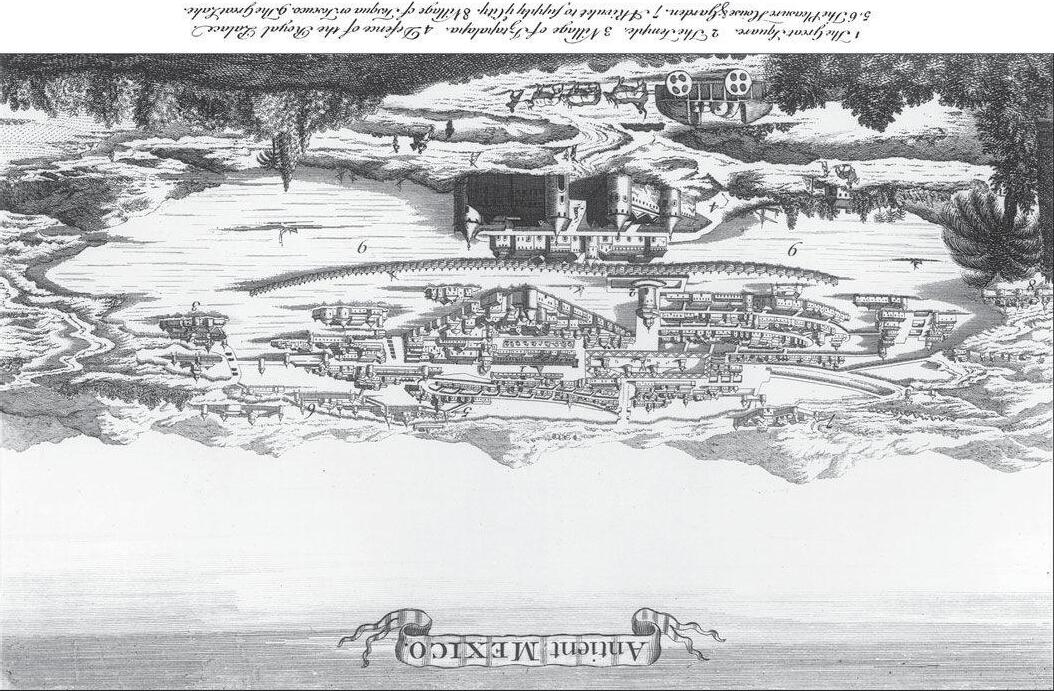
Díaz’s struggle to describe what he saw—the metropolis of Tenochtitlán, studded with pyramids, crisscrossed with canals, seeming to hover on a lake that was “crowded with canoes” and edged with other “great cities”—derived from his shock at realizing that the world was not what he had perceived it to be. Just as artists would for centuries draw pre-Conquest Tenochtitlán with distinctly European features (see Figure 1), so did Díaz try to compare the valley to European cityscapes of his experience, but could not. In the end, he resorted to a reference to medieval fiction, so that the Aztec cities “seemed xiii
like an enchanted vision from the tale of Amadis.”2 Cortés was likewise daunted by the challenge of finding a comparable city in the “old” world, likening Tenochtitlán to Córdoba, Seville, and Salamanca all in the same few pages. 3 But whether the Aztec capital was deemed to be more like Venice, Seville, or the fictional Amadis, the accounts by Díaz, Cortés, and the other Spaniards of what they saw and did in the Americas were inescapably framed by the concepts and language of their own culture.
As a result, a set of interrelated perspectives soon developed into a fairly coherent vision and interpretation of the Conquest—the sum of Spanish conquest activity in the Americas from 1492 to about 1700. While many aspects of the Conquest and its interpretation have long been debated—from the arguments of sixteenth-century Spanish ecclesiastics to those of professional historians today—most of the fundamental characteristics of that vision, and a surprising number of its details, have survived.
Cortés would be most gratified by the credit given to him for the fall of the Aztec Empire in many a website and textbook. The seven myths of the Conquest can all be found in the Cortés legend, in which his military genius, his use of superior Spanish technology, and his manipulation of credulous “Indians” and a superstitious Aztec emperor enable him to lead a few hundred Spanish soldiers to a daring conquest of an empire of millions —and thereby set an example that permits the rest of the Spanish conquests in the Americas. In the sixteenth century Cortés became the archetypal conquistador, and he remains so today.
At the same time, our understanding of the Conquest has become far more complex and sophisticated, owing not least to the increased availability of source documents written by Spaniards and Native Americans in the colonial period (that lasted from the sixteenth to early nineteenth centuries). It is true that in recent years historians have become increasingly concerned with the problem of subjectivity and our inability to escape it. Truth itself has been discredited as a concept relevant to historical investigation.4 But the impossibility of being completely objective need not be so discouraging. In the realm of subjectivity things can get really interesting. The concepts of a particular culture, the way they are expressed, and the relationship between those words and reality, can lead to genuine insight into an historical phenomenon such as the Spanish Conquest—and a better understanding of how such a phenomenon has been understood over the centuries.
For example, Cortés becomes more interesting and more believable when his myth is explored and broken down. The realization that conquistadors
Facing page: Fig. 1. Tenochtitlán, or “Antient Mexico,” portrayed as more of a European city than a Mesoamerican one, complete with medieval towers and Old World oxen; from John Harris’s Voyages and Travels (1744 [1705]).
before and after Cortés behaved like him leads to other, equally fascinating stories. Awareness of the decisive role played by West Africans and native allies of the Spaniards enriches Conquest history and helps explain its outcome. The revelations that most conquistadors were not soldiers, and Native Americans did not believe Spanish invaders were gods, prompts investigation into the tangle of sources that both produced such misconceptions and permit alternative arguments.
This book is about the pictures painted by men like Díaz of the Spanish conquests in the Americas, and the pictures painted by historians and others who in the past five centuries have followed Díaz across the Atlantic and into Tenochtitlán and other places of wonder in the “new” world. The book’s sources range from documents written by Spaniards, Native Americans, and West Africans who experienced the Conquest and its aftermath, to the tomes of academics produced in colonial and modern times, to Hollywood movies.
Each of the seven chapters articulates a myth about the Conquest, dissects it, and places it in the context of alternative sources of evidence. At its most basic level, the book juxtaposes false and accurate descriptions of the Conquest.5 But the book is also more than that. In presenting historical interpretations of the Conquest as myths rooted in the cultural conceptions, misconceptions, and political agendas of their time, I am aware that I too am inescapably influenced by the concepts and language of my own culture. Beyond simply contrasting myth and reality, my analysis recognizes that myths can be real to their progenitors and that a supposed reality built by researching archival sources can also generate its own myths. This is therefore not just a book about what happened, but a book that compares two forms of what is said to have happened. One form is created at the time of the historical moment itself. The other form is germinated in archives and libraries, when historians write historical accounts that strive to achieve objectivity (even if it must always remain just out of reach).6
The term “myth” is used here not in the sense of folklore, of popular narratives and beliefs featuring religious systems and supernatural characters. Rather it is used to mean something fictitious that is commonly taken to be true, partially or absolutely.7 Both of these meanings of “myth” have an ambiguous connection to “history.” Ever since Plato set about exploding the myths of his day, Western thought has viewed history and myth as standing in opposition to each other; one is true, being the reconstruction of actual events and people who really lived, the other is fiction, being a construction of invented events and imagined people. However, this polarity is not always so clear. Plato sought to replace the “lies” of old myths with historical “truths” that were laced with new myths invented by him.8 Historian Paul Veyne has argued that ancient Greek myths were “neither true nor fictitious because [they were] external to but nobler than the real world.” Scholars of Mesoamerica, a civilizational area covering most of Mexico and Central America,
assert that native people did not recognize such a distinction between myth and history. Instead Mesoamericans viewed the past in a way we would characterize as combining elements of myth and history. The great surviving text of the Quiché Mayas, the Popol Vuh, seamlessly blends mythic and historical components into one epic narrative, called “mythistory” by anthropologist Dennis Tedlock. 9
Does this ambiguous relationship between myth and history, or their fusing into mythistory, undermine the quest to find truths about the past? In pursuing that quest, do we run the risk of following in Plato’s footsteps and replacing old myths with invented truths or new myths? Are our truths really convenient fictions?10 They may often be just that, but we can still examine the context and purpose of such fictions. We can compare the truths of the conquistadors to our truths about them, and as a result achieve a better understanding of the Conquest—even if that understanding does not pretend to be the truth in an absolute sense. Historical conclusions are not infallible, but when they are well evidenced and carefully argued they deserve to be taken as telling us something true about the world. We can question the truth claims of an historical narrative without going so far as to relegate it to merely one fiction among others.11 There are always multiple narratives of any historical moment, but that does not mean that as interpretations they cannot tell us something true.
The Spanish writer Valle Inclán’s famous aphorism “things are not how we see them but how we remember them” prompts us to be skeptical of eyewitness accounts like Díaz’s.12 But—more importantly—we are also reminded that within those memories history persists, myth is engendered, and truths of some kind await our discovery.
The moment in Bernal Díaz’s narrative when he writes that he and his comrades were lost for words at the first sight of Tenochtitlán is a moment pregnant with interpretive possibilities. Perhaps the moment was created by Díaz in his old age, a product of his imagination. Perhaps it was a deliberate dramatization of an incredulity really experienced—but at a later date, when he was less exhausted, or his view of the valley was clearer. Perhaps the sensation of seeing something so new that it seemed unreal forced Díaz, in that moment of stunned silence, to open his mind to a larger vision of the world. Or perhaps he was simply terrified, as he hints later in his story, at the prospect of being one of a few strangers in a vast and potentially hostile city.
Although Díaz’s silent awe does not last for long, he never completely fills in the moment, nor should we expect him to. The silences in Díaz’s narrative include not only his own thoughts then and decades later, but also those of his Spanish comrades, the Africans they brought with them, and the central Mexican natives whom the Spaniards were forcing to take sides in a bloody civil war. And then there are the reactions of Díaz’s readers, from his own
time to today, reactions that fill silences throughout narratives such as his and thereby become part of the process of historical production.
The fact that there are so many phrases we can insert into Díaz’s silent moment does not render the exercise of its exploration and reconstruction impossibly nebulous. Amidst the uncertainty and multiplicity of narratives, in such a moment and its interpretations, something true about the world can surely be discovered.
This book begins that endeavor with a critique of the idea that the Conquest was made possible only through the audacity and achievements of “great men”—the unique few to show such daring, to paraphrase Bernal Díaz. I argue in Chapter 1 that we can view the Conquest more clearly through the patterns created by the biographies of many Spaniards, rather than the lives of the supposedly exceptional few. The Spaniards who invaded the Americas followed procedures developed and standardized by generations of settlers. Their destinies were not determined by the bold genius of a handful of adventurers (to paraphrase the nineteenth-century historian William Prescott).13 Chapter 2 tackles the myth that the conquistadors were soldiers sent to the Americas by the king of Spain. In fact, the conquistadors were far more varied in their identities, occupations, and motivations—and far more interesting— than that.
The myths of Chapters 3 and 4 are rooted in the accounts of the Conquest written by the conquistadors themselves. They were generated by specific political circumstances and cultural contexts, and yet, as with all Conquest myths, they have shown remarkable longevity. These are the notions that conquest was achieved and colonialism rapidly imposed, first, when native armies were defeated and Spanish cities founded, and second, by surprisingly small groups of Spaniards acting alone. Such narratives disguise the protracted and incomplete nature of the Conquest, as well as the crucial roles played by Native American “allies” and free and enslaved West Africans.
Chapter 5 navigates the reader through the rough waters of what I have termed the “myth of (mis)communication.” This chapter argues that just as the Spaniards themselves fabricated the myth that they were able to communicate with native leaders, so have modern historians swung the pendulum too far in the opposite direction and generated a countermyth that emphasizes Spanish-native miscommunication. A middle ground between the two extremes allows a better understanding of how Spaniards and natives came to view each other’s intentions. The topic of native roles leads us to that of native reactions. In Chapter 6 I take issue with the widespread misconception that the Conquest reduced the Native American world to a void.14 In diverse and profound ways native cultures displayed resilience, adaptability, ongoing vitality, a heterogeneity of response to outside interference, and even a capacity to invert the impact of conquest and turn calamity into opportunity.
The final chapter discusses the ultimate myth, the foundational concept that has served for five centuries as the simplest—and most facile—explanation for the Conquest. This is the myth of Spanish superiority, a subset of the larger myth of European superiority and the nexus of racist ideologies that underpinned colonial expansion from the late fifteenth to early twentieth centuries.
The Epilogue is framed by the 1525 encounter of Cortés, Cuauhtémoc, the last Aztec emperor, and Paxbolonacha, the ruler of a small Maya kingdom. This episode, which has received little attention from historians, is presented here as illustrative of all the themes of the Conquest discussed in the book— viewed both through the seven myths and through their counterpoints. The myths surrounding Cuauhtémoc’s death, which is the climax of the episode, function as metaphors for the larger myths of the Spanish Conquest.
This page intentionally left blank
Seven Myths of the Spanish Conquest
This page intentionally left blank
1
AHandful of Adventurers
The Myth of Exceptional Men
Mr. Christopher Columbus,
sailed the seas without a compass.
Well, when his men began a rumpus,
up spoke Christopher Columbus.
He said, ‘There is land somewhere,
so until we get there,
we will not go wrong,
if we sing a swing song.
Since the world is round,
we’ll be safe and sound.
Till our goal is found,
we’ll just keep a-rhythm bound.’
Soon the crew was makin’ merry.
Then came a yell,
‘Let’s drink to Isabel-la!
Bring on the rum!’
That music ended all the rumpus.
Wise old Christopher Columbus.
—Andy Razaf (1936)
The Conquest of Mexico and the conversion of the peoples of New Spain can and should be included among the histories of the world, not only because it was well done but because it was very great. . . . Long live, then, the name and memory of him [Cortés] who conquered so vast a land, converted such a multitude of men, cast down so many idols, and put an end to so much sacrifice and the eating of human flesh!
—Francisco López de Gómara (1552)
When in ancient or modern times have such huge enterprises of so few succeeded against so many? . . . And who has equaled those of Spain? Certainly not the Jews nor the Greeks nor Romans, about whom most is written.
—Francisco de Jerez (1534)
To such lengths of blind partiality will men be carried, who care less for the truth of history than for the fame of its creatures.
—Aaron Goodrich (1874)
One of the great themes of historical literature over the past five centuries has been the assessment of the European discovery of the Americas as one of the two greatest events in human history. Perhaps the earliest such judgement made in print was the claim by the Paduan philosopher Lazzaro Buonamico in 1539 that nothing had brought more honor to mankind “than the invention of the printing press and the discovery of the new world; two things which I always thought could be compared, not only to Antiquity, but to immortality.” A similar, better-known pronouncement was penned by Francisco López de Gómara, Hernán Cortés’s private secretary and official biographer, in 1552. “The greatest event since the creation of the world (excluding the incarnation and death of Him who created it),” wrote Gómara, “is the discovery of the Indies [i.e., the Americas].”1
By the eighteenth century, the “discovery” had come to share its number one position with a related European achievement.2 “No event,” wrote the French philosopher Abbé Raynal in 1770, “has been so interesting to mankind in general . . . as the discovery of the new world, and the passage to India by the Cape of Good Hope.” Six years later the economist Adam Smith issued a bolder version of this assessment, stating that “the discovery of America, and that of a passage to the East Indies by the Cape of Good Hope, are the greatest and most important events recorded in the history of mankind.”3
In the theme’s most recent incarnation, the Discovery has acquired a distinctly modern companion. Writing near the dawn of the space age, in 1959, the intellectual historian Lewis Hanke focused not so much on the Discovery as the subsequent debate over Native Americans. “No matter how far rockets may reach into outer space,” he asked,“will any more significant problems be discovered than those which agitated many Spaniards during the conquest of America?” In a similar vein, more than a decade after men walked on the moon, the semiotician Tzvetan Todorov declared that the voyages of the astronauts were of secondary significance because they led to “no encounter at all.” In contrast,“the discovery of America, or of the Americans, is certainly the most astonishing encounter of our history.”4
The connection between seafaring and spacefaring is made particularly explicit in the Smithsonian’s National Air and Space Museum. In an exhibit titled Where Next, Columbus? the exploratory achievements of mankind are placed within a trajectory beginning with Columbus’s transatlantic voyages, running through the European settlement of the North American West, and climaxing in space travel. One graphic from the exhibit even shows Columbus and the moon afloat in the same constellation.5
That image illustrates a second theme that has run parallel to the “greatest event” theme ever since the days of Columbus himself. This is the characterization of the European discovery and conquest of the Americas as the achievement of a few great men. This theme can also be summed up in a phrase that has appeared in print over and over—a handful of adventurers.
The roots of this interpretation run deep into the Conquest period itself, and versions of the phrase go back at least to the eighteenth century. Denis Diderot, for example, described the conquistadors as a mere “handful of men.”6 The version I have chosen as emblematic of the theme appears to have been coined in 1843 by the great nineteenth-century historian William Prescott. The Conquest of Mexico, wrote Prescott, was “the subversion of a great empire by a handful of adventurers.”7 Since then the phrase and variations upon it have become inescapable in the historical literature. The Conquest is the tale of “how a handful of Spaniards won two empires;” Cortés and Francisco Pizarro overthrew empires “leading only small bands of adventurers” with “no more than a handful of men”; the Conquest of Peru is achieved by “illiterate adventurers,” or “by a mere handful of men,” and that of Mexico by“a small contingent of Spanish adventurers” or “a motley bunch of Spanish adventurers.”8
These two themes have inevitably given rise to a third. If history’s greatest event—the European discovery and conquest of the Americas—was achieved by a mere “handful of adventurers,” how did they do it? In the words of Francisco de Jerez, a conquistador of Peru who in 1534 published an account of the initial Spanish invasion of the Inca empire, “When in ancient or modern times have such huge enterprises of so few succeeded against so many?”9 Historians writing today continue to repeat Jerez’s question. “What . . . made so awesomely implausible a victory possible?” “How were small bands of conquistadores successful against powerful and populous polities?” “How could empires as powerful as those of the Aztecs or the Incas be destroyed so rapidly by a few hundred Spaniards?”10
The question represents “one of the most puzzling problems to have vexed historians.”11 Indeed, it is at the heart of this book, not only because the answers to it written before so often contain elements of all seven of the myths anatomized in these pages. It is also because the very posing of the question itself is profoundly misleading; it is the lid to the Pandora’s Box of Conquest myths. Viewed within the circular confines of these three themes, the question of “how” answers itself. How could so few accomplish something so great? Because they themselves were exceptionally great men. This is the myth that is the focus of this first chapter.
DIn 1856 the Mexican artist José María Obregón completed a painting titled The Inspiration of Christopher Columbus (see Figure 2).12 The painting captures the two principal elements of the Columbus myth—his brilliant use of the technology of the day, and, more importantly, the genius of his vision. The source of his inspiration is the ocean itself and what he somehow knows