https://ebookmass.com/product/secret-worlds-theextraordinary-senses-of-animals-1st-edition-martin-stevens/
Instant digital products (PDF, ePub, MOBI) ready for you
Download now and discover formats that fit your needs...
The Secret Barrister The Secret Barrister
https://ebookmass.com/product/the-secret-barrister-the-secretbarrister/
ebookmass.com
The Sounds of Life: How Digital Technology Is Bringing Us Closer to the Worlds of Animals and Plants Karen Bakker
https://ebookmass.com/product/the-sounds-of-life-how-digitaltechnology-is-bringing-us-closer-to-the-worlds-of-animals-and-plantskaren-bakker/
ebookmass.com
Shopping and the Senses, 1800-1970 Serena Dyer
https://ebookmass.com/product/shopping-and-thesenses-1800-1970-serena-dyer/
ebookmass.com
The Trump Doctrine and the Emerging International System
Stanley A. Renshon
https://ebookmass.com/product/the-trump-doctrine-and-the-emerginginternational-system-stanley-a-renshon/
ebookmass.com
2022/2023 ASVAB For Dummies 11th Edition Angie Papple Johnston
https://ebookmass.com/product/2022-2023-asvab-for-dummies-11thedition-angie-papple-johnston/
ebookmass.com
Sound and Recording: Applications and Theory 7th Edition, (Ebook PDF)
https://ebookmass.com/product/sound-and-recording-applications-andtheory-7th-edition-ebook-pdf/
ebookmass.com
eTextbook 978-1285448817 Criminal Law and Procedure
https://ebookmass.com/product/etextbook-978-1285448817-criminal-lawand-procedure/
ebookmass.com
Goldfrank’s Toxicologic Emergencies, 11E [TRUE PDF] 11th Edition Robert S. Hoffman
https://ebookmass.com/product/goldfranks-toxicologicemergencies-11e-true-pdf-11th-edition-robert-s-hoffman/
ebookmass.com
Steps to Writing Well, 2016 MLA Update 13th Edition, (Ebook PDF)
https://ebookmass.com/product/steps-to-writing-well-2016-mlaupdate-13th-edition-ebook-pdf/
ebookmass.com
Trial Techniques and Trials (Aspen Coursebook Series) 10th Edition, (Ebook PDF)
https://ebookmass.com/product/trial-techniques-and-trials-aspencoursebook-series-10th-edition-ebook-pdf/
ebookmass.com
SECRET WORLDS
1
Great Clarendon Street, Oxford, OX2 6DP, United Kingdom
Oxford University Press is a department of the University of Oxford. It furthers the University’s objective of excellence in research, scholarship, and education by publishing worldwide. Oxford is a registered trade mark of Oxford University Press in the UK and in certain other countries
© Martin Stevens 2021
The moral rights of the author have been asserted
First Edition published in 2021
Impression: 1
All rights reserved. No part of this publication may be reproduced, stored in a retrieval system, or transmitted, in any form or by any means, without the prior permission in writing of Oxford University Press, or as expressly permitted by law, by licence or under terms agreed with the appropriate reprographics rights organization. Enquiries concerning reproduction outside the scope of the above should be sent to the Rights Department, Oxford University Press, at the address above
You must not circulate this work in any other form and you must impose this same condition on any acquirer
Published in the United States of America by Oxford University Press 198 Madison Avenue, New York, NY 10016, United States of America
British Library Cataloguing in Publication Data
Data available
Library of Congress Control Number: 2021934078
ISBN 978–0–19–881367–5
Printed and bound by CPI Group (UK) Ltd, Croydon, CR0 4YY
Links to third party websites are provided by Oxford in good faith and for information only. Oxford disclaims any responsibility for the materials contained in any third party website referenced in this work.
For Lenny, Sam, and Audrey
PREFACE
The philosopher Thomas Nagel once posed the question ‘What is it like to be a bat?’ in a thought experiment about perception and consciousness. In doing so, he was really asking questions about what consciousness means, but we might equally pose the same question to think about what the sensory world of a bat is like and how that governs its life. It is easy to fall into the trap of assuming that other animals perceive the world in the same way that we do, but the reality could hardly be more different, or exciting. What we perceive are but snapshots of the physical world, measured and interpreted by our senses and our brain. The product of our evolutionary past, our senses only allow us to perceive those aspects of the world for which we have the necessary apparatus, used to gather the information we needed to survive.
Far from being uniform across species, how an animal perceives the world is heavily dependent on its sensory systems and brain. In the case of bats, many species have a highly sophisticated ability to use echolocation to navigate and hunt for prey. This is centred on ultrasonic frequencies that operate well above our hearing range. Our ears are simply not tuned to detect these frequencies. Each animal’s perception of the world is therefore a product of its sensory systems, and the information detected can differ greatly from other species.
It’s worth pausing for a moment to consider how crucial our senses are to everything we do. Vision, smell, taste, hearing, and touch all provide us with an essential ability to respond to threats, communicate with one another, perform numerous daily tasks, avoid obstacles, and interact appropriately with the
world around us. To people who have lost just one of their main senses, such as vision, many tasks the rest of us take for granted can be challenging. So, imagine what life would be like if we lost our vision, our hearing, our smell and taste, our touch, and so on. Our senses provide a critical gateway to the outside world, allowing us to interact with it. The same is true for all animals— their sensory systems are what enables them to forage, avoid predators, attract mates, navigate, and much more. Without them, individuals would be completely helpless.
Human senses do a reasonable job of allowing us to gather information from the world and behave accordingly. But throughout this book we will encounter many animals with senses that, in comparison to ours, seem extremely refned. By contrast, we are more of a jack of many trades, with a range of good but not spectacular senses. I say ‘many’ rather than ‘all’ trades because we lack entirely some sensory systems that other animals possess. Ultimately, the sensory systems of other animals are tuned to widely different stimuli. For example, many animals, from spiders to birds, can detect and respond to ultraviolet light, to which we are blind. Others, including numerous insects, rodents, and bats, can hear high-frequency ultrasonic sounds well beyond our own hearing range. And this is just the tip of the iceberg. Consider the magnetic sense of birds, turtles, and other animals, or the electric sense of many fsh and some mammals. Such great differences in sensory ability refect adaptations to different habitats and lifestyles. And, when sensory systems adapt to different parts of an environment and affect behaviours such as mate choice, they can even drive the formation of new species.
This book is about the remarkable sensory worlds that animals experience, often so different from our own. It will explore how different animal senses work; what they are used for; how
they evolved and were shaped by the ecology of a species, the environment where it lives, and the tasks it must complete during its life. Throughout, we will also see how scientists investigate the ways that animals use their senses, given that we can’t experience their sensory worlds at frst hand. What I hope to show is how such work reveals the remarkable diversity of animal life, and how the study of sensory systems has shed light on some of the most important aspects of behaviour and evolution. Work on animal senses covers vast ground and goes back a very long way. Some of the earliest evolutionary biologists, not least Charles Darwin and Alfred Russel Wallace in the mid-tolate 1800s, and many philosophers well before them, investigated how the senses function and posed questions about how they differ among species. Much has been learned over decades of research, but there are many outstanding questions too—such as how the magnetic sense actually works at all. It was a challenge from the outset to decide how to frame this book and what to cover. From the start, I decided simply not to cover everything— there is far too much. Instead, for each of the main chapters, I consider one sense in turn, focusing primarily on three animals or animal groups. Of these, I have picked examples of species that we understand quite well, or which are particularly remarkable in how their senses operate or in their level of specialization, although I touch on other examples too for wider context. Together, these three animals per chapter tell the story of how different senses work, and also illustrate broader issues regarding the role of animal senses in the ecology and evolution of all species. I have been a little loose with the three-animal rule when needed—sometimes one very specifc species forms an adequate example, when it has been the focus of a concerted research agenda. This is the case for the star-nosed mole and its sense of touch in Chapter 6. On other occasions, much of what we know
comes from a wide range of similar species, as is the case with groups of fsh that all produce and detect low levels of electricity. But the idea is the same: each animal or group reveals the wonderful nature of animal senses, how they operate, what they are used for, and their importance to an animal in the environment in which it lives.
The original idea for this book has a fairly long history. Back in 2013, I published a textbook, also with OUP, on sensory ecology. This was never intended as light reading, but rather as a reference book for students and scientists. Still, it was impossible not to think about how exciting the subject would be to wider audiences. I then wrote a book for a wider readership about deception in nature (Cheats and Deceits, 2016). This turned out to be a very enjoyable experience, and it was almost immediately obvious that I should write a similar one on animal senses. This is it.
Many people have helped with this book and supported me during the process. My wife Audrey has, as always, been wonderfully supportive, encouraging, and enthusiastic throughout, and my two boys Sam and Lenny have provided endless inspiration with their own fascination for the natural world. I am very grateful to an anonymous reader for a range of helpful feedback, and Jim Galloway and Katya Zaki for their comments on an early draft. Particular thanks are due to my editor Latha Menon for an abundance of feedback, guidance, and advice on the book and the process as a whole. Her various inputs and critiques have been invaluable. I also thank Jenny Nugee at OUP for a wide range of help and input on the book and its contents. Finally, my research group past and present, and the various undergraduate students who have taken my sensory ecology lectures, frst at Cambridge and then Exeter, have provided an endless source of inspiration and enthusiasm for the subject.
A PLETHORA OF SENSES
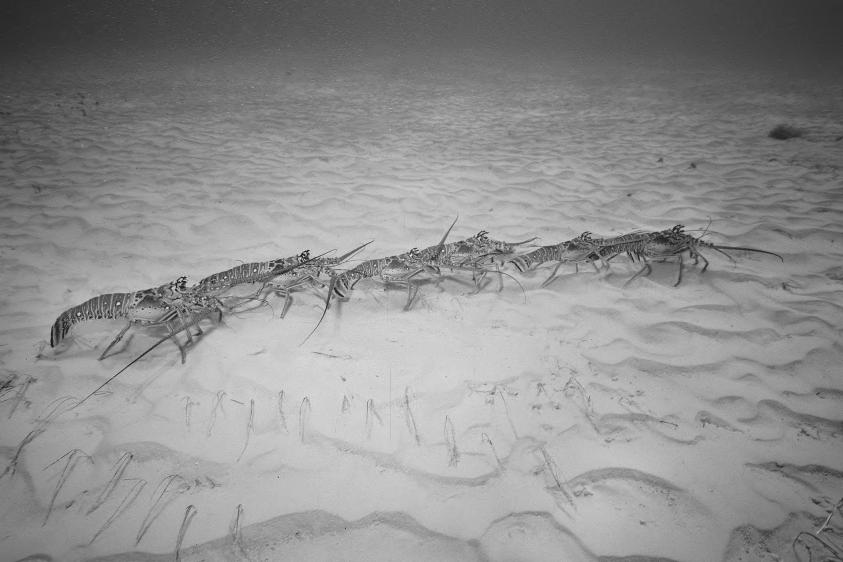
The Caribbean spiny lobster (Panulirus argus) lives on coral reefs in the western Atlantic. In the autumn, you can witness thousands of these lobsters all migrating en masse. It makes an incredible sight. The creatures head out to sea and away from the shallow coastal waters, often in head-to-tail queues occurring over both day and night. The procession is remarkable both in numbers but also in formation, with each lobster holding out its antennae to touch the back of the individual in front, an arrangement that reduces drag in the water. Their movements are driven by the onset of the frst autumn storms in shallow seas, which stir up the water and lower its temperature.
During these events, the lobsters in a particular area all tend to walk in the same direction, as if guided by some invisible force. They head some 30‒50 km away from the shore and down to depths of up to 30 m, where the waters are calmer. Outside of the migratory period, when they are still living on the shallower reefs, the lobsters lurk hidden away during the day in one of a number of dens, only emerging at night to feed. Once they venture out
2 · A PLETHORA OF SENSES
from the safety of their shelters, each individual wanders over a wide area. As the morning arrives, they return in a straight line back to their homes (Figure 1). Clearly, the lobsters have some sort of ability to determine where they need to head, both when migrating and in order to fnd their way back to their dens every morning. How do they do this?
In the 1990s, the biologists Kenneth Lohmann and Larry Boles from the University of North Carolina, together with colleagues, set out to fnd the answer.1 They suspected that the lobsters are governed by a mysterious magnetic sense. The team captured lobsters on the Florida Keys by diving and prodding them out of their crevices with rods, or ‘ticklesticks’. They then covered the eyes of the lobsters with eye caps, to prevent them from using visual information to guide their movements, and tethered them to underwater walking areas that were surrounded by a magnetic coil system. In this way, the scientists could alter features of the
Figure 1. A line of Caribbean spiny lobsters migrating across the Atlantic Ocean foor during their autumn movements into deeper waters.
A PLETHORA OF SENSES · 3
Earth’s magnetic feld around the lobsters. And, sure enough, the experiments began to uncover the hidden sensory skills of these animals. The team found that the lobsters tended to move in certain directions, but when they changed components of the magnetic feld, after a few minutes the animals walked in different orientations. It looked as though the lobsters had some sort of internal compass that could guide where they should go.
Some years later, the same team tried another kind of experiment. They moved a sample of lobsters a long way from their original homes, between 12 and 37 km away, in fact. In the process, some lobsters were also prevented from gathering information about the Earth’s magnetic feld (or visual cues), by using magnets hung inside the transport vehicles. This meant the displaced lobsters would have to navigate back to their homes by working out their new magnetic position relative to where their home should be. The lobsters were able to do just that; they could navigate home. They were probably able to do this by using some sort of internal magnetic map of their surroundings, because when the scientists put lobsters in magnetic felds that simulated areas corresponding to real-world locations, the lobsters moved in the correct directions that would get them home. If a lobster was presented with a magnetic location north of its territory, it would orientate south, and vice versa. These simulated locations were large distances (around 400 km) away from the lobsters’ home sites, but the lobsters are thought to range this far. By knowing the magnetic features of their surroundings, these creatures can work out their position and then return to a specifc spot. This goes beyond how we would use a compass to orientate; it’s more like having an in-built GPS. Quite how the magnetic sense works in lobsters and many other species is a mystery of Sherlock Holmes proportions, and we’ll come back to it in Chapter 7.
Other animals use different yet equally highly refned senses to survive and reproduce. The common vampire bat (Desmodus rotundus), from Central and South America, seeks out mammals, perhaps a wild tapir or domesticated cattle, in order to feed on their blood at night. Many bats have elaborate structures on their face and around their noses that are used for enhancing their echolocation ability by helping to emit sound. The vampire bat instead has a nose structure that is packed with infrared thermal receptors. Unlike most other bats, vampires don’t have to capture prey on the wing, but rather land near their prey and then scuttle on the ground towards them (presumably so they don’t wake their victim by crash landing on them). Once within touching distance, the bat uses its infrared receptors not just to fnd suitable skin but to pick out blood vessels to bite into with its sharp teeth.
Detecting tiny differences in heat requires the evolution of a precision gauge operating in the right temperature range. The bats can do this because a gene known as Trpv1, present in other mammals and normally used for detecting high temperatures that might cause damage, has in vampire bats become modifed by natural selection. Somewhere in the bat’s evolutionary history, mutations occurred in the gene that altered the temperat ures the receptors detect, and this was advantageous to those blood-feeding bats, helping them to fnd a meal more effciently. Instead of preventing the animal from getting burnt, the modifed gene now enables the sensory cells around the nose to detect much lower temperatures. The sensitivity of these cells has shifted into the temperature range for detecting mammalian body heat.2 Such genetic changes, resulting in a slightly different role, happen often in the evolution of the senses, and in vampire bats it allows great refnement in their unusual habits.
Infrared and magnetic detection are senses that we humans lack; we have no conception of what it must be like to sense the magnetic feld of the Earth and use it in any way, at least not without technology. The same is true for other non-human senses, not least the exquisite electric sense that a variety of fsh and a handful of other animals possess. Even when it comes to the senses we do have, our abilities are restricted. We can’t hear the ultrasonic calls used by many bats and insects, for example. Nor can we smell and interpret the changes in odour plumes blown around by the wind, originating from female moths and used by males to locate a mate from as far away as 10 km. In short, our senses are limited, and we perceive only a part of the world that is available to other animals.
It’s natural to wonder what the world must be like to these species that perceive things that we cannot, but we should also ask why the senses vary so much among species anyway. These two questions are central to this book, but let’s begin by considering the variety of animal senses; how they work; what they are used for; and why such a staggering array of senses exists in nature. As we will discover, the senses found across animal species, and even among individuals of the same species, vary according to many factors, not least the habitat in which an animal lives, the key behaviours it must perform in its life, and the costs and limitations of having and maintaining different sensory systems.
Animal senses are carefully refned through evolution and development for the things that matter most to them. To accomplish the numerous tasks every individual must perform, the senses are tuned to work best in the habitats where the creature lives and to acquire the best available sources of information. Sometimes, one or more of the senses are exquisitely tuned to a few crucial
6 · A PLETHORA OF SENSES
tasks an animal must perform in order to survive and reproduce successfully.
The parasitoid f ies demonstrate this rather nicely, albeit gruesomely. The hearing organs in some of these fies have evolved extreme levels of specialization. Many of them fnd their hosts—male crickets—by eavesdropping on the calls that the males make to females during mating. Male crickets compete with one another by making high-pitched calls during courtship. It’s a lovely sound on a summer evening to hear groups of male crickets chirping away, all in the hope of an amorous liaison. Quite often, females prefer males with the loudest or most elaborate calls as a suitable partner. Such males might be the best around with whom to mate and sire the fttest offspring. Unfortunately for the crickets, the parasitoids reproduce in a rather grisly way. Once they have located a suitable chirping host, they lay an egg on the male’s back. When it hatches, the maggot burrows into the cricket’s body, eating him from the inside out. To be successful, the parasitoid fies must locate males, and they can be very good at this: in some bush cricket populations, up to 60 per cent of the males are infested.
Although they may use their ears for other tasks, clearly both the fy and female crickets need to detect male calls. Take the example of the fy Ormia ochracea, which targets a specifc feld cricket, Gryllus rubens. Normally, these two groups of insects (crickets and fies) would have quite different hearing organs. However, in this case, not only are the ears of both the female cricket and fy fnely tuned to detect the peak frequency of male calls (4‒5 kHz), but the fy’s hearing organ has a physical structure very similar to that of the female cricket.3 The parasitoid’s hearing has evolved along the same path as that of the female cricket, as both depend on detecting the call of the male cricket. This phenomenon, in which animal species or groups that have
A PLETHORA OF SENSES
· 7
been exposed to similar selection pressures independently evolve similar adaptations, is known as convergent evolution. For example, dolphins share similar features of a streamlined body shape with certain prehistoric ichthyosaurs because it helps them move effciently through the water. In the parasitoids, a task of great importance for the fy and for the female cricket has led to matching specialist tuning of a critical sensory system in both. As for the male crickets, sometimes the best males that call the loudest pay the cost of also being those most likely to fall victim to the fies.
Quirky, and somewhat less grisly, examples of sensory systems used to fnd prey abound in nature. One is the sense of smell (olfaction) of the ‘vampire’ jumping spider (Evarcha culicivora) found in East Africa. This spider feeds on the blood of vertebrates like humans, but it does so in a roundabout way. The spider hunts and kills female Anopheles mosquitoes (the type that carry human malaria), and they do this especially when the mosquitoes have fed on mammalian blood. Like many other jumping spiders, the vampire spider has excellent eyesight and can recognize mosquitoes based on their visual appearance. But more unusually for jumping spiders, it also has an excellent sense of smell which it uses to fnd its prey. Interestingly, the spider is known to frequent locations where humans reside. Scientists have investigated how these spiders in Kenya fnd mosquitoes, and why they are so often found with people, including how the spiders respond to a very specifc stimulus—worn socks.4 The researchers obtained cotton socks from a human donor who had worn them for 12 hours immediately prior to the experiments, and compared how the spiders responded to the smelly socks versus an identical pair of clean socks. The spiders were more attracted to the socks smelling of human than to the clean socks. So, the spiders seem to fnd humans based on their smell,
in order to be in the right location where a key prey source is likely to visit.
Eyes also have many adaptations in nature linked to how animals go about their lives. The four-eyed fsh (Anableps anableps) lives in northern parts of South America, inhabiting fresh and brackish waters. It foats at the top of the water looking for both predators and prey (mostly insects that fall into the water) from above and below at the same time. Half of each eye sits above the water, and half below. This creates a problem, because light is bent or refracted as it passes the boundary between air and water, and vision benefts from the eyes being able to form a sharp image. Our eyes have evolved for vision out of water and so things are blurry when we look underwater. Water, and any particles in it, also affects the wavelengths of light that are available. In clear water, longer ‘red’ wavelengths of light get fltered out earlier, shifting the light spectrum (the range of ‘colours’) towards blue and green light. Anyone who regularly dives in clear ocean waters knows that it becomes bluer as you descend deeper. Any particles in the water can absorb and scatter light, further changing the spectrum. Many freshwater lakes and streams look brown or green due to the scattering or absorption of light by the organic material foating around. The four-eyed fsh has sophisticated tricks to deal with these challenges—it has divided its eyes into two, with two pupils, and two sets of photoreceptors, each of which focuses and analyses the spectrum of light coming from either above or below the water line. It’s probably about the closest thing we have on Earth to a vertebrate with four eyes. In doing so, the fsh can see the world in sharp focus both above and below the water at the same time, and utilize differences in sensitivity in the two parts of the eyes to best see in the different light conditions. Quite how the fsh’s brain is able to
process these two views of the world is another matter waiting to be investigated.
Almost certainly the most important factor that dictates what senses an animal has, and how they work, is the environment in which the creature lives. The Mexican tetra (Astyanax mexicanus), also known as the ‘blind cave fsh’, mostly live, as the name suggests, in dark caves, so their vision is of no use, and their sight has degenerated. Instead, they invest in other senses, especially those that respond to vibrations and water movement. Other animals that spend their entire lives underground in caves, so-called troglobites, likewise commonly have no vision but instead have elongated antennae, sensory hairs, and various other adaptations for sensing chemical and tactile information. These underground beasts are often of bizarre appearance, being ghostly pale since they tend to lack pigments in their bodies. After all, there’s no need for colour or pattern if there is no light for anything to see them. While there are many species of troglobites, lifestyles need not always be so extreme. Many species spend only part of their lives in caves, or they simply live in habitats where light and visibility are restricted, or they are primarily nocturnal. Such animals also tend to invest more in senses other than vision. For ex ample, electric fsh, which are capable of producing weak electric felds for navigation and communication, tend to be nocturnal or to live in water that has poor visibility. Likewise, bats with their remarkable sense of echolocation tend to hunt at night and live in caves and crevices where vision is of less value. That said, things sometimes go the other way. Species that are active at night, as long as there is still enough light to see, may instead have very enlarged and sensitive eyes, as do some nocturnal primates such bush babies and birds like owls. But the general point is that the
environment in which an animal lives, and when it tends to be active, dictates the senses in which evolution has tended to invest. The environment is critical in tuning the way the senses work too, and in the specifc information they collect. In the deep ocean, aside from being very dark, the cutting out of longer, redder wavelengths by the seawater results in light that is more blue-green. If there is no red light to see, then there’s no point in having a visual system tuned to see longer wavelengths. And, sure enough, the majority of deep-sea animals have eyes that can detect shorter to medium wavelengths of light, but rarely red light. This also explains why many deep-sea animals are red: in the depths of the ocean, since there is no red light, they just look very dark and are well hidden. Only when we bring them to the surface and out of their natural environment do they take on a red colour to our own eyes.
The deep ocean is also rich in a variety of bioluminescent light, emitted by a plethora of creatures from jellyfsh to squid. Far from being desolate and devoid of life, the deep-sea can be a constant freworks display of fashes of light, from creatures which emit these bursts for a multitude of purposes: some to startle or scare predators; others to lure prey or attract mates. Again, this light is mostly blue-green in colour, so there is rarely a need for a visual system that can see red in the twilight zone. Indeed, many deepsea fsh, such as some shark species, have visual systems tuned to detect blue bioluminescence, either of prey or of one another.
On land, too, the times of day that animals are active also drive differences in vision. Among several species of Myrmecia ant from Australia, for example, the species and the worker castes among them that are more active at night tend to have larger eyes, and cells in their eyes that are more sensitive to low light levels.5 I’ve focused here on vision to illustrate how an animal’s environment infuences its sensory systems, partly because animal vision has
been well studied, but the same applies to other senses too, to a lesser or greater extent.
The environment can also place constraints and challenges on how the senses actually work. For instance, if there is a lot of noise, then an animal may need an auditory system that can overcome this. Some species of echolocating bats modify their calls to avoid interference from the noises made by other bats and insects that use similar frequency ranges. They do this by shifting the frequencies of their calls.
When it comes to detecting chemical information, we’ll be looking here mostly at animals’ sense of smell rather than that of taste. Nonetheless, the ability to detect chemicals through taste illustrates how the environment can limit how some senses work. Scientists have identifed fve basic types of taste thought to exist in vertebrate animals in nature (sweet, bitter, salty, sour, and umami). For some reason, most birds seem to have lost the ability to sense sweetness. Penguins also lost the genes encoding the receptors used for sensing umami and bitter tastes some 20 million years ago.6 This seems odd because umami is thought to give rise to a sense of ‘meaty’ tastes, and penguins are car nivorous. The answer potentially lies in the environment where they live, and how the proteins that enable these sensations to work are affected by temperature. A key basis for adaptive evolutionary change is mutations, which can lead to alterations in some aspect of an animal’s morphology or behaviour. Benefcial mutations that might improve features of an organism’s biology, such as its sense of taste, can be subject to selection if the bearer of the mutation is better able to survive and reproduce. This would have been the case for the mutated gene Trpv1 in the vampire bat, which, as we saw earlier, enables the bat to detect small changes in temperature, improving its effciency in feeding. Conversely, mutations can also be deleterious, producing traits that are less
useful or even damaging. Alterations of that nature will often be selected against, should they be suffciently detrimental to ftness. Yet traits may also be degraded by mutations that render them less effective, but those changes might not be selected against if there is actually little impact on how an animal lives and reproduces in its current environment. Returning to penguin taste, a particular protein (Trpm5) seems very important in the sensory receptors that encode sweet, umami, and bitter sensations, but this does not work at cold temperatures. Penguins originated in the Antarctic around 60 million years ago, and diverged into different species approximately 35 million years later. The intervening time period coincides with phases of signifcant climate cooling in Antarctica, and penguins are still most often found in very cold conditions. Over the period of initial penguin evolution and climate cooling, penguins may have lost these types of taste through the build-up of mutations because their sense of taste simply does not work properly in the icy cold. In fact, penguins also seem to have very few taste buds. Maybe we shouldn’t be too surprised by this, since we ourselves don’t taste things quite so well when food is cold.
In many of the animals we will encounter in this book, one or two senses are supremely developed, like the hearing of a bat or the vision of a bird, but this is rarely the case for all their senses. Another approach is for species to adopt something of a jack of all trades, with a couple of preferred senses but a reasonable allround set, even if none of them are particularly remarkable—a bit like humans perhaps. Not having amazing senses all round in part comes down to one key thing: the costs involved. We might not realize it, but our senses (and those of any animal) are expensive to run. For sensory and nerve cells to function, the body must constantly pump charged ions like sodium and potassium
across the cell membranes so that the electric signals with which these cells communicate can be generated. This process consumes energy. If we take a fairly unglamorous animal, the blowfy (Calliphora vicina), scientists have calculated that around 10 per cent of all the energy it uses up while in a ‘resting state’ (that is, not fying around) is simply due to the functioning of the photoreceptors and associated nerve cells in its eyes.7 In fact, blowfies have quite impressive vision. They use it to fy around rapidly and interact with objects (like other fies) at very short notice, so they need to invest a lot in their visual system. Nonetheless, similar calculations could no doubt be done for a range of animals, and if you were to add up the energy costs of not just the vision of an animal, but also its sense of hearing, taste, touch, smell, and any other senses it has, the costs would be pretty high.
If there is one thing evolution is good at, it’s making the best use of the energy that animals have available to them. On the most fundamental level, sensory systems respond to changes happening in the environment. The reason for this is simple— when something changes it tells you something new, and that may require some action on your part, perhaps moving to avoid a threat or obstacle. But when things are the same, you need not worry. So, responding only to changes in the world around you is a sensible thing to do, and cuts some of the cost of continuously processing all the steady sensory information at the same time. Remarkable tricks appear over and over again in animals for encoding information that is specifc to what they need to know, and at least two common ways to manage the costs of sensory systems emerge. One is to create nerve circuits and processing mechanisms that are effcient, and sometimes even focused on a specifc task (such as detecting prey). We will come across many ingenious solutions throughout the book for how animals and their senses do this.