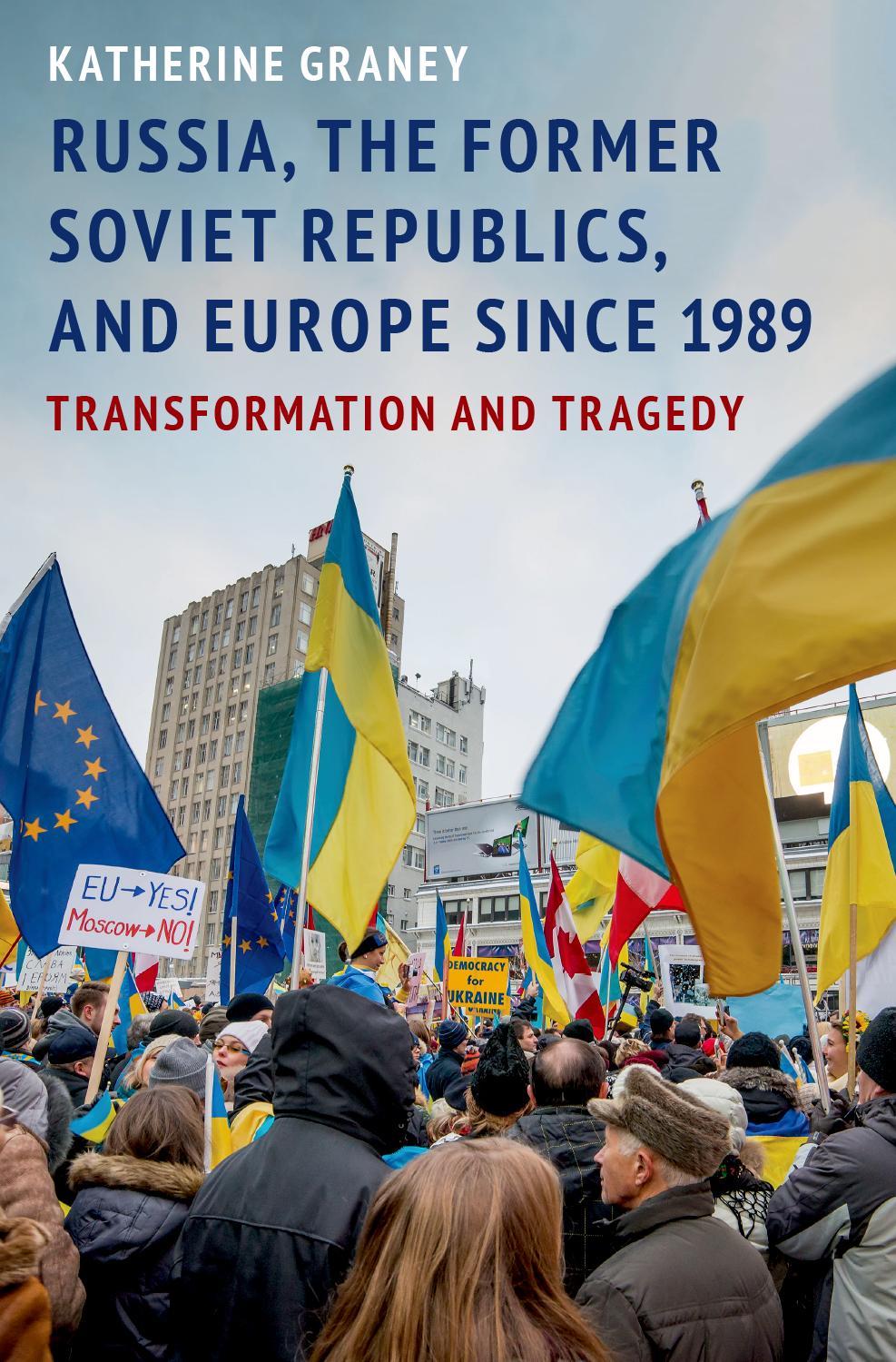
Russia, the Former Soviet Republics, and Europe since 1989
Russia, the Former Soviet Republics, and Europe
since 1989
Transformation and Tragedy
KATHERINE GRANEY
1
Oxford University Press is a department of the University of Oxford. It furthers the University’s objective of excellence in research, scholarship, and education by publishing worldwide. Oxford is a registered trade mark of Oxford University Press in the UK and certain other countries.
Published in the United States of America by Oxford University Press 198 Madison Avenue, New York, NY 10016, United States of America.
All rights reserved. No part of this publication may be reproduced, stored in a retrieval system, or transmitted, in any form or by any means, without the prior permission in writing of Oxford University Press, or as expressly permitted by law, by license, or under terms agreed with the appropriate reproduction rights organization. Inquiries concerning reproduction outside the scope of the above should be sent to the Rights Department, Oxford University Press, at the address above.
You must not circulate this work in any other form and you must impose this same condition on any acquirer.
Library of Congress Cataloging-in-Publication Data
Names: Graney, Katherine, 1970– author.
Title: Russia, the former Soviet republics, and Europe since 1989 : transformation and tragedy / Katherine Graney. Description: New York, NY : Oxford University Press, 2019. | Includes bibliographical references.
Identifiers: LCCN 2018061177 | ISBN 9780190055080 (hardback) | ISBN 9780190055097 (paperback)
Subjects: LCSH: Russia (Federation)—Politics and government—1991– | Former Soviet republics—Politics and government. | Europe—Politics and government—1989– | Russia (Federation)—Foreign relations—Europe. | Europe—Foreign relations—Russia (Federation) | Former Soviet republics—Foreign relations—Europe. | Europe—Foreign relations—Former Soviet republics. | BISAC: POLITICAL SCIENCE / International Relations / General. Classification: LCC DK510.763 .G7357 2019 | DDC 303.48/24704—dc23 LC record available at https://lccn.loc.gov/2018061177
1 3 5 7 9 8 6 4 2
Paperback printed by WebCom, Inc., Canada Hardback printed by Bridgeport National Bindery, Inc., United States of America
For Sean, Ronan, and Maeve, with love and gratitude
CONTENTS
List of Figures ix
List of Tables xiii
List of Boxes xv
List of Maps xvii
Preface xix
Acknowledgments xxi
List of Abbreviations Used in Text xxiii
List of News Sources Cited in Text xxvii
PART ONE THEORIES AND HISTORIES OF EUROPEANIZATION AND THE POST- COMMUNIST WORLD SINCE 1989
1. From Europhilia to Europhobia?: Trajectories and Theories of Europeanization in the Post-Communist World since 1989 3
2. Europe as a Cultural-Civilizational Construct 36
3. Political Europeanization since 1989 62
4. Security Europeanization since 1989 88
5. Cultural-Civilizational Europeanization since 1989 113
PART TWO CASE STUDIES
6. Russia: Eternal and Incomplete Europeanization 141
7. The Baltic States: Successful “Return to Europe” 171
8. Belarus, Ukraine, and Moldova: Almost European? 210
9. The Caucasus States: The Endpoint of Europe or Europe’s New Eastern Boundary? 264
10. The Central Asian States: Not European by Mutual Agreement? 317
11. Conclusion: The Continuing Influence of the EurocentricOrientalist Cultural Gradient on European, Russian, and PostSoviet Politics 375
Notes 381
Bibliography 393
Index 419
FIGURES
1.1 Phase One of Europeanization: Europhoria (1989–1999) 15
1.2 Phase Two of Europeanization: Europhilia (2000–2008) 17
1.3 Phase Three of Europeanization: Europhobia (2009–) 18
1.4 Europeanization in Political Institutions 28
1.5 Europeanization in Security Institutions 29
1.6 Europeanization in Cultural-Civilizational Institutions 34
2.1 Factors of Intrinsic Europeanness 60
6.1 Factors of Intrinsic Europeanness in Russia 144
6.2 Cultural-Civilizational Europeanization in Russia 147
6.3 Political Europeanization in Russia 159
6.4 Security Europeanization in Russia 167
7.1 Linguistic, Religious, and Historical Attributes of the Baltic States 172
7.2 Factors of Intrinsic Europeanness in Estonia 174
7.3 Factors of Intrinsic Europeanness in Latvia 175
7.4 Factors of Intrinsic Europeanness in Lithuania 176
7.5 Cultural-Civilizational Europeanization in Estonia 192
7.6 Political Europeanization in Estonia 195
7.7 Security Europeanization in Estonia 196
7.8 Cultural-Civilizational Europeanization in Latvia 197
7.9 Political Europeanization in Latvia 200
7.10 Security Europeanization in Latvia 202
7.11 Cultural-Civilizational Europeanization in Lithuania 203
7.12 Political Europeanization in Lithuania 206
7.13 Security Europeanization in Lithuania 208
8.1 Linguistic, Religious, and Historical Attributes of Belarus, Ukraine, and Moldova 211
8.2 Factors of Intrinsic Europeanness in Belarus 214
8.3 Cultural-Civilizational Europeanization in Belarus 216
8.4 Political Europeanization in Belarus 222
8.5 Security Europeanization in Belarus 226
8.6 Factors of Intrinsic Europeanness in Ukraine 229
8.7 Cultural-Civilizational Europeanization in Ukraine 233
8.8 Political Europeanization in Ukraine 240
8.9 Security Europeanization in Ukraine 244
8.10 Factors of Intrinsic Europeanness in Moldova 247
8.11 Cultural-Civilizational Europeanization in Moldova 249
8.12 Political Europeanization in Moldova 255
8.13 Security Europeanization in Moldova 260
9.1 Linguistic, Historical, and Cultural Comparison of Georgia, Armenia, and Azerbaijan 265
9.2 Factors of Intrinsic Europeanness in Georgia 270
9.3 Cultural-Civilizational Europeanization in Georgia 272
9.4 Political Europeanization in Georgia 278
9.5 Security Europeanization in Georgia 284
9.6 Factors of Intrinsic Europeanness in Armenia 288
9.7 Cultural-Civilizational Europeanization in Armenia 290
9.8 Political Europeanization in Armenia 295
9.9 Security Europeanization in Armenia 299
9.10 Factors of Intrinsic Europeanness in Azerbaijan 302
9.11 Cultural-Civilizational Europeanization in Azerbaijan 304
9.12 Political Europeanization in Azerbaijan 308
9.13 Security Europeanization in Azerbaijan 314
10.1 Linguistic, Religious, and Historical Comparison of the Central Asian States 318
10.2 Factors of Intrinsic Europeanness in Kazakhstan 341
10.3 Cultural-Civilizational Europeanization in Kazakhstan 342
10.4 Political Europeanization in Kazakhstan 345
10.5 Security Europeanization in Kazakhstan 347
10.6 Factors of Intrinsic Europeanness in Kyrgyzstan 349
10.7 Cultural-Civilizational Europeanization in Kyrgyzstan 350
10.8 Political Europeanization in Kyrgyzstan 352
10.9 Security Europeanization in Kyrgyzstan 353
10.10 Factors of Intrinsic Europeanness in Uzbekistan 355
10.11 Cultural-Civilizational Europeanization in Uzbekistan 357
10.12 Political Europeanization in Uzbekistan 359
10.13 Security Europeanization in Uzbekistan 360
10.14 Factors of Intrinsic Europeanness in Tajikistan 363
10.15 Cultural-Civilizational Europeanization in Tajikistan 364
10.16 Political Europeanization in Tajikistan 366
10.17 Security Europeanization in Tajikistan 367
10.18 Factors of Intrinsic Europeanness in Turkmenistan 369
10.19 Cultural-Civilizational Europeanization in Turkmenistan 370
10.20 Political Europeanization in Turkmenistan 372
10.21 Security Europeanization in Turkmenistan 373
11.1 Strength of Europeanization Projects in the Former Soviet Union 377
TABLES
1.1 Post-Communist and Post- Soviet Countries 5
1.2 Strength of Europeanization Projects in the Post- Soviet States 11
2.1 Post- Soviet States: Levels of Intrinsic Europeanness 61
4.1 Levels of Integration of Post-Communist States with NATO 97
7.1 Demographics of the Baltic States, 1989 and 2014 172
7.2 Major Trading Partners of the Baltic States, 2014 173
8.1 Demographics of Belarus, Ukraine, and Moldova, 1989 and 2014 211
8.2 Major Trading Partners of Belarus, Ukraine, and Moldova, 2014 212
9.1 Demographics of Georgia, Armenia, and Azerbaijan, 1989 and 2014 268
9.2 Trading Partners of Georgia, Armenia, and Azerbaijan, 2014 269
10.1 Demographics of the Central Asian States, 1989 and 2014 319
10.2 Trading Partners of the Central Asian States, 2014 319
10.3 Economic Impact of Petroleum Resources in the Central Asian States, 2014 320
11.1 Factors Influencing Strength of Europeanization Efforts in Eastern Partner States 378
11.2 Factors Influencing Future of Strong Europeanization Efforts in Eastern Partner States 379
BOXES
1.1 The Ukraine Crisis (2013–) 8
1.2 Three Sets of Actors in Europeanization 12
1.3 Three Animating Forces Characterizing Europeanization since 1989 13
1.4 Three Chronological Phases of Europeanization since 1989 14
1.1 Europe and the Former Soviet Union 6
2.1 The Different “Europes” 40
3.1 Europe According to the European Union: Current and Candidate Members 63
3.2 The Eastern Partnership States (EAP) 75
4.1 Europe According to NATO 90
5.1 Europe According to Eurovision 118
5.2 Europe According to UEFA Membership 130
PREFACE
This is a big book about a big topic. I wrote this book in part to solve a problem that I encountered every time I taught my Politics of Russia and the former Soviet Union class at Skidmore College. There are many books about Russian politics, and an increasing number of books about each of the other fourteen exSoviet republics. But I was never able to find a book that provided a historically rich, theoretically sophisticated, and relatively undated introduction to both Russia and the other states that used to make up the Soviet Union. I decided to write such a book myself.
A second reason for this book dates back to the fieldwork I did for my dissertation in Tatarstan, Russia, in 1996–1997. During the interviews I conducted with ethnic Tatar political and cultural leaders, I was quite surprised by the number of times these actors would bring up the question of the “civility” of the Tatars. They wanted to be sure that I understood that Tatars were “civilized, like you in Europe and the West,” and that “Tatars do not eat raw meat—we are not savages” (a reference to steak tartare). Relatedly, I was also struck by the prominence of Europe in the strategy of Tatarstan’s leaders during the quest for political sovereignty in the 1990s and 2000s—their sincere belief that “European” norms of democracy, human rights, and the respect for ethnic diversity should serve as the basis for a renewed form of ethno-federalism in Russia in the post- Soviet period. While space prevents me from discussing this specific aspect of the Europeanization process here, I am happy that the genesis of the present project can be found in my earlier work on Tatarstan, Of Khans and Kremlins: Tatarstan and the Future of Ethno-Federalism in Russia.
As I began to think about ways to approach a one-volume treatment of Russia and the post- Soviet states that would be more than just an encyclopedic recitation of facts and important political developments in these countries, it was becoming more and more clear that the early promise of “a Europe whole and free” arising out of the fall of the Berlin Wall and collapse of the Soviet Union was
in serious eclipse. Indeed, it became apparent that “European expansion,” once seen by many in the former communist world as a concept bearing the promise of progress and plenty, was more and more viewed as a nefarious plot emanating from Brussels and Washington aimed, at best, at the exploitation of the ex- Soviet states and, at worst, at the total destruction of their “way of life.” (Russia has become the foremost proponent of this discourse, but variants of it can be heard in Hungary, Poland, and other places as well.)
I came to see that the deeply felt concerns that my Tatar friends voiced in the 1990s about their status in a world where “Europeanness” was still the standard of civility and worthiness, and their hopes for a future organized along “European” political and economic principles, were closely related to the tensions that began to arise both within Europe and between Europe and Russia in the 2000s (and have come to a boil in the 2010s, as the continuing Ukraine Crisis that began in 2013–2014 demonstrates). As they have been historically—since Peter the Great decided to “hack a window to Europe” in the late seventeenth and early eighteenth centuries—cultural-civilizational understandings about “Europe” and “Europeanness” and the political and security arrangements based on those understandings are a singularly important factor in understanding patterns of political development in the former Soviet Union since 1989.
I have tried to produce a volume that can serve as the basis for an introductory course in post- Soviet politics but that is also appropriate for courses on contemporary European politics. (As the history of Russia is inextricably intertwined with that of Europe, and as the practical overlap between these two regions has increased dramatically since 1989, it hardly seems possible to do otherwise.) And while appropriate for students with little to no background in Russia and post- Soviet politics, I believe this analysis has much to benefit even long-time students of Russia and the former Soviet Union. As this project roamed far from my own small area of expertise, I have relied on the research and analyses of the leading scholars in our field of Russian and post- Soviet politics and on Europeanization, and I am grateful for the opportunity to share with my colleagues and students these scholars’ insights into the concepts of Europe, Europeanness, and Europeanization and how these concepts animate political developments in Russia and the former Soviet Union.
ACKNOWLEDGMENTS
I am very grateful to the Skidmore College Collaborative Research program for funds to support work on chapter 5 and the creation of the maps and graphs in this book, and to Emma Kurs, Katie Morton, Jennifer Cholnoky, and Reilly Grant for their skillful work on the same. I am also grateful to Skidmore College for the sabbatical leave that helped make this book possible.
I want to thank the many other students who helped me greatly at various stages of this project, including: Michael Bruschi, Elizabeth Collins, Britt Lynzee Dorfman, Misha Lanin, Matt Marani, Katie Morton, Jesse Ritner, and Megan Schachter. I am also grateful to my friend Barbara McDonough for helping with logistical aspects of this work’s production.
Special thanks to Jennifer Delton for helpful and intellectually stimulating conversations as well as necessary respites to ski. I am also grateful to the anonymous reviewers from Oxford University Press, whose insights helped shape the final draft in important and helpful ways.
Most of all, I want to thank my family for bearing with me during this long journey. Ronan and Maeve—it’s finally done! And you have your dogs, too. See, it all worked out. Sean, thank you, as always, for everything. The only thing I love in the world more than reading and writing and teaching about Europe and Russia is you guys.
ABBREVIATIONS USED IN TEXT
AA association agreement
ADR Azerbaijan Democratic Republic
AIOC Azerbaijan International Operating Company
APF Azerbaijani Popular Front
BALTOPS Exercise Baltic Operations
BSS Black Sea Synergy
CAS Central Asian Strategy
CFE Conventional Forces in Europe
CIA Central Intelligence Agency (US)
CIS Commonwealth of Independent States
CIS FTA Commonwealth of Independent States Free Trade Area
COE Council of Europe
CPC Conflict Prevention Center
CPSU Communist Party of the Soviet Union
CRRF Collective Rapid Reaction Force
CSCE Conference on Security and Cooperation in Europe
CSTO Collective Security Treaty Organization
DCFTA Deep and Comprehensive Free Trade Acts
DCI development cooperation instrument
EAP Eastern Partnership
EAPC Euro-Atlantic Partnership Council
EAPP Eastern Partnership Plus
EBU European Broadcasting Union
EC European Community
ECHR
European Court of Human Rights
ECSC European Coal and Steel Community
ECSR European Council on Social Research
ECU
Eurasian Customs Union
EEAB East European Assistance Bureau
EEC European Energy Community
EEU Eurasian Economic Union
ENP European Neighborhood Policy
EOC European Olympic Committee
EP European Parliament
ESC European Song Contest (Eurovision)
EST European Security Treaty
EU European Union
EURO European Football Championships
FARE Football against Racism in Europe
FFP Fair Play Program
FRG Federal Republic of Germany (West Germany)
FSU former Soviet Union
FYU former Yugoslavia
GDR German Democratic Republic (East Germany)
GOC Georgian Orthodox Church
GUAM Georgia, Ukraine, Azerbaijan, and Moldova
HDI Human Development Index
IPAP Individual Partnership Action Plan
IS Islamic State
ISAF International Security Assistance Force
ITU International Telecommunications Union
K2 Karshi-Khanabad Airbase
KFOR Kosovo Force
KHL Kontinental Hockey League
KUMU Art Museum of Estonia
LGBTQ lesbian, gay, bisexual, transgender, and queer (or questioning)
MAP Membership Action Plan
MFA Minister of Foreign Affairs (Russian Federation)
MOC Moldovan Orthodox Church
NACC North Atlantic Cooperation Council
NATO North Atlantic Treaty Organization
NGC NATO-Georgia Commission
NGO non-governmental organization
NRC NATO-Russia Council
NUC NATO-Ukraine Council
OIRT International Radio and Television Organization
OSCE Organization of Security and Cooperation in Europe
PACE Parliamentary Assembly of the Council of Europe
PCA Partnership Cooperation Agreement
PCRM Party of Communists of the Republic of Moldova
PFP Partnership for Peace
PHARE Poland and Hungary: Assistance for Restructuring Their Economies
PJC Permanent Joint Council
REACT Rapid Expert Assistance and Cooperation Teams
RFU Russian Football Union
ROC Russian Orthodox Church
RPL Russian Premier League
SCO Shanghai Cooperation Organization
SOCAR State Oil Company of Azerbaijan Republic
TACIS Transition Assistance to the Commonwealth of Independent States
TCP Trans-Caspian Pipeline
TURKSOI International Organization of Turkish Culture