Introduction
Robert Altman’s death in 2006 brought an end to a remarkable filmmaking journey that spanned six decades. Several months prior, he received an honorary award from the Academy of Motion Picture Arts and Sciences. Altman had been nominated for best director five times by the Academy, first for M*A*S*H in 1970 and finally for the 2001 film Gosford Park. He had, though, never won, a fact that would seem to confirm his status as a maverick—both part of and apart from Hollywood. The academy’s announcement of the award framed it as a “recognition of a career that has repeatedly reinvented the art form and inspired filmmakers and audiences alike.”1 Anodyne as it may seem, this plaudit suggests an important perspective frequently absent from the extant critical literature on the filmmaker. The dominant critical position presents Altman’s oeuvre as rejection, a modernist movement away from Hollywood practice and toward a democratization of the screen, upending the inherently conservative ideological work of Hollywood storytelling.2 A minority position, less concerned with Altman per se than with the Hollywood mode of filmmaking within which he worked, proposes that Altman, along with his Hollywood Renaissance peers, assimilated art cinema techniques, harnessing the innovations of European auteurs, but doing so largely in service to the standard aims of the Hollywood cinema.3
Both positions, though to different extents, overstate the stakes and underestimate Hollywood’s capacity for meaningfully accommodating innovation. Both accounts, furthermore, misapprehend Altman’s formal strategies and, to varying degrees, fail to consider what the Academy acknowledges—that Altman’s long career involved repeated reinvention. Altman did not reject Hollywood. This is a plot that is best understood as serving the purposes of the auteurism industry, which thrives on career-encompassing accounts focused on uncovering a filmmaker’s core expressive preoccupations and assessing the ideological implications of any novel uses of cinematic form. Altman’s work, though, is also not wholly assimilable to classical Hollywood. He did not tell the same old stories in the same ways for the same old purposes, simply adding an arty gloss appropriated from European art cinema.
In contrast to sweeping generalizations, this book aims to describe the filmmaker’s day job, that is, the concrete and contingent configurations and modulations of aims and strategies that characterize filmmaking practice, both within and across films. In doing so, it reveals an Altman barely glimpsed in previous critical accounts. This re-examination of his seminal work during the Hollywood Renaissance period of the early 1970s sheds new light on both the films and the filmmaker, reframing Altman as a complex, pragmatic innovator whose work exceeds, but is also grounded in, the norms of Hollywood storytelling. His films of the early 1970s display a classical-plus relationship with Hollywood tradition, in which Altman works within and from key Hollywood storytelling norms while elaborating on and around them in order to also fulfill extraclassical or nonclassical aims. Additionally, Altman’s aims were not just or even primarily product-oriented. That is, he was not exclusively focused on producing perfectly polished Hollywood films, or even refined embodiments of his cinematic philosophy and overarching worldview. Instead, his objectives were significantly practice-oriented. Altman was focused on achieving and sustaining a particular kind of filmmaking experience that might provide greater opportunities for creative encounters with circumstance.
The approach presented here holds significant implications for the study of cinematic authorship and of Hollywood’s formal norms, calling into question long-standing assumptions about the subjects and methodology of auteurist criticism and the nature and dynamics of the Hollywood cinema. Displacing the ahistorical thematic exegesis and impressionistic misdescription that have dominated accounts of Altman’s films, this book strives to employ rigorous description, robust analytic frameworks, archival research, and, in places, statistical methods to demystify what are widely agreed to be the defining aspects of Altman’s filmmaking. This book’s findings require that we rethink the supposition that “Hollywood” names a cramped and rigid set of norms that Altman defied in the spirit of politically modernist art cinema. In demonstrating that this opposition has been overdrawn, the book provides a clear example of how a filmmaker might work collaboratively and pragmatically within media institutions to elaborate and expand on their sanctioned practices and aims. We misunderstand Altman’s work, and the creative work of Hollywood filmmakers in general, when we insist on describing innovation as opposition to institutional norms. We do the same when we describe those norms as assimilating Altman’s innovations instead of acknowledging the more complex range of possible relationships between filmmaking aims and strategies and institutional constraints and opportunities.
In many ways, the imperative to manufacture a comprehensive study of a filmmaking career works against comprehension of filmmaking complexity. To insist on that complexity, this study takes a historically bounded approach, focusing on an iconic six-year and eight-film period ranging from M*A*S*H (1970) to Nashville (1975). This period has been deemed essential to understanding both the Hollywood Renaissance as a broader movement and Altman’s overall authorial profile. A careful reexamination and recharacterization of Altman’s body of work in this crucial period provides a critical perspective on assertions about Altman’s career both before and after. Such a reexamination also suggests a new model for understanding innovative filmmaking within and across institutions.
Reframing Altman as an elaborative filmmaker revitalizing Hollywood cinema, this book’s chapters isolate for analysis the aspects of his authorial profile typically held to define his work and to defy mainstream norms. In each case, careful reexamination discovers Altman to be working situationally to expand the customary aims and capacities of Hollywood style by desanctifying some of its mustier standards and practices. His films’ alleged narrative lack, for instance, turns out to be a perversely efficient approach to conventional Hollywood storytelling that integrates and alters rather than assimilates or approximates aspects of art cinema narration. In mathematical terms, Altman’s narrative approach is additive rather than subtractive or simply equivalent to Hollywood’s standard storytelling. Likewise, the subliminal, wandering zooms that supposedly characterize Altman’s films during this period prove to be critical mirages. Altman’s actual practice is dominated by highly intentional and narratively significant, though also frequently ornamental, uses of the zoom. Similarly, Altman’s novel employment of overlapping dialogue is not designed in service to either liberatory or democratic chaos. Rather, Altman and his collaborators’ development of this technique consists of technological innovation driven by an elaborative logic: the multiplication of recording tracks expanded the domain of sound design and encouraged more meticulous audio hierarchies rather than more democratic, unplanned uses of sounds. The standard assumptions of expansive on-set improvisation and willful rejection of the screenplay are tested against the archival record to demonstrate that Altman’s actual practice involved strategic elaboration. The book’s capstone chapter makes use of the redrawn “Early Altman” established in the previous chapters to upend critical deployments of “Earlier Altman’s” time in industrial filmmaking and filmed television. These media forms have frequently been mischaracterized, most often via a reduction to simple training grounds that Altman suffered or subverted before escaping, or graduating, into the unfettered auteurism of the Hollywood
Robert Altman and the Elaboration of Hollywood Storytelling
Renaissance. By carefully establishing institutional contexts and re-examining key works in light of the book’s revised account of Altman’s later practices, the chapter both illuminates significant continuities of practice and reframes Hollywood’s regularly denigrated media siblings as complex creative venues worthy of careful study.
Rejection, Assimilation, and Elaboration
Unlike the majority of book-length work on Altman, then, this is not an “authorship study” in the traditional sense of grand-scale thematic exegesis and ideological assessment.4 Instead, it is best understood as aligned with what Stephen Crofts has termed the “author in production institutions” mode of historical authorship study. This mode is most prominently represented by the work of Kristin Thompson and David Bordwell in, for instance, Thompson’s Herr Lubitsch Goes to Hollywood, and Bordwell’s book-length studies of Ozu, Dreyer, and Eisenstein.5 As Crofts describes it, under this model, the filmmaker is understood as having “of necessity to work within existing industrial and institutional frameworks and dominant aesthetic conventions.”6 Such an approach is particularly pertinent given the core question of this book—how are we to understand the formal design of Robert Altman’s work in the context of the early 1970s Hollywood Renaissance period’s contested relationship with the frameworks and conventions provided by Hollywood storytelling practice?7 Answering that question requires a reconsideration of the boundaries of and the creative possibilities within institutions such as Hollywood. Because my focus is on Altman’s approach to storytelling rather than, say, the interdependent but profitably separable question of how Altman negotiated the budgeting and financing of his films during his career, the general framework applied here is that of “poetics.”8 Bordwell, a key figure in introducing the poetics approach to media studies, distinguishes it from methodsbased approaches by articulating a general domain of inquiry (rather than a master theory)—the “inquiry into the fundamental principles by which artifacts in any representational medium are constructed, and the effects that flow from those principles.” This book synthesizes what Bordwell terms analytical poetics, which studies “particular devices across a range of works or in a single work,” and historical poetics, which asks about “how artworks assume certain forms within a period or across periods,”9 or, “how and why [fundamental] principles [have] arisen and changed in particular empirical circumstances.”10 These principles, more often than not, “will be in the nature of norms, those explicit or implicit guidelines that shape creative action,”
and “govern conventions.” Norms, then, can be described as a delineation and hierarchization of aims as well as a paradigmatic set of more or less favored options for filmmakers.11
Bordwell argues that the study of filmmakers and filmmaking practices is usefully guided by two key ideas, proposing that, “we should assume that the stylistic organization we detect is the result of filmmakers’ choices among the alternatives available to them,” and that such choices are both enabled and constrained by institutional contexts. Filmmakers are historically situated intentional agents guided by a “problem/solution model,” in which “stylistic strategies” are best understood as “solutions to problems.” These problems, or goals, may be of the filmmakers’ own making or institutionally determined.12 This “institutional dimension” plays a role in setting the agendas of filmmakers and in forming “the horizon of what is permitted and encouraged at particular moments. The filmmaker works, most proximately, within a social and economic system of production, and this involves tacit aesthetic assumptions, some division of labor, and standard ways of using technology.” These constitute a “mode of filmmaking practice,” which both constrains and enables the filmmaker’s choices.13
It is easy to imagine objections to the utility of the institutionally constrained intentional agent model for the study of Robert Altman. To some extent the rejectionist account depends on the notion of an unshackled, improvisatory Altman whose films operate, as Robert T. Self puts it, to depict a “subliminal reality” that “recognizes the unspoken, and unspeakable, dimensions in human interactions,” and whose approach “resides in lyrical fictions, in metaphoric discourse, and in inexplicable human associations.” Yet Self presents Altman as goal-oriented, describing the depiction of “subliminal reality” as “the goal of his movies.”14
Skeptics of the problem/solution model might be persuaded by Altman himself, speaking at a 1975 American Film Institute seminar:
The whole business, as one of my cohorts pointed out to me, of what this art is is just solving problems. You start out and you say, “Okay, we’re going to do a picture about Buffalo Bill and Sitting Bull.” “Well, shit, how can you do that?” You say, “Well, you could do it in a Wild West show.” One problem solved. Whack! Now you’ve got the basis for the thing. From this point on until the last day, you’re solving a bunch of problems. You set up a goal and then you start cutting your way through the underbrush to get to it.15
Indeed, the thrill of on-set problem-solving was one of Altman’s major motivators, a key reason why he persisted in filmmaking and why his output
Robert Altman and the Elaboration of Hollywood Storytelling was so prodigious. Stephen Altman (who, beginning with McCabe & Mrs. Miller, regularly worked on his father’s films and has had a significant career as a production designer) reported that his father was motivated by “the excitement of going to set and dealing with what he’s going to get—the ‘battlefield of problem-solving.’ ”16
Bordwell’s evocation of “empirical circumstances,” cited earlier, signals a foundational tenet of poetics—that scholars and critics should “invoke concrete evidence that allows [others] to appraise [their] claims,” whether in relation to historical contexts or the design of creative works.17 This book’s emphasis on close and careful description, then, is not just a corrective to the rampant underdescription in previous scholarship on Altman; it is founded on the principle that evidence should be an essential component of critical activity, both to the formulation of theories and the presentation of arguments. Bordwell conceives of poetics as a domain in which analysis is “driven by data and midrange concepts rather than by abstract or absolute doctrines.”18 It is arguably the adherence to these kinds of absolute doctrines rather than a commitment to a more dynamic and targeted process of theorizing, testing, and revision that has led to the overclaiming found in standard explanations of the novel aspects of Altman’s storytelling. These accounts tend to apply a formulation in which a novel device is assumed to serve a disruptive function—where overlapping intelligible dialogue automatically undermines narrative clarity, where a zoom’s perspectival distortions necessarily dissolve narrative space. The contextualizing evidence of a particular zoom’s configuration and coordination with other aspects of style and narrative situation, or of the careful design of any particular passage of overlapping dialogue, can only get in the way of these kinds of predetermined functional claims.
This book instead starts from something approximating what Meir Sternberg has referred to as “the Proteus Principle,” which holds that, “any effect can be produced by an infinite number of forms, and any form can produce an infinite number of effects.”19 This serves as the basis for Sternberg’s functionalist approach, which lends itself to poetics in its deliberate avoidance of predetermined analytic outcomes. Bordwell has incorporated Sternberg’s functionalist approach in his own work—arguing that analysts are best served by assuming that identifiable formal features and techniques “are not necessarily ends in themselves. They are most fruitfully considered a byproduct of a holistic strategy, an effort after effect.”20 This perspective complements consideration of the role of practice-oriented preferences like those indicated by this book’s account of Altman.
It is also usefully supplemented by psychologist J. J. Gibson’s concept of “affordances,” a term that recurs throughout this book. As adopted by media
scholars, “affordance” refers to the notion that, while formal features, works, and contexts (like institutions) are not determinate, they are also not wholly neutral in that their contours present to those engaged with them both constraints and opportunities for effects and actions.21 Creative agents like Altman might recognize and capitalize on the full range of affordances provided by institutional frameworks or filmmaking technologies, or they may perceive and act on only a few. Similarly, these creative agents design works whose features present a range of affordances to audiences, who may or may not recognize and capitalize on these opportunities. A key point of this revised account of Altman’s work is that he recognized how common structures, features, and techniques might be elaborated on and around to create affordances for a greater range of experiences than standard Hollywood storytelling. Likewise, Altman managed to negotiate the affordances offered by the technologies and institutions of Hollywood filmmaking so as to accumulate the authority to fashion both these novel works and the novel production environments he preferred.
A historical poetics of Altman’s early 1970s oeuvre requires, then, redescribing Altman’s formal strategies, reassessing their functions in light of his films’ complex design and through robust functionalist frameworks, and more carefully contextualizing them by situating them in relation to specified institutional norms of aims and practices, both aesthetic and technological. In my discussion of Altman’s use of the zoom, I use a qualitative/quantitative approach to construct an account of the immediate context of zoom practices in the work of Altman’s early-1970s contemporaries. However, to a large extent, this book relies on established scholarship to constitute the bases for claims about the key underlying “modes of film practice.” Here, the work of David Bordwell and Kristin Thompson, particularly their work with Janet Staiger in The Classical Hollywood Cinema: Film Style and Mode of Production to 1960, has been extremely useful. Bordwell, Thompson, and Staiger define a mode of film practice as “an integral system, including persons and groups, but also rules, films, machinery, documents, institutions, work processes, and theoretical concepts.” The authors rely on extensive primary source research and the employment of a large context set of 100 films to provide a carefully argued description of classical Hollywood cinema. In their subsequent work, Thompson and Bordwell develop what have become the standard accounts of classical Hollywood narrative structure and narration, and Bordwell’s account of the art cinema as a mode of film practice, though not uncontested, is broadly regarded as authoritative. Their names, then, appear frequently in this book not just because Bordwell and Thompson are progenitors of the poetics approach to cinematic form, though Thompson frames her particular
Robert Altman and the Elaboration of Hollywood Storytelling approach as neoformalism, but because of the extent, rigor, and influence of their work in relation to the particular modes of film practice relevant to understanding Altman’s filmmaking.
Indeed, tensions in the literature on Altman, with accounts unevenly split between what I label rejectionist and assimilationist, are based largely in a disagreement about how to place Altman in relation to classical Hollywood storytelling and European art cinema. As previously noted, assessments of Altman’s goals and practices tend to cluster at one end of this spectrum of classificatory possibilities, situating Altman as a modernist art cinema auteur and a radical rejectionist of Hollywood practices. Self’s seminal work on Altman frames his feature films as a break from a “Classical Narrative Past,” embodied in his pivot away from the Warner Brothers B film Countdown (1967).22 After he was removed from that film during the editing process, “Altman,” according to Self, “renounced authorship of its conventional narrative work.”23 In doing so, Self implies, Altman rejected not just Countdown’s studio-directed revisions to his work, but Hollywood storytelling itself, turning instead to the norms of art cinema narration. To define art cinema, Self cites the narrational parameters described by Bordwell’s “The Art Cinema as a Mode of Film Practice”—authorial expressivity, objective and subjective realism, and ambiguity—while emphasizing art cinema’s tendency to “liberate the spatial and temporal systems from subservience to narrative cause and effect.”24 Along these lines, Self claims that Altman’s next film, That Cold Day in the Park (1969), “for the first time . . . displays the expressionistic style of art cinema that subverts this subordination.”25 For Self, Altman’s followup, M*A*S*H, confirms his transition “from journeyman television director in the classical storytelling tradition to director as auteur in the art cinema” and progenitor of a “new American cinema” that was “modernist” in its orientation.26
Robert Kolker’s similarly influential work also labels Altman a “modernist” filmmaker, emphasizes Altman’s rejection of classical Hollywood storytelling, and describes M*A*S*H and the films in its wake as radical experiments in “decentralization.” According to Kolker, “what Altman creates is not the conventional structure of a whole analyzed into its parts, but a simultaneity of the whole and its parts, a simultaneity the viewer must always attend to.”27 Altman’s films, Kolker proposes, present spectators with an expansive diegetic world that they are then left to sort through on their own.
This purported radical openness and freedom, this revolutionarily unstructured depiction of space and time, accomplished through spurning classical Hollywood storytelling in favor of modernist art cinema practices, is central to the rejectionist account of Altman. Its influence is pervasive,
disfiguring otherwise invaluable scholarship. Take, for instance, the characterization by Nick Hall, relying on John Belton for poetic support, of Altman’s overall approach to the zoom in McCabe & Mrs. Miller as “preoccupied with depth, and with making direct transitions into the depth of the miseen-scène, via the zoom. Here, Belton suggests, ‘Altman’s zooms function like jazz improvisations superimposed on a fixed melody: whether motivated or not, they signal his presence as a narrator.’ ”28 We should, of course, be skeptical of the claim that all zooms function to signal the overt presence of a narrator, though, as chapter 2 relates, there is, within the film, a significant internal patterning of certain kinds of zooms, coordinated with key narrative moments, which like much formal patterning works both expressively and as a sign of the filmmakers’ formal virtuosity. I would agree, though, that a significant number of McCabe & Mrs. Miller’s zoom shots are preoccupied with depth, a preoccupation that extends, as chapter 5 illustrates, at least as far back as Altman’s largely zoom-free work in filmed television on Combat!. Hall offers the following example to support and develop his (and Belton’s) claim about the film (see the companion website for a video clip):

In McCabe, the zoom towards a banjo [sic] player strumming in a gambling parlor is a particularly strong example of the film’s many zooms through cluttered and dimly-lit interiors. The soundtrack is as confusing as the image: the low, overlapping chattering of the gamblers vies for attention with the banjo [sic]. The zoom advances slowly and uncertainly. It finally picks out the banjo [sic] player, but, like virtuoso single-take Steadicam shots often found in later films, part of the visual pleasure of the mobile frame lies in this uncertainty of the final destination. Zooms like these, Belton suggests, create “a very flat, dimensionless space which enhances the enclosed, claustrophobic nature of the film.”29
While it seems self-defeating to assert without explanation that a zoom into a cluttered mise-en-scène through multiple planes of depth, including a figure who walks across the foreground in medium shot during the zoom in, suggests a “very flat, dimensionless space,” there are more substantial problems to be found in the analysis and misdescription of this particular zoom shot. These errors repeat and rely on the rejectionist account’s misapprehension of Altman in each of the three dimensions that, respectively, constitute the subjects of the first three chapters of the book—narrative design, the zoom, and overlapping dialogue.
The narrative situation developed by the shot is more focused than Hall acknowledges. McCabe returns to the improvised gambling parlor from a brief upstairs tour of the overnight accommodations at Sheehan’s, which he
Robert Altman and the Elaboration of Hollywood Storytelling
finds entirely, and understandably, unsatisfactory. His initial one-word response to Sheehan’s offerings, “shit,” punctuates the transition back to a shot of the first floor of the establishment, where two side-characters have been discussing personal grooming at the bar. Their conversation is accompanied by the introduction of the diegetic pizzicato fiddle to the soundtrack, which continues to be heard across the cut into the next shot—the one addressed by Hall. Over the cut to that shot, McCabe’s offscreen voice returns to the soundtrack, as he colorfully elaborates on his previously stated opinion of Sheehan’s establishment while descending the stairs. The camera tilts down and then pans left to follow McCabe, trailed by Sheehan, as he moves into the parlor. The murmur of the men is audible but clearly de-hierarchized on the soundtrack. At some moments, the fiddle becomes inaudible under McCabe’s dialogue, the conversing men, and footstep sound effects. The camera comes to a rest as McCabe sits down at his seat at the table, which another man gives up without being asked, and McCabe is now framed in the lower half of the screen on the right rule-of-thirds line. He cracks a joke, the men all laugh, and they begin playing cards.
This redescription establishes that the scene has a clear narrative center— McCabe’s move back to the table and his confident, charismatic assertion of dominance in this new milieu. The camera movement up until this point maintains McCabe’s compositional dominance in the shot, and even as McCabe sits at the crowded table audience attention is likely to remain primarily tethered to McCabe. The soundtrack similarly prioritizes McCabe’s dialogue. While there are some intelligible bits of the miners’ conversations, the general sense provided by the dialogue, intelligible or not, is of amused, excited anticipation for the card game—just what McCabe wants. I find it hard to accept that this mise-en-scène or narrative situation deserves to be called confusing, even though the frame is full of men. I suppose the feeling could be described as claustrophobic, though extending this characterization to the entire film, as Belton does, is flatly wrong. More likely, Sheehan’s establishment is presented as a counterpoint to the more spacious accommodations for gambling and prostitution developed by McCabe and Mrs. Miller’s entrepreneurial endeavors. This kind of close and careful consideration of narrative situation, though, seems less important to Belton’s account than the modernist logics of expressive technological essentialism by which optics necessarily smoosh diegetic space and subvert storytelling.
It is when McCabe proposes the men make this “a quarter game” that the zoom in begins, and while it is true that it has its terminus at the fiddler, and that its route undergoes alteration, characterizing its trajectory as uncertain seems flatly wrong. Before getting to the zoom itself, though, given that Hall’s
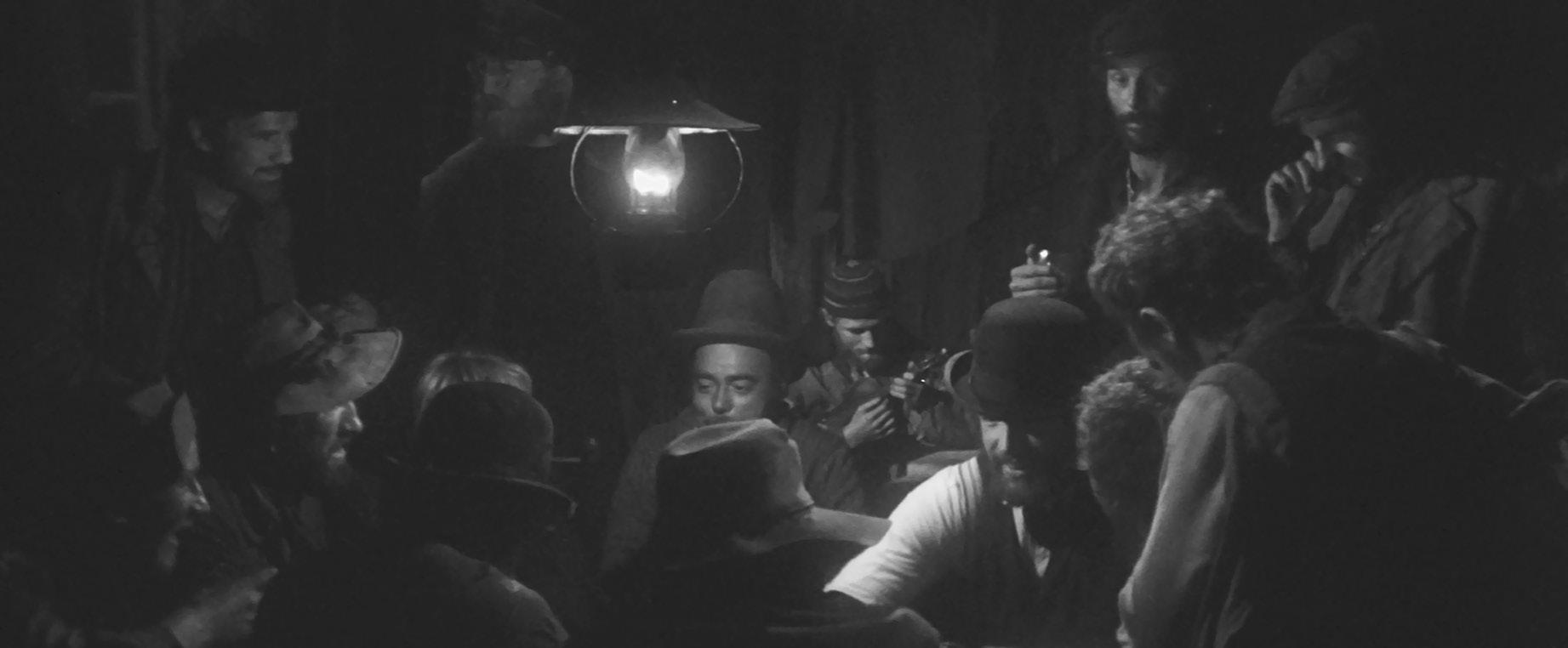
claim is one of surprising attentional trajectories, it is important to robustly describe the shot’s blocking—a key cinematic technique for directing attentional focus. At the beginning of the zoom, McCabe, as described earlier, is in the lower right middle-ground. The majority of the men are seated around the table, and while McCabe is seated at the table’s far side, the men on the near side are lower in the composition than McCabe, ensuring that his face is visible as he leans in to deal (Figure I.1). Moreover, while the shot could be described as dimly lit—the backs of the men on the near side of the table are in shadow—a lantern hung overhead and slightly left of center motivates the golden glow that illuminates the faces of the men on McCabe’s side of the table as well as, significantly, the face of the fiddler, sitting apart in the near background. Not only is the fiddler well lit in the shot, he is also compositionally prominent. He is only slightly right of the absolute center of the composition, and his head is just above those of the men on the far side of the table. Moreover, he is positioned directly adjacent to McCabe, occupying the compositional gap between McCabe and the man seated to McCabe’s right. In short, even before the zoom in on the fiddler, he is already well lit and positioned as close to the center of attention as possible. That he is also the source of diegetic music makes the notion that a zoom discovers him for the audience even less likely.
What the zoom does instead is emphasize and juxtapose the fiddler with McCabe’s satisfied grin. The initial trajectory of the zoom is actually a straight line toward the fiddler, and the magnification of the character is matched by an increase in the volume of the fiddle. The shift in the zoom’s direction characterized by Hall as displaying uncertainty is actually a slight pan right toward McCabe as he turns to ask Sheehan to “give these boys a bottle on me,” an ingratiating request given prominence by the sound mix. McCabe is in focus
Figure I.1 McCabe & Mrs. Miller
Robert Altman and the Elaboration of Hollywood Storytelling
during the request, but as he turns back to the table and the zoom continues, the fiddler, glancing up at McCabe and now the only remaining character in the shot, comes into focus. A very slight pan left pulls the framing to rest finally on the magnification of his hands, strumming away. Essentially, the move here connects McCabe’s seduction of the men with the pizzicato fiddle music and the fiddler, who seems aware of McCabe’s maneuvering and serves as its playful, commentative accompanist. The zoom also allows Altman the opportunity to virtuosically orchestrate a shot that both elaborates and then moves through a densely packed depth staging.
The functions afforded by the shot’s use of the zoom are obviously more robust than the rejectionist account allows for. It provides an aperture framing, surpasses obstacles (the table and men), and connects McCabe directly to the fiddle. It certainly plays a role in directing attention, but this should be understood not as a journey of space-flattening uncertainty but as focusing the audience on aspects of the mise-en-scène and soundtrack that provide commentary on the story events. Here, thanks in part to the coordination of the zoom with the design of the mise-en-scène and soundtrack, the attentioncalling is more plausibly explained as an act of emphasis than discovery.
This extended example illustrates the dangers and limitations of the rejectionist account, but it also suggests a problem with its opposite—the “assimilationist” view of Altman that places his work, particularly his early 1970s oeuvre, squarely within the tradition of Hollywood filmmaking, albeit with the caveat that this tradition was undergoing significant revision during the late 1960s and 1970s. While the prioritization of narratively significant sound and the careful direction of attention using framing and blocking are standards of Hollywood storytelling, the employment of indirect narrational commentary is more evocative of the authorial expressivity associated with the European art cinema. Self makes a point of describing Altman as part of a “New American Cinema” rather than New Hollywood, probably in order to further mark what he sees as the distance between Altman’s art cinema practice and classical Hollywood storytelling. But other scholars have consistently framed Altman within the big tent of the New Hollywood concept or, as I do, frame Altman’s work within this period as part of the Hollywood Renaissance. Labeling this period in Hollywood filmmaking has proven a tricky task for film scholars, and, before elaborating more fully on what I label the assimilationist position, it is worth reviewing the ways in which “New Hollywood” has been deployed and how Altman has been situated in relation to these groupings.
Perhaps the most cited statement on the disputed meaning of New Hollywood comes from a footnote in Jon Lewis’s 1995 book on Francis
Ford Coppola, Whom God Wishes to Destroy . . ., in which Lewis remarks, “there have been, I know, a lot of new Hollywoods.”30 Murray Smith has observed, “since the 1960s, there has been a proliferation of terms designating more-or-less fundamental shifts in the nature—and thus the appropriate periodization—of Hollywood,” of which he names “New Hollywood, the New New Hollywood, post-classicism,” and “post-Fordism and postmodernism.”31
In much of the literature on New Hollywood, this shifting nomenclature has consistently been linked to groups of directors. This is not to say that accounts of New Hollywood have ignored economic or technological factors, but that groups of directors and their films have served as a primary focal point of the scholarship and as a justification for labels attached to certain groups, and what some term group styles, that during this period either arose or whose arising has been asserted by critics and scholars.
For instance, Diane Jacobs, writing in 1977, popularized the term “Hollywood Renaissance” to describe filmmakers whose “major works” were made after 1970. She includes on her list Altman, as well as Ashby, Cassavetes, Coppola, Mazursky, Ritchie, and Scorsese.32 Jacobs usefully characterizes her grouping as a shared response to a particular industrial formation:
What distinguishes certain films of the Seventies is neither artistic superiority nor administrative autonomy—but a happy combination of the two, a fusion of ability, accessibility, and yes, inspiration, at a fortuitous juncture in time. Someone got it into his head that an amorphous under-30 audience did exist out there, that it was tired of the costume drama and the safe situation comedy, and that with business so bad anything new was worth a try. The phenomenon that resulted was not a matter of one or two outstanding individuals . . . but of a conglomeration of talent descending upon Hollywood and insisting on having a say in the future of movies.
Using Altman as her example, Jacobs describes how even though his films during the period were made for different distributors, “each is an ‘Altman’ film with an Altman crew and cast and look.” Citing Jerzy Toeplitz’s Hollywood and After, she attributes this development to “permutations in the role of the producer” resulting from the dissolution of the studio system and changes in the organization of production aligning the producer with director rather than studio.33 Steve Neale takes up Jacobs’s “Hollywood Renaissance” term and similarly applies it to “a window of opportunity” constituted by “a brief moment of aesthetic adventure that happened between the mid-1960s and the mid to late 1970s and then vanished.” He defines New Hollywood around a second group of films and filmmakers “generally exemplified by Jaws and Star Wars.”34
Although scholars have frequently disagreed about how and whether to define or subdivide New Hollywood, they seem to have reached a consensus about the major influences on New Hollywood filmmakers. David Cook describes how, in the late 1960s, Hollywood faced a serious recession and struggled to capture and retain audiences. One strategy was based on a 1968 survey commissioned by the MPAA, which found that, “being young and single is the overriding demographic pre-condition for being a frequent and enthusiastic movie-goer.” Hollywood’s response was to target a younger, hipper, and more educated demographic. By appealing to “tuned-in youth” the industry believed it could ride out the recession. The industry’s solution was to encourage and promote domestic “auteurs” who might produce Hollywood’s version of art cinema.35
Logically enough, then, for most film scholars the unity of the New Hollywood designation relies not just on a historical period but also on the consistent employment of filmmaking techniques characteristic of art cinema within Hollywood filmmaking. Paul Ramaeker takes the influence of art cinema to be the key influence on New Hollywood, creating first a wave of what he terms “Hollywood Art Cinema” from 1965 to 1971 and then a cycle of “Hollywood Art-Genre Films” from 1971 to 1978.36 Similarly, Mark Shiel argues, “as widespread acclaim was achieved by European art cinema masterpieces . . . particular European auteurs, including Truffaut, Godard, Rohmer, Fellini, Antonioni, and Bergman, were celebrated in the United States as part of a pan-European New Wave which an emerging generation of filmmakers . . . began to emulate.”37
As Neale points out, the claim of influence by European auteurs has sometimes been conflated with a second influence, and a second kind of auteurism—that practiced by the critics of Cahiers du Cinema and imported and modified by Andrew Sarris. According to Neale, this second auteurism valorized “hitherto undervalued Hollywood directors” rather than European art cinema filmmakers, and it is this veneration of “Old Hollywood” directors that influenced “younger Movie Brats like Martin Scorsese, Brian De Palma, Steven Spielberg, and Francis Ford Coppola.” Neale argues that Hollywood Renaissance directors like Altman, Arthur Penn, and Mike Nichols, “most of whom began their directorial careers in film or television in the 1950s and the early 1960s, were much more influenced not by older Hollywood directors and the critical culture that valued their work, but by ideas of film art associated with European directors.”38 Schatz similarly argues that it was on the Movie Brats, the film-school generation whose university training provided them with a “conceptual handle on film history and theory,” that American auteur theory had its impact.39 In a real sense, they were the “tuned-in youth”
to whom the industry was so eager to appeal. James Bernardoni has also cited auteurist conceptions of Hitchcock and Hawks as major influences on New Hollywood filmmakers, and has gone so far as to claim that M*A*S*H and Jaws (1975) were attempts at following in the tradition of Hawks, though as misdescribed by auteurist critics.40
Bernardoni’s basic premise—that M*A*S*H contains elements of Hawksian screwball comedy—may be valid, but given Altman’s lack of a film school education and consistent placement in the earlier of the two groups of New Hollywood filmmakers, it is also problematic for the distinction that Neale, Schatz, and others wish to make within New Hollywood. While Neale is likely generally correct in affirming Sarris’s influence, his generational thesis arguably presents a false choice. Dividing New Hollywood cleanly into two cadres based on their age and “educations” elides the probability that the two groups shared, to a significant extent, in an American film culture that was not limited to university classrooms. There seems to be little evidence for the notion that art cinema was located outside universities while Hollywood auteurism was located inside them. The influence of art cinema and auteurism, the major foci of American film culture, can be indexed according to a number of factors that extend well beyond film schools, including box office success, industry and critical awards, popular press coverage, and publications like Movie. 41
Given the fairly concentrated genre-revisionist nature of Altman’s early 1970s output, it seems particularly important that even if we accept the validity of distinguishing between the Hollywood Renaissance and the movie brat–dominated New Hollywood we also acknowledge that Altman straddled both domains. His work during the period we might designate as “New Hollywood proper” refers to the filmmakers and genres of classical Hollywood, while also showing the influence of the techniques and innovations of the art cinema, particularly their foregrounded authorial expressivity.
Self’s work wisely acknowledges both of these influences but incorporates them into an argument for Altman’s rejection of Hollywood norms. He does so partly by framing Altman’s genre work as more reflexive than revisionist. While he acknowledges that, “Within the industry, Altman’s constant manipulation of various genres during the transitional 1970s amounted to an ongoing research and development effort on behalf of one of Hollywood’s most successful commodities,” he also labels these films, “a subcode of the Hollywood fringe.”42 Altman’s genre films, according to Self, “lay bare the terms of generic readability” and “call attention to themselves as products made by the entertainment industry.”43 These may be qualifiedly accurate claims, but focusing exclusively on these functions would seem to disregard the ways in which they participate in an ongoing tradition of revisionism and self-consciousness